
I walked around for a while angry, in a bad mood… ‘Woe is me.’ I’ve gotten over that. It doesn’t do any good.
– Peyton Manning, on his attitude following neck surgery

“I used to be a runner.”
Joking or not, I’m sure Katie’s more than a little tired of hearing me utter that line. Eight weeks since the Big Sur International Marathon and seven weeks into Operation: Heal Heel, I’m slowly working my way back into running shape. Sure, last week’s easy five-miler felt like someone had shortened every tendon and ligament in my legs by an inch, but despite feeling like a puppet with its strings pulled too tight, I’m happy to report that the foot held its own. Now I just hope that light at the end of the tunnel isn’t another train.
No doubt about it – having plantar fasciitis (PF) sucks. Not running sucks. Watching others run when you can’t, sucks. Reading about others running when you can’t, sucks. Looking forward to National Donut Day more than National Running Day sucks. Having a Thera-Band as a constant companion sucks.
As my labmate used to say in moments like these, “Deep breaths – in with Jesus, out with Satan…”
But the truth is, although PF could easily stand for “Plenty Frustrating”, a lot of good has come out of the past two months, apart from building a better foot. So I thought I’d share 9 PFun PFacts I‘ve learned (or in some cases, re-learned) during my stint with plantar fasciitis:
1) R-E-S-T-E-D, find out what it means to be…
Yes, I frequently (and unapologetically) trumpet the glory of California with its extended beach paths, picturesque trails overlooking the Pacific Ocean and perennially perfect running weather. But the flip side to being able to train year-round… is that I train year-round. No winter breaks, no changing of the seasons to remind the body of its natural biorhythms, and no downtime to heal fully from the previous year’s training and racing schedule. Running in California means running as far as I want, as often as I want. Which often means running when I should probably be resting.
So these past six weeks have forced me to do what I’d never have done on my own – stash my Sauconys and rest. I can’t say it’s my preferred approach, but admittedly my legs feel stronger than they have in at least two years (which they actually are, see point #6 below). That was the last time I gave my body this much of a break, and I followed up with my current marathon PR in Chicago. So for me at least, the evidence suggests that downtime now improves uptime later. We’ll see.
I’d love to say, I’ve learned my lesson! I’ll change! and mean it. But the reality is, that when I’m feeling perfectly healthy next January 15 and it’s 70°F outside, counting down intervals on a stationary bike or swimming laps in a crowded pool is unlikely to happen. I’m good at recognizing when I need to shut it down because I’m injured… but asking myself to shut it down because I’m healthy? Don’t hold my breath.
2) Working out at the gym isn’t the terriblest thing
First in the Bay Area and now in SoCal, I’ve found the YMCA to be a better, more focused workout experience than any of the countless for-profit fitness clubs, which primarily serve (especially in L.A.) as expensive venues for pretty people to see and be seen. Until last month, though, I rarely ventured into the Y more than twice a week… and even then, I’d usually use my visit as an extended cooldown at the end of a run.
Part of my problem with the whole gym experience is that it reminds me a) I’m injured and b) I’d rather be outdoors. But with patience, I think I’ve begun to find my niche (five hours a week in a room with mirrored walls will provide some level of clarity). I still have no intention of stepping on a treadmill any time soon, but I have discovered several new arrows for my training quiver – for example, I’ve grown surprisingly fond of the Stairmaster, where I can crank up the intensity while I struggle to avoid George Jetson-ing myself under its increasingly relentless pace.
With muted MSNBC always showing on one corner TV and muted Fox News on the other, I generally prefer people-watching to help pass the time at the Y… especially since the best thing about the Y may be its diverse clientele. Perched atop my stationary bike, my gaze recently settled on one particular “Customer of size” (to borrow Southwest Airlines’ euphemism) sporting a brightly colored tank-top with the normally arrogant message “Your workout is my warmup” stretched across it.
The whole scene screamed You go, girl! She may have an uphill battle ahead of her, but the sign posted next to the treadmills says it all – “No matter how slow you go, you are still lapping everybody on the couch.”
3) WARNING: Google-ing your injury may be hazardous to your health
Two summers ago, when acute foot pain after the Wildcat Half Marathon convinced me to put my training on hold, the interwebz quickly pointed me to a diagnosis of either a) posterior tibial tendinosis, b) compartment syndrome, a painful and potentially life-threatening condition caused by increased pressure and a lack of blood flow to the limbs, or c) a brain tumor.
Luckily, I decided to take matters out of my own hands and consult a physical therapist who specialized in running-related injuries. Thanks to a diligent program of stretching and (more importantly) strengthening, my posterior tibial tendon soon returned to good-as-new status and has been nothing but supportive ever since.
The upshot: experts are experts for a reason. Google is not an expert, and using Google won’t make you one.
On the one hand, the internet is a fantastic and unrivaled source of information. On the other, it’s a world of worst-case scenarios and paralysis by analysis. To spare other PF-stricken runners the frustration of online self-diagnosis, here’s a summary of what I learned by Googling “plantar fasciitis treatment”:
Ice. Don’t ice. Take ibuprofen (to prevent inflammation). Don’t take ibuprofen (what inflammation?). Lose weight. Stay off concrete. Stay off uneven surfaces. Stay off sand. Stay off your feet and stop running. It’s ok to run, as long as you reduce your mileage. Wear orthotics to support your heel and expedite healing. Don’t wear orthotics, you’ll only weaken your foot so it will never heal. Go minimal. Go maximal. Run in super-cushioned Hoka shoes for added support. Running in super-cushioned Hoka shoes will make your PF worse. Use a frozen golf ball to massage the plantar fascia and break down scar tissue. Massage is at best a temporary fix, not a cure. Get a corticosteroid injection. Corticosteroid injections may help – or they may cause your plantar fascia to rupture. Change your running gait. Don’t change your running gait, it will only lead to other problems down the line. If all else fails – extracorporeal shockwave therapy! Iontophoresis! Platelet-rich plasma! And wear a night splint – but don’t tighten the velcro straps too much, or you’ll cut off circulation to your foot.

The PF night splint has helped a lot… and kept my plantar fascia stretched on the drive to Big Sur
To make matters worse, runners who do successfully recover from plantar fasciitis rarely understand what they did right – they typically attribute their recovery to a combination of two or three things that eventually worked, one of which is invariably some unappealing superstition such as alternating between the same two pairs of socks twice a day for a month.
In the course of my Google-fueled “research”, I happened upon the website for “Plantar Fasciitis Secrets Revealed”. This site promises the holy grail every injured runner seeks: an easy, sure-fire non-invasive treatment that will “eliminate plantar fasciitis and foot pain in as little as 72 hours and cure it completely within 30 days GUARANTEED.” Every rational bone in my body screamed shyster!, and the $37.97 price tag did nothing to allay my suspicions.
So continuing down this poorly lit alley, I decided to investigate “Plantar Fasciitis Secrets Revealed” and found – among other gems – this awesome “review” that reads like it was written by either Chuck Palahniuk or a tweaking Yoda:
Home Treatment System is an easy to follow Plantar Fasciitis as well as Feet Soreness Remedy treatment guide as well as step-by-step instructional videos. Laser hair removal can function completely with out really breaking the perspiration neither commit unique break of your frantic day time that…. Due to this the dog owner present a person 100% income back again assure.
After some consideration, I opted to spend my $37.97 on tickets to see the 3D showing of “X-Men: Days of Future Past”. And I stayed off my foot for the entire two hours.
4) The injured runner never suffers alone…
Reading about others running may suck when you’re injured, but reading about others not running sucks more.
At first I thought it was my own injury that had tainted my perception. Soon, though, I realized that a too-high percentage of the bloggers I follow have recently been injured, among them Jen with her traveling hip pain, Jeff with his overworked Achilles, and Scott with his own amazing (and amusing) head-to-toe panoply of injuries, PF included. Luckily this running thing is good for us, or we’d all be in a world of hurt.
As an injured runner, and especially when you’re not sure what caused your injury in the first place, it’s easy to feel like you’ll never run healthy again. For non-runners, I equate it to the beaten-down, woe-is-me feeling that comes with having the flu, when just struggling out of bed saps all your energy and you can’t imagine ever being healthy again.
But you will.
I’m not here to cheerlead for Team Positivity, but scientifically speaking the body is an amazingly adaptable machine. Like any machine it requires maintenance and will occasionally falter, especially when pushed to its limits or fed a steady diet of the “-itos” food group (Fritos, Cheetos, Doritos…). But unlike other machines it will rebuild itself, fix its broken bits (especially if you help out by strengthening them), and return to work with a renewed sense of appreciation and purpose.
‘Cuz your body is your biggest fan – even if it may sometimes feel like a bandwagon fan.
5) … except in the case of plantar fasciitis
If Hester Prynne were a runner, her scarlet letters would have been “PF”. Utter the words “plantar fasciitis” to any experienced runner, and it’s likely he or she will:
a) recoil as if they just rested their hand on a hot stove;
b) respond plaintively with “Oh man, that suuuucks,” as if you’d told them your cat just died;
c) immediately (and silently) celebrate the fact they’re not you.
Three months ago, any or all of these responses would have been me. I felt great, coming off back-to-back marathons, runnin’ while the rest of the country was still (literally) chillin’, and steeling myself for the hills of Big Sur.
But PF is to runners what the Rage virus was to the general populace in the movie “28 Days Later”, rapidly transforming happy and healthy runners into limping, grimacing shadows of their former selves. Luckily PF isn’t contagious, so it has that going for it – but no other running injury elicits the same unsettling mix of sympathy and horror from other runners as does PF.
Dan best summed up the healthy runner’s perspective in likening the words plantar fasciitis to the familiar dissonant and staccato strings from Alfred Hitchcock’s classic “Psycho”. And for good reason – whereas other common running injuries such as Achilles tendonitis and stress fractures will likewise bring your training plans to a screeching halt, at least there are definitive treatment plans and timelines to guide the recovery process.
PF, on the other hand, is more like Churchill’s “riddle wrapped in a mystery inside an enigma”. The lifespan of PF in most runners isn’t measured in days or weeks, but in months or even years, exacerbated by the fact that no legitimate doctor seems to know how long the plantar fascia tissue takes to heal. And the most frustrating aspect is that there’s no sure-fire road to recovery.
So, to draw from the same fountain of wisdom that advises us to choose our parents wisely, the simplest and most definitive treatment plan for plantar fasciitis is to avoid getting it in the first place. And with that, I just saved you $37.97.
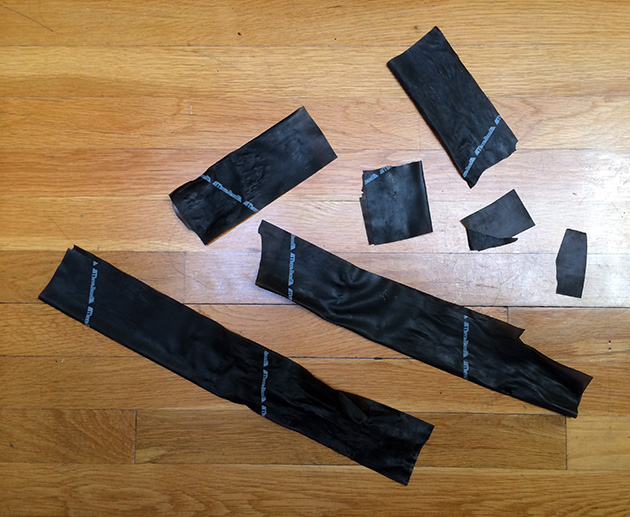
Even my high-resistance Thera-Band shredded under the twice-daily demands of PF rehab
6) If exposed, seek immediate physical therapy
Too often, doctors and coaches seem content to regurgitate misinformation or hearsay that at best is unhelpful, and at worst harmful. Massage therapists are excellent go-to’s for general soreness, but much less helpful for injury because the temporary relief they offer does nothing to resolve the underlying problem. Physical therapists, on the other hand, prefer a more hands-on, get-under-the-hood-and-see-where-that-oil-leak-is-coming-from approach.
I recently had the good fortune to be referred to Doris, a PT who works with the L.A. Clippers. She listened as I described my symptoms and their progression, then had me lie on my side on her padded workbench. Within moments she’d zoned in on two trigger points on my lower left leg directly above the offending plantar fascia (I assume these are called “trigger points” because her poking and prodding felt like she’d shot me in the leg).
She recommended several simple yet targeted stretching and strengthening exercises, and within two weeks, soreness and discomfort I’d had for months had faded, replaced by real live muscles that now seem to support the muscles in my feet. Tibialis anterior, extensor digitorium longus, peroneals – all present and accounted for!
Whether this rest-and-strengthen strategy will be my silver bullet remains to be seen… but it’s a promising start. And as an added bonus, my running gait now feels more fluid and balanced than it did pre-Doris.
And all it took was one appointment.
So if you’re unfortunate enough to have PF, I’d recommend you forego the internet-inspired home remedies and find yourself a reputable physical therapist… unless you really enjoy popping Advil and storing golf balls in your freezer.
7) Not running frees up a lot of time
As in, a lot. Start with the hour-plus of actual running – or several hours, for the once-a-week long run – throw in the warmup and cooldown sessions, sprinkle liberally with stretching and recovery time, and my May featured large blocks of unscheduled time like never before. I managed to transfer some of that angst free time to the gym, but the past month has left me wondering what non-runners do with all their free time. And I’ve begun to understand why Americans – especially those without kids – watch on average five hours of TV per day.
(I recently read that chimpanzees spend ten times longer than humans – 48% vs. 4.7% of their days – chewing and eating their food… no wonder you seldom see a family of chimps huddled together in front of their TV!)
Katie and I aren’t TV-ophiles, so instead I’ve been channeling my energy into several long-overdue projects. And I’m happy to report that after ten years spent hanging from a doorknob in Berkeley or living in a cardboard moving box, my race medals finally have a home on our office wall, courtesy of Katie’s motivation and two 5/8-inch curtain rods from Home Depot:

BEFORE: Ours may have been the most well-decorated doorknob in the East Bay (2013)…

AFTER: Thanks to Katie’s initiative, I can now admire medals I haven’t seen in years
Two buddies and I also filled several days exploring beautiful Sequoia & Kings Canyon National Parks, where we happened upon this lovely fellow digging for critters in a tree stump he’d just yanked apart without breaking a sweat:
8) Not running is a very affordable hobby
I haven’t purchased, or really even ogled, any new running gear since before Big Sur. And I’m not much for retail therapy, so I hope the folks at Running Warehouse understand that honestly, fellas… it’s not you, it’s me.
My newfound frugality also extends to food, my appetite having diminished markedly without the need for all the extra calories. On a good day I’m able to work straight through, from the time I get up until the time I eat dinner, on little more than trail mix and a banana.
Naturally, all this talk of parsimony ignores the fact that I’ve registered for two RunDi$ney races while I’ve been sidelined. Dammit Mickey, I wish I could quit you.
9) Running is a fickle mistress
Few relationships have rewarded me the way running has. She’s many things to many people – a competitive sport, a lifelong hobby, a release valve for stress, a friend in tough times, a cheap and ready source of dopamine, a personal identifier, an all-purpose anodyne, a conduit to experience the world around us, an excuse to jack out of the matrix, a reprieve from routine, a time to turn the day’s lemons into lemonade and make sense of the nonsensical. Like a trusted credit card she’s everywhere I want to be, and she’s priceless.
Pay her the proper attention, eschew shortcuts and she’ll make it worth your while. Like any meaningful relationship, you’ll get out of your time together only as much as you put into it. Start to take her for granted, let arrogance intervene, and you could suddenly find yourself rehabbing an injury and wondering where it all went wrong. And some days… some days she’ll knock you down a peg or two, just because she can.
No doubt about it – running is a fickle mistress. I’m just hoping she takes me back soon… I’m tired of sleeping on the couch with a splint on my foot.
So that’s my 9, but since 10 is a nice round number – injured or otherwise, what’s one important lesson you’ve learned during your time away from training?
 Blisters, Cramps & Heaves