Posts Tagged ‘longreads’

We can complain because rose bushes have thorns, or rejoice because thorn bushes have roses.
– Abraham Lincoln
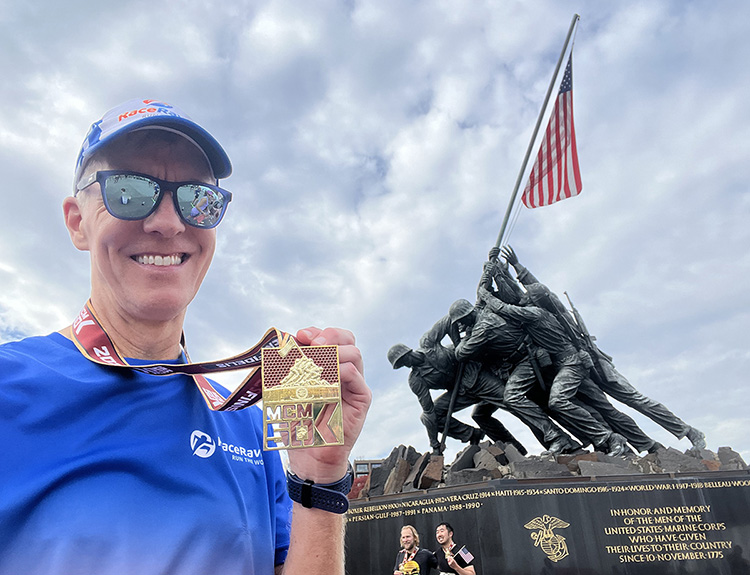
Mike Sohaskey with Marine Corps Marathon medal at Iwo Jima Memorial

Riddle me this: How do you follow up a race day in one of the world’s most excellent cities? With a race day in one of the nation’s most excellent cities, of course! And with little more than that tenuous logic to guide my decision making, I renewed my 50 States tour six weeks after Sydney with a trip to Washington D.C. and the Commonwealth of Virginia for the Marine Corps 50K.

While most of the 21,000+ runners in Virginia would be lining up for the 48th annual Marine Corps Marathon, I opted to embrace a “more is better” mindset and commit to the 50 km (31-mile) distance. In only its third year—after launching in 2019, the event was canceled in 2020 and 2021 due to the pandemic—the Marine Corps 50K already wore the crown as the nation’s largest ultramarathon.

Washington Monument as seen across Lincoln Memorial Reflecting Pool
The Washington Monument as seen across the Lincoln Memorial Reflecting Pool

Surprisingly, choosing a marathon (or ultramarathon) in Virginia was tougher than I’d expected. Yes, the Marine Corps Marathon (MCM) is the obvious first choice as one of the largest and most iconic marathons in the country, with a race day that hosts upwards of 20,000+ runners annually. But with other top-rated marathons in Richmond, Roanoke, and even Virginia Beach, the decision to run MCM was no foregone conclusion…

Until I realized that unlike Richmond, Roanoke, and Virginia Beach, I could convince my brother Chuck and my sister Sandy to join me for a family trip to Washington D.C. Despite her activist mindset, this would be Sandy’s first visit to our nation’s capital, and I was keen for her to immerse herself in 247 years of American history. To my thinking, D.C. is the one city every American should visit in their lifetime. Chuck had visited the city on several occasions, while Katie and I would be returning for the first time since I’d run the JFK 50 Mile five years earlier.

Trip planning went smoothly but for one hitch: Sandy would need to be back at work in Dallas by Tuesday morning after the Sunday marathon. This minor inconvenience meant we’d need to front-load our visit so that most of our sightseeing happened before race day.
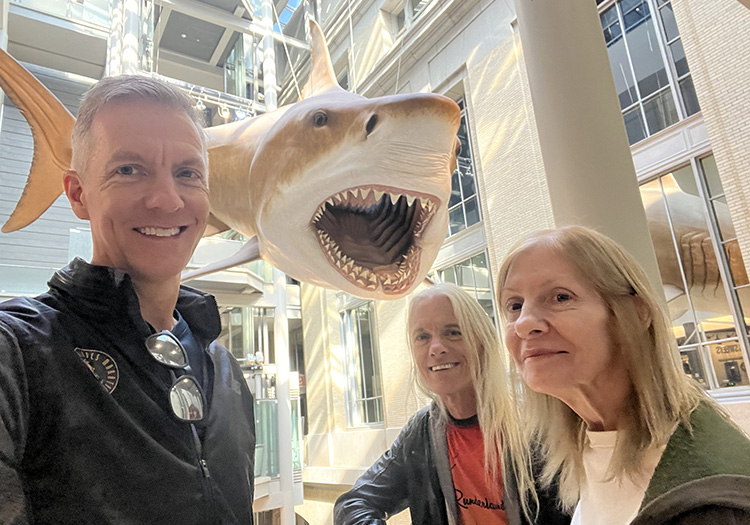
Sohaskey siblings and megalodon from Smithsonian National Museum of Natural History
The Sohaskey siblings and a photo-bombing megalodon (Smithsonian National Museum of Natural History)

As any traveling runner will tell you, for the sake of your race-day performance it’s best to defer the bulk of the sightseeing and extracurricular activities until after the race—and particularly in a walker-friendly city like D.C. where you’re likely to do most of your exploring on foot. In our case, that wouldn’t be possible. At the same time, full immersion was the true raison d’être of this trip, with the Marine Corps 50K providing a convenient justification. (Admittedly, this is the case with many of our travels on this 50 States quest—race day is often a healthy afterthought.)

And so before I could notch another state, I notched down my expectations for race day and set my mind to simply enjoying the opportunity by invoking a mantra that’s served me well in my travels through the years: physical baggage good, mental baggage bad.

With that settled, the five of us—me, Katie, Sandy, Chuck, and his girlfriend Christine—touched down at Reagan International Airport on Wednesday ready to hit the ground walking for our whirlwind tour of D.C. in advance of Sunday’s main event.

Monkey taking selfie at Smithsonian National Museum of Natural History
The art of the selfie dates back millions of years (Smithsonian National Museum of Natural History)

And walk we did, our tireless peregrinations covering the city like the dotted line in a Bil Keane Family Circus cartoon. And it was awesome. After enjoying dinner outdoors Wednesday night in National Landing, we spent Thursday touring the Smithsonian National Museum of Natural History followed by the National Archives, where my long-time friend Jill (who works as Deputy Chief of Staff for an Illinois congressman) introduced us to one of the friendly archivists who generously took the time to share his insights on the Rotunda that houses the Declaration of Independence, the Bill of Rights, and the U.S Constitution. We then strolled to dinner at nearby Oyamel (a local Mexican mainstay from celebrity chef JosĂŠ AndrĂŠs) before joining a guided “monuments at night” tour that showcased the city’s iconic monuments, memorials, and landmarks including the Washington Memorial, the Lincoln Memorial, and the White House.

On Friday we picked up where we’d left off with several hours in the sprawling Smithsonian National Zoo. Predictably, despite stiff competition from the zoo’s other residents the giant pandas stole the show, and with it many onlookers’ hearts. The youngest panda, 3-year-old Xiao Qi Ji, entertained the audience by playfully somersaulting down the hill in his enclosure. We easily could have filled an entire day at the zoo; reluctantly, though, we pulled ourselves away and headed back to the National Mall for a quick tour of the National Air and Space Museum.

From there we circled the perimeter of the U.S. Capitol before arriving at the Supreme Court. As we stood regarding its white marble exterior in the fading light, the words “EQUAL JUSTICE BEFORE LAW” inscribed on the portico above its grand staircase, I tried to assure myself that the timing of our visit—with the sun setting on the highest court in the land—was strictly literal and not metaphorical as well. Luckily my thoughts were interrupted as we set off for another excellent meal with another long-time friend, this time in the Mount Vernon Square neighborhood at Ottoman Taverna with Acting Secretary of Labor Julie Su.

All in all, we’d enjoyed 2+ days of unrivaled sightseeing. Not only that, but I’d get to see much of it all over again on race day. And though the nagging voice of experience in my head insisted the bill for so much time on my feet would come due Sunday morning, the voice wasn’t loud enough to prevent me from falling quickly into a deep and peaceful slumber that night.

Equal Justice Under Law inscription on U.S. Supreme Court building

On Saturday, under an intense autumn sun, Katie and I hailed an Uber for the 30-minute drive (even longer by Metro) to the pre-race expo held across the Potomac River in “OMG where are we going,” otherwise known as National Harbor, Maryland. Yes, the expo was held in the next state over. There, as temperatures peaked in the low 80s on the warmest day of an unseasonably warm October week, we followed the ant-like procession of runners with their clear plastic bags to the spacious Gaylord National Resort & Convention Center.

By the time we arrived in the early afternoon after a leisurely morning, the crowds at the expo had thinned considerably. With most of the vendor booths touting the Armed Forces and not of particular relevance to us (though we did visit with the fine folks at the Richmond Marathon and Air Force Marathon booths), we were able to get in and out with almost military efficiency.

I was disappointed to discover that the merch tent lacked an appealing option for 50K runners; I refused to wear anything labeled simply “Marine Corps Marathon” because, well, I wouldn’t be running the marathon. And dammit, those extra five miles deserved their own merch. Fortunately, and by now I shouldn’t be surprised, Katie (in cahoots with Santa) later found an attractive, steel blue MCM 50K sweatshirt that showed up under the Christmas tree.

Owing to a lack of available Ubers around National Harbor, we left the expo and hopped aboard a shuttle transporting runners between the expo and the closest Metro station. And from that Metro station we eventually made it back to home sweet home at the Crystal Gateway Marriott in Arlington. Conveniently located adjacent to the Crystal City Metro station (mile 23 of the marathon) and one mile from Reagan International Airport, I can heartily recommend the Crystal Gateway Marriott as your headquarters for Marine Corps Marathon weekend.

After the obligatory carbo-load dinner at nearby La Bettola Italiano, we turned in early for our customary predawn wake-up call. Because as the military mantra goes, “If you’re early, you’re on time; if you’re on time, you’re late.” And I didn’t want to be late.

Turns out I’m not cut out for the military.
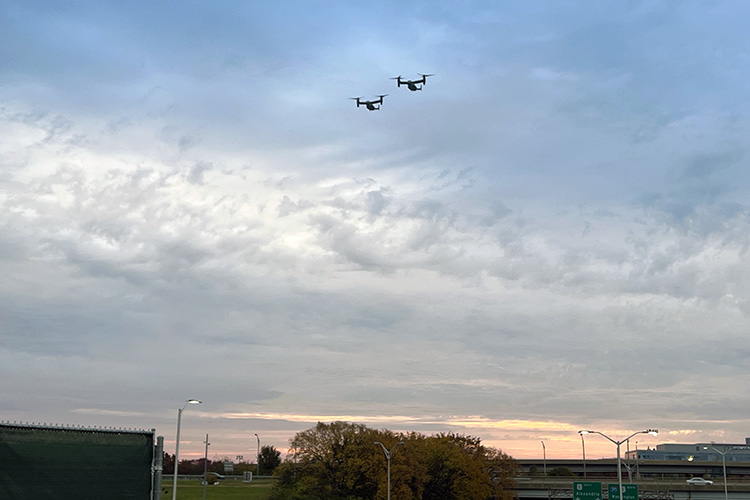
MV-22 Osprey flyover before 48th annual Marine Corps Marathon
Race day begins with an MV-22 Osprey flyover

Getting There Is Half the Fun
I awoke Sunday morning feeling relaxed after a decadent seven hours of decent sleep—not bad for race day. The world outside remained shrouded in darkness. I ate and dressed quietly, then headed downstairs with Katie to where Chuck waited in the lobby.

After a short walk from our hotel to the Crystal City Metro station, the three of us rode the yellow line two stops to Pentagon City. There’d been some confusion as to how exactly we should get to the start line—uncertainty re: the schedule of the official race shuttles had compelled us to take the Metro; unfortunately, it turned out the Metro station located steps from the start line at Arlington National Cemetery was closed on race morning, leaving as our only option the Pentagon City station which, in turn, meant a significantly longer walk to the start line.

Ironically, the stunningly beautiful morning that greeted us in Pentagon City foreshadowed a tough day ahead—perfect weather for spectators, not so much for runners as temperatures hovered already in the low 60s before the sun had made an appearance.

Exiting the Metro station at 6:45am with hordes of our fellow runners, I assumed I’d have plenty of time—assuming no emergency pit stops—to make it to the start line. I was all kinds of wrong. (This seems like the right place for a public service announcement to MCM hopefuls: Save yourself some stress on race morning, and DO NOT UNDERESTIMATE the amount of time needed to reach the start line. This should be common sense to someone who’s run as many races as I have, and yet somehow…).

All told, I tallied at least 1½ miles on the walk/jog from Metro station to start line. The three of us walked and walked—past the Pentagon (very cool), through a brief security checkpoint, and toward the Runner’s Village set up in the North Pentagon Parking Lot. Cutting through the Runner’s Village, I craned my neck in search of the start line before we were finally pointed in the general direction of muffled noise.
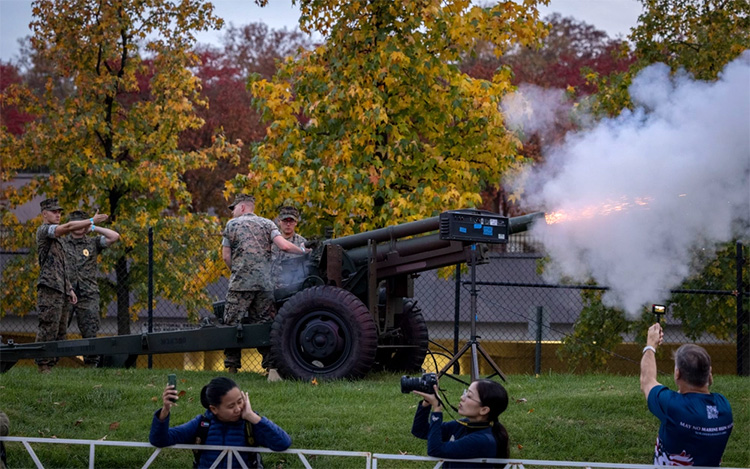
Marines fire M-102 howitzer to start 48th Marine Corps Marathon
Marines fire a M-102 howitzer to start MCM 48 (📸 USMC Cpl. Mitchell Johnson)

As the clock ticked down to my 7:15am start time and the first glow of dawn lit the horizon, I bid Chuck and Katie a hurried farewell before hustling ahead. Following the flow of foot traffic up the on-ramp and onto SR 100, I could hear the PA announcer in the distance but still couldn’t see the start line. As his disembodied voice counted down the seconds to the start, I broke into a slow jog. Approaching the back of the very long—and very empty, with the marathoners waiting in the wings—start corral, to my chagrin I found myself still unable to see a start arch. That’s when the {BOOM} of the howitzer split the morning air, sending the 50K runners on their way.

Several other 50K runners jogged alongside me, time slowing to a crawl as we took seemingly forever to cover the length of the never-ending marathon start corral, which I now noticed was taking up both sides of SR 110. Finally the highway dipped downward, and I was relieved to see at last two familiar orange start-line arches directly ahead, with the 50K start arch on the opposite side of the highway (of course it is, I thought). Crossing the median as the full-throated voice of the PA announcer warned all 50K runners to get to the start line asap before it closed, I paused for a quick selfie (I’d earned that much!) before crossing the start line. Returning my iPhone to my Spibelt I realized I’d already lost one of my GU packets, my nutrition for the day.

C’est la vie. It was go time at the 3rd annual Marine Corps 50K, the warmup act for the 48th annual Marine Corps Marathon which would start 40 minutes later. All that was left was the running. And yes, my word count just to reach the start line exceeded most people’s entire race report.

TL;DR: Don’t. Be. Late.
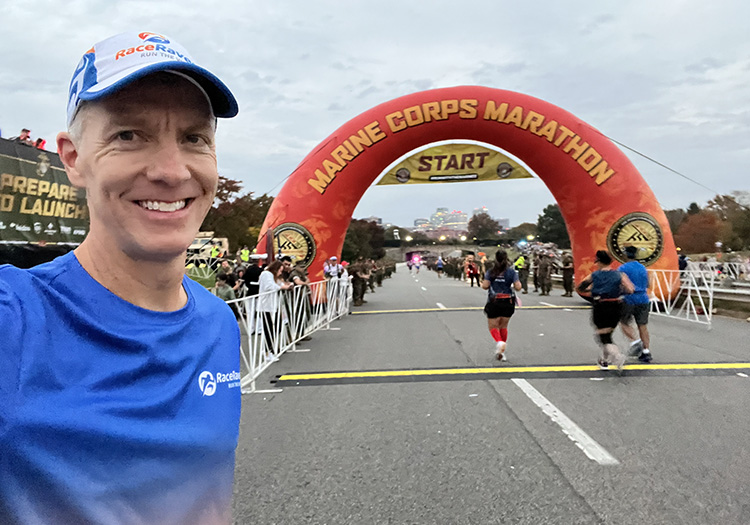
Mike Sohaskey in front of start arch at MCM 50K
Believe it or not, sunrise isn’t for another 15 minutes

Calm Before the Storm
Our first few steps were greeted with enthusiastic cheers from a small group of Marines before we passed Arlington National Cemetery, a somber and respectful moment in the first light of day. With more than 2,200 active and retired Marines supporting the day’s festivities, men and women in uniform would be a frequent sight on this day. (Sound familiar, D.C.?)

Having started four minutes after the gun, I ran by myself for the first half mile or so before I started to catch up with the 50K back-of-the-packers. With little more than the rhythmic patter of our footfalls for company, we set our sights on the glass-and-steel cityscape in the distance. Moments later we reached the urban village of Rosslyn, its towering office buildings and luxury condominiums flanking the course like silent sentinels standing watch over empty streets and darkened storefronts.

Into the heart of Arlington we ran, transitioning from the business district into more residential neighborhoods where the first civilian spectators of the day greeted us with exuberant cheers. For a visitor coming from the West Coast, the stately red-brick buildings were an appealing sight, and I almost expected to see the crowds here dressed in powdered wigs, petticoats and tricorne hats.

Marines cheer on runners at start of 48th Marine Corps Marathon
Marines cheer on the runners at the start of MCM 48 (📸 USMC Cpl. Mitchell Johnson)

I was loving the wide, well-maintained streets, and soon we found ourselves in more rural surroundings reminiscent of the “in between” stretches of vast green countryside that separate points A and B on long road trips. Autumn had not yet run its course here—no surprise, with high temperatures hovering around 80°F during our visit—and many of the trees still flaunted their flamboyant fall wardrobes.

The course rolled quite a bit in the first five miles, and already I could feel the humidity coming on strong. In mile 3, I noticed that the fellow running ahead of me was already soaked in sweat. Likewise, I could tell I was glowing more than usual; this reminded me of summer training runs in Los Angeles, a city that’s gotten increasingly humid in recent years. Only this wasn’t Los Angeles, and late October definitely wasn’t summer.

I was convinced all our walking and sightseeing around DC—coupled with the day’s heat and humidity—would eventually catch up to me; the only question was how long it would take. So I decided to maintain a comfortable sub-5-hour pace for as long as possible before fatigue inevitably set in and forced me to adjust on the fly.
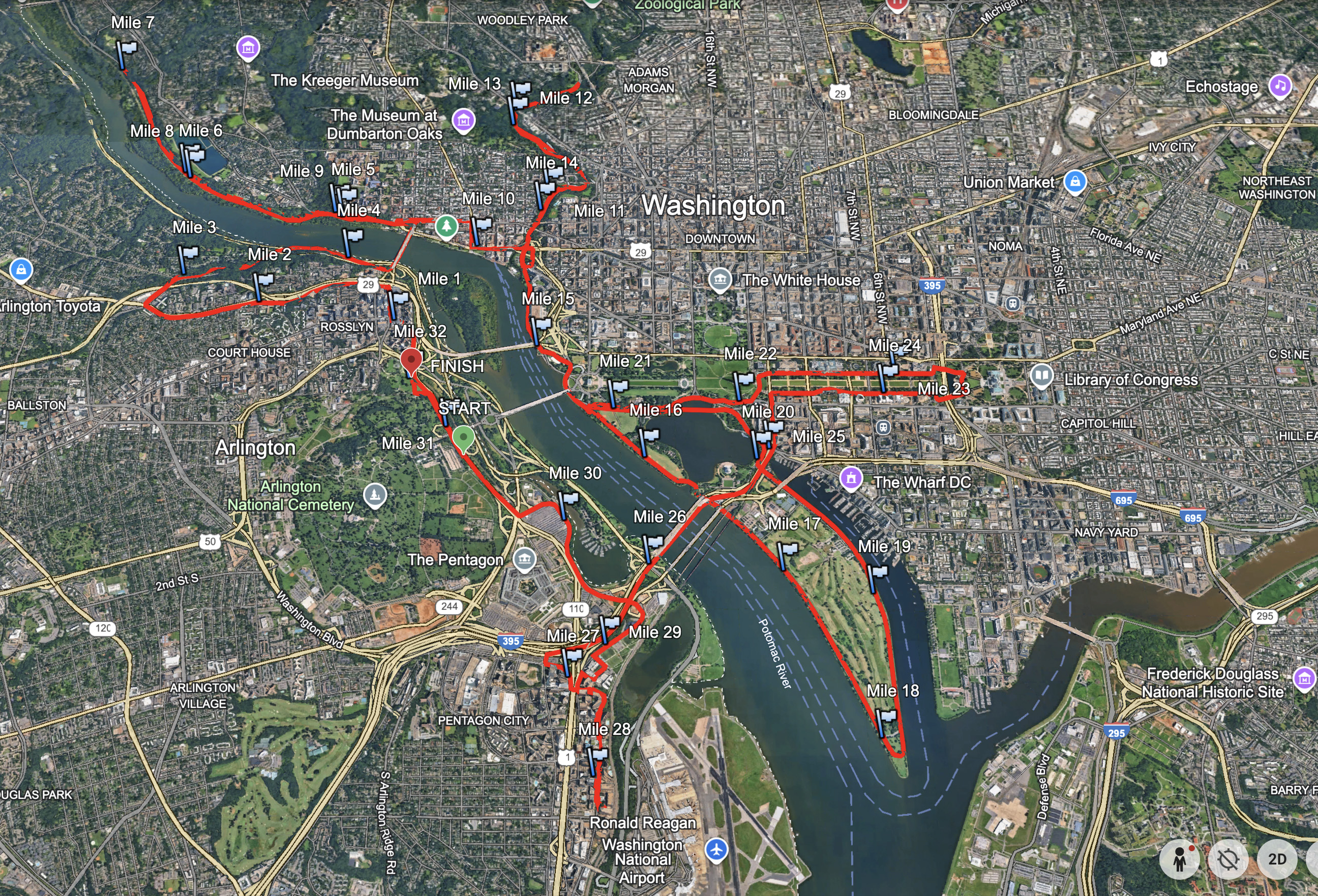
Google Earth course map for the Marine Corps 50K
Google Earth course map for the Marine Corps 50K (click for higher-res image)

Not only would this be my second straight warm-weather race after Sydney, but it would be my fifth marathon in six months with two of those international. My body was tired to be sure, but after this I could cruise into the holidays and start looking forward to 2024. I just needed to get this done, and I was determined to enjoy the doing.

Turning onto the George Washington Memorial Parkway we ran along the Potomac River, the natural dividing line between Virginia and Washington DC. Having pulled ahead of the 5-hour pace group, I pumped the brakes to ensure I didn’t get too far ahead since I suspected—to misquote Ben Franklin—that a penny’s worth of energy saved now would be a penny earned later.

Leaving the George Washington Memorial Pkwy in mile 5, a brief but nasty uphill jag led us onto the Francis Scott Key Memorial Bridge, named for the author of the poem “Defence of Fort Mchenry” (1814) which eventually (in 1931) would become “The Star-Spangled Banner,” aka our national anthem. Putting Virginia in our rearview mirror, this short stretch across the Potomac afforded us a nice view of Georgetown as we prepared to start the out-and-back portion that was unique to the 50K course.

Rather than running on the C&O Canal Towpath alongside the calmly flowing waters of the Potomac River, however, we ran this 5-mile out-and-back stretch on the parallel road, which afforded us a questionable view of the glorified drainage ditch known as the Chesapeake and Ohio Canal. No matter, these miles would be the most peaceful of the day as the humidity here was countered by a cool breeze that made me feel (incorrectly) like I could run all day.

U.S. Supreme Court building
The Supreme Court of the United States (SCOTUS)

I ran largely by myself until our speedier counterparts began to pass us in the opposite direction. Eventual winner Calum Neff (2:55:57), who would outpace the competition to a new course record, took the time to pump a fist and encourage the rest of us slow-footed types. Trailing in fourth place, eventual runner-up Michael Wardian flew by looking dialed in and zoned out. For my part I cruised along, knocking out easy miles at a four-hour marathon (and 4:45 50K) pace, not a pace I intended to sustain but one that felt very comfortable at that moment. If only the entire race could be this serene and uncrowded…

The only disturbance in the force along this stretch was two handcycle athletes who came up on us fast from behind, each yelling “ON YOUR LEFT!” loudly and repeatedly as my fellow bipeds and I swerved quickly to get out of their way. Why these athletes were behind us and not leading the way, I had no idea. Whatever the reason, this was a terrible idea for both us AND them—the handcycle athletes should start ahead so they can stay ahead of the runners, and it’s not fair to anyone that they should have to navigate their way through crowds of runners. I couldn’t imagine what they’d do once we merged with the tightly packed crowds of marathoners.

Approaching the end of this out-and-back section, we passed the first (and only 50K-specific) food station. I don’t recall what they were serving, but subsequent food stations (five in all) would offer Honey Stinger waffles, applesauce, and UnTapped gels made with maple syrup, none of which my stomach found remotely appealing.

Movie buffs (which I am not) running the Marine Corps 50K should keep an eye out for an Easter egg here. As you return to the start of the out-and-back section, off to your left just before the merge with the marathoners coming across the Key Bridge, you’ll pass a former gas station-turned-public parking lot. Unremarkable to be sure, but hidden in the back corner of this parking lot—between the stone wall covered in creeper vines and the neighboring building—is a stone staircase where the priest apparently falls to his death in the movie The Exorcist.

Coincidentally or not, the Exorcist Steps (as they’re now known) marked another melancholy ending of sorts on this day—the end of my personal peace & quiet.

Fall foliage in late Oct in Washington DC
Even in late October, the fall foliage was out in force

Into the Storm
Suddenly, like a dam breaking we found ourselves swept up in the flood of marathoners as we entered Georgetown proper on beautifully surfaced streets lined with trendy, upscale shops and gold-lettered storefronts. And it was here the realization hit me that I was running the Marine Corps Freaking Marathon, 20,000+ participants and all. Turns out “The People’s Marathon,” as the race is known due to its lack of prize money, hosts a LOT of people.

Unfortunately, with no pace groups in my field of view, I had no way of knowing how fast the marathoners hemming me in on all sides now were running, which made me feel like a fish out of water.

Turning right at the golden dome of the Farmers and Mechanics Bank building we reached the riverfront, where a band—apparently the Marine Corps Base Quantico Band, whom we’d see again later—was playing “I Melt With You” by Modern English. “Dude, it’s U2!” a fellow next to me exclaimed to his friend as we banked left beneath the freeway. There we slowed for road construction before a 270° turn pointed us north along Rock Creek and Potomac Pkwy for another out-and-back.

Mike Sohaskey looping onto Rock Creek and Potomac Pkwy in Georgetown at mile 11 of the Marine Corps 50K
Looping onto Rock Creek and Potomac Pkwy in Georgetown, mile 11

Certainly the going had slowed at the 50K/marathon merge, but now it became even more challenging to maintain pace as our progress slowed to almost a shuffle. I felt like a sweaty sardine, and my focus shifted from pacing to footing as I tried to avoid stepping on people and making a bad situation even worse. Crowds like those at MCM are a big reason I’m not a diehard fanboy of the World Marathon Majors (and especially London) while so many others are. Today, though, I was determined to keep my cool and just enjoy the day.

Lack of elbow room notwithstanding, the out-and-back along Rock Creek and Potomac Pkwy was a lovely, tree-lined stretch of parks replete with beautiful fall colors, plus a beautiful spectator in Katie near mile 11 in Francis Park. Along this stretch I focused on the kaleidoscope of colors as well as the incredible energy of the crowds, and I continued to hit every aid station in my bid to stay hydrated. Luckily the cloud cover remained, and I debated if and when the sun might burn away our sole salvation on this increasingly humid day.

One disappointing aspect of race day was the aid stations, which didn’t operate as efficiently as I’d expected from the U.S. Marine Corps. The best aid stations reliably use two different cups throughout the race, one for water and one for sports drink to allow a quick visual ID. Here, though, cup usage was inconsistent, and I was never sure in the hustle and bustle whether I was grabbing one or the other. Normally this wouldn’t matter much, but today in the humidity my stomach wanted nothing to do with an overly sweet sports drink.

Mike Sohaskey running among marathoners in mile 15 of Marine Corps 50K
Finding my happy pace among the marathoners, mile 15

The farther we ran, the more I appreciated that the “bonus mileage” for the 50K had been tacked on early in the race. That way, for the rest of the day I could simply add five to each mile marker without the nagging realization that we’d have to run an extra five miles closer to the end of the race. From now on we’d be in sync with the marathoners, and so when they were done, we were done. Given that the 50K distance always feels to me like an annoyingly long marathon, and especially on a warm day like this, that awareness was key to maintaining a positive mindset.

Leaving Georgetown we entered Foggy Bottom, with the Potomac to our right and the unmistakable curved façade of the infamous Watergate complex to our left. This was followed by a building I hadn’t entered in nearly 40 years, but which I still remember vividly for its posh elegance, ornate décor and signature red carpeting—the Kennedy Center for the Performing Arts. Having failed to scrutinize the course map ahead of time (hey, I was sightseeing!), seeing Watergate and the Kennedy Center in close succession was an unexpected treat.

Continuing south along the river we entered West Potomac Park and the National Mall, aka what every American thinks of when they think of Washington D.C. The National Mall is home to more than 100 unique monuments and memorials. Most of what we could see along this stretch was community baseball & softball fields, but again the crowd support was so intense here that it hardly lacked for energy. And crossing the Ohio Drive Bridge did regale us with an amazing view of the Washington Monument and the Jefferson Memorial. That momentary glimpse of American history across the water left me with a feeling of sudden-onset patriotism and pride.
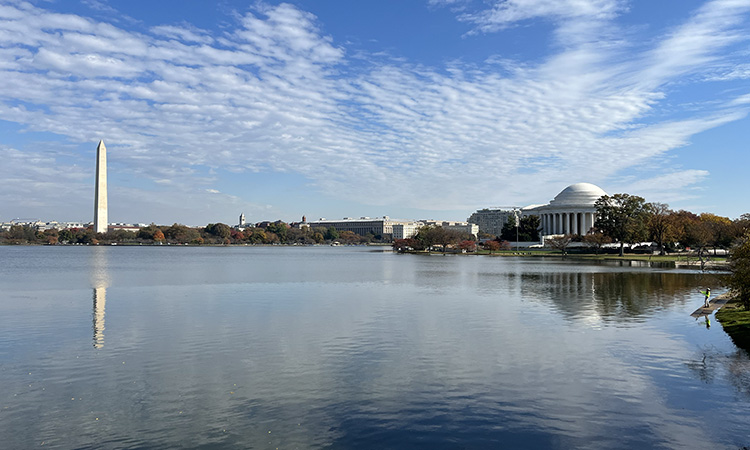
View of Washington Monument and Jefferson Memorial from the Ohio Drive Bridge
View of the Washington Monument and Jefferson Memorial from the Ohio Drive Bridge

Here I downed my first Maurten gel of the day to try to boost my flagging energy levels, to no effect. It was going to take a lot more than a shot of maltodextrin to offset three days of being on my feet 😬

One of the few course highlights I’d noted beforehand was mile 17/12 of the 50K/marathon course. This was the emotional wear blue Mile, a mile dedicated to honoring American servicemembers killed in the line of duty. Blue posters lining both sides of the road depicted “Faces of the Fallen,” individual men and women who made the ultimate sacrifice for our country. This mile is intended as a respite from the raucous madness of the marathon and an opportunity for quiet reflection, and most runners treated it respectfully as such.

Except, that is, for the oblivious jabberwocky to my left whose mouth didn’t miss a beat as we entered the somber stretch. Rather, dude kept up a steady stream of blather directed at his buddy while everyone around us fell silent. I’m sure I wasn’t the only one offended by his clueless banter, and I tried to focus instead on the faces on each poster while accelerating just enough to get out of earshot. Then the moment passed, and as we exited the wear blue Mile volunteers on each side of the route held oversized American flags and cheered loudly as we passed.
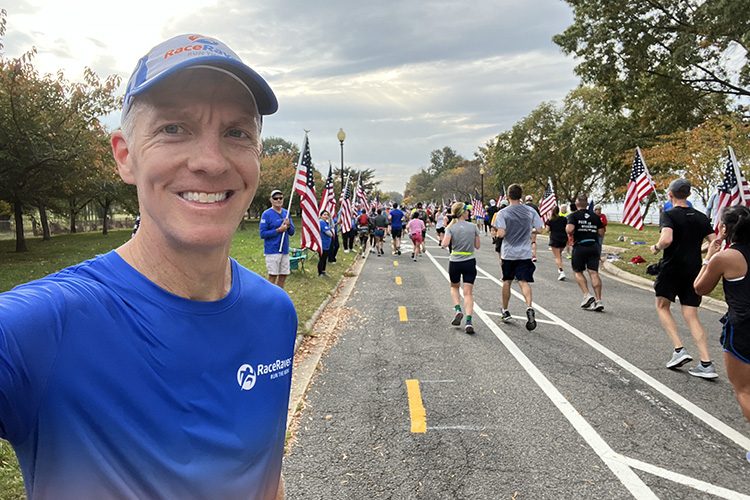
Mike Sohaskey exiting wear blue Mile of Marine Corps 50K
Exiting the wear blue Mile

Running on Fumes
Reaching the southern tip of East Potomac Park (aka Hains Point) at mile 18, we followed the road around Hains Point and back the way we’d come. Pausing at the aid station, I imagined how beautiful this stretch must be during cherry blossom season. I’ve experienced cherry blossoms to some extent in Tokyo and Sydney, and they have a glamour all their own.

Along this stretch, small motivational signs appeared regularly with inspirational messages like “FUTURE SELF WILL THANK YOU FOR WHAT YOU’RE DOING TODAY” and, for the moms among us, “YOU GAVE BIRTH TO A HUMAN, YOU CAN DO THIS.” My pace had started to slip and I dug deep, determined to give as much as I could for as long as I could.

Then we were back in the heart of the National Mall, skirting the Tidal Basin with the Washington Monument towering overhead. Katie had mentioned seeing me at mile 20, and I was hoping she’d be here to snap a photo with the monument in the background. No such luck. And so with my second wind receding and with fatigue treating my willpower like the Kool-Aid Man treats walls, I resolved to keep running until my next Katie sighting.

That resolve lasted less than a mile, when a slight feeling of nausea hit me as we approached the mile 21 marker and turnaround on Independence Ave SW. I slowed to a hike for a couple of minutes to reorient myself before forging ahead.
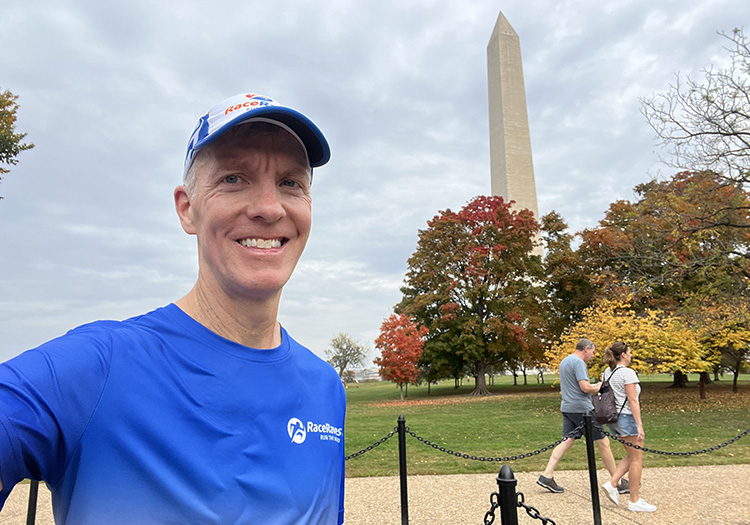
Mike Sohaskey selfie with Washington Monument during Marine Corps 50K
Washington D.C. is nothing if not photogenic

This would be the pattern for the next ten miles as I was forced to battle through fatigue on a run/walk basis. When I did run, I actually ran pretty well, but the inconvenient truth was that I just ran out of gas. This wasn’t a nutritional bonk, this was pure exhaustion caused by a perfect storm of challenges: too much sightseeing, too much humidity, and maybe even too many marathons in the previous six months. More than anything, though, this was karma caused by my failure to respect the 50K distance. And karma really is a bitch.

On the other hand, having wisely set no time goals for myself, I was determined to enjoy the moment—the crowds, the energy, the fact I was running in one of the world’s most remarkable cities surrounded by 247 years of American history. The Marine Corps Marathon in many ways amounts to sensory overload. So many of the city’s iconic monuments and memorials go unnoticed and unappreciated on race day when your brain is fighting for glucose and the streets are packed with rowdy spectators. And yet D.C.’s sensory overload didn’t vex me in the same way that London’s relentless wall of sound had, in part because I wasn’t sick or injured during the race.

The scene and surroundings reminded me of the line from The Rime of the Ancient Mariner where the titular sailor finds himself surrounded by salty ocean water: “Water, water, everywhere, nor any drop to drink.”

At the same time, I’m constantly amazed that cities like Washington D.C. and New York and Los Angeles shut down busy roads for hours at a time to allow weekend warriors like me to see & appreciate their city in a way that even the non-running locals never could. And it’s one of the reasons why, despite their often unwieldy size, I still ❤️ most urban marathons.
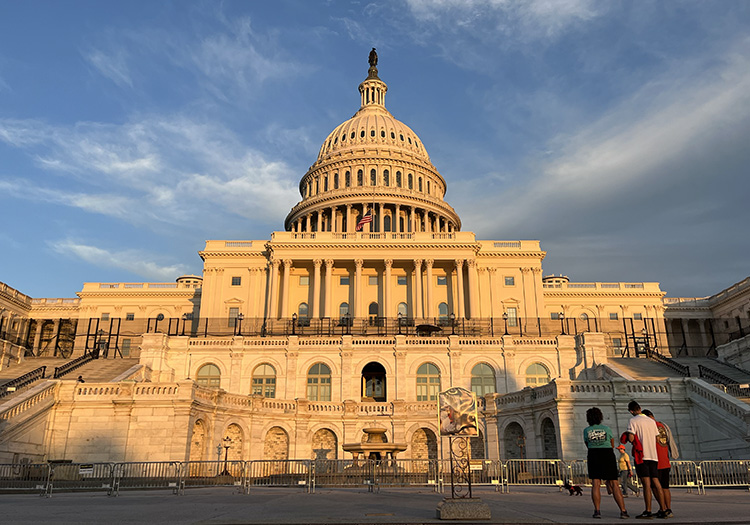
United States Capitol building
The United States Capitol

Speaking of spectators, if you like boisterous crowds then the Marine Corps Marathon is the race for you. On race day D.C. stands for Delightful Crowds, and the spectators consistently brought their “A” game with signs like:

1) “We’ve been trying to contact you about your extended warranty”

2) A drawing of a dog’s face asking, “Why did you throw your ball so far?”

3) Race day fell in the same week that the GOP caucus in the House of Representatives took 3+ weeks to elect a new Speaker, and the historic chaos of that election inspired several wonderfully nerdy signs, e.g. “You’re running better than Tom Emmer (Speaker-Elect for 4 hours)”

4) In the final two miles of the race: “You have 1 more MCM finish than Kipchoge!” (Eliud Kipchoge of Kenya is considered by many to be the greatest marathoner of all time, but he’s never run MCM! 🙌)

5) Plus the obligatory Ken and Barbie signs that were everywhere at that time

On the other hand, as long as I run marathons I’ll never appreciate the “You are NOT almost there” signs early in the race. Not funny, not clever, not now, not never.
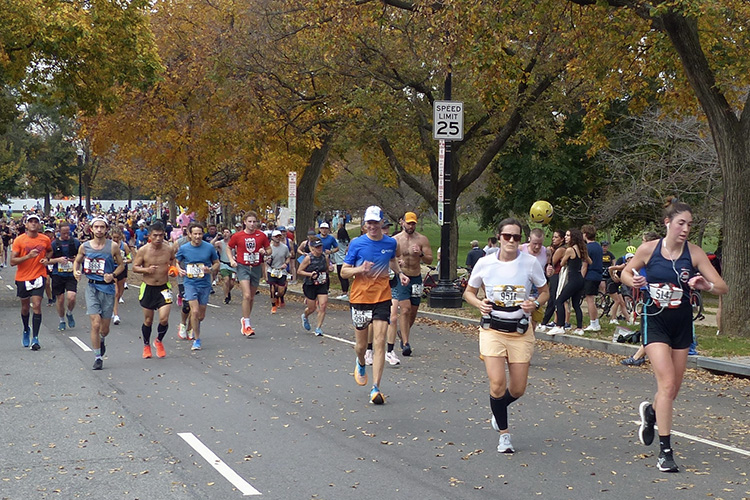
Mike Sohaskey running in National Mall at mile 22 of Marine Corps 50K
Keepin’ the dream alive on the National Mall, mile 22

A Monument-al Effort
As we cleared the Tidal Basin and circled the Washington Monument, I once again slowed to catch my breath, using the opportunity to snap a selfie with the city’s most recognizable landmark. Soon after this I did see Katie in mile 23, and I took the opportunity to pause and try another energy gel with plenty of water. Again, my disgruntled stomach’s response was a mild mutiny that warned me to quit while I was ahead (was I ahead?).

Bidding Katie a weak farewell, we passed the distinctive bronze-latticed exterior of the National Museum of African American History & Culture. This was followed in short order by several other notable buildings including the National Museum of American History, the National Museum of Natural History, and the National Gallery of Art. Certainly my interest in these attractions didn’t help my performance, but at this point enjoying myself too much was the least of my worries.

Reaching the eastern end of the National Mall, we turned onto Pennsylvania Ave and entered Union Square. Here we circled the Capitol Reflecting Pool on the grounds of the U.S. Capitol, arguably the most impressive architectural feat in D.C. Admiring this breathtaking symbol of democracy with The Statue of Freedom mounted atop its dramatic white dome, I struggled to reconcile its 230-year legacy with the harsh reality of all the modern-day cranks and sycophants who now walked its hallowed halls. At that moment, however, my brain was in no shape to grapple with this cognitive dissonance.

Mike Sohaskey by U.S. Capitol dome and the Peace Monument during Marine Corps 50K
The U.S. Capitol dome and the Peace Monument, mile 24

After a quick pause for a photo op during which the 5-hour 50K pace group passed me, we continued past the easily overlooked Ulysses S. Grant Memorial (depicting Grant astride his horse facing the reflecting pool) and around the James A. Garfield Memorial in honor of our 20th president. Then we completed our symmetrical loop of Union Square and headed back the way we’d come, the trees along Jefferson Dr SW modeling a variety of vivid autumnal hues.

Onward we labored, past the Dwight D. Eisenhower Memorial and the National Air & Space Museum. A sign announced the latter as undergoing “major renovations,” a favorite phrase around DC since at any given time, several parts of the city are undergoing a facelift. In this respect the timing for MCM Sunday was advantageous since—according to the guide for our Thursday night tour of the monuments—the final bit of construction scaffolding had come off the Capitol that morning.

Continuing west along the National Mall, we passed a building that stood out among its more muted and monochromatic brethren—the gothic-inspired, red sandstone façade of the Smithsonian Institution Building aka the Castle, which houses the Smithsonian’s administrative offices. The Castle has to be one of the nation’s most attractive administrative buildings, though here I’d like to insert a plug for Lovett Hall on the Rice University campus. And in true D.C. fashion, it’s now closed for the foreseeable future as it undergoes its first major renovation in 50+ years.

Here I was surprised to see Katie again, and instinctively I pulled over before realizing I had no real reason to do so. At the same time I noticed a spectator sporting the midnight-green football jersey worn by the Pro Bowl (and now Super Bowl-champion) quarterback of the Philadelphia Eagles, who were in town to play D.C.’s own Washington Commanders. That says it all, I mused wryly as its owner turned to reveal the name on the back of the jersey: HURTS. Well played karma, well played.
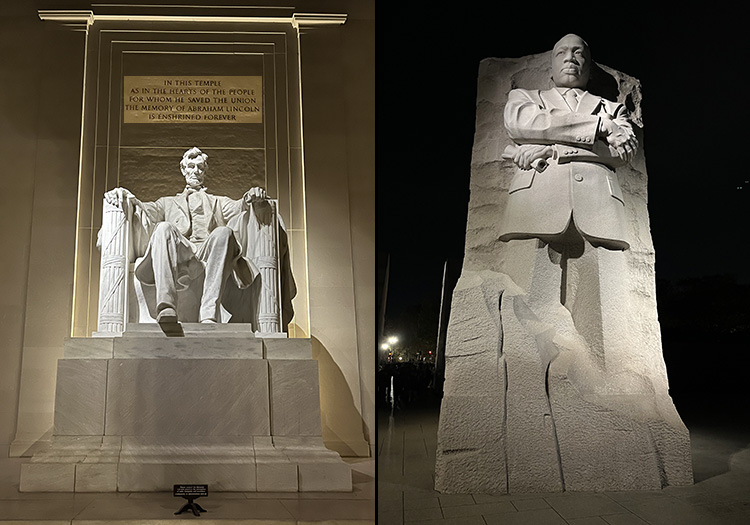
Lincoln Memorial and Martin Luther King, Jr. Memorial
The Lincoln Memorial and Martin Luther King, Jr. Memorial

Charging the Hill
Just as it seemed we were destined once again for the Washington Monument directly ahead of us, we banked left past the U.S. Holocaust Memorial Museum where the other members of our group, who had spent the morning at the museum, just missed seeing me. This was followed steps later by the visually unremarkable but administratively vital Department of the Treasury housing the Bureau of Engraving and Printing, where the nation’s paper money is printed.

Ahead of us, near the 50K mile 25 mark (mile 20 for the marathon), taiko drummers pounded out their motivational rhythm at the “Beat the Bridge” gauntlet, one of four time-limited checkpoints along the course. I’m always a fan of taiko drummers, in part because they remind me of the Big Sur International Marathon and my hometown Los Angeles Marathon.

Pausing briefly at the mile 25 marker to take a few deep breaths and steady myself, I harnessed the percussive energy of the drummers to propel myself forward. Our trajectory afforded us one last stunning view of the brilliant white Jefferson Memorial before we departed D.C. via the 14th Street Bridge over the Potomac. The humidity was taking its toll, and here on the bridge many runners paused to refill their bottles from the self-serve water monster dispensers that lined the route.

Various denizens of the National Zoo, including Western lowland gorillas, meerkats and a red ruffed lemur
Denizens of the National Zoo (clockwise, from top left): Western lowland gorilla, Amur tiger, screaming hairy armadillo, prehensile-tailed porcupine, meerkats, red ruffed lemur

After half a mile that I wished I could have enjoyed more, we re-entered Virginia where we said goodbye to most of the day’s scenery and hello to the final 10K, a grueling gauntlet that’s bad enough during a marathon but even worse in a 50K where it starts at mile 25.

In the distance to our right the sprawling, low-slung form of the Pentagon beckoned us homeward. With that welcome back to Arlington, I slowed to a walk to catch my breath and channel motivation from the mile marker confirming that yes, we 50K runners had reached the marathon distance at last. Now keep running, I thought. Much to my chagrin the midday sun peeked out from behind the clouds for the first time, and I quickly wished it back into hiding.

Minutes later I relaxed a bit as I recognized the familiar skyline and surface streets of National Landing where we were staying at the Crystal Gateway Marriott. Here we embarked on our fourth and final (and least scenic) out-and-back stretch of the day through the Crystal City business district. One last Katie sighting early in this stretch provided some short-lived momentum, as did passing a walker in a Marathon Maniacs “PACER” singlet who looked suspiciously like the 5-hour 50K pacer.

Sohaskeys siblings etal. exploring National Landing
The gang’s all here: Me, Christine, Chuck, Sandy and Katie explore National Landing

By the time we reached mile 28 on the out-and-back, the muscles in the lower back on my right side had tightened up significantly, and I needed another brief walk break to gather myself and quiet the discomfort in my back.

Then we left Crystal City behind and, several quick turns later, set our sights on Pentagon City and the finish line. In the final three miles I kept reminding myself to breathe deeply as my core muscles and lower back tightened unexpectedly, which kept me from running comfortably. Lower back pain during a race was new to me, and I ascribed it to the awkward camber of many of the roads. My core and lower back tightness coupled with the oppressive humidity prevented me from running for more than a few minutes at a stretch.

Mentally and physically, I was DONE. One thing I’d learned, though, in my running career and as I’d worked my way back from a 16-month injury hiatus, was to always keep going—to keep moving forward no matter what. Because you never know what might happen when you refuse to give up and when you give yourself a chance to succeed. As Winston Churchill put it, “If you’re going through hell, keep going.” So that’s what I did, running when I could and walking when I couldn’t, while using each aid station to stay hydrated.

With parts of the road here under construction, this was the least scenic stretch of the day. Not that I cared. One last frontage road led us back to where it all began, as we passed the Pentagon and the marathon mile 25 marker (mile 30 for us 50Kers) before re-emerging on SR 110 where we’d crossed the start line roughly five hours earlier.

T. Rex overpowering Triceratops at Smithsonian National Museum of Natural History
By mile 30, I felt more like the Triceratops than the T. Rex (Smithsonian National Museum of Natural History)

The frenzied crowds here were much appreciated and I pushed forward with everything I had, which at this point wasn’t a hell of a lot. My clothes were soaked through in the relentless humidity, my core muscles felt like armored plates, and my lower back still barked loudly as if imploring me to call it a day and curl up in the soft green grass alongside the highway.

Instead I forged ahead in fits and starts, past Arlington National Cemetery to the final left turn leading up to the finish line at the Marine Corps War Memorial, aka the Iwo Jima Memorial. And when I say “up,” I mean UP—this final climb is among the steepest of the day, and in true Semper Fi spirit, runners are urged to “charge the hill” to the finish line. And how I wish I could have. Walking into the final turn to let my core muscles relax and to summon one last surge of energy, I charged the mercifully short hill with all I had left.

Screaming spectators (though no Katie that I could see) willed us forward to the final right turn that brought the glorious orange finish arch into view. Even in my patently depleted state, I was surprised to discover I had literally nothing left—no residual adrenaline, no higher gear to shift into. And so I simply stayed the course. Basking in those final few yards, I crossed the line with a weak “Oorah!”—the battle cry of the U.S. Marine Corps—and stopped the clock in a time of 5:09:08, an average pace of 9:51/mile.

Mike Sohaskey's Garmin reading after finishing 2023 Marine Corps 50K

The Few, The Proud
Unsteadily I stood basking in a moment of exhausted euphoria. I was totally spent as I shuffled forward through the finish chute to where servicemembers in uniform stood waiting to congratulate finishers. I felt an incredible sense of pride as one hung the hard-earned 50K medal around my neck. Weakly I fist-bumped a number of Marines, thanking them for their service as they in turn thanked me for my support. Had I been more coherent and comfortable, I would’ve thought to take a picture with them 🤦🏻‍♂️

Grabbing two bottles of water and two bananas, I continued toward the Marine Corps War Memorial, where somehow I was able to stand just long enough to take a few selfies. Then I collapsed on the concrete steps in front of the memorial for a couple of minutes, trying to regain some sense of composure before heading for the exit to find Katie.

There I sat admiring one of the more remarkable monuments in a city filled with remarkable monuments. Dedicated in 1954 as a tribute to all U.S. Marines who died in service, the memorial is based on the Pulitzer Prize-winning photograph that shows six Marines raising the U.S. flag atop Mount Suribachi during the Battle of Iwo Jima on February 23, 1945. The iconic moment took place during the final stages of the American campaign in the Pacific during WWII.
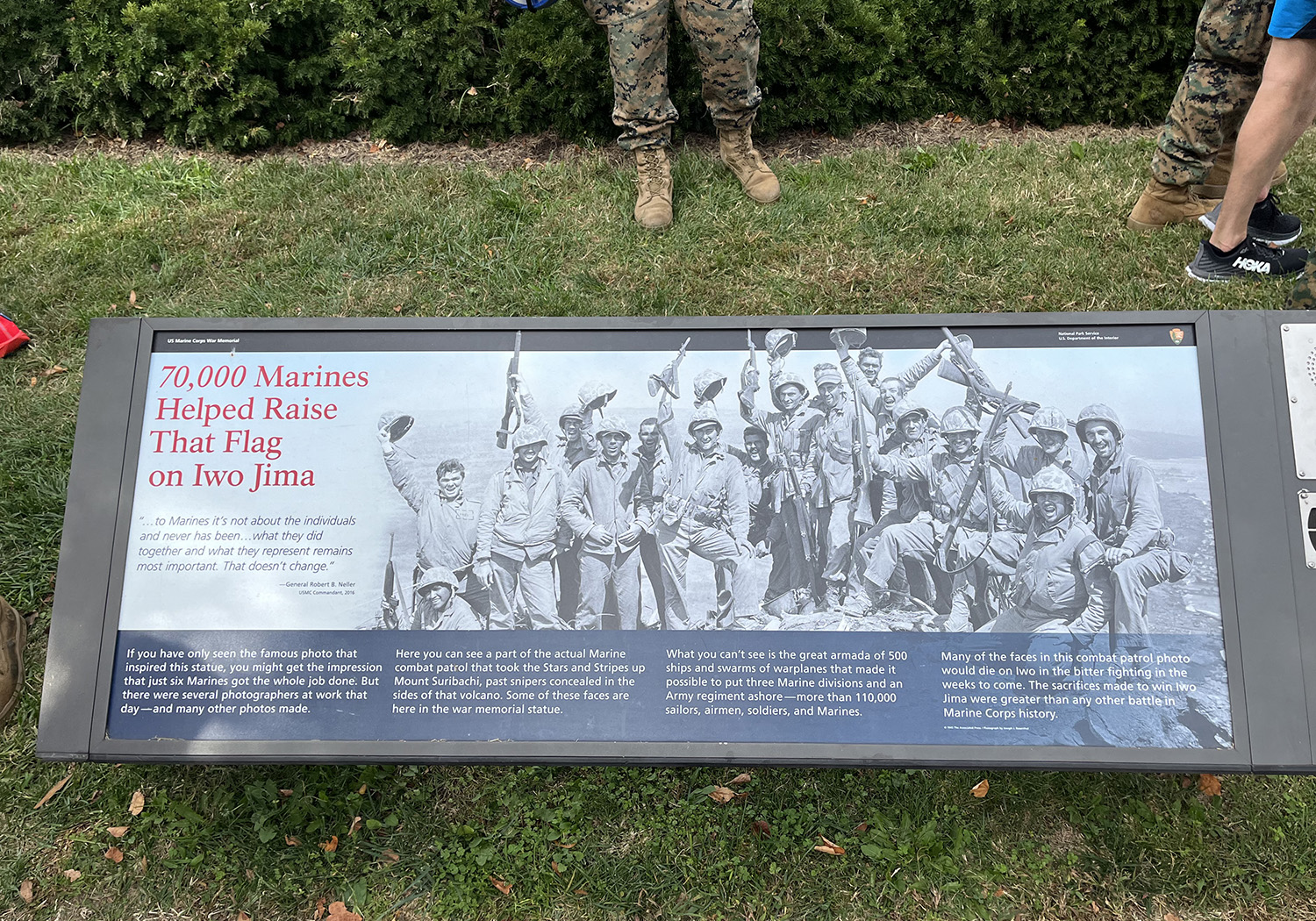
Iwo Jima Memorial plaque

Glancing at my Garmin, I was surprised to note my finish time was much better than expected given all that had transpired. As I’d later discover, I’d finished just outside the upper quartile of 50K finishers, suggesting that aside from the Calum Neffs and Michael Wardians, many of my fellow ultrarunners had suffered right alongside me. Under normal circumstances and with my focus squarely on race day, I’d have set a goal of sub-5 hours. But this was not that day.

In fact, owing to the high humidity, organizers made the difficult decision to close two of the checkpoints on the course earlier than scheduled and then divert those runners to the finish line (where they still received their medals) via a shorter route. Not ideal, and certainly there were arguments to be made on both sides of the decision, but just another indication of how runners and organizers alike grappled with the challenges posed by the unseasonal warmth.

Slowly I stood and headed toward the crowded line leading to the exit. After a few more uncomfortable minutes on my feet I collected my MCM-branded, lightweight mesh poncho—this was late autumn, after all—and finisher’s “hospitality box” containing sweet & salty snacks that I’d save until later, once my stomach and I were on speaking terms again.

I’d run 31.1 miles, and not a single NFL game had kicked off yet.

Men's winners of 2023 Marine Corps 50K
The men’s 50K winners, with new course record holder Calum Neff at center

Clearing the exit, I met Katie and collapsed once again on a crowded grassy incline outside the memorial. Apparently, Katie had just missed my finish as she flew out of her last Metro stop at Arlington National Cemetery and made a mad dash down the hill. Despite her disappointment at missing my dramatic home-stretch shuffle, the truth was that we’d already seen each other five times along the course. Whose spouse does that?

Security reasons notwithstanding, still it was unfortunate that with so much open green space on the grounds of the memorial, we weren’t allowed to occupy or enjoy much of it. Aside from the seemingly interminable walk from the Pentagon City Metro station to the start line, the post-race setup was the biggest downside to race day. On the bright side, the National Watermelon Promotion Board had set up a table on the street below us and was handing out generous servings of watermelon to finishers. Except that neither Katie nor I like watermelon. So instead I lay on the grass, using my MCM poncho as a pillow while dumbly sucking down my Tailwind recovery drink—always a post-race winner with even the most defiant stomach.

Marine Corps Base Quantico Band performing at MCM 48 finish line festival
Make no mistake, Marines can rock out with the best of ’em 🎸

Finally, after gathering my wits on the grassy slope, we rose and headed toward the nearby Rosslyn Metro station. On the way we passed a stage where a live band comprising six talented musicians in uniform—as it turns out, the Marine Corps Base Quantico Band I’d seen earlier in Georgetown—were energetically belting out hits from rock gods like Van Halen (“Jump” and “Panama”), Blondie (“One Way or Another”), Bon Jovi (“Livin’ on a Prayer”) and Green Day (“Basket Case”). For me, the sextet was the hands-down highlight of the finish festival.

On the Metro ride back to the hotel, several runners saw my 50K medal and we exchanged congratulations. “Great day for a marathon,” I responded. Because the truth was, I had no business trying to run 31.1 miles on this particular day, and my best bet would have been to play it “safe” and stick with the marathon distance. But that never entered my mind, and I had as much chance of forgoing the nation’s largest 50K as I did of overtaking Calum Neff on that final climb to win the damn thing. It simply wasn’t going to happen.

Obviously I would have preferred to dial down the suffering in those last 10 miles, but I’d run 21 good miles on an all-around tough day. And I can honestly say I have zero regrets. I’d love to return to D.C. one day to run the Marine Corps Marathon itself. At the same time, I’d be ok if this turns out to be the last 50K of my running career, since the distance feels more like an annoyingly long marathon than a true ultra. But again, I’ll never say never.
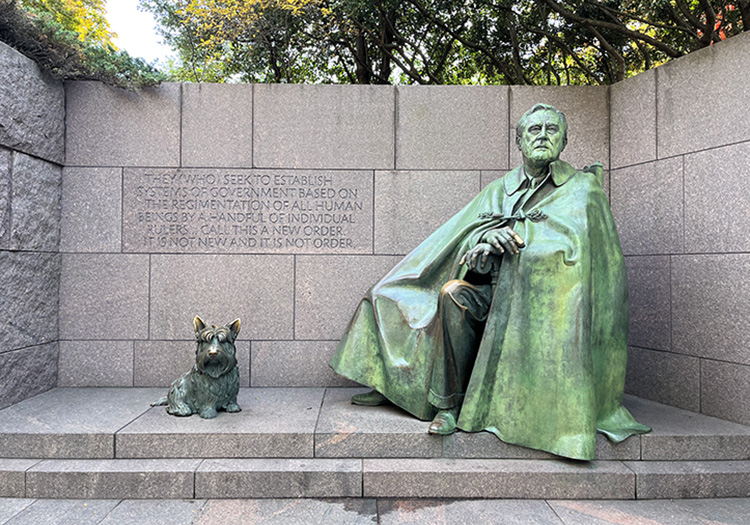
Franklin Delano Roosevelt (and his Scottish Terrier Fala) Memorial
The Franklin Delano Roosevelt (and his Scottish Terrier Fala) Memorial

On a side note, I’m grateful to have run the 50K when I did, because as of this writing—with the Marine Corps Marathon celebrating its 50th anniversary and an expected field of 40,000 runners this October—the 50K distance has been removed from the schedule. If the organizers ultimately decide to move the 50K to its own date as has been rumored, the event won’t be the same without the sheer joy and excitement of marathon race day that transforms D.C. into a living, breathing, sobbing, cheering, screaming, wildly celebrating organism.

And on a personal note, a belated shout-out of support to USMC Commandant Gen. Eric Smith, who had been congratulating runners at the finish line earlier in the day and who, ironically enough, suffered cardiac arrest while out jogging later that day. Fortunately, Gen. Smith made a full recovery and returned to full duty several months later. Best wishes to the commandant on his continued good health—not only do we share a love of running, but we both hail from the same city in Texas.

Eventually we made our way back to the Crystal Gateway Marriott. There we compared notes with Sandy, Chuck and Christine, who’d had a memorable day of their own at the U.S. Holocaust Memorial Museum, before enjoying a satisfying post-race meal at Padaek, a local Thai eatery.

Inside the Thomas Jefferson Memorial

On Monday we all rode the Metro into D.C. one last time to pay a visit to the FDR Memorial and the Jefferson Memorial, before saying goodbye and going our separate ways for the return trip home. With our afternoon free, Katie and I reunited with my friend Jill who met us for an excellent lunch at Rasika—an upscale Indian restaurant from James Beard Award-winning chef Vikram Sunderam—and then kindly chauffeured us to Reagan National Airport for our own flight back to Los Angeles.

As our plane rose from the tarmac and headed west into a glorious sunset, I reflected on the wild racing year I’d had. It had come on the heels of a lengthy injury hiatus that left me second-guessing for a time whether 50 States (or seven continents, or six World Marathon Majors) would ever really happen. And now here I sat, with all six Majors completed and with the delayed-onset muscle soreness of state 37 creeping into my legs. To call the past 6+ months a success would be an understatement, and I was thrilled to call a grand finale like the Marine Corps 50K my last hurrah in an epic year of running.

Or should I say, my last “OORAH!”
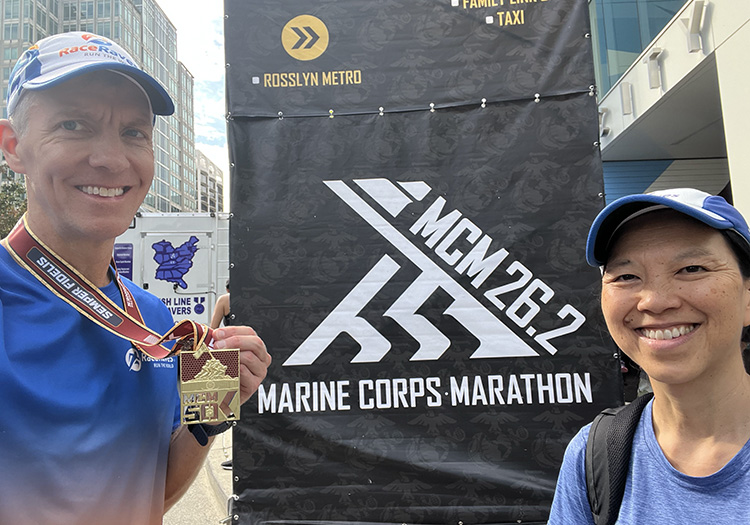
Mike Sohaskey and Katie Ho at MCM 48 finish festival in Rosslyn

BOTTOM LINE: To my mind, there’s one city every American should visit at least once in their lifetime, and that’s Washington D.C. Our nation’s capital is a living, breathing chronicle of 249 years of American history—the good, the bad, and the ugly. And with more than 100 unique monuments & memorials plus another 750+ historic landmarks, it’s an insanely cool place to run a marathon. So much so I figured HEY, why not extend the revelry another five miles and run the Marine Corps 50K instead? So while I did run the 50K distance (the largest 50K in the country), my narrative applies to the marathon as well.

(As I write this, it’s unclear whether the 50K will continue, since it was canceled for 2025 as the organizers focus on the marathon’s 50th anniversary celebration. And no official 50K date has yet been announced for 2026. Stay tuned.)

The Marine Corps Marathon, aka “The People’s Marathon” for its lack of prize money, is an energetic and patriotic powerhouse. And few race days rival the raucous joy and excitement of D.C. on marathon Sunday. The pomp and circumstance of race day is worth experiencing first-hand, from the MV-22 Osprey flyover and USMC Color Guard at the start line, to the emotional wear blue Mile, to the 2,200+ active-duty and retired Marines who support the event.

And did I mention the monuments? MCM is quite literally a run through history from start to finish. The race starts near the Pentagon and alongside Arlington National Cemetery, then enjoys a few quieter miles before crossing the Potomac River into D.C. where the real sightseeing begins. In mile 15 of the 50K (= marathon mile 10), you’ll pass the Watergate complex and the Kennedy Center for the Performing Arts. For the next 10 miles or so through the National Mall, the course is a “who’s who” of iconic monuments and memorials—including (but not limited to) the Jefferson Memorial, the Washington Monument, the United States Capitol, and several Smithsonian Buildings—before finishing strong back in Arlington at the Marine Corps War Memorial aka the Iwo Jima Memorial. There’s even an Easter egg for movie buffs: the fateful steps from the 1973 horror film The Exorcist are located along the 50K course, one block before it merges with the marathon course in Georgetown.

Plus, owing to the delayed onset of autumn in 2023, D.C. was still awash in fabulous fall colors into late October. So MCM really does have it all.

A note on being a tourist in D.C.: If you’re an experienced traveler or 50 Stater, this next nugget may seem obvious. But for the Marine Corps Marathon in particular, I’d recommend saving the bulk of the sightseeing until after the race. As a tourist you’re likely to do a lot of walking around D.C., and being on your feet that much before the race is a recipe for—if not disaster, then at least distress. Trust me, I knew better but still found out the hard way because our schedule left us no choice.

And a note on being a runner at MCM: Again this may sound obvious, but do be sure to leave yourself plenty of time on race morning to get from your hotel/Airbnb/VRBO to the start line. MCM is no laid-back, small-town marathon, and it’s easy to underestimate the amount of time required. The closest Metro station to the start line (Arlington National Cemetery) is CLOSED on race morning, and the walk from the Pentagon City station to the start is roughly 1½ miles with a brief stop for security screening. So don’t be that guy, i.e. ME, who misjudges the timing and shows up minutes after the starting howitzer goes off 🤦🏻‍♂️

That said, all the logistics of race weekend are worth the hassle (yes, even venturing out to Maryland for the expo, see below). Because once you charge the hill up to the Iwo Jima Memorial, let out a triumphant “OORAH!” and receive your finisher medal from a uniformed U.S. Marine who thanks YOU for running, that’s one shining moment you’ll never forget.

Marine Corps War Memorial shines brightly at night
The Marine Corps War Memorial shines brightly at night

PRODUCTION: As you might expect for the Marine Corps Marathon/50K, race weekend for the most part went off with military efficiency. Race day itself was a well-oiled machine, though the organizers’ logistical prowess will clearly be tested this year when the race doubles its capacity to 40,000 runners for the sold-out 50th anniversary celebration. My only complaint—a minor objection made more consequential by the unseasonal warmth and humidity—was the aid stations, which could have avoided considerable confusion by using color-coded cups to distinguish water and sports drink. Instead, more often than not I was left guessing each time I accepted a cup of liquid from a volunteer. (Shout-out to all the incredible volunteers, who without exception were friendly and helpful.) And though I do wish we’d been allowed to stick around and enjoy the copious green space around the Marine Corps War Memorial after finishing our race, it was all worth it to be able to finish a stone’s throw from the memorial itself. Oorah!

My biggest complaint with race weekend was the expo—or rather, the location of the expo which was (and still is) in another state. I know Maryland is a hop skip & jump from D.C., and I’m sure there’s a reason the expo is held at the Gaylord National Resort & Convention Center in National Harbor rather than at one of D.C.’s (or Arlington’s) many meeting spaces. But simply getting to the expo required a 30-min Uber ride or an even longer and more convoluted Metro trip. And with everything else about race weekend (sightseeing included) centered on the nation’s capital, having to go so far out of our way to pick up my bib number and some safety pins felt overly inconvenient. (Luckily, once inside the Gaylord the expo itself was easily negotiated if not particularly compelling, and by arriving slightly later on Saturday we avoided the morning onslaught.) Getting back from the expo was even worse, since the law of supply and demand made it nearly impossible to hail an Uber around bustling National Harbor.

Mike Sohaskey's Marine Corps 50K medal in front of Iwo Jima Memorial

SWAG: The Marine Corps 50K medal is perfectly fine, if less elaborate than the marathon medal. It’s simpler in design and more two-dimensional than the rounded, locket-style marathon medal adorned with the Eagle, Globe and Anchor icon. At the same time the rectangular, burgundy-and-gold 50K medal boldly depicts the Marine Corps War Memorial as its centerpiece, which sets it apart. And the color-matched ribbon is distance-specific as well. But it’s the “MCM 50K” label that will always be my true source of pride.

As for the MCM 50K shirt, that’s another story. Granted, it’s high fashion compared to the notorious 2018 design; still, two years later I’ve yet to find an occasion (or the gumption) to wear it. The shirt is a shiny, long-sleeve mock turtleneck (?) with an inner fleece lining that feels like it wouldn’t breathe well. It’s easily the heaviest non-sweatshirt I own. The color scheme of the shirt matches the finisher medal: the torso is made from shiny burgundy polyester while the arms are an equally shiny gold polyester covered in a busy honeycomb design. #RUNWITH THE MARINES is printed down the right arm while MISSION ACCOMPLISHED runs down the left arm (and honestly, 22 years later that slogan’s still got too much Dubya to it). The front of the shirt is emblazoned with the Eagle, Globe and Anchor icon. From the front, the shirt gives the impression that I have some personal affiliation with the U.S. Marine Corps. Only on the back do the words MCM 50K appear (who sees the back?) above two lines that I can only imagine were the winning entry in the local fourth-grade poetry contest: “WHEN IT COMES TO RUNNING ULTRAS AS A FEAT, THE MARINE CORPS HAS GOT ‘EM ALL BEAT!” Not exactly Shakespeare’s “Now bid me run, and I will strive with things impossible.”

Fortunately, Katie went online after the race and was able to find an attractive, steel blue MCM 50K hoodie that I’ve happily worn and will continue to wear on our travels to cooler-weather destinations. ‘Cuz when it comes to finding race merch as a feat, my wife Katie has got ‘em all beat 🖐️🎤

Updated 50 States Map:
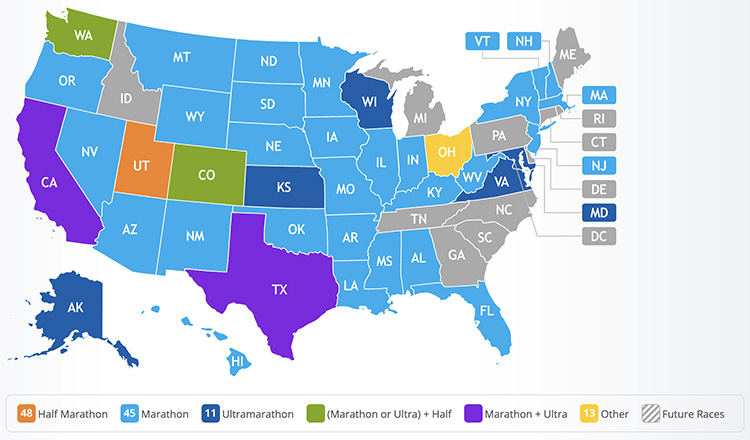
Mike Sohaskey's 50 States map after 2023 Marine Corps 50K

RaceRaves rating:

FINAL STATS:
Oct 29, 2023 (start time 7:15 am)
31.42 miles in Arlington, VA and Washington DC (state 37 of 50)
Finish time & pace: 5:09:08 (first time running the Marine Corps 50K), 9:51/mile
Finish place: 360 overall, 36/171 in M(50-59) age group
Number of finishers: 1,295 (925 men, 370 women)
Race weather: warm (66°F) & cloudy at the start, warm (72°F) & partly sunny at the finish w/high humidity
Elevation change (Garmin Connect): 658 ft gain, 627 ft loss
Elevation min, max: 3.3 ft, 237.8 ft

The appearance of U.S. Department of Defense (DoD) visual information does not imply or constitute DoD endorsement.

I’m looking California, and feeling Minnesota.
– Soundgarden, “Outshined”

Mike Sohaskey and Katie Ho at Grandma's Marathon expo

Like so many great ideas in American history, this one started in a bar.

In 1977, a group of runners met over beers in Duluth, Minnesota, and decided it would be fun to start their own marathon. After asking around and being turned down by several local businesses, the group found one business willing to ante up $600 to sponsor their race. That savvy investment earned the Grandma’s Saloon & Deli the title sponsorship of the fledgling marathon, and 48 years later the Grandma’s Marathon has grown into one of the nation’s largest and most popular marathons, one that sells out well ahead of race weekend.

The Grandma’s Marathon boasts a number of attributes that appeal to a 50 Stater like me. The first is its location: nestled in a beautiful setting along the North Shore of Lake Superior, Duluth is one of those places that’s synonymous with “small-town charm.” The second is its course which, thanks to its gently rolling profile and limited number of turns, is a perennial favorite among runners looking to qualify for Boston. The third is its status as the Best Marathon in Minnesota according to our 2023 RaceRaves Runners Choice poll. And the fourth is its scheduling in the middle of June, at a time of the year shunned by most other U.S. marathons due to the potential for hot & humid weather.

The early summer date is a distinct competitive advantage given that the majority of U.S. marathons—and many of my preferred marathons—fall in May and October, which makes scheduling for those two months a challenging game of “How much recovery time do I really need between marathons?” Never say never, but I’d rather not run a marathon that doesn’t excite me simply because it happens to fall at a more convenient time on the calendar.

Mike Sohaskey with Grandma's Marathon backdrop at expo

In any case, Grandma’s would be my pick for Minnesota. I’d signed up in March—as late as possible ahead of a sellout—in the hopes that my previously injured leg would hold up to the demands of training for and running the London Marathon. Ironically, while my leg had made it through my final World Marathon Major with flying colors, the rest of me had not.

I’d flown home from London in late April and spent the next 18 hours in bed battling what I assumed to be COVID-19. Katie (who shared my symptoms) tested positive three days later, whereas I didn’t bother to test since I wasn’t leaving the house. As it turned out, this lingering reminder of London refused to go quietly, and it wasn’t until early June that my training runs started to feel relatively normal compared to the sluggish, labored miles of the previous month.

And so, two weeks later when our plane touched down at the Minneapolis–Saint Paul International Airport, I brought with me the baggage of decidedly lower expectations than I’d had three months earlier when I’d registered for the race. On the other hand, given the combination of my recent illness and a disheartening race day in London, I was euphoric just to be getting back to my 50 States quest after canceling plans to run the Providence (Rhode Island) Marathon in early May.

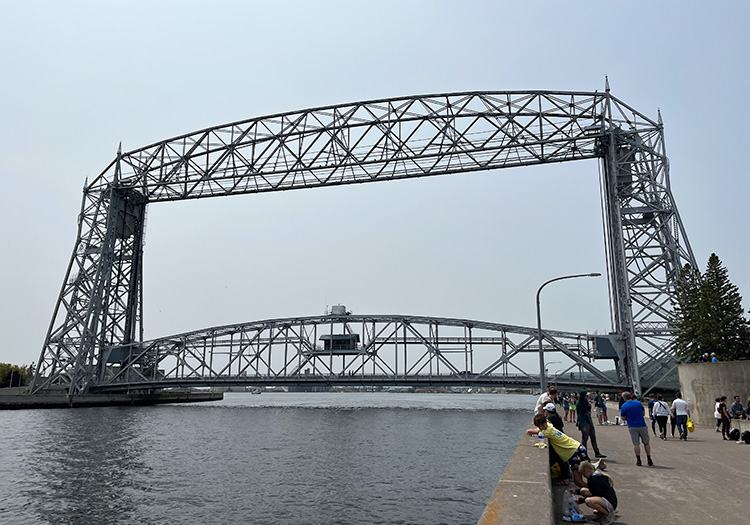
Aerial Lift Bridge and Lake Superior at the MN/WI border, seen from Enger Tower
Aerial Lift Bridge (left) and Lake Superior at the MN/WI border, seen from Enger Tower

Getting to Know Duluth
From the state capital, we rented a car and headed north toward Duluth on I-35 (the same I-35 whose challenge I’d accepted in Kansas City and Des Moines five years earlier). For the next 2½ hours, the lush verdure of early summer filled my passenger-side window until we arrived at our destination on the North Shore of the world’s largest freshwater lake.

That evening serendipity stepped in, and we found ourselves enjoying one of the best meals of our 50 States travels so far at Va Bene, an understated Italian restaurant with fantastic food and an open-air deck boasting awesome views of the lake.

And just like that, our Minnesota adventure was off to a strong start.

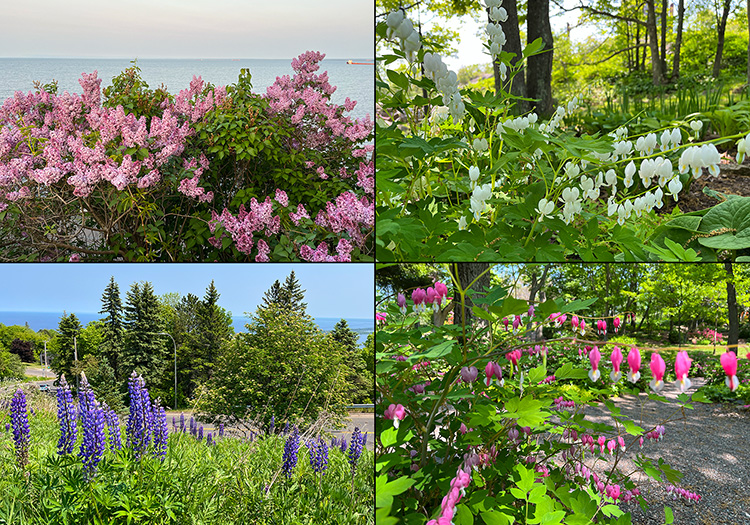
Flora of Duluth: lilacs, white bleeding heart, bleeding heart, lupines
Flora of Duluth (clockwise, from top left): Lilacs, white bleeding heart, bleeding heart, lupines

On Friday we drove the West End and made the short climb to the top of Enger Tower, an 80-foot tall stone observation tower that offers panoramic views of Canal Park, the surrounding harbor and the neighboring state of Wisconsin. And we enjoyed lunch in an otherwise nondescript strip mall situated across the street from the immaculately landscaped Duluth Rose Garden and, beyond that, the brilliant blue expanse of Lake Superior. Location, location, location.

Having gotten a sense for the city’s waterfront district, we stopped by the pre-race expo at the Duluth Entertainment Convention Center (DECC) to pick up my bib number. With a purported 100+ vendors, the Grandma’s Marathon expo was—London notwithstanding—the largest I’ve seen in years. It was a throwback to what midsize race expos used to be before the pandemic.

Leisurely we strolled the aisles, pausing to chat with several race directors and our friends from Marathon Tours. Leaving the expo, we passed the colorfully decorated room that hosted the popular Michelina’s All-You-Can-Eat Spaghetti Dinner—admittedly a bargain at $16 for adults, $8 for kids—en route to our own dinner on the pier overlooking the harbor. I’d briefly considered Michelina’s offering, and I’m sure it would have been as good as advertised. To this day, though, I remain once bitten, twice shy thanks to my, um, interactive dining experience in Alabama ten years ago. 😬

Carbo-loading runners at Michelina's All-You-Can-Eat Spaghetti Dinner before Grandma's Marathon
You can always count on eating well at Grandma’s house

Two Harbors and One Great Lake
Have I mentioned I’m a huge fan of Saturday races? After a relatively hedonistic (by pre-race standards) six hours of sleep, we awoke in the darkness of Saturday morning to clear skies and cool temperatures. If there’s such thing as a good day for a marathon, this was it.

After my usual light breakfast, we made the short walk (five minutes via pedestrian skyway from our room at the Holiday Inn & Suites Duluth-Downtown) to catch our separate modes of transportation outside the DECC. Katie would be riding the 5:30am North Shore Scenic Railroad spectator train to Two Harbors, a unique vantage point from which she’d be able to watch the runners at several stops along the course. She’d reserved her spot several months earlier at a cost of $90, which included breakfast with—for those determined to get their money’s worth—bottomless mimosas and Bloody Marys, plus a pass to the finish-line bleachers and a pair of Grandma’s-branded socks.

For my part, I’d opted against the train to Two Harbors since, due to high demand among runners for limited space, it would have meant getting up even earlier than our already perverse 4:30am wakeup call. Instead, I managed to avoid one of the standard yellow school buses in favor of a comfortable coach shuttle that hummed quietly through the brightening streets, navigating the marathon course in reverse as we caught glimpses out the window of volunteers setting up aid stations along the side of the road.

After a peaceful 35 minutes, the shuttle hissed to a stop and emptied its human cargo on Scenic Hwy 61 in Two Harbors where, standing alongside a Chevrolet dealership, the Grandma’s Marathon start line welcomed us to the party.

Mike Sohaskey parting wave from start line corrals at Grandma's Marathon
A parting wave to Katie aboard the North Shore Scenic Railroad

In retrospect, there looked to be plenty of room here on the highway for the start line to be relocated farther north, a move that would have added enough distance to enable a more direct route through Downtown Duluth to the finish line in Canal Park. Certainly, though, the parking lot of an auto dealership was a convenient space for thousands of marathoners to mill about aimlessly like nervous zombies for an hour.

Stepping off the shuttle, I headed immediately for the porta-potty line on the advice of my friend Krishna, a returning Grandma’s regular whom I’d last seen pre-pandemic at the 2019 Two Oceans Marathon in Cape Town. He’d warned me that the lines would be absurdly long, and he wasn’t kidding—it took me ~35 minutes to get in and get out. During that time I listened to pre-race announcements and the usual start-line favorites (“I Gotta Feeling” by the Black Eyed Peas, “Danger Zone” by Kenny Loggins, plus the theme from “Rocky”), heard a staff sergeant sing the national anthem, witnessed two F-16 fighter jets fly overhead, and cheered the start of the Wheelchair & Adaptive Athletes race.

Like so many races, one key step Grandma’s could take to improve the event would be more porta-potties. My inordinate wait time left me just over five minutes to strip down, hand my drop bag to a volunteer, and wiggle my way through the crowded start corral to stand alongside the 4-hour pace group.

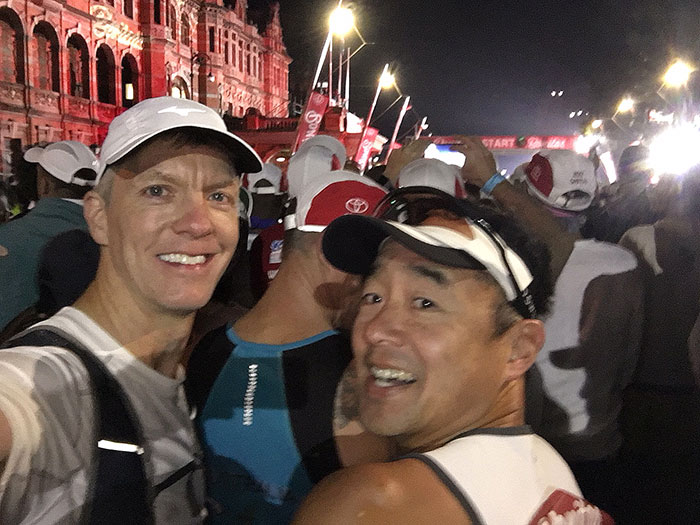
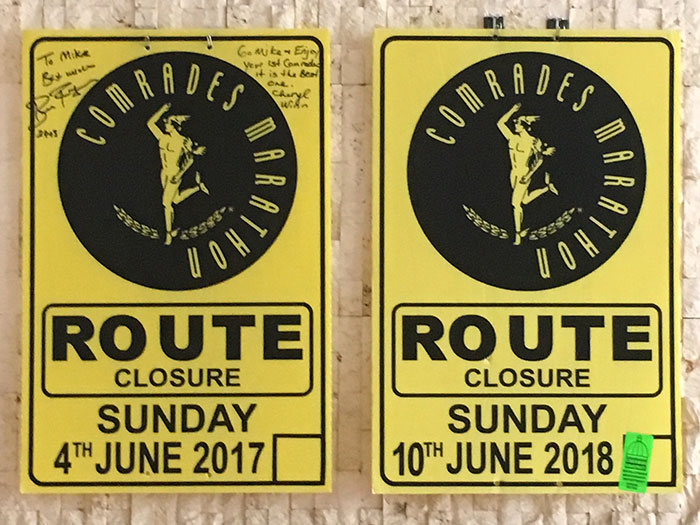
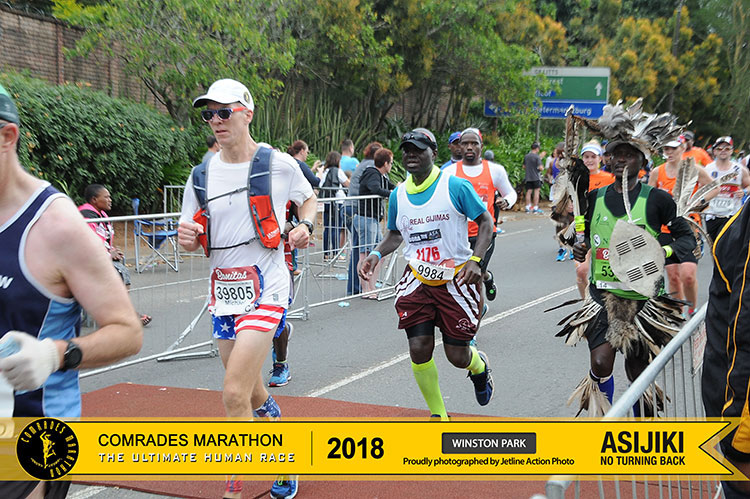
I paused before entering the start corral to wave at Katie on the viewing deck of the North Shore Scenic Railroad, which sat silently on the tracks set back among the foliage on the opposite side of Hwy 61. Then I squeezed into the corral as the theme song from “Chariots of Fire” filled the crisp morning air, its uplifting overture hearkening me back to the race I’ll always associate with Vangelis’ iconic score—the Comrades Marathon in South Africa, the world’s largest ultramarathon and my personal favorite running event.

Seconds later the tightly packed mass of bodies loosened and surged forward in the direction of Duluth. Excited cheers filled the air, and the 47th annual Grandma’s Marathon (aka state 36 for me) was off and running. Thanks for the memories Two Harbors, it’s been real.

Quickly I fell into a rhythm with the 4-hour pace group. Given my post-London illness and suboptimal recovery, I didn’t expect to maintain a 4-hour pace for the entire 26.2 miles; rather, my goal was to stick with the group until the halfway point and then reassess my comfort level.

As the early miles ticked by, I glanced up occasionally from my 4-hour scrum to soak up the surrounding tranquility. Towering trees and tall grasses lined the road on each side, dual swaths of green as far as the eye could see interrupted by the occasional modest residence or small-but-vociferous gathering of spectators. Such was the scenery for the first ten miles as we chased the horizon, the road seeming to grok that the shortest distance between us and Duluth was a (very) straight line.

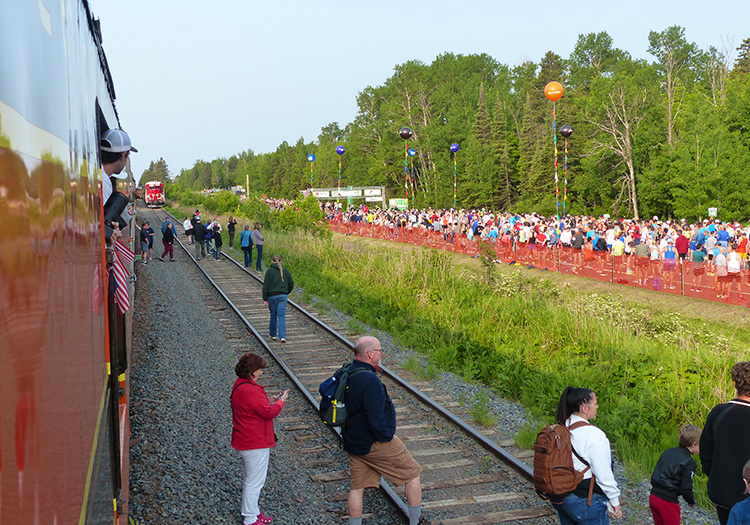
Spectators on North Shore Scenic Railroad at Grandma's Marathon start line
Spectators on the North Shore Scenic Railroad had the best seat in the house

I focused on staying relaxed by settling into a rhythmic breathing cadence—inhale for 3 steps, exhale for 2 steps. So far, Minnesota’s North Shore was the perfect remedy for the claustrophobic chaos of London.

The Grandma’s Marathon surprises and delights with thoughtful details that set it apart from other marathons, case in point its mile markers. Rather than ground-level placards that are designed to be seen only in passing, the Grandma’s organizers float large yellow balloons (blue for half marathoners) tied to long ribbons on each side of the road so they’re visible from afar. Along an extended straightaway like Hwy 61, I felt a tiny shot of adrenaline each time I’d see those balloons approach in the distance.

I’m always amazed by how much energy runners are willing to waste during a marathon, an undertaking that requires nearly every ounce of energy you’ve got to succeed. One fellow to my left kept whooping loudly in response to personalized spectator signs—”GO ELLIE!” he’d scream, or “GO JORDAN!” as if he were seated in the finish-line bleachers rather than running the race. Never mind that neither Ellie nor Jordan was within earshot of his enthusiasm; he may as well have been cheering for the trees. Dude, I thought wryly, that’s energy you’re going to wish you had in a couple of hours.

The chatter around me subsided until we were left with only the voices of runners conversing with the 4-hour pacer. One woman in our group asked, “What’s your name, pacer?” “Danny” came the response. She then proceeded to grill Danny on his strategy, which I’d assumed would be something along the lines of “Run at a pace of just under four hours until we all cross the finish line.”

Greenery = scenery along Grandma's Marathon course
Greenery = scenery for most of the first 23 miles

“What’s your strategy for the hills?” she asked. “There are hills here?” Danny joked. Ignoring his attempt at humor, she reminded him unhelpfully that he had a big group running with him and a lot of folks counting on him. And I felt a pang of sympathy for poor Danny, an unpaid volunteer who was giving back to the running community by helping the rest of us achieve our goals. In the world of the type-A marathoner, no good deed goes unpunished.

The course rolled slightly along its southward trajectory, its scenery as unchanging as any race I’d run—and this was a good thing. In mile 7 we caught our first glimpse of Lake Superior peeking through the trees to our left; it wasn’t until mile 10, though, that the lake emerged in its full glory to wow us with its pristine shoreline and sparkling surface, both of which would remain hidden behind trees for most of the race.

A gentle cooling breeze off the lake helped keep things comfortable as the temperature crept slowly upward toward its projected high of 74°F. This was my kind of race, and I wished again that my post-London regimen had lent itself to training more regularly at a sub-4-hour pace.

To my mind, no endeavor demands a more consistent work ethic than running 26.2 miles. The simple truth is, you cannot fake a marathon. There are no breaks in the action, no teammates to lean on, no timeouts to catch your breath. When the starter’s pistol fires, you’re either ready or you’re not—and even then, race day may not go according to plan with so many variables out of your control. In an age of so much performative BS from politicians and personalities, its brutal and unapologetic authenticity is one of the reasons I love the sport of running.

Runners with pace group at Grandma's Marathon

Feeling Minnesota
I continued to run with the 4-hour pace group as we reached an area lined with blue porta-potties, aka the Garry Bjorklund Half Marathon start line. Here Bon Jovi’s “Livin’ on a Prayer”—predictable to be sure, but always welcome—blasted from the sidelines. I told myself the “fluff” miles were over while trying to focus on the silver lining: one half marathon down, one to go. I knew, though, that things would get tougher from here. Unfortunately, this was all part of the process of getting back to where I wanted to be, one step at a time.

Krishna would later share the story of one spectator in this area yelling “ALL DOWNHILL FROM HERE!” which prompted Krishna, a speedy Grandma’s Marathon veteran who knows the course well, to yell back reflexively, “A LIE!” Any marathoner who’s had to endure obnoxious spectator cries of “Almost there!” at mile 3 can appreciate Krishna’s candor.

By mile 15 I realized that continuing to push a sub-4 pace would lead to a very rough 11 miles, in part because the day was warming (thank you, cool breeze!) and I needed more frequent aid station stops. And so, pulling back the throttle to a more comfortable position, I watched the 4-hour pace group slowly recede into the distance.

Miles 15 and 16 felt largely uphill, though this was apparently due less to reality and more to perceived effort—looking at my Garmin tracing, the actual hills wouldn’t arrive until later. And in mile 18 I was forced to pause and do a few leg lifts to loosen my tightening quads. Just one more thing, I told myself, that would improve with further training. C’est la vie. There’s nothing quite like being undertrained to make you appreciate the epic challenge of running 26.2 miles.

Runners along Grandma's Marathon course along Hwy 61

I was impressed and heartened by the number of boisterous spectators lining Hwy 61 or cheering on the runners from comfortable lawn chairs in their front yards. Their exuberance was a welcome pick-me-up along an otherwise quiet course that was largely devoid of music or other entertainment, though I’d be remiss not to give a shout-out to the solitary tuba player, even if I can’t recall what they were playing or whether a solo tuba did the song justice.

I glanced up at one point to see my companion from the 4-hour pace group, the woman who had been interrogating pacer Danny, now running just ahead of me and well behind the 4-hour group. Bill Rodgers was right, I mused. The marathon will humble you. And we’ve all been there.

As fatigue set in and my lower back tightened a bit, I took time to walk through the aid stations which likewise allowed me to stretch my quads and gather my wits. I forced an energy gel down with water in two installments, my stomach protesting its warm and gooey sweetness. While I’ve typically had better luck at longer distances (like the Denali 100K in Alaska), after 50+ marathons I still struggle to dial in my nutrition on race day. On cooler days I skip it altogether, a strategy that flouts conventional wisdom but which always seems to yield the best results.

On the bright side—and this was the best news of the day—my previously injured leg and the sprained foot that had derailed me in London both felt strong and healthy.

Miles 16–­­­­20 were a no-man’s land of discomfort, fatigue rearing its ugly head to the extent that it was impossible to ignore but not overwhelming enough to make me walk. I kept my eyes on the road five feet ahead of me, trying to marshal my reserves one mile at a time, then one step at a time. Where tree cover hung over the road, I ran on the shoulder to avail myself of the shade. Occasionally the road would exit the trees to reveal Superior’s majesty on full display, the light breeze creating delicate ripples across the water’s surface.

Katie stood waiting just short of the mile 19 marker on the Lester River Bridge, where she enjoyed her own sweeping view of the lake. As if riding the spectator train from Duluth to Two Harbors and back hadn’t been enough show of support, here she was out on the course for a second time, having walked to the hotel to collect the car and drive herself to mile 19. And now, as I leaned against her to stretch my quads, she asked in her earnestly supportive way, “Are you enjoying yourself?” I think we both realized the absurdity of the question as soon as it came out.

I admitted that no, I was not in fact enjoying myself. Then I bid her farewell and told her I’d see her at the finish… eventually. This was going to be a long, slow seven miles.

Grandma's Marathon course at mile 19, with view of Lake Superior
At least Katie had a Superior view of the lake at mile 19

As the miles mounted and we reached the outskirts of Duluth, I passed a surprising number of runners-turned-walkers. Granted I was further back in the pack than usual, but still there were quite a few walkers of all shapes and sizes. Also conspicuous was the number of discarded sponges on the ground. For my part, with temperatures in the 60s I never felt in need of a cold sponge, plus I didn’t want to risk wiping off my sunscreen. As pale as I am, skin cancer and melanoma concern me much more than warm temperatures.

For whatever reason—a second, third or fourth wind perhaps, or maybe I’d entered the eye of the hurricane—life after mile 20 began to look a bit rosier as a brief surge of momentum propelled me forward. I even tried to fall in behind the 4:05 pacer for ¾ of a mile or so before rejecting that idea. During that stretch, we passed one group of young guys on the sideline who saw the 4:05 sign and broke into a raucous chant of “PA-CER! PA-CER! PA-CER!” as he played to the crowd, pumping the sign up and down like a drill team leader wielding a baton.

Modest one- and two-story homes now dotted the landscape with increasing frequency, many of them clad in the protective exterior siding common to colder climates. Approaching the mile 22 marker, my mile times had crept up into the ten-minute range as I struggled to lift my quads, which now felt like solid blocks of granite.

And so, rather than plod along in a bitter haze and with notorious Lemon Drop Hill (named for a now-defunct restaurant that closed in 1988) looming directly ahead I slowed to a walk, took a few deep breaths, and allowed myself to relax. When life gives you Lemon Drop, make lemonade. I didn’t want to let my lack of preparation snowball on me and ruin an otherwise pleasurable run. After taking mile 23 to catch my breath, I’d have only 5K (3.1 miles) or so remaining, and at that point I could focus my remaining energy on pushing through Downtown Duluth to Canal Park. Sure I wanted to finish strong, but realistically I was here to enjoy Minnesota, not to earn an Olympic Trials Qualifying time.

(On that note, two-time Grandma’s winner Dakotah Lindwurm did run an OTQ in Duluth, setting the stage for her third-place finish at last month’s Olympic Marathon Trials which earned her a spot on this summer’s Olympic Marathon Team in Paris 👏)

A sign on Lemon Drop Hill – 4.1 miles to go for Grandma's Marathon runners
A sign from above on Lemon Drop Hill

Exiting the highway and transitioning to London Rd, we entered a more commercial stretch where the sudden appearance of hotels, fast-food restaurants and gas stations (Whoa, Minnesota still has enough water for car washes!) welcomed us to Duluth proper. As much as I’d appreciated the blissfully monotonous greenery and stunning lake views of Scenic Hwy 61, I was gratified now to enter more urban surroundings, a clear indicator that the end was near.

Had I not chosen to walk this stretch, I might have missed my favorite spectator sign of the day; “F*CK THIS SHIT” it read in large letters, with “KEEP RUNNING” written inconspicuously along the sides. More than any other sign I’d seen—NO, I wasn’t kicking ass-phalt and NO, all this sweat wasn’t my fat cells crying—this one spoke to me. Despite my exhaustion, I may even have cracked a smile.

Approaching the mile 23 marker I once again broke into a trot, and moments later we made a right turn away from the lake and onto the block where Katie and I had eaten lunch the day before. This first turn of the day produced an unexpected surge of adrenaline that carried me up the hill to an almost immediate left turn on Superior St, which would lead us into the heart of the commercial district and Downtown Duluth.

From there the scenery became more familiar as we passed the Duluth Running Store, Va Bene (site of our best meal in Duluth), and the collection of buildings housing the centerpiece of Superior Street, the state-of-the-art Essentia Health St. Mary’s Medical Center. The latter’s sleekly modern design, with its bold curves and floor-to-ceiling windows, looked distinctly out of place among its more traditional, low-key neighbors. On the opposite side, Lake Superior remained our ever-loyal companion, its shimmering surface guiding us homeward to Canal Park.

Passing the Medical Center, we seemed to travel back in time as we entered the multi-level red-brick storefronts of the city’s aging downtown district. Downtown Duluth more closely resembled the one-horse, one-street downtown of tiny Ottawa, Kansas than it did a modern urban downtown. Despite being listed on the National Register of Historic Places, during our stay I couldn’t put my finger on anything that struck me as particularly special about Downtown Duluth. Aside from the crowds on race day, that is…

Grandma's Marathon finish line marker

“Gopher” Broke
As we approached downtown, the crowd support grew in both size and intensity. Spirited cheers welcomed us to Duluth while I continued to focus one block at a time on locating the next yellow balloon/mile marker in the distance. Overhead the occasional glass skywalk—a winter necessity in the Gopher State—connected buildings on opposite sides of the street, offering a convenient vantage point from which to watch the runners below.

Controlled chaos was playing out at the intersection of Superior and Lake Street, where race officials and volunteers worked to prevent spectators (and potentially runners) from cutting across the course on Lake Street as a shortcut directly to the finish line in Canal Park. A shout-out of gratitude to the folks in charge of crowd control, because spectators crossing willy-nilly in front of exhausted marathoners at mile 25 could have been an accident waiting to happen.

View of Grandma's Marathon runners from glass skywalk overlooking Superior Street
View from the glass skywalk overlooking Superior St

Just past the mile 25 marker our third turn of the day led us down a short transition zone of bricks, over I-35 and the train tracks, past AMSOIL Arena (home of the University of Minnesota-Duluth Bulldogs) and the Great Lakes Aquarium, and into Canal Park. “Half a mile to go!” yelled a spectator to my right. Nice, I thought, though if there’s one thing I’ve learned from my 50+ marathons, it’s never to trust the spectators. No offense and I appreciate the support, but bystanders tend to have a more nonchalant sense of what “almost there” means than someone who’s already run 25.5 miles.

Duluth’s signature architectural landmark, its iconic Aerial Lift Bridge, came into view across the water, lifting my spirits momentarily as we curved along Harbor Drive. Come on adrenaline, do your stuff! I dug deep, tapping into what little remained of my energy reserves. “Half a mile to go!” shouted another spectator. Huh?

Winding our way around Canal Park with Downtown Duluth now visible across I-35, we passed the hulking steel façade of the SS William A. Irvin. Once the proud flagship of U.S. Steel’s Great Lakes Fleet of bulk freighters (or as we Angelenos know them, “Lakers”), an enormous banner now hung across its port side encouraging visitors with the promise of “KIDS FREE WITH PAID ADULT.”

SS William A. Irvin along course of Grandma's Marathon

A third voice rang out from the sidelines: “Half a mile to go!” People, make up your minds! Fatigue notwithstanding, I couldn’t help but appreciate this well-meaning display of Midwestern hospitality.

Another turn AND… our tour of Canal Park continued. Having failed to study the course map carefully (the first 25 miles was basically a straight line, after all), I didn’t realize we’d saved all our turns for the last mile. Or so it seemed. We’d passed the mile 25 marker, like, forever ago… so where was the damn finish line?

At long last we arrived at Canal Park Dr, where a right turn led onto the final straightaway. Directly ahead the finish line beckoned us home, the imposing steel skeleton of the Aerial Lift Bridge towering in the background. Somehow, I was coherent enough to pick Katie out of the crowd lining the street, her cheers propelling me forward across the finish line and out of my pain cave in a hard-earned time of 4:12:23.

Mike Sohaskey, 100 yards from the finish line of Grandma's Marathon
100 yards to freedom

(Lest there be any doubts as to the city’s support for this race, stenciled permanently on the street at the location of the finish arch are the words “GRANDMA’S MARATHON FINISH.”)

Wobbling to a stop, I paused to gather my wits and bask in the moment before continuing through the finish chute where I gratefully accepted my medal, finisher shirt and heat sheet from volunteers. And speaking of volunteers, I can vouch that the lake wasn’t the only thing that was Superior on this day. From start to finish, everyone was incredibly friendly and helpful including Joyce at the med tent who, as I hobbled past in search of a comfy place to collapse, kindly told me how good I looked for having just run a marathon.

The finishers area offered a variety of fueling options including bagels, yogurt, fruit, chips & snacks, pork sticks, and chocolate milk along with beer and non-alcoholic beverages at the post-race celebration. And true to form, my stomach would have none of it. So I grabbed several bottles of water along with my drop bag and reunited with Katie, before claiming a grassy spot alongside (where else?) Grandma’s Saloon & Grill, a stone’s throw from the lake and the Aerial Lift Bridge.

Having started an hour and 45 minutes before us, most of the half marathoners had long since finished and gone home, leaving ample space in Canal Park for marathoners to spread out and relax.

Mike Sohaskey from behind the finish line of Grandma's Marathon

And relax I did, as much as my exhausted body would allow—it took me a while before I was able to move comfortably under my own power. Unfortunately, I had neither the energy nor the desire to make the 15-minute walk to nearby Bayfront Festival Park for the post-race party. I was spent, and aside from my usual post-race bottle of Tailwind Recovery Drink, I knew I had no choice but to wait out my body and let it dictate its nutritional needs on its own timeline.

Luckily for me, as the host hotel for the elite runners, the Holiday Inn & Suites where we stayed offered complimentary sports massage services for race weekend. So that afternoon I took the opportunity to schedule a relaxing post-race massage, a decision which did not suck. Then we showered and met Krishna for dinner at Ursa Minor Brewery, a bustling spot on the north side of town and an easy five-minute drive from Canal Park.

Over dinner and drinks, we compared notes from the day and caught up on each other’s lives since our last in-person meeting at the Two Oceans Marathon in Cape Town in 2019. We also discussed his own burgeoning desire to run a marathon in all 50 states, which is good news for me since it gives us an easy excuse to meet again before another four years pass. The evening was another compelling reminder that beyond the miles, the medals and the memories, this 50 States quest gets its power from the people.

Mike Sohaskey and Krishna at Ursa Minor Brewery, celebrating Grandma's Marathon finish
We meet again! Two happy Grandma’s finishers

From a preparation and performance perspective, Grandma’s was hardly ideal—given the option, certainly I’d have chosen not to get sick after London, my first marathon in 16 months. At the same time this was clear progress, a milestone in my mental and physical journey back to marathon fitness. I’d finished stronger (and less injured) than London as my body continues to relearn the art and science of running 26.2 miles. As they say, if it were easy everyone would do it, instead of sitting on the couch warning the rest of us it’s bad for our knees.

So there you have it—state 36 is in the books, and one of the nation’s most charming destinations is off the board. On an epic summer day along Minnesota’s scenic North Shore, small-town hospitality and big-city choreography joined forces with the world’s largest freshwater lake to produce a race day I’d highly recommend.

Because this is one Grandma that just gets better with age.

Mike Sohaskey and Katie Ho finish line selfie at 2023 Grandma's Marathon

BOTTOM LINE: Honestly, it’s tough to find fault with the Grandma’s Marathon. Sure, I could complain that true to the law of supply and demand, local hotels and businesses jack up their prices for race weekend—case in point, our room at the Holiday Inn & Suites in Downtown Duluth cost nearly $400/night, more than a room at the world-class Four Seasons Hotel in Sydney, Australia. And maybe I could argue that scheduling a race in mid-June dares Mother Nature to bring the summer heat. But at that point I’d just be looking for reasons to kvetch.

Instead, I’ll say that Grandma’s is where small-town charm & hospitality meet big-city efficiency & logistics, with the world’s largest freshwater lake as its centerpiece. It’s a definite “feel good” race, and in that sense it reminds me of a Fargo (ND) or a Missoula (MT) or a Clarence DeMar (NH), though Grandma’s hosts a significantly larger field than its small(er)-town counterparts. So it’s no surprise that this year’s sellout was the fastest in the race’s 48-year history, because this Grandma keeps getting better with age.

The tranquil, tree-lined course parallels Lake Superior for 23 miles without a single turn before finishing at Duluth Harbor, a stone’s throw from the city’s most iconic architectural landmark, the Aerial Lift Bridge. And the lake’s not the only thing that’s Superior, as every volunteer I met was enthusiastic, supportive and helpful. Grandma’s is a major boon to the local economy, and clearly the city rallies around its race. As well it should— as the tenth-largest marathon in the U.S. in 2023, the pride of Duluth punches well above its weight class and merits strong consideration as the biggest small-town race in America.

Dining Tip: For a memorable meal in Duluth check out Va Bene, an Italian eatery that boasts an enclosed solarium and outdoor deck overlooking Lake Superior.

Aerial Lift Bridge, seen from Canal Park

PRODUCTION: Show me a perennially popular race weekend that hosts nearly 20,000 runners in a town of 86,000 residents, and I’ll show you a level of professional excellence that’s second to none. When it comes to logistics and runner satisfaction, the Grandma’s team does pretty much everything well. In addition to getting the big important things right, the organizers show a thoughtful attention to detail that clearly comes from a legit combination of expertise and caring.

Nothing about race weekend feels half-assed, from the bustling expo (among the best I’ve seen outside a World Marathon Major), to the start-line shuttle buses (comfortable and on time), to the highly visible balloon mile markers along the course, to the strategically positioned aid stations (officially every two miles for the first 20 miles, then every mile to the finish), to the finish-line gathering in Canal Park. I also heard good things about the post-race celebration in Bayfront Festival Park, though I didn’t attend. The race even offered a separate train and viewing experience for spectators (at $90 per person, including a pair of Grandma’s Marathon-branded socks) that Katie would highly recommend.

Mike Sohaskey's Grandma's Marathon medal, with Grandma's Saloon & Grill in the background

SWAG: The 2023 Grandma’s Marathon medal is a well-crafted keepsake and an instant favorite. Suspended from a bright orange ribbon, the medal is a hefty handful of silver-plated hardware that depicts a scene of summer in Canal Park starring Duluth Harbor and the Aerial Lift Bridge. Adding a splash of color are the red race name and blue state outline of Minnesota with red dot showing the location of Duluth. Meanwhile, the finisher shirt—which as the name suggests runners received only after crossing the finish line—is the typical short-sleeve tech tee, though its attractive dark blue color makes it more appealing (and more likely to be worn) than the usual black, white or brightly colored alternative.

Updated 50 States Map:

Mike Sohaskey's 50 States map, from his RaceRaves Staging Area profile

RaceRaves rating:

FINAL STATS:
Jun 17, 2023 (start time 7:45 am)
26.38 miles from Two Harbors to Duluth, Minnesota (state 36 of 50)
Finish time & pace: 4:12:23 (first time running the Grandma’s Marathon), 9:34/mile
Finish place: 3,470 overall, 125/235 in M(50-54) age group
Number of finishers: 6,690 (3,933 men, 2,744 women, 10 non-binary)
Race weather: cool & clear (57°F) at the start, warm & sunny (70°F) at the finish
Elevation change (Garmin Connect): 403 ft gain, 520 ft loss
Elevation min, max: 604 ft, 736 ft

‘Cause tramps like us, baby we were born to run.­
– Bruce Springsteen

(This report is for the Oct 2021 edition of the Atlantic City Marathon… and with that, we’re all caught up!)

In American football, it’s called an audible—a last-second change called by the quarterback at the line of scrimmage in response to the opposing defense. And whether it be due to scheduling, injury, or a global pandemic, when your goal is to run a marathon in all 50 states, you’ll probably find yourself calling a few audibles. Whether you like it or not.

After August’s rough go at the New England Green River Marathon in Vermont, all the pieces were falling into place for a more promising October. With many Americans vaccinated and some even boosted, the country was finally starting to move beyond the pandemic. People were beginning to travel again. And for the first time since the Bataan Memorial Death March in 2018, my brother and I were planning to run a marathon together, this time at the highly acclaimed Mount Desert Island Marathon along the coast of Maine.

All the stars were aligned: our reservations were in order, we were both ready to run, and we’d even talked our sister into joining us from Texas for a weekend of sightseeing and hiking in nearby Acadia National Park. It was shaping up to be an awesome trip.

And yet this blog post isn’t titled “The 19th Mount Desert Island Marathon” now, is it?

Sunrise on the Atlantic City Boardwalk

On September 11, an email announced that the Mount Desert Island Marathon (scheduled for Oct 17) was cancelled, citing “the recent surge in local COVID-19 infections due to the Delta variant, coupled with an already strained medical and emergency services community.” Not the race’s fault, of course—in situations like this, community events like marathons are always the first to go and the last to know. But the news was particularly frustrating in light of the fact that both the Maine Marathon on Oct 3 and the Bar Harbor Bank & Trust Half Marathon on Sept 18, the latter of which was sponsored by the local Mount Desert Island YMCA, seemingly went off without a hitch.

And so, once the initial angst and disappointment of a ruined family weekend passed, it was time to quickly call an audible. October is tricky—it’s the busiest marathon month of the year, and in non-pandemic years the month presents a wealth of riches for 26.2ers like me. In 2021, though, my October options were more limited with some races—for example, the Marine Corps Marathon—becoming pandemic casualties and others falling too late to allow a reasonable recovery before my last race of the year, the Dallas Marathon 50K (the event’s 50th anniversary) on Dec 12.

But there was one race weekend that fit the bill nicely. If I’m being honest, I’d normally not fill a coveted October slot with a New Jersey marathon; however, two factors swayed my decision. First, I’d yet to run in the Garden State, and with April’s New Jersey Marathon cancelled indefinitely due to a loss of venue, Atlantic City stood out as the best of a notably weak slate of candidates. (On that note, New Jersey and Connecticut seem to be the only two states that do not host a marathon in any of their three most populous cities; in New Jersey’s case that’s Newark, Jersey City and Paterson). And second, our old friend John Points—last seen on the Vermont/New Hampshire border weeks earlier—would be running Atlantic City as his own New Jersey marathon and his 48th state.

So while Chuck chose to run his hometown Long Beach Marathon (apparently to his mind the Jersey shore ≠ the Maine coast), and despite any misgivings I may have had about an oceanfront Las Vegas, I decided to push all my October chips to the center of the table and roll the dice on Atlantic City.

At the convergence of Boardwalk and Park Place

Along the Boardwalk
Fun fact about Atlantic City: it was the real-world inspiration for the board game Monopoly. And yet despite the familiar street names that appear at intervals along the Atlantic City Boardwalk, there’s no overt nod to the most popular board game of all time. Apparently there used to be a life-size Monopoly game board outside the Bally’s Hotel & Casino where Boardwalk and Park Place—the game’s two most expensive properties—converge. Unfortunately, it was destroyed in 2012 by Hurricane Sandy and never rebuilt.

Now I found myself at that same real-world corner of Boardwalk and Park Place, steps from the Atlantic Ocean on a crisp, clear October morning. This wasn’t Acadia National Park to be sure, but on the bright side we’d undeniably turned October lemons into lemonade.

The rising sun cast the Boardwalk, the surrounding buildings and our fellow runners in a warm, peach-tinged light as the start corral filled for the 63rd running of the Atlantic City Marathon. First run in 1958, Atlantic City bills itself as “the third oldest continuing marathon in the United States” behind only Boston (1897) and Pikes Peak (1956). Perhaps not the most likely place for one of the nation’s longest-running marathons, but if there’s one thing I’ve learned on this 50 states quest, it’s to always expect—and appreciate—the unexpected.

“Corral”ing John into one last photo before he tackles state 48

Spying John in the tightly packed corral, I pulled up alongside and we chatted until the muted sound of the national anthem reached our ears. Wishing him well in state 48, I turned and Scooz me, pardon me’ed my way forward until I reached the 4:05 pace group. I didn’t need to reach the front; I simply didn’t want to start so far back that I ended up wasting valuable energy weaving around other runners on the narrow Boardwalk. Having spent several miles doing just that as part of my “last man starting” fundraising campaign in Houston, I knew all too well the gruesome toll it would take on my legs by mile 18.

The crowded and mostly mask-free corral felt like the unofficial end to both the pandemic and social distancing. A moment later the scantily clad mass of bodies pulsed forward without the fist-pumping, speaker-searing sendoff I’d expected from New Jersey’s own Bruce Springsteen and his 1975 hit, “Born to Run.” Someone here had clearly dropped the ball.

Crossing the start line, I removed my mask and joined the flow of runners headed east into the rising sun. The Boardwalk beneath our feet remained wet from the previous night’s rain, and together with the blinding sun, the uncertain footing in a tight crowd made for a challenging start.

The start line for the race and the finish line for social distancing

Keeping my head down, I was grateful that no more than a quarter-mile passed before we left the Boardwalk and turned northward, transitioning to asphalt for a 7½ mile circuit of residential neighborhoods and highway off-ramps. I felt unexpectedly good as I cruised along at an 8:30-ish/mile pace, the surrounding high-rises providing sporadic shade from the morning sun.

One memorable stretch in mile 2 took us through the well-lit tunnel on the Atlantic City–Brigantine Connector. The tunnel was a pleasurable distraction as it provided momentary shelter from the sun’s intense rays. Exiting the tunnel, I briefly fell in with the 3:50 pace group before pulling ahead as we navigated the Marina District past the sparkling waters of Absecon Bay. Though the route so far was largely access roads and concrete scenery, these bay views helped to alleviate the boredom of the early miles, and I was appreciating a very pleasant morning run as we circled back the way we’d come toward the casinos.

The Boardwalk offers plenty of room for running

As no fan of casinos, I’d made a fortuitous choice to run the Atlantic City Marathon in pandemic times. In a typical year, the marathon’s pre-race expo and packet pickup are held inside the aforementioned Bally’s Hotel & Casino, one of the city’s nine remaining brick-and-mortar casinos. In the interest of public health and better-safe-than-sorry, however, the 2021 expo was moved outside to the more limited confines of Bally’s Beach Bar overlooking the Atlantic Ocean. Even a long queue under threatening skies couldn’t dampen my spirits, as I’d rather wait in line oceanside for 45 minutes than spend five minutes in a stuffy casino.

Thanks to that near miss, and our decision to stay in nearby Absecon rather than along the Boardwalk, I managed to avoid setting foot in a single casino during our two-day stay. 🙌

On that note, the allure of Atlantic City ain’t what it used to be. Once dubbed “The World’s Playground,” this oceanside resort town has seen its fortunes fade in recent years with a decline in casino revenue and the resulting closure of several waterfront casinos. Donald Trump’s eponymous properties once accounted for nearly a third of the city’s total casino revenue, an era of excess that imploded first metaphorically and then literally when, in February 2021, dynamite reduced the derelict building—and yet another failed Trump enterprise—to rubble.

Granted it’s dicey (pun intended) to judge a tourist destination like Atlantic City by its offseason vibe, and especially coming on the heels of a global pandemic, but the Boardwalk felt very much like a ghost town with a number of shops and restaurants closed during our visit.

Crowds on the Atlantic City Boardwalk, Jan 1920 (Bettmann/Getty Images)

Seeing the 3:45 pacers come into view ahead of me, I pulled back on the throttle to stay between them and the 3:50 group. Whereas 3:50 felt like the day’s best-case scenario, 3:45 wasn’t happening. Still smarting from a difficult day in Vermont, my “A” goal for Atlantic City was to run at a comfortable yet restrained pace and to finish before high noon, that is, in less than four hours. I didn’t care if I bonked later in the race; in fact, that would be par for the course. I just didn’t want to go out too fast and end up ruining an otherwise beautiful morning. Besides, this was essentially a training run for my next target race, the Dallas 50K in December.

I stayed a few paces behind the 3:45 group until we returned to the Boardwalk for my first Katie sighting of the day. Flashing her a thumbs-up, I slowed a bit to let the 3:45ers pull away. It was time to find my rhythm and knock out these middle miles.

Cruising along the wide-open Boardwalk, which was sparsely populated at 9:15am, I glanced up to see a spectator sign that read Keep going, you can do this Mike! Either Katie in her non-athleisure jeans and puffer jacket had somehow beaten me to this spot, or here I was the proud beneficiary of secondhand support.

New Jersey Korean War Memorial, located at Boardwalk and Park Place

In mile 10 we passed “GO” aka the start line, though unfortunately there was no sign of Monopoly’s own Rich Uncle Pennybags handing out $200 to every hard-working runner.

Running on the Boardwalk at this early hour was a pleasure. With the Atlantic Ocean as our constant companion we ran past casinos, past the (Ferris) Wheel at Steel Pier, past the Ripley’s Believe It or Not with its giant planet Earth protruding from the faux-damaged façade. We ran past the New Jersey Korean War Memorial, past two Starbucks, and past an enormous screen showing a trailer for the new James Bond movie.

With our western progression came a conspicuous transition from garish glitz to easy opulence. Casinos and tourist shops gave way to cute beachfront condos and increasingly lavish homes. The entire Boardwalk felt more reminiscent of Manhattan Beach back home than of Las Vegas, which to my mind was a good thing. The nice, wide Boardwalk was much less crowded and claustrophobic than the Vegas Strip. And running a stone’s throw from the ocean never sucks.

The early bird gets the beach before the humans (📸 John Points)

Glancing upward, I noticed seagulls bobbing gently on the brisk breeze as though held aloft by an invisible hand. They reminded me of the department store displays I’d seen as a kid with a colorful beach ball seemingly forever suspended in the air above a blowing fan.

Having read reviews and talked to previous finishers, I knew to be vigilant for loose boards on the Boardwalk. To avoid problem spots I tried to run on the screws that fastened each board in place, under the assumption that the farther I strayed from these screws, the more likely I’d be to encounter a loose board. With this in mind I never had an issue with footing, nor did John who was likewise cautious. Sure, once in a while a board would yield slightly underfoot, but there was always a springiness to it that felt bouncy rather than hazardous.

In mile 13 the Boardwalk ended—we’d run all five miles, end to end—and we zagged over to Atlantic Ave just south of Marven Gardens, the inspiration for another iconic Monopoly property. Here it occurred to me that the 13.1-mile mark would have been the perfect opportunity for the organizers to set up speakers and blast some motivational “Livin’ on a Prayer” by New Jersey rock icons Bon Jovi. Whoa, we’re halfway there…

We all take our motivation where we can get it on race day

Atlantic City sightseeing
Heading west on Atlantic, I kept my eyes peeled for local celebrity Lucy the Elephant who, according to the course map, lived right around mile 13.8. Built in 1881 to attract prospective real-estate buyers, the six-story architectural spectacle originally named Elephant Bazaar and now known as Lucy the Elephant has become a centerpiece of Atlantic City tourism. Once a real-estate office, then a hotel, and more recently an Airbnb rental, the beloved pachyderm is the nation’s oldest surviving roadside attraction. In 1976 Lucy earned the designation of National Historic Landmark, ensuring its status as a permanent resident of both Atlantic City and the hearts & minds of kitsch-loving Americans.

Seeing Katie just past mile 14, I paused to ask whether she’d seen Lucy—after all, a six-story elephant with an ornate carriage on its back is tough to overlook. She gestured across the street to where the object of my desire stood like a caged animal, its mammoth physique completely enclosed by a six-story lattice of construction scaffolding. Its enormous backside was all I could see through the dense web of scaffolding, which served to dissuade all curious comers. Apparently Lucy—biologically a boy, based on its imposing tusks—had closed a month earlier after an inspection revealed the need for an extensive skin transplant to replace its degraded outer covering. Fifteen months and $2.4 million in renovations later, Atlantic City’s hometown hero would reopen to the public in December 2022.

Welcome to Lucy the (caged) Elephant; the massive head with tusks is to the left

I could practically taste my disappointment. Rather than dwell on the unfortunate timing of Lucy’s makeover, however, I set my sights instead on the mile 16 turnaround. Soon I was passed in the opposite direction by a focused, fleet-footed woman coming back from the turnaround. Despite her easy fluidity of motion, what struck me were her long and glamorous eyelashes. The sight of them momentarily took me aback; seeing false eyelashes on a speedy marathoner felt conspicuously out of place, like seeing a cheetah riding a skateboard. I attributed this to the fact that marathoners tend to be more stereotypical in their appearance and behavior than runners as a whole. If false eyelashes can help me run that fast, I thought with a smile, count me in.

As my tired brain struggled to reconcile this walking (or running) contradiction, Atlantic Ave and Absecon Island approached their shared endpoint with a coastal stretch past quaint seaside homes, one of which featured a concrete dolphin sculpture as its mailbox. Where is that freaking turnaround? I thought as Atlantic Ave curved out of sight, and I fought back the mental lassitude that comes with simply wanting something tedious—in this case the “out” portion of the out-and-back—to end.

Several blocks later and just past the mile 16 marker, we reached the turnaround point at the southern tip of the island, where I paused to appreciate the view of the Ocean City–Longport Bridge across the bay before continuing back the way we’d come.

I was enjoying myself, as I always do on race day. At the same time I felt uncharacteristically workmanlike, and I realized my motivation hadn’t fully rebounded from the cancellation of Mount Desert Island. So I focused on staying strong as I ticked off the miles, gauged my pace and fatigue at regular intervals, and forced myself to stay hydrated with frequent sips of water or Gatorade. And unlike most marathons I paused for only a single picture, this one at the mile 16 turnaround.

Ocean City–Longport Bridge seen from the mile 16 turnaround

I can’t be sure because I never saw them, but I feel like somewhere along this out-and-back stretch the 3:50 pace group must have passed me. Not that it mattered; as long as I kept the slower 3:55 pace group in my rearview mirror, I’d allow myself plenty of buffer to ensure my “A” goal of a sub-4 finish. Because I didn’t want a repeat of Vermont.

After the mile 16 turnaround, I immediately began to look ahead for the next upcoming turn which would take us on a loop of Margate, “a community of beautiful beaches and dramatic bay views” according to its website. Marathon organizers often need to get creative to string together 26.2 miles of runnable roads, a particularly difficult task in smaller towns with fewer roads, and the Margate neighborhood would be a prime example of this creativity.

As we turned north into a troublesome headwind in mile 18, a spectator held a sign that read, “If you can read this, you’re not running fast enough.” I saw her point but had to disagree—despite reading it easily enough as I approached, my body let me know I was running plenty fast.

We cruised past seaside homes and businesses for nearly half a mile before again reaching the water. There, a right turn led us along the bay for another mile before a clockwise loop of a local park—its tennis and basketball courts sparsely populated this morning—sent us back the way we’d come along the bay. Clearly this route was designed to eat up mileage in the service of running a full 26.2.

Along this stretch we were greeted twice (on the out and the back) by the only live on-course entertainment, a guitar-driven rock band named Hightide that actually sounded pretty good and whose music carried well on the wind. Due to unfortunate timing, though, the only lyrics I remember were, “I won’t forget to put flowers on your grave.” Welcome to mile 20, runners!

Touring the Margate neighborhood, mile 22

With the wind gusting and fatigue setting in, the Margate loop was the most tedious section of the day. If I’d had one, I would’ve gladly played my “Get Out of Margate FREE” card here.

Heading south, I paused for a quick Katie pit stop before turning left for one last stretch along Atlantic Ave. Ahead of us, the caravan of orange traffic cones extended to the horizon. Time seemed to slow as I sluggishly retraced my steps past a scaffolded Lucy and past groups of enthusiastic spectators, many of them unexpectedly yelling “Jiayou! Jiayou!” (a Chinese cheer of encouragement literally meaning “Add oil,” which I’d last heard along the course in Tokyo).

Glancing up to see John coming the other way, I held up my hand to high-five him as we passed. “You’re under four hours!” he encouraged me with a smile as we passed. I’d better be, I thought, my brain running low on appreciation in mile 23.

Another fellow followed closely behind John, grunting loudly and barking out guttural sounds like the oversized dude in the gym who wants everyone to appreciate just how much effort he’s putting into his workout. His verbal discharge sounded downright painful as he chugged along. Does he do that for 26.2 miles? I wondered. I’d hate to have to run near him.

Just as I started to feel like we were running on an endless asphalt treadmill (“Jane, stop this crazy thing!”), the route zigzagged off Atlantic and back onto the beach Boardwalk for the final 5K. Focusing inward I almost missed seeing Katie in mile 24, and by the time my brain processed her presence I’d already passed with a weak nod and with no intention of turning around. Not that she expected me to; with three miles left it was time to bear down and get ‘er done.

Back to the Boardwalk, mile 24

Landing on Boardwalk and Park Place
Looking up I saw Bally’s—and beyond that, the Hard Rock Hotel—rising above the Boardwalk in the distance. Bally’s was our final destination, and with that as motivation I set my mind to reeling it in, one step at a time. Despite my half-hearted attempts to maintain pace, I could feel my cadence slowing as my legs grew increasingly heavy. In any case, I was determined to enjoy this home stretch.

With pedestrian traffic still relatively light along the Boardwalk, I wasn’t forced to play Frogger with fellow tourists as John would have to do later in the day. Good thing too, because that was energy I didn’t have left to waste.

Aside from the Hightide boys and someone later in the race holding a small speaker that predictably pumped out “Eye of the Tiger,” music had been scarce along the course. No Springsteen, no Bon Jovi, no “I Will Survive” from Gloria Gaynor—no Garden State musicians of note, period. Chalk it up as a lost opportunity.

Never had I been so euphoric to see casinos, the sleeping giants now serving as a long-awaited Welcome home. As we passed under the elevated walkway that connects Caesars Atlantic City with the high-end retail therapy of the Playground Pier, the finish line emerged from the shadows right where we’d left it.

The home stretch: elevated walkway between Caesars and Playground Pier

Like the iconic board game its host town had inspired, and perhaps like a certain race report, the Atlantic City Marathon had felt at times like it would never end. And yet here I was, basking in the cheers of finish-line spectators and pumping a fist toward Katie before stopping the clock in a very reasonable time of 3:53:38, some 40 seconds slower than my brother’s own finish time at the Long Beach Marathon a week earlier. State 35 was in the books. ✅

Hobbling though the finish chute on the former site of the life-size Monopoly board destroyed by Hurricane Sandy, I collapsed on the concrete to gather my wits as Katie joined me. “What a stupid hobby,” I told her, repeating my mantra from past finish lines. I’ll often reach the finish of a half marathon—as I had in Long Beach seven days earlier—feeling strong and with energy left in the tank. Not so for the marathon. As American legend Bill Rodgers aptly put it, “The marathon will humble you.” Every. Single. Time.

Reluctantly pulling myself to my feet, we wandered through the post-race area where I saw a few unappealing post-race snacks laid out on a table. Aside from a race merch tent and an Honest Tea booth handing out samples, the dearth of vendors pointed to another pandemic-related casualty.

All boards lead to the finish line

The finish-line PA announcers did a nice job keeping the energy high as they announced names, greeted incoming runners, and filled the lull between finishers with congratulations, anecdotes, and announcements for upcoming events in their Atlantic City Race Series. I heard them welcome a couple of 50 States finishers across the finish, one of whom had taken more than 20 years to complete his quest. I made sure to congratulate each of them personally.

Katie and I strolled the wide-open Boardwalk, enjoying the sparse crowds and seeing what we’d missed the day before. The post-race party was in full swing as we passed, the sounds of live music drifting well beyond the lively patio of Bally’s Beach Bar. Returning to the scene of the crime, we cheered a still-smiling John across the finish line of his 48thstate. With just Alaska and either Massachusetts or Vermont to go, the ultimate finish line was now in his crosshairs.

(In the intervening 15 months since October 2021, John went on to run the Martha’s Vineyard Marathon in Massachusetts in May 2022 before completing his 50 States quest at the Anchorage RunFest in Alaska in Aug 2022. Congrats to my friend and fellow Rice alum! 👏)

Post-race “pain management” with friends is a key part of the 50 States journey

That evening, the three of us reconvened for dinner at LandShark Bar & Grill, the only year-round restaurant located on the beach side of the Boardwalk. And though darkness kept us from enjoying the ocean views, we were able to quench John’s thirst for post-race “pain management,” as he cheekily refers to his pastime of sampling local brewpubs in every city he visits. The food at LandShark was better than expected, the beer made it that much better, and John’s always entertaining company ensured that another successful marathon weekend went down smoothly.

Certainly it wasn’t Acadia National Park, but the 63rd running of the Atlantic City Marathon easily exceeded my expectations, and I can appreciate why runners nationwide named it the best marathon in New Jersey. The clear consensus seems to be that among Garden State marathons, Atlantic City is The Boss.

And yes, I had to go there… ‘cause tramps like us, baby we were born to pun.

BOTTOM LINE: Life is all about setting and managing expectations, and the Atlantic City Marathon is no exception. If you toe the start line alongside Bally’s Hotel & Casino expecting to run the next World Marathon Major, then you’re likely to be disappointed. But if instead you temper any preconceived notions and open your mind to the beach Boardwalk and quaint seaside neighborhoods, you may just find yourself singing the praises of the nation’s third-oldest marathon. Even if you’re a casinophobe like me.

Atlantic City tends to get a bad rap as a seaside tourist trap with a fading patina of relevance, but for one sunny offseason day in October the town provided an enjoyable and uncharacteristically healthy diversion for its visitors. I appreciated the diversity of the scenery, from urban roads and neighborhoods to seaside stretches along the bay to 8+ miles on the iconic Atlantic City Boardwalk. (I should mention that despite the occasional board yielding slightly underfoot, running on the Boardwalk was an agreeable experience, and neither my friend John nor I encountered any rogue loose boards—a not-uncommon complaint among Atlantic City reviewers). Fans of Monopoly will likewise enjoy seeing many of the real-life streets and properties that inspired the most popular board game of all time. And depending on which way (and how hard) the wind blows on race day, Atlantic City acquits itself well as a fall Boston Qualifier thanks to its scant 45 ft of total ascent. If you like your marathons flat, this is about as flat as it gets.

Preferring to avoid the Boardwalk casino scene as much as possible, we opted to stay in an Airbnb in nearby Absecon, a 15-minute drive from the start line. This decision—together with the organizers’ one-time decision to hold packet pickup outdoors (as opposed to inside the Bally’s Hotel & Casino)—enabled me to avoid setting foot in a single casino during our stay in Atlantic City.

So if you’re a traveling runner searching for an East Coast fall marathon or a 50 Stater looking for an above-average New Jersey option, I’d recommend you roll the dice on Atlantic City 🎲. After all, any town that votes to blow up a Trump property must be doing something right.

PRODUCTION: Production-wise, the Atlantic City Marathon operated like a race that’s been around for 63 years—because it has. Race day featured an abundance of aid stations staffed by friendly volunteers, oversized mile marker flags (many with digital displays showing elapsed time) for most if not all miles, and enough orange road cones to make the most dedicated traffic safety officer jealous. What’s more, despite dropping the ball by not blasting New Jersey icon Bruce Springsteen’s “Born to Run” as our start line sendoff, the announcers did a nice job of keeping the energy high at the finish line by calling out names, congratulating incoming runners, and recognizing 50 Staters who were completing their epic quest in Atlantic City.

On the flip side, as with most races that offer runner tracking, the service worked sporadically at best and proved reliably unreliable. And whereas the post-race email promised “FREE official event photos will be email[ed] and posted on social media on or before Friday,” in the end no photos were emailed, and the official photos from MarathonFoto were decidedly not free. Not that I need more pictures of myself “running” with both feet on the ground, but the bait and switch annoyed me more than the lack of free photos.

SWAG: I can happily report that for bling connoisseurs and apparel aficionados alike, the swag was a highlight of the Atlantic City Marathon experience. The finisher medal, which doubles as a bottle opener, is among my favorites (see photo). Not only does it depict the state’s tallest lighthouse, the Absecon Lighthouse situated at the northern edge of the city just off the marathon course, but the lighthouse lamp—the real-world counterpart of which was extinguished in 1933—blinks with the help of a small battery. Literally and figuratively, a brilliant touch. Similarly, thanks to LA’s mild winters I’ve gotten a lot of wear out of the attractive, lightweight half-zip emblazoned with a colorfully styled print of the Absecon Lighthouse and seagull flyby on the back. Both are thoughtfully designed pieces of race day memorabilia that reflect well on Atlantic City’s hometown race.

Updated 50 States Map:

RaceRaves rating:
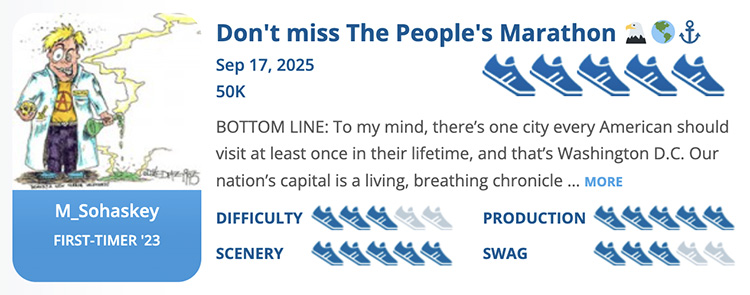
FINAL STATS:
Oct 17, 2021 (start time 8:00 am)
26.42 miles in Atlantic City, New Jersey (state 35 of 50)
Finish time & pace: 3:53:38 (first time running the Atlantic City Marathon), 8:50/mile
Finish place: 394 overall, 49/153 in M(50-59) age group
Number of finishers: 1335 (831 men, 504 women)
Race weather: cool & clear (51°F) at the start, warm & sunny (61°F) at the finish
Elevation change (Garmin Connect): 45 ft gain, 44 ft loss
Elevation min, max: –9.8 ft, 19 ft

Running through the struggle like a golden thread was the indomitable human spirit and a capacity for self-sacrifice and discipline.
– Nelson Mandela

Mike Sohaskey at 2018 Comrades Marathon finish

(Howdy! For those interested in a full treatment of the Comrades Marathon including its many unique and long-standing traditions, I recommend you start with my two-part report from last year’s “up” run HERE. On the other hand, if you’re basically just here for the pictures, carry on…)

“Hello, Moses.”

“I see you, Moses.”

“I am coming, Moses.”

These quiet declarations reached my ears as little more than a mumble emanating from the gaunt runner to my right. Despite my fatigue, I couldn’t help but smile. The two of us strode forward slowly yet inexorably, like iron filings drawn toward the great white magnet looming directly ahead. Every step brought us closer to our ultimate destination and the object of his desire: Moses Mabhida Stadium, its central arch rising in defiance against the afternoon sky.

Despite our conspicuous outer differences — his deep ebony skin and Old World accent vs. my own melanin-challenged physique and New World English — the two of us moved as of one mind and body, eyes locked on our mutual Mecca as we approached the end of this arduous pilgrimage together. Eternal glory and an ice-cold soda beckoned.

At that moment we were kindred spirits, brothers in arms (and legs), intimate associates pulling in the same direction and with the same focused fervor for the same compulsive cause.

Or what Webster’s Dictionary would call comrades.

Mike Sohaskey and Katie Ho at 2018 Comrades Marathon expo


Had it really been a year?

371 days to be exact, since I’d stood in a similar position at the start line of my first Comrades Marathon, sweating incongruously in the cool morning air while the butterflies of the moment treated my stomach like children treat a bounce house.

This was like dĂŠjĂ  vu all over again.

The scene around me now was electric — not surprising at the start line of the world’s oldest and largest ultramarathon. The collective human electricity of nearly 20,000 tightly packed runners intermingled with the harsh electric floodlights, the latter sending the pre-dawn shadows into hiding along the back alleys of downtown Pietermaritzburg.

Directly ahead at one end of the sea of heads stood the brighly lit red arch with “Bonitas” written in script letters on either side of the word “START.” The scene felt very much the same as I remembered it from a year earlier.

And yet different. Durban City Hall, which had towered over these same start corrals one year ago, had been replaced with the equally majestic brick façade of the Pietermaritzburg City Hall. This, of course, is one defining feature of the Comrades Marathon: its course reverses direction in alternating years, so that whereas last year’s “up” ran started in Durban and finished in Pietermaritzburg, this year’s “down” run would travel the opposite route, starting in Pietermaritzburg before finishing 90.184 km (56 miles) away in Durban’s Moses Mabhida Stadium.

Moses Mabhida Stadium in Durban, 2018 Comrades Marathon finish

Moses Mabhida Stadium, Durban

The familiar face alongside me was also a welcome difference from the 2017 run. IRONMAN triathlete power couple Jimmy and his wife Catherine had accepted our invite to join us for this year’s down run, with Jimmy running and Cath joining Katie in providing all-important crew support (or “seconding,” as it’s termed in South Africa). This would be not only Jimmy’s first Comrades but also his first ultramarathon, in recognition of a milestone birthday. What better way to celebrate half a century on this planet than by traveling halfway across it to run 56 miles?

Likewise Beth from Vancouver, whom we’d first met five years earlier when she’d won the half marathon in Antarctica, had decided this year’s down run would be her first Comrades and first ultramarathon in celebration of her own milestone 40th birthday. Because you’re never too old to make questionable decisions!

Beth’s husband Miguel, the only soccer player among us, would be joining Cath and a now-experienced Katie to form the day’s most bad-ass seconding crew. Having the three of them on the course armed with a beautifully detailed map courtesy of 12-time Comrades finisher Rory — another Antarctica pal and our excellent host for Comrades 2017 — gave me a huge sense of confidence. Talk about strength in numbers.

Relaxing at Southern Sun Elangeni leading up to 2018 Comrades Marathon

The days in Durban leading up to Comrades are just packed

Another notable distinction from the 2017 race was my nerves, or more accurately my unnerving lack of nerves. Standing in the monolithic presence of Pietermaritzburg City Hall chatting with Jimmy, I felt none of last year’s anxiety or apprehension. Sure, a lot of unknowns lay ahead on the 90 km journey to Durban, and for that the butterflies in my stomach were up to the challenge. But this time they all seemed to be flying in formation, rather than each doing its separate thing — the moment brought to mind the 80s video game Galaga, with the enemy warships all flying in formation at the start of each new screen, compared to the ensuing swarm of every ship for himself. And as the South African national anthem reached its conclusion, I felt relaxed and strangely at ease.

That said, even the best-behaved butterflies can’t help but be thrown off course by the power and beauty of what comes next: the Ndebele mining song, “Shosholoza.” Rather than observe in awestruck appreciation as other runners around me joined in the performance, though, this year I joined in myself. This despite the fact my voice was little more than a vibration in my head against the sonic wall of vocal harmonies, which resonated deep in my chest like a lion’s roar at close range.

“Shosholoza” segued predictably into “Chariots of Fire” as I made a last-second adjustment to the safety pins holding my bib number. Moments later the last notes of Vangelis’ classic score faded away, and the pregnant pause in its wake sent a few more butterflies fluttering out of formation. Adrenaline flooded my bloodstream.

Then, as loudly as if I’d been carrying a restless rooster in the lightweight pack on my back, the ear-splitting sound of Max Trumbull’s recorded cockerel crow pierced the morning quiet, signaling the start of the 93rd Comrades Marathon just as it has every Comrades Marathon for the past 71 years.

The decisive crack of a gunshot followed and with that, every one of the 19,116 starters assembled outside Pietermaritzburg City Hall — from the eventual champions in Corral A to the final finishers in Corral H — was at the mercy of the ticking clock. Because no matter our corral seeding or how long it would take us to cross under the official red START arch, we would have exactly 12 hours from the moment of that opening gunshot to cross the finish line in Moses Mabhida Stadium some 90 km away. “Gun to gun” (rather than “mat to mat”) timing is one of the signature traditions of the Comrades Marathon.

2018 Comrades Marathon start line selfie of Mike Sohaskey and Jimmy Nam

NO TURNING BACK — except for a start-line selfie

As Jimmy and I joined runners from 79 other nations in the relentless march toward Durban, I reflected on the irony of my being here after last year’s race. Comrades 2017 had left me so emotionally and physically depleted that I’d been unable to get comfortable for hours after crossing the finish line at the Scottsville Racecourse. Even my palate had hurt the next day.

But as every ultrarunner can tell you, miserable is memorable, and it wasn’t long before the siren song of the coveted back-to-back medal (earned by running the up and down runs in consecutive years) had reached my ears in Los Angeles some 10,000 miles away. And as the official Comrades Coach Lindsey Parry had pointed out at the pre-race expo three days earlier, you haven’t really run the Comrades Marathon until you’ve run both the “up” and “down” runs.

In other words, what goes up must come down. And gravity ain’t got nothin’ on Comrades.

90 km to go.

2018 Comrades Marathon start

The calm before Comrades
Jimmy, Cath, Katie and I had arrived in Durban on Wednesday after back-to-back-to-back flights from Los Angeles to London, London to Johannesburg and Joburg to Durban. Based on our positive experience of the previous year, we’d again elected to stay at the Southern Sun Elangeni in coastal Durban near the pre-race expo, rather than save ourselves time on race morning by staying closer to the start line in Pietermaritzburg.

We’d taken advantage of our mid-week arrival to recover from jet lag and tackle the intimidatingly large expo at the Durban Exhibition Centre on Thursday, well before the crush of foot traffic that would descend on Friday and Saturday. (Luckily the registration line for international athletes is typically short on any day, not surprising given that South Africans account for over 90% of registered runners.)

2018 Comrades Marathon expo

After flying 11,000+ miles, you better believe there’s no turning back (Me, Katie, Jimmy, Cath)

All manner of vendors stood alongside their booths hawking various goods and services, from athletic gear and apparel to other South African running events to Cape Town wineries and even an aggressive, aerosol can-wielding team of fellows who seemed hell-bent on shining my New Balance running shoes.

Several local charities had set up tables to raise awareness, and we sought out the Ethembeni School for physically disabled and visually impaired children — the school itself is located near the 37 km mark of the down run — to make a donation. In one corner of the exhibition centre we purchased tickets for the Sunday shuttle to Pietermaritzburg, while in another a convenient food court boasted a diverse selection of lunch fare.

I could only imagine how claustrophobic this hall would feel come Saturday.

[Comrades Tip #1: The earlier you can hit the pre-race expo, the better — things start to get very busy on Friday afternoon.]

Along with the Old Mutual stage where Coach Parry shared his tips and tricks for the down run, the highlight of this year’s expo was the food court, where during lunch we met Benny and his wife Monica, an enthusiastic couple from Johannesburg. With Monica’s support, an infectious smile and an easy laugh, Benny was preparing to run his first Comrades. Nothing unusual about that, except that he’d only run his first mile a year earlier, and so was not only a novice to Comrades but to the sport itself.

Benny was clearly eager to embrace the opportunity and put his best foot forward; at the same time, he harbored no allusions as to the challenge ahead. And though in the end he’d just miss the Pinetown cutoff and be among the 13.8% not to finish this year’s race, he’d message me afterwards to say that he’d had “so much fun” and that he’d start preparing for 2019 just as soon as his “penguin walk” subsided. And I have no doubt he’ll be ready.

Breaking bread with Comrades first-timer Benny (left) and his wife Monica (third from left)

Because that, in a nutshell, is what Comrades does to your brain — like your favorite childhood memory, it takes hold and never lets go. I can’t imagine many Americans following Benny’s ambitious “Couch to Comrades” program. And it’s probably fortuitous that Katie and I don’t live in South Africa, because despite the distance I’d have a helluva time saying “no” to a hometown race like Comrades.

On Thursday evening we’d attended the International Runners Reception at the Hilton Durban, which this year was sparsely attended and featured an obnoxiously loud musical score that quickly drowned out every conversation I tried to start. As usual, the highlight of the reception was 9-time Comrades champ Bruce Fordyce with his waggish energy and bottomless quiver of amusing anecdotes. Everyone appreciates Bruce — he’s a magnetic personality and the best ambassador this race could ever hope for.

As it had last year, our Saturday began with thousands of our fellow Comrades runners at the packed Durban North Beach parkrun, where we’d met up with our buddy John from Anchorage, like me a returning runner chasing his back-to-back medal. Along the 5K route we’d also met “Marathon Granny” Joyce from Kenya, who apparently had taken up running after developing arthritis in her knee and who would be running her first Comrades at age 64. Not only would Joyce start her first Comrades, but she’d finish her first Comrades in an astonishing 10:27:15, easily eclipsing runners half her age to become one of the weekend’s most inspiring stories. Rock on, Joyce!

Durban North Beach parkrun day before 2018 Comrades Marathon

Durban North Beach parkrun (clockwise from top left): Shaking out our selfie muscles with John from Anchorage, center; Cath turns parkrun into a full-body workout; catching up with Marathon Granny Joyce from Kenya; Cath and Katie do their best human butterfly impression

The rest of our Saturday had been overly restful, so that after a solid five hours of sleep I’d awoken on Sunday morning feeling well rested and ready to go, with the voice of experience in my head calming any potentially skittish butterflies in my stomach. After all, as noted American poet Peyton Manning once said, “Pressure is something you feel when you don’t know what the hell you’re doing.” With one Comrades finish under my belt, I liked to think I knew what the hell I was doing.

After a semi-normal breakfast (as normal as 2:00am breakfast can be), Jimmy, Beth and I hopped aboard the 2:45am shuttle bus for the long and (luckily) uneventful ride to the start of our personal journey in Pietermaritzburg.

2018 Comrades Marathon profile map

Asijiki: No Turning Back (Pietermaritzburg to Little Pollys)
Now, with confetti falling all around us, Jimmy and I crossed the start line two minutes and 30 seconds after the gun, 30 seconds slower than last year. As the sea of official red-and-white race caps disappeared into the darkness ahead of us, I fell into a comfortable jog alongside Jimmy, gauging the weight distribution of the lightweight Ultimate Direction pack on my back that held my limited assortment of baby food pouches and GU packets. Learning my lesson from last year’s race, I’d left the hydration bladder at home.

[Comrades Tip #2: Resist the urge to carry a hydration bladder — there’s plenty of water, Energade etc. along the course. If you must carry a pack, limit its contents to solid nutrition.]

Our game plan was simple: start strong to give ourselves a realistic shot at a 9-hour finish (Bill Rowan medal) and then adapt on the fly. Though I knew Jimmy’s competitive streak would drive him to push for 9 hours, I also knew I hadn’t trained to run a sub-9 finish time myself. After a high-mileage training program that enabled my come-from-behind run for charity at January’s Houston Marathon, I’d barely squeezed in a Corral C qualifying time at my hometown Los Angeles Marathon in March, registering at the last minute before beating the cutoff by a whopping 11 seconds. So I didn’t exactly arrive in Durban Bill Rowan-ready.

Even if I had trained properly, pausing along the route to take pictures would easily add 10-15 minutes to my finish time. If everything went according to plan, I saw 9:30 as a more likely scenario, with my primary goal being sub-10 hours as in 2017.

2017-2018 Comrades Marathon course signs

Not only had I not trained for a sub-9, but downhill running isn’t my strength — I’m much more consistent on the uphills. Whereas many runners naturally post faster times on the down run (with its 6,000+ feet of elevation loss vs. 4,000+ feet of elevation gain), I’d diligently trained my quads to survive and hopefully thrive on the extended descents between Pietermaritzburg and Durban. To my usual training regimen I’d added twice-a-week lunges and eccentric quad strengthening, the latter on the recommendation of Rory who’s completed the down run six times. I’d even run the REVEL Mt Charleston Marathon in late April, a doozy of a test run boasting a net elevation loss of 5,300 feet over 26.2 miles.

So my quads were as ready as they’d ever be to tackle the challenge of the Comrades down run.

Luckily we’d have the ultimate wild card on our side this year — the South African winter. Unlike the previous year’s unseasonal heat and unrelenting sunshine, this year’s temperatures were expected to peak in the mid-70s with regular cloud cover to keep the sun at bay. Given that my spring training regimen had included spending 20-30 minutes a day six days a week in a 180°F sauna to build my heat tolerance, this was welcome news. And it would help to make up for the fact that the 2018 course would be the longest in 23 years.

At 90.184 km, this year’s down run would be the longest Comrades course since 1995 and nearly 3½ km longer than last year’s up run, which measured 86.73. Assuming I matched last year’s average pace of 10:53/mile, the extra distance would add over 23 minutes to my projected finish time. So never mind sub-9 hours — I’d have my work cut out for me if I hoped to improve on last year’s finish time of 9:52:55.

Mike Sohaskey and Jimmy Nam at Comrades Wall of Honour

Paying homage to Rory’s Green Number plaque on the Comrades Wall of Honour

Like a gracious host reminding us that this was indeed the down run, the narrow road leading out of Pietermaritzburg started on a gentle descent. As my nerves fired and my pulse rate quickened, I did a full-system check to ensure all systems were go. My gut had dodged a bullet thirty minutes earlier after each and every porta-potty outside the start corrals had inexplicably run out of toilet paper, with no one to refill them. Talk about a helpless feeling, and only a bit of last-minute ingenuity had saved the day…

[Comrades Tip #3: That gauzy Bonitas hospital gown included in your pre-race goodie bag for warmth on race morning? It can also be torn into convenient strips for use as toilet paper.]

Jimmy and I cruised through the darkness of Pietermaritzburg and into Ashburton, the early route narrower and more tightly packed than it had been on last year’s up run, when we’d exited Durban via the well-lit N3 highway. In the pitch black I fell into a rhythm, quieted my mind and focused my mental energy on avoiding potholes as well as other runners carelessly drifting across invisible lanes of traffic.

On that note, I found myself frustrated by the sheer number of runners who seemed either unable or unwilling to run a straight line. And I know I wasted a nontrivial amount of energy pumping the brakes as restless runners insisted on weaving in front of me.

Though Jimmy and I would run together in the early going, each of us had every intention of running our own race. Because despite the fact that you’re surrounded by thousands of other runners and countless screaming spectators throughout the day, Comrades — more so than any other race I’ve run — is a very personal affair. It’s called the Ultimate Human Race for a reason: Comrades is 90 km of you vs. you, and for most of us that’s plenty of competition.

After wearing RaceRaves gear in my Comrades debut, I’d decided to go the patriotic route this year with USA flag shorts, Statue of Liberty calf compression sleeves, an American flag behind my bib number on front and back, plus stars & stripes sunglasses I’d bought for $1 at Target to round out my wardrobe. Bruce Fordyce had recommended wearing our national colors the year before — “I can’t understand why someone travels all this way to run Comrades, and then runs in a San Diego Marathon shirt” — and I’d witnessed first-hand the raucous reception other runners had received for proudly sporting their national colors.

As I’d soon discover the red, white and blue elicits a curious mix of reactions, and especially among 80 nations in which Americans account for less than 1% of the field. Sadly I missed this exchange, but according to Jimmy a woman behind us in the early miles saw my shorts and yelled, “Go America!” to which a salty Brit behind us responded with, “Said no one evah!” In response to Jimmy’s sideways glance he added sheepishly, “Sorry, don’t hate me.”

Comrades is the perfect opportunity to showcase your patriotism

Daybreak’s pale, pink-tinged lips kissed the sky as we reached Polly Shortts — the last of the “Big Five” hills on the up run — at the 82 km mark. As the pace accelerated on the mile-long descent, I paused for important business by the side of the road while Jimmy shot ahead. Though he quickly vanished out of sight, I reeled him in on the next short climb before the pace again increased down Little Polly’s.

It was on Polly Shortts and her sister Little Polly’s (Little Mpusheni) that I realized Jimmy and I were running different races. While he attacked the downhills with gravity as his muse, I worked to keep my pace in check without riding the brakes. Because starting too fast is the #1 cardinal sin of Comrades, and I hadn’t come all this way just to shred my quads before sunrise.

77 km to go.

2018 Comrades Marathon at Camperdown

Little Pollys to Harrison Flats
After Little Pollys, we switched gears once again for our longest extended climb of the day up to Umlaas Road. Along the way we passed under the N3 to reach the first of six cutoff points at Lion Park (~75 km to go). Unsure of the best way to mentally divvy up 90 km, I’d decided the six time cutoff stations would be my best landmarks, as they stand 10-15 km apart.

Despite its significance as the highest point on the course (2,700 feet), Umlaas is nondescript and easily missed during the race — and especially on the down run, where it arrives so early. Except that this year, rounding a corner I happened to glance Rory’s tall distinctive frame among the spectators lining the road.

Unfortunately by the time my brain processed the moment I’d passed Rory by, and so not wanting to slam on the brakes and risk causing an accident, I turned quickly, yelled his name and threw up my hand in greeting as I continued on my way. I saw him respond to his name, but whether he’d recognized my voice or seen me in the crowd, I had no idea.

2018 Comrades Marathon on way to Camperdown

Savoring sunrise on the way to Camperdown

One advantage of the down run is the opportunity to cover the relatively quiet, wide-open stretch through Camperdown and Cato Ridge early in the day, before the sun is high in the sky. I could still recall how interminable these long, desolate and unshaded miles had felt during last year’s up run, with Inchanga in our rear-view mirror and Polly Shortts yet to come.

A pungent odor hit my nostrils, more like rotting animal carcass than the familiar Camperdown chicken farm smell I remembered from the year before. Luckily it passed as quickly as it had appeared. No harm, no fowl.

I texted Katie to let her know we were 2 km away from where she, Cath and Miguel would be waiting. I’d missed her and Rory at our first meeting place last year, and I didn’t want to make the same mistake again. We’d also made the sage decision this year to invest in a South Africa SIM card for our iPhones upon landing at the Johannesburg airport, so we’d be able to text freely throughout the trip.

We reached our terrific trio at the 66 km mark with Jimmy about a minute ahead. He passed the trio quickly without stopping while I paused for a couple bites of a peanut butter & jelly sandwich to supplement the baby food pouch I’d downed earlier. And I laughed as Cath, responding I think to Jimmy’s own sense of focus, urged me to get going while I took a minute to stretch my legs and pose for a picture with Katie.

Even the best seconding crew in South Africa’s gotta eat!

Seconding is a key part of the Comrades experience for both runners and crew; I appreciated their being there, and the excitement on their faces was a definite pick-me-up. I also knew that one or two minutes per pit stop wouldn’t make an appreciable difference in my final time. My nonchalance was fueled by my desire to enjoy race day to the utmost, but also by what I consider to be the most glaring oversight on the part of the Comrades Marathon Association. Let me explain…

One of the distinguishing characteristics of Comrades is its distinctive finisher medals, awarded on the basis of finish time as follows:

  • Gold: Top 10
  • Wally Hayward (named for the 5-time Comrades Marathon champion and oldest runner to finish the race): Out of the top 10 but less than 6 hours
  • Silver: Greater than 6 hours but less than 7½ hours
  • Bill Rowan (named for the first Comrades Marathon winner in 1921): Greater than 7½ hours but less than 9 hours
  • Bronze: Greater than 9 hours but less than 11 hours
  • Vic Clapham (named for the Comrades Marathon founder): Greater than 11 hours but less than 12 hours:

What jumps out at me from these numbers is the sizable two-hour gap between the first and last Bronze medalists. In this year’s race, bronze medalists accounted for 39% of finishers, compared to 31% for Vic Clapham and 13% for Bill Rowan. To my mind, the difference in performance between a runner who finishes Comrades in 9:01 and one who crosses the finish line in 10:59 is significant enough to merit distinct medals.

So then why not introduce a new medal, say the Bruce Fordyce medal, for runners who finish between 9 and 10 hours? Named after the race’s 9-time champion and its premier ambassador, the promise of a Bruce Fordyce medal would immediately inspire many runners who are on the cusp of 10 hours to train harder and run a smarter, more focused race. At the same time, it would set an exciting new standard for sub-10 runners like me — who currently know a Bronze medal awaits us whether we finish in 9:45 or 10:15 — and encourage us to treat the race with less nonchalance, knowing a sub-10 finish means the difference between a Bruce Fordyce medal and a Bronze.

So how ‘bout it, CMA?

The aid stations were as efficient and energetic as I remembered, though thanks to the cooler temperatures I didn’t need to visit quite as many this year. But despite the availability of trash bins, the streets around each aid station were littered with discarded water and Energade sachets, some still partially filled so that they emitted a last-gasp {POP} when stepped on.

[Comrades Tip #4: Unless you’re in the lead pack, toss your used cups and sachets off to one side of the road, near a trash bin. If you don’t like tramping over discarded trash and half-filled water balloons, why should the runners behind you?]

The 12-hour “bus” (pacing group) rolls through Camperdown

During the course of running 90 km you’re bound to experience at least one aid station snafu, and my most memorable came courtesy of a harmless-looking orange slice which I gratefully accepted from a proferred plate. Biting down to release the sweet juice, I was instead greeted by an unwelcome saltiness that nearly caused me to gag. Instinctively I spit out the foul fruit, my taste buds scrambling to reconcile the sensation of salty where there should only have been sweet.

Unfortunately by this time I’d already passed the aid station, and so it would be another km before I could wash the salty aftertaste {blech} from my mouth. Later in the race I’d grab another orange, but not without first interrogating the poor volunteer as to the flavor profile of his fruit. To his credit my ramblings didn’t faze him, and I thanked him as I jammed the sugary slice in my mouth.

Given my newfound suspicion of something as familiar as oranges, you can bet that I politely declined the offer of mageu, a milky drink made from fermented mealie pap and offered at aid stations in plastic yellow bags.

An aid station volunteer offers water sachets to thirsty runners

My stars & stripes running kit was a great conversation starter, with both international runners and fellow Americans curious to know where in the U.S. I was from and eager to share their own home country or state. And my kit complemented the race’s own strategy to distinguish South African and international runners — its colorful bib numbers.

True to the camaraderie of the event, the Comrades bib numbers communicate a wealth of information at a glance. I enjoyed congratulating other back-to-back runners, first-time international runners (as indicated by the “0” under “Medals” on their blue bib numbers) and especially Green Number hopefuls, whose yellow bib numbers distinguish them as 9-time finishers in pursuit of that coveted 10th finish. For the recreational runner, few achievements rival that of earning a Comrades Green Number, and the Green Number Club currently boasts 13,000+ members from the race’s 93 years.

Passing the second cutoff point at Cato Ridge (~60 km to go) brought us to the ironically named Harrison Flats. Luckily its rolling roads struck me as less challenging from this direction with their net downhill profile, and so I was able to make up time as the Old Main Road led us down into the belly of the waiting beast, my old buddy Inchanga.

56 km to go.

Harrison Flats to Drummond (Inchanga)
Though my energy levels remained high, all the climbing and descending was starting to wear on my legs as we made our way up the backside of Inchanga. And speaking of backsides, I can now appreciate that even though the Big Five — Polly Shortts, Inchanga, Botha’s Hill, Fields Hill and Cowies Hill — are notorious landmarks on the up run, they’re just as much a pain in the ass on the down run. Because it’s not like they suddenly flatten out in the opposite direction.

Climbing up the back of Inchanga we reached my favorite section of the course, the Ethembeni School for physically disabled and visually impaired children. At the same time emotionally disturbing and hugely uplifting, no memory of Comrades race day stands out like seeing the troubled children of Ethembeni, many with unfocused or faraway looks in their eyes, lined up with hands outstretched in the hopes of securing a high-five from passing runners.

Still wearing the beaded bracelet I’d received last year from the school’s headmaster, I smiled and high-fived every tiny hand available to me, in the hopes that feeling my encouraging slap on their palm might lift their spirits and, for even a brief moment, bring a smile to their face or heart.

Turning down the backside of Inchanga at the 2018 Comrades Marathon

Turning down the backside of Inchanga

Our brief visit to the Ethembeni School, coupled with the view from the top of Inchanga as runners below us descended the beast like two-legged ants, was well worth the struggle. Particularly since that struggle hadn’t been waged under direct midday sunlight.

Then down, down gravity carried us once again as I lay off the brakes and opened the throttle, taking the opportunity to catch my breath before the course briefly leveled out at its ceremonial midway point (cutoff mat #3) in Drummond. There the folks from Hollywoodbets greeted us alongside their familiar purple-and-yellow inflatable arch with music blasting and spectators screaming, as though we were celebrities, rock stars and supermodels. And while “loud” typically isn’t my scene, I tried to appreciate the raw energy of the moment before we’d immediately shift gears and start climbing again.

Because in case you hadn’t noticed, much like labeling Earth as “blue,” the terms “up run” and “down run” can be pretty misleading.

46 km to go.

Comrades Marathon halfway point: Drummond

Drummond to Winston Park (Botha’s Hill)
Unlike the up run where the second half begins with the nasty climb up Inchanga, this year we had something to look forward to on the climb out of Drummond and the Valley of 1,000 Hills.

First I paid a brief visit (along with a steady stream of fellow runners) to Arthur’s Seat, a shallow alcove carved out of the rock embankment on the south side of the road where 5-time Comrades champ Arthur Newton reportedly used to rest during his training runs. Legend has it that those who greet Arthur and leave him flowers during the race will enjoy a strong second half. And though my greeting had apparently fallen on deaf ears the year before, there was no use tempting fate by being an ugly American.

“Good morning, Arthur,” I said, leaning in and tapping the rock face gently as if to awaken its sleeping denizen. Who am I to flaunt tradition?

Arthur's Seat at 2018 Comrades Marathon

Just beyond Arthur’s Seat on the north side of the road stands the Comrades Wall of Honour, with its collection of plaques set in individual stones and labeled with the names and bib numbers of previous Comrades finishers — yellow plaques signify those with fewer than 10 finishes, whereas green plaques recognize members of the Green Number Club with 10 or more finishes. Amazingly, anyone with an official Comrades finish can buy their own plaque to be displayed on the Wall. Can you imagine the folks at the Boston Athletic Association doing something similar for Boston Marathon finishers? Talk about great fundraising for the B.A.A.

Rounding the corner from the Wall of Honour I spied Katie, Cath and Miguel waving to get my attention. Pulling alongside them, I was psyched to see that Rory and his brother Kirby had joined them. Rory apparently had recognized me at Umlaas and had texted Katie to coordinate their positions. They all looked to be thoroughly enjoying themselves. Katie informed me that Jimmy was about five minutes ahead and that they’d been able to see Beth in Camperdown. Good news all around.

Seeing the five of them was a solid pick-me-up, as was the Tailwind mix I sipped while catching my breath and stretching my legs. I could feel my quads growing heavy from all the hill work, and worried that they’d only continue to tighten as the miles mounted. Luckily the course would be largely downhill from here (= “down” run). So I did what I could to quickly loosen my weary legs before pulling back into traffic and continuing on toward Durban.

Miguel and Beth celebrate her farthest run ever in Drummond — only a marathon+ to go!

Looking around at the caravan of runners, I reflected on the fact that as a woman Beth was definitely in the minority here. Female runners made up less than Âź (23%) of Comrades registrants and only 31% of international runners this year, consistent with the disproportionately lower number of female participants in ultramarathons around the world. This despite the fact that in the United States, women runners now outnumber their male counterparts. Attracting female runners should clearly be a priority for the Comrades Marathon and ultrarunning in general.

On the up run, Botha’s Hill is the third of the Big Five. On the down run, as Lindsey Parry had noted in his pre-race briefing, Botha’s is in fact three separate hills. And while none of the three is particularly steep, the road just seemed to roll ever upwards toward the sky, a physically and psychologically exhausting reality that turns many runners into walkers.

At last we crested Botha’s Hill and reached Kearsney College, where the students had apparently returned home early from a rugby tournament so as not to miss Comrades Day. Some boys lined the road while others sat in bleachers off to one side, each sporting his distinctive blue blazer with its “CARPE DIEM” crest on the lapel.

Top of Botha's Hill during 2018 Comrades Marathon down run

Welcome to Kearsney College and the top of Botha’s Hill

Lindsey Parry’s advice on the down run is to run conservatively until you reach the top of Botha’s Hill, just past the 50-km mark. Then, if you’ve played it smart and still have your legs under you, you’ll be able to pick up the pace in the final 40 km. Luckily my legs felt no heavier than they had during my pit stop in Drummond.

On the other hand, my body was once again rejecting the notion of solid (or even gelatinous) food, and so I knew the next 40 km would be challenging from a nutritional standpoint.

Reaching the bottom of Botha’s Hill, a nasty 1 km uphill jag welcomed us to the town of Hillcrest, one of the most raucous sections of the course. There, supercharged spectators lined the road, whooping and cheering their support for the runners. Many of them focused specifically on my stars & stripes with cries of “Go USA!” and “U-S-A! U-S-A!” I pumped my fist lightly in appreciation, not wanting to sacrifice too much adrenaline to the cause of patriotism.

Mike Sohaskey on Botha's Hill at 2018 Comrades Marathon down run

If you were to close your eyes (though hopefully not while running) and judge solely by the music along the course, you could be forgiven for thinking Comrades was a US race. I heard plenty of American favorites including the theme song from Rocky and (twice) Journey’s “Don’t Stop Believin’ “. Unfortunately I wasn’t fast enough like Jimmy to catch “Sweet Caroline.”

Aid station volunteers were pouring salt into runners’ hands; I recoiled like a red, white and blue slug. Was it really that hot? If so, I definitely wasn’t feeling it. Though the sun was approaching its zenith, extensive cloud cover ensured its influence would be minimal.

With 32 km to go, a quick left-then-right turn on Old Main Road brought us to the fourth cutoff mat at Winston Park. Here in the vicinity of Winston Park, I heard an announcement that the second female had entered the stadium in Durban. As much as hearing this underscored the freakish disparity between our respective athletic abilities, it also heartened me to realize I was far enough along that other runners were already finishing the race.

Have I mentioned how important a positive mindset is to success at Comrades?

30 km to go.

Mike Sohaskey crossing 4th cutoff in Winston Park at 2018 Comrades Marathon down run

Crossing the 4th cutoff mat in Winston Park

Kloof to Pinetown (Fields Hill)
Raise the roof, I’ve made it to Kloof, I thought with a wry smile. The thought lifted my spirits, since Kloof would be my third and final meeting place with the terrific trio of Katie, Cath and Miguel.

“We’re on the right, past the Coca-Cola hoopla at ~26km to go!” Katie had texted moments earlier, and now rounding the corner on the downhill I saw the Coca-Cola aid station just past the red Bonitas sign with its countdown thermometer indicating 28 km to go. I was a bit confused until, passing the aid station, I saw the three of them waiting just beyond.

Katie estimated Jimmy’s lead at 8–10 minutes, and I was psyched to hear he was still running well. So too was Beth, who I was told had looked strong in Drummond.

Jimmy makes one last stop to refuel in Kloof

For my part, I was thrilled to discover my legs felt no worse for wear now than they had at the midway point. Sure, the final 28 km wouldn’t be pretty, but just how un-pretty would depend more on the state of my stomach than the life in my legs. The good news was that I no longer had any need for my lightweight pack, since it wasn’t like my stomach would suddenly start accepting solid food again. So I dropped it with Katie, high-fived each of them to get my blood pumping and reluctantly bid them goodbye for the last time, promising with one last deep breath that I’d meet them at Moses.

Much like last year I know Fields Hills was long; I just couldn’t tell you how long. I do know it ended in Pinetown, an ending that couldn’t come soon enough. Because while the fourth member of the Big Five is definitely long and steep, it’s neither of these endearing qualities that makes Fields Hill public enemy #1 on the down run. That distinction belongs to its awful camber, which punishes the legs like nothing else on the Comrades course. I could easily see how runners might succumb to the siren song of Fields and fly down its steep slope, only to blow out their quads before Pinetown. And while Pinetown features plenty of car dealers and auto body shops, I didn’t notice any businesses touting “quad and calf repair while u wait.”

So I was relieved to reach the fifth cutoff point in Pinetown with my quads intact, and I’m confident my strength training (plus the REVEL Mt Charleston Marathon as a downhill training run) made all the difference.

Conferring with Rory in Drummond

But though my quads remained intact, I can’t say the same for my stomach — because I still haven’t trained it to eat at the speed of Comrades. Thanks to the cooler weather I was able to snack more this year than last year, nibbling on a banana here and an (unsalted) orange there, along with two of my baby food pouches (200 calories, par-TAY!). Eventually, though, as has become its modus operandi, my stomach rebelled at any hint of solid food, so instead I resorted to the occasional sip of Coke or Energade to satisfy my body’s caloric cravings.

Turns out the problem with this strategy was the disconnect between mind and body — whereas my mind told me I needed the sugar/calories, as soon as I’d take another sip of Coke or Energade I’d feel the uncomfortable sloshing in my stomach. I ran ~15K from Kloof to Pinetown to Westville feeling like a human water balloon, even stopping once to answer nature’s call at a Pinetown porta-potty.

Finally, in the midst of my rising frustration it occurred to me to just ignore my mind and let my body use its fat stores as fuel, as I had for so many of my training runs. And though this certainly didn’t have the same magical effect as Popeye’s spinach, at least I was able to ease the bloating and get back to running (semi-) comfortably the rest of the way.

Again, it’s called the Ultimate Human Race for a reason: you have to be ready, willing and able to adapt, mentally and physically, to any challenge and any situation.

Mike Sohaskey and Jimmy Nam at Arthur's Seat

Pinetown was off the chain, much more so (understandably) than during last year’s up run when we’d arrived early in the day at around the half marathon mark. Now, loud and high-spirited crowds several deep lined the road, which narrowed at one point to almost single file as spectators pressed in from both directions. Boisterous chants of “U-S-A! U-S-A!” filled my ears, and I seemed to be running with my hand in a perpetual “thumbs-up” position.

Pinetown was amazing.

One of the human highlights of Comrades is the volunteers — like the race itself, they’re in a class by themselves. They do a remarkable job maintaining their focus as sweaty glassy-eyed runner after sweaty glassy-eyed runner shuffles toward them, eagerly snatching two water sachets at a time from their outstretched hand and often dropping one in the process. So the undisputed lowlight of the day was seeing one runner in Pinetown pause to reprimand a volunteer who apparently hadn’t lived up to his lofty expectations. “Pay attention!” the runner barked at the volunteer, who I didn’t see.

If you have enough energy to be dressing down volunteers this late in the race, I thought, you should be running harder.

Leaving Pinetown, a mild-mannered older woman saw my shorts and replied, “Oh, America… so sorry about Trump, eh?” I smiled wryly and thanked her for her sympathy, waving over my shoulder as I passed. I was admittedly curious to see what reactions my USA running kit would evoke, and hers was the overwhelming sentiment within South Africa, from runners and spectators on the course to our safari ranger several days later who matter-of-factly referred to our 45th President as “a retard, eh?”

20 km to go.

Mike Sohaskey running 2018 Comrades Marathon down run

Based on the crowds around me, I must have been leading the race at this point

Pinetown to Mayville (Cowies Hill)
With nearly 72 km (45 miles) in my legs, the last of the Big Five loomed large. On the up run, Cowies Hill makes an early appearance as a key part of the long, steady climb toward Drummond. On the down run, though, it includes a nasty ½ mile ascent that reduced me unashamedly to a walk and earned me with a 12:25 mile, my slowest moving mile of the day. Luckily the payoff for reaching the top of Cowies was a smooth downhill run into Westville.

[Comrades Tip #5: Uphill, downhill, it doesn’t matter — smile for the photographers when you see them. One moment of faux happiness is worth a lifetime of memories. And at very reasonable prices relative to other large races (I paid ~$33 USD for the entire digital package), you’ll likely want to purchase your race day photos.]

Descending toward Westville I thought Ah, so this is why it’s called the down run. Seeing the urban landscape of Durban laid out below me, I let myself relax as waves of suppressed fatigue washed over me. Having been on my feet for over eight hours, I let my mind wander as we cruised along King Cetshwayo Hwy, the encouraging shouts of the spectators now sounding muffled and distant as I retreated into my own head.

Last year the 10-hour “bus” (Comrades-speak for a pacing group) had caught me as we approached Little Polly’s with 10 km to go. I was determined that wouldn’t happen this time as I kept pushing forward whenever possible. At the same time, I still recalled the punishing latter stages of last year’s up run and had no desire to relive that misery. Because the thought suddenly struck me like a bolt of lightning on a clear day — this may be the last time I ever run Comrades.

With that sobering thought in mind, I allowed myself to look up, look around and use my walk breaks to soak it all in. I basked appreciatively in the adulation of the endless throngs with their tireless cheers, their uplifting chants of “U-S-A! U-S-A!” and their altruistic offers of whatever we needed to help us get to Durban.

Yes, I wanted to run my best possible Comrades — but not at the expense of hating the final 20 km.

My reverie was shattered by a fellow runner dressed in African tribal gear who insisted on blowing his referee’s whistle as loudly and as frequently as possible. And while I appreciated both his enthusiasm and his outfit (and especially his ability to run 90 km in such an impressive headdress), at that moment I wanted to be anywhere else but running next to him and his freaking whistle. So whenever he’d pull alongside me with several shrill blasts to announce his whereabouts, I’d quickly speed up just enough to propel myself out of his direct earshot.

I’m sure the spectators appreciated his shrill whistle

In my bid to conserve energy, I wasn’t happy at being forced to accelerate in short, sporadic bursts. It felt like a bad dream where I’m trapped in drill team practice and can’t escape. And I wondered irately, Why blast a f@*#king whistle in your fellow runners’ ears for 10 hours?

Luckily I soon pulled far enough ahead to escape his one-note recital. The silver lining? His shrill blasts helped me stay sharp and maintain focus as we descended into Westville. After all, this stretch along King Cetshwayo Hwy is a quieter section of the course where, with Cowies behind and Durban ahead, it’s easy to lose your mental edge momentarily and feel fatigue setting in.

In the final ten miles or so as we neared Durban, every uphill seemed to require at least a short stint of walking, usually just long enough to take a few deep breaths and pull myself together. And though my legs were always reluctant to start running again after these slowdowns, once I did I found myself able not only to run but to run well, making solid progress and passing other runners. So I was definitely using the walk breaks to my advantage.

In Mayville we crossed the sixth and final cutoff mat, the last major milestone en route to finish line glory.

9 km to go.

The crowds thinned a bit between Cowies Hill and Westville — it is a highway, after all

Mayville to Moses Mabhida Stadium (finish)
One of the most memorable climbs of a long and memorable down run was also one of its shortest — the on-ramp from the M13 to the N3 at around the 83 km mark. After a sharp left turn, this steep uphill jag greeted us with a rise of 50 ft in just over 1/10 mile.

As I power-hiked upward to begin my final approach to Durban, a South African runner congratulated me on having my back-to-back medal “in the bag” — which at that moment sounded brilliant. I thanked him, and seeing my shorts his friend added that “Trump would be proud of you.” “Don’t think you want to go there,” the first fellow responded, and I agreed with a nod that our President’s approval was the furthest thing from my mind. Didn’t these two realize that exercise only depletes the body’s finite amount of energy?

[Comrades Tip #6: For all things coaching, Lindsey Parry is the definitive voice of the Comrades Marathon. That said, I’d respectfully disagree with his claim that the N3 on-ramp in Mayville is the last real uphill on the down run. With 84+ km in my heart and legs, the subsequent climb up to Tollgate and the N3 off-ramp into Durban both took the wind out of my sails.]

While it’s easy to predict the beating your legs will suffer over the course of 90 km, what may be less obvious is the steady pounding absorbed by the core muscles of your stomach and lower back. As we crested Tollgate my core muscles grew increasingly weary, and I did some quick high knee lifts in the hopes of granting them a momentary reprieve.

As it turns out, it’s tough to do much of anything without full cooperation from your back and stomach.

On the other side of the highway, drivers heading in the opposite direction honked (or hooted, as the South Africans say), and passengers hollered their support from passing cars. Which reiterated the insane fact that on this day we silly, selfish runners pursuing our silly, selfish hobby were the proud focus of a nation 56 million strong. And that humbling reminder immediately put a pep in my step.

Setting sights on Durban during 2018 Comrades Marathon down run

Hello Durban!

With around 7 km to go the concrete, steel and glass skyline of urban Durban came into view at last. The moment was empowering, to be running on a national highway lined with cheering supporters as the sprawling skyline of South Africa’s third largest city — and our final destination — beckoned in the distance. Welcome, the soaring gray skyscrapers seemed to say. We’ve been expecting you.

Pulling out my iPhone for a picture, I happened to glance down at the time: 2:35pm. Which meant I had roughly 54 minutes to cover 7 km and still finish in less than ten hours, a much slower pace than I’d been running to that point. And I’ll be honest — after seeing the time and doing the math, it became increasingly difficult to push myself any harder. As long as I broke ten hours, what was the difference between finishing in 9:54 (last year’s finish time) vs. 9:44? Aside from my overall place in the final results, to my mind there was no meaningful difference.

Moments like this emphasize the importance of a well-defined goal to help maintain focus; without one, a race like Comrades becomes even more challenging than its 90 km distance.

Though barely a blip on my final Garmin tracing, the last uphill of the day would be the N3 offramp that would drop us down onto the city streets of Durban for the final 5 km. Though not a formidable climb at any other time, glancing up now I felt almost dizzy following the sweeping arc of the overpass as it curved upward and away toward Moses Mabhida Stadium. And so, with heavy legs and a light head, I walked.

From there the course did something it hadn’t done in the first 85 km — it leveled out.

Scenes from Durban before 2018 Comrades Marathon

Scenes from Durban (clockwise from top left): “Mzansi” is the Xhosa word for South Africa; Indian Ocean’s-eye view of the beachfront; with an expected R355 million (~$24 million USD) impact on Durban’s economy, Comrades is all around you; street market spices — the city is home to the world’s largest Indian population outside India

We’d been told so many times leading up to race day that the new course would pass by the old finish venue at Kingsmead Stadium, that by the time we finally passed the unassuming cricket facility with 3 km to go, I felt as though I’d been here before. But even with 87 km in my legs, I was more than happy to bypass Kingsmead in favor of shiny new Moses Mabhida Stadium, which as we rounded the bend just past Kingsmead came into full and glorious view.

From there, the final “Toyota Mile” was a straight shot past the cheering masses lining Masabalala Yengwa Ave, as though Moses (Mabhida) himself were parting the sea of spectators ahead of us.

“Hello, Moses.”

“I see you, Moses.”

“I am coming, Moses.”

I glanced over at the gaunt fellow mouthing these words to my right and smiled weakly as the object of his desire rose up to greet us. The screaming onlookers faded into the background as I focused on the stadium’s distinctive ladder-like arch, reminiscent of a DNA double helix. Meanwhile, the asphalt beneath my feet rolled by like an urban treadmill. One step at a time. Step, stride, repeat. Feel free to breathe.

Absurd as it may sound, even better for me than seeing the finish line at Comrades is seeing the big red Bonitas sign announcing 1 km to go. Because that’s when I know the official victory lap begins. Being nearly 11,000 miles from home, soaking in that last ½ mile while basking simultaneously in the exhaustion and glory of the moment is like no other feeling I’ve experienced as a runner. And that includes right on Hereford, left on Boylston.

The understatement of the year — on Africa or any other continent — goes to the official-looking banner hung the full width of a pedestrian bridge just outside the stadium that read earnestly, “THERE IS NO TURNING BACK NOW!”

89km mark of the 2018 Comrades Marathon down run

Nothing like a bit of last-minute motivation at 89 km

Then we’d arrived, and with a left turn we entered the stadium through a dark tunnel, emerging onto the bright green grass of the playing field. Ironically, after running under open sky for nearly ten hours, I suddenly felt very small under the venue’s massive open-air roof surrounded by 56,000 seats. Originally built to host the World Cup in 2010, Moses Mabhida Stadium is a breathtaking venue in which to complete your Comrades journey.

I’ve heard other runners, in the full throes of cliché, say there are no words to describe the finish of the Comrades Marathon. I disagree. There are plenty of words, with “freaking awesome” being the first that come to mind. The last stretch from entrance tunnel to finish line is a moment of sheer exultation that I wish I could have bottled to relive and share with others for the rest of my life. And when I die, the bottle could live on, inspiring other runners in its new home at the Comrades Museum in Pietermaritzburg.

The familiar green-and-white finish line topped with its double balloon arch welcomed us in full view — unlike last year’s winding finish inside the Scottsville Racecourse, there would be no game of “Find the finish line.” I savored those final 100m to the fullest, scanning the stands quickly for familiar faces before raising my arms in triumph and completing my back-to-back quest in an official time of 9:48:25.

U-S-A! U-S-A! U-S-A! U-S-A!

0 km to go. AND… breathe.

Mike Sohaskey crossing finish line of 2018 Comrades Marathon down run

Holy Moses!
Wobbling to a stop after my longest run ever, the first booming voice I recognized was Rory’s, and I glanced up into the stands to see him clapping excitedly in my direction. I was psyched to see him, and I can’t tell you how much it means to receive personal congrats from a fellow who finished this race 12 times, who earned a Green Number and to whom this event means so much.

Shuffling through the finish chute, I gratefully accepted my second consecutive bronze medal and Comrades patch, though sadly a yellow rose was excluded from this year’s awards. Hopefully Katie would understand when I showed up empty-handed.

Looking up at the steps that led from the field to the International Runners seating area, the grim reality of Moses Mabhida Stadium reared its ugly head. Because after covering 90 km in less than 12 hours, there’s nothing a runner wants less than to climb or (worse) descend stairs, and especially a stadium full of them. On the bright side, thanks to the mild weather I was in better post-race shape than last year when I’d been unable to move, much less negotiate stairs.

Jimmy Nam in homestretch of 2018 Comrades Marathon finish

Jimmy’s day-glo calves put the finishing touches on their first ultramarathon

One slow and unsteady step at a time, I ascended the concrete stairs in search of the others. I saw Jimmy seated in a section by himself and waved — he’d run a brilliant race in his first Comrades, finishing in 9:25:23. From my vantage point, he looked comfortable and none the worse for wear.

For my part, I’d run 4½ minutes faster than last year, despite this year’s course being 3½ km longer. The mild weather had a lot to do with that, as did a familiarity and comfort with the event itself. And even with all else being equal, most folks clock faster finish times on the down run.

Reaching the top of the stairs and the inner concourse, I bumped into John from Anchorage who had finished just one minute and 52 seconds ahead of me to earn a second consecutive bronze of his own. Tiredly we congratulated each other and agreed that yes, two in a row was just about enough Comrades for a while.

But aside from finding Katie, my immediate post-race focus was on securing my back-to-back medal. Eventually I located its caretaker, a Comrades official on the move who wore the medals around his neck and who quickly presented me with mine before hurrying past on another mission. Why the back-to-back medals hadn’t been made available at the finish line with the other finisher medals is unclear, but who am I to tell the CMA their business?

The back-to-back medal is hands-down my proudest achievement in running. If I were to come home one day to find our house in flames and I could grab only one earthly possession, my Comrades back-to-back medal may just be it. I don’t know whether I’ll have the chance to add a third Comrades medal to my collection (though I’m already eyeing Comrades #100 in 2025), but in any event the first two — along with their back-to-back brethren — will never get lonely.

At last, ambling weakly around the concourse in search of familiar faces, I found Katie and threw my arms around her, lingering for a few seconds to let her hold me up. Because the alternative wasn’t pretty.

Exhausted finishers sprawled out on the floor of the concourse as other runners and supporters gingerly stepped around them. Unlike Scottsville Racecourse which last year offered grassy expanses on which to rest and recover, Moses Mabhida provided nowhere for finishers to comfortably gather their wits. The only available options were the cramped stadium seats with little room to stretch your legs, the cold concrete ground around those seats or the floor of the concourse with its busy foot traffic.

Acknowledging Rory’s support in the grandstands

None of the three options was ideal, but I needed to collapse somewhere. So while I sprawled uncomfortably on the floor of the concourse trying to a) get comfortable and b) avoid getting stepped on, Katie visited the concession stand and returned with nirvana in a cup. I don’t think I’ve had orange soda since I was like ten years old, but the Fanta orange soda she brought me at that moment was the best orange soda — and maybe the most amazing beverage — I’ve ever tasted. It was life itself, equal parts nectar, unicorn tears and liquid crack. Hello, insulin!

In addition to all the stairs and the lack of recovery spaces, massage tents (which last year were easily accessible) were inconveniently located on the outer concourse of the stadium, a fact I didn’t realize until it was time to leave. And immediately past the finish chute, South African runners were being directed to their club tents outside the stadium, meaning that unlike last year they were unable to mingle with the international runners. All because running clubs were prohibited from setting up their tents on the grass playing surface inside the stadium.

The five of us were on “Beth watch” as the clock ticked toward 11 hours. We wouldn’t be disappointed. As it turns out Beth paced the latter stages of her race beautifully, finishing with the 11-hour bus in 10:57:28 and earning her own bronze medal with 2½ minutes to spare.

With everyone present and accounted for we all reconvened, shared congratulations and then made our way toward the seats at midfield, directly in front of the finish line. Despite feeling like the walking undead, we weren’t about to miss what came next.

Cath and Jimmy wisely wasted no time in celebrating

The Spirit of Comrades
Without a doubt, the 12-hour cutoff for the Comrades Marathon is one of the most dramatic moments in all of sports. It’s the thrill of victory and the agony of defeat, played out within yards of each other on a national stage. And I wasn’t going to miss the opportunity to witness it in a venue like Moses Mabhida, with its warm fluorescent lighting and grandstand seating offering a full view of the finish line. Spectator viewing is where Moses Mabhida really excels as a finish venue — no offense to the rickety bleachers and overmatched floodlights of the Scottsville Racecourse.

[Comrades Tip #7: If you’re an international runner, and unless you were swept off to the med tent or have a bone protruding through your skin after the race, DO NOT MISS the 12-hour cutoff. It’s human drama like you won’t see at any other sporting event, and it may make you cling just a bit tighter to your own finisher medal.]

The announcer was again in top form for this year’s finish, setting the stage in dramatic fashion with his full-throated countdown. And it was in the final minute of the 12 hours that the Spirit of Comrades played out magically before our eyes.

View from the 2018 Comrades Marathon finish chute inside Moses Mabhida Stadium

View from the finish chute inside Moses Mabhida Stadium

Wobbling down the home stretch toward the finish line like a drunken schoolboy, a runner lost control of his body and collapsed to the grass roughly 30 yards from the finish. Several fellow runners, so close to glory themselves and risking their own finish, lifted the man off the ground and supported his limp body while propelling him forward, his head bouncing listlessly like a rag doll. Only his legs still seemed to grok their role, churning slowly beneath him as the rest of his body tried to call it quits. Apparently 11 hours and 59 minutes of concentrated effort had been enough.

It was like Weekend at Bernie’s meets reality television. About five yards from the finish he collapsed for the final time, and a volunteer signaled to his impromptu crew, presumably telling them he had to cross the finish line under his own power. And so, as the energized crowd cheered him to glory, he crawled on hands and knees past the waiting human chain of volunteers and across the finish line with 40 seconds to spare. It was then that I realized I’d been holding my breath behind my camera, and immediately I exhaled and erupted in applause of my own.

I’ve never seen anything like it, and I may never see anything like it again. And if I had to summarize the Spirit of Comrades in 45 seconds, I’d probably point to this footage:

Then the final countdown began, and seconds later the human chain swung into place, blocking the finish line as approaching runners looked on in a poignant mix of horror, disbelief and resignation. So close and yet so very, very far. Like marionettes who had danced for 12 hours before having their strings cut, several dropped to the grass within yards of the finish line and lay there with exhausted bodies and broken hearts.

The six of us stood for several heartbeats in shocked silence before our sympathy gave way to heartfelt applause. Two women seated nearby wiped tears from their eyes.

And with that, the curtain fell on the human theater of the 93rd Comrades Marathon. All the actors had played their roles admirably, and the performance would predictably garner rave reviews. The sequel opens June 9, 2019, and though the itch will undoubtedly be there when registration opens in October, I’m hoping to scratch it with a different South Africa race in 2019. But where Comrades is concerned, I’ll never say “Never again” — and especially since #100 happens in seven short years.

I’d be remiss if I didn’t mention the day’s most remarkable story. Though he didn’t earn a medal, South Africa’s Xolani Luvuno earned a whole lot of love from his fellow athletes and countrymen by completing the 2018 Comrades Marathon — on one leg. Luvuno, a former addict who lost his right leg to amputation following a bone cancer diagnosis in 2009, started 5 hours ahead of the field and completed the 90 km distance on crutches in 15 hours, 50 minutes.

The next time your brain tells your body it can’t do something, think about Xolani Luvuno. Then stop listening to your brain and go do it. No less an authority than Nelson Mandela once said, “It is what we make out of what we have, not what we are given, that separates one person from another.” He would know.

When the dust settled and the sun descended over Moses Mabhida Stadium, 16,478 of the day’s 19,116 starters (86.2%) had earned a finisher medal, with the distribution as follows:

618 = Gold + Wally Hayward + Silver
2491 = Bill Rowan
7,455 = Bronze
5,914 = Vic Clapham

(Source: Louis Massyn on Facebook)

As for the elites, Comrades 2018 was a clean sweep for the home team, with Bongmusa Mthembu claiming his third overall and second consecutive Comrades title in 5:26:34, while Ann Ashworth led the South African women to four of the top five slots, winning in a time of 6:10:04. (Defending champion Camille Herron of the US was forced to withdraw ten days before the race with a quad strain.)

2018 Comrades Marathon winners

Comrades champions Bongmusa Mthembu and Ann Ashworth led the way for South Africa (photo: Jetline Action Photo)

I’ve gotten the question several times now: Which direction do I prefer, the up run or the down run? And the honest answer is, both and neither. Because there’s so much more to this race than the placement and gradient of the hills.

On the one hand, given the amount of downhill in the second half, the down run is traditionally a faster course (Lindsey Parry agrees). If I were ever to seriously consider a run at a sub-9 hour finish and Bill Rowan medal, I’d do it on the down run. I also met a handful of Comrades veterans whose only successful finishes have been on the down run, along with several unsuccessful attempts at the up run. (I’ve yet to hear of the reverse happening.) If you’re a slower runner who’s concerned with beating the 12-hour cutoff, I’d recommend the down run.

On the other hand, the down run is consistently 3-ish km longer (89 vs 86) than the up run, and will punish your quads and calves if you haven’t adequately trained for downhill running. By the midway point of this year’s down run, my legs definitely felt more fatigued than they had after the first 43 km of climbing last year. So if your strength (like mine) is uphill running, the up run may be your best bet.

That evening, despite our sadly limited appetites, Rory generously hosted dinner at the Japanese restaurant in our hotel. Dining at a nearby table, Bruce Fordyce dropped by to say hello and shake Jimmy’s hand in recognition of an excellent performance in his first Comrades. It was a singular moment and, together with dinner itself, a perfect ending to a day I didn’t want to end. Because it’s not often you earn a personal congratulations from one of the planet’s greatest athletes, amirite?

Nine-time Comrades champ Bruce Fordyce congratulates Jimmy on a race well run

Nine-time Comrades champ Bruce Fordyce congratulates Jimmy on a race well run, while I steal a handshake

Turns out our day wasn’t quite over — or at least not our night. With wire cutters in hand, Katie and I drove the darkened streets around Moses Mabhida Stadium, snipping yellow Comrades “ROUTE CLOSURE” placards from lamp posts to keep and distribute as souvenirs. (I’d secured my matching 2017 placard, signed by both Bruce and 1982 women’s champ/current CMA Chairperson Cheryl Winn, via a charitable donation at the International Runners Reception.) The street crews were happy for the help, since they planned to remove the signs within the week anyway.

[Comrades Tip #8: Want a cool unofficial souvenir? If you have a car, on the night of the race borrow a set of wire cutters (we got ours from the hotel) and go snip one of the yellow Comrades “ROUTE CLOSURE” placards that are affixed to lamp posts along the route. This also helps with post-race clean-up.]

Amazingly, come Monday morning my legs were minimally sore, and even that low-level soreness faded by Wednesday. Either I hadn’t run hard enough, or I’d training my quads well for the downhill pounding — or maybe both. As usual after a tough marathon or ultra, though, my immune system was the real casualty. Over the course of the next week I developed a nasty cold and cough, just in time for back-to-back 11+ hour return flights from Johannesburg to London and London to Los Angeles.

Having crossed finish lines in both Pietermaritzburg (up run) and Durban (down run), I can now say by any standard that I’ve completed the Comrades Marathon. And I’m not exaggerating when I say there’s nothing else like it in the world. It certainly isn’t the most scenic event — there are many more picturesque courses including South Africa’s own Two Oceans Marathon, which bills itself as the “World’s Most Beautiful Marathon.” But it’s hands-down the best, owing to its epic scope — its 93 years of history, its uniquely time-honored traditions, its diverse brotherhood of runners from around the globe, and its cultural and spiritual significance to an entire nation that has fought long and hard to embody the values of dignity, respect and equality that are the cornerstones of the Ultimate Human Race.

Bruce Fordyce has said that “If you don’t shed at least one tear during Comrades, you must have ice in your veins.” He may be right. But even if you’re not the misty-eyed sentimental type, you’ll never be the same once you’ve experienced this event for yourself. And my suggestion for next year’s race slogan would simply be Liyakushintsha, from the Zulu meaning, It changes you.

Though unthinkable a year ago, the truth is that this year’s sequel more than lived up to the original. This was in large part thanks to the excellent companionship of Jimmy, Cath, Beth and Miguel, plus the excellent returning companionship of John and Rochene from Anchorage and other friendships renewed and forged throughout the weekend. The only thing better than competing in the Ultimate Human Race may be sharing the experience with someone else.

Because while the 90 km marathon may be the focus of the weekend, and rightfully so, this race is all about the comrades.

U-S-A! Ca-na-da! U-S-A!

Comrades Marathon resources I leaned on (in addition to Rory):

  • Lindsey Parry’s podcast “RUN with Coach Parry”—especially its archives—is a treasure trove of expertise and insights from the official Comrades coach; older episodes are less than ten minutes each, so you can listen to several at a time. Coach Parry also has some very good content on YouTube.
  • Bruce Fordyce’s blog is another invaluable source of tips & tricks. And though I’ve not read them myself, both volumes of his “Fordyce Diaries”—Conquering the Up as well as Tackling a Down Run—are available as e-books exclusively on the site. If anyone can teach you to conquer Comrades, it’s the man who won it nine times!
  • Though we planned our own itinerary this year, our friends at Marathon Tours & Travel helped out with logistics, flights and lodging for Comrades 2017 and for our post-race travels in South Africa.

2018 Comrades Marathon finish line selfie with Mike Sohaskey and Katie Ho

BOTTOM LINE: At the risk of sounding like a (happily) broken record, the Comrades Marathon is the greatest running event on the planet. Not only is it the oldest and largest ultramarathon in the world, but no other event can match its epic scope and time-honored traditions, its all-day adrenaline, and the easy camaraderie forged among runners from around the globe. Comrades is truly a race that celebrates all runners and wants everyone to succeed, from international runners who travel halfway around the world to local runners who qualify for the race but can’t afford lodging — for these athletes, the Comrades Marathon Association (CMA) sets up cots to sleep on near the start line the night before the race.

But to whom much is given — in this case, the opportunity to participate in the Ultimate Human Race — much is expected, and you can expect the journey from Pietermaritzburg to Durban (or the reverse) to be anything but smooth. Because Comrades is a trial by fire. Both mental and physical hardships await on the long, hot, hilly road to Durban, each of which will test you, test your resolve, and ultimately change you. As the 2016 race slogan predicted, Izokuthoba: It will humble you. And if you’re anything like me or the many other runners from around the world who return to this event year after year, you’ll discover that 90 km cycle of destruction and renewal to be cathartic and even downright addictive — physically, spiritually and psychologically. You’ve been warned.

2018 Comrades Marathon and 2017-18 back-to-back medals

PRODUCTION: Awesome, except for the post-race logistics in Moses Mabhida Stadium, which despite its sleek modernity was less runner-friendly than the smaller Scottsville Racecourse last year. I won’t be the first or last person to tell the CMA that the stadium as a finish venue is a work in progress. Whereas its grandeur and spectator-friendly viewing arrangement are beyond reproach, as a post-race recovery zone for runners it leaves a lot to be desired.

There’s plenty of work to be done to reimagine Moses Mabhida as a more comfortable and inviting post-race venue, and hopefully that starts with letting finishers and running clubs gather on the grass playing field. While I’d imagine there are liability and security issues that limit its access, it seems absurd to have exhausted runners dragging themselves up and down concrete stairs, sitting in cramped plastic seats and sprawling underfoot on the floor of the concourse while an immaculate grass surface lays unused below them.

Aside from that, race day was perfect. And a special shout-out of appreciation to all the volunteers without whom Comrades would be impossible — I’m constantly amazed at the selflessness of the folks who voluntarily stand on their feet for hours in any weather to help runners like me achieve our personal goals. You all are the real heroes of the Comrades Marathon!

Appropriately, Jimmy’s shoes get the last word

SWAG: At roughly the size of an American quarter or RSA 5 Rand coin (the back-to-back medal is only modestly larger), the Comrades finisher medal may be the smallest in distance running. And yet it’s also among the most coveted. My three Comrades medals — two bronze, one back-to-back for running consecutive years — are the guests of honor in my collection alongside my Boston Marathon unicorn. To me, the medals are beautiful in their simplicity. Plus, they’re great conversation starters, particularly for puzzled non-runners who balk at the notion of running 90 km for something that small.

Unfortunately, the official race shirt this year was downright ugly. As Jimmy suggested, it’s almost as if Mizuno learned they’d won the Comrades sponsorship and immediately sent someone into the back of the warehouse to find a bunch of blank tech shirts on which to print a Comrades logo, year and distance. The royal blue shirt has the beginnings of a honeycomb pattern on front which morphs into a strange geometric pattern reminiscent — to this lab rat — of viruses viewed under an electron micropscope. All of which adds nothing to the design. The shirt lacks the design sensibility of last year’s New Balance merch, a truth that extended to everything in the Mizuno store at this year’s expo. I showed up at the expo ready to support all things Comrades as I had in 2017, only to be disappointed by Mizuno running shoes with no Comrades branding and Mizuno t-shirts that simply said “Osaka Japan” on the front. In the end, I grudgingly saved my money and opted for a simple black tech shirt with a tiny Comrades logo on the sleeve. So a word to the wise at Mizuno: get back to the drawing board before next year’s event and KNOW YOUR AUDIENCE. You could sell hella more merch with even the slightest bit of foresight and design sensibility.

(Huge thanks to Cath, Katie and Miguel, without whose photos I couldn’t have filled up a 13,000-word race report!)

2017-2018 Comrades Marathons medals

RaceRaves rating:

FINAL STATS:
Jun 10, 2018 (start time 5:30 am, sunrise 6:49 am)
56.58 miles (91.1 km, officially 90.184 km) from Pietermaritzburg to Durban, South Africa
Finish time & pace: 9:48:25 (second time running Comrades, first “down” run), 10:24/mile
Finish place: 4,957 overall, 1,760/5,710 in M 40-49 age group
Number of finishers: 16,478 total (78% men, 22% women)
Race weather: cool (57°F) & partly cloud at the start, warm (72°F) and partly cloudy at the finish, overcast throughout the race
Elevation change (Garmin Connect): 4,024 ft ascent, 6,134 ft descent
Elevation min, max: 20 ft, 2,710 ft

I walked around for a while angry, in a bad mood… ‘Woe is me.’ I’ve gotten over that. It doesn’t do any good.
– Peyton Manning, on his attitude following neck surgery

28 Days Later_PF_BCH

“I used to be a runner.”

Joking or not, I’m sure Katie’s more than a little tired of hearing me utter that line.  Eight weeks since the Big Sur International Marathon and seven weeks into Operation: Heal Heel, I’m slowly working my way back into running shape. Sure, last week’s easy five-miler felt like someone had shortened every tendon and ligament in my legs by an inch, but despite feeling like a puppet with its strings pulled too tight, I’m happy to report that the foot held its own.  Now I just hope that light at the end of the tunnel isn’t another train.

No doubt about it – having plantar fasciitis (PF) sucks.  Not running sucks.  Watching others run when you can’t, sucks.  Reading about others running when you can’t, sucks.  Looking forward to National Donut Day more than National Running Day sucks.  Having a Thera-Band as a constant companion sucks.

As my labmate used to say in moments like these, “Deep breaths – in with Jesus, out with Satan…”

But the truth is, although PF could easily stand for “Plenty Frustrating”, a lot of good has come out of the past two months, apart from building a better foot.  So I thought I’d share 9 PFun PFacts I‘ve learned (or in some cases, re-learned) during my stint with plantar fasciitis:

1) R-E-S-T-E-D, find out what it means to be…
Yes, I frequently (and unapologetically) trumpet the glory of California with its extended beach paths, picturesque trails overlooking the Pacific Ocean and perennially perfect running weather.  But the flip side to being able to train year-round… is that I train year-round.  No winter breaks, no changing of the seasons to remind the body of its natural biorhythms, and no downtime to heal fully from the previous year’s training and racing schedule.  Running in California means running as far as I want, as often as I want.  Which often means running when I should probably be resting.

So these past six weeks have forced me to do what I’d never have done on my own – stash my Sauconys and rest.  I can’t say it’s my preferred approach, but admittedly my legs feel stronger than they have in at least two years (which they actually are, see point #6 below).  That was the last time I gave my body this much of a break, and I followed up with my current marathon PR in Chicago.  So for me at least, the evidence suggests that downtime now improves uptime later.  We’ll see.

I’d love to say, I’ve learned my lesson! I’ll change! and mean it.  But the reality is, that when I’m feeling perfectly healthy next January 15 and it’s 70°F outside, counting down intervals on a stationary bike or swimming laps in a crowded pool is unlikely to happen.  I’m good at recognizing when I need to shut it down because I’m injured… but asking myself to shut it down because I’m healthy?  Don’t hold my breath.

2) Working out at the gym isn’t the terriblest thing
First in the Bay Area and now in SoCal, I’ve found the YMCA to be a better, more focused workout experience than any of the countless for-profit fitness clubs, which primarily serve (especially in L.A.) as expensive venues for pretty people to see and be seen.  Until last month, though, I rarely ventured into the Y more than twice a week… and even then, I’d usually use my visit as an extended cooldown at the end of a run.

Part of my problem with the whole gym experience is that it reminds me a) I’m injured and b) I’d rather be outdoors. But with patience, I think I’ve begun to find my niche (five hours a week in a room with mirrored walls will provide some level of clarity).  I still have no intention of stepping on a treadmill any time soon, but I have discovered several new arrows for my training quiver – for example, I’ve grown surprisingly fond of the Stairmaster, where I can crank up the intensity while I struggle to avoid George Jetson-ing myself under its increasingly relentless pace.

With muted MSNBC always showing on one corner TV and muted Fox News on the other, I generally prefer people-watching to help pass the time at the Y… especially since the best thing about the Y may be its diverse clientele. Perched atop my stationary bike, my gaze recently settled on one particular “Customer of size” (to borrow Southwest Airlines’ euphemism) sporting a brightly colored tank-top with the normally arrogant message “Your workout is my warmup” stretched across it.

The whole scene screamed You go, girl!  She may have an uphill battle ahead of her, but the sign posted next to the treadmills says it all – “No matter how slow you go, you are still lapping everybody on the couch.”

3) WARNING: Google-ing your injury may be hazardous to your health
Two summers ago, when acute foot pain after the Wildcat Half Marathon convinced me to put my training on hold, the interwebz quickly pointed me to a diagnosis of either a) posterior tibial tendinosis, b) compartment syndrome, a painful and potentially life-threatening condition caused by increased pressure and a lack of blood flow to the limbs, or c) a brain tumor.

Luckily, I decided to take matters out of my own hands and consult a physical therapist who specialized in running-related injuries. Thanks to a diligent program of stretching and (more importantly) strengthening, my posterior tibial tendon soon returned to good-as-new status and has been nothing but supportive ever since.

The upshot: experts are experts for a reason.  Google is not an expert, and using Google won’t make you one.

On the one hand, the internet is a fantastic and unrivaled source of information.  On the other, it’s a world of worst-case scenarios and paralysis by analysis.  To spare other PF-stricken runners the frustration of online self-diagnosis, here’s a summary of what I learned by Googling “plantar fasciitis treatment”:

Ice.  Don’t ice.  Take ibuprofen (to prevent inflammation).  Don’t take ibuprofen (what inflammation?).  Lose weight. Stay off concrete.  Stay off uneven surfaces.  Stay off sand.  Stay off your feet and stop running.  It’s ok to run, as long as you reduce your mileage.  Wear orthotics to support your heel and expedite healing.  Don’t wear orthotics, you’ll only weaken your foot so it will never heal.  Go minimal.  Go maximal.  Run in super-cushioned Hoka shoes for added support.  Running in super-cushioned Hoka shoes will make your PF worse.  Use a frozen golf ball to massage the plantar fascia and break down scar tissue.  Massage is at best a temporary fix, not a cure.  Get a corticosteroid injection.  Corticosteroid injections may help – or they may cause your plantar fascia to rupture.  Change your running gait.  Don’t change your running gait, it will only lead to other problems down the line.  If all else fails – extracorporeal shockwave therapy!  Iontophoresis!  Platelet-rich plasma!  And wear a night splint – but don’t tighten the velcro straps too much, or you’ll cut off circulation to your foot.

PF splint

The PF night splint has helped a lot… and kept my plantar fascia stretched on the drive to Big Sur

To make matters worse, runners who do successfully recover from plantar fasciitis rarely understand what they did right – they typically attribute their recovery to a combination of two or three things that eventually worked, one of which is invariably some unappealing superstition such as alternating between the same two pairs of socks twice a day for a month.

In the course of my Google-fueled “research”, I happened upon the website for “Plantar Fasciitis Secrets Revealed”. This site promises the holy grail every injured runner seeks: an easy, sure-fire non-invasive treatment that will “eliminate plantar fasciitis and foot pain in as little as 72 hours and cure it completely within 30 days GUARANTEED.”  Every rational bone in my body screamed shyster!, and the $37.97 price tag did nothing to allay my suspicions.

So continuing down this poorly lit alley, I decided to investigate “Plantar Fasciitis Secrets Revealed” and found – among other gems – this awesome “review” that reads like it was written by either Chuck Palahniuk or a tweaking Yoda:

Home Treatment System is an easy to follow Plantar Fasciitis as well as Feet Soreness Remedy treatment guide as well as step-by-step instructional videos.  Laser hair removal can function completely with out really breaking the perspiration neither commit unique break of your frantic day time that…. Due to this the dog owner present a person 100% income back again assure.

After some consideration, I opted to spend my $37.97 on tickets to see the 3D showing of “X-Men: Days of Future Past”.  And I stayed off my foot for the entire two hours.

4) The injured runner never suffers alone…
Reading about others running may suck when you’re injured, but reading about others not running sucks more.

At first I thought it was my own injury that had tainted my perception.  Soon, though, I realized that a too-high percentage of the bloggers I follow have recently been injured, among them Jen with her traveling hip pain, Jeff with his overworked Achilles, and Scott with his own amazing (and amusing) head-to-toe panoply of injuries, PF included. Luckily this running thing is good for us, or we’d all be in a world of hurt.

As an injured runner, and especially when you’re not sure what caused your injury in the first place, it’s easy to feel like you’ll never run healthy again.  For non-runners, I equate it to the beaten-down, woe-is-me feeling that comes with having the flu, when just struggling out of bed saps all your energy and you can’t imagine ever being healthy again.

But you will.

I’m not here to cheerlead for Team Positivity, but scientifically speaking the body is an amazingly adaptable machine. Like any machine it requires maintenance and will occasionally falter, especially when pushed to its limits or fed a steady diet of the “-itos” food group (Fritos, Cheetos, Doritos…).  But unlike other machines it will rebuild itself, fix its broken bits (especially if you help out by strengthening them), and return to work with a renewed sense of appreciation and purpose.

‘Cuz your body is your biggest fan – even if it may sometimes feel like a bandwagon fan.

5) … except in the case of plantar fasciitis
If Hester Prynne were a runner, her scarlet letters would have been “PF”. Utter the words “plantar fasciitis” to any experienced runner, and it’s likely he or she will:
a) recoil as if they just rested their hand on a hot stove;
b) respond plaintively with “Oh man, that suuuucks,” as if you’d told them your cat just died;
c) immediately (and silently) celebrate the fact they’re not you.
Three months ago, any or all of these responses would have been me.  I felt great, coming off back-to-back marathons, runnin’ while the rest of the country was still (literally) chillin’, and steeling myself for the hills of Big Sur.

But PF is to runners what the Rage virus was to the general populace in the movie “28 Days Later”, rapidly transforming happy and healthy runners into limping, grimacing shadows of their former selves.  Luckily PF isn’t contagious, so it has that going for it – but no other running injury elicits the same unsettling mix of sympathy and horror from other runners as does PF.

Dan best summed up the healthy runner’s perspective in likening the words plantar fasciitis to the familiar dissonant and staccato strings from Alfred Hitchcock’s classic “Psycho”. And for good reason – whereas other common running injuries such as Achilles tendonitis and stress fractures will likewise bring your training plans to a screeching halt, at least there are definitive treatment plans and timelines to guide the recovery process.

PF, on the other hand, is more like Churchill’s “riddle wrapped in a mystery inside an enigma”.  The lifespan of PF in most runners isn’t measured in days or weeks, but in months or even years, exacerbated by the fact that no legitimate doctor seems to know how long the plantar fascia tissue takes to heal.  And the most frustrating aspect is that there’s no sure-fire road to recovery.

So, to draw from the same fountain of wisdom that advises us to choose our parents wisely, the simplest and most definitive treatment plan for plantar fasciitis is to avoid getting it in the first place.  And with that, I just saved you $37.97.

Thera-band

Even my high-resistance Thera-Band shredded under the twice-daily demands of PF rehab

6) If exposed, seek immediate physical therapy
Too often, doctors and coaches seem content to regurgitate misinformation or hearsay that at best is unhelpful, and at worst harmful.  Massage therapists are excellent go-to’s for general soreness, but much less helpful for injury because the temporary relief they offer does nothing to resolve the underlying problem.  Physical therapists, on the other hand, prefer a more hands-on, get-under-the-hood-and-see-where-that-oil-leak-is-coming-from approach.

I recently had the good fortune to be referred to Doris, a PT who works with the L.A. Clippers.  She listened as I described my symptoms and their progression, then had me lie on my side on her padded workbench.  Within moments she’d zoned in on two trigger points on my lower left leg directly above the offending plantar fascia (I assume these are called “trigger points” because her poking and prodding felt like she’d shot me in the leg).

She recommended several simple yet targeted stretching and strengthening exercises, and within two weeks, soreness and discomfort I’d had for months had faded, replaced by real live muscles that now seem to support the muscles in my feet.  Tibialis anterior, extensor digitorium longus, peroneals – all present and accounted for!

Whether this rest-and-strengthen strategy will be my silver bullet remains to be seen… but it’s a promising start.  And as an added bonus, my running gait now feels more fluid and balanced than it did pre-Doris.

And all it took was one appointment.

So if you’re unfortunate enough to have PF, I’d recommend you forego the internet-inspired home remedies and find yourself a reputable physical therapist… unless you really enjoy popping Advil and storing golf balls in your freezer.

7) Not running frees up a lot of time
As in, a lot. Start with the hour-plus of actual running – or several hours, for the once-a-week long run – throw in the warmup and cooldown sessions, sprinkle liberally with stretching and recovery time, and my May featured large blocks of unscheduled time like never before.  I managed to transfer some of that angst free time to the gym, but the past month has left me wondering what non-runners do with all their free time. And I’ve begun to understand why Americans – especially those without kids – watch on average five hours of TV per day.

(I recently read that chimpanzees spend ten times longer than humans – 48% vs. 4.7% of their days – chewing and eating their food… no wonder you seldom see a family of chimps huddled together in front of their TV!)

Katie and I aren’t TV-ophiles, so instead I’ve been channeling my energy into several long-overdue projects.  And I’m happy to report that after ten years spent hanging from a doorknob in Berkeley or living in a cardboard moving box, my race medals finally have a home on our office wall, courtesy of Katie’s motivation and two 5/8-inch curtain rods from Home Depot:

Medals on doorknob

BEFORE: Ours may have been the most well-decorated doorknob in the East Bay (2013)…

Medals on display_MS

AFTER: Thanks to Katie’s initiative, I can now admire medals I haven’t seen in years

Two buddies and I also filled several days exploring beautiful Sequoia & Kings Canyon National Parks, where we happened upon this lovely fellow digging for critters in a tree stump he’d just yanked apart without breaking a sweat:

8) Not running is a very affordable hobby
I haven’t purchased, or really even ogled, any new running gear since before Big Sur.  And I’m not much for retail therapy, so I hope the folks at Running Warehouse understand that honestly, fellas… it’s not you, it’s me.

My newfound frugality also extends to food, my appetite having diminished markedly without the need for all the extra calories.  On a good day I’m able to work straight through, from the time I get up until the time I eat dinner, on little more than trail mix and a banana.

Naturally, all this talk of parsimony ignores the fact that I’ve registered for two RunDi$ney races while I’ve been sidelined.  Dammit Mickey, I wish I could quit you.

9) Running is a fickle mistress
Few relationships have rewarded me the way running has. She’s many things to many people – a competitive sport, a lifelong hobby, a release valve for stress, a friend in tough times, a cheap and ready source of dopamine, a personal identifier, an all-purpose anodyne, a conduit to experience the world around us, an excuse to jack out of the matrix, a reprieve from routine, a time to turn the day’s lemons into lemonade and make sense of the nonsensical.  Like a trusted credit card she’s everywhere I want to be, and she’s priceless.

Pay her the proper attention, eschew shortcuts and she’ll make it worth your while.  Like any meaningful relationship, you’ll get out of your time together only as much as you put into it.  Start to take her for granted, let arrogance intervene, and you could suddenly find yourself rehabbing an injury and wondering where it all went wrong.  And some days… some days she’ll knock you down a peg or two, just because she can.

No doubt about it – running is a fickle mistress.  I’m just hoping she takes me back soon… I’m tired of sleeping on the couch with a splint on my foot.

So that’s my 9, but since 10 is a nice round number – injured or otherwise, what’s one important lesson you’ve learned during your time away from training?

It’s a global sport; this isn’t a little sport anymore.
– Bill Rodgers at the Boston Marathon, 21 April 2014

Meb & Shalane

(source: boston.com)

John Skipper
President, ESPN Inc. and Co-Chairman, Disney Media Networks
Bristol, CT 06010

Dear Mr. Skipper,

Did you see THAT?

Did you step out of your thrice-daily NFL draft meetings in time to catch the Boston Marathon on Monday?  Did you see one of our country’s all-time great marathoners, Meb Keflezighi, not only keep the race close near the end but actually win it, the first time an American has captured Boston since 1983?  And did you see him show more heart in 2 hours, 8 minutes and 37 seconds than my rudder-less Dallas Cowboys team has shown in the past 15 seasons?

Did you happen to catch Shalane Flanagan’s act on the women’s side?  The rhythmic bouncing of her blonde ponytail gracefully leading the pack for the first 18+ miles?  And did you watch as she made it clear from the opening gun that she was in it to win it, fearlessly setting a blistering early pace that would ultimately betray her, before having to settle for a heart-breaking seventh-place finish?  Never mind that her personal-best finish of 2:22:02 was the fastest time ever for an American woman in Boston, and would have won the race in 12 of the past 13 years.

To say that emotions were running high out on the course on Monday would be like saying that the sinking of the Titanic was peculiar.

True, I like to jab at ESPN now and again here on the blog for your unapologetic disinterest in the sport of running. Despite your network’s claim-in-the-name to being an Entertainment and Sports Programming Network, I certainly don’t come to you for my marathon updates on race day.  On the other hand, I know I can always count on you for timely updates on NASCAR, golf, soccer, boxing, poker, lacrosse, mixed martial arts, the Bassmaster Classic and even the Scripps National Spelling Bee.  Marathoning, though?  Not so much.  Last year on Patriots’ Day, for example, WNBA draft coverage on ESPN.com trumped the Boston Marathon, before two horrifying explosions forced you to confront both Boston and the running community in a way you never could have imagined.

But now, on the heels of your coverage of last year’s bombings and Monday’s defiant resurgence, you have the opportunity and the resources to change all that.  If you haven’t noticed, our country is in the midst of another running boom that makes that of the Bill Rodgers/Frank Shorter era look like the Geico lizard walking next to Godzilla.  According to Running USA, in 2012 alone over 15.5 million runners crossed the finish line in a U.S. running event, including 487,000 marathoners.  Since 2000 the number of race finishers in the U.S.has increased by 80%, and female representation has increased from 42% to an all-time high of 56% in 2012.  Simply put, people like to run.

Running USA's chart of running event finishers 1990-2012

(source: Running USA)

Granted, people also like to sit and watch enormously gifted talents like Lebron James, Peyton Manning and a steroid-infused Barry Bonds perform acts of freakish athletic prowess.  But anywhere there are athletes wearing team jerseys and brandishing over-the-top contracts, there also exists a fan base with an inevitable sense of detachment fueled by the sobering recognition that I could never in a million lifetimes do what they’re doing.  I may – and in fact I do – love watching David Ortiz hit a baseball.  But once I reached junior high and my Mr. Magoo-like eyesight and unexceptional hand-eye coordination kicked in, my own career as a baseball player was effectively over.

Running, though, is different.  Imagine stepping up to the plate in the World Series.  Or sinking a clutch three-pointer in the NBA Finals.  Or throwing a touchdown pass in the Super Bowl.  Chances are, unless you win either the genetic lottery or a role in a Bud Light commercial, ain’t none of these ever going to happen for you.

But imagine running on the same course, and at the same time, as some of the greatest and most highly trained athletes in the world.  And now stop imagining, because not only is this a possibility, it’s a given.  Because that’s what the Boston Marathon and the other World Marathon Majors (Berlin, Chicago, London, New York and Tokyo) are all about.

With its singular qualifying standards, Boston in particular is the Super Bowl, World Series and World Cup of running all rolled into one – an event where decidedly non-elite competitors can run with (though not quite alongside) elite athletes like Meb and Shalane, whose huge hearts reflect more than just their cardiovascular fitness.

I’m guessing more people would rather tune in to your network to hear 50K American record holder Josh Cox break down the elite field for Boston, than spend two minutes trying to decipher Barry Melrose‘s hockey talk and figure out what he has growing out of his skull.  Admittedly I’m a hockey fan, and few sporting events rival the Stanley Cup playoffs for sheer drama, but Barry showing up on my TV is the mute button’s immediate cue to do its thing.

You can do this, ESPN!  It’s not like you have a shortage of time and space to fill, with your ridiculously extended family of networks – including ESPN, ESPN2, ESPN3, ESPN Films, ESPNews, ESPNU, ESPN Brazil, ESPN Classic, ESPN Deportes, ESPN Plus, the Longhorn Network and the SEC Network.  ESPN2’s current five-year contract to broadcast the New York City Marathon is a step in the right direction, but it’s only one step.  And I understand that NBC currently televises four of the other five world marathon majors on their obscure affiliate Universal Sports Network – but they seem unwilling to give endurance running the exposure it deserves, to promote it front and center rather than book-ending each marathon telecast by true fringe sports like cycling and rugby.  Remind me again, how many Americans competed in a rugby match last year?

Not only that, but ESPN’s budget would allow the network the luxury of buying video equipment that won’t glitch right in the middle of the marathon action (thanks Universal, for that decidedly below-average feed of the women’s race on Monday).

Maybe you’ll argue that running isn’t enough of an American sport, since we don’t restrict participation to North America-based teams while still labeling the championship a “World” Series.  But geographical borders in professional sports are now more perception than reality anyway – just look to the wealth of Latin American and Asian talent on Major League Baseball rosters, or to the influx of European players in the National Basketball Association.  Even the born-and-bred-here National Football League has kicked around the idea of putting a team in London.

Hockey, golf, tennis, even that spelling bee I mentioned – sporting competitions are increasingly global events played out on international stages.  And with 90 countries represented at Monday’s Boston Marathon (compared to 32 in this year’s FIFA World Cup), the marathon embraces the international stage like no other sport.

Maybe, too, you’ll point to the recent dominance of the sport by Kenyan and Ethiopian runners, in which case you’d be absolutely right – before Monday, East Africans had won every Boston Marathon since 1991.  But Meb’s victory shows that America can still compete on running’s biggest stages, as does the inclusion of two other American men – Nicholas Arciniaga and Jeffrey Eggleston – among this year’s top ten finishers.  Likewise, Jason Hartmann finished fourth here in each of the past two years.  And let’s not forget that American Desi Linden (née Davila), the Boston 2011 women’s runner-up, lost that race by two seconds.

Top American men

Jason Hartmann runs to a fourth-place finish at last year’s Boston Marathon (left); Nicholas Arciniaga celebrates a win at the 2013 Medtronic Twin Cities Marathon (center); Jeffrey Eggleston breaks the tape at the 2011 Pittsburgh Marathon (right)

So then given our nation’s wealth of athletic talent and resources, coupled with ESPN’s clout and ability to educate a vast and impressionable audience from a young age, there’s no reason to think the future of endurance running in this country can’t be dazzlingly bright.

Plus, as parental and scientific concerns about concussions continue to escalate, we’ll soon need somewhere to divert all the talented young’uns who might otherwise turn their attention to football.

Your network’s capacity to reach and inspire new generations of endurance athletes would be just the beginning.  At the same time, you’d be motivating the average couch potato/weekend warrior to open their mind to self-improvement, and to try their hand feet at a sport for which the necessary equipment is genetically provided (with the exception of shoes and hopefully shorts), the obstacles to participation are minimal, and the venue lies right outside their door. Tuning into the Boston or Chicago or London Marathon and watching thousands of runners, some with physiques not unlike their own, compete in the same arena as the elites may get them thinking that maybe, just maybe, running isn’t as bad for their knees and other joints as they’ve been led to believe.

And unlike team sports, running knows no age limits.  Just ask Fauja Singh, the 103-year-old “Turbaned Tornado” who lives in Britain and who ran his first marathon at age 89 before retiring from the sport at age 102.  Wikipedia lists Singh’s occupation as “Marathon runner”.  “The first 20 miles are not difficult,” Singh says of the marathon.  “As for last six miles, I run while talking to God.”

Even my Mom, who hasn’t run a day in her life, found herself tuning back into the Universal Sports Network yesterday to catch a re-broadcast of last weekend’s Rotterdam Marathon.  Nothing reinforces for me the awesome power of running more than reading an email from Mom with the name “Kipchoge” spelled and used correctly.

Taking my argument for ESPN’s involvement in the sport a step further, I envision Meb and Shalane as the “Tiger Woods(es) of running” – minus the surly personality, overturned SUV and sensationalized divorce.  What Tiger did (however unintentionally) in attracting a whole new generation to the sport of golf, they could very well do for running.  And in the ongoing battle against childhood obesity, I’d wager that reaching that target audience through a couple of world-class athletes on a high-profile sports network would nicely complement the First Lady’s own “Just say no to fat kids” campaign.

If it’s sponsorships and advertising revenue you’re worried about, I can promise you that runners love their gear, apparel, fitness gadgets and nutritional supplements like no other demographic.  Running USA’s “State of the Sport” report from June 2013 concluded that the running industry is thriving despite a still-sluggish economy.  And since marathoners don’t wear team uniforms during races (the Olympics being a notable exception), the potential advertising opportunities for elites to run with their sponsor’s logo(s) emblazoned across their chest is a no-brainer.

Plus, with your network placing a premium on the “cool” factor of the one-name superstar (Lebron, Kobe, Papi), humble and articulate athletes like Meb and Shalane should integrate seamlessly into the ESPN marketing machine.

Dopey Challenge

There’s nothing dopier or more challenging than trying to run 48.6 miles in a green frock and floppy purple hat (source: rundisney.com)

As a Disney subsidiary, you’ve experienced first-hand the enormous growth of your parent company’s own running events in recent years.  Every new race event offered by the geniuses at Disney, despite increasingly exorbitant price tags, reaches capacity before you can say “Steamboat Willie”.  One of Disney’s most popular events, for example, the Dopey Challenge, allows participants to run a 5K, 10K, half marathon and marathon through the Disney World theme parks in the span of four days, along the way collecting six different medals at the seemingly goofy price of $10.90 PER MILE (thanks to Dan for crunching these numbers and providing this perspective).

Now then, can I interest you in a series of ESPN-produced running events?  The timing couldn’t be better, particularly in light of the explosive popularity of adventure racing in this country.

So then Mr. Skipper, it’s time for your network to step up and ride the Meb wave – after all, it’s a strategy that’s certainly working for Skechers.  Clearly ESPN and the sport of running have a lot to offer each other.  I’d be happy to lend my expertise and consulting services to an ESPN race series, or to help a fledgling ESPN Running network get off the ground, starting with my recommendations for compelling programming opportunities.  If you’re interested, feel free to reach me through the Comments section of the blog.

In the meantime, since I have your attention, can we please talk about Barry Melrose’s hair…?

Best regards,

Mike Sohaskey, PhD
Boston Marathon hopeful

Every traveler has a home of his own, and he learns to appreciate it the more from his wandering.
– Charles Dickens

California on Google Earth

Admittedly I’m biased – but to my mind the coast is clear, and it’s the West one.  California’s temperate climate and 840+ miles of ocean coastline complement a natural splendor that whispers “God’s country” in the ear of the most ardent atheist.  From sun-washed beaches to picturesque vineyards to soaring redwoods to iconic urban landscapes, California is a land of great expectations.  Not to mention we’re polar vortex-proof… though these are hard times for our water table, and we’ll gladly trade you some 70-degree days for a few rainy ones.

Yet despite its 58 counties, 482 municipalities and 26 national parks, the state is in many ways a tale of two cities: San Francisco in the north, Los Angeles in the south.  Many proudly autonomous communities – including Oakland and San Jose up north, Anaheim and Long Beach down south – find themselves living in the long shadows cast by these two cultural and economic goliaths.  San Francisco and Los Angeles set the tone not only for how others view our state, but more importantly for how California views itself. And in the hearts and minds of many residents, the state can and should be neatly bisected into Northern California (NorCal or NoCal) – loosely defined as the San Francisco Bay Area extending north to wine country and south to Monterey – and Southern California (SoCal), delineated by Los Angeles with its megalopolitan sprawl.

(Some folks recognize San Diego and its environs as a third distinct region termed Lower California or, more affectionately, LoCal.  Unfortunately San Diego, though a year-round weather wonderland, isn’t exactly a vibrant cultural hotbed.  As one colleague recently put it, “They wear what we were wearing five years ago, you know?”  Because I’m less familiar with San Diego and can neither confirm nor deny his claim, I’ll stick here with the NorCal/SoCal distinction.)

After living, working and playing in the Bay Area for nearly two decades, Katie and I moved to West Los Angeles last May to seek out new life and new civilizations, and to boldly go… no wait, that was those other guys.  We came in search of new adventures and a change of pace.  Ten months later, while I’m no authority on L.A. living, I’ve gained enough perspective to offer my three cents on California’s own clash of the titans.  Whether I have anything insightful to add is beside the point – I have a blog!

Time then to break out my blogging cal-ipers and evaluate my home state based on 12 criteria that matter most to me (translation: I know nothing about school districts or coffee shops).  So if you’re sick of bleak winter weather and tired of having to bundle up like Kenny from “South Park” every time you want to leave the house, or if you’re a fellow Californian who’s simply curious as to how the other half lives, read on!  Feel free to play along at home… but do keep in mind the opinions expressed are 110% my own:

1) Road running
This is ostensibly a running blog, so let’s start there.  The truth is, whether you prefer the NorCal or SoCal running experience depends in large part on what you want to accomplish.  If you’re primarily a road runner who sticks to pavement and/or who wants to get faster, there’s no better place to do both than on the Marvin Braude Bike Trail (i.e. the Strand), the nearly continuous 22-mile beach path here in West L.A.  The Strand runs (no pun intended) north from Torrance County Beach in Torrance up to Will Rogers State Beach in Pacific Palisades.  Along the way it minimizes elevation gain while maximizing the SoCal vibe, particularly along Venice Beach.  And if you’re okay with a perpetual dusting of sand underfoot, the Strand – with mileage markers painted on the path – offers a nice alternative to the local track for speed workouts.

By contrast NorCal (specifically the East Bay) does feature my favorite stretch of road running, but like much of the Bay Area its demanding elevation profile is much more conducive to a leisurely toil than an uptempo gallop.  And here the East Bay loses points for its suburban sidewalk slog that is the Iron Horse Regional Trail.
ADVANTAGE: SoCal

2) Trail running
On the other hand, the trail runner side of me can’t say no to NorCal.  Granted the L.A. area has more than its share of excellent trail systems, from the Santa Monica Mountains and San Gabriel Mountains to the Cleveland National Forest to an amazing assortment of regional and state parks (rattlesnakes notwithstanding).  And Big Bear Lake, hometown of Ryan Hall and high-altitude training ground for elite runners, lies in the San Bernardino Mountains northeast of L.A.  But the Bay Area boasts my favorite trail network – and perhaps the most frequented race venue in the state – in the Marin Headlands.  Throw in Mount Tamalpais State Park, the Santa Cruz Mountains, a wealth of regional parks and preserves and the sun-scorched trails around Mount Diablo, and it’s much more than a convenient cliché to call the Bay Area a trail-running mecca.
ADVANTAGE: NorCal

Mike Sohaskey running 2012 Brazen Racing's Drag 'n Fly half marathon


Trail running up north in the Black Diamond Mines Regional Preserve… (photo credit: Brazen Racing)

Mike Sohaskey running in El Moro Canyon in Crystal Cove State Park


… and down south in El Moro Canyon, Crystal Cove State Park (photo credit: Chuck)

3) Races
Admittedly, this is a work in progress as I continue to explore the SoCal racing scene.  Luckily I have a head start, thanks to several years spent running as a tourist: my first-ever marathon in Long Beach in 2010, my age-group victory at the 2011 Malibu Half Marathon, and L.A.’s well conceived “Stadium to the Sea” Marathon in 2012, to name a few.  NorCal, though, may be the footrace capital of the country; its bounty of memorable (and challenging) courses includes the San Francisco and Oakland Marathons, Big Sur, Bay to Breakers, several wine country races, any of Brazen Racing’s excellent trail races and my personal favorite, the North Face Endurance Challenge Championship.  So L.A. has a lot of catching up to do here… but who doesn’t like a good underdog story?
ADVANTAGE: NorCal

Mike Sohaskey with running buds at 2012 Oakland Half Marathon


Happy feet and faces after the 2012 Oakland Half Marathon

4) People
Californians tend not to exude the down-home hospitality or Midwestern sensibilities that typify the more genial parts of the country.  Rather, we prefer to abide by our reputation as snooty, self-satisfied shmucks.  But despite the popular stereotype of the self-involved, narcissistic Angeleno who answers texts, eats breakfast, applies makeup and checks for physical imperfections all while swerving through traffic and flipping off other drivers on the 405 freeway, my personal interactions since arriving in L.A. have been overwhelmingly positive.  Not to say they’re not out there… but I have yet to encounter a disrespectful neighbor, an apathetic waiter or a disgruntled driver showing off their middle finger – and this includes several incident-free trips to Dodger Stadium.  Driving in Berkeley, on the other hand, was a regular exercise in temper control and crisis management.
I don’t think I cut a very menacing figure.  But as a runner in the Bay Area, I was bemused by the lack of response I’d receive whenever I’d acknowledge a fellow runner in passing.  Rarely would I receive so much as a nod or a smile or even the most fleeting recognition of We’re in this together.  I’ve yet to experience this aloof-itude in any other city – not in Dallas, nor Boston, nor Portland, nor St. Louis, nor Chicago.  And not in L.A, at least not to the same extent.

During one of my first runs along the Ballona Creek Trail here in SoCal, I struck up a brief but animated conversation with another runner after I complimented her on her eye-catching orange footwear.  Based anecdotally on facial expressions and fleeting one-on-one exchanges, runners in L.A. seem less distressed and more mindful of the fact that this is supposed to be fun.

Dancing in Playa del Rey


My surreptitious flip-phone photo of Playa del Rey’s dancing queen

Many folks up north harbor a curious animosity toward SoCal that seems not to be reciprocated.  I’ve yet to meet anyone around L.A. who doesn’t openly recognize that the Bay Area is a beautiful place, before admitting they’re perfectly content with their SoCal lifestyle.  People like living here, and if you don’t… well, it’s no skin off their back.

And I appreciate the diverse collection of colorful characters who spice up my training runs.  These include the fellow walking his mini potbellied pig on a leash last summer near Venice Beach, as well as the older woman, skin as leathery as a well-worn catcher’s mitt, dancing her way jerkily along the beach path near Playa del Rey, all of her twisting in fits and starts to the music flowing through her earbuds.  And consistent with California’s reputation as a rainbow land of diversi-tunity for all people, Oakland was recently ranked the third most ethnically diverse city in America, with our own “Creative Capital of the World” earning top honors.
ADVANTAGE: SoCal

5) Weather
Whether he said it or not (research suggests “not”), the Bay Area’s favorite Mark Twain quote is “The coldest winter I ever spent was a summer in San Francisco.”  In general, NorCal does feature the mild Disney-esque weather most outsiders associate with California.  But the Indian summers of S.F. and the East Bay typically last only from September and October, as the summer months usher in frequent blankets of fog that watch over the region as an attentive parent would a sleeping child.  And darkness brings with it an almost year-round chill.

Facebook comment


A friend and fellow trail runner summed up summer in the Bay Area last August

By comparison, the weather in L.A. is consistently glorious (and that’s not just me talking).  On my first 11-mile run along the beach path from Marina del Rey to Redondo Beach last March, I finished my run in the dark and felt my body tensing expectantly, waiting for the night air to chill my skin as it always did in the Bay Area.  But the goose bumps never arrived, and in that moment I realized just how much I was going to like it down here.

This past December along the Strand, I was greeted by the surreality of a christmas carol drifting from the beachfront condos to my left, while shirtless and bikini-clad beach volleyball players frolicked on the sand to my right.  And last month, with wind chills in the frigid Midwest pushing toward -30°F, my heat-training season began in earnest under bright sunlight and 70-degree temperatures.  As an added bonus, I’m always happy to skip right over the winter training articles in whatever running magazine I’m reading.

Bottom line, I’ll be the first to extol the virtues of California’s weather – in all its forms – over anywhere else in the Lower 48.  But comparing NorCal to SoCal in this respect is like comparing Kobe Bryant to Michael Jordan: sure Kobe is a future hall-of-famer, and your team couldn’t go wrong drafting him… but Michael was simply the best.
ADVANTAGE: SoCal

6) Urban scenery
The Bay Area – especially the Mission District of San Francisco – features an amazing and ever-changing assortment of “crazy eclectic” street art (graffiti).  Some of it’s legal, much of it is illegal, but all of it lends its surroundings an immediacy and vibrancy you won’t find anywhere else.  And while L.A. has its own fair share of impressively realized pieces that we’ve only begun to explore, I’m always puzzled by how many wannabe (or maybe that’s “failed”) artists here choose to practice their craft on public toilet seats.  Either they realize they have a captive audience, or they simply had time to kill and angst (among other things) to relieve.

San Francisco street art

SF Giants World Series 2012 mural


Two of San Francisco’s umpteen street art masterpieces… there’s an awful lot going on in that top piece

San Francisco’s scroll-like list of urban landmarks includes the San Francisco-Oakland Bay Bridge, Alcatraz, the Palace of Fine Arts and Lombard Street.  But more than anything else, S.F. boasts the Golden Gate Bridge, its International Orange icon that single-handedly places the city among the world’s most recognizable and postcard-worthy destinations.  Its urban landscape largely accounts for the seductive je ne sais quoi that’s led Tony Bennett and so many others to leave their hearts in San Francisco.

L.A. on the other hand boasts… not a whole lot other than the Hollywood sign in Griffith Park.  Did I mention our weather?
ADVANTAGE: NorCal

7) Beaches
To anyone who knows the state this comparison is laughable.  But since we’re talking about two coastal regions, and since many non-residents equate “California” with “beaches”, I figured I’d go ahead and include it.  Exhibit A: a representative response to that age-old summertime question, “Wanna head to the beach?”:

SoCal native {enthusiastically}: “Wicked idea, it’s been a while since I evened out my tan!  You grab the sunscreen and volleyball, I’ll grab the cooler.  Are you thinking Manhattan Beach or Hermosa Beach?”

NorCal native {reluctantly}: “Wicked idea, it’s been a while since I had a debilitating head cold.  You grab the gloves and scarves, I’ll grab the Dramamine for the car ride.  Are you thinking the foggy beach with the wind, or the windy beach with the fog?”
ADVANTAGE: SoCal

Gloomy Stinson Beach


If the tortuous car ride to oft-chilly Stinson Beach doesn’t deter you… (photo credit)

Stinson Beach shark sign


… the locals just might (photo credit)

8) Dining
This is a toughie.  The Bay Area is renowned for its restaurants, and many foodies would scoff at the notion that SoCal could compete in this category.  Blasphemous at it may seem though, I’d suggest L.A.’s dining scene can and does hold its own, particularly in the one area that matters most to Katie and me – vegetarian options.  Whereas reasonably priced vegetarian/vegan restaurants are more sporadic in the Bay Area (notable exceptions being Source in San Francisco, Nature’s Express – and now Source Mini – in Berkeley, and Souley Vegan in Oakland), West L.A. features a number of unassuming, healthy franchises like Native Foods Café, Veggie Grill, Sage and Tender Greens.  Not to mention excellent (and always veggie-friendly) Ethiopian, Indian and Thai offerings, plus no shortage of farmers’ markets and food trucks.  And though you may (if you’re so inclined) cynically suggest that the wait staff in L.A. are all practicing their actor-ing and actress-ing skills on the customers, servers here come across as more genuinely interested and less put-upon than their Bay Area counterparts (see point #4, above).

San Francisco deserves its world-class reputation as a foodie’s paradise and one of the birthplaces of the “Slow Food” movement.  But if the quickest way to a man’s heart is indeed through his stomach, then slow ‘n’ snooty just won’t cut the mustard.
ADVANTAGE: SoCal

9) Leading industry
The Bay Area’s Silicon Valley is and will continue to be the epicenter of the technology universe.  It’s an incredibly forward-thinking place with incredibly forward-thinking people – people with tremendous power to change the world for the better.  But as Uncle Ben told nephew Peter, with great power comes great responsibility.  And with stories of out-of-touch executives behaving badly and a community backlash against tech workers in S.F. surfacing in recent months, Silicon Valley’s beauty is now very much in the eye of the beholder.  That said, Katie and I are pretty much immune to the charms of Hollywood, since we watch less than an hour of TV per day and maybe three movies per year.  So if you ask me which the world needs more – the Internet and electric vehicles, or mucho macho Mark Wahlberg and another “Transformers” sequel – I’d say there’s even less to your question than meets the eye.
ADVANTAGE: NorCal

Elite pack at 2014 Tokyo Marathon


Silicon Valley = Apple = my friend Ken’s excellent photo of the lead pack from Sunday’s Tokyo Marathon

10) Violent crime
In so many respects, Oakland has the resources and the potential to once again be a thriving metropolis where companies flock to do business and people move to raise kids.  As mentioned above, it’s the third most ethnically diverse city in America.  But it’s also the third most dangerous city in America, with feckless leadership that’s proven unable to stem the relentless tide of violent crime in recent years.  Nowhere in L.A. comes close to matching Oakland’s violent crime rate.
ADVANTAGE: SoCal

11) Professional sports
AT&T Park, where the San Francisco Giants play baseball, is among the crown jewels of the baseball stadium world (one friend who’s visited all 30+ major league ballparks ranks Baltimore’s Camden Yards at the top of that list).  It’s a beautiful stadium that hosts a lot of cold baseball games.  Dodger Stadium, on the other hand, is 38 years older and lacks the “wow” factor of AT&T… but with the San Gabriel Mountains visible over the outfield fence, and game-time weather that’s often so perfect it feels more like the absence of weather, Dodger Stadium gets my heretical vote for game-day experience.  And despite the fact that Giants management is practically printing money after lucking into two World Series titles in the past four years, the Dodgers are the team willing to pay top-flight talent who can actually hit the ball over the outfield wall once in a while.

View from AT&T Park


It’s good to be a baseball fan at either AT&T Park in San Francisco…

View from Dodger Stadium


… or Dodger Stadium in Los Angeles on a summer evening

Meanwhile, pro sports wouldn’t be pro sports in the Bay Area without the Raiders, A’s and Warriors all threatening to leave Oakland for greener pastures.  Which is sad, because Oakland’s abused fans are far more supportive than they have any right to be.  The Warriors have already announced plans to relocate to S.F., while the Raiders and A’s throw perennial temper tantrums to try to pressure the economically challenged city into building them shiny new stadiums (they currently share the badly named and poorly maintained O.co Coliseum).

That said, one of my favorite memories of A’s baseball actually took place at the concession stand between innings of a game, when the middle-aged white fellow in front of me politely asked the black cashier whether they might have any vanilla malts rather than the usual chocolate.  “Sweetheart,” she said, eyeing him with an amused expression and a twinkle in her eye, “You in Oakland… all we GOT is chocolate.”

The L.A. area has two baseball teams, two basketball teams, two hockey teams and – best of all – no pro football team (no NFL team, that is; I’m not counting those upstanding amateurs over at U$C).  I’m admittedly proud to live in a city – and not just any city, but the second-largest media market in the country – that in recent years has repeatedly told the greed-soaked, non-profit NFL to f*&# off.  And I can’t say I miss the predictable ritual of 49ers fans and Raiders fans beating on each other, which prompted the cancellation of the teams’ annual preseason game for the past two seasons.

Head coach Jim Harbaugh likes to ask his 49ers team, “WHO’S GOT IT BETTER THAN US?”  My answer: those of us who aren’t on the hook for your new stadium.
ADVANTAGE: SoCal

12) Parking enforcement
I acknowledge and appreciate that there is honor in all work… except when it comes to meter maids.  Dante’s Inferno holds a special circle for these folks somewhere between bounty hunters and Bernie Madoff.  San Francisco is the kingpin in this respect, but Berkeley and Oakland are worthy disciples, as their ticket-writing automatons exhibit as much common sense and compassion as a methed-up pitbull.  Case in point, our car was once cited for parking in front of our own house after we neglected to display our annual parking permit on day one.  Even worse, the city refused to rescind the fine.  Never mind that we’d lived at that same address for several years, or that a glance at the city’s records would have revealed our updated registration.

To supplement the income from parking tickets, Oakland city officials in 2009 extended parking meter hours from 6pm to 8pm, prompting a backlash from local business owners who claimed the extended hours were deterring customers and hurting business.  Five months later SFGate reported that Oakland parking officers had been ordered to enforce parking violations everywhere but in the city’s two wealthiest neighborhoods.  It would seem that raining down parking citations like urban confetti – with exceptions made for its most privileged members – is the East Bay’s Oaklandish plan for lifting itself out of economic recession. And I wouldn’t be surprised to learn that Google’s new fleet of parking enforcement drones will soon descend on the Bay Area.

SoCal is no innocent babe in matters of parking enforcement, as anyone who’s encountered Santa Monica’s maddening parking meters can attest.  But since moving to L.A. I’ve received zippo zilch zero parking tickets, and it’s not for lack of trying.  It’s that this city contains 1) parking garages that respectfully offer free parking to customers, and 2) law enforcement officials who apparently have more important things to do than circle the block waiting to pounce the minute your parking meter expires or you forget to move your car for street sweeping.

This past September I found myself doing a double-take when, upon entering a parking garage in a busy neighbor-hood, I was greeted by four words I’d never seen in the Bay Area: THREE HOURS FREE PARKING.  Rock on, L.A.
ADVANTAGE: SoCal

BONUS) Batkid
I couldn’t in good conscience call this list complete without a nod to this remarkable Bay Area achievement… I look forward to seeing first-hand if and how L.A. rises to the challenge.
ADVANTAGE: NorCal

So there you have it – the great debate on the Golden State rages on.  Hopefully this year I’ll bolster my research with some quality time in San Diego, so I can get to know LoCal better.  For now though, I guess the million-dollar question is whether I’d rather live, work and play in Northern or Southern California… and on that point there’s no debate at all.

You bet I would.

If you’ve ever lived in or visited the Golden State: Are you an “up there” or a “down here” type?  Or would you be just fine with California sliding into the ocean tomorrow?

BC&H BONUS: Because blogging’s no fun without the games, I’ll send a $10 Running Warehouse gift certificate to the first (non-family) reader who figures out what I did to amuse myself while writing this post, and provides at least four pieces of evidence (there are six found within this post) to support their answer.  Leave your response in the Comments section below, and I’ll publish the winner and correct answer here on Monday, March 3.  You don’t need to “like” me, you don’t need to “follow” me, you just need to humor me.  Good luck!

Mike Sohaskey & Katie in front of Golden Gate Bridge & Hollywood sign

When I was a boy of 14, my father was so ignorant I could hardly stand to have the old man around.  But when I got to be 21, I was astonished at how much he had learned in seven years.
– Mark Twain

Dad & Mom (1958)


Clark Gable and Carole Lombard? Nope, it’s Dad and Mom in Nuevo Laredo, Mexico (1958)

Today would have been Dad’s 82nd birthday.

Dad was never a runner per se, though that’s hardly surprising – he grew up in an era when few people identified themselves as “runners”.  Running was a means to an end – how else to steal a base, score a touchdown or start a fast break? – rather than an end in itself.  For most of society running was a fringe activity, certainly not a legitimate sport and something that really only happened (much less mattered) once every four years under the auspices of the International Olympic Committee.

So Dad didn’t run.  But he was definitely athletic.  At different stages in his life he tackled baseball, racquetball, handball and golf.  His two (or was it three?) career holes-in-one testified to his skill and comfort with a 7-iron, and though he might feign modesty, he’d be happy to share the details if you asked.  Likewise he married Mom and tackled the rugged terrain of fatherhood, that most contact of all sports.  In this arena his three children – an older daughter and two younger sons – testified to his skill, if not always his comfort, with being a father.  Here too, though, he’d gladly share the details when asked.

Even after 20 years in the U.S. Air Force and another 3+ decades in suburban Texas, Dad’s distinctive accent remained as thick as New England clam chowder.  Service to his country may have taken the boy out of Boston, but no one was taking Boston out of the boy.  Accordingly, Dad was a firm adherent to what we wannabe linguists termed the “Law of Conservation of R’s” – any “r” that vanished inexplicably from the end of one word would soon reappear at the tail of another.  We rarely passed up an opportunity to offer up our best Dad impression, parading around the house wondering out loud where we’d pahked the cah or asking Mom whether she’d be making tuner fish casserole for dinnah.

Needless to say we cracked ourselves up.  Even better, Dad never understood what was so funny – we sounded perfectly normal to his New England-trained ear.

We teased Dad too for being (in his own words) a “cheapskate.”  Granted his post-military career as an auditor for the Department of Defense, together with a mortgage and three kids, wasn’t the most lucrative lifestyle.  But he took great pride in his cheapskatedness, regularly extolling the virtues of Sam’s Club and purchasing most of his wardrobe from the Air Force Exchange Service, the headquarters for which was conveniently located in nearby Dallas.  And true to form, when faced with a nerve-wracking diagnosis of prostate cancer, Dad scheduled his surgery at the military base hospital to take advantage of the veterans discount.

Despite his 20 years in the military, Dad wasn’t much of a disciplinarian.  Any vestige of draconian rule had been vanquished by my older siblings by the time I entered the picture, 8½ years after Chuck and nearly 10 years after Sandy.  Though neither parent ruled with an iron fist, hearing the words “Wait until your father gets home” was enough to scare me straight for a couple of hours.  At the top of their parenting game, he and Mom made a formidable tag team.

Dad_golf champ


I suspect Dad (left) may have joined the Air Force just to win golf tournaments

In school I was the kid who always looked forward to bringing home his report card… to unfolding it noisily in front of the parents, laying it out with great pomp and circumstance on the kitchen table, and hearing Dad say – after several seconds spent appraising its value as a jeweler would a diamond – “Can’t do any bettah than that.”  More often than not he was right.  Though never a stickler for details anyway (Santa’s handwriting, for example, always looked so familiar), Dad recognized early on that any external motivation on his part wouldn’t compare to the pressure I put on myself.

My early success at reading, writing and arithmetic evolved into high school success evolved into graduating summa cum laude from Rice University evolved into earning my PhD in Cancer Biology from Stanford University.  Each step of the way, even if he wasn’t always sure what I was studying or why I was studying it, Dad would smile and offer up his own fatherly appraisal: “Can’t do any bettah than that.”

There were times when Dad could live up to his name and be brutally Frank.  When I’d say or do something that didn’t pass muster, he’d counter by taking the name of my alma mater in vain – “For someone who went to Rice, you sure are dumb.”  After I finished my PhD, that jab evolved to incorporate Stanford as well.  Though not so much in the moment, eventually I grew to appreciate his willingness to call me out, and his honest assessment still echoes in my brain whenever – well, let’s just say I hear it a lot.

But Dad could also be incredibly generous.  With the launch of every holiday season he and Sandy would head straight to the shopping mall, where they’d buy Christmas presents for underprivileged children whose names adorned the Salvation Army Angel Tree.  Some years, undoubtedly, they were the only gifts those kids received, and hearing him talk about his young charges (whom he never actually met) was a far better start to the holidays than Black Friday.  He took his annual responsibility to the Angel Tree very seriously.  Mom and Sandy still do.

Sometimes it seemed those kids were the only residents of the Dallas/Fort Worth metroplex Dad didn’t know.  In a family of textbook introverts – including a younger son who was perfectly happy reading his comic books, or practicing the guitar, or shooting baskets in an empty gym – Dad stood out like a zebra with spots.  One summer evening, en route to a little league baseball game I was scheduled to umpire, we found ourselves lost in an unfamiliar neighborhood.  Pulling over to ask a random pedestrian for directions, Dad leaned out the window and called to her, “Excuse me, could you tell me how to get to – hey, Linder!  How ya been?  Haven’t seen you in a while!”  By the time he and long-lost Linda concluded their chat, we barely made it to the baseball field in time for first pitch.

Me & Dad (1971)


Dad worked the night shift while I held down the morning shift in our home veterinary clinic (1971)

Dad and I enjoyed several father-son road trips/vacations over the years – my first visit to Boston and Fenway Pahk in 1987; New Orleans for the 1984 Louisiana World’s Fair; Washington D.C. the summer before that; and an early 80s road trip from Dallas to Orlando FL, over 1,000 miles of driving in each direction and all in the name of – what else? – Mickey Mouse.  We got around, me and Dad.

But father-son (or in this case father-sons) bonding was nevah bettah than in 1998.  That April, Dad flew the three of us out to the East Coast to watch Chuck run in the Boston Marathon.  At that point I was still a basketball player for whom “off-court running” generally meant sprinting through airports.  And the only races I had under my belt wing were a couple of turkey trots in which I’d taken the “trot” label to heart, and where I’d functioned mainly as a human drop bag for Chuck’s street clothes while he ran.

But whether you’re running, trotting, walking or crawling, the ‘wow’ factor of Boston on Patriots Day can’t be denied.  Dad himself seemed stunned by the sheer magnitude of an event he hadn’t witnessed in nearly 50 years, this formerly provincial footrace of fewer than 200 runners that passed within a strong snowball’s throw of his childhood home in Newton Lower Falls.

He and I jockeyed for position with the hordes of fervent spectators near mile 12, until I hopped in to join Chuck for the next five miles.  My timing was no coincidence.  Those five miles were without question the LOUDEST stretch I’ve ever run, courtesy of Wellesley’s tireless spectators and especially the celebrated Wellesley College Scream Tunnel (though I left the hard-earned kisses to the real runners).  Even without a medal to show for my effort, those remain five of the most memorable miles of my running life.  So technically I have run in the Boston Marathon, all thanks to Dad the non-runner.  And to Chuck for being fast enough to qualify in the first place.

Dad also used that weekend to don his tour guide hat.  As if in homage to his city’s iconic Dunkin’ Donuts, Dad’s childhood memories of Boston were dipped in nostalgia and sprinkled with absurdity.  He shared (tall?) tales of sneaking over the chain-link fence around Fenway Park to watch Ted Williams play.  He introduced us the house where he, together with his Polish immigrant parents, sister and four brothers, hunkered down to escape the ruthless Northeast winters.  And he showed us the spot near his home where he and his reckless buddies would dive into the Charles River: “Jimmy cracked his head open down theah” he said matter-of-factly, indicating the concrete embankment sloping down to the river.  Seeing the horrified looks on our faces, he followed up with a dismissive wave and an assurance of “Ah, he was fine.”  Hazarding one last downward glance to check for faded blood spatter, I wondered whether Jimmy would be so quick to agree.

Dad on the golf course


Dad’s sense of humor could rise to the occasion… that’s him hitting balls into an apparent construction site

As I transitioned into adulthood, chinks appeared in his impenetrable Dad armor.  Successful prostate cancer surgery was followed by in situ carcinoma of the bladder, and by the usual spectrum of age-related maladies.  Not that he’d ever complain, at least not in front of us kids – he was solidly of the “Rub some dirt on it” era.  In fact, Chuck and I later learned that during our visits home to Texas, Dad would sneak off to the oncologist’s office for radiation therapy without a word to either of us.  Why bother your own kids with something as trivial as cancer treatments?  Never mind that one of those kids had his graduate degree in Cancer Biology.

But as tough as a man must be to endure 20 Boston winters, 20 years in the military and two cancer diagnoses, Father Time will always be tougher.  As the years accelerated, so too did the aging process.  Not that he’d ever complain, at least not in front of us kids.

But frailty and weakness are never so jarring as when they appear somewhere you’ve never seen them.  Most striking was the weight loss, which he would dismiss in typical Dad fashion – I began to feel like an NFL linebacker standing next to him.  Then came more time spent “resting his eyes” in front of the television and, when we’d walk together, increasingly frequent respites to catch his breath.  Finally and most alarmingly, he stopped playing golf altogether, although that decision he attributed more to the arthritis that had robbed his knee of its flexibility.  After he retired in 1993, Dad eschewing a round of golf would have been like a Kardashian eschewing the spotlight.  It just didn’t happen.  So his sudden lack of interest in the sport was troubling.  And telling.

In October 2009 came the phone call I’d been dreading silently for years: Dad had suffered a heart attack and been rushed to the hospital.  Fortunately Sandy had been with him at the time – nobody took better care of Dad than Sandy, and nobody took better care of Sandy than Dad.  But this second “episode” (doctor’s words) in seven months had been more severe than the first.  And over the next three months, as doctors fought to prove otherwise, his heart made it gut-wrenchingly clear it was no longer in the game.  With Dad in the hospital and Katie, Chuck and I staggering our trips home to help Mom and Sandy as much as possible, 2009 quickly became a very un-merry Christmas.

Dad with Katie's parents


Breaking bread with Katie’s parents at our wedding rehearsal dinner in Kaua’i (2004)

One month after his 78th birthday, in January 2010, Dad passed away from congestive heart failure.  He’d been married to Mom for 51 years, served his country for 20 more, fathered three (by my estimate) beautiful kids, and tallied two (or was it three?) aces on the golf course.  He’d outlived the Great Depression, a World War, five siblings, two bouts with cancer and – unlike many of his contemporaries – 86 years of Red Sox futility.  By all accounts, for a self-professed “knucklehead” from Newton, it had been one hell of a ride.

Admittedly I’ve forgotten the exact date he left us… who wants to remember the worst day of their life?  I’d rather remember today, and the decades worth of todays our family celebrated together.  In reading other blogs, I see jubilant finish-line photos of runners posing with their own dads; my favorite photos show both generations sporting a bib number and running shoes.  I don’t write this blog to dish out advice, but my advice to other runners would be to snap that photo, whenever you can.

And though I know it’s not really him, I do still make it a point when I’m home to visit Dad at the Dallas-Fort Worth National Cemetery, where he is appropriately honored alongside his fellow veterans.  Why I visit him there, I’m not quite sure – maybe to assure him we’re all taking good care of Mom (though we don’t have the 51 years of practice he had).  Or to share the news that whereas the Celtics now suck, the Red Sox have suddenly become a baseball dynasty. Or maybe, in a regrettably selfish moment, to chastise him for not listening to others and taking better care of himself.  Death is such a high price to pay for living.

Then again, standing in respectful silence among the granite and marble headstones, I realize exactly why I visit – to let him know he’s not alone.  To let him know I still hear him, I’m still listening, and that his legacy is in part my own determination to take care of those close to me, and those who can’t take care of themselves.  He is, after all, the reason I donate every year on this day to The American Association of Free and Charitable Clinics (NAFC), whose mission is to broaden access to affordable health care for the nation’s medically underserved.

I’ve yet to qualify for the Boston Marathon.  But one Patriots Day soon, when I’m lining up among the compression-clad masses in Hopkinton, or maybe when I’m struggling through the hills in his hometown Newton late in the race, I’ll hear Dad’s voice slice loud and clear through the controlled chaos all around me.  Not for its volume, or its intensity, or even its strict adherence to the law of conservation of R’s… but for its simple and well-timed message, a six-word anthem from father to son:

Can’t do any bettah than that.

Happy birthday, Dad.

Dad_headstone

If you got a weak brain and a narrow mind, the world gonna leave you way behind.
– Willie Dixon

As a runner, it helps to have a really good brain on your shoulders

It’s late June, though it could just as easily be October or February.  After all, the concept of seasons is largely an abstract one in Southern California.  A light but steady breeze – a product of Venice High School’s proximity to the ocean – complements a stunning azure sky interspersed with sparse white clouds that seem the floating remnants of shredded cotton balls.  It’s a perfect day to be outside… and a perfect day to be outside running.

Certain members of the Venice High Gondoliers football team may not agree.  On the unkempt grassy field encircled by an unmarked dirt running track, sweat-soaked teenage boys in oversized navy-and-white practice jerseys run short sprints of ~20 yards each.  This will be the last drill of today’s practice, and if body language is any indication, for many in this weary group the end can’t come soon enough.  Players cross the finish line and then circle back slowly in an effort to secure as much rest as possible before repeating the ordeal.  Hands rest on knees and faces contort in fatigued grimaces, as varsity hopefuls await their turn in perpetually moving lines that offer little respite.  Two drill sergeants coaches oversee the operation – the first launches each wave of sprinters with a clipped “Go!” while the second stands at the 20-yard mark, urging his charges across the finish line with three strong-throated syllables: “Run through it!”

From my vantage point on the dusty track, rounding a turn on one of my drawn-out recovery laps, the scene feels awfully familiar.  Adolescent memories harken me back to stifling summer days spent enduring similar {ahem} character-building experiences under the watchful eye of a questionably qualified coach.  But what arouses my interest here isn’t nostalgia – it’s that barked command that awaits each group of sprinters at the finish line: Run through it!  Three words that some kids take to heart, leaning forward and jutting their chest out as if to break an imaginary tape, whereas others clearly take their foot off the gas after no more than 15 yards.

It’s doubtful I’ve ever used the terms “high school coach” and “thought-provoking” in the same sentence – growing up in Texas, my 9th grade basketball coach clumsily sliced off three of his toes while mowing his lawn.  But like Valvoline for the brain, that single coaching directive – Run through it! – lubricates my mental gears and gets me thinking:

Why do some runners attack the finish line like shark on seal, while others falter much earlier in the race?  Why don’t we all “run through it”?

The mind is a powerful thing.  It can take you through walls. – Denis Avey
Runners love their motivational quotes about always giving 100% (or for the mathematically challenged, 110%).  But as inspiring as this sentiment is, the reality is that most of us will never come close.  And that reality is a major reason why, in the hearts and minds of the running community, the legends of Alberto Salazar and Steve Prefontaine continue to grow long after the end of their storied racing careers.

Salazar – widely regarded as one of the greatest marathoners (and now coaches) of all time – was once read his last rites prematurely after collapsing at the finish line of the 7-mile Falmouth Road Race with a body temperature of 107°F.  Salazar was able to filter out pain and push through perceived limits to an extent that very few runners can.  Indeed, it was in large part this unwillingness to heed his own physiological signals that short-circuited his racing career due to illness, injury and burnout after his “Duel in the Sun” victory at the 1982 Boston Marathon at age 24.

Similarly, Prefontaine – whose competitive drive remains the stuff of legend 38 years after his premature death at age 24 – once famously said:

A lot of people run a race to see who is fastest.  I run to see who has the most guts, who can punish himself into exhausting pace, and then at the end, punish himself even more…. Someone may beat me, but they’re going to have to bleed to do it.

And Pre was the authority on guts, having held the U.S. record at all seven track and field distances ranging from 2,000m to 10,000m.  Clearly both men recognized mental fortitude (or “guts”) as their competitive advantage, an advantage they’d use to claim psychological victory over an exhausted opponent before ever reaching the finish line.  An advantage they’d use to run through it.

So then is it the case that these two simply trained harder and were more genetically gifted than the rest of us, enabling them to dominate their competition?  No doubt that’s a big part of it.  But aside from easily defined measurables like lactate threshold and VO2 max, it was each man’s immeasurable psychological edge that ensured his eventual rise from “runner” to “champion” to “legend”.

Salazar and Pre’s singular ability to reach deep and run through it raises a tantalizing question: what if our own inability to push beyond perceived limits is based on a clever lie, meticulously crafted by our brains over evolutionary time scales, and fraught with lactic acid demons and muscle depolarizing goblins?

In effect, what if our brain is running the show?  What might be possible, in terms of athletic performance, if we can override its self-imposed limits?  Because recent evidence suggests an inconvenient truth of exercise physiology – namely, that the body has more to give than the mind is willing to admit.

Although originally drawn as “The Gout” in 1799, with a little imagination this could be a lactic acid demon


Reality leaves a lot to the imagination.
– John Lennon
In his book Incognito: The Secret Lives of the Brain, neuroscientist David Eagleman makes a compelling case for the dominant role of the subconscious mind in our everyday lives.  Eagleman cites both experimental and anecdotal evidence to argue that the subconscious mind is the engine that drives our decision-making and which enables the entire machine to run smoothly.  He writes:

Our brains run mostly on autopilot, and the conscious mind has little access to the giant and mysterious factory that runs below it…. The truth is that it’s better this way. Consciousness can take all the credit it wants, but it is best left at the sidelines for most of the decision-making that cranks along in your brain.

Extending Eagleman’s argument to running performance yields the provocative notion that the final frontier in exercise science may well be our ability to harness the power of our own subconscious… and to use that power to regulate the flow of information between mind and body.

Samuele Marcora would likely agree.  Dr. Marcora studies fatigue and endurance performance as Director of Research at the University of Kent School of Sport & Exercise Sciences.  His research into the causes of fatigue in endurance athletes have led him to conclude that rather than effort itself, it is the psychological perception of effort which induces athletes to quit before their physiological well runs dry.  “Perception of effort” is basically a euphemism for “level of suffering,” so runners ultimately stop running not when they experience muscle fatigue, but when they feel they’ve suffered enough.  By extension, anything that lowers perception of effort – smarter training, superior genetics, forgoing those last five beer-battered onion rings, etc. – will increase the likelihood of reaching the finish line faster.

Other observations, scientific and otherwise, support the “perception of effort” hypothesis.  Negative thoughts and facial grimaces while running lead to a greater feeling of fatigue than a positive mindset and relaxed countenance.  Running against competition raises one’s pain threshold compared to running alone.  We’ve all experienced the “end spurt” phenomenon, that lactate-infused dash to the finish in the home stretch of a race.  And most men can vouch for the fact that their mental fatigue and perception of effort both decrease dramatically under the watchful eye of an attractive female.

I don’t have far to look for my own practical example.  The final interval of my speedwork sessions is usually faster than it has any right to be.  Instead of reflecting a predictable deterioration in performance consistent with muscle fatigue, my last interval is frequently the fastest of the bunch.  And that only makes sense if I’m (consciously or otherwise) holding something back – “chickening out” as Matt Fitzgerald bluntly puts it – to prevent the all-out suffering that would accompany an all-out effort.  But once the imaginary coach in my head snaps “Go!” to start that final interval, all bets are off – because the sooner I reach the finish line, the sooner it will all be over.  And the sooner those dissident voices in my head can turn their attention to dinner.

Now that we understand what “perception of effort” means and why it matters, what do we do with that information?  One quote from Dr. Marcora’s 2010 interview with Fitzgerald sticks with me like mental mucilage:  “If you didn’t have perception of effort, you could run your marathon much faster, definitely!”

So naturally the question becomes… how much faster?  Fast enough for an elite runner to, say, run a marathon in less than two hours?

Deserving cover boys Roger Bannister (1955), Steve Prefontaine (1970) and Alberto Salazar (1980)


Physiology always wins the day.
– Ross Tucker, Jonathan Dugas and Matt Fitzgerald (p. 187).
No question sparks a more lively debate among hardcore runners than “Will someone break the two-hour marathon barrier in our lifetime?” (although the prospect of a woman chasing the four-minute mile is intriguing in its own right).  In many minds, the word “barrier” aptly describes the potential for a two-hour marathon performance.  And while no less a runner than Ryan Hall believes it can be done, many well-reasoned data-driven arguments suggest it won’t… at least not anytime soon.  Arguments citing the undeniable fact that no runner has ever clocked a sub-hour split – much less two – in the marathon, despite this having happened 178 times (for 89 different runners) at the half marathon distance.  Arguments suggesting that marathon times have more or less plateaued, and that the world record is gradually approaching the uninspiring limit of… 2:02:43.  And arguments pointing to the requisite (and admittedly mind-blowing) 5K and 10K “equivalent performances” as proof that a sub-two marathon ain’t happening in our lifetimes.

Granted a sub-two marathon doesn’t feel imminent – the current world record, set by Patrick Makau at the 2011 Berlin Marathon, stands at 2:03:38.  Given that the record has dropped by only 2:27 in the past 15 years, two hours still feels like a distant target.  Then again, nobody expected Paula Radcliffe to shatter the women’s world record by nearly 3-1/2 minutes when she clocked an astonishing 2:15:25 at London in 2003.  But two analyses published in the Journal of Applied Physiology – one from University of Montreal mathematicians François Péronnet and Guy Thibault, and the other from Mayo Clinic physiologist Michael Joyner and colleagues – do foresee the marathon world record falling below two hours by 2040.  And several of Hall’s elite colleagues – including U.S. teammate Meb Keflezighi, former world-record holder Haile Gebrselassie and London course-record holder Emmanuel Mutai – agree it’s not a matter of if, but when the two-hour mark will fall.

So then if you’re scoring at home, weighing the pros and cons of each side’s argument and taking all the data into account, the answer to whether we’ll see a two-hour marathon in our lifetime is a categorical, rock-solid maybe.

But keep in mind… before that spring day in 1954, when Roger Bannister ran four laps around a cinder track in 3:59.4, the four-minute mile was considered by many an insurmountable barrier.  Turns out that barrier was actually more of a hurdle, and the floodgates were open – Bannister’s record quickly fell to Australian John Landy 46 days later, after which the mile record time would drop four more times in just over a decade.  Clearly the four-minute mile “barrier” was more mental than physical.

As you can see, a two-hour marathon is on the horizon (distance measured in SoCal units; updated 28 Sept 2014)


That’s your best friend and your worst enemy – your own brain.
– Fred Durst
All that said, the future – the real future – of exercise physiology doesn’t lie in incremental improvements to our VO2 max or our running economy.  It doesn’t lie in thrice-weekly interval workouts, or healthier eating, or improved stretching techniques, or radical advances in footwear technology, or increasingly elaborate (and expensive) tools for monitoring heart rate and metabolite levels… though these familiar themes should continue to keep Runner’s World in circulation.

Likewise, it doesn’t lie in bigger, better and harder-to-detect supplements that target every organ below the neck – supplements like erythropoietin (EPO) to produce more red blood cells, human growth hormone to increase muscle mass and speed healing, amphetamines and other stimulants (55-Hour Energy?), plus masking agents to dilute ‘em out and decrease the chances of getting caught.  The introduction of the “biological passport” that ultimately led to Lance Armstrong’s downfall makes conventional performance-enhancing drugs a much riskier proposition for elite athletes.

No, my expectation is that the real future of exercise science lies not so much in the heart, lungs and legs (though we’ll want to hold on to those), but in the ability to modulate our perception of effort.  If I may redirect the wisdom of former U.S. Defense Secretary and noted non-brain surgeon Donald Rumsfeld, the human brain is an untapped treasure trove of “known unknowns… things that we now know we don’t know.”  But even more alluring to me are the brain’s “unknown unknowns… things we do not know we don’t know.”  And while well-respected authors such as Matt Fitzgerald and Tim Noakes offer practical guidance on how we can train our brains to improve running performance today, I’m more intrigued by the boundless promise of tomorrow.  Because as neuroscientists roll up their sleeves and poke around under the hood, what they learn about the brain will have game-changing implications for the future of the sport.

Luckily, cutting-edge approaches – non-invasive imaging technologies together with President Obama’s recently unveiled BRAIN Initiative to map the human brain – should offer a wealth of insight into how three pounds of squishy pink biomass governs athletic performance.  Because if we’re to keep pushing the limits of human endurance, we need to know which regions of the brain control each stage of the race-day experience – from pre-race anxiety to onset of fatigue to post-race euphoria – and which neurons fire when we’re nervous, or relaxed, or focused, or overheated, or exhausted, or triumphant.

(This isn’t wishful head-in-the-clouds thinking on my part: similar brain-imaging studies are already being used to map the neural circuits that underlie feeding behavior, with the long-term goal of combating the nation’s obesity epidemic.)

With that toolkit of knowledge in hand the real fun begins, as neuroscientists and exercise physiologists fine-tune their neural tinkering in an attempt to manipulate – via drugs, electrical stimulation, meditation, or other – the pain-and-pleasure center of the brain.  To limber up the limbic system, as it were.  Because what if – to take the mechanic analogy one step further – we could disable the catalytic converter in our own brains?  Might we desensitize our perception of effort, and coax out just enough of a performance boost for us to run our fastest mile, our best 10K, our speediest marathon?  For an elite runner with world-class training and resources to run a sub-2 marathon?  What a brave new world of performance enhancement that would be.

MRI scans

Brain imaging is the future of exercise science (MRI scans courtesy of Dana-Farber Cancer Institute)


Never was anything great achieved without danger.
– Niccolò Machiavelli
This is a high-risk, high-reward proposition.  To the victor go the spoils, and the first marathoner to break the tape in less than two hours – whether American (though probably not), British, Kenyan, Ethiopian, Eritrean or a citizen of Atlantis – undoubtedly will write his own ticket.  The running community and the world at large will rightly genuflect before their modern-day Roger Bannister.  Who knows, ESPN may even break into its own brain-draining Tiger Woods or New York Jets coverage to report the story!  Or, it may not.

But the greatest resistance to a two-hour marathon will come between the ears of the person running it.  Because like any good police force, the job of the mind is to protect and serve.  And for that purpose it deploys powerful feedback mechanisms – mechanisms such as pacing, perception of effort and “anticipatory regulation” (discussed by Tucker, Dugas and Fitzgerald) – as protective strategies to keep the body from burning out five miles short of the finish line.  Therefore, striving to override these mechanisms – or even tweak them – may be asking for trouble, and may even jeopardize racing careers in the same way that Alberto Salazar’s maniacal training regimen undermined his own.

In any case, physiological limits eventually collide with cold hard reality… all the motivational tools in the shed won’t help you beat a cheetah in the 100-yard dash.  And it may ultimately be those physical limitations, including the body’s capacity to offset excessive heat production with sufficient heat loss, that determine if and when a human being runs 26.2 miles in less than two hours… and whether they’re still standing for the post-race interview.  But one day, and hopefully in my lifetime, some supremely focused runner with a high-altitude background and the mental wherewithal of Bannister, or Salazar, or Prefontaine, will step up and make a legitimate bid for running immortality.  And my guess is that when that happens, the operative word of the day will be “headstrong”.

Because if neuroscience has taught us anything, it’s that deceiving is believing.  And with the right combination of physical stamina and mental fortitude, it’s only a matter of time before someone looks the two-hour marathon barrier straight in the eye, and refuses to blink.  Before someone runs her mile in less than four minutes.  Before someone does the seemingly impossible.  Before someone runs through it.

But they still won’t give 110%.

What do YOU think is the limiting factor for a sub-2-hour marathon?  And how do you envision the future of exercise science?

For a fantastic “State of the Union” on the two-hour marathon debate, check out this recent post on Dan’s Marathon.

And for those readers living in 2030, keep your eye on Berlin this weekend.

If you run, you are a runner.  It doesn’t matter how fast or how far.  It doesn’t matter if today is your first day or if you’ve been running for twenty years.  There is no test to pass, no license to earn, no membership card to get.  You just run.
John “The Penguin” Bingham

A long walk on a short pier – actually, the south jetty in Marina del Rey

So far so good… lower body strong, upper body loose, stride fluid, breathing rhythmic, hands relaxed, man it’s warm today, run in the moment, focus on the now, don’t stress the later, hold that posture, own that pace, damn it’s warm today, train fast to race fast, you’ve got this, breathe in, breathe out, keep it up, keep it up, keep it –

“EXCUSE ME!”

It sounded almost apologetic.  Forceful to be sure, yet oddly apologetic, this appeal that jarred me out of my mental cocoon, silencing my internal coach and interrupting the audiobook narrative playing in my earbuds.  Now? questioned my startled brain, annoyed at its train of thought being so suddenly derailed.  Really?  I’d only completed 2-1/2 miles of my planned 15-mile “progressive” run, so-named because my pace would progressively quicken over the duration of the run.

Today’s progressive run called for five miles at an 8:00/mile pace, followed by five miles at a 7:45/mile pace, and finally five miles at a 7:30/mile pace… a challenging enough run without sunny skies and temperatures in the mid-70s (not accounting for humidity).  I’d not even reached the beachfront yet, with roughly half a mile still to go past the upper-crust apartment buildings that line Via Marina.  And already this new distraction?

Despite the prevalence of smartphones these days, people still stop me to ask for directions while I’m running.  Normally they’ll pull over and flag me down from a car, though occasionally someone on the sidewalk will wave to get my attention.  Maybe they figure I must know where I’m going, since I’m clearly in a hurry to get there.  Or perhaps they think they’re doing me a favor by letting me stop to rest.  Treadmill runners, this is one advantage I’ll concede to you – unless they’re after your phone number, nobody’s stopping you to ask for directions.

In any case, being stopped mid-run because someone can’t read a map is irritating.  If you just woke up on the sidewalk with “Memento”-like amnesia, or if your infant child is stuck up in a tree, then I’m happy to stop and help. Otherwise, please consult one of the many other (casually strolling) individuals who are inevitably available to answer questions and point you in the right direction.  Those white cords sprouting from both ears are the universal sign for “Me no talk now.”

But this time, I sensed as my brain reluctantly dragged my body to a sweaty halt – this time was different.  Not only because of who had spoken, but because her follow-up question took me completely by surprise.

“Could you help me with my running?” asked the older woman smiling back at me from the sidewalk.  “I’m sorry to stop you,” she continued, her voice like her face animated in apparent frustration.  “I want to start running, but I’m doing it all wrong.”

I was taken aback – I might have been less surprised if she’d confessed to killing a man with a spoon.  Admittedly, “glib” wouldn’t be among the top ten words I’d use to describe myself, so I spent the next several seconds grasping for words as I sized up both situation and speaker.

Despite the dark, rounded sunglasses that shielded her eyes and much of her face from the morning’s glare, my immediate impression was of a spry, recently anointed octogenarian with an easy smile.  Copper-blonde hair peeked out in all directions from under a colorful head kerchief.  Her casual, comfortable-looking marina gear included a lightweight, long sleeve navy blue blouse, simple beige slacks and white canvas shoes.  Most striking was her pronounced New York City accent, a near-caricature that evoked childhood memories of Edith Bunker from the ‘70s TV show “All in the Family”.  My overall sense was that among Father Time’s children, she must have been a favorite.

∞

Time conquers all.  But it doesn’t conquer all equally, and one reason why is running.  Just ask Canadian distance runner Ed Whitlock.  At an age when most people would be happy to make it out to the mailbox and back under their own power every morning, Whitlock continues to rewrite the running record books.  At age 72, his 2:59:09 finish time at the 2003 Toronto Waterfront Marathon made him the first – and still the only – septuagenarian to run a marathon in less than three hours.  He improved on that time one year later at age 73, running the same race in a mind-blowing 2:54:48, the current 70-and-over world record.  And seven years later he was at it again, setting the marathon world record for octogenarians with a 3:15:54 finish in Toronto at age 80.  Whitlock also holds a slew of indoor and outdoor track records, including a 5:41.80 mile in Ontario at age 75.

I’d give my brother’s right arm to be able to run either a 3:15:54 marathon or a 5:41.80 mile at any point in my life.

Ed Whitlock shows off his medal after breaking the 80-plus half marathon world record in 1:38:59 at the
Milton (Ontario) Half Marathon on Sept. 16, 2012
(photo Š 2012 Graham Paine/Milton Champion)

And apparently Whitlock isn’t fazed by the specter of his own mortality.  He trains exclusively in a cemetery, running a paved 1/3-mile loop without any of the benefits that many runners now deem indispensable to their training – no coaches, training partners, massage therapists, nutritionists, specific diets, stretching exercises or weight training.  He has professed to owning ten pairs of running shoes, which he said he alternates so they don’t wear out.  By all indications, the shoes will wear out before the man does.

∞

I may not be much of a running coach, but I’m a decent judge of people.  And intuition told me my spirited new friend wasn’t a lonely senior citizen looking for companionship or an ear to bend.  She seemed altogether lucid and genuinely concerned about… something.  Could this really be about running?

She repeated her conviction, this time with a twist: “I know I’m doing it wrong, and” – she gestured palms-up with both hands to indicate the sweaty fellow standing in front of her – “you just look so fabulous!”

Clearly this woman knew her stuff.  But sincere or no – and I had no legitimate reason to doubt her – I couldn’t deny her infectious energy.  “Have you done any running?” I asked, easing into my sudden mentor status.

“I’ve done some walking, but everybody around here drives, and that’s just not good for me.  So I want to start running, but I know I’m doing it wrong.”

I offered a couple of pointers to get her started: first, that she run with good posture – in response to which she stood erect and simulated a slow-motion running movement – and bent forward ever so slightly at the waist.  Her hips, I explained, would be the engine powering the machine.  Second, I suggested she use her arms in sync with her lower body to drive her forward progress.  As I demonstrated by jogging a few steps, she burst out as if she’d had a bet riding on this, “I knew I was doing it wrong!”

Trying to ease her mind, I quickly explained that there are as many different body types and running techniques as there are runners.  And I stressed that it was more important to run comfortably than to focus too much on “right” or “wrong” technique.  As long as she took it slow (I assumed this wouldn’t be a problem) and didn’t try to do too much, she should be fine.

My new friend looked like a cheerier version of greeting card icon Maxine

“How long have you been at this?” she asked, still smiling.  I assumed she meant running, not offering questionable advice to strangers on the street.  “Several years now,” I rounded off.

This answer seemed to jibe with her worldview, and she nodded.  “How far should I go?”

I suggested she choose a nearby object – say maybe the street sign 20 yards ahead of us – then jog to that target (staying on the sidewalk, of course) and back again.

“What’s the difference between a run and a jog?”

Wow, she’s actually listening.  By “jog,” I clarified, I meant a pace somewhere between a walk and a faster “run,” since it’s important to start slow and gradually build up speed over time.

“So I should jog there and back?  I’ve been walking from the hotel, but I don’t know how far I should go.”

I reiterated that she should start by jogging to a nearby object – a street sign, a mailbox, a palm tree – and back, as many times as she felt comfortable.  Then, after a few days of that, she should choose an endpoint slightly farther away and repeat the process, again based on her comfort level.

“So you think twice a day would be all right?”  Sure, absolutely, if you’re comfortable with that and your body responds well.

“It still responds pretty well for 87!” she smiled brightly, straightening up and planting fists squarely on hips in her best superhero stance.

Now it occurred to me that I should probably be the one asking for advice.

∞

If youth is wasted on the young, then our best bet is to avoid – or at least delay – getting old.  This approach is embodied in the concept of healthspan.

Whereas lifespan – a term everyone knows – refers to how long a person lives, healthspan refers to how long a person lives in the best possible health.  The word first landed on my radar during a March 2012 visit to The Buck Institute for Research on Aging.  The Buck, an independent research institute in Novato, CA, is leading the way in its mission to demystify the aging process and extend healthspan.  What struck me during my conversations with Buck scientists was their collective conviction that aging – and the chronic diseases of aging – are not necessarily inevitable side effects of living.  For a (slightly) more scientific introduction to the importance of healthspan, check out PhD and Buck CEO Brian Kennedy’s recent TED talk below:

Studies from other groups support this seemingly heretical notion.  In a 2004 study published in the journal Circulation, Dr. Benjamin Levine and colleagues at the University of Texas Southwestern Medical Center in Dallas tested cardiac function in a group of endurance athletes with an average age of 68 who, like Ed Whitlock, had competed regularly since their 40s.  Compared to sedentary individuals of comparable age, the heart muscles of the endurance group were more elastic and resisted shrinking, making them indistinguishable from a group of sedentary 29-year-olds tested in the same way.  These findings led the authors to conclude that “prolonged, sustained endurance training preserves ventricular compliance (i.e. cardiac function) with aging and may help to prevent heart failure in the elderly.”

Similarly, James Fries and colleagues at Stanford University (arguably the greatest research institute in the world, ahem) published a 2008 study in the journal Archives of Internal Medicine, in which they tracked running frequency, disability and mortality in 538 runners and 423 “healthy control” individuals, aged 50 and older, over a 21-year period beginning in 1984.  Notwithstanding the inevitable dropout rate in such “longitudinal” studies (40% in this case), their findings were clear:  Habitual runners enjoy a “notable survival advantage” and, maybe more importantly, a significantly longer healthspan than their non-running counterparts.

∞

Surprised by her candid revelation, I instinctively grinned back and stammered out something I hoped would be received as a compliment – “Wow, I would not have put you at 87.”  Really, tongue?  That’s the best you could do on short notice??  I was relieved to see her wrinkled grin widen.  “Yes indeed!” she said.  “But I’m sorry to have stopped you… thank you very much, I knew I was doing it wrong.”

I couldn’t leave without a name, so I introduced myself.  “I’m Claire,” she reciprocated and held out her hand, which I shook gently with one last word of encouragement: “Take it slowly, and you’ll do great.”  This time, brain and tongue were solidly in agreement.

With that, I beeped my Garmin back to life and continued on my way, though the persistent heat and beachfront foot traffic would combine to quash the day’s overambitious time goals.  My entire conversation with Claire had lasted less than five minutes… which, to my data-obsessed Garmin, meant five minutes of “lost time” it was unable to account for, unable to record, unable to analyze and regurgitate in its reliably reductionist manner.

To its owner, however, those five minutes were anything but lost.  And over the next several miles, as my body transitioned into autopilot mode, I’d replay those five minutes in my head, mulling them over and carefully analyzing every angle and facet of our conversation, like a jeweler admiring a flawless gemstone he’d fortuitously discovered in a place he never would have thought to look.

“You only get 26,320 days, more or less.  How will you spend them?” asks one running shoe company’s ad depicting the last vestiges of sand flowing through an hourglass.  I may not spend my own numbered days running in that company’s shoes… but I do plan to spend them running.

Life is uncertain, life is unfair, and life – as we’re constantly reminded – is perversely unlong.  It can’t be beeped on and off like a trusty Garmin (though I’m hoping for a firmware update soon).  And not one grain of sand from the miles of beaches I run every week can add a second more to my hourglass.  But if I can reach year 87 with my sand still flowing, and with the same verve and mobility as Claire, then I’ll look back on a life well-lived.  And hopefully, when that day comes, some fabulous-looking lad will jog past me on the sidewalk, heed my wizened wave and allow me to instruct him on the finer points of proper running technique.

For now, though, I plan to spend what’s left of my 26,320 days – more or less – working diligently on my own technique.  Up roads, down trails, over the river and through the woods, whenever and wherever I can… so that as new memories prove gradually harder to come by, I’ll have plenty of good ol’ days to fall back on.  Even if I’m not the next Ed Whitlock.

“People underestimate what old people can accomplish,” a 73-year-old Whitlock said in a 2005 interview.  “Old people are the worst in that respect.  They let themselves be inhibited by age.”

Not Claire, though.  Approaching the end of Via Marina, I glanced back one last time to see my first and only disciple shuffling – check that, running – with spine straight and arms pumping, toward the street sign that doubled as her designated turnaround.  And I had to smile… not only at her comically exaggerated arm swing, but at her youthful resolve, her earnest refusal to act her age, and her heartfelt insistence that “I’m doing it all wrong.”

Because in that singular moment, I’d never seen running done more right.