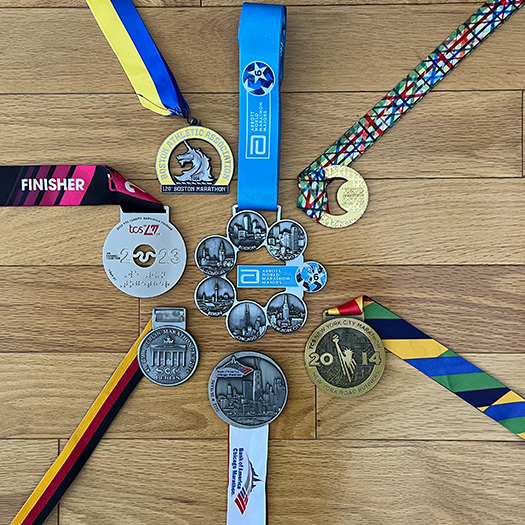
Posts Tagged ‘World Marathon Majors’

Australia is about as far away as you can get. I like that.
– AndrĂ© Benjamin

Mike Sohaskey & Katie Ho at Featherdale Sydney Wildlife Park with koala Byron

(Long story short, 2024 was a rough year for me personally. As John Lennon noted, “Life is what happens when you’re busy making other plans.” But I hope to make up ground here in 2025, starting right where we left off…)

As compelling tourist destinations go, Sydney lands near the top of my list. Australia’s largest city is a gem, from its world-famous beaches to its native wildlife to its iconic cityscape featuring beloved landmarks like the Harbour Bridge and Sydney Opera House. So when it came time to choose a marathon in Oceania as part of my seven continents quest, naturally I gravitated toward
 the tiny neighboring nation of New Zealand.

Nothing against Sydney or its parent country, which I assumed we’d make time to visit after our stay in New Zealand. But since completing my fifth continent in Tokyo/Asia in 2019, and with a global pandemic effectively shutting down international travel for two years, I’d had plenty of time to mull over marathon options in Oceania. And having spent two memorable weeks in New Zealand—as compared to two days in Sydney—on our honeymoon in 2004, I’d been leaning toward a return trip to Queenstown or even a first visit to the bustling port city of Auckland.

Truth is, I’d given surprisingly little thought to running a marathon in Australia. Despite its cosmopolitan appeal and its status as the largest city in Oceania, Sydney’s hometown marathon had always kept a relatively low profile on the world stage. In fact, as recently as 2022 it wasn’t even the largest marathon in its own country, with both Melbourne (6,215) and the Gold Coast (4,059) boasting higher finisher numbers than Sydney (3,452). Based on its online reviews, the Sydney Marathon had always struck me from afar as a scenic but immature urban marathon with too many out-and-back sections.

Then the World Marathon Majors came calling, and faster than you could say “kookaburra” everything changed.

Sydney Harbour Bridge view at night
The Sydney Harbour Bridge lights up the night

On July 27, 2022, the powers-that-be announced Sydney as the newest candidate for the prestigious Abbott World Marathon Majors, a series comprising six of the world’s most popular marathons in Berlin, Boston, Chicago, London, New York City, and Tokyo. Along with the Cape Town Marathon, which had likewise been announced as a candidate race 15 months earlier, Sydney would be evaluated on a three-year timeline with an eye toward joining the Majors in 2025. For two years in a row, race organizers would need to step up their game and satisfy a checklist of 104 criteria; one of the most challenging would be a requirement for 15,000+ finishers, more than three times Sydney’s previous high of 4,493 in 2019.

Satisfy all 104 criteria for two years in a row, and Bob’s your uncle!

And so, more than two decades after its inaugural running as a legacy of the 2000 Summer Olympics, the Sydney Marathon set about transforming itself—almost overnight—into a World Marathon Major. Immediately on social media the organizers promised “an increase in entertainment on the course, with a vastly improved race-day experience, cheered on by more people and more runners celebrating Sydney.” Such a transformation would also necessitate dramatic changes to the marathon course itself.

In short, success would demand that the Sydney Marathon finally live up to the sparkling reputation of its world-class host city.

Harbour view of the Sydney Central Business District (CBD) from ferry
Harbour view of the Sydney Central Business District (CBD)

For years I’ve had a love/hate relationship with the Majors, culminating in an anticlimactic experience at my sixth and final Major in London in April 2023. So it wasn’t until months after the announcement of its candidacy that my own interest in running Sydney was piqued. That was when the marathon organizers, in partnership with our friends at Marathon Tours & Travel, reached out to RaceRaves to ask for our help in promoting Sydney to our largely American audience of traveling runners. Needless to say, we were thrilled to join the team that (fingers crossed) would help Sydney rise to the occasion and achieve World Marathon Major status. We’d even had the opportunity to sit for a pint in London with the man himself, long-time Sydney race director Wayne Larden.

With that, Katie and I seized on this golden opportunity to visit Australia, notch our sixth continent, and judge for ourselves Sydney’s readiness to join the Majors. New Zealand would have to wait.

And so it was we found ourselves touching down in Sydney on Thursday, Sept 14, just over 15 hours after we’d boarded a nonstop flight from Los Angeles two days earlier. Thanks to the time-warping power of the International Date Line, we’d essentially skipped Wednesday. Fortunately, our decision to fly business class using mileage points had made (literally) a world of difference by ensuring that the seemingly forever flight had been as comfortable as humanly possible.
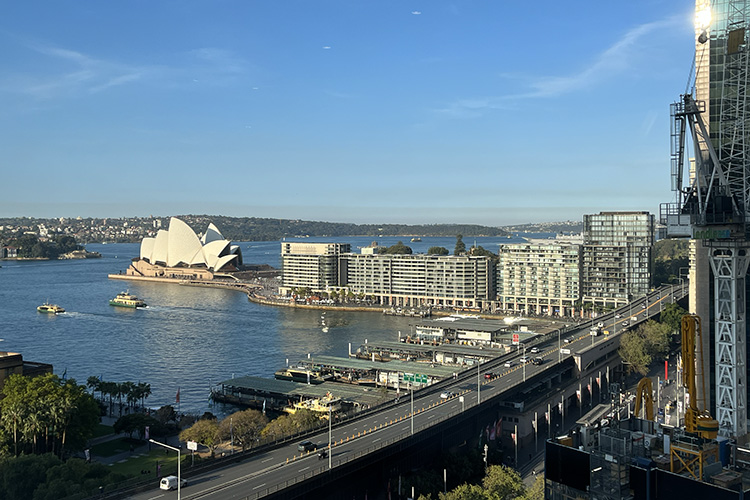
View overlooking Sydney Harbor from Four Seasons Hotel
View overlooking Sydney Harbour from our room at The Four Seasons Hotel

Getting to Know Sydney
Arriving early Thursday morning, we checked into our room at The Four Seasons Sydney and immediately set about exploring one of the world’s most beautiful cities.

(It may sound indulgent, and maybe it is
 but a spacious room at The Four Seasons Sydney overlooking Sydney Harbour and the Sydney Opera House cost less than—and this is not a typo—our unassuming room at the Holiday Inn & Suites in Duluth, MN for Grandma’s Marathon weekend. The American dollar travels well.)

We enjoyed a leisurely breakfast in The Rocks, a charming neighborhood near the Sydney Harbour Bridge where a large and attractive Australian white ibis (aka “bin chicken” to the locals) played opportunistic scavenger beneath vacated sidewalk tables, a role typically filled by pigeons in American cities. Then, before the long shadow of jet lag could overtake us, we headed to the pre-race expo to avoid the bustling crowds that the weekend would inevitably bring.

Australian white ibis (aka "bin chicken" at Sydney outdoor cafe
The Australian white ibis (aka “bin chicken”) is a regular at outdoor cafĂ©s

One Uber and a short shuttle ride later we arrived at The Venue Alexandria, host venue for the Sydney Marathon Running Show. The expo, which was surprisingly small and easy to navigate, will no doubt see tremendous growth in the future as Sydney embraces its (spoiler alert) newfound World Marathon Major status. I didn’t count vendors along the U-shaped loop, but the overall expo felt much smaller than its promised collection of “over 75 booths with 35 quality exhibitors,” including an empty stage presumably intended for guest speakers. The entire scene felt more like packet pickup at a midsize American marathon, as all I received was an envelope containing my bib number and a few safety pins, with finisher shirts available—as the name implies—at the finish line.

Located at the expo entrance, the ASICS official merchandise area set the tone with its disappointing lack of marathon-branded merch, suggesting ASICS had signed on as the presenting sponsor too late to meaningfully expand its inventory of Sydney apparel. In any case, this felt like a huge mi$$ed opportunity, though I did manage to come away with a lightweight Sydney Marathon-branded running tee that I’m actually wearing as I write this.

After a rejuvenating night’s rest in one of the most comfortable hotel beds on the planet, Friday began with a beautiful solo shakeout run along Sydney Harbour and past the Botanic Gardens to Mrs. Macquarie’s Chair, a sandstone city landmark that offers unmatched views of the Harbour Bridge and Sydney Opera House.
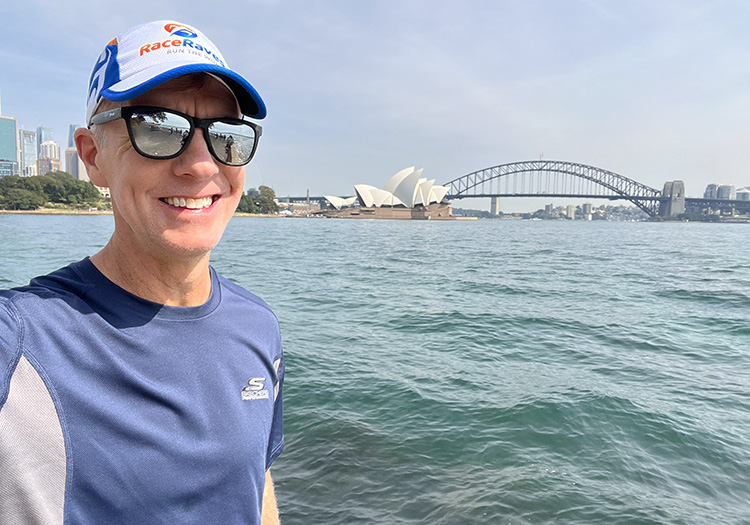
Mike Sohaskey shakeout run with Sydney Opera House & Harbour Bridge as backdrop
Not a bad backdrop for a shakeout run

Sydney boasts an impressive number of world-class zoos and wildlife parks, several of which we’d visit—and all of which we’d recommend—during our stay. After my shakeout run, we grabbed lunch and hopped a ferry across the harbour to Taronga Zoo, home to more than 4,000 fascinating animals including Australian pelicans (the continent’s largest flying bird), kangaroos, wallabies, western lowland gorillas, a Sumatran tiger, and of course, koalas 🐹

September (aka early spring) is a terrific time to visit Sydney, as it precedes Australia’s peak season and the arrival of cruise ships full of international tourists. As such, we had each of the local zoos largely to ourselves, a luxury that allowed us to avoid crowds, observe the animals without human interference, and converse at length with several zookeepers.

That evening we returned to The Rocks to dine along Sydney Harbour, where we were treated to an unforgettable display of fireworks above the Sydney Opera House. Even to this long-time fireworks skeptic, the colorful spectacle staged on the backdrop of the city’s most iconic landmark was mesmerizing and the stuff of promotional tourism videos.

Fireworks over Sydney Opera House

And speaking of fireworks, in recent days a smoky haze had blanketed the city courtesy of controlled hazard-reduction burns, a strategy used to reduce the amount of flammable foliage and mitigate the risk of destructive blazes during wildfire season. Coming from California I applauded the city’s foresight; however, the timing meant that in the days leading up to the marathon, Sydney’s air quality would be among the worst in the world. Why they couldn’t have timed these burns for the weekend before or after the marathon, I have no idea.

As if wildfire smoke weren’t enough, the race day forecast also called for unseasonably high temperatures approaching 32°C (90°F). On the bright side, the high heat would be accompanied by low humidity. I don’t mind high heat (to a point), but high humidity on race day is a stone-cold killah.

The organizers had emailed us on Thursday with weather and air quality updates, along with the helpful reminder that “If there is poor air quality, NSW [New South Wales] Health recommends that people reduce or avoid outdoor physical activity.” You mean, like running a marathon?

View of Manly Beach, one of Sydney's welcoming white-sand beaches
Manly Beach is just one of the city’s welcoming white-sand beaches

On Saturday we ferried north of Sydney Harbour to spend a few blissful hours on Manly Beach (“Manly” being a reference to its location, not necessarily its clientele), an idyllic 3-km stretch of white sand and a mecca for local surfers. And that evening, we accepted a generous invite from our friends at Marathon Tours & Travel (with whom we’d worked to promote the Sydney Marathon) to crash their pasta carbo-load at the Hotel Intercontinental Sydney.

I enjoy the diverse and accomplished cast of characters we meet through Marathon Tours and this was no exception, with one fellow in attendance having run 428 marathons and counting. (On a side note, call it anecdotal but whenever I meet someone with a triple-digit marathon total, they always seem to be wearing Boston Marathon apparel.) Like other runners I’ve met on my seven continents quest, the folks in Sydney were decidedly more chill than their counterparts at the six World Marathon Majors. I expect that dynamic will change somewhat as Sydney prepares to host its own AWMM coming-out party in 2025, though hopefully the race remains popular with the seven continents crowd.

Mike Sohaskey in front of "Nothing Feels Better than Running Sydney" sign at 2023 Sydney Marathon expo

Sydney “Struts” Its Stuff
On Sunday I awoke at 4:45am ready to roll after a near-hedonistic seven hours of sleep. In the silent harbour below, the burgeoning orange glow on the horizon chased the darkness and backlit the shadowy sails of the Sydney Opera House.

Marathon start time would be 7:10am, following the half marathon at 5:45am and the 10K at 6:05am. The morning forecast called for temperatures to reach the low 80s by 11:30am, around the time I planned to cross the finish line. Having trained through the humid summer months, I wasn’t overly concerned.

On a more positive note, the smoke from the bush fires had dissipated, giving way to clear skies and the promise of a beautiful spring day. Sure, I’d dial back my effort to compensate for the heat, but I didn’t expect a shitstorm on the level of London.
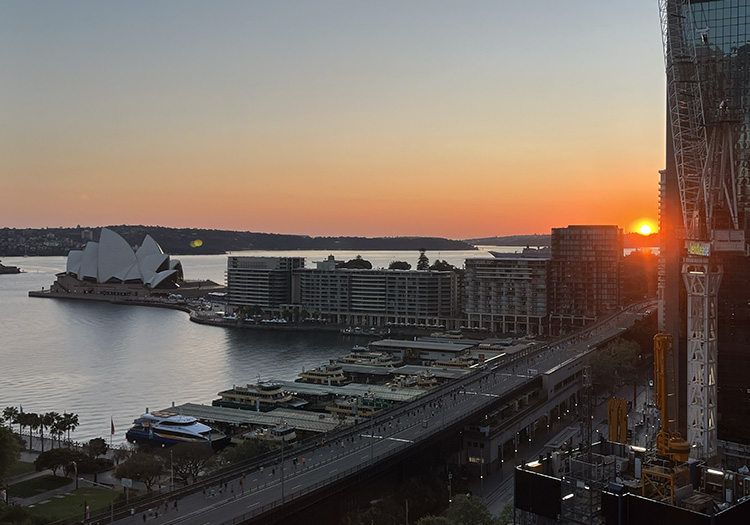
Sydney Marathon half marathon runners at sunrise
Rise and shine! It’s race day Down Under

I didn’t want to spend any more time than necessary at the start line, so after eating and dressing I strolled leisurely to Circular Quay, the main ferry terminal located a 5-minute walk from our hotel. There I boarded a 6:30am ferry (again courtesy of Marathon Tours) which transported several other stragglers and me across the harbour to North Sydney, where we passed quietly beneath the towering steel, concrete, and granite form of the Sydney Harbour Bridge before deboarding at Milsons Point.

Glancing back, I briefly admired the view of the city skyline across the harbour. “See you soon,” I murmured before making the short walk uphill to a small park teeming with runners, aka the staging area. My timing was perfect, as we were immediately herded onto the main road over which an arch-shaped sign welcomed us to North Sydney. There, on a slight uphill grade, we awaited the start with 17,000 other runners. Without having to queue for the porta-potties (which I later heard were a bit chaotic), my journey from hotel room to start line had been smooth sailing (pun intended, and no worries if you don’t like my dad jokes—I don’t harbour grudges).

In between “Get Lucky” by Daft Punk and “Firework” by Katy Perry (apparently a start line staple even in Australia), a didgeridoo player on a raised platform within our “B” corral entertained the crowd. (Enjoy the didge, then run the bridge!). Swiveling my head in all directions, I tried to envision this overcrowded postage stamp of grass-phalt straining to accommodate the 35,000+ participants of a World Marathon Major.

Mike Sohaskey at start line of Sydney Marathon – Milsons Point
“GO” time at Milsons Point, let’s make this a Major!

Fortunately, I didn’t have long to ponder as the PA announcer counted down—notably minus the fanfare of the national anthem, unlike American races—and sent us on our way. Flames bellowed from alongside the start line as the “A” corral runners merged onto the road ahead followed by our “B” corral.

The whole operation went smoothly enough, and moments later continent #6 was underway on a gorgeous morning under brilliant blue skies. Leaving Milsons Point and heading north, we’d barely had time to break a sweat (even on this warm day) before the course narrowed and then circled back in the direction we’d come, leading us under and up onto the Sydney Harbour Bridge for one of the most glorious and memorable stretches of the day.

Crossing one of the world’s most iconic structures, I appreciated that this was all happening early in the race while we still had the energy to enjoy it. Running in the center of the roadbed meant minimal views of the azure swath of harbour below us; rather, our scenery was limited in large part to the crisscrossing steel girders of the lattice arch directly above our heads. The massive arch had begun its life as two halves, which in August 1930 had been assembled on opposite sides of the harbour before being joined and stabilized in the middle to create the finished arch. Nineteen months later, in March 1932, the ceremonial ribbon was cut and the Sydney Harbour Bridge officially opened for business.

Mike Sohaskey running across the Harbour Bridge at 2023 Sydney Marathon
Crossing the Sydney Harbour Bridge with Spidey in hot pursuit, mile 2

Glancing to my left, the spectators lining the wide roadbed felt comically far away. Exhilarating as this stretch was, it didn’t (understandably) boast the electrifying energy of Tower Bridge, one of the loudest and most raucous stretches on the London Marathon course. I did, however, prefer it to the crowded opening stretch across the Verrazano-Narrows Bridge at the NYC Marathon which, after hours of waiting for the start, had been a study in sheer adrenaline. (For what it’s worth, the Golden Gate Bridge crossing in mile 8 of the San Francisco Marathon may be my favorite bridge segment of any race, as it affords epic views of sunrise over Alcatraz and the SF Bay.)

Running behind someone dressed as Spider-Man (or maybe he was the real McCoy, who am I to judge?), I heard an excited shout from one of the younger spectators: “Spider-Man! It’s Spidey!” And now you know the truth, kid—real heroes run marathons.

As the bridge itself ended and the water below us transitioned to concrete and bitumen, the elevated roadbed carried us past soaring glass and steel edifices like the Hotel W, its radically curved face designed to resemble a wave. Feeling somewhat seasick alongside its hulking presence, I shifted my attention to the other side of the road where the sparkling waters of Darling Harbour shimmied in the morning light.

Tasmanian devil at WILD LIFE Sydney Zoo
Apparently most Tasmanian devils do NOT spin like tornadoes when moving

Exiting onto city streets, we continued through the Pyrmont neighborhood. Attractive red-brick buildings garnered my attention as we followed tree-lined roads bathed in dappled sunlight. At one point, we were treated to a view in the distance of the city skyline under the watchful eye of—well, the Sydney Tower Eye, the tallest structure in Sydney and the second-tallest observation tower in the Southern Hemisphere.

For the most part, with 14,000 marathoners in 2023 the streets of Sydney felt sufficiently wide and runnable, unlike Berlin and London. How those same streets will fare when the city welcomes 35,000 runners in 2025, that is the question.

Starting at 5km, I resolved to sip a cup of water at most of the aid stations. If I played it smart and stayed hydrated, the heat shouldn’t overly impact my performance. As it turns out, the initial aid station would be a sign of things to come, and an ominous one at that. The first water table I reached was already empty as the volunteers filled empty cups as quickly as possible. Grabbing a half-filled cup, I took a few sips and then tossed it aside, passing several other tables where full cups of water sat untouched. Clearly what was needed here was one or two vocal volunteers to direct traffic and encourage runners to bypass the first table, as larger American races do. This would have eased the flow of traffic through the early aid stations at least, even if it wouldn’t necessarily have avoided the chaos awaiting us at later stations.

And yes, there would be chaos.
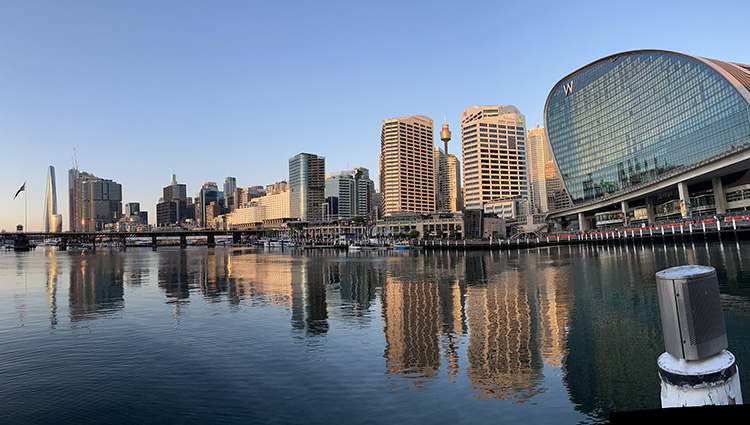
Darling Harbour, with the Sydney Tower Eye visible at center right
Darling Harbour, with the Sydney Tower Eye visible @ center right

Darling, You Look Marvelous
Circling along the waterfront, we reached a turnaround point in the shadow of the Anzac Bridge, its steel cables radiating out like spider webs from concrete piers. Heading back the way we’d come, our route deviated from its original trajectory to follow the boardwalk and waterfront along Johnstons Bay. Another glimpse of the Sydney Tower Eye, a few more surface streets, and the course opened up into Darling Harbour—but not before we hopped a couple of curbs and crossed a brief stretch of crushed gravel. That’s gotta go before next year, I thought, again donning my World Marathon Majors assessor’s hat.

Darling Harbour is one of the city’s most beautiful neighborhoods and one that very much resembles its animated counterpart in Finding Nemo, seagulls and all.

Curving along the wharf past the excellent Wild Life Sydney Zoo and Sea Life Sydney Aquarium, I noticed Spider-Man now running immediately ahead of me. The warmly costumed Web-Slinger looked to be struggling as the morning heated up. Passing him on the right but not wanting to bug him in mile 8 of a marathon, I pulled out my phone and snapped a selfie on the fly. Because as a Marvel Comics fanboy who grew up wanting to be Spider-Man for the first ten (twenty?) years of my life, I couldn’t let this opportunity pass me by. And besides, wouldn’t Peter Parker himself, in his part-time role as a photographer for The Daily Bugle, have done the same in my shoes?

Mike Sohaskey running in Darling Harbour (in front of Spidey) at 2023 Sydney Marathon
Spidey sighting in Darling Harbour

Leaving Darling Harbour, we were treated to an Aussie-fied version of “Sweet Caroline.” Then hugging the shoreline we cruised through Barangaroo, circling beneath the Harbour Bridge—how cool to behold the bridge from above AND below—on our way to where Katie waited near the 15km point in The Rocks at Circular Quay, the closest point to our hotel. The noise took me by surprise as throngs of raucous spectators lined this narrow stretch, and I located Katie in the crowd just in time to share a smile and a high-five before we continued into the heart of the city.

Skirting Hyde Park we passed Saint Mary’s Cathedral, its twin gothic spires extending heavenward through a cloudless sky. Leaving the central business district, forgettable corporate signage was replaced by eye-catching rainbow flags as we turned onto Oxford Street and entered the city’s LGBTQIA+ district.

Here I ran with the 4-hour pacers as we approached Centennial Park, being careful to keep my pace in check and not chase them as we entered the park. With suboptimal performances in London and Minnesota still fresh in my mind, the last thing I wanted on a warm day was to implode and have to walk any significant mileage. Clearly I was in a better place than I’d been at either of those races, so I wanted to keep things smooth and enjoy the day. And I knew my best bet for success was to stay humble and hydrated.

Mike Sohaskey running through The Rocks at mile 10 (15 km) of the 2023 Sydney Marathon
Passing through The Rocks, mile 10 (15 km)

Although Sydney’s 1,000+ ft of elevation gain marks it as the hilliest of the World Marathon Majors, I would call the course we ran more “rolling” than “hilly.” None of the hills were particularly long or steep, and most rewarded us with a corresponding downhill on the other side. Overall I prefer courses with—let’s call it character—and my legs seemed to respond well to Sydney’s ups and downs.

It helped that I was running in my bouncy new ASICS Metaspeed Sky “super shoes,” which I’d bought on a whim two weeks earlier and which to this point felt great. They spared my legs some of the usual wear-and-tear while helping me maintain my cadence by smoothly rolling each foot forward into the next step. The blue-and-orange RaceRaves color scheme didn’t hurt, either. I’d notice several other runners wearing them throughout the day, and though my own performance in Sydney would fall short of “super,” the shoes certainly wouldn’t be to blame.

If you return from Australia without kangaroo footage, did you really go at all?

Welcome to the Twilight Zone
Approaching the 20km mark near Allianz Stadium (built for the 2000 Summer Olympics, it’s one of Sydney’s largest stadiums), we got to watch the elites blow by us in the opposite direction as they passed their own 36km mark.

For the next 10 miles, our aspiring World Marathon Major transformed suddenly into a local parkrun. Through Moore Park and Centennial Park we followed park roads out and back, out and back, out and back, circled Centennial Park counterclockwise, then reversed direction and retraced our steps clockwise. All the while I hoped the next stretch would be the one to lead us out of this maze. Despite all my rage, I am still just a rat in a cage. On the plus side, it was an attractive cage with plenty of tree cover and the occasional pond. We must have covered every square inch of those two parks in a clear bid to accrue the necessary 26.2 miles/42.2km.

After the race, I’d hear several runners point to this inescapable “Blair Witch” portion as their least favorite of the day. For my part, I was relaxed and determined to run as best I could in the heat while enjoying the opportunity to be here in Australia running a marathon 7,500 miles from home. The seemingly endless park miles were made more palatable by the extensive shade, the energy from the spectators, and the (too) many chances to see our fellow runners passing in the opposite direction. And while a couple of out-and-backs remain in 2025, I’m pleased to report that this year’s marathon course includes only a single loop of Centennial Park.

Mike Sohaskey and others running through the endless green expanse of Centennial Park at the 2023 Sydney Marathon
Somewhere within the endless green expanse of Centennial Park

On the other hand, with temperatures rising I definitely did not enjoy seeing runners being tended to by medical personnel or sprawled out on the grass alongside the course. At one point we passed a police car with lights blazing that looked to be responding to a medical emergency. I took a deep breath, calming my nerves and sending positive vibes as I passed. Unfortunately, one of my enduring memories of the Sydney Marathon would be the number of sidelined runners I’d pass in the final 10–15 km. At the same time, I can’t feign surprise—if running 26.2 miles in the heat were easy, everyone would do it.

As if I needed further encouragement, the on-course carnage reminded me to stay hydrated. We passed a heat warning gauge showing green (safe), yellow, orange, and red (dangerous) quadrants, its arrow pointing toward orange. Could be worse, I thought wryly.

A fellow runner—from Los Angeles, coincidentally—would later tell me that, because the race had no food at the aid stations, he’d stopped at a kiosk in the park to buy ice cream. Not a bad idea on this day to be sure, though why an experienced marathoner (which he was) wouldn’t carry their own nutrition was baffling. There are more than enough mistakes to be made on race day without making a rookie one.

And speaking of nutrition—despite feeling neither hungry nor depleted, I finally decided to gulp down a Maurten gel as the 30km aid station came into view. I was pleasantly surprised when my stomach, despite the double whammy of sweet and heat, didn’t protest as it so often does with gels. If I felt myself fading I’d have another at mile 22, though I wasn’t sure I’d need it—I’d done a nice job of fortifying my carbohydrate stores leading up to race day.

We interrupt this riveting race narrative for a climbing koala

With the surrounding roads closed and a dearth of public transit options, Katie had been unable to access the park for this extended stretch, which made neither of us happy but c’est la vie.

It occurred to me that, aside from the “Sweet Caroline” singalong near Darling Harbour, on-course entertainment had been sporadic. Not that I wasn’t entertained by the city itself, but I’d struggle to recall more than a few of the 28 (an oddly specific number) on-course entertainment zones promoted by the organizers. Or maybe the heat ate my brain?

I didn’t commit many of the spectator signs to memory—again I blame the heat—but two that did stand out (for better or worse) read “Beer + Boobies at the Finish Line!” (huh?) and “RUN LIKE FUCK” đŸ€·đŸ»â€â™‚ïž

Sometime after mile 20, I heard someone blast a whistle behind me and brusquely order me to move to the side as a handcycle athlete struggled past. This “cycle” repeated itself a couple more times as I’d pass her on the climbs, and she’d return the favor on the descents. Why were the handcycle athletes sharing the course with the runners? Typically the handcycle athletes start several minutes before the runners to avoid such logistical snarls. I could only assume she’d hit a rough patch of her own like so many of the runners I’d seen sprawled out on the grass. Mother Nature, she’s an equal opportunity offender.

Just as we reached the 35km mark and I was starting to think we’d entered the twilight zone of no return, the park spat us out and we escaped exited the way we’d come. I pulled over, pausing for 15 seconds to do some quick knee raises and loosen my quads while kindly refusing a spectator’s generous offer of ibuprofen. Then I pushed onward, determined not to walk outside the aid stations. Mind over muscles, I thought. This last 7km would definitely be a test of my physical and mental fitness.

The Heat Is On
Remember that chaos I mentioned earlier? As I pulled into the aid station at the 37.5km mark, runners were pulling cups from the bulk package themselves and holding them out to be filled by frenetic volunteers. My cup was partially filled by a frazzled fellow pouring as quickly as possible from a plastic bottle. Another volunteer, whether doing as instructed or simply taking the initiative, chose to spray down groups of runners with the hose instead. That aid station logjam cost me upwards of 30 seconds; luckily I was in no real hurry and empathized with the volunteers, who were doing everything in their power to make the best of a bad—and potentially dangerous—situation.

Mike Sohaskey running past Saint Mary's Cathedral at mile 26 of the Sydney Marathon
Third time’s a charm past Saint Mary’s Cathedral, mile 26

Not only that, but aid station tables were inconsistently labeled as to whether they held water or sports drink, meaning I had to ask several times throughout the day to ensure I got it right. The chaos evident at several (though certainly not all) of the aid stations—particularly on a hot day when many folks were already struggling—was to my mind the biggest black eye for a race that experienced some very public growing pains in real time. That said, every last volunteer was freaking amazing and deserving of their own medal.

Rising heat notwithstanding, a cool breeze coupled with low humidity and plentiful shade—I can’t recall any extended stretches of direct sunlight—made Sydney’s 26.2 miles decidedly more manageable. Besides, this wasn’t much different than some of my summer training runs in humid Los Angeles. At the same time, I could foresee that many of the slower runners would suffer as the mercury continued to climb and the aid stations struggled to meet demand.

Leaving the 37.5km aid station, I settled in for the last 5km and focused on pushing forward. My efforts paid off as I passed a number of walkers and shufflers in the throes of a zombie-like march to the finish. Through the lush Royal Botanic Garden we ran, circling past Mrs. Macquarie’s Chair at the water’s edge. I recognized this route from my shakeout run two days earlier, the hand-carved sandstone “chair” affording a sublime view of the Harbour Bridge and Sydney Opera House. Likewise I recognized the turn that led along the edge of Hyde Park and onto Macquarie St, the Sydney Tower Eye now rising above the skyline on the far side of Hyde Park.

Mike Sohaskey making the final turn on Macquarie towards the Sydney Marathon finish line
Making the final turn on Macquarie with salvation in sight

Knowing the end was near, I kept pushing as the road started its gradual downward trajectory, the remaining spectators (Katie among them) creating a wall of sound as the Sydney Opera House came into view. At last we reached the stretch I’d been anticipating for months, and I summoned one last giddyup as the road banked downhill toward home. With 200 yards to go I found myself sprinting (rather than hanging on for dear life) toward a postcard-perfect finish line, the Harbour Bridge standing tall across the water on a stunning canvas of deep blue.

This was the home stretch you wish you could bring to every race, and at that moment it was worth every step of the preceding 26.1 miles. Along with the Brandenburg Gate in Berlin, it was the most beautiful finish line I’d ever crossed.

And so I did, stopping the clock at the steps of the Sydney Opera House in an official time of 4:08:14. Damn, what a feeling. Clearing the finish line, I paused to gather my wits and bask in the love of the crowd, so proud to be part of this historic event warts and all (the race’s, not mine). Standing there soaking up the spectacle of my sixth continent, I had no doubt Sydney would soon be the next World Marathon Major.
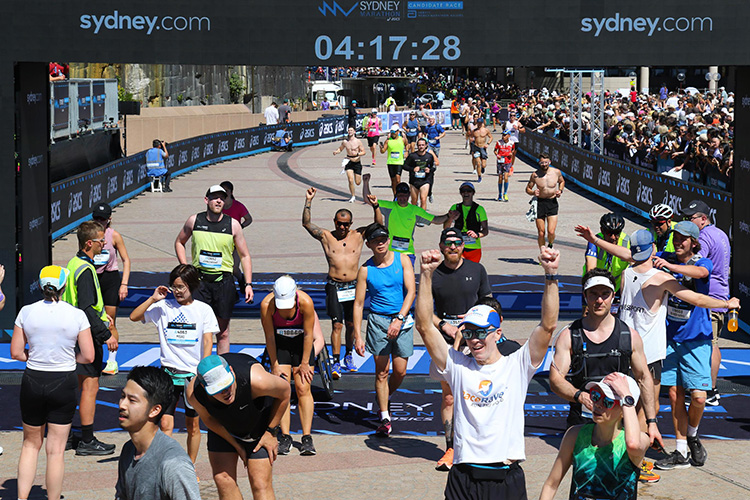
Mike Sohaskey with arms raised past the Sydney Marathon finish line for continent #6!
Continent #6 ✅

Slowly I strolled through the finish chute, gratefully accepting my attractive blue finisher medal (depicting—what else?—the Harbour Bridge and Sydney Opera House) before following the caravan of exhausted and euphoric runners out into the Royal Botanic Garden. Each of us was handed a single bottle of warm water, limited to one per runner. We also passed a table serving warm cups of sports drink. Wow, the organizers really hadn’t prepared well for this heat. And as temperatures climbed past 80°F/27°C, the idea of rationing bottled water seemed unwise to say the least.

Happily collapsing in the shade of a tree I lay waiting for Katie to find me, my outgoing texts reaching their target slowly and sporadically in the overcrowded post-race area. Finally we reunited, and it felt so good. I threw my arms around her in a sweaty victory embrace before peeling myself off the ground and walking with her to collect my finisher shirt. (For her part, she was plenty glow-y after working her way from the finish line through the masses to find me.)  Along the way we passed a table holding boxes of warm bananas and a truck offering green cans of non-alcoholic Nort Ale. Whether that, too, was at room temperature, I didn’t stop to find out.

Wandering further into the grassy post-race area, we encountered several food trucks and I settled for an açaí bowl, the only option my stomach could manage. A live band filled the air with music, while the ASICS recovery zone offered exclusive access to OneASICS members. Like afterthoughts, a few smaller sponsor tents sat back away from the flow of foot traffic. And there, sitting under the hot sun, was another table holding small cups of warm water. Was Sydney not privy to the awesome twin technologies of ice and refrigeration?
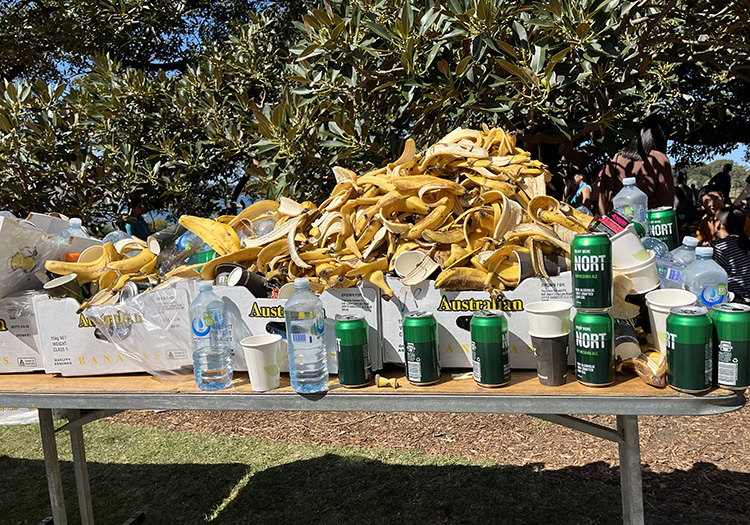
A pile of banana peels and cans of Nort Ale in the finishers area of the Sydney Marathon
Admittedly not one of my most ap”peel”ing photos

Making one last stop alongside the Opera House/finish line, we took advantage of the spectacular backdrop and the sun’s ideal positioning to snap a finisher selfie with the Harbour Bridge. Normally we’d opt for the finish line in the background, but then normally we don’t have the Sydney Harbour Bridge as an alternative.

Then we exited across Macquarie St, pausing to cheer on back-of-the-packers as they trickled in, their faces radiating with the effort of the day and what seemed to me more than the usual number of smiles.

News reports in the days after the race, however, would tell a different story. “Dangerous scenes of chaos from start to finish,” proclaimed one outlet. Start to finish? That smacked of sensationalism. Granted, 40 runners were treated in the medical tents and 26 were hospitalized, something you never want to see. One hospitalization is too many. And yes, some aid stations were overwhelmed. At the same time, this is not a leisurely walk through the Royal Botanic Garden—this is a marathon. 26.2 miles in unseasonably hot weather. And if you’re going to line up on the start line, you have to know your body’s capabilities and how hard you can push.
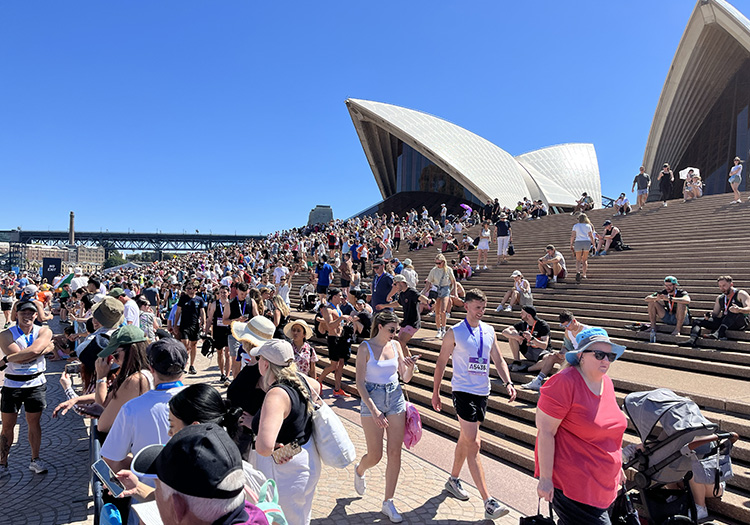
Friends & family watched the Sydney Marathon finish from the steps of the Sydney Opera House
Friends & family watched from the steps of the Sydney Opera House

As singer/songwriter/non-runner Kenny Rogers taught us in “The Gambler,” You’ve got to know when to hold ‘em, know when to fold ‘em, know when to walk away, and know when to run. The truth is that some folks don’t know when to hold ‘em and when to fold ‘em. And this is particularly true of marathoners who thrive on discomfort—at the notoriously warm 2012 edition of the Boston Marathon (which started at 10am EDT), more than 2,100 runners were treated in the medical tents with 152 being hospitalized.

I’m not exempting the organizers from responsibility, but I do think responsible marathoning is a two-way street. And it’s easy to say “They should have moved the start time up earlier” when you’re not the one in charge of logistics. For me, the biggest oversight of the day was the lack of ice and/or cold sponges at aid stations, which would have limited the number of casualties.

Of course the rest, as they say, is history. The race passed its first and second stages of candidacy in 2023 and 2024, respectively, and in Nov 2024 the TCS Sydney Marathon was announced as the 7th member of the Abbott World Marathon Majors. Unfortunately, none of us who helped Sydney achieve its lofty aspirations were rewarded with a star for running the race during its candidacy years, a decision that flew in the face of precedent since all six member races had grandfathered in past runners when they themselves were introduced as World Marathon Majors.

Mike Sohaskey and Katie Ho celebrating after the Sydney Marathon with Opera House evening backdrop

That questionable call, together with continued expansion (Cape Town and Shanghai are currently being assessed as candidates) and a 90% reduction in overall prize money from $500,000 to $50,000, make it clear that the series is focused on maximizing its golden goose, the Six- (and eventually Nine-) Star Medal for amateur runners. Honestly, I can’t say I blame them—theirs is a captive audience and when it comes to commitment, the eyes-on-the-prize obsession of Six-Star hopefuls rivals the fiery fandom of Swifties.

Sunday evening we rejoined our friends at Marathon Tours & Travel for their post-race party at The Squire’s Landing in The Rocks, a short walk from our hotel. Jeff Adams, MT&T president and fellow Antarctica 2013 alum, introduced six new inductees into the company’s Seven Continents Club Finishers Hall of Fame. And I promised him I’d be coming for that award soon. Ten years and one global pandemic after crossing the finish line of my second continent in Antarctica, I’d completed continent #6 with only South America to go. Unless they dredge up Atlantis between now and then


Koala-ty Recovery Time
Still basking in the warm afterglow of an amazing race day, we took Monday to explore Sydney on foot with a focus on Darling Harbour. There, we visited the Wild Life Sydney Zoo where we chatted with several of the animal keepers at length (as mentioned above, September is the non-peak tourism season in Sydney). We learned about the zoo’s Tasmanian devils (the largest carnivorous marsupial in the world), and one keeper generously borrowed my camera to record a nostril-cam video of the resident red kangaroo enjoying a snack of butternut squash.

Then it was time to take our talents north to Queensland and the Great Barrier Reef. On Tuesday we flew to Cairns (pronounced kénz with a silent “r”) where we continued on to Port Douglas, a tiny coastal town located close to both the reef and our Wednesday destination, Daintree Rainforest. Located within Daintree National Park, the rainforest was well worth the day spent with fellow tourists learning about its wonders.

At last we arrived at one of the hands-down highlights in a trip filled with them. On Thursday we boarded a ferry for the 45-minute ride to Green Island, a coral cay and eco resort in the Great Barrier Reef encircled by white-sand beaches and azure waters. Green Island would be our headquarters for the next two days as we explored the Outer Barrier Reef, swimming with sea turtles and the reef’s many other fascinating occupants in the crystal-clear ocean. Even Katie, who’s not the most enthusiastic of swimmers, took to the water like a fish, exploring the reef’s nooks and crannies in her search for locals. It was an intoxicating experience I can’t recommend enough, and one that reaffirmed mankind’s urgent need to protect the world’s oceans.

Collage of denizens of the Daintree Rainforest and the Great Barrier Reef
Denizens of Daintree Rainforest and the Great Barrier Reef (clockwise, from upper left): Boyd’s Forest Dragon, a circulus of skinks, saltwater crocodile, green sea turtle

Snorkeling off Green Island we swam with sea turtles, colorful sea stars, giant clams, and even a shy octopus. On my approach, the octopus quickly reversed direction and slithered back into the crevice from which he’d emerged, a cloud of dirt spitting from the hole in his wake. His coloration blended smartly with the coral, and I found him again to show Katie only by looking for the suckers and the inquisitive eye staring back at us. The big fella had deftly squeezed himself into a very small hole, and my heart filled with awe for this exquisitely adapted creature.

Unfortunately all good things, even bucket-list visits to the Great Barrier Reef, must end. On Saturday we boarded the ferry back to Port Douglas as the first leg in our return trip to Sydney via Cairns. And on Sunday we continued to explore Sydney where we’d left off, starting with the gorgeous Coogie to Bondi Beach Coastal Walk (6 km) before watching the sunset from high atop the city at the breathtaking Harbour Bridge Pylon Lookout. Having admired the bridge from almost every conceivable angle during our stay, this was the one remaining vantage point available to us that didn’t involve tethering ourselves to other humans while scaling the arch itself. I’d say we chose wisely.
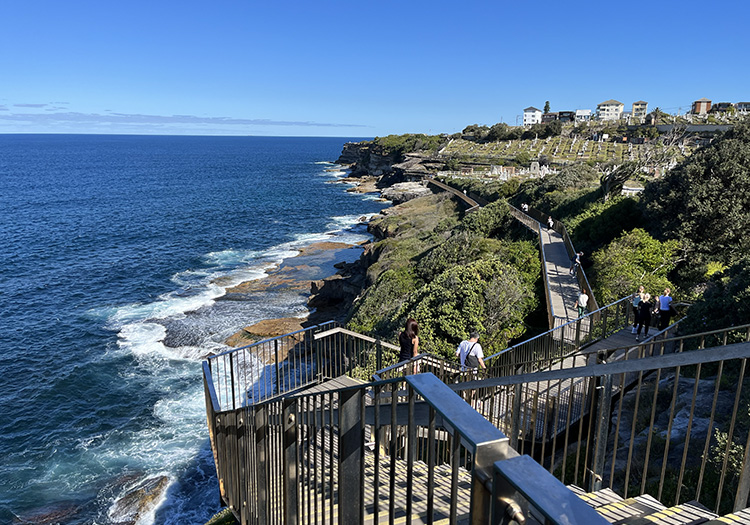
View from Coogie to Bondi Coastal Walk, a great way to loosen the legs after a marathon
The Coogie to Bondi Coastal Walk is a great way to loosen the legs after a marathon

Sydney really is one of the world’s most beautiful and welcoming cities. Everyone was nice without fail, and as an American it occurred to me there’s a lot to be said for paying your employees a real living wage.

Our last full day in Australia we reserved for a day trip to the beautiful Blue Mountains an hour’s drive (on a tour bus) outside the city. There, among other things, we rode the steepest passenger railway in the world down a 52° incline from the upper sandstone cliffs to the rainforest valley floor and back. Later, on the drive back to Sydney, we stopped at our third and final animal habitat of the trip, the Featherdale Wildlife Park. In between up-close-and-personal encounters with tiny kangaroos and a handsome, very chill koala named Byron, we got to know more of the continent’s native wildlife highlighted by a southern cassowary. The ornery, ostrich-sized fellow with bright blue neck and two red wattles was one of the coolest birds I’ve seen on any continent, and I wish we’d had more time to just observe and admire him. But I’d happily take what I could get.

Collage of Australian animals seen at Featherdale Wildlife Park
Seen at Featherdale Wildlife Park (clockwise from upper left): short-beaked echidna, sleepy koala, quokka, southern cassowary, Australian pelican, kookaburra

Our final day in Australia would be 41 hours long, and we’d be awake for 35 of them. Fortunately, being able to fly business class would pay huge dividends for my physical and mental well-being. Should you decide to run Sydney, I’d 100% recommend business class or first class—as savvy travelers (say that three times fast), we’d accumulated enough points to submit for an upgrade from economy to business class, although the airline wouldn’t confirm our upgrade until 72 hours prior to departure based on availability. Our return flight to the U.S. departed Sydney Airport at 9:20am on Tuesday and landed in Los Angeles at 6:14am on—Tuesday, three hours before we’d supposedly left.

Which, given the magic of the past two weeks, seemed just about right.

Mike Sohaskey & Katie Ho – selfie after Sydney Marathon with Harbour Bridge backdrop

BOTTOM LINE: This August, when Sydney hosts the largest marathon in the city’s history, it will do so as the newest and most beautiful member of the Abbott World Marathon Majors. Not to throw shade on the other six Majors (Tokyo, Boston, London, Berlin, Chicago, and NYC)—each has its own unique charm, and I’m fortunate to have run them all. But Sydney boasts arguably the most beautiful cityscape in the world, and its marathon smartly plays to that strength. With an opening mile across Harbour Bridge overlooking the sparkling Sydney Harbour, a segment through Darling Harbour (which owes its global celebrity to the Disney movie Finding Nemo), and arguably the best finish line in the world at the steps of the Sydney Opera House, Sydney is a marathon you’ll love yourself for running and a city you’ll love yourself for visiting.

I ran the race in 2023 in its second year as a candidate race for the World Marathon Majors. Meaning, the organizers were dealing with all the growing pains you’d expect from a race that was trying to grow its finisher numbers from fewer than 3,500 in 2022 to 20,000+ just two years later (with 35,000+ expected in 2025). With that in mind, and on an unusually hot day, the race understandably had the feel of a work in progress, as several aid stations struggled to meet the demand caused by the perfect storm of higher numbers and hotter weather. Accordingly, I adjusted my expectations and crossed the finish line upright and with a smile on my face, heat and all. The organizers did enough things right, and the course itself was so visually stunning, that I feel it’s appropriate to grade the Sydney Marathon on a curve based on its future potential rather than its frenetic growth phase. And on that score, Sydney will soon be tops in its class. This despite the fact it will also be the hilliest of the Majors, with its current course measuring 1,000+ ft of elevation gain.

During our time in Australia we visited (among other attractions) three zoos/wildlife parks and three white-sand beaches, plus one of the seven natural wonders of the world in the Great Barrier Reef. So I can vouch that Sydney is the ultimate destination race. If you haven’t already, check out the rest of my race report for the nitty-gritty with answers to all the what, when, where, why and how questions. Then do yourself a favor, mate, and make plans to run the Sydney Marathon. Much like the other Majors, general entry is now via a lottery, but don’t let that dissuade you—there are other ways to gain entry, as any World Marathon Majors aficionado can attest.

Mike Sohaskey & Katie Ho post-snorkel on Green Island in Great Barrier Reef
The sun sets on another perfect day in the Great Barrier Reef

PRODUCTION: As mentioned above, here I prefer to channel my inner Wayne Gretzky and skate to where the puck is going to be, not where it has been (a hockey analogy for Australia, yikes). Yes, the 2023 Sydney Marathon experienced its share of growing pains as the organizers introduced a new course, reimagined the pre-race expo, and ironed out kinks on the fly in the midst of unprecedented growth and high heat. But it’s clear they care a lot, so all the trial and error presumably amounted to invaluable lessons learned for a race day that will soon be among the most popular in the world. And honestly, I was well aware when I registered that growth was the #1 goal for Sydney in 2023. My only regret is that the powers-that-be didn’t award us a star (which would have been my 7th) for being among the faithful who helped to elevate a fledgling candidate race to World Marathon Major status.
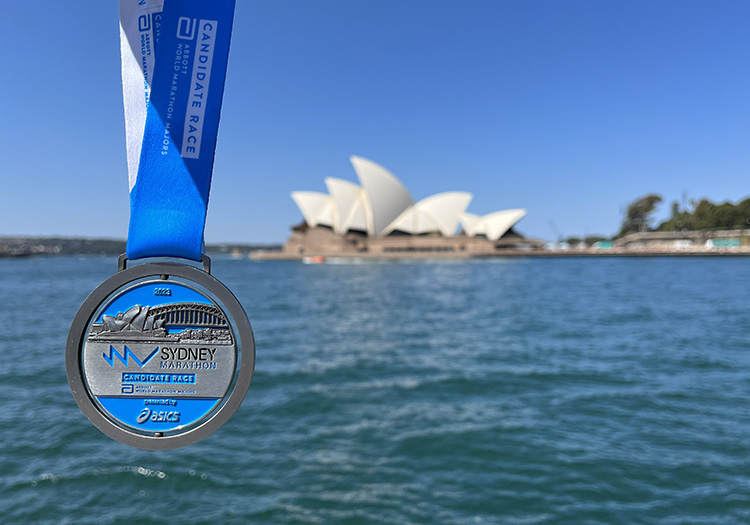
2023 Sydney Marathon medal with Opera House backdrop

SWAG: As a medal maniac coming from a country that tends to (over)emphasize its race swag, I like to temper my expectations for international races. Sydney, however, rose to the occasion with a more attractive finisher medal than any of the other three international Majors, a sky blue-and-silver-plated souvenir that smartly depicts—as it should every year, like the Boston unicorn—the Sydney Opera House and Sydney Harbour Bridge. The medal also includes the Abbott World Marathon Majors logo below the label “CANDIDATE RACE” as a reminder that no, you didn’t earn a star for your efforts this time (jk Sydney!). Fortunately, ASICS signed on as the presenting sponsor in the months before the marathon so the short-sleeve, navy blue finisher shirt—which, as the name implies, was available at the finish line—likewise turned out to be a pleasant surprise, even if ASICS ran out of time to produce much else in the way of marathon merch before race day.

RaceRaves rating:
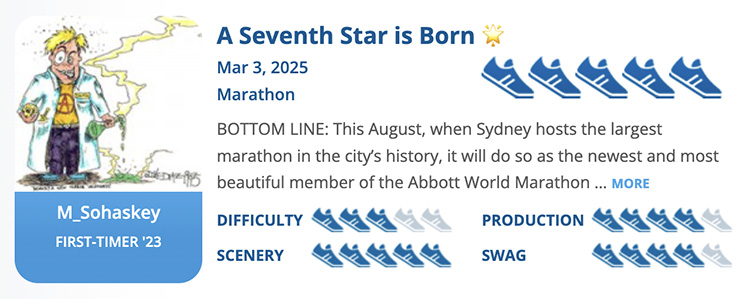
FINAL STATS:
Sept 17, 2023 (start time 7:10 am)
26.47 miles in Sydney, NSW, Australia (continent 6 of 7)
Finish time & pace: 4:08:14 (first time running the Sydney Marathon), 9:28/mile
Finish place: 4,384 overall, 231/687 in M(50-54) age group
Number of finishers: 13,297 (9,574 men, 3,680 women)
Race weather: warm & clear (63°F) at the start, hot & clear (82°F) at the finish
Elevation change (Garmin Connect): 2,012 ft gain, 2,161 ft loss
Elevation min, max: –78 ft, 245 ft

Screenshot

The biggest temptation on the London Marathon is to run into a pub along the route.
– Joe Strummer (The Clash), 1983

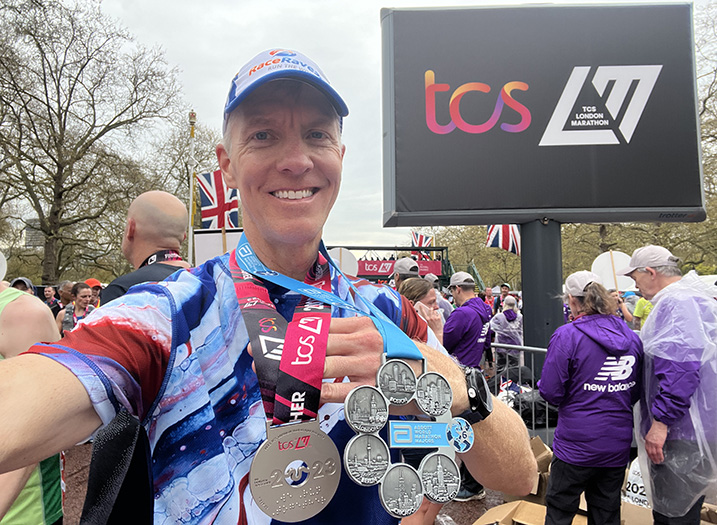
Mike Sohaskey with London Marathon and Six Star medals 2023

Rarely does a marathon go according to plan. It’s a universal truth I learned—and learned to accept—long ago. For every finish line you cross, there’s always something that could have gone better, whether it’s something you can control like your nutritional intake, or something that’s totally out of your hands like the weather. Some race days, you’ll wake up feeling born to run; other times you’ll realize before you can even break a sweat that it’s not your day.

With 50 marathons under my belt as I write this, I’ve experienced all of the above and more. But I’d never experienced anything like London.

By all accounts, my arrival in London should have been cause for personal celebration. Most importantly, it would be the triumphant finale to my decade-long goal of completing all of the Abbott World Marathon Majors, a wildly popular series comprising six of the world’s largest marathons: Berlin, Boston, Chicago, London, New York City and Tokyo. Runners who complete all six marathons—in no particular timespan or chronology—earn the highly coveted Six Star Medal, which to my mind may be the most beautiful medal in the sport. It’s a magnificent piece of hardware, though whether it’s ultimately worth the time, effort and resources required to earn it is a highly personal question each runner has to answer for themselves. So far, for 12,772 motivated marathoners (including 2,866 U.S. finishers) through 2023, the answer has been an unqualified yes.

Not only would London be my sixth World Marathon Major, it would also be my first marathon in more than 16 months after a ruptured Baker cyst behind my knee, followed in short order by a bone bruise in my lower leg, sidelined me for the entire 2022 racing season. Those 16 months were the longest I’d gone without running a marathon since—well, since I’d first run a marathon in 2010.

If the term “bone bruise” sounds to you—as it did to me when I first heard it—like a “rub some dirt on it” type of injury, trust me it’s not. Case in point, pro basketball player Kendrick Nunn missed the entire 2021–22 NBA season with a bone bruise in his knee. Basically, as I understood it, my bone bruise was a result of edema (swelling) within the bone that would subside gradually on its own over the course of several months. In my case, my orthopedic surgeon’s best guess was that my particular injury had resulted from the repetitive stress/overuse of distance running coupled with very tight hamstrings, which attach to the lower leg more or less at the site of the injury.

Mike Sohaskey & Katie Ho at 2022 Surf City Half Marathon finish
My only finish line in 2022 was a bru-tifully slow Surf City Half Marathon

The funny (in the non-amusing sense of the word) thing was, most of the doctors I saw on my road to recovery assumed that, regardless of what they told me, as a crazy runner guy I’d be back out running in no time, injured or not. My physical medicine doctor told me the story of one runner who’d come to him in severe pain after injuring her knee, but rather than play it smart and give her body time to heal, she’d requested the doctor do whatever he could (within ethical limits) to enable her to run the upcoming Boston Marathon. I assured him Boston wasn’t on my schedule; at the same time, he didn’t increase his credibility by hypothesizing with conviction—before I ultimately insisted on an MRI—that I’d torn my meniscus and by advising that maybe it was time for me to stop running marathons and limit myself to shorter distances. Had I thought about running 10Ks instead?

And that’s when I stopped listening—he may as well have told me it was time to amputate.

Instead, I split the difference. With my ultimate goal being a return to running marathons, I opted to take a patiently impatient approach to rehab & recovery. I also insisted on having an MRI, because with hard tissue injuries you can’t treat what you can’t see. After finding an orthopod I trusted and receiving an actionable diagnosis, I gave my leg ample time to heal while ramping up my strength training regimen.

Never did I imagine I’d get so much value out of my gym membership. Day after boring day, as I worked diligently to stay in shape and recover from injury, I focused on my strength and flexibility while trying to stay motivated with audiobooks like Rebound: Train Your Mind to Bounce Back Stronger from Sports Injuries. Mentally I recalibrated my expectations and my day-to-day definition of success, even replacing my long-time disdain for the stationary bike with, if not eagerness, then at least appreciative apathy.

Five months after my initial injuries I cautiously returned to running, shuffling along the beach like a tentative toddler between the soft sand near the bike path and the firmer sand at the edge of the water. After a calf strain suffered on the uneven terrain sidelined me for another frustrating few weeks, it wasn’t until November that I started running indoors on a treadmill, extending those painfully tedious sessions to nearly an hour before I finally—and with a heavy dose of hesitation—transitioned back to paved surfaces and my usual running routes. Maybe not the best analogy here, but with that first healthy run on the bike path, I felt like I’d been released from prison and a whole new world had just opened up to me.

And with that, training for the 2023 London Marathon had officially begun.

Mike Sohaskey running in Maui
The good news? Rehab included plenty of miles on the beach

The Comeback is Greater than the Setback
As the final piece in a much larger puzzle, London struck me as the perfect comeback marathon because success would mean completing the World Marathon Majors and collecting my Six Star Medal. Nothing like a meaningful win coming off a year-long injury to lift the spirits. The marathon itself mattered very little in the grand scheme of things, which was ideal for another, more ignominious reason: London was the first marathon I’d entered that I didn’t want to run.

I’d chosen each of my first 47 marathons specifically because I’d wanted to run them—after all, isn’t that the point of this silly hobby? Even for the first five World Marathon Majors (Chicago in 2012, Berlin and New York City in 2014, Boston in 2016 and Tokyo in 2019), I’d looked forward to each and every one of them and the opportunity they’d afforded me to visit amazing cities like Berlin and Tokyo. Tokyo (or more accurately, Asia) had even doubled as my fifth continent.

Not so with London, which is ironic given that the race is arguably the most popular marathon on the planet. In 2023, 410,000+ people entered the “ballot” (i.e. random lottery) in the hopes of securing one of approximately 20,000 slots, an acceptance rate of less than 5% which qualifies London as the world’s most sought-after marathon. Like many runners, I’d gotten so accustomed to London Marathon ballot failure year after year that I’d simply started referring to the process as “my annual commiserations” (the word used in their mass rejection email).

Ultimately, I knew that unless I got wildly lucky in the ballot, I’d be traveling to London with our tour operator friends at Marathon Tours & Travel, the same team with whom we’d traveled to Antarctica in 2013, Berlin in 2014, my first Comrades Marathon in 2017, and Tokyo in 2019. Due to high demand, Marathon Tours has its own priority selection process for London; however, given my standing as a long-time member of their Seven Continents Club, I could be confident that my acceptance was all but assured whenever I chose to run London.

Marathon Tours group at Albert Memorial in Kensington Gardens, London
Friday city tour w/ Marathon Tours (Albert Memorial in Kensington Gardens)

Don’t get me wrong—every time I lace up my running shoes, I am incredibly appreciative for my health and privilege and for the opportunity to do what I love. And that appreciation extends without exception to every race I run, London included. But appreciation is not the same as anticipation, and I simply could not wrap my mind around London, for two big reasons.

First, every World Marathon Major is a ginormous production of epic proportions that requires hours of careful planning and choreography just to reach the start line. Chicago and Tokyo were the easiest to navigate, as I was able to walk from our hotel (or in the case of Chicago, my friend Pete’s house) to the start line. New York was the most elaborate, requiring as it did two segments by land (subway, bus) and one by sea (ferry), followed by a lengthy wait at the start line on Staten Island.

So even before the starter’s pistol fires, each of the World Marathon Majors is to varying extents its own test of endurance. And for a life-long introvert like myself, the process can be equal parts invigorating and exhausting. As I’d learned the hard way in the lead-up to Marathon Monday in Boston, much of the energy I typically conserve for the marathon gets sucked away in the hectic days leading up to the race itself. So then by the time London 2023 rolled around, I’d had my fill of oversized marathon productions in general and the World Marathon Majors in particular.

The second reason I was less than thrilled to be running London, aside from the opportunity cost (I could instead have been running Providence, RI as my 36th state), was that I simply didn’t want to be there. This may not endear me to my British friends, but London is one of the world’s most overrated cities. With notable exceptions, it’s a gloomy (in April in particular), gritty, land-locked combination of old—check that, historic—grandiose architecture and incongruous contemporary design dominated by an anachronistic culture of royal entitlement and outdated traditions. Most of what we’d learn on our pre-race tour of the city would center on the monarchy, a topic I actively endeavor to know nothing about. I couldn’t tell you who came from who’s womb, who married whom, or who’s in line for what title by birthright. I’ve not seen a single episode of “The Crown,” or “Bridgerton,” or “Downton Abbey,” or even “Game of Thrones.” I don’t care for castles. I’m not a fan of palaces. I don’t like tea, or “pigeon sweat” as fellow American Ted Lasso sagely refers to it. I’m not big on bland cuisine. And most of what I know about Harry and Meghan I learned from watching a less-than-flattering South Park episode.

(Fortunately, recent numbers suggest the pomp and circumstance of the monarchy is wearing thin on even the Brits themselves at this point.)

LEGO London Beefeater and Queen Elizabeth II at Hamleys
Everything—British monarchy included—is better in LEGOs (seen at Hamleys, the world’s largest toy store)

Even the River Thames—a murky waterway that, like a distended serpent, traces a slow and sinuous path through the heart of the city—is overhyped, though not through any fault of its own since the river is flanked on either side by concrete embankments and urban overkill.

All that said, I understand London is a perennial favorite of travelers worldwide (and Russian oligarchs favor it as well); likewise, its marathon is arguably the world’s most popular. And I respect all the love that London gets, I really do. But I prefer cities that offer some semblance of natural beauty—attractive green spaces, for example, or an active harbor, or maybe even a coastline. As Olde World (i.e. European) cities go, I loved Berlin—the city more than the race—with its world-famous Tiergarten as the dynamic centerpiece of the city. Different strokes for different folks, I reckon.

So then why not wait on London? Because given my extended injury and the nagging uncertainty of how my untested leg would respond to the distance, I wanted to ensure I got the most out of my remaining mileage. That meant completing the World Marathon Majors, stat. And that meant running London now. With 15 U.S. states and two continents still remaining, the sixth World Marathon Major was the lowest-hanging fruit available to me. And honestly, 10+ years after running my first Major in Chicago, it was time to seal the deal.

There would be a silver lining to my London experience—thanks to an off-handed comment on social media, sometime in March I’d discovered that my long-time friend, travel companion and frequent RaceRaves graphics consultant Matt would be in London to support his brother Paul’s own Six Star journey. Paul, a member of New York Road Runners, would be running to capture his 4th star in the series, with only Boston and Tokyo remaining. This heartening nugget of good news raised my spirits and amped up my interest in London considerably.

Mike Sohaskey at 2023 London Marathon expo

London Calling 🇬🇧
So it was that by the time we touched down at Heathrow Airport on Thursday, three days before the 43rd London Marathon, for better or worse I was crackling with pent-up marathon energy. Certainly I felt as prepared as possible, having ramped up my training as much as the residual scar tissue in my lower leg would allow and having run two solid half marathons in the past two months, including a comfortable 1:50:02 finish at the Oakland Half in March. But I worried that the sheer adrenaline of race weekend in London coupled with the anticipation of running on such a huge stage after such a long layoff would prove tough to temper.

Our Marathon Tours package included lodging at the swanky InterContinental London Park Lane in the upscale neighborhood of Mayfair and in close proximity to the city’s main attractions including Buckingham Palace, site of the marathon finish line. Dropping our bags at the hotel, we hopped the Tube (i.e. the London Underground or subway) and headed to the pre-race expo in an attempt to avoid the claustrophobic crush of crowds and slim pickings of race merchandise that are Friday and Saturday at the World Marathon Majors.

Mike Sohaskey at Abbott World Marathon Majors booth at the 2023 London Marathon expo

London is home to an estimated 9.65 million people, more than any U.S. city, and at any given time it feels like most of them are packed into the Tube. Every train seemed to be operating near capacity during our stay, and I’d quickly tire of leaving daylight behind and descending by escalator or stairs deep into the subterranean bowels of the city, only to board another subway car filled with silent faces cast downward to avoid eye contact. (In fairness, I’m typically a fan of public transit but dislike the New York subway for the same reason.)

Located an hour from our hotel and across the city in the ExCeL Centre, the expo (aka the London Marathon Running Show) was as massive as expected. At the same time, the floor plan—which included registration tables, vendor booths and speaker stages—was masterfully laid out to optimize the flow of foot traffic. The only (strategic) bottleneck would come immediately after packet pickup and before the main body of the expo, as all runners were channeled through the New Balance sponsor booth where official race merch could be purchased, much like the familiar gift shop located at the exit to each Disneyland attraction. The ploy admittedly worked on me, as I came away with London Marathon-branded shoes, running tee and light jacket for running in the rain—the latter a must-have for someone who lives in drought-prone Los Angeles. Typically I don’t buy merch for the World Marathon Majors because seemingly every runner owns a Boston Marathon jacket or New York City Marathon tee that they wear every chance they get. And yet, given my appreciation for simply being in position to run again after 16 months of uncertainty, I couldn’t help myself.

London Marathon New Balance shoes & medal

On Friday morning, we boarded a charter bus for a guided tour of the city with our Marathon Tours group. Though not usually an aficionado of these types of tours, I’d found the analogous tours in Berlin and Tokyo to be informative and educational outings that provided a compelling overview of each city, much more so than we would have gotten on our own.

The tour featured its share of centuries-old landmarks, red-brick facades and commissioned statues under gray skies and a steady drizzle. Our guide offered frequent references to royalty past, present and especially future, as the Coronation of King Charles III would take place two weeks after the marathon. As such, the grounds of Buckingham Palace—as well as many of its usual photo opportunities—were marred by the rows of temporary seating and fencing already in place for the Coronation. Though we missed the Changing of the Guard ceremony on our tour, Katie and I would see a curious sight the next day as a member of the King’s Guard strolled leisurely away from the palace through Green Park in full uniform.

It was on casual walks like this, overhearing random snippets of other conversations, that I discovered my favorite thing about London: with upwards of 300 languages and dialects spoken, London is one of the world’s most cosmopolitan cities. I was fascinated by the sheer number of people in this English-speaking city for whom English was not their native language, and coming from Los Angeles I felt strangely as ease.

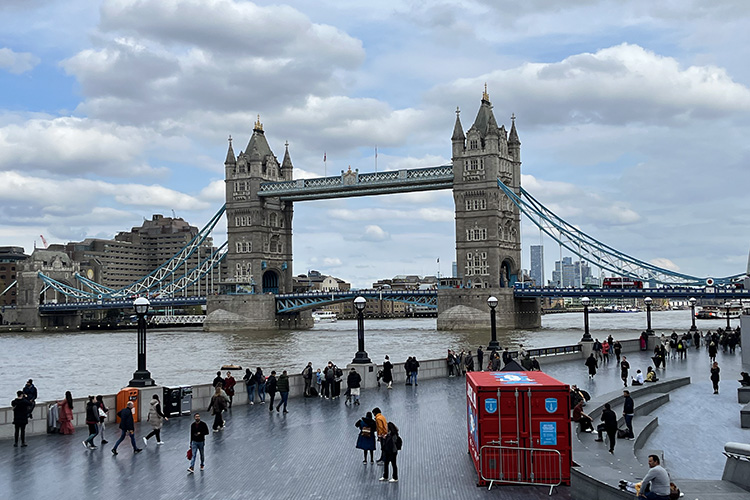
After stops in and around Buckingham Palace, St. Paul’s Cathedral and Tower Bridge, the bus dropped us off at the race expo, which as expected was now significantly more crowded than the day before. There we took the opportunity to meet and chat with Wayne Larden, the race director for the Sydney Marathon. Sydney is currently vying to (and likely will) become the 7th member of the World Marathon Majors and the Southern Hemisphere’s first Major, and we (i.e. RaceRaves) would be working with Wayne and his team to raise Sydney’s profile among our largely American audience of runners.

Katie and I then took a more leisurely stroll of the expo than we had the previous day, stopping by vendor booths (including the Cape Town Marathon, another World Marathon Major hopeful) and listening to a couple of insightful talks on the speaker’s stage to help me prepare for Sunday.

St. Paul's Cathedral, the tallest building in London from 1710-1963
St Paul’s Cathedral, the tallest building in London from 1710–1963

Saturday began with a dry cough and sniffle. Dismissing my symptoms, which I attributed to either the joy of pre-race tapering or the reality of being a stranger in a strange land, I headed out for a slow 30-minute shakeout run across the street from our hotel in Green Park. The area around Buckingham Palace was crowded and inaccessible due to in-progress races for the boys, girls and wheelchair / handcycle athletes that signaled the start of London Marathon weekend. After my run we met briefly with my friend Matt, whose brother Paul would be running London as his fourth star, to discuss the next day’s spectating strategy.

Given our shared apathy toward castles, Katie and I chose to skip the day’s group trip to Windsor Castle, home to British royalty for more than 900 years and the final resting place of Queen Elizabeth II. Instead we took a short Tube ride to Covent Garden, a high-end shopping and dining district in the city’s West End. Covent Garden boasts 200+ shops, restaurants and street entertainers—including the Jubilee Market Hall featuring a variety of crafts, antiques and collectibles—all laid out around a pedestrian-friendly piazza (public square). Having satisfied my need for retail therapy at the pre-race expo, we strolled idly along the busting brick and cobblestone streets, killing time and always with one eye on a sky that looked ready to rain on our parade at any moment.

Covent Garden flower cart

That evening we joined our Marathon Tours group for a pre-race pasta dinner in the hotel ballroom. Not surprisingly it was a large affair, with the Marathon Tours team hosting 450 runners along with 650 guests in London. Sydney Marathon Race Director Wayne Larden, whom we’d met at the expo a day earlier, was the evening’s guest speaker and shared Sydney’s ambitious plan to become the 7th World Marathon Major in the next few years. Right then and there, we resolved to join him in September to support his efforts and to see for ourselves what Sydney was all about while also notching my 6th continent.

Chatting with many fellow runners at the dinner, I was reminded of a truth I’d almost forgotten since my last World Marathon Major in Tokyo in 2019—the folks you meet at World Marathon Majors, the ones vying for Six Star glory, are a different breed than even the usual crazy marathon runner. The series clearly attracts Type-A personalities. Six Star hopefuls tend to be single-minded of purpose and hyper-focused on finishing the Majors as soon as possible. To many of the folks I met, their Six Star journey was all-consuming and their running plans had been—if not derailed, then at least hijacked—by their obsessive pursuit of the Six Star Medal. Until they crossed that 6th and final finish line, nothing else mattered.

Whereas I’d leisurely run the six Majors over the course of more than a decade—in fact, I’d run my first three in Chicago, Berlin and New York even before the introduction of the Six Star Medal—most of the runners I met in London and Tokyo had charted a much more abbreviated and intensive course. At the same time, many bemoaned the difficulty of qualifying for Boston, or the challenge of getting into Tokyo and London via the random lottery, or the overall cost of the Six Star journey. The longer each person’s timeline, it seemed, and the more their expenses and injuries mounted, the more it became about the destination rather than the journey.

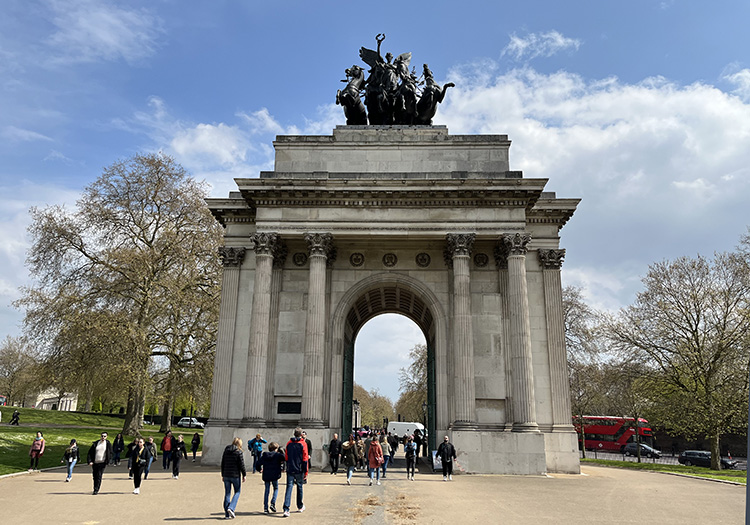
Wellington Arch in Green Park
Wellington Arch in Green Park, seen on my pre-race shakeout run

As much as I value the opportunity to visit each of the six cities and run each of the six races, for me the hype of the World Marathon Majors has always exceeded their appeal. They are in large part social media monstrosities, and the epiphany for the World Marathon Majors team came with the realization that nothing in the sport of running inspires greater FOMO than the Six Star Medal. I’ve been incredibly fortunate to run all six, but if I’m being honest, I’ve gained more joy from my quest to run in all 50 states and on all seven continents. And my two finishes at the Comrades Marathon in South Africa stand as arguably my proudest achievements.

For this reason, having saved (to my mind) the least for last, London felt like an anticlimactic ending to my World Marathon Majors journey. But an ending nonetheless.

After dinner we headed up to our room, where we truncated our sleep time by roughly 20 minutes after plugging too many electronics into our voltage converter and blowing a fuse, thus plunging our room (and apparently the room next door) into darkness. Fortunately the hotel was able to dispatch electricians quickly to our room, even on a Saturday night, and they resolved the issue in short order. Clearly you get what you pay for at the InterContinental London Park Lane, as that’s certainly not the response we would have expected from a Hampton Inn in the States.

Six Star Medal, the Holy Grail for many marathon runners
The Six Star Medal is the Holy Grail for many marathon runners

The Calm Before the Storm
With the arrival of Sunday morning, I awoke in darkness to an uneasy sense of relief. Race day, at last! I’d slept off and on for maybe four hours; fortunately, the test of the National Emergency Alert System that we’d been told to expect at “3:00” had not interrupted my already fitful sleep.

My dry cough and congestion had worsened slightly overnight, but there was nothing to be done about that now. My real concern was something I’d experienced only once before, on the morning of the Boston Marathon seven years earlier—profuse, uncontrollable sweating. Try as I might, I couldn’t stop perspiring. I don’t sweat much even in the heat, and we’d kept our hotel room on the cooler side, so this was seemingly a case of too much race-day adrenaline. The same situation hadn’t boded well in Boston, and I could only hope this didn’t portend a repeat of that near-disaster. Turns out I was right to worry.

I drank plenty of water, then polished off a quiet breakfast of peanut butter toast, coconut yogurt and granola in a dining hall heavy with groggy, nervous energy, before saying my farewells to Katie and loading onto the 7:30am shuttle bus for the meditative 30-min drive to Greenwich Park. Not being in a talkative mood, I was lucky to find myself seated next to a Polish fellow who scrolled on his phone for the duration of the journey.

Cherry blossoms in Greenwich Park at start of London Marathon
Is this Tokyo? Cherry blossoms greeted us in Greenwich Park

Testifying to the sheer magnitude of the London Marathon, the race deploys four designated starting areas. My starting area, the red area located in Greenwich Park, would be the largest of the four with 32,000 starters. Pulling up to the park at 8:00am, we deboarded and I wandered the large, grassy expanse until I found a strategic place to stretch out on the sidewalk close—but not too close—to the Portaloos. (This is one facet of race day where London stuck the landing, with row upon row of clean Portaloos stretching toward the back of the park to prevent painfully long wait times). There I sat conserving my energy, nibbling on an energy gel, and texting Katie until cell phone reception became untenable due to the sheer number of people on their phones in Greenwich Park.

As I sat watching the sky and awaiting my 10:15am-ish start time, I could hear but not see the PA announcer for the BBC who was practically begging folks in the park to join him “on the telly” for the live broadcast. Judging by the urgency in his voice, he didn’t have many takers. Clouds gradually obscured the once-promising blue sky and by 9:15am, as I watched runners of all shapes, sizes and shoe models idle about killing time, a light rain had begun to fall. Because this was London, and I wouldn’t have had it any other way.

After one last Portaloo visit, I headed straight to the kitbag lorry (i.e. bag drop) where I stuffed my pullover and gloves into my bag, handed the bag to a volunteer, and made my way through the crowd of randomly diffusing bodies toward the sign that welcomed Wave 2 runners for their designated 10:17–10:21am start time. While waiting, I chatted with a couple of runners who (prematurely) congratulated me after seeing the sign pinned to my back that announced London as my 6th and final Star. I’d been given the sign by the folks manning the World Marathon Majors booth at the expo.

London Marathon and Six Star race bibs

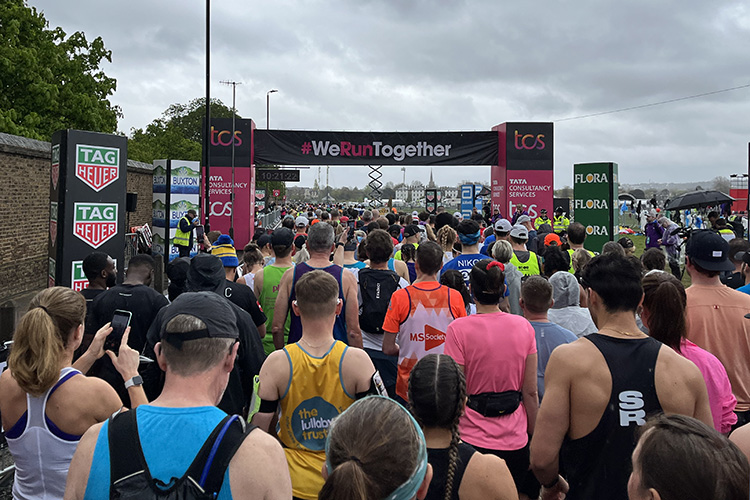
The trees provided some protection from the rain as we stood on the wet grass, waited, shuffled forward, waited, shuffled forward again, waited, and finally shuffled forward onto the road where the official start line came into view. This is it. Glancing around I couldn’t see a pace group for 3hrs50min (3:50), my best-case scenario finish time, which meant I was on my own. In retrospect, I wish I’d been more—let’s say generous—on my race registration and had predicted a speedier 3:30 finish time to get myself closer to the front of the pack and avoid the chaos that awaited.

I took a few deep breaths to clear my lungs as the starting airhorn sounded, and we watched on the big screen set up alongside the road as runners in Wave 2 crossed the start line. Moments later we were doing the same as one massive, metronomic organism surged across the start line in Greenwich Park and set its sights on Buckingham Palace.

More than ten years after my first World Marathon Major in Chicago, I’d reached the beginning of the end.

London Marathon Greenwich Park start line
“GO” time in Greenwich Park

A Marathon Like No Other
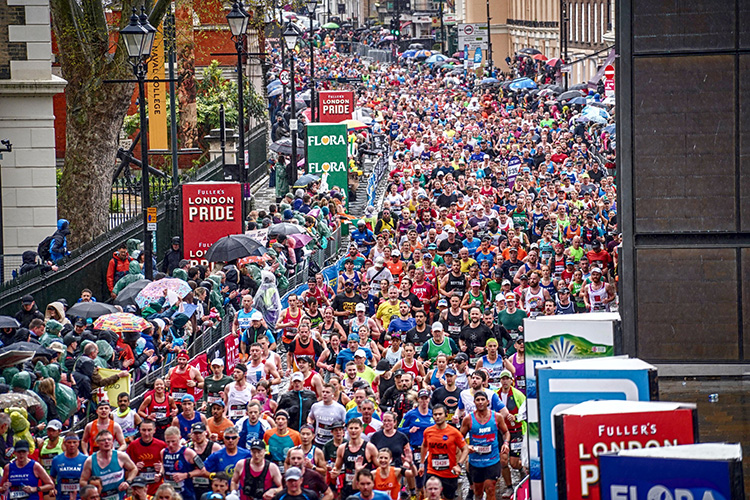
A light but steady rain was falling as we exited Greenwich Park into the residential neighborhoods of Vanbrugh Park, passing tightly packed rows of multi-story brick flats with gabled roofs set close to the narrow street. Even here in the early miles and in the rain, spectators already lined the route. I made a point of high-fiving several kids in the opening couple of miles to help slow me down and ensure I kept my pace in check. Above all else today, I wanted to try to enjoy the moment.

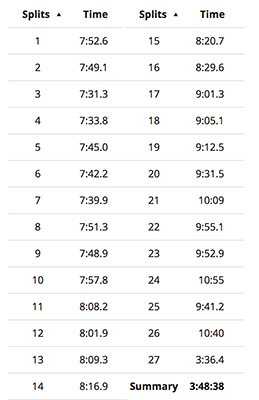
Before the race, I’d struggled with the question of expectations and had ultimately conceded an “A” goal of a sub-4-hour finish, a reasonable time based on my training. This was due in large part to the fact that I’d run each of my previous five World Marathon Majors in less than four hours, with Boston being my slowest at 3:48:36. In reality, I had no idea what to expect from my recently injured leg, this being my longest run since Dallas in Dec 2021. My “B” goal I set at sub-4:15, while my “C” goal would be to finish and finish healthy, since being able to run 26.2 miles on a healthy leg was my biggest goal of all.

Smart, closely spaced flats transitioned to retail establishments transitioned to less attractive residences and more commercial neighborhoods. These early miles struck me as the typical urban/suburban juxtaposition with a pinch of Victorian sensibility. Fast-forward a month or so, and I could imagine this area would come alive in the full bloom of spring; now, however, under leaden skies, the overwhelming impression was a muted palette of grays and browns.

Glancing to my right in mile 3, I saw a sight that caused a momentary surge of angst as runners from the other start lines merged with us to form one steady stream of traffic. I’d already found the slick, narrow roads leading out of Greenwich Park to be a tight fit for so many runners, and our numbers would only increase with these new arrivals. Which meant increased vigilance to avoid stepping on and being stepped on by other runners. I knew from experience (in Houston for example, where I was the final marathon starter by design) the energy required to navigate throngs of runners, and so I knew I had to tread carefully and avoid riding the brakes to try to conserve my quads.

Mike Sohaskey and Katie Ho in front of Buckingham Palace
If you don’t have a photo in front of Buckingham Palace, did you really visit London?

But that was easier said than done. More nondescript urban scenery passed, but the scenery was secondary to my immediate surroundings as I focused on my footing in the rain, on avoiding the feet of other runners constantly cutting in and out of my path, and on the boisterous crowds lining each side of the street. In fact, I’d seldom been less focused on the local scenery during a marathon. I frequently found myself having to weave around other runners and run through swinging elbows to keep my pace. It was a claustrophobic feeling and particularly for someone like myself who prefers smaller, less crowded races.

Seeing a familiar sign for a popular American sandwich shop, it crossed my mind: Shouldn’t Subway be renamed “Tube” here? This is the type of profound thinking that goes on during a marathon.

For a while, I did my best to follow the blue line on the road that signaled the shortest distance between the start line in Greenwich Park and the finish line at Buckingham Palace. After the merge with the other runners, though, it became too difficult to follow the line through the wall of bodies and limbs.

As we passed the University of Greenwich in mile 7, I experienced something I’m not sure I’ve seen in any of my nearly 50 road marathons, let alone in a World Marathon Major—without warning, we were forced to slow to a walk for several steps as the road narrowed dramatically owing to high water and the crush of spectators on both sides. I couldn’t believe it.

Mile 7 of the 2023 London Marathon
The Running of the Bulls in Spain? Close, it’s mile 7 of the London Marathon

Just past the university we detoured from our straight-line path to circle Cutty Sark, a 19th century British clipper ship and the fastest of its time. Our arrival at Cutty Sark in all its glory made me realize that this course was not particularly scenic—rather, its nondescript commercial and residential neighborhoods faded into the background as the massive, screaming crowds demanded and got pretty much all of our attention.

After Cutty Sark I tried to refocus my efforts and calm my jittery nerves, telling myself there’d be nothing else to see until Tower Bridge at the midway point. Well, nothing except the natural beauty of Katie and Matt at mile 9 alongside Surrey Quays. I barely broke stride as I passed and pantomimed taking a picture to suggest we take a selfie at our next planned meeting point in mile 15.

At some point the rain stopped, and in mile 10 I knocked back my first energy gel. My stomach wasn’t especially happy with my decision, but then again that wasn’t unusual, and for now it was more important to try to stick to my nutritional plan.

Cutty Sark at mile 7 of London Marathon
Cutty Sark awaits at mile 7

Running in this chaotic stampede was starting to take its toll, and I recorded my first 9-minute mile in mile 10. Still, I resolved to stay focused and maintain my current pace for as long as possible. Giving up a few seconds per mile wouldn’t be a problem and was, in fact, something I’d expected in the course of the race. I’d just hoped it wouldn’t happen this early.

Three times in London I remember running through a cloud of cigarette smoke, an unpleasant sensation that hearkened me back to Berlin, the only other European city in which I’ve run and, perhaps not coincidentally, the only other race where I’ve run through cigarette smoke. Later in the race the unmistakable stench of grilling meat wafted past my nose, reminding me of the many tailgate-style cheering parties encountered along the 90km route at the Comrades Marathon in South Africa.

In mile 12 I glanced up serendipitously to get my first look at the soaring spire of The Shard, the tallest building in Western Europe, before a hard right turn brought the arches of Tower Bridge into view directly above and ahead of us. As most London Marathoners will acknowledge, despite only spanning 0.15 miles the awesome architectural marvel of Tower Bridge is the hands-down highlight of the entire day—and for me, the entire city.

Tower Bridge, the architectural highlight of London

The spirited spectators lining the bridge were several deep and full throated, propelling us along by sheer force of sound. The decibel levels on Tower Bridge alone would have put Wembley Stadium to shame. And while I tried to enjoy the moment and smile for the photographers I knew would be there, my primary focus was on staying calm and breathing rhythmically, as I had begun to feel like a balloon that was slowly losing air. On the bright side, the wide-open stretch across Tower Bridge was a welcome reprieve from the claustrophobic feel of the first 13 miles.

I clawed back a bit of momentum coming off the bridge as we started the “out” portion of the out-and-back (because this course wasn’t narrow enough?) along The Highway into East London. Here we saw our much faster counterparts (already in their mile 22/23) as they passed us in the opposite direction, which I always enjoy and which prompted a surge of adrenaline.

Mike Sohaskey running on Tower Bridge, mile 13 of London Marathon
Running elbow to elbow on Tower Bridge, mile 13

London was consistently the loudest marathon—and the loudest race—I’ve ever run. To be sure, each of the other five Majors boasts its own raucous crowds. London, however, was far and away the most overwhelming of the six, in large part because the spectators felt like they were on top of the course and inches from your head at all times, as I’d imagine being near the track at a NASCAR event must feel. It was like a 26.2-mile pep rally.

There were cowbells and kazoos and music and confetti cannons. And there were drums, LOTS of drums. Steel drums, taiko drums, drum ensembles, even a fellow banging away enthusiastically on his own enormous drum, no doubt much to the chagrin of the eardrums around him. Because what better way to maximize your noise-making potential?

Not only is London arguably the loudest marathon in the world, but it’s also become a proving ground for costumed runners, a significant number of whom come chasing world records. As such, London is now the marathon of choice for incognito runners. I saw runners dressed as Big Ben, as a Fuller’s London Pride Amber Ale, and as a conspicuously tall blue Na’vi from the movie Avatar. I saw a few rhinos (supporting a “Save the Rhino” charity) and a few dinosaurs (unclear if there was a “Save the Dinosaur” charity). I saw lobsters, owls, an unidentified rodent, automobiles, ballerinas, a legion of superheroes, a bone, a tooth, and a host of more intricate group costumes that involved two or more individuals running while connected together. For a while I ran near a two-legged Blackpool Tower that seemed to be running on fumes.

When the dust and accessories settled, 44 costumed runners set Guinness World Records at the 2023 London Marathon. These included fastest marathon dressed as a fairy tale character, fastest marathon dressed as a Christmas cracker, fastest marathon dressed as a body part (do you really want to ask?) and my personal favorite, fastest marathon dressed as a scientist. But the most well-supported runner at London 2023 had to be the woman who broke the world record for most underpants worn during a marathon. Her mum must be beaming with pride.

Costumed runner at 2023 London Marathon
Beer-lieve it or not, sightings like this are common in London

But if 44 costumed runners set world records, that meant all the other costumed runners on the course did not. And with all due respect to the record-setting lumberjack and the world’s fastest insect, the bloke who shows up at a marathon start line dressed as a lighthouse tends not to be the most, well, focused runner. As if London’s narrow roads weren’t enough of a challenge, many of the costumed runners on the course seemed to give little thought to the personal space of their fellow runners, specifically how their elaborate costumes may impinge on that space.

But wait, there’s more! London runners also get the opportunity to run alongside a sizeable number of first-time marathoners, since the race is incredibly popular with runners looking to check “marathon” off their bucket list. Which is brilliant, since I’m of the mind every able-bodied individual should run at least one marathon in their lifetime—after all, if you can run a marathon, who can say what else you may be able to achieve? And you can’t become a second-time (or 50-time) marathoner without running your first.

With great endurance, however, comes great responsibility. And for first-time marathoners, that means understanding the rules of the road. Unfortunately, the runner etiquette in London—which I’m assuming was due in large part to careless first timers—was as bad as any I’ve seen at a big-city marathon, much less a World Marathon Major. Sure, I recall in New York having to swerve around a runner or two who’d come to a sudden stop right in front of me. But the hijinks in New York were nothing compared to London, which felt a lot like amateur hour at the races.

Big Ben
Big Ben is London’s *other* architectural highlight

A Tragedy of Errors
One of the unwritten rules of crowded marathons is that you stay in your own lane. Yes, you’ll need to pass other runners and pull over for aid stations and the like, but for everyone’s safety erratic or unpredictable navigation should be avoided. In London, though, runners bobbed and weaved back and forth across the course like punch-drunk boxers, often not bothering to look while misjudging the speed & trajectory of surrounding runners. People accelerated and decelerated suddenly and without warning, like a child’s remote-control car.

In addition, and unlike every other World Marathon Major, London hands out full plastic water bottles at aid stations rather than drinking cups, a practice that only contributed to the problem (and to the world’s supply of plastic waste). Instead of tossing them off to the side of the course, runners would occasionally discard half-filled bottles by simply dropping them in full stride, the logical result of which was that same bottle ending up under the feet of the runner directly behind them with little warning. Similarly, I saw someone spit a mouthful of water toward the ground, only to have its trajectory interrupted by another runner’s leg. OOPS.

This was like the Keystone Kops in running shoes, a comedy of errors minus the humor. In contrast to my usual marathon, my eyes spent more time scanning the ground ahead for potential hazards than they did taking in their surroundings. In this sense, London felt more like a trail race than a road race. A new experience to be sure, and not what I’d expect from a World Marathon Major.

And despite all I’ve said so far, I certainly didn’t expect what happened next. As we approached Canary Wharf in mile 14 and shortly after I downed my second energy gel, a larger runner to my right waved at friends or family on the left side of the road before making the split-second decision to pull over and see them. Unfortunately, the shortest distance between those two points—him and them—was a straight line passing directly through me. Not the path of least resistance to be sure, but still the path he chose.

City of London financial district, including the distinctive 20 Fenchurch Street building aka the Walkie-Talkie
City of London financial district, including the distinctive 20 Fenchurch Street building aka the Walkie-Talkie (left)

Clearly he never saw the collision coming as he hip-checked me sideways, his momentum knocking me off my stride. I probably would have hit the ground hard had I not pinballed off another runner—I felt awful for them, but what could I do? Inertia and gravity don’t give a shit. I never heard an apology as I quickly righted the ship and, after offering a few expletives under my breath, continued on my way.

Thanks to that hockey-style hip check, my right foot now ached near the shin bone owing to a reawakened injury that had bothered me off and on during training but which had remained dormant to this point. And my heart was jackhammering thanks to a fresh surge of wasted adrenaline that coursed through my bloodstream and which, in turn, was followed by a wave of fatigue and nausea as my body struggled to recover from being treated like an unwitting bumper car.

On the bright side, my injured leg was none the worse for the collision.

Lead runner at 2023 London Marathon
Apparently crowded roads aren’t an issue when you run at near-world record pace

Looking for Katie and Matt in mile 15, I glanced up to see a sign announcing “Narrow St,” though whether this was simply a peculiar warning in a city where seemingly all the streets were narrow or rather a legit street name, I couldn’t be sure. As we circled Canary Wharf, near but not yet within view of the River Thames, I scanned the crowd for familiar faces while trying to gauge the discomfort in my ankle. Running among the soaring glass-and-steel skyscrapers of London’s central business district, it struck me again that during sunnier times, this was probably a very attractive area of a not-so-attractive city.

Apparently, as I’d discover after the race, Katie and Matt’s Tube station near mile 9 had been closed without warning between the time they’d arrived and the time they’d returned. So they’d had to rejigger their spectating plans on the fly, and I wouldn’t see them again until mile 19. Fortunately I knew the two of them were together, so I wasn’t concerned.

Prior to the collision, my pace had slipped above 9+ minute/mile, neither surprising nor alarming given this was my first marathon in 16 months. After the collision, though, the combination of a dodgy ankle and London’s overwhelming chaos began to take its toll. I couldn’t seem to find my groove, and in mile 17 I recorded my first 10-minute mile.

The London Eye & County Hall
The London Eye (left) and County Hall, the former seat of London government

It would only get worse from there. Sometime in mile 18, I was forced to stop on a dime as, without warning, another runner sidestepped in front of me and slowed to a walk. Slamming on the brakes to narrowly avoid a rear-end collision, I felt a sharp stab of pain in the same ankle I’d aggravated four miles earlier. I let loose a profanity that was drowned out by the surrounding tumult, but the damage was done. And now every step hurt. Gritting my teeth I pressed on, assuming this too would pass and the pain would subside as it always had.

Except it wouldn’t. Every stride was uncomfortable, and though I wasn’t concerned with doing further damage to my foot, I knew I couldn’t run another 9+ miles like this—and especially with no guarantees that the same thing wouldn’t happen again. I was in no shape to navigate other reckless runners. I was reminded of the only other time I’d run a race while injured, 10 years earlier at the ET Full Moon Midnight Marathon in Nevada when I’d twisted my ankle at mile 17 and run 9+ additional miles in the dark with what felt like a sandbag strapped to my ankle. That mishap had been my own fault. Fortunately this was not a sprained ankle, so I didn’t expect the same grotesque swelling as a result. What a fucking optimist I’d suddenly become.

Forty years earlier, Joe Strummer of the English punk rock band The Clash had run London, finishing in 4h13m and famously joking that â€œThe biggest temptation on the London Marathon is to run into a pub along the route.” At that moment, I couldn’t agree more.

Winston Churchill statue in London

“If you’re going through Hell, keep going” –Winston Churchill
Both the foot and my exhausted, adrenaline-addled body earned a brief respite when I paused for a selfie with Matt and Katie in mile 19, a much-needed pick-me-up. I managed a weak smile to hide my distress (a learned skill I’ve honed over the years), then limped on as I felt my foot tightening rather than loosening with every step. I was determined to keep pushing, to reach the mile 20 marker before I stopped to walk and give the foot a break. More than anything, my focus now turned to one overarching goal—to finish the race without further injury.

Nonetheless, I forced myself to smile whenever I saw an official race photographer. That snapshot, that moment in time, may not tell the whole story—may not even tell the true story—but for most of us who don’t write painfully long race reports, years down the road as memories fade, it’s all we’ll have to remember the day. And the more races you run, the more adept you get at spotting photographers on race day.

Mike Sohaskey, Katie Ho & Matt L in Canary Wharf, mile 19 of London Marathon
Matt & Katie sighting in Canary Wharf, mile 19

Reaching the mile 20 marker as we exited Canary Wharf, I finally threw in the towel and slowed to a walk, taking a few deep breaths and gratefully accepting a bottle from the water station. I did a few knee raises and shook out my foot as I walked, the din around me now even more pronounced. A confetti cannon erupted near my head, feeling like a sonic boom.

I was so tired of the London Marathon—more than a year of rehab and training to get back to marathon fitness, and this was the marathon I was running? At the same time, I wanted to try to turn these gators into Gatorade by enjoying the remaining miles as much as possible. Otherwise, this last 10K threatened to become an all-out suckfest.

As healthy runners passed me by, several wearing the same “TODAY IS THE DAY! CHEER ME ON” 6th Star sign I wore on my own back, I fought back frustration—being forced to walk during a marathon is miserable, and a mile takes forever at a walking pace. Walking is a leisurely activity, and I was categorically not in the mood for leisure. It didn’t help that I couldn’t escape the noise, which now felt like it was coming from inside my skull. As an introvert I have a huge aversion to random cacophony—the shrieks of an unhappy infant, the roar of an airplane flying directly overhead, or the volume for volume’s sake that was the case here in London. Loud music I embrace, but noise without rhyme or reason makes my brain hurt.

On the bright side, to me the best part of race weekend was the money raised for so many worthwhile charities. London claims to be largest annual fundraising event on the planet, a credible assertion given the number of unsuccessful lottery entrants who secure a spot instead through charitable fundraising. I must have seen dozens of runners sporting the logo of the Great Ormond Street Hospital (GOSH) Children’s Charity, which was named the London Marathon Charity of the Year and which ended up raising more than ÂŁ1.8 million ($2.25 million) as a result.

The 3h45m pace group passed me… then 4h… then 4h05m, whom I knew had started in the wave behind me and so in my case was closer to 4h15m. And still I soldiered on.

Reaching the mile 22 marker I broke into a half-hearted run, the pain in my foot—and now the tightness in my quads from all the walking—precluding much more than a feeble jog. But at least this felt like progress, my exhaustion and aching foot notwithstanding.

We ended the out-and-back portion on The Highway and re-entered the City of London. Ahead of us, the distinctive edifices of the London skyline came into view including the gleaming, bullet-shaped Gherkin and The Shard, the tallest building in Western Europe and an architectural eyesore that towers above the city skyline. The splintered glass spikes that form the 1,000ft high spire of The Shard give the impression of a project left unfinished, a deliberate choice on the part of the designer.

The Shard dominates the London skyline
Love it or leave it, The Shard dominates the London skyline

Picking up my pace briefly for the cameras, I walked a portion of mile 23 past the Tower of London and the Tower Hill Memorial, the site of ~125 public executions (including 93 beheadings) from 1388–1780 and 11 executions by firing squad in the early 20th century. Neither landmark registered in my mind given that I was in sensory overload and each was obscured by the raucous crowds standing several deep along this stretch.

Again I broke into a jog as the course became even more claustrophobic, with increasingly tall buildings lining either side of the narrow street. Even the occasional darkened tunnel or underpass offered no reprieve from the high-decibel mayhem, as two knuckleheads insisted on filling these quiet interludes by echoing each other’s screams. I was in a waking nightmare.

In mile 25 we followed the Victoria Embankment along the riverfront. On the opposite bank of the Thames, the Ferris Wheel-like profile of the London Eye and the curiously curvaceous glass tower of “The Boomerang” dominated the cityscape, for better or worse.

Mike Sohaskey running by Tower of London & Tower Hill, mile 24 of London Marathon
A fleeting smile for the cameras at Tower of London & Tower Hill, mile 24

With roughly a mile to go, I ignored my barking foot and broke into a jog for the last time. I was determined to run the rest of the way, knowing the most boisterous crowds of the day were sure to be lining this final stretch. Approaching Big Ben, the Palace of Westminster (aka the House of Parliament) and Westminster Abbey, I felt a wave of appreciation wash over me as Neil Diamond’s “Sweet Caroline” filled the air, prompting runners and spectators alike to sing along in unison (“SO GOOD! SO GOOD! SO GOOD!”). Finally, I thought as I felt my body relax, motivation not aggravation.

Not realizing they’d be there, I didn’t see or hear Katie or Matt cheering as we turned directly in front of Big Ben and the Palace of Westminster. The two iconic facades commanded all attention, towering above us like the body and tail of London’s own Gothic Godzilla. Much like Tower Bridge, this magnificent stretch adjacent to Parliament Square was a course highlight that, together with Neil Diamond’s vocals resonating in my head, provided the decisive burst of energy needed to dig deep and focus on the finish.

Mike Sohaskey running in front of Palace of Westminister, mile 26 of London Marathon
Coming around the Big Ben(d) at the Palace of Westminister, mile 26

600m to go. The final countdown began as we cruised along tree-lined Birdcage Walk adjacent to St. James’s Park, where in October 2020 an elites-only edition of the 40th London Marathon had been staged during the pandemic. (It would be the only World Marathon Major held in 2020.)

400m to go. A right turn led us past Buckingham Palace and the rows of fenced-off Coronation seating. From there we wound our way around the Victoria Memorial, where the gilded bronze figure of Victoria, the Roman goddess of victory, watched over the exhausted runners from her perch atop the palace fountain. I couldn’t imagine a better sentry to herald our arrival.

200m to go. OMG, at last. Leaving Buckingham Palace behind, we turned onto The Mall for the final straightaway of my final World Marathon Major. Breathing a sigh of relief, I accelerated down a festive home stretch lined with gently fluttering Union Jack flags. Numb to everything but the finish line directly ahead of me, my pace dropped below 9:00/mile for the first time in hours as I tried to embrace the moment before crossing the line in an official time of… 4:25:22. YIKES.

Mike Sohaskey finishing the London Marathon
Ten years later, the final steps of my Six Star journey

The Sweet Smell of Six-cess
In the weeks before the race, I’d tried to visualize this crowning moment and anticipate the emotions of that sixth and final finish line. Much like Ralphie Parker dreaming of his Red Ryder BB gun, I’d imagined an epic sense of finality washing over me, the clouds (it was London, of course there’d be clouds) parting and a fanfare of trumpets sounding from on high as a single tear rolled down my cheek and I thrust my fists skyward, before sharing a high five with a jubilant King Charles in the triumphant conclusion to my decade-long quest for Six Star glory.

Turns out I may have seen too many Disney movies in my life. Because finding myself in a sea of sweaty finishers, I wanted nothing more than to collect my medals, hit the shower and get out of there. I felt devoid of any emotion except relief, my adrenal glands long since depleted of their signature hormone. After wrapping myself in a heat sheet (aka space blanket), I was handed a heavy bag of drinks and nutrition including an Oatbake that looked distinctly unappetizing.

Gratefully I accepted my London finisher’s medal before being directed by friendly volunteers to the Abbott tent. There, a good-natured representative with arguably the best assignment of the day hung the long-awaited and hard-earned Six Star Medal around my neck, appropriately covering my London medal in the process. At that moment, as I posed proudly for pictures with my sleek new hardware, I had to admit—the Six Star was a beautiful freaking medal. And the fiasco of the past four hours notwithstanding, it had all been worth it.

Crowded finishers area at London Marathon
The finishers area was even more crowded than the race itself

The two medals clinked together with every step, and I turned my London medal behind me to avoid sounding like a walking wind chime. After retrieving my drop bag, I shuffled through the densely packed throngs of runners and non-runners toward the family meet-and-greet area where Katie, Matt and his brother Paul presumably waited. Along the way I paused and sat for several minutes to rest my aching legs and arms (with two full bottles of liquid, my bag was heavy). And I struck up a brief conversation with a fellow from Thailand for whom this was marathon #50, with the goal of reaching 100.

As I resumed my stroll, everyone’s phones suddenly sounded in unison as the high-pitched siren of the National Emergency Alert System filled the air. So then the warning must have been meant for 3:00pm rather than 3:00am. Just another head-shaking misadventure in a day full of them.

Finding my group at last near the far end of The Mall, I threw my arms around Katie before meeting Paul for the first time. He’d run a great race, and I congratulated him on finishing in a personal best time of 3:29:39. I was happy to hear he’d had a positive experience in his fourth World Marathon Major, and I was reminded of my error in not estimating a faster finish time on my race application, since starting with the speedier runners presumably would have meant thinner crowds to contend with closer to the front and… who could say, really? A lesson for another day.

That evening, after eventually working our way back to the InterContinental London Park Lane via a convoluted route necessitated by all the Coronation infrastructure and road closures, Katie and I attended the Marathon Tours post-race reception in the hotel. During the reception, 14 new finishers were welcomed into the Six Star Hall of Fame—fewer than I’d expected in a group of 450 runners, and especially given that 376 new inductees earned their Six Star Medal in London this year.

Then we met Matt and Paul for an excellent dinner—a culinary and social highlight of our trip—at a Turkish restaurant named Sofra. And I was again reminded of why traveling to races—and particularly races that appeal to as diverse a swath of the population as the World Marathon Majors—is so often its own reward.

Shakespeare's Globe in London
Shakespeare’s Globe was demolished in 1644 and rebuilt in 1997

On Monday I awoke to another gray day and the realization that my cough and congestion lingered, worsened no doubt by the previous day’s exertions. Most tourist attractions in London require advanced reservations, which Katie and I hadn’t taken the time to research since we had no interest in time-honored traditions like the Changing of the Guard at Buckingham Palace. And so we happily avoided all museums, theatre productions and official ceremonies in favor of more leisurely sightseeing strolls.

Faced with my low energy levels and still-cranky ankle, we decided to follow a recommended One Day in London itinerary and stroll the South Bank of the Thames. Taking our time we visited Buckingham Palace, Big Ben, the Palace of Westminster, Trafalgar Square, the London Eye, Shakespeare’s Globe Theatre, Tower Bridge, and the Tower of London, among other sites. The day was pleasant for the most part, and we lucked out with only a modicum of rain and intermittently sunny skies. Unfortunately in London, a spring day without rain is like an NFL game without a concussion, and that night as my symptoms persisted and the heavens opened, we opted to stay in and order room service.

Before saying “Cheerio” to the city on Tuesday we took a walk to Regent Street to visit Hamleys, the world’s oldest and largest toy store. We also discovered the unassuming plaque, located in a narrow alleyway behind one of London’s most revered wine merchants, that commemorates the former home of the Embassy of the Republic of Texas from 1842 to 1845.

Mike Sohaskey in front of London plaque commemorating former home of the Embassy of the Republic of Texas from 1842 to 1845.

The greater part of the day was then spent on a mercifully smooth, 11-hour flight back to Los Angeles. Arriving home we unpacked, ate a light dinner and then headed to bed, where I’d remain for the next 18 hours as my body fought the good fight against whatever it was I’d had percolating in my system the past few days. Because whatever happened in London, definitely didn’t stay in London. (I never tested, but Katie would test positive for COVID-19 three days later—an outcome that felt as inevitable as Cookie Monster demanding dessert, given the tight confines of the London Tube at all times and particularly on race day, when the Underground was so overcrowded she felt as though she may suffocate if she wore a mask.)

Not only did our shared illness impact the end of our London adventure, but it prevented me from running Providence (R.I.) two weekends later, a marathon I’d been hoping to run as my first new U.S. state in 19 months. In fact, the effects of my illness would linger through May and end up impacting my performance at my next scheduled marathon in June. C’est la vie.

On a performance level London had been a stinker, to be sure. In the same race I’d experienced one of the highest peaks (Six Star finisher) and one of the lowest valleys (slowest road marathon) of my running career. What stung the most was that it wasn’t like I’d slacked off in my training—I’d prepared well for the distance and had put myself in position to finish in less than four hours.

Ultimately, though, none of that mattered, because next to finishing the race, the most important measure of success in London was that my previously injured leg had crossed the finish line feeling strong and ready to fight another day. After laboring through an uncertain 2022 that ended before it began, that in itself was a victory worth celebrating. And if you think getting into shape to run a marathon is tough, try getting back into shape once you’ve lost your hard-earned fitness. As a friend astutely pointed out, the mental challenge of getting back into shape is a whole different ballgame than getting there in the first place. So I’m proud to say—at least until my leg or some other fussy body part decides otherwise—that I’m back.

Victoria Memorial at Buckingham Palace

Despite my unenviable finish time in London, still I completed my Six Star journey with an average finish time of 3:42:43 across the six World Marathon Majors. My fastest time—and my first Boston qualifier—had been a 3:24:14 in Berlin, a race in which I’d inadvertently tied my shoes so tightly that I’d cut off all feeling to my toes. I have no interest in running any of the six again, though if the opportunity presented itself to run either Boston or Chicago, I’d have to give that strong consideration.

From an organizational perspective, the numbers in London didn’t add up. In 2014 when I ran Berlin, the city had hosted 29,000 finishers on its own narrow streets, which as I wrote at the time placed it “among the most crowded courses you’ll ever run.” But that was like a local 5K compared to London’s mind-boggling 49,000 finishers, making 2023 the biggest edition in the event’s 43-year history. I don’t claim to understand the mindset or motivation behind that decision, but to this participant the London Marathon felt a lot like the popular “clown car” circus routine, the goal being to pack as many runners as humanly possible onto the course despite the implications to the runner experience and potentially runner safety.

Unfortunately, as long as London remains one of the world’s six most popular marathons, catering to a captive audience by dint of its membership in the World Marathon Majors, it has no reason to change. With that in mind, I’d anticipate its continuing to chase New York City-type finisher numbers unless something happens to make the race organizers rethink their approach.

Until then, I wish each and every Six Star hopeful all the success in the world, because the medal and especially the journey really are worth the price of admission. And now, with my own Six Star medal in hand, I’m excited to focus on bigger and better running goals.

Because baby, I’m LonDONE.

Mike Sohaskey and Katie Ho after 2023 London Marathon

BOTTOM LINE: Though he died more than a century before his hometown marathon was born, long-time Londoner Charles Dickens’ words still ring true: It was the best of times, it was the worst of times. On the one hand, I did complete my sixth World Marathon Major and earn my Six Star Medal in London (best of times); on the other, my finish time was easily a personal worst for a road marathon (worst of times, literally) for reasons outside my control and which could have been avoided. To be clear, I have mad respect for any event that raises as much money for charity as London does and which bills itself as the largest annual fundraising event on the planet. Supporting charitable causes has become, in essence, its raison d’ĂȘtre. That said, and despite its global popularity and party atmosphere, London was hands-down my least favorite of the six World Marathon Majors.

If you’re reading this and are not a UK resident, odds are you have no choice but to run London—you’re more than likely somewhere along the path to completing the six Majors (including London) in order to earn what is arguably the sport’s most coveted award, the Six Star Medal. I don’t blame you in the least—it’s an epic journey with an enviable payoff. And if you’ve run any of the other five Majors (Berlin, Boston, Chicago, New York City and Tokyo), you know they’re all crowded races that pack thousands of fast-moving runners into limited space. And yet, I enjoyed them all. But when London posted on its Facebook page after the race that “The TCS London Marathon isn’t about running,” I couldn’t have agreed more. London hosts the world’s most popular 26.2-mile party, and as such it attracts a lot of first-timers and one-timers who are there to celebrate (not a bad thing) but who aren’t well-versed in the rules of the road (not a good thing). What set London apart from its fellow Majors was the appalling runner etiquette—dodging and weaving without looking, or throwing elbows and flapping arms wildly for the cameras or spectators, or stopping suddenly in their tracks without warning, or running in costume with little thought given as to how a bulky, oversized outfit might navigate such tight quarters. (London prides itself on the number of Guinness World Records set annually by costumed runners, so do expect to share the road with all manner of landmarks, superheroes, and extinct or endangered species.) To be sure, the lion’s share of the field was competent and mindful of their fellow runners. But every big-city marathon resembles a congested freeway in its choreographed flow of movement, and it doesn’t take long for careless (or reckless) behavior to cause avoidable accidents.

Case in point, in mile 14 I was side-swiped by a larger runner who didn’t bother to check his blind spot before cutting sharply across traffic to visit his cheering section on the sidelines. And in mile 18, I was forced to jam on the brakes after the runner ahead of me stopped suddenly to walk without warning. Together the two incidents caused an ankle injury that forced me to walk much of the remainder of the race. And walking during a marathon when you had no plans to do so sucks. Aside from a sprained ankle caused by my own carelessness in Nevada years ago, London was the first time I’ve ever injured myself during a race. The whole day felt more like a trail race than a road race in the amount of vigilance required, my eyes constantly scanning the ground ahead of me as I tried to avoid being stepped on or running into someone else. Spread that mental focus across 26.2 miles, and you’d better believe it takes a toll on physical performance.

(On a related note—if you do intend to run a sub-4-hour marathon in London, I’d recommend that on your race application you estimate your projected finish time on the speedy side, because presumably the closer you can get to the faster, more serious runners near the front, the thinner the crowds and the less chaos/fewer costumes you’ll have to contend with.)

For better or worse—and for many runners this is their favorite aspect of the race—London is also the LOUDEST marathon you’ll ever run. Admittedly I’m sensitive to volume, and so I tend to eschew loud, boisterous marathons in favor of smaller, quieter affairs. Even so, as raucous as the previous five World Marathon Majors had been, none of them consistently achieved the decibel level of London, where the cacophony of wildly cheering spectators started almost immediately and never let up. Not to mention that at several places on the course (including one stretch in mile 7 where the course bottlenecked, forcing us to slow to a walk for several seconds), the close-packed throngs felt like they were almost on top of us. I felt like I went to a rave and a marathon broke out. Rambunctious crowd support and bedlam for the sake of bedlam may look great in a 30-second sizzle reel, but the reality for an introvert like me can be unnerving and border on sensory overload. But again, I recognize that for many runners that’s the best part of race day. Different strokes, I reckon.

In the end, I feel like London’s ambition to throw the biggest running party on the planet prioritizes participant numbers over the runner experience. Hopefully this year was an outlier with its record number of finishers (48,791 per the results page), because in its 43rd year the organizers seem to have conflated “greatest marathon” with “biggest spectacle.” As a result, their race day has simply gotten TOO BIG. (For comparison, London totaled nearly 20,000 more finishers than when I ran an overcrowded Berlin Marathon in 2014 on similarly narrow streets.) For many runners and spectators, this amounted to a rollicking good time. And if you want to complete the World Marathon Majors and earn the Six Star Medal, you have no choice but to run London. But if you DO have a choice, and unless you have a specific reason to visit London (a city devoid of natural beauty and still fixated on the monarchy), I’d say do yourself a favor and skip it in favor of one of the many other excellent European marathons in a more interesting city. With so many other brilliant marathons in beautiful and rewarding destinations, London is simply not worth the hassle, the stress, and the hype—not unless you happen to be a UK resident, a raging extrovert (e.g. the runner cupping your hand to your ear and urging the already-deafening crowds to cheer even louder), or a serious Anglophile.

Independent from the marathon itself, I’d be remiss not to give a shout-out to the pros at Marathon Tours & Travel, who did a terrific job of organizing and executing for the 450 runners & 650 guests they hosted in London. MT&T has built and nurtured relationships with events like the London Marathon for 45 years, and it’s one of the reasons they’re the best in the industry. Sure you’ll pay a bit of a premium for their service—this is their business, after all—but if you’re an American who wants to run (and experience) London with minimal hassle, I can’t recommend them highly enough. Tell ’em Mike from RaceRaves sent you!

Mike Sohaskey with Six Star Medal

PRODUCTION: Admittedly it takes an enormous amount of time, resources and careful planning to pull off a race day as big and bombastic as London, and for that the organizers deserve huge credit. Not many races require four separate start lines to host nearly 50,000 runners, and as such it’s tough to fault the organizers for the 2œ hour wait I experienced from the time I stepped off the shuttle bus in Greenwich Park to the time I started running. (On the bright side, I’ve never seen so many Portaloos at a start line.) Despite being held across the city and an hour from our hotel, the pre-race expo too was masterfully laid out with enough packet pick-up kiosks to prevent long wait times plus a host of interesting speakers, vendors and events including the two candidate races vying to become the next World Marathon Majors, Cape Town and Sydney.

As expected, the temporary seating and fencing set up around Buckingham Palace for the Coronation inconvenienced runners and spectators alike. Fortunately, that was a one-time annoyance and not something future runners will have to contend with.

My biggest issue with London, as detailed above, is that the organizers cram their 50,000 runners onto some of the narrowest roads I’ve ever run, roads made narrower in places by the crush of spectators standing several deep on either side. Even as the notoriously crowded World Marathon Majors go, London was excessive in this respect. (See for yourself in the official race photo I’ve uploaded, taken at mile 7.) And my concerns were validated by the fact that I ended up injured due to runner recklessness and had to walk much of the second half of the race as a result—not how I’d hoped to experience my sixth Major. Try as it might, London is not New York City, and more is not necessarily better when it comes to the city’s narrow roads. After celebrating its largest marathon ever in 2023, it feels like now’s the time to pump the brakes and let some of the air out of London’s balloon before it blows up in someone’s face.

2023 London Marathon medal with Tower Bridge in background

SWAG: As with most of the other World Marathon Majors, the swag was minimal but sufficient. This included a blue short-sleeve New Balance tee depicting London landmarks of interest in yellow silhouette, along with a finisher’s medal that displays the year prominently on front with those same urban landmarks subtly embossed on the back. The medal looks suspiciously like the 2022 version, which is perfectly fine if you’re Boston with its iconic blue-and-yellow unicorn, not so much if you’re London and seemingly relying on your status to excuse your lack of creativity. On the plus side, London may be the first medal I’ve earned with braille on the front, which apparently translates to this year’s race slogan, “WE FINISHED TOGETHER.”

One design note for future editions of the London Marathon: the race desperately needs a new logo. Since TCS became the title sponsor in 2022, the logo has been a stylized “LM” that feels apologetic and secondary to the TCS branding. The logo doesn’t stand out on any medium on which it’s used, and nobody who sees my London Marathon tee will recognize it for what it is. So it’s time for London to take a cue from Boston (unicorn), Berlin (Brandenburg Gate) and NYC (Statue of Liberty) and seize on one of its iconic landmarks—I’d suggest Big Ben or the Tower Bridge—as the centerpiece of a new logo for 2024 and beyond.

I also went home with my own Six Star Medal, which was all the swag I needed and the only reason I’d opted to run London in the first place. Mission accomplished!

RaceRaves rating:

FINAL STATS:
Apr 23, 2023 (start time 10:21 am)
26.73 miles in London, United Kingdom (World Marathon Major 6 of 6)
Finish time & pace: 4:25:22 (first time running the London Marathon), 9:56/mile
Average AWMM finish time: 3:42:43
Finish place: 25,820 overall, 1,993/3,716 in M(50-54) age group
Number of finishers: 48,791 (28,487 men, 20,216 women)
Race weather: cool & rainy (50°F) at the start, cool & partly cloudy (50°F) at the finish
Elevation change (Garmin Connect): 1,506.6 ft gain, 1,613.8 ft loss
Elevation min, max: –4.6 ft, 463.9 ft

Mike Sohaskey's Six Star medal surrounded by his individual World Marathon Major medals

My Six Star medal collection (clockwise, from top left): Boston 2016, Tokyo 2019, New York City 2014, Chicago 2012, Berlin 2014, London 2023 and (center) the Six Star Medal

Some people feel the rain. Others just get wet.
– Roger Miller

Mike Sohaskey at Tokyo Marathon expo

(Planning a trip to Tokyo? Check out my Tips for an excellent Tokyo experience at the end of this post.)

Cold, wet, and packed like sardines — the comparison felt appropriate given the steady drizzle and translucent, rain-slicked ponchos that lent many of my fellow runners a silvery sheen not unlike their oily marine counterparts.

This, I thought, gazing out over the vast sea of rain-soaked heads extending in each direction alongside the Tokyo Metropolitan Government Building, is awesome.

The rain continued to fall, my body quickly approaching saturation as the pre-race announcements from the PA system washed over me in Japanese. (Wait, was that a “Yokoso”? I think that means “Welcome.”) As if the wide-open heavens weren’t enough, sporadic gusts of wind shot like chilled daggers through the crowd as we stood shoulder to shoulder, collectively willing the starter’s pistol to fire.

Like shooting sardines in a barrel, Mother Nature must have been thinking.

Silently I glanced around at the restless, unsmiling faces in my vicinity. Worst people-watching ever, I thought with a smile. Despite the foul weather and my own lack of natural insulation, I was feeling great. And why not? This was the Tokyo freaking Marathon, a bucket-list race for runners across the globe. I was basking in the moment and primed to appreciate every step of the 26.2 miles from here to the finish line alongside the Imperial Palace.

Tokyo Marathon porta-potty queue at start line

Waiting in the porta-potty queue with my fellow sardines

The sheer number of heads ahead of and behind me in the start corral — a seemingly endless flood of people — reminded me of the Comrades Marathon in South Africa, but on an even larger scale. Because whereas the world’s largest ultramarathon welcomes fewer than 20,000 starters, roughly double that number now waited for their cue to fill the streets of Japan’s capital city.

The logistics of the Tokyo Marathon start line contrast with other massive marathons such as Boston, Chicago and New York City, where runners are seeded into individual corrals based on speed, and start in one of several discrete “waves.” Faster runners start in the early waves and slower runners in the later waves, with each wave typically starting 15-30 minutes after the preceding wave to spread out the runners and limit overcrowding on the course.

Like its American brethren, Tokyo assigns each runner to a start corral based on recent and projected marathon finish times, with the corrals labeled alphabetically A–L (I’d be starting within view of the start line, in corral C). Unlike its US counterparts, however, the Tokyo start is one continuous wave rather than several smaller waves. Fortunately, the slick city streets would prove wide enough to accommodate 38,000 runners without excessive crowding.

All around us nondescript skyscrapers filled the bleak sky, their stark gray facades mirroring the weather if not the mood of the morning. My eyes flicked downward at my Garmin, tiny rivulets dripping from its own face. 9:05am. Hurry up and wait, I thought. Pre-race instructions had urged us to arrive in our corral by 8:45am for a 9:10am start, lest we be denied entry and shunted to the back of the pack. Glancing back again at the shapeless sea of bobbing heads stretching down the street, around the corner and out of sight, I shuddered at the thought of further prolonging this wait as much as at the persistent chill now gripping my body.

Mike Sohaskey with Louann & Shilpa at Tokyo Marathon start

Shilpa, Louann and I couldn’t be happier to be standing in the rain

Unlike Boston or New York City (but much like Chicago), getting here on this Sunday morning had been relatively easy despite the weather. After a short walk from our host hotel the Hilton Tokyo, I’d kissed Katie goodbye and made my way past the security checkpoint, where I’d immediately encountered friendly faces in fellow Marathon Tours travelers Louann and Shilpa, likewise sporting disposable ponchos and headed toward their own corrals. One “before” selfie later, we’d wished each other well and parted ways, and I’d stopped to pack away my rain gear and check my drop bag.

Following posted signs toward bag check, I’d spied a curious sight I’d not seen since Berlin in 2014 — a separate Smoking Area where runners congregated for a last-minute charring of the lungs and hardening of the arteries in preparation to run 26.2 miles. And if that doesn’t convince you that nicotine is addictive, well


I’d relinquished my drop bag and claimed my spot in — where else? — one of the lengthy queues for the porta-potties. A British fellow next to me in line wore short shorts and a fur-collared jacket, which I imagined to be getting heavier by the moment as the steady rain suffused it like a sponge. Impatiently I’d waited in line until finally I’d arrived at the front, only to be greeted by the announcement that the start corrals would be closing in five minutes. Yikes.

Smoking area at Tokyo Marathon start

When running 26.2 miles is just too easy…

Faced with the specter of being the last runner to cross the start line, I’d been in and out of there like Superman in a phone booth. Fast-walking my way down the street toward my corral, I’d surveyed the scene of last-minute chaos, poncho-clad runners zigging and zagging across the street in all directions. I’d half-expected to feel a shadow engulf me and to find myself staring up at Godzilla’s massive clawed foot blotting out the sky.

Safely passing my checkpoint, I’d followed the frenetic stream of runners up a flight of concrete stairs to the street’s upper level, where a row of both Western- and Japanese-style porta-potties stood unoccupied. Dammit, shoulda waited. The desire to duck inside one of the plastic boxes even momentarily to escape the rain had been strong; instead, though, I’d joined my corral in front of the Tokyo Metropolitan Government Building where 38,000 runners (37,500 marathoners, 500 10Kers) now stood eagerly awaiting the last of the pre-race announcements.

At last the elite runners were introduced, followed a moment later by trails of smoke launched skyward alongside the start line. And with that, the first World Marathon Major of 2019 was underway.

View of Tokyo Marathon start line from Hilton Tokyo

Awaiting the start of the 2019 Tokyo Marathon (view from the Hilton Tokyo)

Off and raining running
Established in 2007, Tokyo is the youngest member of the World Marathon Majors, a select group of six of the world’s most popular marathons that includes (in chronological order) Boston, London, Berlin, Chicago and New York City. The series was launched in 2006 with a mission to “advance the sport, raise awareness of its elite athletes, and increase the level of interest in elite racing among running enthusiasts.” Since then, the popularity of the series has continued to grow as amateur runners from around the world pursue the goal of completing all six marathons in the series to earn the coveted Six Star Finisher Medal. To date, 6,133 runners have earned this award, fewer than the number of summits of Mount Everest.

Aside from qualifying for Boston (the only marathon in the series which requires a qualifying time), one of the most challenging and frustrating aspects to completing the World Marathon Majors is accessibility. Tokyo and London are the most difficult marathons in the world to get into, and demand shows no signs of abating. For this year’s race alone, 330,271 Tokyo hopefuls submitted applications for fewer than 37,500 slots. And if you think those sound like tough odds, they’re downright favo(u)rable compared to London’s. This year 457,861 people submitted applications to run the 2020 London Marathon, a world record total that eclipsed the race’s own record number of 414,168 applications set just last year.

What not to bring into Tokyo Marathon start corrals

Restrictions a-plenty on what you can bring into the start corrals

Not surprisingly, the past several years have seen both the Tokyo and London lotteries treat me like Lucy’s football treats Charlie Brown. And so, with rejection emails piling up in my Inbox, this year I decided to secure a Tokyo entry the easy (if more expensive) way — through a tour operator, in this case Marathon Tours. With 40 years in the business and deep connections within the sport, Marathon Tours is the single largest third-party provider of official entries for both the Tokyo Marathon and London Marathon. This would be our fourth time traveling with the company internationally, having first joined them on our life-changing trip to Antarctica in 2013, during which their Seven Continents Club had inspired a new goal of running a marathon or ultramarathon on all seven continents.

Tokyo would earn a special high-five as my fifth World Marathon Major and (in the case of Asia) my fifth continent, with only Oceania and South America remaining. It would also be the first time I’d run in rain since
 when? I couldn’t remember. I’d run in nasty heat on several occasions, but never in steady rain. So this would be another change of pace in an already memorable weekend.

And speaking of steady rain, here 6,700 miles away I’d witnessed first-hand the lingering effects of last year’s Boston Marathon, where icy rain and howling headwinds had left many runners battling hypothermia throughout the race. Faced with the harsh reality of another cold, wet and windy race day, the anticipatory looks on the faces of those who had suffered through Boston 2018 had been nothing short of PTSD.

Fortunately, “icy” and “howling” weren’t in the forecast for Tokyo.

Sensoji Temple in Tokyo

Sensoji Temple

In bleachers alongside the start line sat a number of happy faces — presumably marathon alumni of some sort — wearing green Tokyo Marathon shirts. Many of them smiled and waved as we crossed the start mat, our feet crunching on a slushy white substance underfoot. Was that snow?? I thought, before quickly deciding it was more likely salt or some similar substance to improve footing in the starting blocks.

Making our first right turn, I waved upward at the glass windows of the Hilton Tokyo many stories above, where Katie presumably sat watching the stampede start of the race before venturing out onto the course herself (she’d actually left moments before to try to catch me at the 10K mark). I ran comfortably — which usually means “too fast” — on the initial downhill, exercising caution and letting other runners pass me as I gauged the traction on the wet asphalt.

My goal for the day would be more ambitious than in recent marathons, but then again where better than Tokyo to get ambitious? I’d be targeting my fastest marathon in nearly two years, as I’d trained to run (in more favorable conditions) in the 3:30-3:35 range, meaning an average pace of 8:01-8:12/mile. In any case, I wanted to run well and start to regain some of the speed I’d lost to a slower 2018, a busy year of work and running which had included two 50+ milers at the Comrades Marathon and JFK 50 Mile.

Aiding me in my pursuit would be a brand-new pair of vermillion Nike Vaporfly 4% Flyknit shoes. Despite its terrible name, the 4% is the hottest new running shoe in recent years, having hit the market with the pricey promise of improving your running economy — if not necessarily your finish times — by an impressive 4%. (Notably, this claim gained credibility thanks to two third-party studies featured in The New York Times.)

Mike Sohaskey sports the Nike Vaporfly 4% Flyknit shoe

Originally designed for Nike’s Breaking2 project in May 2017, the shoe — along with considerable talent and support — propelled Kenya’s Eliud Kipchoge to within one second per mile (2:00:25) of the two-hour marathon mark at that unsanctioned event. Kipchoge would follow up that gem with another dramatic effort, crushing the world record in a time of 2:01:39 while wearing the shoe at the 2018 Berlin Marathon.

As a full-time running nerd and part-time shoe geek, I’d been intrigued by the 4% since it had first arrived on the scene with its curved, full-length carbon-fiber plate embedded in a layer of lightweight foam, a construction designed to act much like a spring underfoot, reducing energy usage while increasing propulsive forces. And yes, if you’re wondering how running on springs can be deemed legal by the sport’s governing bodies, you’re not alone. Which is why so many elite runners can be seen wearing the 4%.

Thanks to a generous Christmas gift from Katie’s parents, my fluorescent orange feet with the familiar gray swoosh now propelled me along the wet streets of Tokyo. Not knowing how much their lightweight springiness would be negated by the slick footing (based on reviews I’d read, traction isn’t their strong suit), I’d hesitated to wear them in the rain. In the end, though, I’d opted to give ‘em a go; certainly I wouldn’t be chasing a PR or BQ today, but dammit this was Tokyo, and we hadn’t crossed the Pacific Ocean so I could play this conservatively.

Fire-breathing dragon on side of Tokyo building

Breathing fire or spewing lunch? It all depends on your point-of-view

My Garmin struggled to find consistency amid the city’s soaring skyline. At one point in the opening mile my watch read a 6:45/mile pace, a number I knew to be a figment of its imagination. Luckily, the voice of experience had warned me to be ready for GPS issues, since tall buildings tend to block satellite signals. And in any case, I’m rarely a Garmin gazer; I generally prefer to run by feel and enjoy my surroundings rather than being a slave to my watch — which admittedly is one reason I run so many positive splits (i.e. second half slower than the first).

Looking at the downloaded data after the race, I was right not to trust my Garmin — whereas my total time was correct, total distance (27.3 miles), elevation (1,285 ft of gain??) and individual mile splits were all wonky, including a 6:26 mile 19 and 6:39 mile 20 that I only wish I could have credited to my new Nikes.
That said, the shoes felt good — comfortable, lightweight and bouncy. Having only run 6œ miles in them before this, and having never worn Nikes in a marathon before, my hope now was that they’d be kind to my feet for the full 26.2 miles.

Katie and I had visited this area two days earlier, and so at about the Ÿ-mile mark I knew to glance to my left and — sure enough, there was Tokyo’s favorite monster peering out over the top of the Shinjuku Toho Building at the end of the block, the one with the “Captain Marvel” movie poster taking up much of its façade. Godzilla!

Godzilla atop building on Godzilla Road in Tokyo

The King of the Monsters surveys his kingdom on Godzilla Road

Getting to know Tokyo
In fact, in our three short days here we’d already had a chance to visit some of the city’s most vibrant, quirky and photogenic neighborhoods. On Friday we’d joined our Marathon Tours group on a half-day driving tour of Tokyo. There we’d been reunited (and it felt so good đŸŽ”) with Louann, one of our favorite people whom we’d met in Antarctica in 2013 and whom we’d seen most recently in Kansas City last year. Tokyo would be the final stop on her own incredible 12-year journey to run a marathon on all seven continents, and so Katie and I had devised a fun plan to help her celebrate, which we planned to unveil on race day


One of the coolest things about traveling with a group like Marathon Tours is the opportunity to meet interesting, like-minded folks, and Tokyo would be no exception. Louann immediately introduced us to her travel buddy Shilpa, whom she’d first met at the Petra Marathon in Jordan, generally considered one of the world’s toughest marathons. Coming from Oklahoma City, Shilpa was looking forward to 2019 as a victory lap of sorts, with Tokyo being her 6th World Marathon Major followed by her 7th continent at the Gold Coast Marathon in Australia in July. She and Louann made an always entertaining pair, as they kept each other (and the rest of us) honest and amused.

Louann is the type of person who can find cherry blossoms in the winter

Our Friday morning tour included a stop at Tokyo’s oldest temple, the colorful Sensoji Temple, where we learned Buddhist history and rituals as well as the proper Buddhist prayer stance. Inside the temple’s outer gate, a centuries-old street market sold a wide variety of Japanese snacks and souvenirs. The sights, sounds and smells of the bustling market all commingled, creating at once a sense of both indifference and intimacy that seemed to say, Welcome to Tokyo.

Fun fact: According to our local tour guide, sushi was invented in the 17th century by busy Japanese dock workers who needed to eat quickly so they could return to work.

Our second stop for the day would be a demonstration of Taiko drumming techniques, which although initially interesting (in part because we were able to participate), ended up feeling like an overly long group version of “Simon Says” in which we’d simply follow the lead of the head drummer, whose verbal descriptions were difficult to understand on the suboptimal sound system.

After lunch our group visited the race expo, which this year was held for the first time in an outdoor tent city located at the Odaiba-Aomi Event Area, across the Rainbow Bridge in Tokyo Bay. This change in venue had been necessitated by ongoing construction projects as the city prepares for the 2020 Summer Olympics. As it turns out, our timing was optimal — Friday afternoon’s dry weather was a marked improvement over Thursday’s rain, which had made life uncomfortable for expo visitors and exhibitors alike.

Packet pickup, which happened at the expo entrance, was amazingly efficient with the volunteer scanning my passport to verify my identity before securing a plastic bracelet around my wrist. And with that, I was street-legal and ready to run the Tokyo Marathon.

Entering the expo was like walking into a shopping mall, game show and video game rolled into one. I felt like a character out of Ready Player One. Voices, alarms, bells and whistles assailed my ears from all directions, many of them repeating themselves with unnerving regularity. Like high-pitched carnival barkers, young women played the role of enthusiastic hosts, attracting curious visitors who couldn’t resist the urge to stop and either watch or participate. Meanwhile, life-size PokĂ©mon-style characters greeted visitors at several booths, hawking everything from tourism packages to athletic gear to cell phone plans. Even Pac-Man had his own booth and hey, who doesn’t love Pac-Man?

Mike Sohaskey & Katie Ho at Pac-Man booth at Tokyo Marathon expo

Now, racing through a steady drizzle that seemed in no hurry to abate, I was thankful for the one preemptive purchase I’d made at the expo — a pair of moisture-wicking gloves to keep my fingers warm in the event of
 well, weather like this. Likewise, I was grateful for my RaceRaves cap which kept a steady stream of water out of my face. Overall, things were going swimmingly, pun intended.

That is, up until the 10km mark when, scanning the crowd in vain, I missed my first Katie sighting. Turns out she was trapped on the right (far) side of the street which, as luck would have it, happened to correspond to the 10km finish line. Trying to find her in a seemingly endless sea of raincoat-clad Asian faces would (luckily) be my only stressor of the day, as I quickly realized that the needle in the haystack analogy was maddeningly appropriate here in Tokyo.

Crowds outside Shinjuku station in Tokyo

Just another Saturday on the streets of Tokyo

Jiāyóu! Jiāyóu!
My inability to read signage motivated me instead to focus on my fellow runners. At one point my attention settled on a woman running ahead of me who wore a shirt that read, in large letters on the back, “Mexico is the” with the last line covered by her running belt. My mind raced along with my body: “Mexico is the
 Mexico is the what??” In the end, I lost track of her without learning what it was she wanted me to know about our southern neighbor. On an otherwise satisfying day, it was a wholly unsatisfying interaction.

Another fellow won my “least motivational message” award with his shirt that read, “Don’t finish last.” And why not? I thought. Unless you’re planning on going home with prize money, we’re all running this for the same medal. Besides, wouldn’t the final finisher enjoy a better dollar-per-minute value than the rest of us?

For better or worse, running 26.2 miles gives you plenty of time to think.

Besides its soaring buildings and life-size Godzilla head, Tokyo’s defining feature was its raucous crowds and high-energy community support. Even in the cold and rain, smiling faces and enthusiastic throngs greeted us at seemingly every turn, many of them wielding umbrellas against the elements. I’d not experienced crowd support like this since my last World Marathon Major in Boston in 2016, and I could only imagine what these streets might look like in more ideal weather.

The occasional “Go! Go! Go!” was the only English I could make out from the crowd, though happily I did recognize cries of “Jiāyóu! Jiāyóu!” (literally “Add fuel!”), an all-purpose Chinese cheer with which Katie’s Mom encourages me before each race.

Jiayou sign at Tokyo Marathon expo

Jiāyóu!! Jiāyóu!!

Bands played, dancers performed, and at one point we were treated to a version of “YMCA” that had the runners ahead of me shaping their arms into each letter without breaking stride. And even 5,500 miles from home we couldn’t avoid the universally popular theme from “Rocky,” which I heard not once but twice along the course, the first time on a plaintive-sounding horn which made me think this must be the “rainy day” version.

Even with my eyes closed, though, I would have known I wasn’t running in the United States by the absence of Ozzy Osbourne’s “Crazy Train” along the course.

I’d be lying if I were to look at a map of the marathon course and rattle off a list of Tokyo landmarks, as though I remember seeing them along the way. With all signage in Japanese and the rain dulling my sense of our surroundings, few distinct highlights stuck with me. Two that did, though, waited in close succession at the route’s northernmost boundary in mile 10. There we passed the Thunder Gate (Karinarimon) to the Sensoji Temple we’d visited two days earlier. And turning to return the way we’d come, we were immediately greeted by a majestic if hazy view of the Tokyo Skytree, the tallest tower in the world and the second-tallest structure behind only the Burj Khalifa in Dubai.

Mike Sohaskey running near Sensoji Temple during Tokyo Marathon

Running past the Sensoji Temple (background), mile 10

It was a memorable moment along what, for me as a Westerner, felt like a largely homogeneous urban course.

Near the halfway point the course opened up somewhat and would stay that way for the duration. With wider roads than Berlin, the route was never too crowded to be comfortably runnable. Though make no mistake, 38,000 runners never thin out too much.

Marathoners like to say that mile 18 or so is the real halfway point. Once I pass 13.1 miles, though, I feel like I can flip a mental switch and focus on running a solid half marathon. The key to the marathon is to stay mentally sharp, as I learned the hard way in Tucson in 2015. Once you clock out and lose that competitive edge, the finish line starts to feel increasingly far away.

Luckily I was feeling good, and why not? I’d slept well — actually, better than well; I’d slept great. Falling asleep immediately, I’d awakened 7œ hours later raring to go at 5:53am, seven minutes before my alarm. Unusual for race day, to say the least.

We interrupt this marathon race report for a snow monkey intermission:

For once, the toughest part of race morning hadn’t been getting out of bed; rather, in a uniquely Japanese twist, I’d had to coerce myself away from the electric toilet in our room, the one with the comfy heated seat and other options such as the privacy setting that introduces white noise while the user, um, takes care of business. I’ve yet to own a car with heated seats, much less a toilet. If I were a cat I would have curled up on that seat and gone to sleep, and especially on a day when a cold and steady drizzle awaited us outside.

Making a bold escape from our room, we’d joined the hotel breakfast buffet 12 hours after a full carbo-load session at the pre-race pasta dinner hosted by Marathon Tours. There our friend whom we’d first met at Comrades 2018, Coach and “Marathon Whisperer” Denise Sauriol from Chicago, had been the guest speaker.

(By the way, if you or someone you know is looking to run their first marathon, do yourself a favor and check out Denise’s excellent primer Me, You & 26.2. Yes, I read and enjoyed it despite being nine years removed from my first marathon — it’s that good, and so is she.)

Me, You & 26.2 book by Denise Sauriol

At breakfast we’d checked in with Louann and Shilpa. There’d be no downplaying the significance of this day for both, and they were ready. Not taking any chances, Shilpa would be packing — in her case, potato chips along with tater tots smuggled out of the buffet as in-race salty snacks, plus a few yen to buy herself a Coke along the route. This was a woman who’d done this before (118 times before, but who’s counting?). Clearly, though, she wasn’t alone in her thinking — descending to the hotel lobby in an elevator full of runners, we’d overheard one woman confess to her friend, “I have a pantry around my waist.”

Occasionally along the out-and-backs, I’d glance over to look for familiar faces — Louann, or Shilpa, or maybe our speedy new friend Eric from Kansas City whom we’d met on Friday evening, when the five of us along with Eric’s friend Kenny had spent the evening out on the town, sampling the tasty menu at a standing sushi bar (where a friendly Japanese businessman had treated Louann and Shilpa), carbo-loading on dessert crepes, and people-watching at the iconic Shibuya Crossing intersection.

Unfortunately, with a steady stream of runners always coming in the opposite direction, I never saw a familiar face
 though the thought of Shilpa leaving soggy potato chip crumbs in her wake like a modern-day Hansel and Gretel made me smile.

Spotting cherry blossoms in Tokyo

Here comes the rain again
The rain started, the rain stopped, the rain started, the rain stopped. After a while it became hard for me to tell whether it was in fact still raining. The reality to running in steady rain is that once you’re soaked, you’re soaked, and at that point you’re not getting any wetter. The silver lining on this day was that the rain never became heavier than a drizzle.

Volunteers stood every 50 yards or so along the course, holding trash bags to ensure that every discarded paper cup or empty gel packet found a happy home. Before, during and after the race, Tokyo’s streets were hands-down the cleanest of any city I’ve visited — a truth made more remarkable by the fact that Tokyo is also the largest city I’ve ever visited. I’ve never experienced an urban setting (and certainly not in the US) where trash bins were both unavailable and unnecessary.

As we ran, clear signs pointed down alleys along with a “Next bathroom: ___ km” message. I’d later hear complaints of long lines at porta-potties which were already a significant distance removed from the course, causing some back-of-the-pack runners to stress about making the official cutoff times. Luckily my own innards would behave well, and I was relieved not to have to relieve myself.

Tokyo Skytree, seen from the Sensoji-Nakamise Market

The Tokyo Skytree, seen from the Sensoji / Nakamise Market

Reaching the 27 km mark I began to scan the crowd as planned, until at last I heard Katie calling my name and saw her smiling face in a crowd of black raincoats around 28œ km. Quickly returning the smile, I thanked her and snatched a Maurten gel from her outstretched hand as I passed.

The gel was for insurance purposes rather than out of any immediate need, since I’d opted to carry only a single gel during the race. As in other marathons, my main concern here wouldn’t be nutrition but rather cumulative muscle fatigue in my legs — and all the gels in Japan weren’t going to change that.

I waited until the 32 km (mile 20) mark to down the gel; even at that late stage the calories had little effect. I never felt my energy levels dwindle, and in the cold rain I never felt thirsty. So I didn’t stop at aid stations, and I couldn’t tell you what the Pocari Sweat electrolyte drink served at those aid stations tastes like.

Standing Sushi Bar near Shibuya Crossing

Not an aid station, but an excellent Standing Sushi Bar

Somehow “32 km” sounded less intimidating than “20 miles” (mind games, mind games), and with 10 km to go I resolved to bear down, focus on the ground a few steps ahead of me, and keep pushing along the final out-and-back. Despite the sense that I was still giving my all, I knew I was starting to slow — though I’d long ago given up on trusting my Garmin’s pace calculations.

Glancing to our left as we passed Shiba Park and the Zozoji Temple, the distinctive orange-and-white Tokyo Tower (Japan’s second-tallest structure) provided a splash of eye-catching color in an otherwise achromatic sky.

Approaching 35 km, a momentary pang of nausea chased away any thoughts I might have had of force-feeding myself a second gel.

Tokyo Marathon finisher times decorating Metro trains

A cool touch: finisher times decorated Metro trains on Monday

Seeing a fellow with “# Run Your Own Race” printed on the back of his shirt, the only thought my marathon-muddled brain could formulate in the moment was a drunken, Hey waitaminnit, that hashtag won’t work AT ALL


With around 6 km to go I began to notice nice, big signs counting down the distance remaining rather than counting up the distance already run, similar to the signage at Comrades. I’ve found this shrewd strategy to be a motivational pick-me-up near the end of races, and especially when the distance is in km since, well, they’re shorter than miles.

At 38 km I willed myself to dig deep as I wished for one more second (or third, or fourth) wind to carry me to the finish. In response, a stiff headwind rose up and blasted me in the face. Wrong wind! I thought bitterly as I put my head down and leaned in.

Carbo-loading on crepes before Tokyo Marathon

CrĂȘpe-loading! (Clockwise from bottom: cameraman, Louann, Kenny, Eric, Katie, Shilpa)

Our final km of the day led us along the glistening stone surface of Marunouchi Naka-Dori Ave, a seemingly high-end retail district where bougie shops lined the street on either side of us. After 25 miles on asphalt, the potentially slick stones presented a new challenge, and I could feel my legs wobbling and my form disintegrating as I shortened my stride to gauge the footing. I wanted to finish strong, and so I tried to savor this final stretch while continuing to pound as hard as I could.

Hearing Katie’s shouts of encouragement was like divine intervention, and I knew at last that the glorious ending to another painful blog post marathon was near. Oh, what a feeling.

Mike Sohaskey in mile 26 of Tokyo Marathon

Hanging on in mile 26

With a final left turn and the sprawling red-brick Tokyo Railway Station at our backs, I emptied the tank with one last burst of energy and crossed the finish line all by myself


 or so it seemed. Because despite this being one of the largest marathons on the planet, I felt in that moment as I crossed the blue mat that I was running solo, the finish line belonging to me and me alone. I’m not sure I’ve ever experienced such an ironic sense of solitude. And it drove home a universal truth — that even here among 37,499 other runners in a city of 13+ million, the marathon is at its core a solitary endeavor. You can’t reach the finish line without the support of many others, but success or failure as you define them are ultimately your own. And in an era when individuality feels increasingly hard to come by, isn’t that why we do this?

Looking back at the photos, I was genuinely surprised by the number of runners surrounding me at the finish. For one exhilarating moment time stood still


 before the world sped up again, and I stopped the clock in an official time of 3:37:14, missing my 3:35 goal while still recording my fastest marathon in nearly two years.

Glancing down at my Garmin, I was momentarily confused by its message of “Fastest marathon!” and its perceived time of 3:27:xx. Then I realized it had registered a total distance of 27.3 miles, which by interpolation would indeed have put my marathon time in the 3:27 range. If only.

Finding Mike Sohaskey at Tokyo Marathon finish line

What the finish line actually looked like (that’s me circled in green)

A soggy mile 27
Moving unsteadily through the finish chute, I paused to collect my finisher’s medal, race-branded towel (not particularly useful in the rain), snack bag and heat sheet. To one side, newly minted Six Star Finishers claimed their well-deserved hardware at the Abbott booth. I congratulated my fellow finishers as we strolled, including one emotional woman from Iceland who’d just earned her own Six Star. If you think running six World Marathon Majors is challenging (and expensive) as an American, try doing it from Iceland.

Then I turned and breathed it all in, shivering as I watched the crowd of fatigued faces drift toward me, their bodies beaten and minds spent, chilled by the weather yet warmed by the journey. And ready to get the hell out of the rain.

And that’s when we discovered the worst thing about the Tokyo Marathon — the 27th mile. With my heat sheet wrapped tightly around me and the wind fighting to wrest it from my grasp, I reunited with Katie for the long, cold, wet, 25-minute stroll to the Tokyo International Forum, the post-race meeting area for friends and family. I know many runners objected to the absurd distance — hypothermia’s no joke — but with a high-octane cocktail of adrenaline and endorphins coursing through my bloodstream and warming me from within, I actually treated the long, slow walk as my personal victory lap.

Mike Sohaskey finishing 5th World Marathon Major at 2019 Tokyo Marathon

Tokyo = 5 continents & 5 World Marathon Majors

Reaching the International Forum at last, I happily changed into dry clothes in the men’s changing area, which included an acupuncture care area and foot-soaking stations. Then Katie and I compared notes while we waited for Shilpa, who would be the next of our group to finish.

She entered the building sometime later looking like a drowned rat, exhausted but triumphant with her Six Star Medal but with no dry change of clothes. I gave her my Boston Marathon jacket to wear and pointed her toward the hotel shuttles so she could get back and warm up. The road to the Six Star is costly enough without tacking on a hospital bill for pneumonia.

Then Katie and I left the comfort of the International Forum and headed back out into the rain. Because our day was not yet done, and one of the best parts was still to come


Marathoners making long post-race walk after Tokyo Marathon

Hypothermic technicolor zombies

Six Stars and Seven Continents
Completing a marathon on all seven continents is a long and arduous undertaking, and so it’s important to embrace both the journey and the destination. Louann had certainly done that — after all, embracing life in all its possibilities is how she rolls. And having first met her in Antarctica in 2013 midway through her own seven continents quest, we now wanted to help her celebrate its finale in a fun and fitting way. Though the truth is, nothing short of a Disney-style electrical parade feels sufficient to recognize such an epic achievement.

With that in mind, we’d created and brought with us to Tokyo a custom “Cheerleader Louann on a stick,” i.e. an oversized cutout of her face, mounted on a wooden rod and adorned with its own blue ribbon and paper Seven Continents Club finisher medal. Like the trooper she is, Katie had carried Cheerleader Louann — wrapped in plastic to protect her from the rain — with her throughout the day, though unfortunately she’d missed seeing the real Louann out on the course.

With Cheerleader Louann at mile 26

Walking a straight line from the International Forum to the course (a much shorter distance than the walk from the finish line), we arrived on Marunouchi Naka-Dori Ave and planted ourselves between the 41 km and 42 km markers. There we waited, scanning the oncoming crowd as we cheered and encouraged soggy runners. Some glanced over at us with dull eyes, their minds and bodies on the brink of exhaustion as hypothermia nipped at their heels. Arms pumped furiously, presumably trying to offset the loss of momentum in depleted legs.

Soon we saw Louann approaching, eyes cast downward and still smartly sporting her disposable poncho. She glanced up in response to our shouts and cheers, and the look that flashed across her face as she locked eyes with — well, herself — was priceless. Nothing captures the sheer elation, pride, appreciation, and even relief at a 12-year journey successfully concluded quite like Louann’s reaction in that moment. And I like to think the last-minute surge of adrenaline was just the oomph she needed to propel her to a sub-6-hour finish.

Louann spies her (literally) biggest supporter

Congrats Louann! As our mutual friend Rory would say, love your work. So happy we could be there to witness and share in your awesome accomplishment first-hand.

That evening we attended the Marathon Tours post-race party, held in The Ballroom on the 39th floor of the Park Hyatt, the hotel where “Lost in Translation” was filmed. As post-race parties go, this was easily the best I’ve attended, with a wide assortment of hors d’oeuvres and drinks to pep up even the most exhausted runner.

And both Louanns clean up beautifully, too!

Jeff Adams, the President of Marathon Tours, said a few words of welcome and congrats. Then he called up Louann and another Seven Continents Club (SCC) finisher to recognize their achievement, though admittedly the finisher’s medal he hung around their necks was significantly smaller than the one modeled by Cheerleader-Louann-on-a-stick. Nonetheless, with fewer than 800 SCC marathon finishers in the world, theirs is a feat that makes summiting Everest look like a paint-by-numbers exercise.

Next the group acknowledged over 100 new Six Star Finishers, including Shilpa and our new buddy Eric. Tom Grilk, the CEO of the Boston Athletic Association, said a few words of congratulations, as did the fellow in charge of the Six Star initiative at Abbott. It was a fitting ending to a terrific weekend. Though when Jeff mentioned the possibility of Singapore as the 7th World Marathon Major, skeptical groans arose from the room
 and did I see a couple of finishers grip their new medals just a bit more tightly? Clearly six stars is plenty for most folks.

Six Star Finishers at the Marathon Tours post-race party

Six Star Finishers at the Marathon Tours post-race party

With 119 marathon finishes to her name, including all 50 states and six World Marathon Majors, Shilpa has her sights set on completing her 7th continent at the Gold Coast Marathon in Australia this July. After which she claims she’s done with marathons. Quite a rĂ©sumĂ© for someone who professes not to enjoy running.

And since you can’t spell Tokyo without “Kyoto” (or vice versa), on Monday we bid sayonara to Tokyo and boarded the bullet train to Japan’s former capital city. With 1.5 million residents, Kyoto felt more manageable and less intimidating than Tokyo, and the city is what most Westerners think of when they think of Japan — ancient Buddhist temples, colorful Shinto shrines, serene Zen gardens, women clad in elaborate kimonos. We even caught the start of cherry blossom season and scored an audience with an entertaining troop of Japanese snow monkeys (macaques).

Mike Sohaskey's Kyoto collage

Scenes from Kyoto (clockwise from top left): Imperial Palace; Kinkakuji (Golden Pavilion); Arashiyama Bamboo Forest; Fushimi Inari-taisha Shrine to the god of rice and sake; dinner is served; kimono-clad women; a few of the 10,000 torii (gates) which line the walkways of Fushimi Inari-taisha; Uji Matcha, a Kyoto specialty; pensive snow monkey (macaque)

And with that, we closed the book on Japan and World Marathon Major #5, with only London remaining. But not before Tokyo had left its mark on my heart and on my psyche, and had made clear why it hosts a World Marathon Major. It’s a vibrant, soaring, imposing, boisterous, exhilarating city. It buzzes with pressurized neon and crackles with human electricity. It’s distinctly cosmopolitan yet decidedly traditional, serious-minded yet unabashedly whimsical. It’s a palette of infinite color on a backdrop of functional gray. Tokyo is New York City on Red Bull. It’s a global city unlike any other. And as a country, the United States could learn a lot from the Japanese about cleanliness, respectfulness, civic pride, and a comfortable toilet experience.

Upon exiting the changing room in the International Forum, we’d been greeted by exuberant, yellow-jacketed volunteers who had formed a congratulatory chute, applauding and high-fiving appreciative marathon finishers as we passed. A smile spread across my tired face. One volunteer held a sign that read, “Congratulations! Tokyo loves you.”

Arigato gozaimashita, Tokyo. The feeling is mutual.

Mike Sohaskey and Katie Ho after Tokyo Marathon

Tips for running in the rain:

  • Once you’re wet, you’re wet, and so as long as you’re dressed appropriately and generating enough body heat to avoid hypothermia, don’t let Mother Nature throw you off your game.
  • Avoid stepping on metal manhole covers, bridge expansion seams, painted lines, or other potentially slick surfaces.
  • Wear a hat with a brim to keep the rain out of your face — this makes a huge difference and especially over the course of 26.2 miles. I recommend a comfortable and stylish RaceRaves running hat!
  • Apply an anti-chafing salve liberally to any region of the body that stands even the slightest chance of chafing. If you think you chafe badly on a dry day, you ain’t seen (or felt) nothing ‘til you’ve chafed in the rain.

Tips for an excellent Tokyo experience:

  • Tokyo is an amazingly clean city with highly respectful residents, so don’t be freaked out by anyone wearing a hospital-style face mask. The air in Tokyo is perfectly breathable, and so some folks will wear a mask to avoid allergens or, if they have a sniffle, as a courtesy to others to prevent the spread of germs.
  • The Metro/Subway and JR (Japan Railways) transit systems are much more intuitive to use than their maps — which resemble a plate of rainbow spaghetti — would suggest, since they smartly use colors, numbers and symbols as well as words to indicate routes and directionality. With that in mind, I wouldn’t waste your time trying to figure it out from afar before you get here. The easiest way to ride the Metro and JR commuter trains (which operate on separate lines) is with a prepaid PASMO card that you can easily buy when you arrive. Train stations do tend to be much larger than their American counterparts, so build in time to navigate their maze-like corridors. Here’s a helpful article on the Tokyo train and subway system.

Tokyo Subway Route map

  • The bullet train from Tokyo to Kyoto (and other cities in Japan) is a sweet ride, and on a clear day you can glimpse Mt. Fuji in the distance from your train car.
  • Cabs in Tokyo are super-expensive; we made that mistake once.
  • Japanese fluency is helpful but not essential when dining out; many restaurants feature an English menu, and most waiters/waitresses know enough English to get by. As pescatarians, we had little trouble avoiding the abundance of meat. Trying to locate a specific restaurant based on map directions, however, could end up being an adventure.
  • Speaking of food, even if you’re not typically a fan of sushi, you have to try it in Japan (when in Rome
). I’m not a seafood lover myself, but the difference between Japanese and most American sushi was striking even to my unrefined palate.
  • The Google Translate app does a very rough job of translating Japanese to English for both text and photos.
  • Tokyo is an expensive city in many ways; at the same time, there are plenty of opportunities to eat well at reasonable prices, and especially if you like ramen or soba noodles. Not surprisingly, some of the ramen is incredible — in particular, one noodle dish that was recommended to us and which I’m now recommending to you is abura soba, which uses oil instead of broth to lightly coat the noodles. Simple but brilliant.
  • Vending machine selections are color-coded to indicate hot (red) and cold (blue) drinks.
  • Credit cards are widely accepted, so don’t feel like you need to carry much cash.
  • Spoiler alert: Tokyo is a big city and, as in other big cities, it can feel like it takes at least 30 minutes to get anywhere. Plan accordingly.
  • Those bumpy surfaces found on sidewalks, crosswalks, and transit boarding platforms in subway and train stations? They’re actually tactile paving (or “Tenji blocks”) developed by inventor Seiichi Miyake in the 1960s to assist the visually impaired.
  • Unlike the United States where tip jars are now ubiquitous, gratuities are neither expected nor, in some cases, accepted in Tokyo. And boy, is it nice.

Tokyo's replica Statue of Liberty stands ~13% the height of its US counterpart

Tokyo’s replica Statue of Liberty stands ~13% the height of its US counterpart

BOTTOM LINE: Tokyo is big, it’s bold, it’s bonkers. It’s eclectic, electric, hypnotic, frenetic. And it’s a heck of a place to run a marathon. As the most populated metropolitan area in the world, Tokyo feels like New York City — on steroids. Coming from Los Angeles, I felt strangely at ease with Tokyo’s vast urban sprawl, which others may find unsettling (though if you’re only in town for the marathon, you may not experience it). And speaking of unsettling, the city is remarkably clean — never would I have expected to find myself in an urban setting of 13+ million residents where trash bins are both unavailable and unnecessary.

If you’re an American planning to run the Tokyo Marathon, odds are you’re doing so in your quest to run all six World Marathon Majors (Tokyo, Boston, London, Chicago, Berlin, NYC) and earn the coveted Six Star Finisher Medal. Either that or you love banging your head against the wall, because Tokyo (along with London) is the most difficult marathon in the world to get into; last year alone, the race received 330,271 applications for fewer than 37,500 slots.

With that in mind, if you’re determined to run Tokyo then your best bet is either to run for one of the race’s approved charities or to travel, as we did, with a tour operator like Marathon Tours — though be aware that given the high demand, Marathon Tours conducts its own mini-lottery to distribute its available Tokyo and London entries. And though you will pay a premium through Marathon Tours (this is their business, after all), it’s unlikely to be a deal-breaker for runners with Six Star fever on the brain.

Plus, the company hosts a Friday city tour and pre-race pasta buffet, as well as a terrific post-race party replete with drinks and hors d’oeuvres, the latter held in the swanky 39th floor ballroom of the Park Hyatt, the hotel where the movie “Lost in Translation” was filmed. (Apparently the Park Hyatt was also destroyed by a UFO in the movie “Godzilla 2000,” but hey you can’t win ‘em all.) As part of the post-race festivities, two Seven Continents Club finishers (including our friend and fellow Antarctica adventurer Louann) as well as over 100 Six Star Finishers were recognized. It was a unique opportunity to meet fellow traveling runners, and the perfect ending to an amazing day.

Rainbow Bridge across Tokyo Bay

Rainbow Bridge across Tokyo Bay

As for the race itself, Tokyo is quite possibly the most high-energy marathon you’ll ever run (I can’t speak for London yet, though apparently it holds its own). It’s a sporting event on a global scale, hosted by folks who know how to throw a party. Even in the cold and rain, the streets of Tokyo were lined with spectators and supporters holding signs and cheering loudly. If you’re the type of runner who’s motivated by community support, Tokyo will inspire you from start to finish. And being able to see fellow runners coming from the opposite direction on the out-and-backs was a nice distraction, as I scanned the soggy crowd for familiar faces. One word of warning: the combination of soaring skyscrapers and frequent turns may cause your GPS to betray you at times (mine claimed a final distance of 27.3 miles, along with a 6:26 mile 19 and 6:39 mile 20 that I’m confident I didn’t run).

Like the other World Marathon Majors, Tokyo is decidedly unique in the way it carries and presents itself. It’s the very definition of a well-oiled machine, professional and buttoned-up without sacrificing its luster and charm. After the race we were greeted back at the Tokyo International Forum by smiling volunteers holding signs that read “Congratulations! Tokyo loves you.” And the feeling was mutual.

No scene epitomizes Tokyo like the iconic Shibuya Crossing intersection:

PRODUCTION: Tokyo Marathon 2019 production can best be described in terms of pre- and post-finish. From the start line alongside the Tokyo Metropolitan Government Building to the finish line on the grounds of the Imperial Palace, race day production didn’t miss a step or skip a beat. Similar to Chicago but unlike Boston and New York City, the start corrals were easily accessible and within walking distance of the host hotels. And volunteers posted every 50 yards or so along the course held trash bags to ensure that every scrap of trash found its happy home.

To be able to organize and mobilize 38,000 runners (including 500 10K runners) from around the world through the streets of a densely packed city like Tokyo without incident is an extraordinary accomplishment, one for which the organizers deserve huge props.

The only downside to race day (aside from the challenge of finding Katie amid throngs of raincoat-clad Asian people) was the long walk from the finish line to the Tokyo International Forum building, where friends and family waited for finishers. Fortunately I was wearing gloves and wrapped in a heat sheet; nonetheless the 30-minute walk in the cold drizzle was a bizarre end to such an impeccably organized event. But in the words of every pro athlete who’s ever been interviewed, it is what it is — and honestly I was too busy basking in my post-race high to focus on much of anything else, which made the lengthy stroll feel more like a slow victory lap.

As far as nutrition goes, with the weather virtually eliminating my thirst I didn’t take advantage of the plentiful aid stations, so I couldn’t tell you what Pocari Sweat (the on-course electrolyte drink of choice) tastes like — no reason to try something new on race day if I didn’t need it. And understandably given the sheer size of the race, post-race food was limited to a bag of munchies, the best of which was an odd custard-like peanut-butter sandwich which most runners seemed to agree hit the spot. That, and I always bring my own supply of Tailwind Rebuild for after the race.

Characters at Tokyo Marathon

Some of the locals you might meet at the expo

The pre-race expo was unlike any I’ve experienced in the US or abroad. Strolling the expo was like stepping into a game show/video game, with high-pitched voices, alarms, bells and whistles assailing the ears from all directions. If you’re generally not a fan of busy expos or high volume, you may not appreciate the Tokyo expo; admittedly, though, I found it oddly fascinating and difficult to leave. Luckily, few of the booths were of real relevance to me (in part because, well, language barriers), though we did visit our friends from INKnBURN whose headquarters is located near us in SoCal. Due to ongoing construction as the city prepares for the 2020 Summer Olympics, this year’s expo was held in a new outdoor venue, a tent city set up at the Odaiba-Aomi Event Area, across the Rainbow Bridge and about an hour subway ride from the marathon start line in Shinjuku City. Whether the expo will return to this same venue in 2020 is unclear.

One note of warning: I’m not much of an expo shopper myself, but I heard several folks say the official marathon jacket sold out quickly, so if that’s your angle you’ll want to hit the expo on Thursday to beat the crowds.

Not surprisingly, Tokyo’s race photos were expensive — in fact, the most expensive of any of my 40 marathons to date. Even so, $39 per picture or $195 USD (21,600 yen) for the entire set felt like highway robbery. So if you have your heart set on buying professional photos of your Tokyo Marathon experience, be sure to factor that cost into your budget.

Tokyo Marathon medal against cherry blossoms

SWAG: Much like the other World Marathon Majors, Tokyo swag for me was all about the finisher medal, which is colorful and distinctive. On the other hand, I’ve yet to remove the short-sleeve white race tee from its plastic wrapper, since having seen it on others I know I’m unlikely to wear it. Cooler than the tee, though, is the full-size towel emblazoned with the race design and logo that we received at the finish line and which will come in handy.

In the end, completing the Tokyo Marathon is not only an awesome experience and a humbling achievement; it’s also one step closer to the ultimate prize of the Abbott Six Star Finisher medal. Five down, London to go!

RaceRaves rating:

Mike Sohaskey's Tokyo Marathon review on RaceRaves.com

FINAL STATS:
(Distance data may be inaccurate due to tall buildings)
Mar 3, 2019 (start time 9:10 am)
27.32 miles in Tokyo, Japan (continent 5 of 7)
Finish time & pace: 3:37:14 (first time running the Tokyo Marathon), 8:17/mile (assuming 26.2 miles)
Finish place: 6,068 overall, 1,182/6,328 in 40-49 age group (men & women)
Number of finishers: 35,440 (27,238 men, 8,202 women)
Nationality place: 232/1,039 (USA)
Race weather: cold (43°F), rainy & windy at the start & finish

Mike Sohaskey's mile splits at Tokyo Marathon

The “Marathon” race from Ashland to this city, held under the auspices of the Boston athletic association yesterday… proved a great success and is an assurance of an annual fixture of the same kind.
– The Boston Globe, 20 April 1897

Boston Marathon finish line

I’d made it to Mecca.

Not the Holy Land to which devout Muslims make their annual pilgrimage, but the one to which devout runners make theirs. I’d made it to Boston.

Ok, so technically that wasn’t true — not yet. As Katie’s childhood buddy Paul and I meandered through the Athlete’s Village awaiting the start of the world’s most prestigious marathon, the truth was that I’d made it to Hopkinton, a town conveniently located 26.2 miles west of the finish line in Boston. Now that the hardest part — the months of high-mileage weeks, long training runs and marathon-pace workouts required to get here — was over, the long-anticipated last step in my journey to Boston Marathoner was about to begin.

As sacred as Mecca is to Muslims, I’m not sure many would eagerly run the last 26.2 miles to get there.

Boston Marathon course elevation profile

But eager was just one of the raw emotions crackling like unseen currents of electricity through the Athletes’ Village — unseen yet unmistakable, like the metallic scent of ozone before an electrical storm. And all of us good conductors. Eager. Nervous. Cheerful. Stoic. Adrenalized. Ready. In some corners, a dash of nauseous and a smidgen of scared. Some runners chatted as they waited in line for the porta-potties; others splayed out on the shaded grass under the tents, conserving energy; still others sat absentmindedly reading the ingredients on their race-day packets of yummy GU.

Early to bed and early to rise makes a man healthy, wealthy, and first on the bus. — Benjamin Franklin, philosopher, politician, Boston Marathoner
Katie’s and my iPhone alarms had chimed simultaneously at 5:45am, nearly two hours after I’d first bolted awake, my mind instantly alert to the fact it was Marathon Monday. Feeling cold, I’d realized I was drenched in sweat thanks to our hotel room’s faulty thermostat. Bad omen #1 on a day when my hydration needed to be dialed in.

I’d dressed & packed quickly, donning the Goodwill hoodie & pants I’d brought in anticipation of a comfortably cool wait in Hopkinton. Unfortunately the weather had other ideas, and like an excitable runner on the first downhill, it too had started too fast. By the time Paul and I deboarded at the Athletes’ Village after the easy 45-minute bus ride from the Boston Common, sunny skies and temperatures in the mid-60s greeted us. Ideal weather for watching the Boston Marathon, not so much for running it. Coming from SoCal though, where I regularly train in 70+ degree temps, I wasn’t overly concerned. Maybe we’d still get lucky as in 2011, when an epic tailwind propelled Geoffrey Mutai of Kenya to a course record 2:03:02 and Ryan Hall to an American record 2:04:58.

Mike Sohaskey & Paul Ishimine at Boston Marathon Athletes Village

Paul & I kill time at the Athletes’ Village in Hopkinton

Though teeming with runners, the smartly laid-out Athletes’ Village offered plenty of elbow room compared with the crush & sensory overload of the pre-race expo, which was the most jam-packed expo I’ve ever attended (with Berlin a close second). Though conveniently located adjacent to the finish line on Boylston, the Hynes Convention Center is a smaller space than either McCormick Place in Chicago or the Javits Convention Center in New York. Definitely not a place for claustrophobics. Luckily bib pickup was in a separate & much less crowded hall than the exhibitor booths, leaving each runner to decide whether & for how long they’d brave the expo itself.

This year’s race would be unusual in its dearth of big names on the American side. Rather than competing at Boston, our country’s best marathoners will instead be representing the U.S. at the Summer Olympics in Rio. For that reason, sightings of Meb, Shalane, Desi & Amy were limited to weekend expo appearances and — for those of us who’d planned ahead and snagged tickets — throwing out the first pitch before Saturday’s Red Sox game at Fenway Park.

Fenway Park panoramic view

Welcome to historic Fenway Park, only 16 years younger than the Boston Marathon

U.S. elites (Shalane, Meb, Desi & Amy) throwing out first pitch at Fenway

Shalane, Meb, Desi & Amy prepare to throw out the first pitch(es) (photo: Shalane Flanagan)

Group carbo-loading at Mike's Pastry in Boston's North End

The all-important Sunday night group carbo-loading session (L to R: Paul, me, Sandy, Katie, Jenny)

Adding to the festive atmosphere of the race, the B.A.A. would be celebrating 50 years of women running the Boston Marathon — 50 years since Bobbi Gibb (this year’s Grand Marshal) made history in 1966 by banditing the race, six years before women were officially allowed to run. This year’s women’s winner, Atsede Baysa of Ethiopia, would later recognize this landmark occasion by presenting Gibb with her trophy after the race — a classy microcosm of the entire weekend.

50 Years of Women logo at Boston Marathon

Showtime! The PA in the Athletes’ Village called on all runners in Wave 2 (our wave) to line up for the stroll to the start line. Dormant butterflies in uneasy stomachs fluttered to life. Our qualifying times — which this year needed to be 2 minutes, 28 seconds faster than the official B.A.A. standards for acceptance — placed Paul and me squarely in Wave 2, though in different corrals. So after exchanging “good luck”s, we joined our respective corrals for the 0.7-mile trek to the start, me chatting all the while with a 3x Boston finisher from Cincinnati who’d qualified this time around at the Indy Monumental Marathon.

Volunteers were handing out cups of water near the start, and with the sun now high in the sky I was already sweating as I approached Corral 5. Bad omen #2.

Heading to Boston Marathon start corrals

The anticipation builds during the 10-minute walk to the start line

As I stretched my calves, I took a moment to reassess my time goals. On a warm day and on a rolling course like Boston which I’d never seen much less run, sub-3:30 would be a jog well done. More than anything, though, I wanted to seize the day as much as possible — who knew if or when I’d make it back. Which was one reason I’d chosen to carry my iPhone to take pictures, the other reason being the handy Share My Run app I’d be using so Katie and my sister Sandy (in her first visit to Boston) could follow my progress in real-time.

Before my excitement had time to crescendo, the 120th running of the world’s oldest continuous marathon had begun. Carried inexorably across the start line in a parade of brightly clad bodies, I settled in with the other 27,486 runners bound for Boston, bracing myself for the opening salvo I’d heard so much about — the fast downhill out of Hopkinton.

Boston Marathon start in Hopkinton

The streets of Hopkinton were hoppin’ on Patriots Day

Rarely do I Garmin-gaze like I did during those first three miles. Based on past experience and the warnings I’d heard all weekend, I was determined to stay in my shoes and not start too fast. I’d noted on a wristband my desired pace-per-mile — 7:54, 7:49, 7:25 — so when my Garmin chimed in with a 7:52 followed by a 7:49 followed by a 7:33, I was feeling good.

Except I wasn’t. By mile 3 in Ashland, I could already tell my breathing was labored and my heart rate elevated — on a largely downhill stretch. And I’d yet to find the easy rhythm I typically fall into by mile 3. Too much of my attention was focused, not on the cheering spectators already lining both sides of the course, but on checking my pace and not stepping on/elbowing others in this 26.2-mile caravan. On the narrow suburban streets, running a straight line proved impossible as other runners frequently cut in front of me trying to find personal space or access the aid stations.

Boston Marathon finish line sign

(Left) Go fo(u)rth & conquer: Boston was also World Marathon Major #4; (Right) Fellow Antarctica finisher & French RaceRaves evangelist Didier notched his 5th WMM in Boston

I have not yet begun to fight. — John Paul Jones, naval war hero & runner
Despite my own issues, the locals lining the course did everything they could to verbally propel us forward, with their unflagging cheers and personal touches that make Boston the one-of-a-kind event it is. I heard no fewer than half a dozen cheers for RaceRaves (the shirt I was wearing) throughout the day, and though I neither saw nor met her I know I was running near Molly for the better part of a mile.

Several groups were clearly out to make a day of it, with smoke billowing from their grills and sprinklers set up to help cool overheated runners. Both kids and adults cheered while simultaneously bouncing on mini-trampolines. And the musical highlight of the course was Neil Diamond’s “Sweet Caroline” — embraced & adopted by Red Sox fans for their 8th-inning singalong — twice in the first seven miles, making me wonder just how many times we’d be hearing it in the span of 26.2. Luckily, twice would be enough.

https://youtu.be/3i3oQAB0yLA

Most of the course is distinctly and charmingly suburban New England. Granted, Hopkinton looks like Ashland looks like Framingham looks like Natick — but running Boston isn’t about the scenery, and I scarcely noticed the unchanging backdrop of white picket fences and calligraphic trees still in search of spring’s first kiss.

Somewhere along the way I caught up with the unmistakable duo of Team Hoyt. After Rick Hoyt was born with cerebral palsy, he and his father Dick began racing in 1977 and completed every Boston Marathon together — with Dick pushing Rick in his wheelchair the full 26.2 miles — until Dick hung up his racing shoes for good following the 2014 race. Team Hoyt member Bryan Lyons accepted the mantle from Dick and now continues the tradition of pushing Rick in his wheelchair. I applauded and cheered them on as I passed, feeling distinctly humbled to be running alongside such inspiring & beloved icons.

Team Hoyt in Newton at mile 16 of Boston Marathon

Team Hoyt rolls through Newton

As my pace slowed gradually over the next several miles and I realized sub-3:30 would be an epic struggle, I exchanged more high-fives with spectators, including one tiny fellow whose dad called out a “Thank you” to me for my detour. Spectators, supporters and volunteers thanking me for running their marathon — this was a theme repeated all weekend and one that gave me goosebumps pretty much every time I heard it.

Tom Grilk, Executive Director of the Boston Athletic Association, said it best in the title of his 2014 TEDx talk — In Boston, everyone owns the marathon.

As I neared the 13.1-mile mark in Wellesley, I found myself solidly wishing I’d qualified for the Boston Half Marathon. Though I wasn’t hungry or thirsty, my breathing was ragged and my energy levels were fading fast. So Wellesley College couldn’t have come at a better time.

The Wellesley Scream Tunnel, which lines the right side of the course in mile 13, is the hands-down highlight of the Boston Marathon. As vociferous as the rest of the course is, Wellesley makes the other 26 miles feel almost monastic. Donald Trump and Captain America could have been exchanging punches on the left side of the road and I doubt anyone would have noticed. Awesomely and profanely raucous, if anything could make you forget you’re running a marathon, it’s the women of Wellesley. Where else in the world can you ever get free kisses from strangers you might actually want to kiss??

https://www.youtube.com/watch?v=jsIca9EYuWg

I opted to stay left of the double-yellow line to soak up the scene and avoid any overexuberant runners dive-bombing into the screaming throngs of coeds. I wasn’t disappointed — not only by the volume, but by the signage. Like Ulysses to the song of the Sirens, I nearly found myself drawn irresistibly to two signs that read “KISS ME I’M GAY” and “KISS ME OR I’LL VOTE FOR TRUMP”. Not to mention the handful of signs — “CHECK THAT ASS AS YOU PASS” may have been the tamest — suggesting that someone’s parents weren’t running this year’s marathon.

“BOSTON STRONG” and “RUN WICKED FAST” signs filled the rest of the course, complemented by the occasional other memorable sign like “DO EPIC SHIT” and “RUN! THE KENYANS ARE DRINKING YOUR BEER!”

Sandy Pitcher & Mike Sohaskey at Boston Marathon finish

Ironically, the missing sibling is our 2x Boston Marathoner brother

These are the times that try men’s souls. — Thomas Paine, statesman & marathoner
After Wellesley every mile became a struggle. So I was much relieved to reach Sandy, Katie and our friend Albion waiting at mile 16 in Newton, at the bottom of the steep downhill that empties into Newton Lower Falls. There they waited less than ÂŒ mile from my Dad’s boyhood home. I checked in briefly, stretched my legs and pushed onward, warning Katie it would be a while before I rejoined them at the finish.

Mike Sohaskey at Mile 16 in Newton at Boston Marathon

Looking better than I felt in Newton Lower Falls

Even the psychological lift of counting down single-digit miles from 16 provided little (if any) physical boost. I wasn’t hungry, having eaten my usual meal before the race — plus I’d run plenty of 16+ mile training runs at marathon pace with minimal nutrition. I wasn’t thirsty, having made frequent use of the aid stations. And my quads & hip flexors weren’t hurting, still feeling strong without any apparent tightness. I simply had… no… energy. And a body that didn’t want to cooperate.

I tried to take solace in the fact that, since Boston doesn’t have pacers, at least I didn’t have to watch each successive pace group pass me.

Trying to draw inspiration from the tireless crowds, I shuffled up each of the four Newton Hills, which culminate at mile 20 in the most infamous hill in all of road racing, Heartbreak Hill. An increasingly stiff headwind greeted us as we climbed, though luckily the mercury had progressively dipped since Hopkinton.

(If you don’t know the story of how Heartbreak Hill got its name, turns out it had nothing to do with the hill’s steepness — read all about it HERE.)

The Boston course includes only five turns along its entire 26.2 miles, and here we made the first of these, a sharp right turn by the firehouse in mile 18 just before the second of the Newton Hills.

View from Boston Marriott Cambridge

View across the Charles River from our hotel room at the Boston Marriott Cambridge

On any other day I would have been bent but not broken by this 5-mile stretch, with four successive inclines of moderate but not intimidating steepness (most trail runners would scoff at the use of the term “hills” to describe them). Unfortunately, this wasn’t any other day. Even with the sheer wall of spectator noise pushing runners up Heartbreak, by the time I reached the mile 21 marker I was moving so slowly that the wheels were in danger of falling off if I didn’t take a walk break. And suddenly, the thought of running the Big Sur International Marathon (as part of the Boston 2 Big Sur Challenge) in six days left me queasy. One race at a time, one step at a time…

It was like an out-of-body experience, and I felt like a first-timer in this my 20th marathon. In fact, Boston was the first time since Crazy Horse 2011 — my second marathon — that I’d stopped to walk during a road race, that’s how bizarre this day was. I hadn’t even stopped to walk after twisting my ankle at mile 17 of the E.T. Full Moon Midnight Marathon. By the time I crested Heartbreak Hill, though, I had no choice. So for the next few miles, as the course followed a downhill-yet-still-rolling trajectory — past the screaming Eagles of Boston College, through Brookline and into Boston at last — I walked briefly at each mile marker, high-fiving spectators and regaining my momentum in short bursts.

Through all the misery of those last ten miles, I kept flexing the one set of muscles I could still control — I refused to stop smiling, even as I passed an increasing number of cramped-up runners trying desperately to stretch out their failing calves & locked-up quads. And was it just me, or was the number of medical tents increasing as well?

Citgo sign at mile 25 of Boston Marathon

The Citgo sign high in the sky signals you don’t have much fahthah to go

The finish is coming! The finish is coming! — Paul Revere, patriot & Boston Marathon finisher
At mile 25, with the beckoning Citgo sign now dominating the skyline and the roars from the onlookers intensifying, both mind & body sensed the finish line within reach. The “ONE MILE TO GO” marker painted on the ground in Kenmore Square provided one last shot of adrenaline, and I glanced up to see the familiar green outer walls and light towers of historic Fenway Park off to our right.

Mike Sohaskey with one mile to go at Boston Marathon

One mile to go in Kenmore Square!

Even in my exhausted state, I recognized the moment when it arrived. I’ve never wanted a tattoo, but if I ever get one I know exactly what it will say — right on Hereford, left on Boylston. The final two directions every Boston runner hears, and the six celebrated words that tell you, I am this close to finishing the freaking Boston Marathon.

As I made the left turn onto Boylston, I glanced off to my right to see my buddy Neil from Minnesota, whose wife Jody had run a great race, cheering me on. I gave him a euphoric thumbs-up and turned my attention directly ahead of me, to the blue & gold pearly gates finish line arch 300 yards in the distance. Ironically, this home stretch was the only time all day when I legitimately wanted to slow down, and I took the time to bask in the moment and to soak up every last cheer from the thunderous walls of human sound urging us toward the finish. And I seriously would have high-fived every person on Boylston if I could have.

Mike Sohaskey at mile 26 of Boston Marathon

Feelin’ the magic of Boylston Street (photo: Neil Hetherington)

Eventually I ran out of room and had to cross the finish line into Copley Square, finishing my first Boston Marathon and my best worst marathon ever in 3:48:36. Even as competitive as I am, I can live with that result — because Boston (especially the first time) is all about the experience, and luckily I hadn’t set my sights on requalifying this year.

Clearly I still owe the course my best shot — though not immediately, as I’d like to step back and let the magic of this year’s experience sink in before I chase another BQ. And I have other racing goals to pursue in the meantime. But boy, it’s easy to understand how chasing (and re-chasing) the high of that qualifier year after year could easily become a full-fledged addiction. Heroin ain’t got nothin’ on the Boston Marathon.

Boston Marathon finish line shot

Mission accomplished — looking back on Boylston from under the finish arch

Turns out even the elite times were slower than usual, with no men breaking the 2:12 mark and only one woman cracking 2:30. And I heard more than a few horror stories of runners ending up in the medical tents with cramps or worse. Clearly I wasn’t the only one who’d misplaced my running mojo this year.

And yet I’m still puzzled by the fact that my day went south so quickly, and with so little help from the course itself. I would say it’s something I need to figure out and correct pronto, but then again I may never know exactly what went wrong on Marathon Monday. After all the solid training, preparation & tapering that preceded Boston, how could I have begun the day with an elevated heart rate? I have my suspicions — maybe filling every waking moment in the two days before the race wasn’t a great idea. Or maybe waking up in a cold sweat on race day was an even worse omen than I knew.

Boston Common post-Boston Marathon

The Boston Common after a very uncommon day

In any case, Boston reinforced the lesson I continue to learn time and time again: the marathon is the ultimate “tough love” teacher, and the lessons it teaches are humility, adaptability and don’t you dare give up-ity. Anyone can finish a race when they’re feeling good & running strong — but if you have a weakness the marathon will find it, exploit it and beat on it until you’re ready to throw in the towel. And then kick you in the gut a couple more times, just for good measure. It’s like a bully who turns you upside-down, shakes all the money out of your pockets and then takes your clothes just because, leaving you out in the middle of nowhere naked in the dead of winter. Laughing all the way.

As I shuffled triumphantly through the finish chute, Dad’s smiling voice — Boston born & bred — filled my head: Can’t do any bettah than that. And I could feel his hand on my shoulder, proudly confirming what my depleted body already knew and what I’d worked so hard to hear.

At Boston Marathon Expo

Post-race drinks are on me! — Samuel Adams, brewer & patriot
Sheer exhaustion was probably all that prevented me from tearing up as yet another smiling B.A.A. volunteer hung the coveted unicorn medal around my neck. I’d honestly never given much thought to the unicorn as the universally recognized symbol of the Boston Marathon, but it’s perfect — wild & ferocious, forever elusive yet endlessly pursued by man for its mythical power, beauty and ability to heal sickness.

Paul had run an excellent race (3:18:07), and he and his wife Jenny were already headed back to their hotel when I texted them, in between posing for the MarathonFoto minions. Reveling in the slow, deliberate stroll out of the finisher’s area, where volunteers continued to thank us for running Boston, I eventually reached the perimeter of the Boston Common where Sandy and Katie were waiting.

Boston Marathon finish line family hug
En route I was greeted by a group of four college-age fellows in Red Sox and Patriots gear, one of whom embraced me while another proclaimed loudly how totally awesome I was. Much as I would have loved to respond with a rapid & witty retort, all my fatigue & surprise would allow was a weak “No, YOU guys are awesome.” Anyone else, anywhere else, on any other day and I would’ve assumed I was the victim of a practical joke or hazing stunt. But on Marathon Monday in Copley Square, these guys were 100% sincere — and I was 200% appreciative.

Mike Sohaskey & Paul Ishimine at Mile 27 sign

Tapering for Big Sur

Mike Sohaskey & Katie Ho with Red Sox World Series trophies

Still plenty of room on that table for a 4th (and 5th) World Series trophy

The post-race party that night at Fenway Park (sponsored by Samuel Adams, of course) was the perfect nightcap to a Patriots Day that I wish I could bottle and share with every runner & non-runner I meet. Feeling down? Stressed? Overwhelmed? Overworked? Insecure? Crack open a bottle of Marathon Monday, breathe deeply and let one of life’s most amazing experiences wash away all negativity.

Hear the cheers. See the high-fives. Feel the gratitude. Everyone, from the most hardcore runner to the most sedentary bystander, coming together with a common purpose — to celebrate, support and inspire everyone else. A common humanity you have to feel & see to believe, shaped by 120 years of history and two bombs that showed the world — with all eyes watching — what it means to be Boston Strong. In this town, everyone takes this day to heart.

Because in Boston, everyone owns the marathon.

Mike Sohaskey with Boston Marathon medal 2016

Tips & Tricks for Boston Marathon weekend:

  • You can score a discount on Adidas official Boston Marathon gear by signing up for their email list as a first-timer, and they’ll probably send you another coupon with your first order (e.g. $30 off $100 or more). I signed up for their email list back in January and have yet to receive a marketing email from them.
  • If you can, wait until Sunday late morning/early afternoon to hit the expo — it’s SO much easier & more time-efficient than braving the Saturday madness (I can’t vouch for Friday).
  • No matter when you hit the expo, take a few minutes to watch the street-view video of the course with elevation profile and expert analysis from elites, past champions, and others.
  • At least 100 additional porta-potties with minimal wait times await you in the corrals at the start line, so if you can wait I’d think twice before standing in the long, slow lines at the Athletes’ Village.
  • The Marathon Sports retail store on Boylston typically offers free medal engraving the day after the race (this year the time slot was 10:30am – 2:30pm).
  • For more helpful tips from a 12-time Boston finisher, check out Scott Dunlap’s post, “Running The Boston Marathon? Here Are Some Tips and Things To Do”.

8 towns of the Boston Marathon

Click on image for a larger version, sun streaks and all (source: Adidas RunBase, Boston)

BOTTOM LINE: Boston is a pretty cool race. And Tyrannosaurus rex was a pretty cool lizard. I’m flattered and appreciative that you’re reading this, but if you’re scanning blog posts & reviews to decide whether or not to run the Boston Marathon, we need to talk. Boston is hands-down (and it’s not close) the coolest race in the country, if not the world. Chicago has a similar feel in terms of race magnitude, community support/civic pride and an historic sports venue in Wrigley Field, but Boston is without rival. And unfortunately, the Cubs’ season typically ends well before race day in early October (oh no he di’int!).

So if you’re fast enough to run Boston, do it — early & often. If you’re on the cusp of being fast enough to qualify, train your butt off now before they tighten the qualifying standards again. And if you’re simply counting on attrition to qualify when you’re 80, hit up some family/friends/unguarded piggy banks and raise the $5,000 minimum needed to enter as a charity runner. No matter how you get to Boston (short of cheating the system and calling attention to yourself on Facebook), you won’t regret the effort.

Not surprisingly, Race Director Dave McGillivray said it best when asked what he does for a living: “I help raise the level of self-esteem and self-confidence of tens of thousands of people across America every year.” Now there’s an elevator pitch.

Boston Marathon finish line selfie
PRODUCTION:
Spot-on flawless, from start to finish. Every race of any size could learn a lot simply by standing on the sidelines observing Boston Marathon weekend. McGillivray and his team are master choreographers, and it’s almost laughable (& unfair) to compare any other marathon to Boston. The genius of the production is that it’s airtight and yet never in your face to spoil the experience. And unlike Berlin, the porta-potties in Boston had toilet paper! The only potential downside to race weekend was the overcrowded expo… but even that can be avoided by waiting until Sunday afternoon to attend. Four thumbs up (I’m borrowing Katie’s) on a job masterfully done.

SWAG: No finisher’s medal outside the Olympics is more coveted or more instantly recognizable than the unicorn earned by Boston Marathon finishers. I was awestruck as the friendly B.A.A. volunteer hung the blue-&-gold ribbon around my neck, and that was when the reality of my achievement really hit home.

In addition, the official Adidas long-sleeve race shirt isn’t your typical wear-once-and-donate race tee, but like the medal itself a classic blue & gold that fits well and which I can imagine wearing until the sleeves fall off. Everything about this marathon screams “attention to detail”, even if Adidas has (for better or worse) boldly steered away from the classic color scheme and gotten a bit sassier with the colors of its celebration jackets in recent years. I definitely didn’t envy the women their teal-&-pink jacket this year (look it up if you don’t believe me).

2016 Boston Marathon medal, finisher's shirt & bib

RaceRaves rating:RaceRaves-rating
FINAL STATS:

April 18, 2016 (start time 10:25am)
26.41 miles from Hopkinton to Boston, MA (state 11 of 50)
Finish time & pace: 3:48:36 (first time running the Boston Marathon), 8:39/mile
Finish place: 13,459 overall, 1693/2504 in M 45-49 age group
Number of finishers: 26,639 (14,471 men, 12,168 women)
Race weather: warm & sunny at the start (temp 69°F), cool & sunny at the finish
Elevation change (Garmin Connect): 539 ft ascent, 983 ft descent

Boston-splits_BCH

Do. Or do not. There is no try.
– Yoda

Boston Marathon acceptance email
This blog post is brought to you by the letters I, M, N.

As in, I M N the 2016 Boston Marathon.

After years of training, two frustrating rehearsals at Berlin & CIM, a decisive 3 hours 22 minutes 7 seconds at the Mountains 2 Beach Marathon and four more months of awaiting my day in unicorn court, the jury (i.e. the Boston Athletic Association) has finally returned its verdict:

Guilty of speeding. Meaning that next April 18, I’ll be fighting back imposter syndrome while lining up alongside some of the world’s most fleet-footed runners at the 120th Boston Marathon.

The most prestigious marathon on the planet will also be my fourth World Marathon Major, after Chicago in 2012, Berlin in 2014 and New York City in 2014. But even with a qualifying buffer of 2 minutes 53 seconds, getting in was never a sure thing – the BAA’s cutoff for acceptance this year was the most severe in the race’s history at 2 minutes 28 seconds faster than the official qualifying times (don’t know what I’m talking about? Read all about it HERE). So my qualifying time of 3:22:07 means I squeaked in with all of 25 seconds to spare.

A shocking 16% of applicants – all of whom had met the BAA’s official qualifying standards – weren’t so lucky, including one of my own running buddies. His 2015 Boston finish time, which at the time seemed like a can’t-miss return ticket, left him out of the 2016 field by two seconds. If I’d run one second per mile slower at Mountains 2 Beach, I’d be staying home next April as well.

But 25 seconds or 2500, I’ll take it and (literally) run with it, because I know how much work & how many miles went into this. And because to my mind Boston is the pinnacle of competitive – or in my case self-competitive – racing. I could cross 100, 200, 500+ finish lines over the course of my life, and with luck maybe I will. But I know myself well, and if I’m honest I know that only the blue & gold unicorn will ever make my medals rack feel complete. Silly as it may sound, I can’t rationalize my way around it. You can’t fake Boston – unless of course you’re Kip Litton or Mike Rossi.

So I’m already counting down the ticks and tocks to 10:00am EST on Patriots’ Day, hopefully followed the next week by a return to Big Sur for the Boston 2 Big Sur Challenge. In fact, next year’s race schedule is already taking shape – and for good reason.

Qualifying for Boston 2017 has already begun.

CONGRATULATIONS to the 24,032 athletes accepted into the 2016 race!

You will never understand it cuz it happens too fast,
And it feels so good, it’s like walking on glass.

– Faith No More, “Epic”

World Marathon Majors (New York, Berlin & Chicago) medals

Bigger! Faster! Better! – three World Marathon Majors down, three to go

I don’t typically look to ‘90s experimental funk rap metal bands to summarize a year of my life, but in this case I’ll happily make an exception.  2014 was an epic year that flew by in a flash… and what’s a blog for if not to document epic-osity?

Consider the evidence:

1) The new year was still in its infancy when I tackled my first challenge of the year, running back-to-back (meaning consecutive days, not consecutive weeks) marathons in the Deep South, at the Mississippi Blues Marathon (in Jackson, MS) and the First Light Marathon (in Mobile, AL).  I finished both marathons in sub-3:45 and even qualified as a Marathon Maniac at the “Iridium” level (maniac #9273, if you’re counting).  All of this despite some discomforting race-day gastrointestinal hijinks, courtesy of the pre-race pasta dinner in Mobile.

Note to anyone running the First Light Marathon in nine days: given that I’m still awaiting an explanation from the Alabama Department of Public Health (hey guys, what’s the poop?), you may want to consider the local Olive Garden for your pre-race carbo load.

2) Responding to my brother’s challenge in March, I broke 20 minutes in my first-ever 5K race, winning the monthly Boeing 5K in nearby Seal Beach in 19:53.  I was walking on sunshine after that race, even running eight more miles home from Manhattan Beach later that day.  All was right in my running world… until suddenly it wasn’t.

28 Days Later_BCH

3) Because then I got injured, developing a sudden case of that-which-must-not-be-named-iitis.  “Plantar fasciitis” is second only to “stress fracture” among two-word phrases that make healthy runners burst into tears.  For a while I tried to push through the nagging heel pain, even managing a satisfying sub-4:00 at the Big Sur International Marathon – though my heel would have its revenge in the days following the race.

Unfortunately, with no idea as to what had caused my PF in the first place, and thanks to a wealth of shockingly uninformed professional advice, I soon found myself lamenting (cue George Michael) I’m never gonna run again, achy feet have got no rhythm….  Luckily I found Doris, a physical therapist apparently sent by the running gods, who in short order prescribed a regimen of stretching and strengthening that completely cured my PF within a month.

Now in retrospect, after seven months of pain-free running, I’ll urge all PF-stricken runners one more time: before you numb your heel with ice and ibuprofen, before you order custom orthotics or switch to massively cushioned shoes, and before you consider expensive treatment options, please do yourself a favor and give Doris’ regimen a shot.  I’m not promising it will be your sure-fire cure as it was for me – but it just might, and full recovery may be just a Thera-Band away.  For those who have spent weeks, months or even years waking up every morning unable to put any weight on their heel, this “too good to be true” therapy may actually be both.

4) Coming on the heels of my plantar fasciitis, I got faster – in my next marathon in Berlin, I set my current marathon PR of 3:24:14, and in the process knocked 4:31 off my previous PR.  I followed this up with a 3:32:04 at the New York City Marathon and an oh-so-close 3:24:15 at the California International Marathon, closing out 2014 with three of my five fastest marathons in a span of 71 days.

5) Two of those three fastest marathons came as I ran dual World Marathon Majors in Berlin (on the world’s fastest course) and New York City (in the world’s biggest party).  Most runners (including me) would consider themselves crazy lucky to be able to run one WMM in a year, so being able to run two on opposite sides of the Atlantic was appropriately epic. For those of you keeping score at home that’s three Majors down (including Chicago), three to go.  Boston, I’m coming for you.

Mississippi Blues Marathon, First Light Marathon, Big Sur Marathon, California International Marathon finish line selfies

Top to bottom: Mississippi Blues, First Light, Big Sur, CIM


6) As the cherry atop my 2014 racing sundae, I qualified for Boston twice, at both Berlin and CIM.  Unfortunately, thanks to the Boston Athletic Association’s nebulous new “maybe you did, maybe you didn’t” qualifying standards, past performance is no guarantee of future results.  So I’ll have to wait until September to know for sure whether I’ll be lining up in Hopkinton in 2016.  In the meantime, I’ll use the intervening eight months to try to nail down a more convincing BQ.

7) Like the immovable object meeting the irresistible force, my pre- and post-pubescent lives collided head-on in November when I ran the Disney Avengers Super Heroes Half Marathon.  I’m still finding time to chronicle the experience… though I’m probably Goofy to think that will happen before my next Disney race in nine days.

RaceRaves logo

8) Following through on 2013’s year-end promise of a new project filling the space between races, Katie and I launched a new online community based on our shared passion for running.  RaceRaves.com is a resource that enables runners (and running bloggers!) of all levels, distances and terrains to find, discover, rate, review and organize races around the world.  The site has only been public for a month, but we’re psyched by the positive response it’s gotten already, and we can’t wait to keep improving and evolving.  Plus, two PRs (that I know of) were set by runners wearing RaceRaves t-shirts in 2014, and I think it’s safe to assume that can’t be simple coincidence.

So please keep those raves and referrals coming in 2015 – we couldn’t do this without your support!

9) This one has nothing to do with me, but nobody in 2014 defined “epic” more than 38-year-old Meb Keflezighi, who pulled away from the lead pack and held off a late charge from Wilson Chebet of Kenya to become the first American to win the Boston Marathon since Greg Meyer in 1983.  In a year where no American cracked the top 100 fastest marathon times, Meb’s triumph allowed everyone associated with American running to stand tall for at least one Patriots’ Day.  In my own living room, watching Meb break the tape, don the laurel wreath of the victor and wrap himself in the Stars & Stripes – while dedicating it all to the people of Boston – gave me my most inspired case of runaway goosebumps since I-can’t-remember-when.

10) Best of all, thanks to my running trinity of racing, raving and blogging, I renewed old friendships while building new ones, in the U.S. and abroad.  The core attitude behind RaceRaves is reflected in the Christopher McDougall quote on our home page: “The reason we race isn’t so much to beat each other… but to be with each other.”  From Boeing to Big Sur to Berlin – and despite the endless solitary hours spent training on the track and along the beach – Katie and I are very fortunate to be able to practice what we preach.  Bottom line: neither personal bests nor glorious bonks mean a whole lot without others to share them with.

My “Go far, go fast” mindset will continue to evolve in 2015.  I’ve got my sights set on my first 50-miler, though I’d like to improve my marathon PR before that happens.  And after an entire year of nothing but road races, I need to get back on the trails, pronto.  Other than that, with no World Marathon Majors or other high-profile events demanding a commitment months in advance, I’m looking forward to a more spontaneous racing schedule than 2014.  So if you’ve got something epic in mind, let me know and I just may join you!

And while I refuse to label this a resolution, I may even work on getting my race reports under 10,000 words each.

Hope you conquer all your running goals and make 2015 your own epic year, filled (of course) with Blisters, Cramps & Heaves.

Run strong and rave on!

2014 collage of Mike Sohaskey & friends

FINAL STATS of 2014:
1,912 miles run in 197 days (9.7 miles/day average)
~ 60 days lost to injury (plantar fasciitis before & after the Big Sur International Marathon)
173.4 miles raced
8 races (six marathons, one half marathon, one 5K) in 4 states (AL, CA, MS, NY) and on 2 continents (North America, Europe)
Overall race percentile: 89.2 (down 1.8 from 2013) = 10,853/100,532 total finishers
Fastest race pace: 7:44/mile (Berlin Marathon, a PR)
Slowest race pace: 9:01/mile (Big Sur International Marathon)
14 (epic) blog posts written

It is only exceptional men who can safely undertake the running of twenty-six miles, and even for them the safety is comparative rather than absolute…. For the great majority of adults, particularly in an urban population, to take part in a Marathon race is to risk serious and permanent injury to health, with immediate death a danger not very remote.
– The New York Times, “Marathon Racing Dangerous”, February 24, 1909

Get Your Signage On
You’re going to need a bigger bridge.

Sure I’d seen the pictures, and so I knew all these runners really would fit (in waves) on the Verrazano-Narrows Bridge. And yet gazing out over the huddled masses yearning to breathe free – the shivering runners who covered seemingly every square inch of Fort Wadsworth on Staten Island – I understood how Police Chief Brody must have felt upon seeing his great white shark breach the water’s surface for the first time.

Puny. Overwhelmed. And wholly exhilarated.

Admittedly New York City and I don’t see eye to eye. As the country’s biggest cities go, L.A. is our home for its year-round sunshine and creative culture, Chicago beguiles with its Midwestern affability and striking architecture, and Houston imprinted me with some of my fondest memories for having spent my college years there.

New York City, though, has always filled me with meh. Subway stations infused with the waft of indifference and the unmistakable stench of… seriously? A half-full (or is that half-empty?) coffee cup thrown from a passing car that lands at our feet on a stroll through industrial Brooklyn. Piercing screams of “Shut the fuck up!!” exploding from the open windows of a battered black sedan as it accelerates through the intersection in front of us to beat a red light. Car horns that seem a natural extension of their driver’s arm, and which raise stress levels far more often than they raise awareness. And in the summer months, urban “drips” that {bloop} on your head unannounced and which you can only hope came from that overhead A/C window unit.

Speaking of the summer months, being a Red Sox fan doesn’t help to nurture a love for New York.

Like its residents, a city that never sleeps starts to get bloodshot in the eyes and ragged around the edges. Its reaction times slow and its patience thins. It requires ever more caffeine and adrenaline to maintain its façade of invulnerability. And Times Square, with its perpetual luminescent glow, gaudy advertising and food carts selling soggy hot dogs at 2:00am, starts to look and feel an awful lot like the Vegas strip.

As if that weren’t enough, the Shark Foundation tells me I’m 10x more likely to be bitten by another human in New York City than by a shark anywhere.

So the upshot is that blasphemous though it may be, I don’t ❀ NY. And yet, if you chum the autumn waters with the world’s largest annual 26.2-mile running party, you can bet I’ll bite hard. At least once.

Scenes from NYC - (C) Mike Sohaskey

Scenes from the NYC (clockwise from upper left): the Rink at Rockefeller Center; Lady Liberty, seen from the Staten Island ferry; Central Park; the Empire State Building dominates the night skyline

I’d arrived at the start line of the 2014 TCS New York City Marathon via a more circuitous route than most of my fellow runners. This had nothing do with the 6-hour flight from LAX to JFK, the 60-minute rush-hour cab ride from JFK to Brooklyn, the 15-minute subway ride from Brooklyn to Manhattan, the 30-minute ferry ride from Manhattan to Staten Island and the 30-minute bus trip to the start line at Fort Wadsworth. Rather, after failing to gain entry via the New York Road Runners (NYRR) lottery system for the past three years (at $11 a pop), I was able to invoke their excellent “3 strikes and you’re in” policy. Meaning that having lost out in the lottery for three straight years, I was automatically accepted for the 2014 race.

Apparently this rule rubbed someone at NYRR the wrong way, because 2014 would be the last year they’d honor it. So despite the fact that I’d just run another huge World Marathon Major in Berlin five weeks earlier, my timing for NYC would be perfect.

We’d arrived at our hotel in Park Slope, Brooklyn on Thursday evening. On Friday, after lunching at a super-speedy Chinese dumpling restaurant in downtown Brooklyn, we’d spent a cool and cloudy afternoon on the other side of the East River in Manhattan. There, as all good marathoners do, we’d attended the pre-race expo in the impressive glass belly of the Javits Convention Center.

Mike Sohaskey - World Marathon Major #3!

They say you never forget your third…

Clearly a lot of forethought was given to the expo’s design and execution, because it was surprisingly intimate and easy to negotiate. All sponsor booths were contained within one reasonably sized conference hall, where upon entering we immediately found ourselves in the registration area. There, after a zero wait time to pick up my race number, drop bag and t-shirt from friendly volunteers, we were channeled through the Asics store where colorful racks of official marathon merchandise stretched in all directions. Diffusing into the expo proper, a thirsty Katie appreciated that water (courtesy of Poland Spring) and Gatorade greeted attendees exiting the Asics store. Other booths laid out the usual free samples of protein bars, Stinger waffles, electrolyte drinks and smoothies. BERLIN ARE YOU PAYING ATTENTION?

A separate hall upstairs hosted various NYRR presentations and appearances (e.g. Kathrine Switzer). And speaking of halls, Ryan Hall was scheduled to appear at the Asics booth on Friday, since apparently he doesn’t run the actual race anymore. Then again, American marathon record holder and 41-year-old bad-ass Deena Kastor also appeared at the Asics booth that same day, before finishing as the third American woman in Sunday’s marathon.

New York City Marathon stats from Expo

From these stats I learned 1) as in life, men fade sooner than women in the marathon (upper left); and 2) NYC is understandably popular with first-time marathoners (lower right)

The expo consisted primarily of large corporate sponsors – TCS (TATA Consulting), Gatorade, Poland Spring Water, Oakley, PowerBar, GU, Saucony, runDisney, The North Face, Tag Heuer and even Tiffany – along with a smattering of smaller players, such as Altra and Vitamix. The highlight of our expo time was a visit to the Marathon Tours & Travel booth to catch up with Thom, Scott and Jeff… always great to see those guys preaching the globerunner’s gospel to a receptive audience.

From the expo we walked straight to the Theater District, where we enjoyed dinner in the excellent company of fellow traveling runners and Antarctica/Berlin buddies Jeff and Susan. Jeff and Susan are the type of folks you hope to meet as a traveling runner – very fun, call-it-like-they-see-it couple with a much-appreciated edge to them, and always with entertaining stories from their travels. After a meal that flew by way too quickly (and which ended with Jeff recounting his awkward meeting with a couple looking for a good time in a Vegas hotel pool), we ventured out to catch the Halloween night freakery around Times Square.

Mike Sohaskey and Katie Ho at dinner with Jeff & Susan at Lattanzi

Susan, me, Jeff and Katie at Lattanzi

It didn’t disappoint. Looking at the pint-sized superheroes on one hand and the blood-soaked zombies on the other, it struck me that nowhere is the stark difference between a child’s and an adult’s mindset more apparent than in their Halloween costumes. My favorite was the fuzzy, three-foot-tall great white shark with menacing teeth and an impressive dorsal fin, sobbing in its mother’s arms after swimming right into the sidewalk. Clearly this predator was of the “Fish are friends, not food” lineage. But the most memorable exchange was overheard on the stairs of the subway station heading back to Brooklyn:

Dude #1: “Hey, you get my mask?”
Dude #2: “What’s that?”
Dude #1: “My mask! My mask! My mask! Did you get my mask?”
Dude #2: “IDIOT! It’s on your fucking HEAD!”
Dude #1 (feeling for the mask atop his head): “Aw, maaaaaaan…”

Saturday would have been the calm before the storm, except that an actual storm rolled in early and dropped rain for much of the day. In any case we spent the day close to home, joining friends Eric and Betsy and adorably rambunctious 3-year-old Phoebe for brunch at their stylishly decorated loft condo, which overlooks the Gowanus Canal and offers breathtaking views of the Manhattan skyline.

The rest of the afternoon was spent pounding out work at a cafĂ© and strolling the cold, wet and windy streets of Brooklyn. That evening we settled in at Broccolino, a comfortably authentic Italian restaurant across the street from the Barclays Center (home of the New Jersey Nets) for my customary carbo-loading session. Another diner passed our table and instantly identified me as a runner, saying “You look like you’ve done this before.” He seemed like a pleasant and earnest fellow, so without further elaboration I chose to accept this as a compliment.

Back in our hotel room I organized my race-day gear, along with the extra layers needed to weather the two-hour wait outdoors on Staten Island. On the bright side, thanks to either lucky coincidence or shrewd planning by the NYRR, we’d be gaining an extra hour overnight with the end of daylight savings. Settling into bed for an extravagant 6œ hours of sleep, I lay in the dark listening to the Ghost of Marathons Yet To Come whistling and howling outside our window.

Getting there is half the battle (and half the fun)
And a restless ghost it was, as Sunday began just as Saturday had ended – dark and windy. If my iPhone alarm were not insisting it was 4:50am, I would have guessed I’d just fallen asleep. T minus 4 hours, 50 minutes until marathon start. Pulling aside the curtains, I was pleased to discover that at least the rain had subsided, which would make the wait on Staten Island significantly more tolerable, if not quite comfortable.

Methodically I dressed, donning my RaceRaves t-shirt along with black arm sleeves (for warmth) and calf sleeves (for compression). Jamming my gear into my drop bag along with my standard granola/yogurt/peanut butter breakfast for later, I bid Katie farewell until mile 6, when the course would pass in front of our hotel. Then I embarked on the subway-to-ferry-to-bus-to-start line journey that is a logistical hallmark of the NYRR’s flagship race.

Groggily poking at my phone on the near-deserted subway, my first real sense of forboding arrived as an email from the NYRR:

Due to high winds, we are reducing the amount of tenting, directional signage, and other structures at the marathon staging areas at the start, along the course, and at the finish.

Good thing I’d left my running cape back in California.

Staten Island Ferry - (C) Mike Sohaskey

Even in my groggy state at 6:15am, this was hard to miss

Twenty minutes later, listening to the animated chatter around me while awaiting the Manhattan ferry to Staten Island, I recalled Dan’s half-joking reference to NYC as the “Europe Descends Upon America” Marathon. Nowhere else in the U.S. have I ever been so grossly unable to eavesdrop. Myriad languages and conversations jostled for space in the crowded terminal, and only the PA announcer and the clearly readable ads decorating the walls confirmed I was no longer in Berlin.

My second real sense of forboding came on the ferry ride, when I stepped outside momentarily to snap a photo of the Statue of Liberty. Instantly my cheeks felt bombarded by tiny ice daggers, my eyes began to water and my nose began to run its own race.

You may think it’s funny that my nose was runny… but it’s snot.

Roughly an hour later, after a protracted but uneventful bus ride from the ferry terminal to Fort Wadsworth, I stood scanning the area where the “blue” runners gathered. (Runners are typically organized into three groups by color: blue and orange runners start on the upper deck of the Verrazano-Narrows Bridge, green runners start on the lower deck.) Although an orange runner myself, I was now in search of Otter, who’d been assigned to blue and had caught an earlier ferry. According to his Saturday text he’d be wearing a royal blue long sleeve shirt and dayglo orange running cap, a bright combination I figured would stand out in even a crowd this size.

Turns out the running gods have a wicked sense of humor.

Many among the assembled masses wore their official race shirt, an attractive royal blue long sleeve tee. Many others wore pom beanies bearing the orange-and-pink color scheme of race sponsor Dunkin’ Donuts. Hunting for Otter in the royal-blue-and-orange throng brought to mind the final museum scene from “The Thomas Crown Affair”. Admitting defeat and still needing to check my drop bag, I headed grudgingly toward the orange gathering area.

Did I mention I had 50 minutes to kill in a crowded corral

I had a “burst” setting and 50 minutes to kill in the start corral

Thirty minutes later I stood in my start corral, where all orange runners in Wave 1 would remain for another 50 minutes until race start. Luckily the corral was largely shielded from the wind. As in the ferry terminal, excited chatter in a thousand (or so) languages added to the electricity. I’d shed all my non-running clothes except for light gloves and January’s Mississippi Blues Marathon fleece with the broken zipper. Waiting in line for the porta-potty, I had to admit ignorance (if not indifference) to a fellow who saw the logo on my fleece and asked who’d won the Mississippi State vs. Arkansas football game.

Not knowing what to expect with the high winds, and planning to carry my iPhone so I could take pictures along the course, I lined up near the 3:30 pacer as a starting point.

Verrazano-Narrows Bridge at New York City Marathon start

Yes people of the world, RUN! Run from me and my mighty iPhone camera!

Staten Island start
Finally, at around 9:30am, the corral surged forward toward the direction of the Verrazano-Narrows Bridge and the waiting start line. Outer garments of all colors and sizes were discarded in the Goodwill bins, my own fleece among them. My prize for “most expendable garment” goes to the woman wearing a “Kerry/Edwards Iowa Election Team 2004” fleece with the price tag still attached.

In the distance the final notes of the “The Star-Spangled Banner” drifted faintly toward us before being whisked away on the prevailing gusts. Adrenalized runners jogged toward the start line, only to endure another “hurry up and wait” moment as race organizers made last-minute announcements over the PA, introducing Mayor Bill de Blasio and (twice) the elite runners.

Unlike the clear skies we’d left behind in Manhattan, a patchwork quilt of gray clouds had gathered over Staten Island and the Verrazano-Narrows. The weather – well, I’ll let The New York Times describe it:

The runners were greeted with a sunny day for the marathon, in contrast to Saturday’s rain and gloom, but it was cold and windy for the entire race. The temperatures poked into the mid-40s, and the winds were about 31 miles per hour at the start but gusted to nearly 50.

Nearly five hours after I’d awoken in the dark in Brooklyn, the starter’s pistol fired at last. Months of mounting hype and anticipation coursed through my body. My legs awoke from their four-day slumber and fired to life, carrying me confidently out onto the bridge…

… and into the teeth of Mother Nature’s ferocious lung power. After 60+ races, the wind on the Verrazano-Narrows was unlike any I’ve ever raced in. In fact, concerns over wind strength had compelled race organizers to shorten the wheelchair and handcycle races by three miles and move their start line to the Brooklyn side of the bridge. I can see how having your challenged athletes blown into the East River might make for a suboptimal race and some bad publicity.

Dunkin’ Donuts hats soon littered the road bed, and “tempest-tost” runners pushed forward with one hand on their chest as if to prevent their safety-pinned numbers from taking flight. With my head focused on battling the wind and struggling not to be blown off balance, I never felt the steady incline that makes mile 1 among the steepest on the course. At the same time I soaked up the scene around me – on Jeff’s recommendation I had begun on the left side of the bridge with the Manhattan skyline visible in the distance. Now I drifted cautiously toward the center divide to capture the runners streaming toward and away from me.

I glanced down as my Garmin chirped and vibrated to signal the end of mile 1 in 8:49. This certainly wasn’t beginning like a 3:30:00 marathon (average pace 8:00/mile)…

New York CIty Marathon - Brooklyn on 4th Ave

Heading north on 4th Avenue, with One Hanson Place on the horizon

Brooklyn
After mile 1, the bridge’s steady incline transitioned into a gradual decline, finally dropping us down into South Brooklyn. Here sunnier skies and gentler breezes greeted us on the six-mile trek north along 4th Avenue. Miles 2-8 passed through largely commercial/industrial neighborhoods, with One Hanson Place (formerly the Williamsburgh Savings Bank Tower) standing tall in the distance.

I distracted myself by scanning the spectators to my left, in the hopes of glimpsing Eric with Phoebe atop his shoulders cheering from the sidelines. I wasn’t sure where to expect them, and of course they could be on the right side of the road, in which case I’d miss them completely. At the same time I tried to appreciate the abundant spectator signage, while mentally filing away three of my favorites:

Restrooms are conveniently located at the finish!

If a marathon were easy, it would be called your Mom! (i.e. “Welcome to New York!”)

You are my density, Kosuke.

And I’ve gotta admit to enjoying the “big head” signs that spectators create for their favorite runner. If I saw a ginormous and disembodied image of my face bouncing up and down on the sidelines, I’d speed up if for no other reason than to escape the horror.

Approaching mile 6, my attention turned to where Katie waited outside our hotel on the (agreed-upon) left side of the road. The bluster atop the Verrazano-Narrows had yielded to now-perfect running weather, and I tossed her my gloves which by that point served only to hinder operation of my iPhone.

New York City Marathon elite packs (men and women) at mile 6

The men’s (not surprisingly with Meb in the lead) and women’s lead packs chew up mile 6 in Brooklyn

Nearly half the race (~12 miles) would be run in Brooklyn. During our stay, I appreciated Brooklyn for the simple fact that I saw more Dodgers apparel than Mets and Yankees gear combined, despite the fact that the Dodgers left Brooklyn for Los Angeles in 1957.

Other than bagpipes (always cool!) early in our Brooklyn segment, I can’t recall where I heard who for the musical entertainment. Sprinkled along the course were a gospel choir, assorted rock bands, Jack Johnson-type singer-songwriters and a horns section playing what sounded like “Eye of the Tiger” performed on whoopie cushion as we passed.

Finally around mile 9, our surroundings transformed into real Brooklyn – residential neighborhoods lined with traditional brownstones. Here immodest trees lined Bedford Avenue, scantily clad in green, orange and gold leaves and deep in the throes of their autumn striptease. Our more attractive surroundings helped to fend off the ennui that normally strikes around miles 9-13, which for me are the “gotta get through ‘em” miles.

Then it was past more shops and stores, past cheering Jews and gentiles and up onto the Pulaski Bridge, where we marked the halfway point of the marathon on our way out of Brooklyn. Stretched out ahead of and below us lay Queens.

New York City Marathon - Pulaski Bridge halfway point

13 down, 13 to go on the Pulaski Bridge leading from Brooklyn to Queens

Queens
Queens was probably – check that, definitely – the least memorable segment of our 26.2-mile journey. But in defense of Queens, this was largely due to the brevity of the segment rather than any shortcoming of the borough itself. Only two miles elapsed before our next transition, over Roosevelt Island and into Manhattan via the Queensboro Bridge.

As the only bridge crossing where we didn’t run on the top deck, and which felt claustrophobic with its dark and rusted steel infrastructure overhead, Queensboro was my least favorite of the bridges.

The “highlight” of Queens was not a highlight at all; rather, I missed seeing Katie at mile 14 when she exited the subway on the right (i.e. wrong) side of the street and couldn’t cross over to the left side in time to catch me. Here, despite her innocuous position just off the curb, a walkie talkie-toting officer brusquely grabbed her by the arm and pulled her back, suggesting belligerently that “If you like running so much go join them, otherwise back away.” And Katie wasn’t alone – apparently Otter’s friend got to wear the metal bracelets after calling another officer a “prick” and telling him to “get off [his] high horse” in the face of similar treatment. Hey race security, hands off the spectators!

New York City Marathon - on 1st Avenue in Manhattan

Heading north on 1st Avenue in Manhattan – even the spectators had Dunkin’ Donuts hats

Manhattan
Most of the runners I talked to after the race – and especially the first-timers – said they hit a low point if not a wall right around the Queensboro Bridge (miles 16-17). This jibed with a telling statistic shared by one NYRR member at the expo on Friday. He cautioned runners to be wary of the transition off the Queensboro Bridge into Manhattan, saying an energizing burst of spectator support causes runners to accelerate by nearly 5% on average during this mile. For an 8:00 mile, 5% equates to 24 seconds… probably not what you want to be doing in mile 17 of a marathon. Especially as a first-timer.

Growing up in Texas I’m a fair judge – everything in Manhattan was bigger. The buildings, the crowds, the sense of being in the nation’s largest city. Running up 1st Ave, I tipped my imaginary cap as we passed Memorial Sloan Kettering Cancer Center, one of the world’s foremost cancer research and treatment hospitals where several friends have and (in Eric’s case) still do work.

New York City Marathon - fun t-shirt

In my defense I only followed this guy for, like, 24 miles

Sometime in mile 17 or 18 I glanced up to see Kenya’s finest Wilson Kipsang smiling broadly on a huge video screen set up above the crowd to my left. Kipsang wore the laurel wreath crown declaring him the 2014 World Marathon Majors champion and (by extension) the NYC Marathon winner. Though I didn’t catch his finish time (a wind-swept 2:10:59 at a relatively lethargic 5:00/mile), I smiled knowing his victory had just earned him the $500,000 World Marathon Majors prize. Dennis Kimetto’s world record in Berlin notwithstanding, it’s tough to argue – after setting a course record in London and winning NYC outright – that Kipsang isn’t currently the greatest marathoner in the world. In any case, I’m amazingly lucky to have run my past two races with the two most recent world record holders.

And as I cruised along at my reasonably taxing 8:00/mile pace, the fact that Kipsang and I had started within two minutes of each other wasn’t lost on me. As the t-shirts say, in my mind I’m a Kenyan.

As if suddenly realizing it had only four miles left to wreak havoc, the northern wind awoke as we made our way up 1st Ave. Strong gusts reared their head for the first time since the Verrazano-Narrows, and discarded paper cups blew toward and swirled around us as we approached aid stations. It wasn’t ideal, but then again it wasn’t as debilitating as I’d imagined. Of course I’d imagined my pants and shoes blowing off, so clearly perception is all about expectations.

You’ve heard of shrinkage? That’s exactly what happened to the buildings as we transitioned into East Harlem and high-rises turned to low-rises. Soon we found ourselves heading up the Willis Ave Bridge, over the Harlem River and into the Bronx.

New York City Marathon - Willis Ave Bridge entering Bronx

That fellow straddling the rail to the right? Definitely not running the tangents

The Bronx
Our mile+ in the Bronx passed quickly, and given that it was mile 20 I’m guessing most runners were preoccupied with their own mind games and trying to coax their hip flexors back to life. In any case my own memories of the Bronx were limited to 1) red brick facades, and 2) an older lady holding up a sign that read “Thanks for visiting the Bronx. See you next year!”

Crossing five major bridges within 21 miles (literally) elevates NYC above other urban marathons. Starting and running on the Verrazano-Narrows is hands down the highlight of the course; however, the Madison Ave (138th St) Bridge by which we re-entered Manhattan from the Bronx, with its Erector Set-like construction and arch bridge design, holds a certain charm of its own.

Five bridge crossings sounds like an intricate bit of course choreography on the NYRR’s part, until you realize that the city has over 2,000 of them. Basically, New York City is one big bridge.

New York City Marathon - 5th Avenue in Manhattan

By the time we reached Manhattan for the second time, many runners were shadows of their former selves

Manhattan, the sequel
Approximately 9 miles of the marathon were run through the streets of Manhattan. Together with the 12 miles or so through Brooklyn, this meant roughly 80% of the race would take place in Brooklyn and Manhattan. This also meant that in hop-skip-&-jumping through the other boroughs, the course bypassed both Citi Field (home of the Mets) in Queens and Yankee Stadium in the Bronx. Ah well, can’t win ‘em all – especially if you’re the Mets! {rimshot}

Heading south down 5th Ave toward Central Park, buildings and spectators were silhouetted against the midday sun directly ahead of us. I spied Katie – smiling and cheering as always – for the second and final time at mile 22. And the wind – damn, we were still running into a headwind! I should have known better than to trust that a headwind would seamlessly morph into a tailwind once we turned the other cheek(s) – winds like these don’t blow in one direction, they swirl.

New York City Marathon - Mike Sohaskey in mile 22 (Harlem)

Cruising through Harlem in mile 22

As usual I bypassed the aid stations, opting instead to pop the occasional Clif Shot Blok and use that time to snap photos. With every stop I noticed the 3:30 pacer gradually fading in the distance, until his sign was engulfed in the surging wall of bodies ahead of me. Stifling my competit-osity, I chose not to put my head down and give chase, since what did I stand to gain other than more quickly finishing a race I was in no hurry to finish?

As we skirted Central Park along 5th Ave I was too busy sightseeing and picture-taking to feel the steady tug of gravity. Even so, with its deceptively steady uphill mile 24 (Museum Mile) ended as my second-slowest of the day. Understandably this late-stage ascent broke some wills, and a couple of runners stopped right in front of me in the middle of the street, so that I barely avoided rear-ending them (note to reader: don’t never ever NEVER do this). Others showed Rocky Balboa-like stamina in refusing to concede; these exhausted souls simply drifted into or out of my path, as though inebriated or blown gently by the crosswind.

As my Garmin chimed to signal the end of mile 25, I glanced down for the first time since mile 1 to see the display reading 3:22:something. And I decided that a sub-3:33:00 would be an excellent goal.

New York Marathon - Central Park home stretch

Mile 26: fall foliage meets finishing fever in Central Park

In and out of Central Park
At last we skirted Columbus Circle and turned north into Central Park. Reaching the final straightaway, with the world’s flags flanking the road along with bleachers of rowdy spectators, I momentarily considered pulling up short to snap one final photo. Then I quickly came to my senses, discarded that idea as borderline reckless and crossed the multi-hued mat to finish World Marathon Major #3 – and the largest marathon ever held – in 3:32:04.

Realizing I’d quickly be herded away from the finish line in the opposite direction, I took a few steps forward to get out of the way before turning and taking one final photo of the oncoming finisher’s traffic. Soon afterward I received an awesome text from Jen back in the Bay Area, who’d been watching the marathon coverage on ESPN2 and had seen me with camera raised at the finish line.

And just like that, RaceRaves had our first national TV exposure!

New York City Marathon - Finish line

Victorious runners stream across the finish line, all warmed up for the long walk out of Central Park

I gratefully (as always) accepted my medal and mylar heatsheet from a friendly (as always) volunteer, and began the long mile 27 walk toward 85th St at the northern end of the park. A huge swath of Central Park was designated as a “frozen” zone inaccessible to spectators, and so runners had to exit the park before reuniting with friends and family. Meaning the next 30-45 minutes just sucked. Exhausted yet elated runners shuffled north toward their designated exits, those who’d checked bags having to walk farther than those who had not. Meanwhile, Central Park’s inviting green expanses lay inaccessible behind makeshift fences to our right.

Race organization and execution was unrivaled, it really was… and I can’t imagine what goes on behind the scenes to choreograph so many moving parts. But my one (significant) complaint to the NYRR would be this: I understand that New York as a city is hypervigilant about security, but YOU HAVE TO OPEN UP CENTRAL PARK TO RUNNERS AND SPECTATORS. Roll in food trucks and sponsor booths and let the runners celebrate their accomplishment (keep in mind that upwards of 75% just finished their first marathon!). And if security is your primary concern, throw up your makeshift fences around the post-race party and install metal detectors at the entrances – it worked on Staten Island before the race, so why not in Central Park after?

New York Marathon - Heatsheet crowd at finish

It was as if the Dunkin’ Donuts hats turned into mylar heatsheets after the race

This long cold stroll out of Central Park prevented finishers from cheering on other runners at the finish and from easily finding each other after the race. I had no chance of hanging around to catch either Jeff or Otter – once your race was over, your race was OVER. You don’t have to go home, but you can’t stay here.

Without the benefit of 8:00/mile progress to keep me warm, and with cold gusts blowing my heatsheet up around my armpits like Marilyn Monroe’s iconic wind-blown dress, self-congratulation soon turned to self-preservation.

Runners who chose not to check a bag would have a shorter post-race walk and receive a Marathon finish poncho upon exiting the park. Given we live in a region where it never rains and rarely drops below 50°F, I opted for the bag drop, deciding I needed a poncho like Lebron James needs a pair of cleats. In retrospect, had I known a) how nice the ponchos would be (were those vinyl?) and b) by the time I retrieved my bag I’d be shivering too hard to even tap out a text, I might have reconsidered.

“You just ran 26 miles, don’t stop smiling now!” offered one female volunteer to shivering, slack-jawed finishers along this stretch. Thanks, shiny happy volunteer in jacket, gloves and long pants!

But all’s swell than ends swell, and my New York state of mind quickly returned once I found Katie and donned warmer clothes.

New York City Marathon winners (1970 & 2014)

Then and now: Gary Muhrcke wins the 1970 inaugural NYC Marathon in 2:31:38 (photo @NYCParks via Instagram); Wilson Kipsang crosses the 2014 finish line in 2:10:59 (photo AP)

Not only was the 2014 New York City Marathon the largest marathon ever held (with 50,564 finishers), but the race also celebrated the one-millionth finisher in its 44-year history. Congrats to Brooklyn native and one-millionth finisher Katherine Slingluff, whose 4:43:36 performance guaranteed her entry into the NYC Marathon for life. If you haven’t gotten your “funny photo fix of the week” yet, check out this awkward gem.

As World Marathon Majors go, NYC was a better overall experience than Berlin (PR notwithstanding), due in large part to its stellar production. So then how did this windy city compare to The Windy City? Setting aside my preference for Chicago the other 364 days a year, the NYC Marathon is a remarkably ambitious production, epic in scope and challenging by design. And yet I still think the flatter course in Chicago does a better job of showcasing the city’s distinct neighborhoods, ethnic diversity and architectural grandeur. Nowhere else but Chicago have strangers on the street congratulated me upon seeing my medal. And Chicago even lets its runners step on the grass in Grant Park after the race.

So as much as I’d recommend NYC, and though I’m not quite ready to buy Dan’s impassioned argument for Chicago as the “best race in the world,” I would give the World Marathon Majors edge to Chicago. As huge and impersonal races go, Chicago just felt more personal. But you can bet all three medals will hang proudly on my wall alongside each other for a long time.

That night, as we nestled all snug in our hotel room bed, the Ghost of Marathons Past took the baton from its predecessor, whistling and howling and raising a ruckus outside our window. Only this time I smiled to myself, knowing we had nowhere to go.

So let it blow, let it blow, let it blow.

Mike Sohaskey & Katie Ho at the New York City Marathon finish line

Getting our “hurry up and smile before they dismantle the finish line” on

BOTTOM LINE: New York City is a marathon in every sense of the word, and if you don’t like your races epic, you probably won’t enjoy New York. But I’m willing to bet you will – and that like the rest of us, once you’re running through its five boroughs with thousands of raucous strangers cheering you on, you’ll be willing to forgive New York its logistical hoops. The lengthy lag time between rise-and-shine and time-to-run is now an engrained part of the New York experience; it’s well worth the chance to start on the Verrazano-Narrows Bridge, and it hella beats running several loops within Central Park (as runners did until 1976). And by the time you reach that start line, you’ll be ready to run through a wall. Besides, what marathoner doesn’t want to be part of the world’s largest running party? Boston may be the marathoning mecca for the fast kids, but for everyone else, that distinction goes to New York City.

New York City Marathon 2014 medal
PRODUCTION: Not once did I hear – nor have I ever heard – a single runner complain about the marathon’s $255 entry fee ($288 for me, taking into account my three previous lottery entries at $11 apiece). Because it’s clear where all the money goes. This is a first-class production, choreographed down to the smallest detail and on par with the Best of Broadway. The NYRR did a {insert superlative here} job of ensuring the race and the entire weekend went off without a hitch. The expo was easily navigable, the swag (nice shirt, cool medal, sleek finisher poncho) was great, and the entire weekend was laid out in a colorful 53-page PDF, of which half the pages were ads.

So race production was silky smooth from the time we set foot in the expo to the moment I crossed the finish line. Which makes the NYRR’s misstep in mile 27 even more perplexing. Once the cheering died, and despite finding ourselves in the city’s emerald oasis, exhausted finishers were unceremoniously funneled out of the park and regurgitated onto Central Park West. Even – or maybe especially – with post-marathon brain it struck me: Why can’t we hang out here?

Note to NYRR CEO Mary Wittenberg: official post-race party or not, that’s your call… but you need to convince the city to open up Central Park to your runners and spectators. You already have the biggest race on the planet – this will bring you one step closer to having the best.

You must know better than anyone that endorphins sell merch. Were I in your position, I would a) be overwhelmed, but b) take full advantage of each and every runner’s post-race euphoria and hard-earned sense of accomplishment by setting up food carts, sponsor booths, a massage tent, the Asics finisher gear store and a medal engraving station right there in Central Park. My guess is the NYRR lost a lot of potential profit by inexplicably herding runners out of Central Park immediately after the race, and by asking them to return on Monday to buy finisher gear and have their medal engraved. Many folks were on their way home or already back at work by Monday, so this finish-line faux pas was a head-scratcher.

FINAL STATS:
November 2, 2014
26.37 miles in New York, NY (state 8 of 50, World Marathon Major 3 of 6)
Finish time & pace: 3:32:04 (first time running the NYC Marathon), 8:03/mile
Finish place: 4,772 overall, 864/5,881 in M(40-44) age group
Number of finishers: 50,511 (30,097 men, 20,414 women), largest marathon ever
Race weather: clear and windy (starting temp 43°F, winds 31 mph gusting up to 50 mph)
Elevation change (Garmin Connect): 499ft ascent, 529ft descent

Mile split times