
As one went to Europe to see the living past, so one must visit Southern California to observe the future.
– Alison Lurie

I do believe I owe my hometown race an apology.
Sure I’ve cheated on her, time & again (17 times in fact, but who’s counting?) since we first started seeing each other in March 2012. But that’s not it – after all, I’m a serial marathoner targeting all 50 states and all 7 continents, so no one could honestly expect this leopard to change its spots. And it’s not like she hasn’t been entertaining plenty of other runners in my absence.
And not to say I’ve taken her for granted, but I definitely underestimated her. It’s not every race in every major city that could deftly host an epic Olympic Marathon Qualifying Trials the day before its own 20,000+ person event. In fact, this year’s Los Angeles Marathon was moved up a month specifically to accommodate the Trials. As a runner, the thought of all this happening in my hometown without me would have been like Bernie Sanders suddenly coming out as a fascist. So after three years apart, it was time for my hometown race and me to start seeing each other again.
Saturday’s Olympic Trials were the perfect start to our reunion weekend. Admittedly the location of the finish line could have been better, as its positioning 100 yards beyond the start line arch/official clock caused several finishers – including women’s champion Amy Cragg and men’s third-place finisher Jared Ward – to mistakenly slow down or even stop prematurely, as screaming spectators urged them to finish (#runnersbrain). Luckily, none of the top three finishes came down to the wire, or cooler heads might not have prevailed on the hottest day in Olympic Trials history.
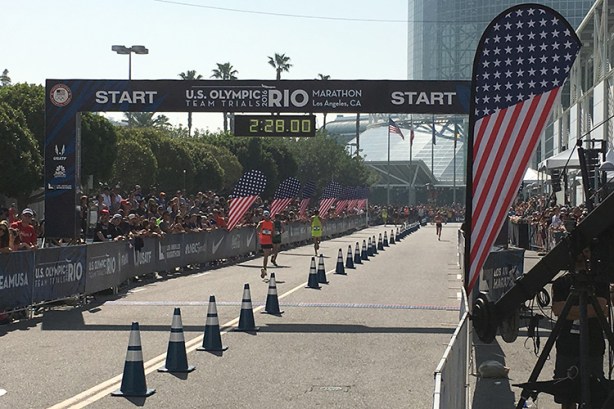
There’s no arch and it’s tough to see, but the finish is ~100 yards beyond the start line
But WOW, what a jaw-dropping debut for 29-year-old Galen Rupp (2:11:12), the 2012 Olympics silver medalist in the 10,000m who was taking his first crack not only at the Marathon Trials but at the marathon distance. And are there any superlatives left to describe 40-year-old runner-up Meb Keflezighi, the ageless crowd favorite who’s spoiled us with so many thrills in his career, that the only surprise on this day would have been if he hadn’t placed in the top three?
The women’s race, though dominated by familiar faces, was no less exhilarating, highlighted by some spirited teamwork from training partners Cragg and Shalane Flanagan. As Flanagan began to succumb to the heat in the final miles, Cragg did everything she could – short of piggybacking her to the finish – to help her teammate fight through The Wall. As eventual second-place finisher Desi Linden came charging from behind, Cragg was eventually forced to pull away from Flanagan at mile 25. But in the aftermath of the race, after hanging on to third place and collapsing at the finish line, Flanagan made clear her appreciation for her teammate’s selfless support.
“Sweet baby Jesus I’m so thankful for her,” she said of Cragg.
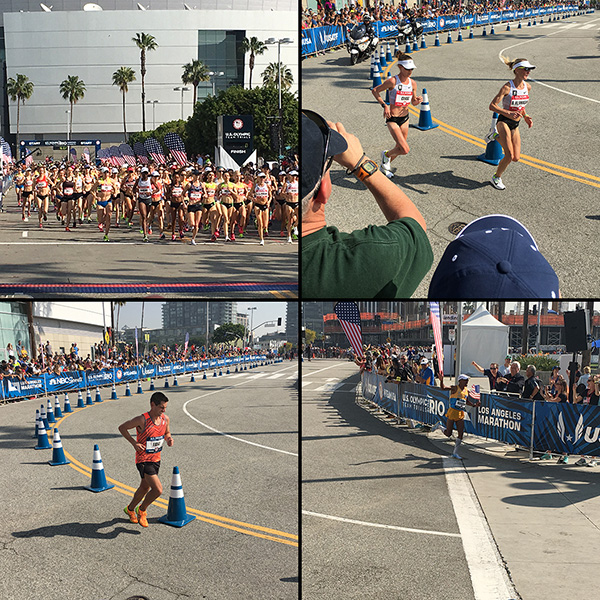
Scenes from the Olympic Marathon Trials (clockwise, from top left): Stampede start to the women’s race; leaders Amy Cragg & Shalane Flanagan run stride for stride at mile 20; runner-up Meb Keflezighi celebrates in the final turn; the strain shows on Chris Frias’ face
And while I’m dishing out apologies, I should probably offer one to Kara Goucher, whose fourth-place/first alternate finish (after a relatively ho-hum qualifying time of 2:37:03 at NYC 2014) honestly surprised me, despite two impressive 2015 wins at the Big Sur Half and San Antonio Rock ‘n’ Roll Half. She’s clearly been working her Skechers off to get back to her 2012 Olympic form, and she deserves huge kudos for her effort in LA.
From my front-row seat near the start and finish lines, I cheered as elite marathoners with apt surnames like Payne, Fog, Comfort & Deatherage passed several times on the multi-loop course, the twin demons of heat & fatigue playing out on many faces thanks to an unusually late (10:06 am) start. And as the midday SoCal sun beat down, I reflected gratefully on the fact that we slow-footed runners would be starting our own 26.2-mile journey just after sunrise the next morning.

Next up was the always inconvenient pre-race expo, located in the heart of downtown LA. Though I understand the need to placate the sponsors, I wish someone would re-invent the expo into something that makes sense for runners who can’t or don’t want to commit a large chunk of Friday or Saturday to preparing for the race. One side benefit of the Olympic Trials was that after the race, we were able to stroll next door into the Los Angeles Convention Center and pick up my race-day bib and other materials; otherwise I would have had to make the unpalatable hour drive into downtown LA.
Don’t get me wrong – I’m a huge fan of both Clif Bars and Dean Karnazes, but at this point the Clif Bar buffet o’ samples and the Ultramarathon Man have become such ubiquitous expo staples that I’d suggest they join forces in one booth, if for no other reason than to make the expo more efficient for the rest of us.
But if pre-race expos are here to stay, then for LA in particular I’d recommend the floor layout follow a more systematic flow. This could have the dual benefit of a) ensuring runners pass all sponsor booths, and b) introducing runners to the marathon course, with faux mile markers set up along the expo “course” along with visual highlights of what runners can expect to see in that mile of the actual marathon. This would familiarize participants with the course and build anticipation for the race ahead – all while avoiding the situation I encountered after the 2012 LA Marathon, when I read down the list of attractions listed on the race shirt and thought, “Really, I ran past all of these?”

Like the city itself, the pre-race expo had its own cool mural
Sunday began unlike any of the 18 marathon race days before it – with me waking up in my own bed. And I took my time doing it – having spent most of the previous four days on my feet and sleeping poorly, I was in no hurry to hop out of bed for what promised to be more of a “long training run for Boston” than “race”. Seven hours after my head hit the pillow (a luxurious night’s sleep by pre-race standards), I rolled out of bed and we rolled out of our garage into a bizarre coastal fog – check that, marine layer – that enveloped the predawn sky like a scene from a Stephen King novel.
Heading east we quickly left the marine layer in our rearview mirror, and arrived at Dodger Stadium (a seriously great place for a staging area) just in time to park, make a quick pitstop and join the anxiously waiting congregation. The start “corrals” were aptly named, a mass of 20,000 brightly colored human cattle packed nose-to-neck, and I arrived just as Randy Newman’s “I Love LA” erupted over the PA, signaling the start of the stampede toward Santa Monica. With no chance to reach my designated “B” corral near the front, I let myself be swept along like a beach ball atop a department store fan.
Start to mile 12: Dodger Stadium, Chinatown, Little Tokyo, Sunset Blvd, Hollywood
Los Angeles, much like Boston, begins with a steep and almost immediate downhill. Part of my strategy required me to ride the brakes to avoid the rookie mistake of flying down this first descent, only to pay for my zeal later. Fly now, drag later. It’s way too easy to start a marathon way too fast when your legs are fresh, your blood sugar levels are high and your myopic mind is telling you to “Go ahead and bank a few fast miles early, while you’re feeling good!” Take its advice, and that same voice will be cursing you three hours later for your arrogance.
Luckily, finding myself trapped in the throng exiting Dodger Stadium was the perfect muzzle for the impatient voice in my head.
Rolling downhill out of Dodger Stadium into the mottled morning sunlight, the course leveled out as we passed under the Golden Dragon Gateway that spans North Broadway and which serves as the de facto entrance to Chinatown. The impressively ornate Chinatown Gate soon followed, and as quickly as we’d entered…
… we were leaving, past City Hall & the Los Angeles Times offices before transitioning into Little Tokyo, with its distinctive orange Watchtower looking out over the largest Japanese-American population in the country (plus, I noticed, a significant number of Korean shops & restaurants).

Chinatown’s Golden Dragon Gateway spans Broadway at mile 2 of the marathon course (Google Maps)
My pacing plan for the day was relatively simple, at least in theory: start slow and pick up the pace. In all 18 of my previous marathons I’d posted positive splits, meaning I’d run the first 13.1 miles faster than the second 13.1. To non-runners and even newbie runners, positive splits sound like an inevitable fact of life when you’re running 26.2 miles: you slow down as you get tired. DUH.
But marathons are like meals – you want to save the best for last. Meaning negative splits (a faster second half than first half) should be the goal for any marathoner looking to run their best race. Case in point, current marathon world-record holder Dennis Kimetto of Kenya. In posting his world record 2:02:57 at Berlin in 2014 (and we were there), Kimetto actually ran the second half 33 seconds faster than the first half (61:45 vs 61:12).
And a more recent example from the weekend’s Olympic Trials: seven runners achieved negative splits, with five of them ultimately making the team (Shalane Flanagan was the lone exception among Olympic Qualifiers, posting a 19-second positive split).
Not surprisingly, women tend to be better at marathon pacing than men, with a less significant dropoff in the final 13.1 miles than their impatient male counterparts. By extension, maybe it’s time we let the more patient gender try running the country…?

All thumbs at mile 7 in Silver Lake
If you can stay patient, giving your muscles & joints time to warm up before the endorphins kick in and you hit your stride, then you’ll enjoy the second half of your race a whole lot more than the shuffling zombies you’ll pass at mile 22. Problem is, patience can be tough to come by at the start line of a marathon, when your gut feels like a playground for over-caffeinated butterflies and the adrenaline coursing through your system could wake a dead buffalo. Throw in the fact that for most of us, race day is the culmination of 16+ weeks of blood sweat & tears focused training, and it’s no surprise so many recreational runners (and even a few professionals) end up singin’ the “Start Too Fast” blues.
So then my pacing strategy was: start slow (8:15-8:30/mile in miles 1-10), pick up the pace (8:00-8:15/mile in miles 11-20) and finish fast (sub-8:00/mile from mile 21 to the end). All while enjoying every step of the way – not hard on LA’s awesome “Stadium to the Sea” course.
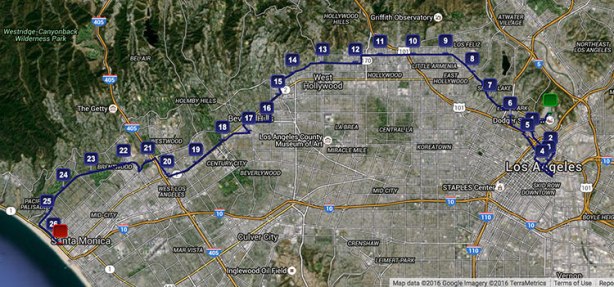
Miles 5 & 6 were punctuated by two nasty hills, the first up 1st Street and the next up West Temple, with the Disney Concert Hall (unmistakably a Frank Gehry creation) awaiting at the top of 1st Street for winded runners able to glance up from their shoetops. I wouldn’t call LA a “flat” marathon by any stretch, but once you pass mile 9 life gets easier… and the second half, with two notable downhills, feels faster than the first.
Past Echo Lake, a quick uphill jag began a two-mile stretch along Sunset Blvd through hipsterrific Silver Lake (Katie sighting #1!), highlighted by a postcard-perfect view of the iconic Hollywood sign overlooking its kingdom in mile 7.

(photo Los Angeles Marathon official race program)
Miles 9-12: Hollywood Blvd
In mile 9 the route detoured from Sunset for a course highlight, the three-mile sightseeing tour of Hollywood Blvd. Bright pink banners for the musical version of “Dirty Dancing” adorned signposts on both sides of the street. Like Vegas, though not so dramatically, Hollywood Blvd is a very different setting by day than by night – and without their brightly lit marquees to catch the eye, popular destinations like the Pantages Theatre, El Capitan Theatre and TCL Chinese Theatre are easy to miss. Passing the Pantages also serves as an immediate cue to steal a glance up Vine St to your right, where you’ll glimpse the Capitol Records building with its distinctive tower resembling a stack of vinyl records on a spindle.
If this will be your only visit to Hollywood Blvd, don’t forget to sneak a peek at the 1.3-mile-long Hollywood Walk of Fame, with its almost 2,600 terrazzo and brass stars dedicated to celebrities past & present.
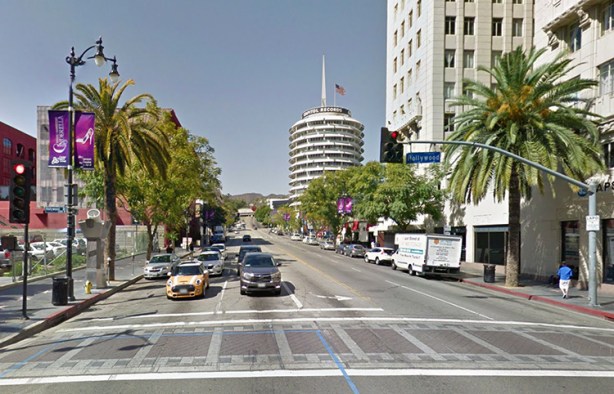
View of the Capitol Records Building from Hollywood & Vine (Google Maps)
This being Valentine’s Day in LA, couples were encouraged to either marry or renew their vows in a ceremony at mile 10 sponsored by Universal Pictures and “My Big Fat Greek Wedding 2”. And although Katie are I are perfectly happy with our 12-year-old vows, this seems like the type of marketing gimmick more studios in LA should take advantage of with a captive audience on marathon day.
As if all this weren’t enough distraction, Ken Nwadike – Race Director for the Hollywood Half and USA Half Marathon – was greeting runners with (literally) open arms at mile 11 as part of his Free Hugs Project. Unfortunately I was running on the opposite side of the street, and by the time I realized Ken was on the scene I’d missed my opportunity. On the plus side, I did benefit from Katie’s own “Free Smiles Project” a mile later.
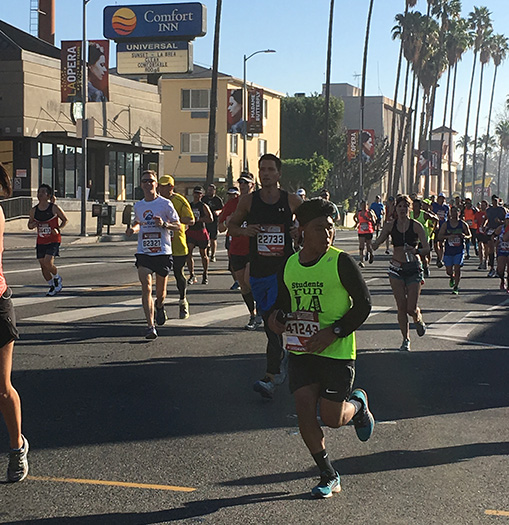
Just past mile 12, on the sunny part of the course near the palm trees
Miles 13-20: Sunset Strip, West Hollywood, Beverly Hills, Santa Monica Blvd, Century City
Transitioning into West Hollywood we re-joined Sunset Blvd on the Sunset Strip, home to famous (and infamous) nightclubs like the Whisky a Go Go, Viper Room and Roxy Theatre – venues where musical bad boys like Van Halen, Mötley Crüe & Guns N’ Roses cut their teeth before dominating the world stage. With a nostalgic nod to the Whisky on one side of the street and the Viper Room on the other, I said my goodbyes to Sunset and let my momentum carry me down the steepest descent of the day, the 0.4-mile drop down San Vicente to Santa Monica Blvd.
There the course detoured briefly away from Santa Monica Blvd and through Beverly Hills’ high-priced Golden Triangle shopping district, where most of us could barely afford to window-shop and where I was careful not to sweat on any of the well-to-do clientele who frequent Rodeo Drive. Nor did I sweat on Katie, whose ubiquitous smile soon after was the highlight of mile 18.
With my tiring brain struggling to sort out course highlights, I recalled a genius touch from the 2009 San Francisco Marathon, where signs had been posted along the course with questions & interesting factoids about the city and its history. I remember thinking at the time, what a cool way to learn about the city we’re running through. The LAM organizers should take a page out of SF’s playbook and do something similar, or even something as simple as posting signs that call attention to course highlights. Because any runner can tell you: the more focused you are on the race itself, the less brainpower you have to soak in your surroundings. But if on-course highlights were pointed out in real time – now that would be a welcome distraction.
Similarly, we passed the occasional musical act/DJ along the course, but honestly unless I recognize the song or the musicians are very distinctive – say, a jug band with banjo, washboard and kazoo – I hardly notice music on race day. I tend to engage with music rather than let it wash over me, so the typical on-course music – unfamiliar & deafening – does nothing for me.

More money, Mormons at mile 20 – the Los Angeles LDS Temple on Santa Monica Blvd (Google Maps)
Speaking of doing nothing for me, all races have their “dead zones”, i.e. stretches of the course where there’s not much to see and little in the way of distraction (in some races, this dead zone covers most of the course). At LA the dead zone is miles 19 & 20 through Century City. This despite the massive LDS temple on the north side of Santa Monica Blvd that, with its perfectly manicured lawn, feels more like Beverly Hills mansion or expansive movie studio lot than legit house of worship.
These sun-exposed miles also contrast with the rest of the course, which offers frequent opportunities for shade. Luckily the 80-degree temperatures that were predicted for race day never materialized, and even this two-mile stretch o’ ennui passed quickly.
Miles 21-finish: VA Medical Center, Brentwood, Santa Monica & the Pacific Ocean
Due to federal regulations, the organizers this year were forced to do us all a favor and re-route mile 21 around the Veterans Affairs (VA) Medical Center, which effectively excluded LA’s equivalent of Heartbreak Hill. As the quads began to tighten, my Garmin chimed to signal mile 21 and I mentally readied for a voyage into unchartered waters: time to speed things up and finish strong. Easier said than done, though I knew if I could just make it to mile 24, it’d be (literally) downhill from there.
After the VA, the course makes a straight shot down San Vicente Blvd through posh Brentwood (think OJ Simpson). Here we entered the first real residential section of the day with its gated homes, pretty people & prettier lawns.
On both sides along this stretch, running clubs & charities had pitched tents to cheer on their runners as they struggled through The Wall. And it struck me – despite the LAM’s reputation for limited spectator support, there was no shortage of bystanders lining the course this year. Sure it’s no Chicago or New York, but in LA’s defense its sprawling, point-to-point course (with minimal public transit) is designed for runners, not spectators. And maybe the crowds were largely friends & family, or local running clubs, or even volunteers assigned to designated cheer zones. But no matter – throughout the race I was surprised and motivated by the frequency of spectators cheering loudly and waving signs from the sidelines.

Exhausted (& ecstatic) finishers soak up the fog in Santa Monica
Speaking of signage, there was a lot more than I’d expected, including at least 20 “Touch Here for Energy/Power” signs. Seeing yet another of these late in the race, I chose instead to slap palms with a fellow on the opposite side of the street sporting a Boston Marathon tee – my kind of power!
Three memorable signs that stuck in my addled, endorphin-soaked brain:
- “You’ve got great stamina – call me!” (also saw this at Surf City 2011… it was clever then and it’s still clever now)
- My favorite of the day: “If Jeb can keep running, so can you!”
- And the Tony Robbins tribute of the day: “The task ahead of you is never as great as the power behind you” (ouch my brain, ouch my brain…)
Despite taking in only 300 calories (via Clif Shot Bloks) during the race, my training – which focused on burning fat rather than sugar – coupled with my measured start ensured I’d avoid the energy crash that usually precedes the downward spiral of miles 20-26. Instead, I was able to ignore my stiffening quads and focus on clocking sub-8:00 miles, fueled by the screams and cheers from the raucous tents lining San Vicente.
Then, like a high-five from the heavens, two things happened as we crossed 26th Street: the course began its final 2+ mile descent, and we re-entered the cool marine layer we’d left behind four hours earlier. That was my cue to step on the gas, and blissfully I cruised downhill toward the ocean, every step feeling stronger than the last. I even took the opportunity to leapfrog another fast-moving runner who clearly had reserves left in his tank as well.
With just under a mile to go we banked left onto the home stretch of Ocean Ave and spied, dead ahead – nothing but fog. Santa Monica was eerily unrecognizable, its trademark palm trees and distant pier swathed in gray. I continued to accelerate, trusting the finish line would soon appear straight ahead, right where it had every year since the Stadium-to-the-Sea course was unveiled in 2010. I wasn’t disappointed. As cheering onlookers materialized like spirits out of the haze, lining the home stretch on the left side, so too did the dark blue finish arch.

Down the stretch they come!
With one final surge I hit the finish mat in a time of 3:34:39, posting my first-ever negative splits (1:50:07/1:44:32) in my 19th marathon. My first and last mile splits told the tale, with mile 1 being my slowest of the day (8:58) and mile 26 my fastest (7:27). I’d even covered the final 0.42 miles at roughly the same pace (6:30/mile) as my 5K PR. Clearly I should have kicked in the afterburners a bit earlier.
All in all, my Sunday long run had been a great success, as it had allowed me to train for the last 10K of the marathon in the best way possible – by running the last 10K of a marathon.
Barely feeling the chill coastal air on my skin, I ambled through the finish chute past the food offerings and exuberant MarathonFoto minions to where Katie and our friend Paul were waiting. Paul always makes the annual pilgrimage up from San Diego to run LA, and he and I will be running Boston together next month. So an earlier-than-usual Los Angeles Marathon was a timely warmup for both of us.
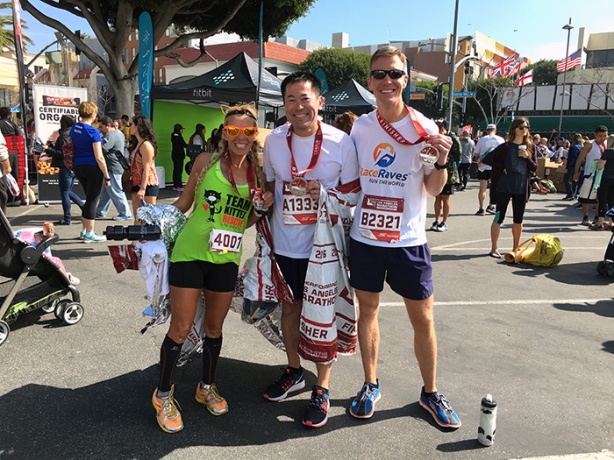
All smiles at the suddenly sunny Finish Festival with sister-in-law Laura & Paul
Together we wandered over to the post-race festival, held in a nearby parking lot where local favorite Angel City Brewery was hosting a free beer garden for finishers. I’m not much of a drinker, but I’ll never refuse a post-race beer – and in fact, the Goose Island IPA I enjoyed in Chicago remains a vivid memory from my first World Marathon Major.
Speaking of World Marathon Majors, the honest truth is that LA is a better race than any of the three Majors I’ve run – better than Berlin, better than Chicago, better even than (blasphemy!) New York City. There’s more to see along its point-to-point course, more hilly bits to keep things interesting, and more natural beauty throughout – mountain views en route, beach and Pacific Ocean awaiting at the finish. And though it tends to fall on the hot side, particularly in March, the weather is always SoCal reliable.
Reunited and it feels so good – so consider this a heartfelt apology to my hometown race, having not experienced it for myself since LA became our hometown in 2013. I’d forgotten all that its scenic Stadium-to-the-Sea course has to offer. Big Sur may be California’s classic “must run” road marathon; San Francisco may be the most stunning city in the country; but Los Angeles has its own underestimated race that I’d recommend to any marathoner seeking the quintessential California experience. You probably won’t run a personal best here, but you probably won’t care either.
Sipping our beers as the sun at last cleaved a path through the stubborn morning fog, it struck me (again) how lucky I am to live in a place where cutting-edge creativity is a way of life, and where I can run alongside the ocean for 20 miles at a time, 12 months a year. So it was that the same refrain which had started the morning’s journey was still stuck in my head at the end.
I love LA!

BOTTOM LINE: Los Angeles should be high on any serial marathoner’s list. California has something for every road runner – the breathtaking beauty of the California coastline in Big Sur, the classic SoCal beach vibe of Surf City, the enchanting allure of San Francisco. LA in turn shines with its unique mix of big-city energy, iconic attractions and laid-back SoCal ambience. If preconceived notions of smog and plastic people are all you know of LA, then you don’t know LA.
Aside from San Francisco, Los Angeles is start-to-finish the most interesting road marathon course I’ve run. Don’t let the net downhill profile (789 ft up, 1,192 ft down) fool you though – most of that downhill is at the very beginning and very end. Nor is the rest of the course particularly flat, so be prepared for several uphills, particularly in the first half.
Another positive note from this year’s race: the number of spectators seemed much greater than I recall from 2012. So if spectator support is important to you, don’t let the LAM’s reputation as a spectator-sparse event dissuade you from running. Sure it’s no Boston, Chicago or New York, but then again not every race can be a World Marathon Major.
LA isn’t a cheap race (I paid $160 on opening day of registration), but it’s reasonable relative to other big-city marathons, and you definitely get what you pay for. And weather-wise, the year-round warmth that draws so many visitors to SoCal is a double-edged sword for runners, since it means temperatures on race day tend toward hot. Just a word of warming warning for those hoping to chase a personal best at LA.

Net downhill yes, but the shortest distance between Dodger Stadium & Santa Monica is not a straight line
PRODUCTION: Aside from the usual expo chaos in downtown LA (with suggestions for its improvement noted above), the entire weekend – from the Olympic Trials to the marathon itself – was a seamless production. As staging areas go Dodger Stadium is among the best, and parking there is relatively easy. Post-race snacks were abundant, and any post-race festival with a free beer garden (+ short lines!) is a sure winner.
That said, I was admittedly disappointed by several aspects of the production & marketing:
1) that on a course with so many iconic landmarks, the organizers didn’t do a better job of calling attention to those landmarks during the race;
2) that pre-race emails lacked personality and were used primarily for sponsor messaging, rather than taking the opportunity to highlight the Stadium-to-the-Sea course
3) that the organizers haven’t done more to #UniteLA, to embrace the community and rally the locals around their event – the truth is that the LAM simply doesn’t resonate with many Angelenos.
4) that the organizers don’t seem to treat their race with the respect that it deserves. Case in point: rather than pre-race communications focused on the course and getting me excited for the marathon, one dedicated email let me know that by running both the LAM and another SoCal relay race, I’d earn a kitschy-looking double medal in the shape of the state of California. How this odd partnership stands to benefit the LAM or its brand is unclear.

I always feel like, some building’s watching me (and I have no privacy, woh)
Plus, no other heavyweight race would move its date up a month for no good reason, much less for an event like the Olympic Trials which few recreational runners even notice. In 2012 when Houston hosted the Trials, the Houston Marathon didn’t budge from its traditional mid-January weekend slot. By moving this year’s race so it fell a week after the nearby Surf City Marathon (which is always run on Super Bowl Sunday), the LAM organizers cannibalized their own audience, including runners who usually run Surf City as a warmup for LA. And that’s not just my opinion – the race failed to sell out this year, and with just 20,627 finishers, this was the first year since its inception in 2010 that the Stadium-to-the-Sea course boasted fewer than 21,000 finishers. That number is down 6% from just one year ago.
So let’s hope the organizers stop treating their marathon like a small-town race and start marketing it like the world-class event it is – you’re Los Angeles, not Omaha!
All that said, these are behind-the-scenes details that don’t affect the actual runner experience, and overall race production was impressive by any standard – so much so that I happily used the discount from my virtual event bag to buy a pair of Skechers LAM model running shoes after the race. Turns out Skechers makes a comfy running shoe!
SWAG: Keeping with the Valentine’s Day theme, both the short-sleeve tech tee and finisher’s medal are a nice shade of red. The shirt lists course highlights on the front, though in small dark font that sort of defeats the purpose. The medal, though, is the real keeper – it’s a shiny round keepsake with the year & downtown LA skyline emblazoned on one side, along with the race logo & iconic LA scenery on the other. It’s among the most substantial medals in my collection, with a heft similar to Chicago or New York.

RaceRaves rating:

FINAL STATS:
February 14, 2016 (start time 6:55am)
26.42 miles in Los Angeles, CA
Finish time & pace: 3:34:39 (second time running the Los Angeles Marathon), 8:07/mile
Finish place: 1,170 overall, 128/1,301 in M 45-49 age group
Number of finishers: 20,627 (11,499 men, 9,128 women)
Race weather: cool & clear at the start (temp 52°F), cool & foggy at the finish
Elevation change (Garmin Connect): 789 ft ascent, 1,192 ft descent

The only real negative to the 2016 Los Angeles Marathon was my splits

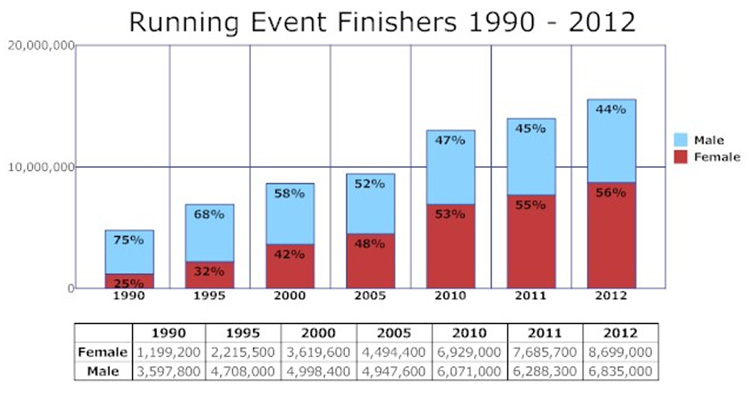


 Blisters, Cramps & Heaves