
We do not rise to the level of our expectations. We fall to the level of our training.
– Archilochus

Extravaganza may be overstating things a bit, I thought as we pulled up in front of Celebration Hall on a cold, gray October Friday. Or maybe an extravaganzum is in the eye of the beholder. I stared out the windshield at the low-slung building with beige siding that looked more like an oversized utility shed than a venue for revelry, as its name would suggest. Having spent much of my childhood on military bases in the Dallas/Fort Worth metroplex, those long-dormant memories sprang to mind as I laid eyes on austere Celebration Hall, the apparent centerpiece of the Franklin County Fairgrounds.
Clearly we weren’t in Los Angeles anymore. We weren’t even in Omaha. As it turns out, the oddly serene town of Ottawa, Kansas—population 12,260 as of 2019—would be among the smallest we’d visited to date on our running tour de America. Ottawa’s eerily quiet downtown district and largely empty streets belied its status as “Playful City USA,” a designation trumpeted by a sign across the street from the local cemetery near the edge of town.
Then again, we’d arrived on a Friday afternoon in the midst of a global pandemic, so I had to assume a perfect storm of quitting time and COVID-induced closures had sapped much of the town’s usual energy. On the bright side, I’m happy to report that if you’re tired of sitting in Friday rush hour traffic and need a change of pace, Ottawa may be just the place for you.

Unfortunately we couldn’t just click our ruby red slippers together to get here… though the actual journey hadn’t been that much more demanding. A three-hour flight to Kansas City on a socially distanced Southwest flight, followed by a 1½-hour drive with a brief stop at the Olathe Whole Foods, had brought us into Ottawa in plenty of time for our current errand—pre-race packet pickup at Celebration Hall, which not surprisingly was a quick and easy affair. Though not exactly the bustling McCormick Place on the eve of the Chicago Marathon, it felt amazingly good to be around a handful of other runners who likewise seemed excited to run the next day.
Here I should back up a step and say that in a perfect world, Ottawa wouldn’t have been my first choice for a Kansas race. That would have been Abilene which, despite being a Toto-size town with half the population of Ottawa, is home to the Eisenhower Marathon and the Dwight D. Eisenhower Presidential Library & Museum. I do appreciate presidential libraries (we’d visited the Clinton Presidential Library & Museum during our first visit to Little Rock three years earlier), and I’d been hoping to visit Ike’s boyhood home for my first Kansas marathon.
But if we’ve learned anything in the past year, it’s that the world is far from perfect (why do you think its two wealthiest individuals are trying so hard to get off the planet?). With the pandemic effectively putting the kibosh on racing season across the U.S., including April’s Eisenhower Marathon, the tiny Kansas Rails-to-Trails Extravaganza (KRTE) in October emerged as one of the few legitimate options that would allow me to check off at least one new state in 2020. I still like Ike and have my eye on Abilene, but aside from Idaho, Washington and Utah (which I’m “saving” to balance out the fact nearly all my remaining states fall east of the Mississippi River), Kansas was the westernmost state remaining on my 50 States Map. Which meant it was also among the shortest flights, a key consideration in the time of COVID.

That said, I never run a race simply to check off a state, and I wouldn’t have chosen KRTE if I’d sensed it would be the red-headed stepchild of my 50 States quest. Rather, KRTE appealed to me as a small, low-key event with a quintessential Kansas aesthetic. As a bonus, its fast and flat course along the remote, unpaved Prairie Spirit Trail offered a golden opportunity to improve my 50K personal best time of 5:35:39, set 3½ years earlier at Way Too Cool. Plus, the spring version of the race, the Prairie Spirit Trail Ultra, gets solid reviews on RaceRaves. So KRTE struck me as the right race at the right time and a much-needed opportunity to escape a locked-down California, if only for the weekend.
My confidence to chase a personal best was due more to the nature of the course than my own preparations. My previous four 50K races had been rugged, challenging affairs, three of which had taken well-nigh everything I had just to finish. And while I wouldn’t be in tiptop shape for Kansas after a high ankle sprain in April had sidelined me for two months and sabotaged my summer training regimen, I felt I was in good enough shape to challenge my personal best on the non-technical, runner-friendly Prairie Spirit Trail.
The more tantalizing question would be, could I break five hours? Because that’s my “A” goal at the 50K distance.
I’d only committed to racing earlier in the month when I’d added my name to the waitlist, at which time Race Director Carolyn had assured me she’d be able to fit me in for the sold-out event. True to her word I’d been plucked from the waitlist the next day, and now here we were two weeks later in a setting that could hardly have been more different than the one we’d left.
Whereas I’d been training in the extended SoCal summer, a parallel weather universe awaited us in Kansas where the forecast called for 85°F heat on Thursday, rain on Friday (our arrival day), cold & partly sunny conditions on Saturday (race day), then more rain on Sunday transitioning to snow on Monday. Apparently, we’d hit the sweet spot between the end of summer on Thursday and the start of winter on Monday—all of autumn in one weekend, as it were. And honestly, the cold (sans precipitation) would be a nice change of pace.
Along with the weather, the most dramatic change of pace was Ottawa itself, which felt very much like the ghost town that time forgot. Strolling its sparse, quiet Main Street, we passed old-school retail establishments like Sears Hometown (a small hardware & appliance store) and several antique shops, most if not all of which appeared to be closed on this Friday evening. The closest we’d come to seeing a crowd all weekend would be the line of cars queuing up outside Daylight Donuts on race morning.

Just as there’s a fine line between antique and old, so too is the relationship between quaint and obsolete. Ottawa walked that line like a skilled trapeze artist. Time and again I’ve discovered that given the chance, every place will reveal its charms sooner or later, and Ottawa was no exception. In the single block that comprised the town’s Downtown Historic District we visited Plaza 1907, believed to be the world’s oldest continuously operating cinema (est. 1907) and certainly not a landmark I’d expect to find in the middle of the country. Due to the pandemic we couldn’t go inside, but just allowing myself to appreciate its unassuming façade and rust-colored marquee through nostalgic eyes was gratifying for someone more accustomed to the glamour, glitz and grit of modern-day Hollywood.
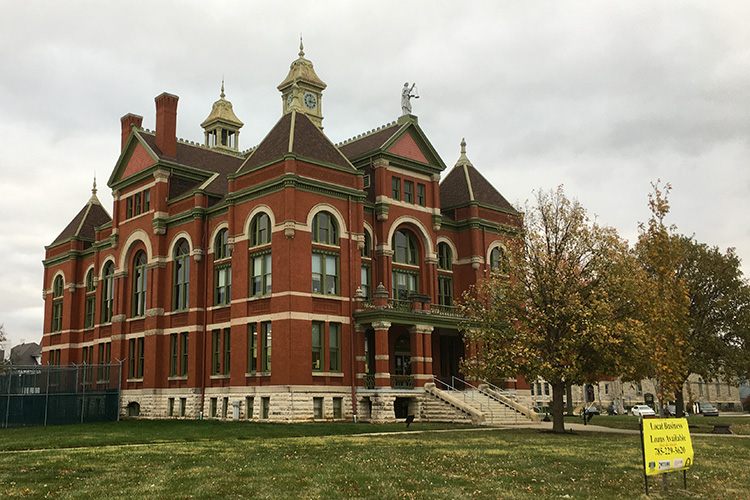
One block south of the Plaza on Main Street, the stately Franklin County Courthouse drew our attention with its soaring red brick exterior and white sandstone trim accented by a series of arches and gables. Sharing the Courthouse grounds were the Franklin County Veterans Memorial and a chainsaw-carved statue of the Courthouse architect, George Washburn.
Our tour of Downtown Ottawa complete, we stepped back into yet another era as we checked into our Airbnb, aka the “Sherbet Suite,” a groovy midcentury modern retreat featuring orange-and-green decor, Star Wars memorabilia and a movie poster from the 1968 Jane Fonda cult classic Barbarella: Queen of the Galaxy. There we settled in comfortably to prepare a pre-race carbo-feast while watching our hometown Dodgers seize control of the World Series with a Game 3 victory over the Tampa Bay Rays. Seeking any edge I could get in my pursuit of a personal best, I internalized the win and treated it as a promising sign for the day ahead.

Sunflower State of mind
Taking one last deep breath I donned my blue surgical mask, pushed open the car door and stepped out into a bitterly cold Saturday morning. The temperature hovered just above freezing with minimal wind as I braced myself mentally & physically for the 31 miles to come. Normally Celebration Hall would have been open to all participants to await the start of the race indoors, but not today—not in the age of COVID.
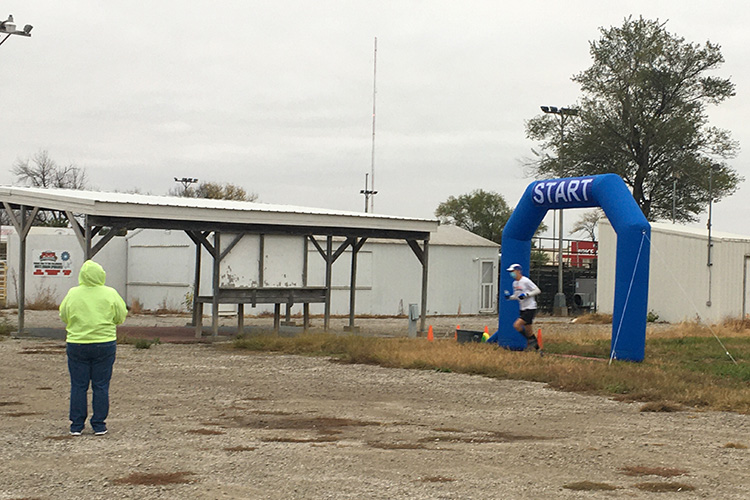
Stepping up to the blue start arch, I marveled at the anticlimactic feel of the moment. That’ll happen when you’re the only runner on the start line. Each participant had been assigned a 10-minute window in which to start their race, and I’d been one of 13 runners assigned to the 8:15–8:25am time slot, the last of the morning. So whether there’d be other runners starting behind me or everyone else had gone ahead, I had no idea. Not that it mattered—this wasn’t a 100-yard dash, after all. So I waved sheepishly to Katie one last time before setting out under the blue arch alone for my 5-hour tour of Ottawa and beyond.
Rather than my usual RaceRaves gear, today I’d be sporting my 2017 Missoula Marathon shirt in remembrance of our friend and Missoula Race Director Tony Banovich, who’d died suddenly in his sleep ten days earlier (and one day after we’d exchanged emails) from progressive viral cardiomyopathy. Tony’s condition had worsened over time (thus the “progressive” aspect) to the point he’d been awaiting a heart transplant when he died. My shirt would elicit a few Missoula shout-outs from volunteers and fellow runners alike, which brought a smile to my face.
Exiting the Franklin County Fairgrounds, we immediately headed north for a 3½ mile out-and-back on the paved, northernmost portion of the Prairie Spirit Trail. Feeling grateful to be back in my element, I greeted runners coming in the opposite direction with a “G’ morning!” as I tried to keep my mile pace between 9:00 and 9:30, a task made easier by my suboptimal training.
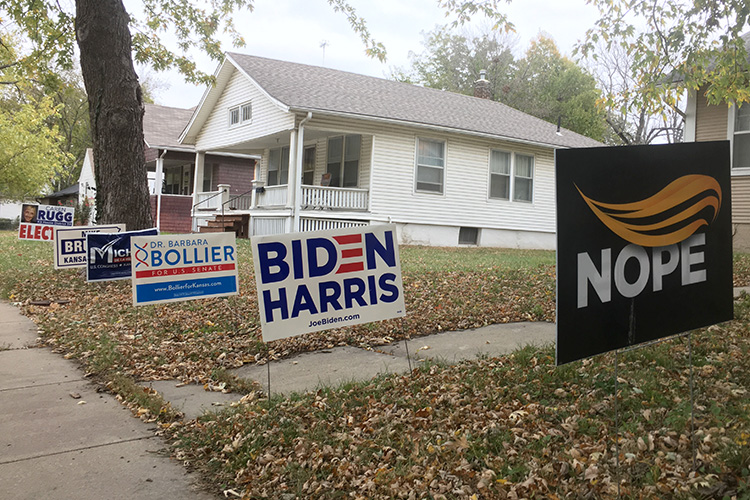
Nice start to the day, I thought as we ran through residential neighborhoods past modest, unpretentious homes and colorful playground equipment made more vibrant by a backdrop of steely gray sky. A sign in front of one building announced the disappointing news that “do to” the pandemic and orders from the state health department, there’d be no Halloween celebration this year. And I was pleasantly surprised by the number of lawn signs proclaiming support for the Biden/Harris ticket and for Democratic Senate candidate Barbara Bollier.
(Unfortunately Bollier would lose her bid, and her newly elected opponent Roger Marshall’s first order of business would be to flaunt his street cred with fellow Republicans by signing on to the Big Lie and voting to throw out the certified results of the 2020 presidential election.)
Ironically, the turnaround for this short out-and-back was located on the street just outside our Airbnb, and when I arrived Katie was cheering from the sidewalk while chatting with the race director’s parents. Retracing my steps, I headed back toward Celebration Hall… and while I did pass a few runners along this stretch, I didn’t see anyone coming in the opposite direction from the start, meaning I may very well have been the last runner across the start line.
The Prairie Spirit Trail actually starts in Ottawa roughly ¼ mile south of the race turnaround point. From there it runs almost due south for 51 miles before ending in Iola, where it transitions to become the Southwind Rail Trail. The Kansas Rails-to-Trails Extravaganza features a variety of distances (hence its name) ranging from a half marathon to 100 miles; intrepid 100 milers cover the trail in its entirety with a turnaround point in Iola at the southern terminus.
Sensing movement to my left, I glanced over to see a squirrel running parallel to me through the trees lining the trail. Kansas wildlife, I thought with a smile.
Passing the Fairgrounds, we continued south until the trail dead-ended at a sidewalk that led us beneath the I-35 overpass. Crossing under the highway, we immediately rejoined the trail as the surface transitioned to crushed limestone and dirt. Happily I cruised along while maintaining that same comfortable 9:00–9:30/mile pace. As I did so, I passed one runner after another spread out along the trail, which added to my confidence—this was one clear benefit to starting last. And I’d definitely picked the right race for social distancing purposes.

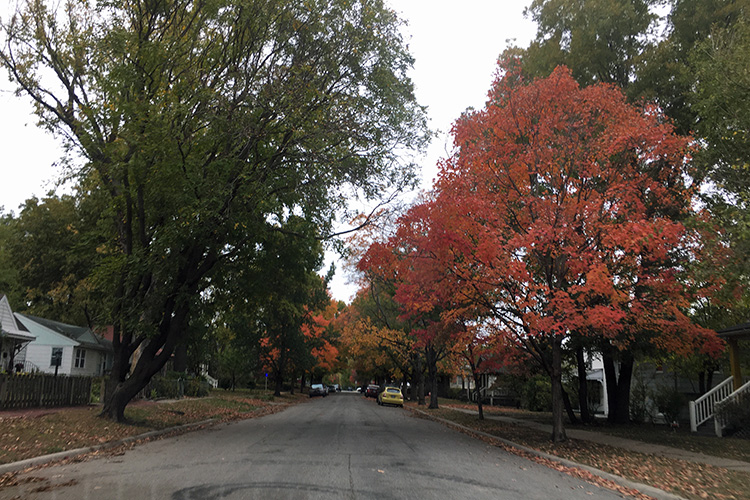
The scenery was unchanging for the most part, and I was fine with that. Trees and bushes in the midst of their autumn transformations lined the double-wide trail on both sides. Beyond those, wide swaths of prairie filled the horizon interspersed with farmland and amber waves of grain as far as the eye could see. In the distance, the occasional low-slung structure (home? ranch? storage shed?) could be seen just off the main highway that shadowed us to the east. Every mile or so, the trail would cross a one- or two-lane road—some gravel, others paved—and though I did see the occasional car kicking up dust, I never had to pause for one.
And that, more or less, was the Prairie Spirit Trail I experienced in all its secluded glory. Having only briefly set foot in the Sunflower State once before, this was exactly what I think about when I think about Kansas. But whereas a state like Utah consists of 70+% public land (owned by the federal or state government), more than 97% of the land base in Kansas is private property, making publicly accessible, recreational trails like the Prairie Spirit Trail particularly important to the health and well-being of the state’s residents.
I approached two women, one of whom wore a sign on her back announcing this as her first 50K while her companion had her own sign proclaiming this to be her 100th marathon/ultra. I congratulated them both, assuring the former (in case she didn’t know) that she’d picked a great course for her first.

Due in part to the cold and my lack of thirst, I hardly registered the unmanned aid station at mile 7 (nor at mile 28 on the way back), a DIY setup that consisted of a storage bin filled with plastic water bottles and left on a bench. Did I mention this was a low-key event?
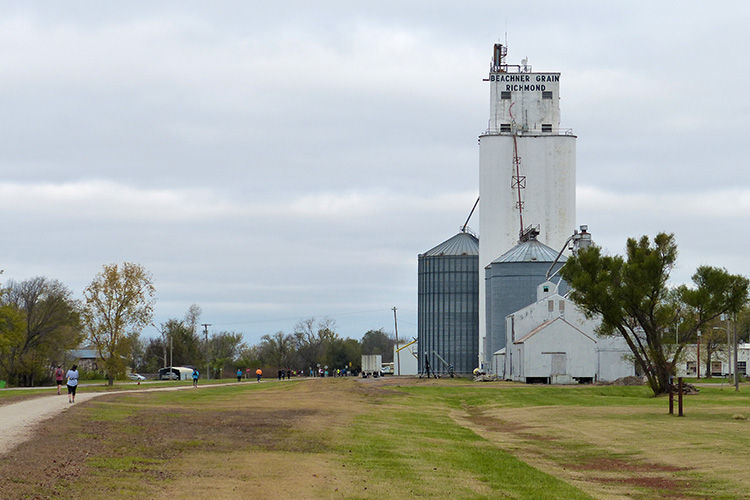
Per race guidelines, aside from the first turnaround in Ottawa my only Katie sightings would be at the three manned aid stations which doubled as crew access points—one in the tiny town of Princeton at miles 11 (out) and 24 (back), the other in Richmond at the mile 17.5 turnaround where the towering Beachner Grain elevator reminded us that we were in the heartland of America.
Thanks in part to the wintry weather and my controlled tempo, my nutritional needs for the day were minimal. I took two sips of Maurten at the first Princeton stop, followed by a semi-frozen GU at the Richmond turnaround where I also grabbed the bottle of Maurten and finished off that morning’s 5-hour Energy to kick-start my return journey. And at my final stop in Princeton I was able to down half a pouch of baby food, a much-needed alternative to GU and one which helped to settle my stomach for the remaining 14 miles.
Given the sparsity of people, most of whom were volunteers or crew for other runners, social distancing was no problem at these stations. Katie, for her part, resembled a purple Jawa (minus the scavenging behavior) with only her eyes visible behind a puffy Columbia down jacket, hood and mask.
With an {ouch ouch} here, and an {ouch ouch} there
Retracing our steps back toward Ottawa, it wasn’t long before I was ready to be done. My attention drifted, and I kept reminding myself that every step brought me one step closer to the finish line, to reuniting with Katie and to notching another state—very likely my only new state of 2020. I could easily imagine this heavily wooded trail in the summer, verdant and alive with ripe, tasty berries, assorted wildlife and flying, biting, stinging insects. As a runner, I much preferred the status quo.
(Side note to trail runners: If you’re in the market for a great trail shoe, I’ve often thought the Altra Superior—which I first purchased for the Ice Age 50 Miler in 2016 and still wear to this day—may be the most comfortable running shoe I’ve ever owned, road or trail. For 50 miles at Ice Age and 31 miles at KRTE my feet felt great with zero complaints, a victory in itself and especially on trails where footing can be notoriously uneven and unpredictable.)
Most of the spectators along the course had four legs, while most of the two-legged spectators had wings. Around mile 25, a few disinterested cows on one side of the trail and several chickens on the other watched as I shuffled by, as if to say Hey human, we’re udder-ly exhausted just watching you, and Hey human, who’s the bird brain now? By this time runners had stopped coming in the opposite direction, meaning I’d be alone with my thoughts—talking farm animals and all—for most of the final 10K (6.2 miles).

Which turned out not to be the best idea. As my mileage mounted and my fatigue followed, it became increasingly difficult to maintain momentum on the flat, unchanging terrain. At miles 25, 26 and 28, I slowed briefly to a walk while trying to loosen up my uncooperative hip flexors and quads with a few quick knee raises. Each time, despite persistent protests from my lower body, I’d force myself to speed up again to a pace that felt more like running than walking.
With less than 10K to go, it would have been oh so easy to extend my walk breaks, to pat myself on the back for an impending personal best, and to listen to the nagging voice in my head telling me I had nothing left to prove here today. But it would have been a lie, because there’s always something left to prove, even if that means pushing myself into an unpleasant place I’d rather not go. More than anything, I didn’t want to look back at my time on the Prairie Spirit Trail as an opportunity squandered.
The truth is, running is a much more nuanced sport than it may seem to the casual observer, and every runner experiences race day in a different way. The gazelles who start at the front and run with the leaders experience a much different race than those at the back of the pack. But no matter where you start or finish, until you’ve been there yourself it’s impossible to describe the willpower needed to persevere in the face of growing exhaustion. One minute of walking can quickly turn into two can turn into four can turn into an easily justifiable excuse for why this just wasn’t my day, I’ll get ‘em next time.
Counterintuitive as it may sound, that exhaustion is my most satisfying and personal reward. Sure, as a collector I love the artistry of the finisher medals, and they make a great Zoom background—but in the end it’s that empowering, full-body fatigue I carry with me across the finish line that I wish I could bottle and share with every non-runner.
Having no idea if a five-hour finish was still in my sights, I resolved to keep pushing, to dig deeper… and in the end that would be enough, no matter the outcome. All of which was easier said than done, as my quads grew heavier with every step. Here, with nothing but fauna and flora to keep me company, I could have used some on-course distraction from someone other than Old MacDonald. Instead I motivated myself with the comforting thought that our friend Tony was running alongside me and kicking my butt to the finish, just as he’d done three years earlier in the home stretch of his own Missoula Marathon.
At last, in mile 30, I emerged from the trees and bid an unsentimental farewell to the Prairie Spirit Trail. Passing a few more runners, including one fellow who was clearly nursing cramps (and so close to the finish!), I focused on making each step as efficient as possible as I shuffled toward home on the unforgiving asphalt alongside US-59. The trail briefly transitioned to gravel and then back to asphalt, not that it mattered—my legs were pretty much toast, and only dialing down the gravity would have made this home stretch less arduous.

The last mile was a painfully straight shot and I kept glancing ahead, wanting nothing more than the reassurance of seeing the final turn into the Fairgrounds that signaled the end. Where was that f*#@ing turn? In the distance I could see tiny orange dots, and as I continued to push, push, push as hard as I could while going nowhere fast, the dots gradually became pylons blocking the trail where the turn would be. As slowly as I was moving, still I caught a fellow runner who’d been far ahead of me but who now was alternating a few steps of jogging with a few more steps of walking. As I passed, I tried to draw any residual energy I could from this final conquest.
My Garmin chimed to signal mile 31 (or maybe to ask, are we there yet?). As if on cue, I’d reached the orange pylons. One thing was certain: this course measurement was spot on. Relief greeted me as I turned onto the dirt for the best part of the race, the last 100 or so yards. Pumping my fists weakly I crossed under the red finish arch, gratefully accepted my medal handed to me by a masked volunteer, and leaned over with hands on knees as a wave of nausea washed over me. Luckily the sensation passed quickly and I threw my arms around Katie, basking in my happy place and the triumphant afterglow of my best-ever 50K. And for just a few heartbeats in the midst of a global pandemic, the world felt almost normal.

Mission (semi-)accomplished
Silently and with immense gratitude I paid my last respects to our buddy Tony, who’d once been known as the fastest man in Montana and whose spirit had sustained me out on the Prairie Spirit Trail when the going got tough.
I’d finished in 5:01:07 to set a personal best by 34 minutes, despite falling 68 seconds shy of my ultimate goal. And I was 100% satisfied with the result—I’d gotten in and out of the aid stations quickly and couldn’t point to a single second (much less 69) of wasted time. What’s more, not a single runner had passed me all day. I’d run as well as my intermittent training allowed, and as I write this now I look forward to my next shot at a sub-5 50K, hopefully at the Dallas Marathon’s 50th anniversary weekend (already twice delayed due to the pandemic) in December.
One year, one new state… at this rate I’ll finish my 50 States quest when I’m a spry 69 years young. Here’s hoping COVID-19 is the last global pandemic of the 21st century.
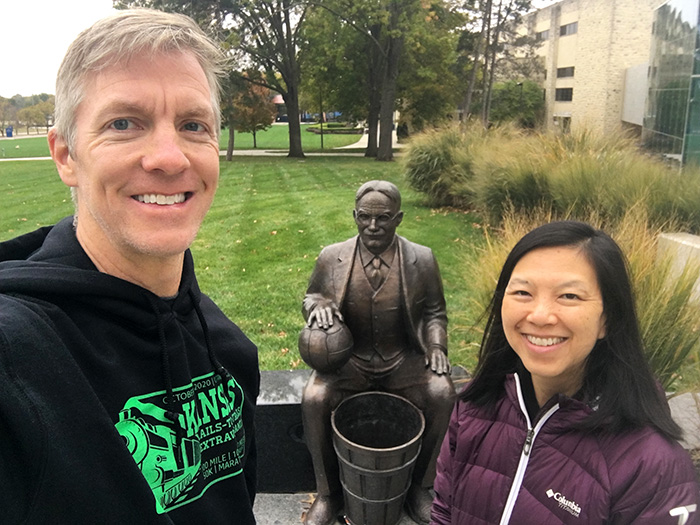
The next day would confirm I’d given everything I had as I hobbled around the University of Kansas campus in nearby Lawrence on stiff, sore and semi-useless legs. And it was only with great effort (and little help from my quads) that I was able to stand up once our flight touched down in Los Angeles on Sunday evening.
Speaking of flights: if not for the Dodgers losing Game 4 in walk-off fashion on Saturday, which delayed their World Series-clinching win to Tuesday, we would have flown out of the home of the NBA champs (Los Angeles) on Friday morning, into the home of the NFL Super Bowl champs (Kansas City) on Friday afternoon, and then back into the home of the MLB World Series champs (LA) on Sunday. Clearly I owe my personal best, at least in part, to karma in the jet stream.
Back at the finish line, I visited the massage table for some much-needed work on my quads and left Achilles, which didn’t last long once my body temperature dropped and I began to shiver uncontrollably. As I lay on the table an older runner charged across the finish, yelled “FUCK YEAH!” and spiked his water bottle like he’d just caught the game-winning touchdown from Tom Brady. Then he kept on running, leaving the bottle on the ground for someone else to discard. Um, congrats?
I thanked Race Director Carolyn for a terrific event; she and her team had been very conscientious about COVID protocols. I also bought an attractive charcoal-and-green race sweatshirt to commemorate my new personal record, because at age 50 I don’t have too many more of those in me. I look forward to the end of this pandemic and being able to escape SoCal for cold climes now and then so I can wear it.
Kansas highlighted one of the many things I appreciate about this 50 States quest. I’ve crossed more than 50 marathon/ultramarathon finish lines, and yet KRTE was unlike any race I’ve run—a fast, flat, easy-on-the-legs trail ultra in small-town America. Aside from Way Too Cool my four previous 50Ks nearly killed me, so it was a (literal) breath of fresh air to be able to get out in nature and simply enjoy running the distance for a change. KRTE was the perfect race for pandemic times. And it’s not every day you can run for five hours and go home with a personal record—though in this case, it just made sense.
After all, you can’t spell “Prairie” without a PR.

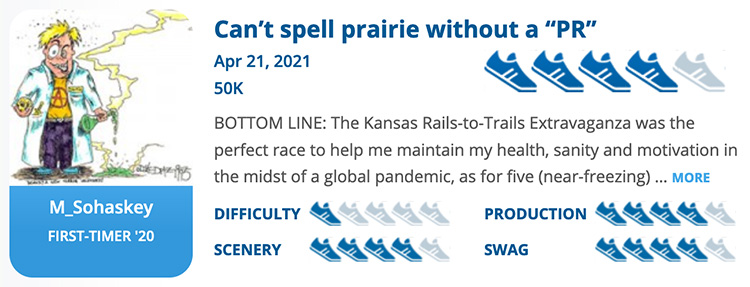
BOTTOM LINE: The Kansas Rails-to-Trails Extravaganza was the perfect race to help maintain my health, sanity and motivation in the midst of a global pandemic, as for five (near-freezing) hours I was able to forget the virus heard round the world. And if you’re a fan of low-key, small-town events that feature grain elevators as highlights, then this may be the perfect race for you in any year. With a population of around 12,000 residents, Ottawa is one of the smaller towns I’ve visited in my 100+ races—a bit ironic, given that my original choice for the Sunflower State was the Eisenhower Marathon in Abilene, a town half the size of Ottawa.
The bulk (24.6 miles) of the 50K course runs north/south on the comfortable crushed limestone of the Prairie Spirit Trail, book-ended by 5 miles at the start and 1.5 miles at the end on paved terrain. (The 100 Mile course covers the entirety of the PST.) It’s tough to imagine a much flatter or straighter course than this one. And though the rural route lets you decompress and breathe, the flip side is that you better enjoy time alone with your own thoughts, because there’s little in the way of distraction—no energetic spectators or musical bands, only amber waves of grain as far as the eye can see. Aside from aid station volunteers and a few folks crewing for other runners, most of the spectators had four legs, and most of the two-legged spectators had wings. With the trail stretching out ahead of you for miles at a time, you’ll swear you can see Nebraska to the north and Oklahoma to the south. At the same time, the unchanging scenery makes it challenging to gauge progress, which in turn makes it easier to surrender to fatigue and give yourself permission to walk. Kansas Rails-to-Trails is a “dig deep, find your inner bad-ass, and keep going” type of race.
I’m not typically a fan of out-and-backs, but in such a relaxed, laid-back setting I appreciated being able to see and lend support to my fellow runners. In that sense, KRTE provides the opportunity to be both competitive and sociable at the same time. How many races can say that?
For anyone who likes the sound but not the timing of the Kansas Rails-to-Trails Extravaganza, the Prairie Spirit Trail Ultra held each March is the spring edition of essentially the same race, minus October’s fall colors and the marathon/half marathon distances.
PRODUCTION: Race production was minimal and even more so during a pandemic. Everything about race weekend was easy peasy, from the start and finish lines separated by just a few yards alongside incongruously named Celebration Hall, to the outdoor packet pickup, to the staggered start times with each runner being assigned a starting window of ten minutes. (I was among the last runners to start at 8:15am and did so alone.) Three well-stocked (though widely spaced) aid stations awaited runners at miles 11 (out)/24 (back) and at the turnaround at mile 17.5, along with a couple of other unmanned “stations” which basically consisted of a stash of bottled water. With crew access limited to the three manned stations, carrying your own nutrition may not be a bad idea. And to help you prepare for race day, the organizers provide a detailed booklet which answers most of the questions you’re likely to ask.
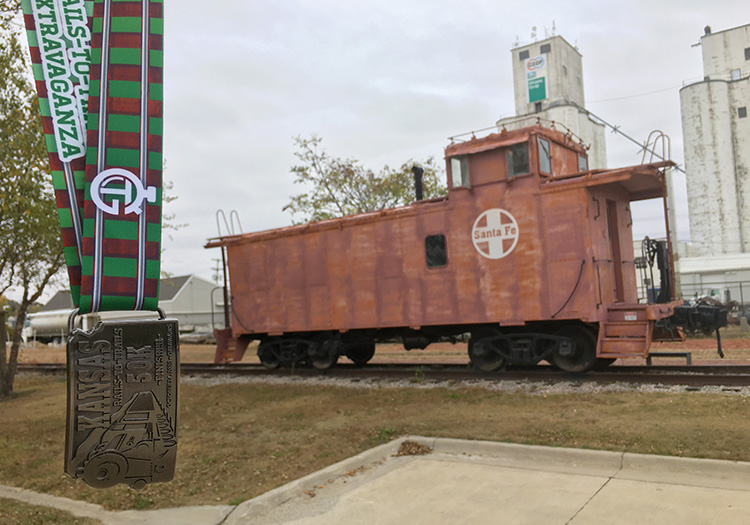
SWAG: Definitely a highlight of this low-frills event. Aside from the potential to set a personal record on its flat & speedy course, one reason I chose to run the 50K rather than the marathon was the promise of a belt buckle rather than the usual finisher’s medal—a minor detail to be sure, but nonetheless a silver lining on the dark cloud of a brutal pandemic/election year. And with Race Director Carolyn being kind enough to provide its own ribbon, the buckle now hangs proudly alongside the other medals on my 50 States Wall o’ Fame. With temperatures in the 30s and my brain awash in post-PR endorphins, I also had no qualms about buying a charcoal-and-green KRTE hoodie to match the standard short sleeve race tee. Both have turned out to be very comfy, even if I do live in Los Angeles where a heavy sweatshirt isn’t the savviest consumer purchase.
Updated 50 States Map:

RaceRaves rating:
FINAL STATS:
Oct 24, 2020 (start time 8:15 am)
31.12 miles in Ottawa, Kansas (state 31 of 50)
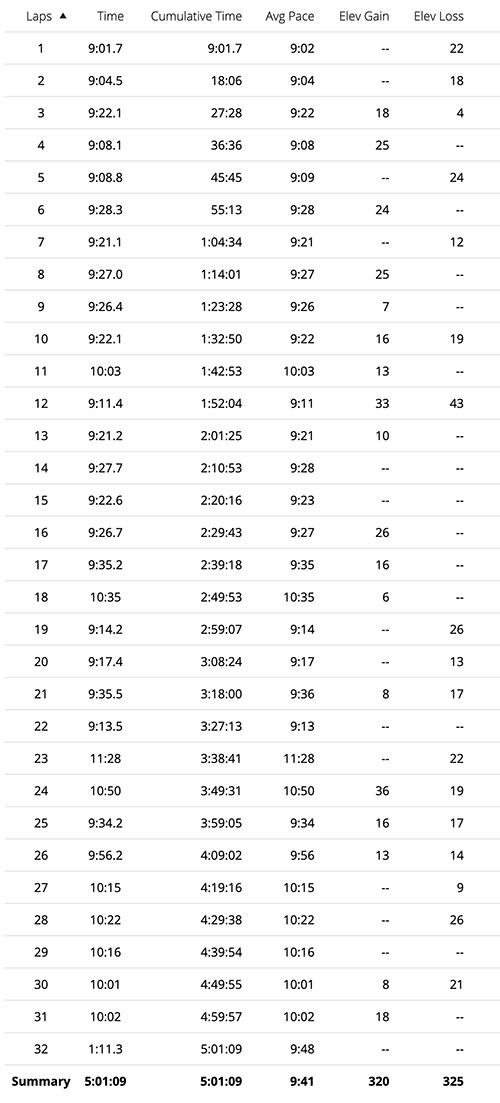
Finish time & pace: 5:01:07 (first time running the Kansas Rails-to-Trails Extravaganza), 9:41/mile
Finish place: 19 overall, 6/15 in M 40-49 age group
Number of finishers: 104 (54 men, 50 women)
Race weather: cloudy & cold (37°F) at the start and finish
Elevation change (Garmin Connect): 320 ft gain, 325 ft loss
Elevation min, max: 899 ft, 1,027 ft
 Blisters, Cramps & Heaves