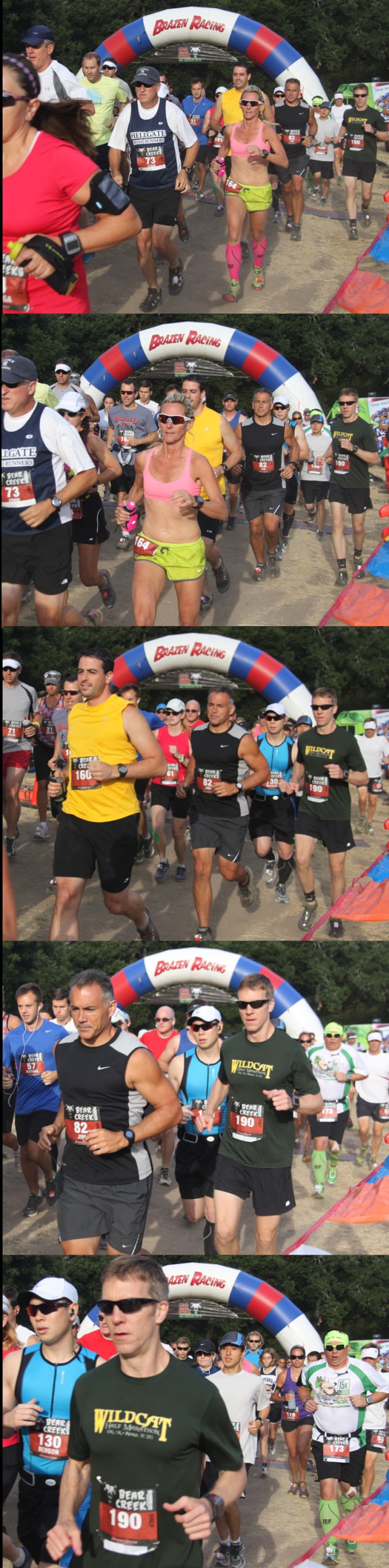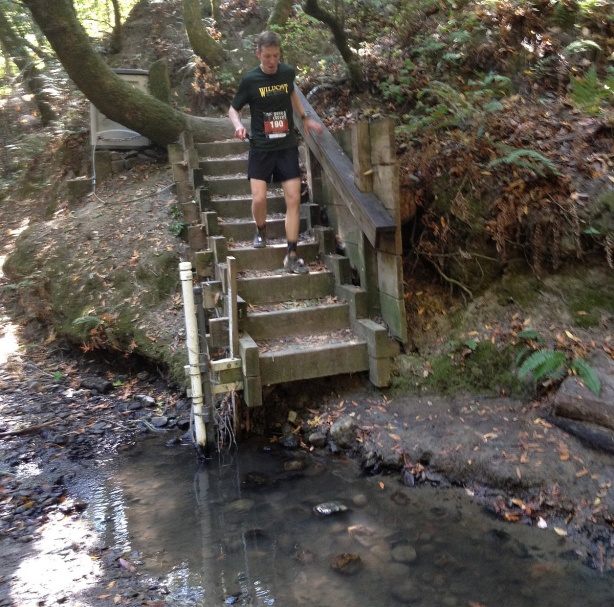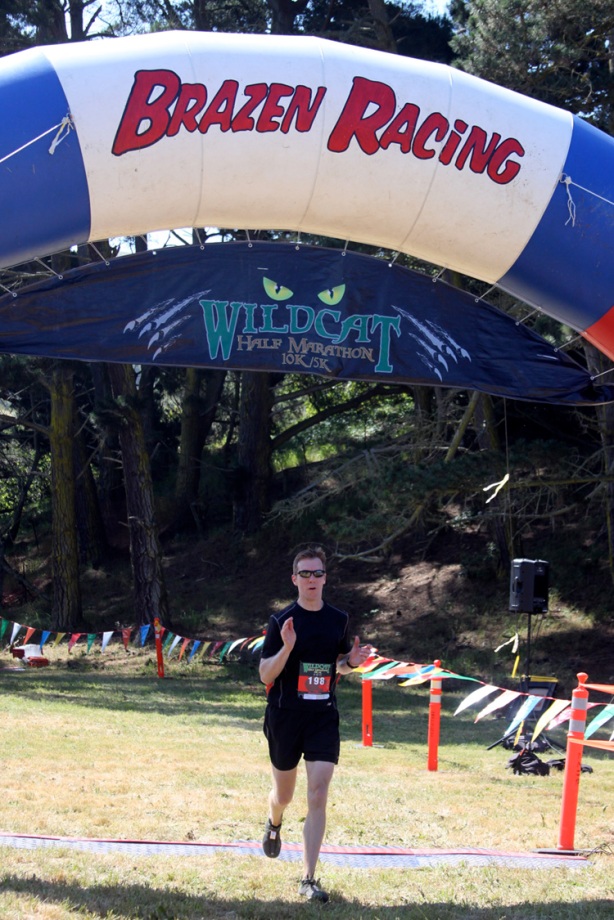
Archive for the ‘RACE REPORTS’ Category

Roads?  Where we’re going, we don’t need roads.
– Emmett “Doc” Brown, “Back To The Future”

Spyhopping humpback in Fournier Bay, Antarctica (photo credit: Mike Sohaskey)

(PREFACE: This is not a blog post in the usual sense.  Rather, it’s my attempt to chronicle an amazing adventure in two acts, and to – “demystify” is the wrong word – inspire an appreciation for a remarkable ecosystem that’s much more than an alien land of ice and snow.  For anyone seeking an even more detailed account of the Antarctica Marathon and its history, I’d recommend John Hanc’s book, The Coolest Race on Earth.  And for time-challenged readers who simply want the gist of our journey, I’d recommend skipping all the cumbersome words and sticking to the pictures.  Whatever your preference, thanks for reading!)

More so than any month in recent memory, March was a month of firsts.  Or maybe more accurately, it was a month of lasts.

Cut to the morning of February 26, and the last place I expected to find myself a month later was exactly where I found myself a month later: joining upwards of 100 highly motivated runners – including one celebrated back-of-the-packer with the all-too-appropriate nickname of “The Penguin” – aboard a Russian research vessel headed toward the South Pole to race The Last Marathon on the Last Great Continent.  All under the watchful eye of a leader named Gilligan.

As absurd as a “spontaneous” trip to Antarctica sounds, that’s exactly what this would be.  Sometimes, truth really is stranger than fiction… and even less likely.

Damn the icebergs, full speed ahead!
Rewind to the morning of February 26, a morning that began like any other: my spring racing plans were gradually taking shape as I contemplated a return to either the L.A. Marathon – one of my 2012 racing highlights – or the Oakland Marathon, site of my half marathon PR (1:34:02) last year.  Also in my sights were one or more upcoming trail races with my favorite local racing outfit, Brazen Racing.

Yep, spring 2013 was falling into place… until the following e-mail message hit my Inbox, and my best-laid plans went out the porthole:

dear Mike,

The ship that we had chartered for the 2013 Antarctica Marathon to depart in a couple of days has been damaged by an iceberg.

We have rescheduled the trip using the sister ship, the Akademik Vavilov which we have chartered many times in the past.

You are currently waitlisted or confirmed in the future for the Antarctica Marathon. Are you interested in confirming space for these new dates in 2013?

[details omitted]

It always is an adventure. Please advise as soon as possible since most of the confirmed passengers have rescheduled for the later dates. We will have a few spots available.

Please contact us immediately if you are interested.

Thom Gilligan
Marathon Tours & Travel

My immediate reaction was probably similar to yours… 101 years after the Titanic kissed the bottom of the ocean, actual operating ships are still colliding with icebergs?  My secondary response, though, was one of adrenalized bewilderment – Antarctica?  On such short notice?  Was this a legitimate option for us?

In short – yes, it was.  Due to the large number of runners vying for a limited number of slots (roughly 100 per year), the Antarctica Marathon typically requires years of advance planning and a lengthy sojourn on the Marathon Tours waitlist.  As referenced in their e-mail, we’d entered the waitlist in mid-2012 and in doing so had confirmed our spot – for 2016.  So we figured to have three more years to plan for this trip.
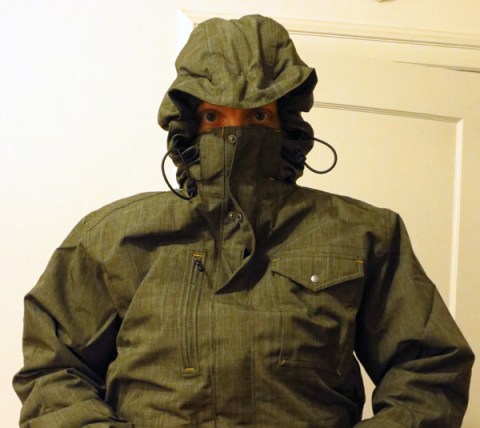
Take me to your freezer!

Thing is, I hate procrastination, and putting off until tomorrow what I can do today.  Paradoxically, I have a lot of patience – research science and delayed gratification go hand-in-hand.  But Antarctica promised to be the opportunity of a lifetime.  Cliché as it may sound, life really is too short, as we were starkly reminded by this past week’s tragic events in Boston.  Who knows where we’ll be and what we’ll be doing three years from now?

And although I wouldn’t classify myself as a “bucket list” runner, I do have a short list of three marathons that I consider must-do events: Boston, New York City and Antarctica.  What did it matter that neither Katie nor I owned a legitimate cold-weather jacket, or that I’d only run in tights once in my entire life?  At least we wouldn’t need any vaccinations or immunizations for this trip… I’m pretty sure penguin fever is both unpreventable and incurable.

As the nail in the coffin of March normalcy, we found ourselves in a relatively obligation-free time of personal and professional transition (another post for another time).  Thus the awesome realization dawned on us that yeah, March was actually the perfect time for a frigid flight of fancy.  And within two days, we’d committed to join 98 other adventure-seekers on an unanticipated journey to the Last Great Continent.  Thankfully, our voyage was scheduled to last a bit longer than a 3-hour tour.

And so it was that on March 21, after a highly successful raid on the winter clearance racks at our local REI, The North Face and assorted outlets, Katie and I found ourselves on a flight bound for Buenos Aires, Argentina, where our 17-day adventure would begin.  With little time for pre-trip research and little idea of what to expect (other than the obligatory requests to “Bring back a penguin!”), our ignorance was bliss.

So, just sit right back and you’ll read a tale, a tale of a fateful trip….

ARGENTINA (Fri – Tues, March 22 – 26)
Since this is ostensibly a running blog, I’ll limit my thoughts on the Autonomous City of Buenos Aires to the high (and low) points of our 5-day visit – though use of the word “concise” here would be disingenuous:

Overall, we had a lively visit to Argentina’s capital city – which wasn’t a foregone conclusion, given that I have virtually no interest in soccer, tango dancing or huge slabs of beef.  But with its European-inspired architecture, socioeconomically diverse neighborhoods, thriving theatre industry and plentiful green spaces, Buenos Aires is a culturally vibrant city and a terrific place to explore on foot.  Fortunately, my sub-fluent yet functional Spanish proved good enough to point us in the right direction and keep us out of trouble.
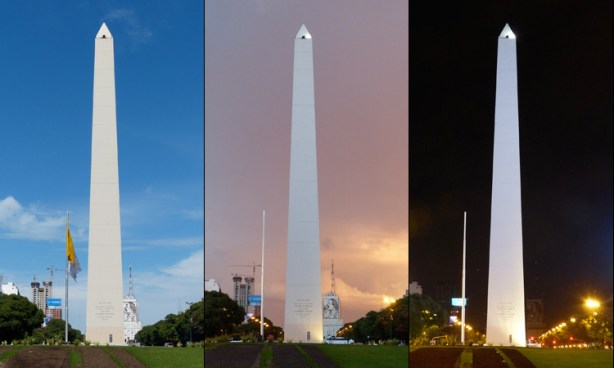
El Obelisco in Plaza de la República, Buenos Aires (photo credit: Mike Sohaskey)

Good morning, good afternoon and good night in the Plaza de la República:
El Obelisco stands on the site where the Argentine flag was first hoisted in Buenos Aires in 1812

Architecturally, the city is a dynamic and captivating mix of old and new.  Highlights of our bus and walking tour included the ornate mausoleums of La Recoleta Cemetary (where many notable Argentinians including Eva Perón are interred), the politically charged Plaza de Mayo (site of La Casa Rosada, mansion and office of the President of Argentina), and the recently renovated Teatro Colón (famed opera house which Pavarotti once praised for its “perfect” acoustics).  And not surprisingly, images of favorite son Cardinal Archbishop of Buenos Aires Jorge Bergoglio, a.k.a. Pope Francis, now adorn the city.

For a city of Buenos Aires’ reputation and importance, however, I was disappointed by the state of abject disrepair in which many of its sidewalks find themselves.  In many places it looked as though The Avengers had been filmed in the city and nobody had bothered to clean up the rubble.  With a marathon on the horizon and after several near tweaks, I felt fortunate to get out of Argentina with both ankles intact.
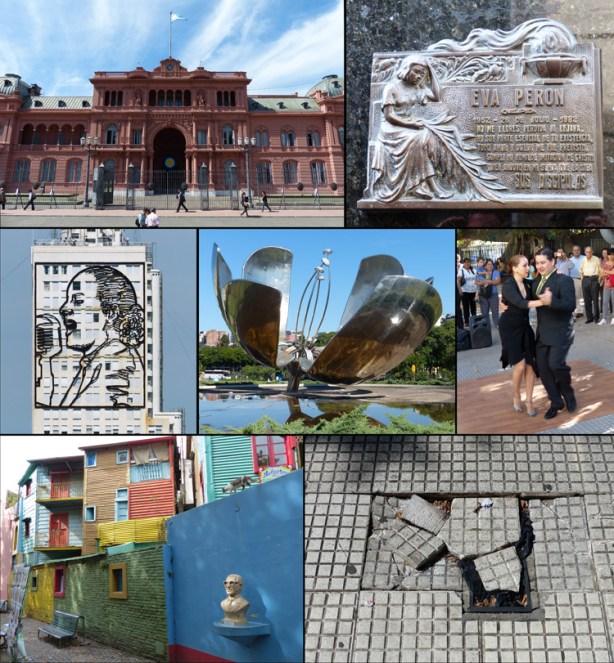
Photo collage of Buenos Aires highlights (photo credit: Mike Sohaskey)

Buenos Aires illustrated (clockwise from upper left): La Casa Rosada, executive mansion and office of the President of Argentina; plaque marking Eva Perón’s tomb in La Recoleta Cemetery; tango demonstration in the Recoleta district; one of the city’s many neglected sidewalks; colorful Caminito street in the neighborhood of La Boca; steel sculpture of Evita on the north facade of the Social Development and Health Ministry; the steel-and-aluminum Floralis Genérica sculpture in Plaza de las Naciones Unidas

As a runner, I was impressed by the number of Porteños (locals) out on the weekend walking, running or cycling through the city’s many bustling parks.  The typical Porteño I saw certainly was not built like someone whose daily diet consists of at least two large servings of beef – I’d guess the average Houstonian weighs roughly the same as 1.5 Porteños.

Speaking of food, the only part of each day I didn’t look forward to were the meals, for instance the vegetarian pizza we ordered for dinner one evening that arrived smothered in ham (I assumed the pig had been an herbivore).  In addition, the extra – and not insignificant – fee that several restaurants charged for “table service,” coupled with their insistence on serving and charging for bottled water despite the potability of the local tap water, amounted to epic scams.

I don’t usually fault cities for their names, but “Buenos Aires” is a conspicuous misnomer.  Granted the city was originally recognized for its “good airs” (or more likely, its “fair winds”) way back in the 16th century, but these days it would be like changing Omaha’s name to Ocean View, Nebraska.  Collectively, the carbon monoxide-induced asphyxiation from urban traffic (particularly the large number of freight trucks headed to and from the port), the secondhand asphyxiation from the local smoking population, and the impenetrable char-grilled asphyxiation from the parrillas (barbecue grills) bordering the Reserva Ecológica where I ran on two occasions, combined to ensure that my lungs never got too comfortable in their pleura.

This was the top Google search result for parrilla, the catch-all name for the city’s popular BBQ grills.

By keeping close tabs on our cameras and backpacks, we were able to depart Buenos Aires with our wallets and all other personal belongings intact.  Unfortunately, not all our fellow runners were so lucky… we heard of at least two cameras being stolen from dinner tables, and one trusting fellow (a fellow Bay Area native, in fact) lost his wallet to an elaborate pickpocket ruse involving fake bird droppings on his head, two helpful bystanders with a towel and an immediately accessible getaway car.

We meet at last (Sunday, March 24)
Our third evening in Buenos Aires featured the Antarctica Welcome Banquet Dinner.  Here we met Thom Gilligan, the founder and leader of Boston-based Marathon Tours, as well as the four members of his race crew who would be joining us in Antarctica: Scott and Anita, respectively the General Manager and Environmental Officer of Marathon Tours, as well as the husband-and-wife team of John “The Penguin” Bingham and Jenny Hadfield, both well-known to the running community for their books and popular columns in Runner’s World and elsewhere.

John opened with some remarks about The Last Marathon, the first organized sporting event in the history of Antarctica.  Thom then said a few words about “Antarcticer” (his Boston-based pronunciation) and introduced our upcoming adventure with the brutally honest classified ad ostensibly posted in the London Times by explorer Ernest Shackleton, in preparation for his 1907 Antarctic expedition:

Ernest Shackleton

Musical accompaniment for the subsequent slideshow included Dido’s “White Flag,” with its (so we all hoped) tongue-in-cheek chorus of “I will go down with this ship.”  After the slideshow, Thom asked for a show of hands as to who had run a sub-3 hour marathon in the past two years.  Three hands went up.  He then asked for a show of hands from runners in the 3:00 to 3:30 range – three or four more hands went up, including mine.  Although I knew this wouldn’t be a typical marathon, in that the 50-59 and 60-69 age groups would be the most competitive, I knew there would still be plenty of representation by the younger demographics, and I was shocked to find myself immediately seeded so highly.

But for me the most striking realization of the evening, which I hadn’t fully appreciated to that point, was the dedication and commitment of every person in that room.  True we were all headed for Antarctica, and that in itself set this room apart.  But whereas running for most people is a hobby, a way to alleviate stress and stay fit, for this group it was a lifestyle, an obsession in the healthiest sense of the word.  And while not everyone in that banquet hall may have possessed the stereotypical “runner’s body” (that’s why it’s a stereotype), I’d be reminded in the coming week that mind really does matter.
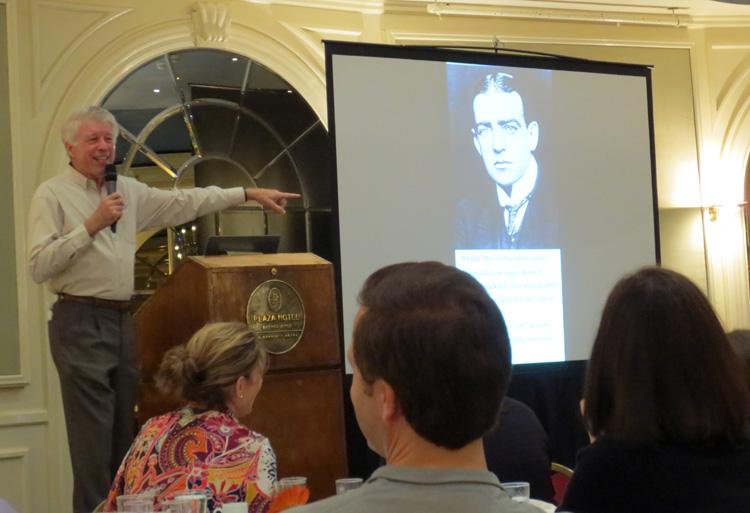
Thom

Thom Gilligan introduces an excited group of marathoners to what lies ahead

That evening I met seemingly normal, well-adjusted individuals who had run over 100, over 200, over 300 marathons.  I met several individuals who had raced in all 50 states, on all 7 continents, and yet had never run a trail race.  I met Winter, a 14-year-old Junior Olympian from Oregon who’d formed Team Winter and resolutely set a goal to run a marathon on all seven continents in support of prostate cancer awareness, after her father was diagnosed with the disease in 2008 and passed away less than a year later.  I met Wes, a 78-year-old lifelong Purdue Boilermaker who’d run 200 marathons (including 100 in the past decade) and in 23 European countries, and for whom Antarctica would be his 7th continent and final marathon.  I met Rory, a charismatic and “Jo-burg proud” South African who had completed the notoriously grueling Comrades Ultramarathon 12 times.  I met Brendan, a running coach and 50 states/6 continents finisher from Chicago who’d failed in his first bid to complete the Antarctica Marathon three years earlier, and was back to exact his racing revenge.  I met the Canadian duo of 70-year-old Georgine and her son James, and was amused to discovered that she was the runner in the family who had persuaded her hockey-playing son to join her in running the Antarctica half marathon.  And I met many others whose stories I’d hear and whose lives I’d share over the next two weeks.

As nonchalantly as most people would discuss their kids’ soccer game, conversations centered around questions like “How many continents is this for you?” and “Have you run Kilimanjaro yet?”  The Great Wall of China, Machu Picchu, the Arctic Circle, even Antarctica already in a few cases – my travel companions had left their footprints, literally, on nearly every conceivable destination on the planet.

I had to admit… these were my kind of people.

Destination: Antarctica (Tues – Thurs, March 26 – 28)
Fast-forward 36 hours, and after one more day spent appreciating the many faces of Buenos Aires, we found ourselves on a flight to Ushuaia (pronounced Oos-why-uh by the locals), the southernmost city in the world and the capital of Tierra del Fuego at the tip of South America.  As the plane touched down in Ushuaia, the cheers from the locals onboard and the sight of the woman seated next to me crossing herself suggested our adventure had begun earlier than planned.
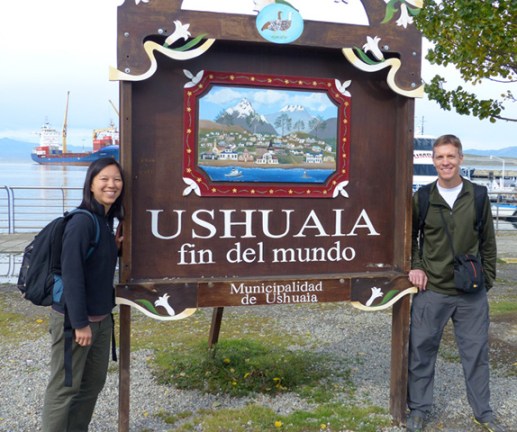
Katie and Mike Sohaskey in Ushuaia, Argentina

It’s the end of the world as we know it… and Katie and I feel fine

After a brief layover and stroll around this sleepy port town we boarded the Akademik Sergey Vavilov, the Russian ship (and one-time research vessel) that would – barring an unforeseen iceberg encounter – carry 105 passengers, 41 crew members and 13 expedition staff to our destination across 600 nautical miles and a particularly gnarly stretch of open ocean that we’d soon come to know all too well.

With rainbows and mist-shrouded peaks dominating the landscape, we “threw ropes” (set sail) at around 6:00pm local time on Tuesday and slowly made our way out of the Beagle Channel.  From that point forward, responsibility for our well-being fell squarely into the hands of the 13-member staff of One Ocean Expeditions.

Akademik Sergey Vavilov in Ushuaia port (photo credit: Mike Sohaskey)

In the Ushuaia port, the Akademik Sergey Vavilov awaits its human cargo

As it turns out, we couldn’t have entrusted our safety and well-being to a more competent, experienced and entertaining group.  As the Managing Director of Canadian-based One Ocean Expeditions, Andrew Prossin would be our solidly-in-charge Expedition Leader whose soothing voice and Canadian sensibilities would greet us first thing every morning with his wake-up announcements over the ship’s PA.  In addition, at each meal he would set our expectations as to weather (always unpredictable), changes to the itinerary and opportunities for wildlife sightings.  His understated cry of “hooray” which punctuated the end of his announcements became a rallying cry for the entire ship.

His One Ocean staff would be an appropriately eclectic collection of three fellow Canadians (Derek, Zoe and Nate); one Australian (Ewan, the kayaking king); a Dane (Louise, our hotel manager); a Welshman-cum-South African-cum-Australian (Mark, passionate whale conservationist and Andrew’s Assistant Expedition Leader); one far-North American (yoga guru Liz, whose “Alaska girls kick ass!” sticker immediately attracted my attention); one Portuguese (all-important mixologist Joao); and chefs Jeremy, John and Mike who, together with pastry chef Elizabeth, embraced and conquered the unenviable task of creatively providing three meals a day, every day, while hundreds of miles from the nearest grocery store or farmer’s market.  Before this trip I’d never eaten, much less looked forward to, daily lunch dessert.

One Ocean Expeditions staff

The One Ocean Expeditions staff included Expedition Leader Andrew (with microphone), Liz, Mark, Ewan, Nate, Zoe and Derek

Katie and I spent the first hour onboard familiarizing ourselves with the ship’s layout and idiosyncracies, including the less-than-romantic bunk beds in our third-deck cabin that prevented me from sitting up straight in either bed.

The next two days belonged to the Drake Passage, the necessary evil of open water between the Beagle Channel and Antarctica that would test every passenger’s sea legs, not to mention their seasickness meds.  We both chose to use the Transderm Scopolamine patch, a nickel-sized prescription patch applied behind the ear that prevents motion sickness for up to three days.  Which it did admirably well, the main drawback being the side effect of dilated pupils that messed up our vision something fierce.  As a result, neither of us felt quite like ourselves during those two days crossing the Drake, as our literal inability to focus prevented productive behaviors such as reading or writing.
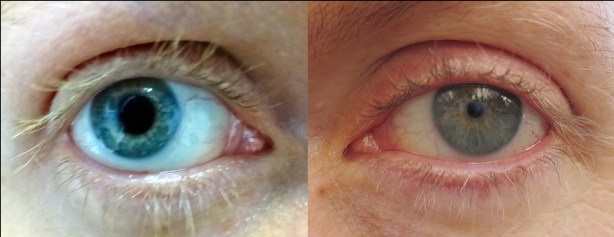
This is your brain on scopolamine (left); normal undilated pupil shown on right for comparison 

Unfortunately, all postcards had to be submitted before race day if we wanted them to be postmarked from Antarctica.  And so I found myself seated in the lounge of a wickedly swaying boat with one eye closed, squinting through my open eye Popeye-style as I tried to stabilize both hand and vision long enough to write legible quips about what an awesome time we were having at a destination we hadn’t yet reached.  Lucky family members will no doubt wonder (assuming the cards ever arrive) how many shots of tequila preceded my postcard-ing sessions.

Luckily the One Ocean and Marathon Tours staff had planned other, less cerebrally taxing distractions to pass the time.  Among these, Thom talked about the history of his brainchild, the Antarctica Marathon; John held court and lightened the mood with his entertaining perspective on life as a back-of-the-pack runner; Derek laid down mad knowledge on “Birds of the Southern Ocean”; Liz provided historical context in detailing the ill-fated Scott/Amundsen “Race to the Pole”; and Nate capped the evening with “Marine Superstitions,” after which nobody was caught whistling aboard ship.

Check out this footage of life in the Drake Passage (a.k.a. the “carbo-unloading zone”), filmed through the porthole in our cabin:

By Thursday evening we’d more or less cleared the Drake Passage, crossing the Antarctic Convergence and the 60th parallel south to enter the Southern Ocean. Soon after that we approached the South Shetland Islands and specifically King George Island, site of Saturday’s upcoming race.  At that point even our first whale (fin whale, to be exact) sighting of the trip couldn’t disguise the fact that the natives were getting restless.

As race day approached and hours spent aboard ship accumulated, the restlessness and nervous energy among the passengers continued to build.  The most tangible reflection of this mindset may have been the bar/lounge on the upper deck of the ship, which experienced two sparsely populated evenings as normally relaxed, sociable runners morphed into their water-swilling, teetotalling pre-race alter egos.  Our bartender Joao was perplexed by but resigned to this transformation, which he’d clearly experienced before.  And his voice of experience predicted a significantly more laid-back ambiance once the race was over.  I raised my water bottle in agreement, and in a toast to more carefree days ahead.

Keeping expectations at (Maxwell) bay (Friday, March 29)
With the planet’s southernmost continent within sight at last, the harsh reality of where we were and what we were about to do finally hit home.  Stepping out on the sixth floor deck to gaze upon King George Island – so close and yet so far – I was greeted by the stinging sensation of a million frozen, finely honed razors slicing right through me.  My skin and two lightweight layers were defenseless against the Antarctic wind.  And to think that tomorrow at this time, I’d be running 26.2 miles in this.  Let the mind games begin…

Despite the initial cold shock, the consensus adjective of the day to describe our first encounter with Antarctica was simply “indescribable.”  A picture may be worth a thousand words, but in this case one would have to suffice.

The plan for the day called for Thom and his crew to make their way across Maxwell Bay to King George Island early that morning to set up the race course.  Meanwhile, the rest of us would finally make an excursion off the boat and potentially even stretch our legs on land at some point.  Ah, perchance to dream….  Instead, the Antarctic winds did what the Antarctic winds do, churning up the water and making conditions unsafe to launch the zodiacs (the rigid inflatable boats used to transport people from ship to shore).  It wasn’t until 1:00pm that the wind died down enough to launch the boats and send Thom’s crew (plus ATVs) on their way to King George Island.  Many of us watched as the zodiacs made their not-so-long yet slow voyage across the bay and toward the Russian base at Bellingshausen Station.

Thom and his crew

The zodiacs approach the Russian base on King George Island, on their way to set up the marathon course

This in itself was uplifting news, because again this was Antarctica, where even the seemingly straightforward process of getting off the boat couldn’t be taken for granted.  Still fresh on everyone’s mind was Thom’s unsettling tale of his 2001 Antarctica Marathon expedition, when uncooperative weather had seized the day(s), only to have the passengers seize it right back.  After several days of thwarted attempts to launch the zodiacs in rough waters, a consensus decision had finally been reached that the show must go on, and that the marathon would be run ON. THE. DECK. OF. THE. SHIP.  Apparently one of the passengers that year had been a qualified race distance certifier, and he mapped out a 26.2-mile course that comprised 422 laps around the upper deck.  The race was run over a 24-hour time period, and don’t ask me how each runner kept track of his/her number of laps completed.  Most strategically, the ship had been moored such that the anchor just touched the continent of Antarctica, thereby validating the venue.  Thus went the story of how the 2001 Antarctica Marathon was staged under the most challenging conditions to date, a testament to human fortitude and resolve that exactly nobody on our ship had any interest in repeating.

Speaking of human fortitude… with our plans for an afternoon expedition foiled, everyone gathered in the bar/lounge to watch “Crossing The Ice,” an intimidating/inspiring documentary about two Aussies and one Norwegian who found themselves competing against each other to become the first persons to complete the trek to the South Pole and back unassisted.  I then retreated to the basement gym to, if nothing else, get the blood pumping and stretch my legs before I’d have to use and abuse them the next day.
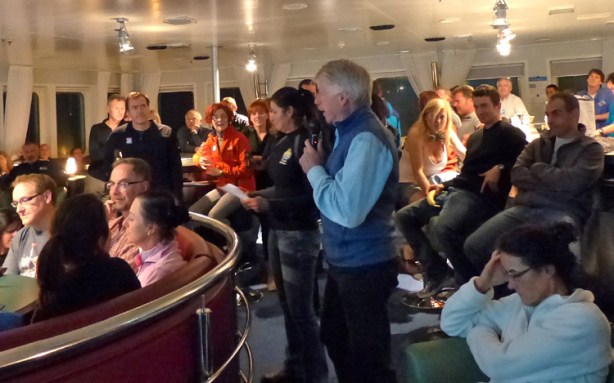
Antarctica Marathon 2013 pre-race briefing (photo credit: Mike Sohaskey)

A weary Thom addresses a roomful of restless runners during his pre-race briefing

After dinner – the last supper before the race, which happened to coincide with this being Good Friday – Thom stepped to the microphone for his pre-race briefing looking ruddy and dog-tired from his afternoon excursion.  He informed us that the hilly course would consist of two different out-and-backs that marathoners would run three times, with the start/finish line separating the two.  The first out-and-back would take us past the Russian base, then out to the first turn-around point at the Uruguaryan Artigas Base and back, while the second out-and-back would lead past the Chilean Eduardo Frei Base and out to the turn-around at the Chinese Great Wall Station before retracing its steps.  There would be icy (if not muddy) patches to negotiate that Thom estimated at around 5% of the total course distance.  And based on today’s course conditions, he and his crew would be strictly enforcing the 6-1/2-hour time limit – anything longer and we risked hypothermia.

Google Earth rendering of the Antarctica Marathon 2013 course (credit: Mike Sohaskey)

Google Earth rendering of The Last Marathon course – thanks to Dan, from whom I stole the idea;
my personal detour can be seen leading toward the airstrip near the yellow church
(Click on the map for a larger image)

As we’d suspected, the day had been a rough one for Thom and his crew – John predicted that if we’d had to run the race that day in those conditions, nobody would have finished.  But he concluded the briefing by injecting a shot of humor, warning the room that “Bandits (runners who race without paying an entry fee) will be pulled off the course.”

Back in my cabin I systematically organized my apparel, bottles of Cytomax/GU, Garmin (don’t be silly, of course GPS works in Antarctica!) and thoughts for the day ahead.  And I realized that realistically, I had no idea what to expect.  Cold to be sure, but beyond that I had zero expectations: could I run a sub-4:00 marathon in these conditions?  Probably not, though “probably not” wouldn’t stop me from trying.  Runners are notorious for downplaying expectations – case in point, those ultra-competitive types who qualify for the Boston Marathon and then vow to treat it as a “victory lap”.

But this time, I realized as sleep engulfed my upper bunk – this time I really was out in the cold.

Continued and concluded in Act 2… with an actual race report!
There’s no such thing as bad weather, just soft people.
– Bill Bowerman, Nike co-founder and Pacific Northwest icon

January.  The word sounds cold, evoking as it does images of textureless gray skies, barren snowy landscapes and people dressed like South Park characters.  Although I largely escape winter by living on the Pacific margin of the U.S., here in the East Bay temperatures still dip into the suboptimal 30s this time of year.  And with few exceptions, January signals the nadir of the racing season.

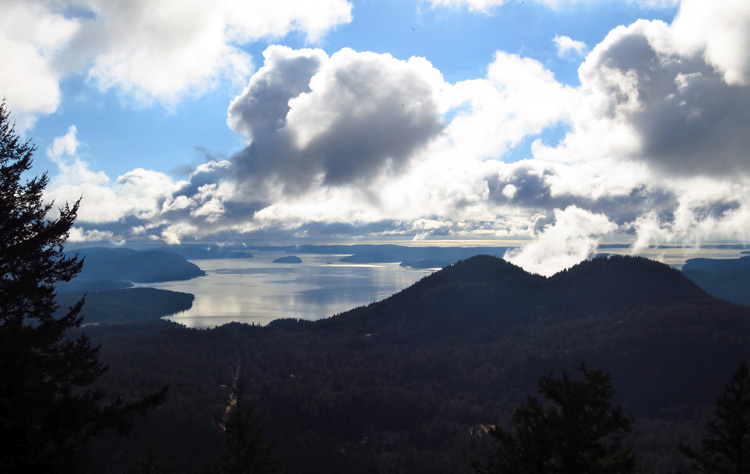
View from Mt Constitution Road

Friday’s view from Orcas Island, with blue sky and gray clouds battling for dominance

So for my first January race ever, you might think I’d choose a warm-weather outing in one of the more cold-resistant pockets of the country.  Maybe, say, the Disney World Marathon in balmy Florida.  Or the Rock ‘n’ Roll Half in hot ‘n’ dry Arizona.  Or maybe even stuff my swimsuit, running shoes and Garmin into a small duffel and head out across the ocean for the tropical Maui Oceanfront Marathon.  All logical, common sense choices.

Unfortunately, common sense didn’t cast the deciding vote this time… Julie did.

We’re told to keep our friends close and our enemies closer.  To that sound advice I’d add one more inner circle for people like Julie.  She’s been one of my closest friends since we met in graduate school.  She knew me back when my diet favored the “carbonated” and “partially hydrogenated” food groups.  We attended each other’s weddings, and she even picked me up from the airport one New Year’s Eve (!) when I could barely stay upright with the flu.  The world would be a shinier, happier place if everyone had a Julie in their lives.  And I’m not just saying that because she might stumble on this post one day while Googling herself.

Julie now lives with her husband David and two children in Redmond WA, best known to the rest of the world as the home of Microsoft.  Surprisingly, we’d never run a race together, though not for lack of trying on her part:

  • She threatened to bully me into running the Eugene Marathon with her in May 2010.  She didn’t, so I didn’t.
  • She floated the idea of organizing a team for the Ragnar Relay Northwest Passage, an idea I supported but which due to miscommunication died a quiet, neglected death.
  • She invited me to run the Victoria Marathon last year… on the same day I’d be running Chicago.
  • I suggested the Seattle Rock ‘n’ Roll Marathon in June, but was told “The Seattle Marathon isn’t all that interesting.”
  • At one point she even offered, “I’m sure I can organize a small race in the middle of nowhere for a cause no one will want to support.” That may have been her most enticing offer yet.

Finally, this past August she appealed to my trail-running sensibilities and sold me on the Orcas Island 25K, a mid-winter event staged by the folks at Rainshadow Running, a Pacific Northwest-based trail racing outfit.  Several members of her local running contingent would also be running Orcas Island, and when I sent her my registration confirmation she was pumped.  Psyched.  Excited.  Like a mosquito in a nudist colony.

And so it was that Saturday found me within snuggling distance of the Canadian border.  Roughly 30 miles northeast of Victoria, British Columbia and 40 miles south of Vancouver as the crow flies, Orcas Island is the largest of the San Juan Islands located in the northwestern corner of Washington state.  The race itself would begin and end at Camp Moran in Moran State Park and feature a climb to the summit of Mount Constitution, the highest point on the island at 2,409ft.

Katie and I flew to dreary-but-dry Seattle on THURSDAY, where after landing I kept a tight grip on my MacBook just in case the airport security/Microsoft gestapo got any ideas.

Clearly we’d landed in Seattle… where else do you see one of these?

FRIDAY morning we packed our gear into Julie’s SUV and, joined by her running buddies Charlotte and Kathie, drove the 80 miles to Anacortes before hopping a ferry to Orcas Island.  En route we saw seals, great blue heron, and plenty of seagulls.  We saw no orcas.  I was ready to sue someone for false advertising.

Four hours after leaving Redmond we docked at sunny Orcas Island, where the mercurial winter sky dangled the possibility of dry race conditions.  We’d seen the forecast and knew better.  After a brief reconnaissance drive up Mount Constitution, we checked in at the Doe Bay Resort on the eastern edge of the island.  Doe Bay is located within 6 miles of the race start and offers simple, no-frills cabin lodging that I’d recommend to anyone visiting the island.  Though somehow the five of us couldn’t find time for the clothing-optional soaking tubs at the resort.  Maybe next time…

That’s no killer whale… oh, wait, we must be in Doe Bay

After killing two hours in the sleepy bayside town of Eastsound, we made our way to Camp Moran for the optional check-in and bib pickup.  Here we also experienced Rainshadow Running’s clever, quirky alternative to the traditional race t-shirt: in the interest of conserving and reusing resources, the RR crew scour thrift stores for diverse articles of clothing, onto which they have printed the Orcas Island race logo.  Fortunately runners were also given the option to save $15 by declining a race “t-shirt” during online registration, an option I enthusiastically endorsed.

Scanning the assembled crowd of jovial runners in their fleece hoodies, puffy down jackets and wool beanie caps, the scene to my mind embodied the Pacific Northwest… if someone had cranked up “Smells Like Teen Spirit” I would’ve guessed Nirvana concert, circa 1992.  The low body mass index of the room added to the peculiar irony of this race’s former name, the “Orcas Island Fat Ass 25K.”  And speaking of low BMI… I had the opportunity during bib pickup to meet elite trail runner Candice Burt, whom I recognized from a recent Trail Runner email as having set the women’s fastest known time (FKT) during an unsupported run on the 93-mile Wonderland trail around Mount Rainier.  She was incredibly gracious and seemed happy to talk to anyone and everyone who approached her.

2013 Orcas Island 25K race shirt

Nothing says “Pacific Northwest runner” like plaid flannel race swag

That evening, while carbo-loading in our Doe Bay cabin, our group voiced two main concerns about the day ahead:

1)  The course. The previous week, race director James had inexplicably re-routed the already challenging course to add another 1,000ft of elevation gain, bringing the total elevation gain/loss to 4,450ft.  Kathie had been the first to notice James’ announcement posted on the race website: “It seems like every year I’m making some kind of change to the race course… This year’s route is totally different than any of the previous 25k courses and is HARDER THAN EVER!”  Julie, Charlotte and Kathie expressed unease over this arbitrary change; I chose to drown my apprehension in a third plate of spaghetti.

2)  The weather. Two days before the race, the forecast called for rain at lower elevations, with temperatures ranging from 38-45°F and winds at 11-13 mph; and for snowfall at higher elevations (above 2,000ft), with temps in the mid-30s, winds around 11 mph and new snow accumulation of 1-2 inches.  This would be the second time in less than a month I’d be running trails in rain and snow, although admittedly this time I’d be better prepared.  And as Washington residents, the other three members of our party were well-accustomed to running in nasty conditions (plus, Charlotte hails from Sweden and Kathie from Canada).  Still, none of this seemed to ease our collective mind, until finally we each sought refuge in the time-tested panacea for all pre-race ills: sleep.

That's the Powerline Climb beginning at mile 6

That’s the Powerline Climb starting at mile 6

SATURDAY morning was a lesson in the predictive power of meteorology, as we awoke to light rain, gusty winds and temps in the low 40s.  At least we’d had the chance to set our expectations accordingly.  We arrived at Camp Moran at 8:00am (for a 9:00am start) and, despite very limited parking, were able to park next door to the main cabin.

As already-soggy runners continued to fill the room and nervous energy mounted, James stepped to the front for his pre-race announcements.  Like everything else about his race, James himself was low-key.  He reminded us (in case we’d forgotten?) about the dreaded “Powerline Climb” he’d added to this year’s course, assuring us it would make the course more “fun” and more scenic.  When asked about cut-off times he replied that he didn’t actually know, then thought for a moment and suggested we “just be back here by 3:30.”  Finally, with a cold steady rain now falling, he led us from the comfortably warm cabin outside to start the eighth annual Orcas Island 25K.

From there things moved quickly.  Scrambling up the steep embankment to the start, I bid the others good luck and positioned myself among the front 20% of the pack.  As James’ countdown reached zero, the line of eager runners shot forward and down the paved road for ~1/4 mile before turning onto the Cascade Lake Trail, where the real race began.

My plan was to treat the day as a training run, rather than an all-out race.  Stay strong on the ascents and aggressive on the descents, but don’t do anything reckless.  My strategy was based on the tricky conditions as well as the unusual distance: I’d run only one other 25K, so it’s not as though a 25K PR would be a life-changing accomplishment.

Mike Sohaskey and fellow runners, minutes before 2013 Orcas Island 25K start

Me, Julie, Charlotte and Kathie flash our “warm and dry” smiles one last time

Because we’d all gathered indoors until the last minute, I’d neglected to give my Garmin the extra time it needed to find the GPS satellites and figure out where it was.  Apparently the impenetrable cloud canopy confused its California sensibilities, because it kept searching for satellites and asking me “Are you indoors now?” as raindrops bounced off its display.  Not the brightest gadget, so after about half a mile I gave up and – for the first time since I’d unwrapped it on Christmas Day 2008 – resigned myself to racing without my Garmin.  So this is how our forefathers did it.

Aside from short stretches on paved roads, the first 5.6 miles were exactly what I had envisioned for a trail run in the Pacific Northwest: muddy, leaf-strewn singletrack snaking through rainforest-like surroundings, past now-torrential Cascade Falls, around pristine Cascade Lake, as well as over and under moss-covered branches.  One key difference between road and trail races is the mental fatigue caused by running on rugged, uneven terrain: I couldn’t let my guard down even momentarily for fear I’d slip on a patch of mud, twist my ankle on a slippery rock or trip over a partially exposed tree root.  This constant vigilance in harsh conditions would take its toll by race end, and in the aftermath I’d encounter several runners with sprained ankles and scraped-up knees.  Such are the casualties of trail racing.

I first saw Katie with camera poised at Cascade Falls (near mile 3), then again at the Camp Moran North Arch (mile 5.6), just after the first of two aid stations.  I tossed her my gloves and turned my attention to the first major challenge of the day, the much-anticipated Powerline Trail.

Rather than having us run the more gradual switchback route, James routed this year’s course straight up the Powerline Trail, which is primarily used during dry months by mountain bikers coming down the trail.  After the race I asked Julie, Charlotte and Kathie to describe the Powerline Trail in one word; several dazed seconds later, each just shook her head as if trying to clear it of the horror.

Cascade Falls

Cascade Falls

“Abomination” was the word that came to mind as I struggled to ascend the steep, muddy slope.  The slick mud immediately reclaimed any forward progress I made until eventually, by pulling myself up on exposed tree roots and stepping in the recessed footprints of other runners, I was able to ascend the first and steepest pitch of the trail.  From there the trail turned just grassy enough to enable forward progress, but only by walking sideways uphill.  That was a racing first for me.  As I doggedly passed several runners-turned-hikers, one woman remarked, “This is an Achilles injury waiting to happen.”  By focusing five feet ahead of me, I was able to maintain a slow jogging pace up most of the Powerline Trail, while my quads and lower back protested the strain of laboring up a muddy hill at a 45° angle.

As both the Powerline Trail and the ache in my quads began to level off (mile 7.3, I heard someone announce), I realized the steady rain had transitioned to steady snow.  The next 6+ miles would be my first time racing in a winter wonderland, with much of the trail at least partially covered in snow.  Fortunately icy patches on the trail were minimal; however, footing was slowed by the accumulated snow, which made momentum and rhythm elusive prey.

Our second major climb of the day began at ~mile 9.6 and ascended a switchback route to the summit of Mount Constitution.  After jogging the first couple of switchbacks and speed-hiking the next, I fell into a jog behind two strong uphillers whose steady pace carried me to the summit.  Here the snow accumulation topped a foot, though I was generating enough body heat that cold wasn’t an issue.  Relieved as I was to have reached the zenith of the course, I was disappointed to find that road closures had prevented Katie from accessing the summit.  And the snow-spitting sky ensured there would be no panoramic vistas today.  No Mount Baker to the east, no Mount Rainier or Mount St. Helens to the south.

Following the trail of pink ribbons and the footprints of previous runners through the packed snow, I passed the second/final aid station at mile 12, where I thanked the shivering volunteers without breaking stride.  Based on my memory of the course elevation profile, I was hoping the final 3.5 miles would amount to a super-squishy downhill victory lap.

Mike Sohaskey heading up Powerline Trail in 2013 Orcas Island 25K

At mile 5.6, the Moran State Park Arch (left) doubles as the gateway to the Powerline Trail (right)

The highlight of the course, and hands-down one of the (literally) coolest things I’ve ever seen while racing, was snowed-over Summit Lake between miles 12 and 13.  If I’d had my camera – or even my camera phone – I would have stopped to snap a few pictures of the tranquil, picturesque landscape.  I’m surprised I didn’t launch myself headlong over a tree root while admiring the expanse of frozen white.

For a 250-person race, I spent a surprising amount of time running by myself.  Much of miles 2-6 (up to the start of the Powerline Trail), miles 7.5-9.5 (between major ascents) and mile 12 to the finish were spent in solitude, and I was able to enjoy the natural beauty of Orcas Island without having to worry about passing or being passed on sodden singletrack.

By the time the snow and ice transitioned back to rain and mud, I was eager to stretch my legs and make up for lost time.  Emboldened by more reliable footing with fewer large rocks and tree roots, my stride became more fluid, and I barely blinked as overhanging fern fronds swatted me wetly in the face.  Despite my faster pace, I was shocked that only a single runner passed me on the ~4-mile descent to the finish.  I expected that a caravan of reckless, eager-to-finish runners would overtake me, but then again that’s what prolonged steep ascents will do to you… the will may be there at the end, but the stamina is gone.

With neither my Garmin nor a single mile marker to gauge distance, the last four miles were peaceful yet seemingly endless.  Refusing to let my tired mind think ahead to the finish line, I arbitrarily repeated “1-1/2 miles to go” to myself while trying to maintain an aggressive pace.  With about a mile to go my victory lap was rudely interrupted by a nasty uphill jag, which although unwelcome would hopefully reinforce my lead over any unseen pursuers.

Mike Sohaskey finishing 2013 Orcas Island 25K

Surging toward my hard-earned high five from James (hidden from view, with umbrella)

As I re-emerged onto paved Olga Rd, black arrows on yellow signage pointed the way home past rows of parked cars.  A final uphill surge brought me to the precipice of Camp Moran, where turning left I dropped down the muddy slope, crossed the grassy field and – with Katie’s cheers penetrating my mud-brain barrier – high-fived James to finish with an official time of 3:12:06.

Mentally more than physically exhausted, I reunited with Katie (who’d wisely sought out the relatively dry comfort of the cabin porch) and stood watching the action while slowly regaining my wits.  Then I hurried inside to towel off and don dry clothes, before returning outside to await the others.  Exactly an hour later the three of them emerged as a group into Camp Moran, finishing within 30 seconds of each other and looking as dazed as I’d felt an hour earlier.

The consensus among Julie, Charlotte and Kathie was overall displeasure with James’ new-&-improved course design.  Another of Julie’s Seattle running buddies, who’d run this race last year, finished more than 38 minutes behind her 2012 time.  And I overheard another runner voice the sentiment that had crossed my own mind late in the race: “Most of the marathons I’ve run were easier than this.”  Kathie (though not Julie) agreed.  At any rate, this had been a whale of a course.

You go, girls! Charlotte, Kathie and Julie in a photo(genic) finish

On the other hand I did run a 25K PR on Orcas Island… though in the interest of full disclosure, I’d gotten lost (along with the leader at the time) during my only other 25K and ended up extending that race by 3 or so miles.

The winner finished with a mind-blowing time of 2:17:12; I’d love to watch the video of his ascent up the Powerline Trail.  And Andrew Fast did his surname proud with a second-place finish in 2:22:59.

In the main cabin I stabilized my blood glucose levels at the post-race spread while waiting for the others to shed their wet gear in favor of dry clothes.  Then, with the double whammy of stifling heat and dank musty runner threatening to overpower us, we made our exit.

We compared race notes over a life-affirming lunch at Tee-Jays, a hole-in-the-wall Mexican eatery in chilly, seagull-rich Eastsound.  Apparently Charlotte had tripped at one point and managed to twist in midair to avoid landing on her previously broken (and still-healing) wrist and elbow; she’d escaped with a bloodied knee and bruised hip.  Julie recalled another runner whom she alleged had been “endorphin goggling,” based on supposedly flattering comments he’d made while running behind the three of them (I’m guessing her cheetah skort inspired him).

Eastsound

Eastsound was swathed in fifty decidedly unerotic shades of grey

We killed a leisurely afternoon in Eastsound before making our way to the docks in time to catch the evening ferry back to Anacortes.  From there, as a collective exhaustion settled over the car, Julie navigated the 80-mile return trip to Redmond through darkness and driving rain.  In Redmond we said our goodbyes and cheerfully parted ways with Kathie and Charlotte, who had been terrific travel companions.  That night I barely remember my head hitting the pillow on the pull-out sofa bed in Julie and David’s guest room.  Even the sound of her son, from his room next door, urgently calling for his mom in the wee hours of the morning barely registered through the haze of my Powerline-induced stupor.

In retrospect, Orcas Island was one of the most memorable and surreal races I’ve run.  In just two days we covered a lot of ground – by car, by ferry and by foot – in a variety of weather conditions – first sun, then rain, then snow.  Thanks to Julie’s persistence in luring us to Washington and her hospitality once we arrived, I spent quality time with her family, met new and interesting people, immersed myself in the Pacific Northwest trail running culture… and returned to the Bay Area with a rattling cough that has slowly succumbed to sunshine and 60° temperatures.

Hey, that’s what friends are for.

*******

PRODUCTION: Unlike my travel companions, I appreciated the difficulty of the new course.  I figure if I’m flying to Seattle, driving 80 miles north, hopping a ferry to Orcas Island and then driving another 15 miles to the race site, I want a legitimate challenge and not a flat out-and-back on paved streets.  What I don’t want is Rock ‘n’ Roll Orcas Island.

James and his crew did a nice job of marking the course… wherever the possibility existed for a wrong turn, pink ribbons and arrow signs pointed the way.  But although I stayed on course throughout, there were lengthy stretches of solitary running where a “reassurance ribbon” would have eased my mind.  Just a thought for next year’s race.

Race registration itself cost only $45, plus a $3.25 processing fee; however, this price of admission didn’t include the ferry ($85 for our five-person vehicle), the Washington State Discovery Pass required to enter Moran State Park ($10 for one day or $30 for an annual pass), or lodging.  So depending on how many people travel together and where they stay, Orcas Island could end up being a less-than-frugal outing.

The race volunteers can never be thanked enough; they were tremendously helpful, friendly and wet.  And the post-race spread was to my liking: plenty of fruit (bananas, oranges and pineapple) and sugary drinks, plus local microbrews, soup and a well-stocked sandwich counter.

The Pine Hearts provide post-race entertainment after 2013 Orcas Island 25K

The Pine Hearts provided post-race music… Katie guessed “Indigo Girls” on every song

As for race swag: unless INKnBURN is involved I’m not a huge t-shirt guy, so I appreciated the “reuse and recycle” ethic practiced by James and his crew.  My biggest disappointment wasn’t the lack of a conventional race t-shirt, nor the quad-busting course, nor even my failure despite my best efforts to give myself pneumonia.  No, ’twas the lack of finisher’s bling that most conspicuously cast its cruel shadow across this otherwise radiant heart.

The medal doesn’t have to be fancy – it can be something old, new, borrowed or blue.  It just has to be SOMETHING.  A reminder of Orcas Island that years from now still triggers instant memories of the Powerline Trail and Summit Lake.  I know that “real” trail runners – those who claim to run out of a sheer love of nature and their fellow man – typically reject the notion of medals (and other material possessions).  And granted, if there were no medals I’d still run, and run hard.  But at the same time, seeing the number of runners last weekend happily sporting “Orcas Island 25K” argyle pullovers or Hawaiian aloha shirts, I’d be surprised if most of them weren’t also medal-grubbing types like me.

If and when I make it back to the Pacific Northwest, I’d definitely race with James and his Rainshadow Running crew again.  Especially if next time they have medals.

GEAR: Faced with slick mud, slippery rocks, ankle-deep snow and patchy ice, my Merrell Mix Master 2s again outperformed the rest of me.  Orcas Island was their toughest test to date, yet the shoes remained grip-tastic and provided reliable footing over the entire 25+K.  Now if only Merrell would make a trail shoe that lifted itself over rocks and tree roots when its owner got tired…

BOTTOM LINE: If you’re new to trail running and looking for a first-timer’s race to ease yourself into the sport, keep looking because this one’s not for you.  But if you’re a trail racing aficionado seeking a low-key yet challenging race in a picturesque setting, I’d recommend Orcas Island in an (elevated) heartbeat.  And admittedly I’m now intrigued by the 50K, which will be held this Saturday and which includes 8,400ft of elevation change.

CHECK OUT CHARLOTTE’S RACE REPORT FOR ANOTHER (MORE CONCISE) PERSPECTIVE.

FINAL STATS: (thanks to Charlotte for distance and elevation change data)
January 26, 2013
16.34 miles (26.3 km) on Orcas Island in Olga, WA
Finish time & pace: 3:12:06 (first time running Orcas Island), 11:45/mile
Finish place: 32/241 overall
Race weather: windy, rainy, snowy and cold (temps ranging from low 30s to low 40s)
Elevation change (Garmin Connect software): 4,505ft total gain/loss

In Hollywood the woods are full of people that learned to write but evidently can’t read.  If they could read their stuff, they’d stop writing.
– Will Rogers

Trail race or death metal concert?  Either way, count me in!

For most of the races I’ve run, I don’t necessarily remember why I decided to run that race.  Sometimes it’s the setting, probably my most common motive here in the Bay Area.  Sometimes it’s a convenient excuse to travel somewhere enticing, as in the case of Moab earlier this month or the Run Crazy Horse Marathon I ran in the Black Hills of South Dakota last year.  Sometimes it’s my preference for a specific race organizer, as in the case of my favorite local outfit, Brazen Racing.  And sometimes the reason is simply, to quote English mountaineer George Mallory, “because it’s there”… this was the case for the Pikes Peak Ascent two years ago.

But for the Griffith Park Trail Half Marathon, staged in the Hollywood Hills last Saturday, I remember exactly when and why I decided to run.  On November 12 of last year, we were at the pre-race expo-on-the-beach for the Malibu Half Marathon, which I’d be running the next day.  My sister-in-law Laura struck up a conversation with a cyclist who was wearing what looked like a race t-shirt, but then again maybe not, because it was honestly the coolest, most eye-catching t-shirt I’d ever seen (sorry, Affliction devotees).  It was more like body art than body wear.  The colorfully clad cyclist told us he’d just run the Griffith Park Half Marathon that morning and had received the t-shirt, crafted by the SoCal-based apparel design company INKnBURN, as part of his race registration.

That was the moment I filled out my mental registration form for the 2012 Griffith Park Half, a scant 371 days away.

To say I’d give you the shirt off my back would, in this case, be a lie

In recent years, the “free” (as it’s often advertised) race t-shirt has become a norm in the racing community, an ingrained feature of just about any race that strives to be taken seriously.  The t-shirt has become the standard entry-level requirement for staging a decent race… any race director seeking customer loyalty and free advertising includes, at the very least, a t-shirt with each registration fee.  For some runners, the t-shirt is the highlight of the race and their raison d’être for lacing up in the first place.  Though others of us frown on this mindset and tell ourselves we would never fall victim to such shallow motives… we run for the medals instead.

Each race t-shirt typically features the race name and logo emblazoned on the front, along with the names and logos of the various race sponsors on the back.  So by proudly showcasing his accomplishment, each race participant in effect becomes a walking billboard.  Although typically short-sleeved, race t-shirts occasionally come in long-sleeved versions, and some race directors even provide each runner with a lightweight jacket, wind shirt, or hoodie (an upgrade usually reflected in higher registration fees).  A recent positive trend in race t-shirts has been the move away from cotton in favor of “technical” t-shirts – these are shirts made from lightweight synthetic fibers rather than cotton, which wick moisture (i.e. sweat) away from your body to keep you cooler and more comfortable during a workout.  And now this is starting to read like a Wikipedia page.

Hollywood beckons!  A place where fog is a natural consequence of hot air meeting cold, hard truth

Like the races themselves, the quality and artistry of race t-shirt varies dramatically.  But for me in most cases, it’s the thought that counts.  Every race t-shirt is unique and has its own distinct charm, and I’ll never disparage a small race on a tight budget for its no-frills t-shirt.  Certainly some are more stylish, useful and wearable than others; the Merrell tech t-shirt I just scored in Moab easily ranks near the top of my list, whereas Nike’s black trash-bag-with-armholes-and-crooked-logo at the well-funded 2011 Austin Half Marathon ranks near the bottom.

And if you’re an endorphin junkie who over time has accumulated a small ransom in race t-shirts while quickly running out of closet space, never fear… there are now companies online that will “turn your favorite t-shirts into a beautiful quilt”.  Call now, seamstresses are standing by!

So clearly the t-shirt has become a race-day staple, but Griffith Park would be the first time I’d ever committed to run a race based first and foremost on the t-shirt.  Couple that with the fact that the race is run on hilly dirt trails with a sweeping view of Los Angeles stretching to the Pacific Ocean, and how could I say no?  The only potential pitfall turned out to be the $120 registration fee… but after a $15.00 online discount (partially offset by an $8.40 service fee) and some adroit sleight of mind, I rationalized the steep fee as a one-time expense for a kick-ass trail race and one-of-a-kind swag.  Plus, racing in SoCal gives us a chance to visit family: my brother Chuck lives with Laura in Long Beach, while Katie’s parents live in Orange County.  By the time my brain’s perverse machinations had run their course, I could no longer think of a viable reason not to run Griffith Park.

This is my brother Chuck… he’ll be standing in for Katie as today’s blog photog

Fast forward to last Saturday, and as I… actually, let me digress to say that “I” will replace the usual “we” in this post: for only the second time in recent history I’d be Katie-less for this race, having left her in bed to recover from a nasty stomach bug.  So as I navigated north on Hwy 5 through pockets of heavy gray rain, I wondered vexedly what had happened to the climate-controlled dome I’d always assumed Disney to operate over the Greater Los Angeles area. Apparently this was one of the five days a year when Goofy and the gang retract the dome to clean it and repair cracks.  But still I held out hope that Griffith Park would remain in a rain-free pocket of the storm, even as the rain intensified on Los Feliz Blvd just outside the park, where I’d arranged to meet Chuck and Laura so we could carpool to the start line.

Traffic into the park was minimal, and we parked with ~30 minutes to spare before the 8:30am race start.  Making our way uphill (already… feeling… winded) toward the staging area over half a mile away, I was relieved to find that the rain had subsided, likely for the moment but hopefully for at least the morning.  I have no problem running in the rain on well-established trails like those in Griffith Park, but I’d always prefer to keep it dry.  And speaking of trails: although a meandering network of trails zig and zag their way through Griffith Park, apparently few of them readily map to a 13.1-mile race course, because the course map showed three separate out-and-back sections.

The staging area on narrow Commonwealth Canyon Drive was small and fairly crowded.  Laura quickly spoke with race director Keira Henninger and then disappeared back down the hill to help in a volunteer capacity.  Chuck tried but was denied race-day registration, since the field had already reached its 400-person capacity.  So instead he strapped on his camera and prepared to play substitute race photog in Katie’s absence.  In contrast to my usual nick-of-time arrivals, I had a few minutes to kill as I collected my racing bib and t-shirt (can I leave now?) at the uncrowded registration tent, conquered the surprisingly brief line for the porta-potties, and cycled through my warmup routine.  I also elected to ignore the race website’s dictum (on its FAQ page) that “You must carry some sort of water bottle with you to start this race,” especially on this day where weather wouldn’t be a factor.

By this time the crowd of runners milling around the start line had grown and become more densely packed.  A pronounced sogginess filled the air and permeated exposed skin.  As I waited for some verbal cue from Keira and the customary countdown to start, I stood behind the crowd talking to Chuck and stretching away my nervous energy.

The soggy staging area on Commonwealth Canyon Drive… red street flags mark the start line

Suddenly a muted cheer went up near the start line and the crowd of assembled runners surged forward, signaling the start of the race.  And there I stood, in the back of the pack still holding my goodie bag and wearing my jacket.  Muttering a few high-impact profanities for Chuck’s ears only (really? not so much as a last-minute heads-up?), I stuffed my jacket and bag into his hands and took off.  I immediately found myself staring into a teeming mass of cheerfully slow-moving backsides… how sadly ironic (in the Alanis sense of the word) that I’d arrived 30 minutes early and still started late.  Immediately I déjà vu’ed back to the 2009 U.S. Half Marathon in San Francisco, where an unanticipated porta-potty stop just before the starting gun had left me in dead-solid last place crossing the start line… I’d needed roughly a quarter-mile just to catch up to the moms jogging leisurely with their strollers.

Back to Griffith Park 2012, and as the swarm of runners turned left off the asphalt and began its collective ascent up the narrow dirt trail, I focused on passing as many people as I could, as quickly as I could.  This initial uphill on soft loose dirt wasn’t quite single- or double-track, but more single-and-a-half track.  By hugging the left side of the trail, I was able to slide by and break free of the slow-moving throng more smoothly and rapidly than I’d anticipated.  So I ended up losing very little time at the start, after all.  Only the fellow ahead of me nearly being clotheslined around his ankles by another runner’s dog leash slowed my progress. Public service message for other racers: While I don’t doubt that your precious Bark Obama or Mutt Romney is the sweetest pup on the planet, if it’s not a service animal then leave… the dog… at HOME.

I was starting to think the Marin Headlands had followed me to Hollywood
(foggy foto by Chuck)

After a steep staircase-style ascent (up, level out for a few steps, up, level out for a few steps) of ~700ft over the first 1.4 miles, a brisk downhill ate up the rest of mile 2.  Mile 3 comprised a gentler up and down, then transitioned briefly onto asphalt before returning to dirt on the Mulholland Trail.  Thus began the first of three out-and-backs, as the trail skirted the ridge overlooking one of the many canyons in the area.  Far below me to the southwest, the impenetrable cloud cover turned Hollywood appropriately enough into its own life-sized model of Gotham City, with foggy tendrils slinking between and obscuring the tops of high-rise buildings.  And the thought crossed my mind: on almost any other day, this panoramic view would be striking.

This section appears like switchbacks on the course map, but more accurately the trail meanders back and forth along the ridge toward the turnaround point at mile 3.7.  This allowed me to look ahead and see the caravan of runners I was chasing, though the turnaround remained out of view.  The lead runners flew by in the opposite direction, and noting that five of the first ten runners who passed looked to be roughly my age, I kissed any hope I’d had of placing in my age group goodbye (as it turned out, there would be no age-group awards).  But as my mind had wandered freely I’d fallen into a comfortable running rhythm, and before I knew it I’d reached and almost blown by the turnaround.  Heading back the way I’d come, I fell into step behind a fellow who seemed to know every tenth runner or so coming the other way, doling out shout-outs of recognition and encouragement like a swiftly moving spectator.

Abandon all hope, ye who ignore the orange ribbons (photo and caption idea by Chuck)

After another brief transition on to asphalt and back on to dirt, we followed our first steep descent down Brush Canyon Trail toward the second turnaround.  I desperately tried to keep pace with the cool kids in the downhill crowd, until an uphill blip at Bronson Canyon Park just before mile 6 slowed their momentum.  Two women leisurely jogging in the opposite direction clapped their hands encouragingly at me and cried “Great job, looking good!”  As I sputtered out an appreciative “thank you” I realized they were looking past me, and they ended their cheer with “you’re the third woman!”  Apparently their support provided said female with a burst of energy, because at that moment she surged past me.  I had just enough time to notice her impressively sculpted calves before we reached the third aid station at the mile 6.1 turnaround, beyond which lay the Batcave featured in the 1960s Batman TV series.

Quickly bat-turning past the aid station with a nod of thanks to the volunteers, I passed both the second- and third-place women and headed back over the uphill blip the way we’d come.  With the most severe climb of the day looming, I wouldn’t be seeing either of them again before the finish.  Shifting back into uphill gear I felt that familiar midrace energy lull wash over me, helped out by a gusty headwind and light drizzle.  Also adding to my fatigue was the steady stream of energetic runners moving easily downhill in the other direction.  Fortunately both the elements and my fatigue were short-lived, and my energy reserves kicked in as I passed several more runners on my way back up the Brush Canyon Trail ascent, which although lengthy (nearly 1½ miles) didn’t feel particularly steep.

Who woulda knew there was an Observatory and city skyline beneath all that fog? (photo by Chuck)

Reaching the top at ~mile 7.4, I followed the paved road until signs directed me back up the dirt on Eckert Trail.  After running a very short distance uphill I heard sounds on the asphalt below, which ran parallel to my trail.  Looking down I saw two runners – both of whom I’d recently passed – running along the asphalt in the same direction as me. “@!#?!” I muttered in frustration, channeling my inner Q*bert.  The last thing I wanted was to lose the edge I’d gained from making great time up Brush Canyon Trail.  I felt sure I’d correctly followed the signs up Eckert Trail, particularly since I’d followed another runner wearing a body-sized plastic-bag-turned-poncho.  Then again, there were two runners on the asphalt below me who clearly felt they too were headed the right way.  Jogging a few steps around the next bend, I saw no orange ribbon marking the trail ahead.  So rather than run another step forward in what could have been the wrong direction, I slowly and reluctantly jogged back the way I’d come, resolving not to continue until I spotted someone else with a bib number following me.

Finally, about 20 seconds (which seemed like 5 minutes) later I got the reassurance I was looking for, in another bibbed runner coming up the trail.  Turning quickly, my legs whirling in place like a Looney Tunes character, I punched the accelerator and tried to make up for lost time.  Despite my frustration at the time lost, I did feel a slight sense of satisfaction at having built a comfortable lead over my closest pursuer.

Descending into the fog toward the Observatory down the Mt. Hollywood Trail (photo by Chuck)

Working my way toward mile 9 and the third out-and-back, it didn’t take me long to catch the plastic bag-clad runner (turns out she was a course monitor).  Soon after that, as I closed in on the lead woman I looked up to see Chuck standing along the trail with camera poised… he’d run a mile up the trail to snap pictures.  I was psyched to see him, but also disappointed that I couldn’t give him a better subject to shoot: me huffing uphill through a bank of fog wasn’t going to win him any Pulitzers.

Chuck saw me on my way, as I transitioned to the Mt. Hollywood Trail and began the descent toward the Griffith Park Observatory and the third turnaround.  Both the Observatory across the canyon and downtown L.A. beyond it were shrouded by the persistent veil of fog that seemed to have leeched all color from the surrounding landscape.  The course contained quite a few dogs walking their people, and at one point I quickly accelerated between two harried dog-walkers on opposite sides of the trail – one with five dogs, the other with four – before any multi-mutt nether-sniffing could break out.

Reaching the mile 10.4 turnaround just short of the Observatory, I started back up the trail and used this final uphill to pass the lead woman.  Then I passed Chuck, who was waiting to take more pictures… luckily for Katie, her contract as my exclusive photographer isn’t up for renewal soon.  At the top of the hill I transitioned to the Hogback Trail once again and headed downhill toward the finish, knowing this final ~1.5 miles would be a furious scramble as I tried to stay ahead of the fleet-footed lead female.

Heading down the Hogback Trail toward home, with lead female Kaitlin Lavin (wearing gray) in hot pursuit
(photo by Chuck)

Cruising downhill at a brisk pace, I hit a couple of short dicey stretches where I focused on vaulting from one dusty rock to another without wiping out.  A fellow walking in the opposite direction clapped and urged me to “keep it strong!” before turning to his buddy and telling him, “My tattoo’s still itching.”  As the terrain stabilized and my footing improved, I focused on maintaining pace while wondering whether I could reach the finish before the first female.  This was going to be close….

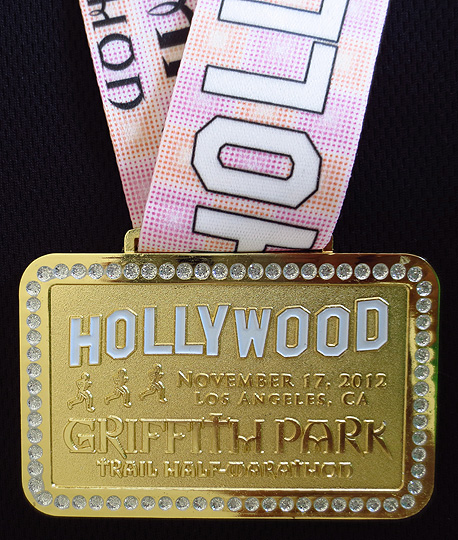
Or so I thought, until a navigational blunder with less than half a mile to go sent me flying by the sharp right U-turn that signaled the final stretch to the finish.  The course signs here were unclear, and almost immediately I knew I’d made a mistake when I saw asphalt directly ahead of me.  As I glanced back skeptically a Japanese woman holding a camera uttered a loud throaty sound, pointed down the trail and said simply, “That way.”  I thanked her and, frustrated with myself and the questionable course markings, headed down the trail in the right direction.  But not before I’d lost several valuable seconds as well as my slender lead over the first-place female.  Down the Aberdeen Trail I followed her to Commonwealth Canyon Drive, where a sharp right turn led back on to the asphalt for the final 50-yard push. Enthusiastic cheers erupted ahead of me for what I assumed was her arrival at the finish line, and as I rounded one last curve I was amused to see Laura awaiting me with medal outstretched, which I gratefully accepted with a finish time of 1:48:00.

Just a few more yards ’til I can wear my INKnBURN shirt
(photo courtesy of Brian Cravens Photography)

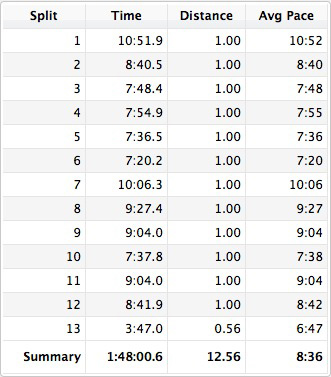
Glancing down, I saw disappointedly that my Garmin read 12.56 miles.  I never object to running farther than 13.1 miles – the lone race I won, the 2009 Limantour Odyssey Half Marathon in Point Reyes, clocked in at a muscular 14.8 miles – but running less than 13.1 is a bummer, because it prevents you from claiming a PR (not that this would have been) and comparing your time to other half marathons.

First things first: I congratulated Kaitlin Lavin, who’d run well down the stretch and finished just ahead of me in winning the women’s division.  Though as I’d expected, that final neck-and-neck downhill chase turned out to be academic: taking into account my back-of-the-pack start, I still finished ahead of her in the final standings based on chip time.  Nonetheless it would’ve been nice to physically cross the finish line first, if for no other reason than in a race with 349 finishers, it would have been a major accomplishment to finish ahead of the entire woman’s field.  Silly maybe, but motivation is as motivation does, and this unforeseen motivation of me vs. the women’s field had arisen organically during the race.  More than anything, my imagined chase had kept me kicking hard up and down those final hills.

The final 20 yards on Commonwealth Canyon Drive

Appreciatively accepting a coconut water from the Naked Juice rep, I stretched out my right calf, which radiated a familiar “thanks for the workout, I’ll quiet down in a couple of days” tightness (which it did).  Laura continued to award medals as I cheered on finishers and browsed the lunch provided by Keira, which included sandwiches, pasta and salad from Whole Foods.  Although some runners were chowing down, my stomach would have preferred the usual post-race standbys of bananas, oranges and peanut butter pretzels.  Instead, I sipped on my coconut water as Chuck rejoined me and introduced me to his friend and ultrarunner extraordinaire Michelle Barton.  Unfortunately a knee injury had forced Michelle to sit out Griffith Park this year, although her 73-year-old father Doug had picked up the slack by winning the M(70-99) age group with a hotshot time of 2:34:22.  Coincidentally, the same knee injury had sidelined her for the Moab Trail Marathon two weeks earlier, so I’d missed seeing her in Utah.  But it was great to finally meet her, and here’s wishing her a speedy recovery and triumphant return to the race circuit very soon.

As the steady current of finishers slowed to a trickle we reclaimed Laura, leaving Keira to distribute medals to the remaining finishers.  During our stroll back to the car, Laura told us that a couple of runners had not only bandited the race, but that each of them had also tried to collect a medal at the finish line.  To “bandit” a race means to run it unoffically without paying the registration fee, a practice that in some circles is now treated as the racing equivalent of treason.  Apparently, when Laura confronted each bandit and asked where his bib number was, the first chose the high road and handed back his medal whereas the second fellow chose poorly and actually ran off with his.  Officers, bring in the medal-sniffing dogs!

Trying not to sweat on ultrarunner Michelle Barton
(photo by Chuck)

After registering for this race based almost entirely on its swag and SoCal location, I was pleased to discover that Griffith Park is in fact a bona fide trail race, meaning plenty of tough hills and scenic views (on a fog-free day).  In the weeks leading up to the race, I’d even held out hope that I’d found a worthy challenger to rival Rocky Ridge as the rootinest, tootinest half marathon in California.  But despite its significant hillage and elevation gain/loss of ~2,500ft (billed misleadingly as 5,100ft on the website), Griffith Park ain’t no Rocky Ridge, as evidenced by my 8:36/mile pace vs. 10:58/mile at Rocky Ridge.  For now at least, Rocky Ridge remains The Big One on the California half marathon circuit.

So bottom line, I’m glad I ran the Griffith Park Trail Half.  It’s a well-executed race on a fun course in a cool location, and with a medal that does its hometown proud.  And thanks to my head-turning race t-shirt courtesy of INKnBURN, I can CRASHnBURN in my next several races and still look good doing it.

Maybe that makes me shallow… but in Hollywood it makes me fit right in.

PRODUCTION:  Griffith Park is a relaxed, well-organized trail race on an excellent (albeit short) course.  Trail races in general are more laid-back affairs than road races, and Keira did an admirable job of ensuring that all the key details were in order and that everything and everyone ran smoothly.  Although I would invest in a bullhorn and forego the silent start next year… even a solitary “one minute to start!” announcement would have been appreciated.  Based on the three criteria of course layout, race organization/execution and overall value, I’d still rate the Brazen Racing crew here in the Bay Area as my favorite trail racing outfit in the state.

In her pre-race email, Keira assured us the course would be “marked so well you could probably run with a blind fold on, and still find your way.”  In general this was true, with orange ribbons lining the course, and enthusiastic and supportive volunteers on hand to direct runners at key transition points.  But allowing for the fact that I often run like I’m blindfolded, I’d recommend clearer signage at a couple of places where multiple trails converge and where course markings might be (and were) overlooked, i.e. the fork up Eckert Trail at ~mile 8, and the final U-turn down Aberdeen Trail.  Most importantly, the course should be extended by half a mile or the race renamed the Griffith Park Trail 20.2K.

Off the dirt and on the street: cool urban scenery in Hollywood

Credit to photographer Brian Cravens for making his collection of start- and finish-line photos freely available on the race’s Facebook page.  Any photographer willing to share his photos without stamping his website URL or the word “PROOF” across them deserves a shout-out on a blog with upwards of a dozen readers. (UPDATE: After posting this, I learned that Keira actually paid the photographer to allow runners free access to all his photos, so let me appropriately redirect my shout-out… thanks, Keira!  Posting free photos is a major bonus, and not many other races do it.)

For many trail runners, the major deterrent to running this race will be the substantial $120 registration fee (minus the online discount and plus the service fee).  A sizeable chunk of this fee seemingly goes toward the INKnBURN race t-shirt, which as I may have already mentioned is very cool (and durable).  So it may be possible to reduce the registration fee by offering a “no t-shirt” option during registration.  However, given that the race is small (400 slots) and only in its second year, its popularity should only increase in the future, meaning the registration fee will likely increase as well.  In which case, maybe next year a tiny portion of that fee could go toward post-race bananas, oranges and peanut butter pretzels?

But hey, these are minor grievances… at least there was no HEED at Griffith Park.

UPDATE: Keira promptly and thoughtfully responded to all my suggestions (see her comment below), which I think speaks to how committed she is to her job as race director and to growing the sport of trail running. Based on her feedback, I’ve no doubt the Griffith Park Trail Half will be an even better experience in 2013.

I would’ve posted sooner if my editor didn’t need so many naps

FINAL STATS:
November 17, 2012
12.56 miles in Griffith Park, Hollywood
Finish time & pace: 1:48:00 (first time running the Griffith Park Trail Half), 8:36/mile (official 8:15/mile pace based on a 13.1-mile course)
Finish place: 19/349 overall; 5/56 in M(40-49) age group
Race weather: foggy and cool (temperatures in the 50s) with intermittent light rain
Elevation change (Garmin Connect software): 2,420ft ascent, 2,431ft descent
(Garmin Training Center software): 2,897ft ascent, 2,815ft descent

In between the bright lights and the far unlit unknown.
– Rush, “Subdivisions”

Few places in the continental U.S. can rival the spectacular vastness and beauty of Southern Utah.  This ~400-mile swath of wide-open highways and byways stretching to the horizon features a “who’s who” of national parks, including (from west to east) Zion, Bryce Canyon, Capitol Reef, Canyonlands and Arches.  Each park is a geological masterpiece of deep sandstone reds and robust earth tones painstakingly laid out and integrated on a distinctive canvas, all of which evoke a strong appreciation for how wild the West once was, and in many places still is.  In the late 1800s, for example, Butch Cassidy and his Wild Bunch took refuge in the remote uncharted wilderness of what is now Canyonlands National Park, frustrating their federal pursuers who quickly abandoned the chase.

I’d been here once before: in the summer of 2000, two buddies and I had road-tripped through southern Utah en route to the state’s five national parks.  In addition to all the natural wonders revealed by daylight, two of my most vivid memories from that trip were actually born in the pitch-blackness that engulfed us during our nighttime drives.  First, I spied for the first time with my naked eye the Milky Way galaxy overhead; and second, while driving one eerily dark and peaceful stretch of road, a winged UFO – we convinced ourselves it must have been a bat – flew into and caromed off our front windshield with an adrenalizing {THUMP}.  So southern Utah was a bit of a wake-up call for us city boys.

Southern Utah’s own start and finish lines include (clockwise, from upper left) Double Arch, Delicate Arch, Landscape Arch, Turret Arch at sunset, Double O Arch, and Mesa Arch.  Mesa Arch is found in
Canyonlands National Park; the others can be found in Arches National Park.

For those approaching from the Colorado (eastern) side, the town of Moab acts as gateway to the natural spoils of southern Utah.  But for trail racing aficionados last Saturday, the town promised more measurable spoils as host to the annual Moab Trail Marathon, Half Marathon and 5K “Adventure” Run, with the Marathon doubling as the 2012 USATF Trail Marathon National Championship.  Meaning there’d be prize money on the line… though not for me, for two reasons:  I’d be running the Half Marathon, and short of showing up with a ski mask and gun, I’m not walking away from a race with prize money anytime soon.

So why Moab?  With a population of roughly 5,000 residents and an economy dependent on eco-tourism, Moab’s laid-back and low-key vibe conveys a “play hard, work not so hard” mentality.  Red sandstone cliffs and miles of dusty trails reflect its definitively Old West character, and earn the town its identity as a mecca for hiking, mountain-biking and rock-climbing enthusiasts.  So Moab itself is a popular destination for outdoorsy types.  But for me its real allure lay in its proximity to both Arches and Canyonlands National Parks, the former of which lies on the town’s doorstep.  Plus, I can’t recall another town where the Chevron gas station advertised itself in the local newspaper as having the “Best Chicken in Town!”

No word on whether the local KFC was offering an 8-piece “high octane” value meal

I’d chosen the Moab Trail Half in collaboration with my college suitemate Ken, who now lives in Denver with his wife Jenny (also a college friend).  Both were willing, able and even excited to meet us for a weekend in the great outdoors, Moab-style.  Plus, I felt I owed Ken another race in the mountain time zone after my ill-timed foot injury had derailed our plans to run the Leadville Heavy Half together in June, leaving his misery without company during the ear-popping climb up to 13,200ft (though he’d sucked it up and run a strong race without me).  Sure my guilt was unwarranted – every runner knows injuries are the great unknown of race training – but still I felt the need to redeem myself, even if he didn’t.

With that in mind, I was looking forward to my first race in the state of Utah.  After a day of travel on Thursday (flight to Denver followed by a 6+ hour, 375-mile drive to Moab), Katie and I spent much of Friday in nearby Arches National Park before picking up our race packets that evening from the friendly race volunteers at Milt’s Stop & Eat (a local hamburger joint and race sponsor).  We then met Ken and Jenny, who drove in late from Denver and arrived just in time to get their bearings and get to bed.  We’d all be lodging at The Gonzo Inn, another race sponsor and for the record someplace I’d definitely stay again in Moab.

Rule #1 of dining out: Never trust a waiter wearing a nurse’s uniform
(Milt’s Avocado Melt was actually very good)

Saturday morning we awoke to bright cloudless sunshine that belied the crisp, though not quite biting, 39°F desert air that awaited us.  Fortunately race start for marathoners and half marathoners wasn’t until 9:00 a.m., giving temperatures a chance to soar all the way up into the mid-40s during the race.  The four of us drove to the start along Kane Creek Road, with sheer vertical sandstone cliffs flanking us on both sides and the Colorado River snaking along next to us on our right.  Our carpool status allowed us to park in the “preferred parking” gravel lot next to the finish line, and after a brief stop at the surprisingly uncrowded porta-potties, we made the short walk to the start line.

The view along Kane Creek Road, en route to the start line

From a distance we could hear race director Danelle Ballengee addressing the crowd over the PA system with several pre-race announcements and reminders.  Danelle herself has a life story worth telling, and one that would make almost any other runner feel like a bona fide weak-kneed couch potato.  For one thing, the 41-year-old Ballengee is a world-class athlete – four-time champion of the Pikes Peak Marathon, three-time winner of the Primal Quest adventure race, and recipient of six “U.S. Athlete of the Year” awards in four different endurance sports.  Sports Illustrated once called her “the world’s premier female endurance athlete.”  And in 2000 she set the women’s speed record by summiting all 55 of Colorado’s 14,000-foot mountains in less than 15 days.

Even more amazing than her athletic achievements, though, is her story of personal survival.  While running with her 3-year-old dog Taz in this same area of the Moab desert in December of 2006, Ballengee slipped on a rock and fell 60 feet.  Somehow she managed to land on her feet, but the fall shattered her pelvis and caused extensive internal bleeding.  After five hours of dragging her broken body through the canyon over frozen terrain, she lay exposed and freezing for another 52 hours until County Search and Rescue members, with help from the unshakably loyal Taz, found her alive and remarkably coherent.  It was an implausibly happy ending: most people with similar injuries don’t live longer than 24 hours, doctors told her, and yet she’d survived for more than twice that time outdoors in sub-freezing temperatures.

Less than five months later Ballengee – registered as a solo competitor under the team name “How’s This for Rehab?” – completed and won the women’s division of the 60-mile Adventure-Xstream adventure race in under 12 hours.

Danelle greets finishers and narrates the action as Ken crosses the finish line behind her

Ballengee’s presence can be felt around Moab in other, more subtle ways.  All proceeds from the Moab Trail Marathon races would benefit Project Athena, a non-profit foundation which Ballengee co-founded and for which she holds the title “Seraphim of Survival.”  Project Athena offers scholarships to female athletes who have “endured life-altering medical setbacks” and are making “that life-affirming transition from Survivor to Athlete.”  And on the topic of potential medical setbacks, in 2007 Ballengee and her husband purchased Milt’s Stop & Eat, a greasy spoon hamburger joint and local landmark since 1954.  Our race goodie bags included a $7 Milt’s coupon which would come in handy after the race.

Mike Sohaskey and Ken pre-Moab Trail Half Marathon

Pre-race posturing with our dual (and dueling) Garmins

So as the four of us approached the start line, the thought of our race director’s own near-fatal outing on these same trails suffused me with a healthy respect for the technical terrain that awaited us.  In this regard, we’d been cautioned to be watchful of the 3 C’s – cliffs, crypto (a living soil crust) and cactus.  Luckily Moab had been precipitation-free in the days leading up to the race, dramatically reducing our odds of discovering first-hand how slickrock earned its name.

Ken and I said goodbye to Katie and Jenny (they’d both be running the 5K beginning 40-ish minutes later) and positioned ourselves at the back of Starting Wave 1 (i.e. the leading wave, comprising the top 1/3 of all runners), behind a mass of lithe excited marathoners and half marathoners engaged in all manner of last-minute warming and stretching.  In true Moab spirit, we were treated to a uniquely free-spirited rendition of “The Star-Spangled Banner” performed by a local zydeco-style band, who offered their own jazzed-up (though no less respectful) interpretation complete with tuba, accordion, frottoir/rubboard and accompanying dancer with baton.  Suddenly San Francisco didn’t feel so far away, after all.

This was the most popular and crowded arch in southern Utah on Saturday

As the last vestiges of accordion faded the assembled masses cheered, runners whooped in nervous anticipation, Danelle’s countdown reached zero and the eventual winners shot forward while the rest of us… shuffled slowly toward the start line.  A classic case of “hurry up and wait.”  Starting on rocky singletrack will do that to you.

Crossing the start mat the crowd began to thin, and the course soon began an uphill trajectory on Pritchett Canyon Trail that lasted for the first four miles.  My Garmin quickly lost its satellite feed twice during that first mile, and by accidentally hitting the “lap” rather than the “enter” button the first time it happened, I ensured that my mile-by-mile pace times for the entire race would be all out of whack.  But at least my Garmin immediately regained its satellite signal each time.

Course elevation profile or in-race heart rate monitor?  You decide

This initial ascent was unlike the uphills I typically encounter in Bay Area trail races, as this terrain was more technical and the footing more variable.  The trail (and really the entire course) was an alternating mix of dry slickrock, red sand and firmly packed dirt overlaid with rocks of all sizes.  Orange flagging tape and white chalk led us over slickrock and loose rock where no true trail existed… singletrack, doubletrack, really what’s in a name?  And it dawned on me just how perilous the footing along this course would have been under wet conditions.  Luckily the course boasted few tree roots, my toes’ usual nemesis on Bay Area trails.  Nonetheless each step demanded my full attention, and by maintaining focus I was able to keep pace with Ken, who routinely trains in mile-high Denver.

Surrounded by slickrock in Arches National Park

Near the mile 4 marker the flow of runners briefly slowed to a crawl as we hiked up several shelves of boulders.  Although this section appears as an intimidating stalagmite-like spike on the course’s elevation profile, it didn’t feel so severe since we were forced to speed-hike rather than run.  But then the trail summited (~4,800ft elevation) and immediately headed back down the other side, and runners eager to release the parking brake dashed downhill over the rocky terrain.  I followed as quickly as I dared, still vigilant of my footing until the course leveled out somewhat and we found ourselves running through red sand, chasing our shadows on the ground ahead of us.  At last I was safely able to look up from the trail and admire striking views, on both sides, of orange-red sandstone cliffs imposing on brilliant blue sky.

This heavy-footed sensation of running through an hourglass – I should’ve trained on the beach! – continued until roughly the first aid station at mile 5.7 (according to their mile markers; my Garmin read mile 6).  Still running together, Ken and I each grabbed a quick swig of water and began our next ascent as the trail morphed into Hunters Canyon Rim Trail.  The next 3.9 miles offered little in the way of level footing, as we renewed our painstaking climbs and descents over alternating loose rock and slickrock, with the occasional delay to hop down from or scramble over boulders.  Along the way we passed through a couple of singletrack sections that bordered relatively sheer drops; here in particular the course demanded a steady focus to avoid a reckless misstep and tumble that would make Humpty Dumpty cringe.

Another slow, switchback-like descent over layered slickrock brought us to mile 9.6, and we emerged on the paved surface of Kane Creek Road next to the second aid station.  By this point my feet, apparently thinking their vote counted, had begun to protest the relentlessly rocky and uneven terrain.

Either this is Katie’s love of rappelling shining through, or she knows where the photographer is
(photo © 2012 Chris Hunter)

Here the marathon and half marathon courses diverged, the former veering left in the direction of the aid station while we 13.1ers headed to the right.  Ken turned into the aid station and, after slowing briefly, I glanced ahead and saw the course continue up paved Kane Creek Road, where a caravan of slow-moving runners were toiling their way to the top.  Like old friends, seeing that paved surface and steady uphill climb renewed my spirit.  I waved to Ken to let him know I was skipping the aid station, and as my second (or third… or fourth…) wind kicked in, I shifted into a higher gear and passed several runners on my way to the top.

The ascent up Kane Creek Road was relatively short (~1/4 mile), but really its length didn’t matter because finally I was able to forget my footing and just run.  And when the road reversed trajectory and started back downhill I seized the opportunity to pick up the pace, stretching out my legs as I focused on the rhythm of my footfall and breathed in the desert scenery around me.

Mission accomplished!

So I was understandably disappointed when a volunteer appeared on the shoulder of the road ahead and signaled for us to veer left, directing us down more slickrock and into Kane Creek Canyon.  As I navigated the narrow sandy canyon where the creek drains into the Colorado River, I envisioned this potentially messy stretch after a hard rainfall and thanked Tlaloc the rain god for his decency.  Only remnants of Kane Creek – no more than small puddles, really – remained here, and my “creek crossings” were limited to splashing through a couple of puddles that barely covered my shoetops.  Though I may have felt some boyish satisfaction at maxing out the splash-ability of each puddle….

Of course even that minimal amount of mud got stuck in the tread of my shoes, and I carried it with me up a short steep embankment to the Amasa Back Parking Lot, and back on to Kane Creek Road.  As I reached the parking lot a volunteer offered me something to eat, which I declined… I think it was candy though I can’t be sure, because with roughly a mile to go I had finish line on the brain.

Ken skywalks his way across the finish line (photo © 2012 Chris Hunter)

After another short but gloriously runnable stretch down Kane Creek Road, two volunteers cheered us on with promises of “half a mile to go!” while again directing us to veer left, off the road and back into the Kane Creek Canyon drainage.  Negotiating several largely avoidable puddles and more undulating rocky terrain, I heard the mellifluous sound of nearby cheering as the orange flagging tape along the trail increased in frequency.

Finally I reached a point where a 6-inch-wide metal pipe spanned the creek, which here was actually creek-like with a width of approximately 10ft.  Two female volunteers assured me the finish line was just up ahead.  Rather than splash through the creek I crossed the pipe in two steps and one awkward leap to the opposite bank.  And I realized, as I stood looking up at a small-scale inflatable finish arch ~10 yards above me, that they weren’t kidding when they said “up ahead.”  Clambering up to the arch on all fours, I peeked out over the edge of the embankment and immediately straightened as I saw the finish line ~20 yards straight ahead.  Katie and Jenny cheered to my right as I high-fived Danelle (narrating the action with microphone in hand) and gratefully hit the finish line in 2:11:22.  Immediately I turned back around to watch Ken emerge over the embankment and finish strong roughly a minute later.

Jenny goes bananas for the post-race spread
(orange you glad I always go for the low-hanging humor fruit?)

In total, Ken and I estimated the half marathon course to contain ~3 miles of legitimately runnable terrain, including the straight-ahead stretch of soft sand leading up to the first aid station.

Collecting our medals and finisher’s mugs (a Moab exclusive), Jenny shrewdly noted that if you held the mug so as to conceal the “half marathon” (for me and Ken) or “5K” (for her and Katie) designation at the bottom, others would simply see the “Moab Trail Marathon FINISHER!” label above it.  Why put yourself through the stress of training for and running 26.2 when you can skip straight to the accolades?

The finishing four: Jenny, Ken, me and Katie

We then diffused around the finish area basking in the noontime sun until it hit me that whoops, I’d forgotten to wear sunscreen.  So I corrected that and then took advantage of the post-race spread, which was impressively stocked with Campbell’s soup, bagels, peanut butter, cream cheese, chips, pretzels, fruit and an assortment of soft drinks.  And we each scrawled a message and signed our name to the inflatable wall that asked the question “Why do you run?”

After what seemed like only a few minutes since our own finish, Danelle announced that the marathon leader was only ten minutes out.  So we gathered to watch her exchange high-fives with Cody Moat of Fillmore, Utah as he crossed the finish line in a crazy-fast winning time of 3:08:27, over six minutes faster than his closest competitor.  Kerri Lyons of Salt Lake City followed him 19 minutes later, winning the women’s division in 3:27:48.

Apparently the 5K lived up to its “Adventure Run” billing, as Katie and Jenny navigated such obstacles as hopping to an orange pylon and back with both feet in a burlap sack, balancing on a seesaw plank, throwing into a frisbee golf basket, crawling under netting, wiggling through a child’s nylon tunnel, climbing two ladders, and negotiating two steep sections using a hand-line.  Katie’s only disappointment was the lack of a crossword puzzle as publicized on the race website… she’d targeted that as her best chance to make up ground on the competition.  I felt like a slacker listening to the blow-by-blow description of their 3.1 miles.

The four of us spent the remainder of Saturday in Arches National Park, before refueling at the very respectable Moab Brewery (the only brewery in Moab) for dinner.  After Ken and Jenny headed back to Denver on Sunday, Katie and I spent the next two days hiking through Arches and Canyonlands, ultimately deciding we needed more time in the latter.  Butch Cassidy and Co. knew what they were doing.

Overall, the Moab Trail Half is among the most rugged and unique trail races I’ve run… the organizers aren’t kidding when they advertise it as “an unforgettable journey through some of the world’s most scenic and unique lands.”  In many ways the course is what comes to mind when I hear the term “trail running.”  Its primarily sand-and-slickrock terrain is unlike anything I’ve raced in California.  As such it’s not my favorite type of course… I tend to struggle with highly technical, unstable footing (as does everyone to some extent), though diligent strengthening of my left ankle over the past few months has certainly improved my technique.

But Moab itself is an awesome backdrop for a trail race that – luckily for us – benefitted from awesome weather.  I’m glad we made the trip to experience both the race and the town first-hand, and if we lived closer I’d probably include the full marathon on my list of must-do races.  But we’ll definitely be back in southern Utah… it’s a stunningly beautiful region, with a far-from-the-madding-crowd vibe and plenty of postcard-worthy scenery.

And besides… what better destination for a runner than a place called Arches?

Unlike Moab’s other landmarks, Finisher’s Arch is visible one day a year for but a few hours

PRODUCTION:  Danelle and her fellow organizers did a terrific job with race organization and execution.  Friday (packet pickup) and Saturday (race day) each had a laid-back yet decidedly professional feel to them.  The course was well marked with orange flagging tape and white chalk, and well designed, particularly given that much of the course travels over slickrock rather than established trails.  Volunteers were across-the-board friendly and helpful, and seemed genuinely proud of the course.  The post-race ambiance was (to use Katie’s word) festive, due in part to the impressive post-race spread.  And Danelle set the tone with her exuberance and constant encouragement.

Swag-wise, the Merrell tech t-shirt (included with registration fee) is the best in class… it’s a solid piece of craftsmanship I’ll wear for a long time.  The medal, which sports a dangly Athena logo in its center, is a generic “Project Athena Race & Adventure Series” medal, but it’s nice in its understatedness.  On the other hand the finisher’s mug, while appreciated, is excessive… I probably should have politely declined it, since I’m not a fan of hot drinks and can’t envision ever using it.  Plus I don’t know a single person who’s ever wanting for a ceramic mug… aren’t they ubiquitous in homes and workplaces?  Based on their numbers, I’ve always assumed that two coffee-stained mugs left on the kitchen counter overnight find each other and generate many ceramic offspring.

Moab/Project Athena Race and Adventure Series medal

To make matters worse, I immediately filled my superfluous mug at the finish line with what I thought was water but which turned out to be HEED, Hammer Nutrition’s sports drink.  I appreciate Hammer’s sponsorship – I don’t want to bite the hand that feeds too hard here – but boy I wish they’d leave the HEED in the van.  The stuff tastes like cough syrup.  One accidental sip brought back my lone negative memory from the 2008 Grizzly Half Marathon in Montana, where I’d sampled HEED for the first (and what I swore up and down would be the last) time.  And as the name implies, since then I’ve been careful to heed my own taste buds.

As for age-group awards… if I understood Danelle correctly, Merrell stepped up nicely and awarded a free pair of shoes to every age-group winner rather than just the top men’s and women’s finishers.  And the top 3 finishers in each age group received “unique locally crafted trophies,” i.e. copper wire sculptures twisted into the shape of a runner and embedded in a large rock base.  Pretty creative and quintessentially Moab.  Since I finished fourth (by chip time) in my age group, I didn’t have to worry about explaining my awkward copper rock art to the friendly folks of the TSA.

The winners podium awaits the top Marathon finishers, including the Trail Marathon National Champion

GEAR:  My Mix Master 2’s took the slickrock challenge and had themselves a day.  They’re lightweight and provided excellent traction on some of the diciest terrain I’ve navigated.  Amazingly, not once did I lose my footing or have my foot slide out from under me.  Unlike at Rocky Ridge I had no problems with my arch, so maybe it was simply a matter of lacing them up tighter or breaking them in more.  I’d highly recommend them and plan to make them my go-to shoe for future trail races.

FINAL STATS:
November 3, 2012
13.0 miles in Moab, UT (click here for course map)
Finish time & pace: 2:11:22 (first time running the Moab Trail Half), 10:02/mile
Finish place: 73/505 overall; 4/43 in M(40-49) age group by chip time (5/43 by gun time)
Race weather: sunny and cold, low to mid-40s
Elevation change (Garmin Connect software): 2,800ft ascent, 2,822ft descent
(Garmin Training Center software): 3,118ft ascent, 3,011ft descent

Oops… mistakenly pressing the “lap” button during mile 1 skewed all my subsequent mile pace times

Experience: that most brutal of teachers.  But you learn, my God do you learn.
– C.S. Lewis

(photo courtesy of Brazen Racing)

The experience of Rocky Ridge taught me a lot last October.

I learned it’s wise to approach the course with a healthy measure of respect.  I Iearned that after 13.7 miles in the Las Trampas Regional Wilderness, I’ll have earned that coveted flaming-tiger finisher’s medal and post-race IT’S-IT.  I learned the humbling frustration that comes from having to walk hills I had no intention of walking, and feel exhaustion I had no intention of feeling.  And I learned (or rather confirmed) that although I’m a sucker for the trails, I’m no mountain goat.

But most of all, I learned that Rocky Ridge is the “Super Bowl of Brazen Racing” for a reason: because with roughly 4,000ft of elevation gain/loss, it’s the most challenging half marathon in the Bay Area, and the toughest half I’ve run aside from Pikes Peak.  All within 2,000ft of sea level, courtesy of a whole lot of up-ing and down-ing.

So with that in mind and 5-Hour Energy in body, Katie and I parked and hustled to the start line at the Las Trampas Corral Camp on Saturday morning.  We’d dragged a bit that morning and ended up cutting it close, arriving just as Sam was announcing one minute until the start of the half marathon (the 10K and 5K would follow 15 and 30 minutes later, respectively).  Truth is, I have yet to find the race where the running part is as difficult as the getting-out-of-bed-that-morning part.  But having carefully read Sam’s pre-race email and having run the course last year, I assumed I could safely dispense with any more pre-race announcements.

So after cycling through the CliffsNotes version of my warm-up routine, I ducked under the ribboned rope and into the start corral, as usual lining up among the front 20-25% of runners.  Forty seconds later the familiar Brazen airhorn sounded one mighty blast, and Las Trampas opened its arms and bared its fangs to welcome some of the strongest trail runners in the Bay Area.  And the rest of us, too.

Rocky Ridge Half Marathon Course Map

I followed the leaders into the wild with one goal in mind: to beat last year’s finish time of 2:33:46.  I was confident for several reasons.  First, I’d learned some valuable lessons from my 2011 experience, lessons that as a now-seasoned Rocky Ridge veteran would help me… if not tame this beast, then at least understand how it hunts.  Second, my half marathon PR of 1:34:02 was set at this year’s Oakland Running Festival the week after I’d run the L.A. Marathon, so I was hoping for a similar post-Chicago bounce.  True, this would be a dramatically different race than Oakland; as Sam had pointed out in his pre-race email, Rocky Ridge is “known for forcing the fastest of runners down to a slow slog!”  Nonetheless, I was psyched for this race and counting on another strong post-marathon performance.  And lastly, weather conditions would be more favorable this year, with persistent morning fog holding the sun at bay, and temperatures hovering in the mid-50s.

So when it came to beating myself, I liked my chances.  But placing in my age group would be another matter.  As Brazen’s championship race with championship money at stake, Rocky Ridge attracts more than its share of talented runners, among them a number of Brazen first-timers including male newbies in the 40-44 range.  Meaning that if I expected to place in my age group, I’d have my work cut out for me.  Last year, for example, I’d placed a ho-hum 6th out of 20 runners in my age group.  And I was pretty sure Brazen hadn’t extended their age-group medals to include a polydactylous six-fingered hand.

I’m still waiting to receive my age-group medal
from last year’s race

Not only is Rocky Ridge the Super Bowl race for all Brazen runners, but it doubles as the final race in Brazen’s more selective Ultra-Half Series.  To qualify as an Ultra-Half Series finisher, runners must race in at least four of the nine series races, plus the series finale at Rocky Ridge.  Scoring is based on each runner’s cumulative “time back” from the winner (the winner’s “time back” being 0) in their four best races, plus Rocky Ridge.  The top three runners with the lowest cumulative “time back” after Rocky Ridge are the Ultra-Half Series winners, and earn the same prize money as the overall winners.  Best of all for the rest of us, all Ultra-Half Series finishers earn a special finisher’s coaster to complement their Rocky Ridge race medal.

I missed out on becoming an Ultra-Half Series finisher last year through my own ineptitude… I’d misunderstood their Nitro Trail Half Marathon to be one of the qualifying races, not realizing until the week of Rocky Ridge that this wasn’t the case.  So I was determined not to screw myself out of another shot at die-cast glory this year.  That is, until tendonitis derailed my plans to run the Trail Quake Half Marathon in June, meaning I would have run only three (rather than the necessary four) qualifying races before Rocky Ridge: Wildcat, Bear Creek and Drag-N-Fly.

In a curious twist, though, I’d also run the Mount Diablo Trails Challenge in April… except that there, I’d chosen to run the longer 50K rather than the qualifying half marathon distance.  Fortunately (and sensibly), the Brazen folks posted on their Facebook page in late August that the Diablo 50K would be accepted as a Series qualifier, though with a caveat: runners using the 50K as a qualifier would not be factored into the final standings and thus would not be eligible for the prize money, due to the differences in “time back” scoring between the 50K and half marathon distances.  I was fine with this decision, since the governing body’s (i.e. Sam’s) reasoning made sense.  My real disappointment lay in my own inability to run Trail Quake… had I run it in a time consistent with my other three finish times, I would have found myself at least 5th, and potentially as high as 4th, in the Ultra-Half Series standings in the week leading up to Rocky Ridge.

Like beach sand in your swimsuit, the Las Trampas fog found its way into every nook and cranny
(photo courtesy of Brazen Racing)

Back to race-day reality, and all these musings amounted to little more than neural debris as the trail rolled gradually upward toward its first steep ascent, beginning just after the midway point of mile one.  Rocky Ridge wastes little time in muscling up, and the last echoes of the airhorn had scarcely faded when we reached the first leg-searing uphill of the course.  Sticking with my usual Brazen modus operandi I hugged the left side of the trail and began to pass other runners, many of whom chose (willingly or unwillingly) to walk this uphill section.  I passed about a dozen walkers before I spotted Julie Neumann, the women’s Ultra-Half Series winner in 2011 and eventual second-place finisher this year.  For a brief stretch she and I were the only two runners maintaining a jogging pace, as I trailed roughly ten yards behind her all the way to the top of that first hill.  Just before the mile 2 marker we crested, the trail began its first extended downhill and she kicked off the parking brake and left me in her dust.  Literally.  Oh downhills, why must you insist on following uphills?

If I told you that miles 2-6 of Rocky Ridge were predominantly downhill, you may be misled into thinking the course can’t be that tough.  And if I then copped to the fact that the final 2.5 miles are mostly downhill as well… well, you may conclude that for a grown man who seems to enjoy punishing his body, I sure do whine a lot.  But Newton wasn’t kidding: what comes down must first go up.  And Rocky Ridge earns its stripes as the most challenging of all Brazen races for five reasons: miles 7-11.

As Hall of Fame golfer Bobby Locke once remarked, “Drive for show, putt for dough.”  By analogy, if the other 8+ miles are for show, then miles 7-11 are for dough (literally, for those runners vying for a share of the prize purse).  Those five life-affirming miles are the reason I didn’t give in to early adrenaline and attack that first downhill more aggressively.  The experience of 2011 had taught me that my real race would begin at mile 7, and that the strategic (i.e. gravitationally challenged) runner tries not to do anything too heroic, too soon.

RUNSTRONG? I sense a sponsorship opportunity! (photo courtesy of Brazen Racing)

Further complicating this initial descent was the muscle on the medial/inner aspect of my left arch (abductor hallucis, I presume?), which suddenly and sharply began to feel over-stretched.  After a quick on-the-move assessment, I concluded that the pain was limited to my arch and excluded from my previously injured tendon, and I self-diagnosed that I wouldn’t risk further injury by continuing to run.  Based on my experience with other Merrell footwear, I attributed the pain to the new Merrell Mix Master 2 shoes I was wearing for only the second time.  The twinge in my foot came and went over the next several miles, though fortunately it never evolved from fleeting discomfort into full-blown “your body’s trying to tell you something” pain.  So on I ran… it wasn’t as though I’d been expecting a comfortable morning in the best of circumstances.

As the trail widened a bit in its descent through mile 3, a shorter gray-haired fellow asked me in a Russian accent, “Excuse me, how many more hills are there?”  I contemplated this for a second, not sure how to break the news to him.  “Two long ones, really,” I breathed roughly. “But miles 7 through 11 feel like one long extended hill.”  He nodded forcefully twice.  “So then one more hill? Thank you!” he replied, and accelerated down the hill.  I was pretty sure I’d be seeing him again before the finish line.

Over the next four miles I maintained a steady pace of ~8:15/mile on the downhill sections, as my foot continued to protest intermittently.  The downhill momentum of the course was briefly interrupted by a short-but-strenuous uphill jag near the mile 4 marker, before continuing its rolling descent through miles 5 and 6.  The final 0.1 miles of this descent were particularly steep, and I kept my own momentum in check to ensure I didn’t stumble over a root and slide the rest of the way down on my face.

Mike Sohaskey on Rocky Ridge Half Marathon singletrack

Leader of the pack on the singletrack (photo courtesy of Brazen Racing)

The trail then bottomed out at what appeared to be a dry stream bed.  By that time, the downward momentum I’d gained made it that much harder to switch gears as the course abruptly began its grueling climb up to mile 10.5 and a peak elevation of 1,950ft.  But switch gears I did, forcing myself to maintain whatever semblance of a jogging pace I could as slowly, with tortoise-like efficiency, I caught and passed many of the speedy downhill folks who had passed me in the previous four miles.  Among these folks was the older Russian fellow, whom I quickly passed, this time for good.  I never got to ask him what he thought of that one more hill.

Having experienced Rocky Ridge before, the anticipation of miles 7 to 11 initially triggered in me the same sort of anxiety a child might feel on hearing his agitated mother promise “Just wait until your father gets home!”  Sure the reality would probably be unpleasant, but the psychological distress inflicted by the anticipation itself would always be worse.  What I needed was a more productive strategy.  So I channeled my own anxiety into a respectful appreciation for what lay ahead of me, and resolved to maintain as fast a pace as possible for as long as possible.

Like most of the course, miles 7-9 featured plenty of soft dirt and prominent roots along singletrack trail.  This kept me on my toes knowing, as I’d slide past someone walking uphill, that he or she would likely be right on my heels trying to pass me once the trail leveled out or headed back downhill.

One of my greatest triumphs at Rocky Ridge was that only twice did I have to slow to a true hiking pace: once during an infuriatingly steep stretch just before the mile 7 marker, when I felt like a bowling ball on legs; and again during mile 8, when my legs refused to turn over and the sand-like quality of the dirt rewarded maximum effort with minimal progress.  Understanding the dangers of inertia, though, I kept my hiking to a minimum (less than 0.1 miles in each instance) and picked up the pace again as soon as possible.

During the uphill portion of mile 8 I also encountered a Brazen first for me: a fellow runner’s stomach reversing gears (i.e. vomiting) on the side of the trail.  Assuming he would be fine I soldiered on, which turned out to be a good call since he passed me on the next downhill.  We then switched places again as I caught and passed him for good on the next uphill.  After the race I found him sitting near the finish line and congratulated him on a strong showing… though now that I think about it, I probably shouldn’t have shaken his hand.  Purell, anyone?

Unlike the two miles on either side of it, mile 9 is largely downhill and a welcome reprieve from the uphill grind.  Which may explain why I’d forgotten one of the more sadistic aspects of the course layout.  As I reached the mile 9 marker, I could clearly hear Sam’s disembodied voice booming from the PA system at the nearby finish line, a finish line I wouldn’t be seeing for another 50 minutes.  Adding insult to injury, I was just in time to hear him announce the men’s half marathon winner across the finish line.  The trail then turned away from the finish line, Sam’s voice was engulfed by fog, and I transitioned on to the paved section of the course at aid station #3 – the gateway to mile 10 and the most relentless uphill yet.

Heading up, up and away into the fog on mile 10 (photo courtesy of Brazen Racing)

Around this time I had an epiphany of sorts, as I realized that the beastly beauty of Rocky Ridge lay not just in the severity of its hills, but in their strategic positioning as well.  The most lung-busting, gut-churning and soul-squelching uphills on the course – those beginning at miles 7 and 10 – immediately follow steep extended downhills.  And if you haven’t experienced it for yourself, this abrupt shift in both momentum and muscle groups can be exhausting.  In effect it’s this transition from downhill to uphill, and the stark contrast between the two, that deadens the legs and makes the uphills seem even nastier than they are.  It’s also a major reason why strength training for trail runners typically emphasizes the gluteal (butt) and core (abdominals, back, hips) muscle groups.  I’d reached the same conclusion about hill placement and this “roller coaster effect” as I’d struggled up and down the Marin Headlands during the 2008 and 2009 North Face Endurance Challenge half marathon.

Now, with mile 10 and Rocky Ridge itself looming ahead of me, I recalled vividly the critical first-timer’s mistake I’d made here last year – allowing myself to look ahead at the paved trail stretching out in front of me, winding its way up, and up, and up some more, until it seemed to disappear into the clouds like Jack’s beanstalk.  And in that same moment I’d seen all the other runners painstakingly hiking their way up toward the ridge like a caravan of snails.  Understandably, my glimpse into the future had been demoralizing.  The gut-wrenching promise of another punishing ascent, coupled with the heat and the crippling power of suggestion conveyed by so many others walking, had taken their toll on my psyche and led to a less-than-stellar performance the rest of the way.

So with the tough-love lessons of 2011 in mind, I hit the asphalt with my head down this time, only glancing up to thank the aid station volunteer as he pointed straight ahead and said, “That way!  That’s all I’m going to say.”  Staring at the ground two feet ahead of me, I plowed straight ahead at a labored but consistent jog.  With this strategy I passed three more people on my way to the top, and before I knew it asphalt was once again yielding to more forgiving dirt.  Which of course makes for more difficult footing… but still I kept my head down and stuck with the game plan.

View from the curiously stationed mile 10 “flatter cam”
(photo courtesy of Brazen Racing)

During this stretch I also comforted myself by deploying one of my favorite mental pick-me-ups during a race, asking: If I’m feeling this ugh, how must the runners behind me be feeling?  That thought usually helps me to wrestle aside fatigue and renew my focus on chasing down runners ahead of me.

And then, around mile 10.5, something glorious happened: the running gods smiled down, tiny angels danced on the heads of the safety pins holding my racing bib in place, and the course started… to level… out.  Finally, I’d reached Rocky Ridge.  And finally I started to enjoy myself.  Unfortunately the view from on high was minimal thanks to the dense fog, but I’d gladly trade last year’s heat for this year’s cool.  With the trail shrouded in fog and visibility at times limited to no more than 20ft, I half-expected the Black Pearl to emerge from the fog bank ahead of me.  Eerie.  The scene reminded me of running in the Marin Headlands, a favorite hangout for Bay Area fog.

Mike Sohaskey running Rocky Ridge Half Marathon in fog

Looks like the scenery wasn’t the only thing in a fog
(photo courtesy of Brazen Racing)

Up on the ridge I could again hear Sam’s PA-amplified voice, though I still couldn’t see him or the surrounding scenery.  Moisture from the saturated air began to soak my hair and drip into my face.  As I approached the end of the ridge and one final uphill jag, a chilly headwind blasted me in the face.  I hate running into a headwind – I’ll take heat, cold, rain, snow or a plague of locusts over a stiff headwind – and as I labored forward, I briefly toyed with the idea of hiking that short uncomfortable stretch.  But I kept my head down and plowed on, knowing that significant downhillage (and soon after, the finish line) awaited me on the other side.

As I passed the mile 12 marker, the course turned off Rocky Ridge and on to Elderberry Trail for the home stretch.  At that point my foot stopped whining and I was able to stretch my legs, lengthen my stride and actually run for a change.  Although Las Trampas wasn’t about to go down quietly, as confirmed by a couple more short-but-sweet uphill jags en route to the finish line.

The Pearly Gates, seen through the eyes of a trail-running atheist (complete with Saint Katie in purple fleece)

I ran more or less by myself for the last 4+ miles.  And as I made one last downhill turn and saw the finish line laid out beautifully ahead of me, I had that all to myself as well.  Basking in the last 10 yards between me and the finish, I could hear Katie and a few other spectators cheering, and the official clock welcomed me back with a reading of 2:29:14 (chip time 2:29:11).

When I say I ran by myself, I’m not kidding… I finished over three minutes behind the runner ahead of me, and one minute ahead of my closest competition.

Mike Sohaskey crossing finish line at Rocky Ridge Half Marathon

In stark contrast to Chicago, I had the finish line all to myself at Rocky Ridge
(photo courtesy of Brazen Racing)

As I thanked the volunteer who cheerfully handed me my finisher’s medal, I flashed back to last year’s finish line.  There I’d been greeted with a look of horror from a fellow finisher, who’d handed me a cup of water and proclaimed “Dude, you need a salt tablet!”  Apparently sunscreen mixed with sweat on a hot day had left my face streaked with a white residue that Mr. Well-Meaning had mistaken for my body’s weight in salt.  This time I gulped down my remaining bottle of coconut water, which I’d carried the entire race but had only felt the need to sip from in the final two miles.  Without the heat, my thirst had been minimal… that, and it’s tough to swallow when you’re using your mouth as an extra breathing orifice on uphills.

And though I’d carried my own bottle and bypassed the well-stocked aid stations, I’d made sure to gasp out my thanks to the volunteers at all four stations.  They’d offered plenty of smiles and encouragement to supplement their selection of GU, Ultima and M&Ms.

I reunited with Katie and we made our way toward the one table set up for just this occasion, where qualifying runners could claim their hard-earned coaster as a (say it loud! say it proud!) Ultra-Half Series finisher.  And though admittedly I’d been dubious about the idea of a coaster rather than another hangable medal, Brazen’s artwork does not disappoint… it’s an impressive piece of die-cast craftsmanship with significant heft.  In the event that a Wizard of Oz-style tornado hits Berkeley anytime soon, I’ll be perfectly confident dropping this anchor in my pocket and waiting out the twister in my living room.

Mike Sohaskey with finisher's & Ultra-Half Series medals at Rocky Ridge Half Marathon

Forget the Shake Weight®… hoisting the Ultra-Half Series finisher’s coaster is the ultimate forearm workout

As for the final Ultra-Half Series standings (for which you’ll recall I didn’t qualify): not that I’m keeping track, but in this the Series finale I finished nearly seven minutes ahead of the eventual Series 4th-place finisher.  Fourth place, as in one spot out of the prize money.  I can live with that.

As I helped myself to the always excellent post-race spread and exhausted finishers continued to trickle in, Sam played the role of trail racing’s Ed McMahon and presented oversized sweepstakes-style checks to the first- ($1,000), second- ($500) and third- ($250) place men’s and women’s finishers for both this race and the Ultra-Half Series.  CONGRATULATIONS to all the winners, it’s a kick to race alongside (ok, behind) some amazing trail runners.

Sam (in blue) presents the winner’s checks to the men’s and women’s Rocky Ridge champions…

and to the men’s and women’s Ultra-Half Series champions

Also saw hardcore Brazen-ophile Isak, wearing his familiar black skullcap, cross the finish line in just over 3½ hours. True to what he’d told us at Drag-N-Fly, he apparently hadn’t looked at the course elevation map before Rocky Ridge.  Honestly, I’m not sure whether to label that decision “ballsy” or “reckless.”  But I have to admire his attitude and respect his reasoning: to his mind, he’d already registered for all of Brazen’s races this year anyway, and he intends to run every step of every race as well as he can, regardless of what the course he can’t see looks like.  At any rate, he survived Rocky Ridge and received his own well-deserved coaster.  Having had the opportunity to chat with Isak at several Brazen races, I’ve no doubt that if it’s up to him, he’ll be back at Las Trampas next October to do it all over again.  And I’ll be lining up next to him.

Isak Saad and Mike Sohaskey after finishing Rocky Ridge Half Marathon

No Brazen race feels official until the finish line debriefing with Isak

Before I finished my race Katie witnessed a 4-year-old and his father, each wearing a 5K bib, cross the finish line… almost.  Apparently the father crossed first, then retraced his steps to retrieve his tiny son, who had stopped juuuust short of the finisher’s mat and stood rooted to that spot, hugging his stuffed animal.  “We’re pretty sure he won his age group,” Jasmin offered over the PA.

Brazen’s littlest Rocky Ridge finisher, 3 steps from glory

As the finish area filled with tired but triumphant runners, Sam urged everyone to chow down on the IT’S-ITs, challenging each person to eat two.  I limited myself to one, never being sure how and when my stomach will respond to post-race snacking.  But that one was frozen perfection as usual… and hopefully my frugality allowed someone else to enjoy three of their own.

Making our way toward the parking lot, I shook hands with Sam (not to worry Sam, I found the Purell) and thanked him for another great outing.  Jasmin was still moving quickly and purposefully around the finish area so I didn’t want to bother her, but now I can take this opportunity to say… if you’re reading, thanks again Jasmin!  Look forward to seeing you both at another Brazen start line soon.

After the race Chuck texted me to ask how it went, and I texted back: “3 words: brutal. brutal. over.”

Mike Sohaskey and Katie Ho at Rocky Ridge Half Marathon

All smiles on the happy side of the finish line

But again, I learned (and re-learned) a lot from Rocky Ridge.  I learned that although I’ll never be a mountain goat, it won’t be for lack of trying.  I learned that those Bay Area folks who don’t know about Las Trampas are missing out.  I learned that Brazen’s championship race may be brutal and grueling, but it’s precisely that brutality and, um, gruel that keep me dragging my uncooperative body out of bed on race mornings.  If 4-year-old legs can conquer Rocky Ridge, then I have no excuses.  And I learned that no matter how many times I see ’em, giant prize checks will always be cool… and presumably even more so if one has your name on it.

Most of all, I was reminded that although huge, adrenalizing road races like Chicago certainly have their place in my racing schedule, nothing beats the cathartic solitude of lacing up my trail shoes and hitting the dirt.  What some would call the middle of nowhere, I call the middle of nowhere-I’d-rather-be.  No concrete.  No traffic.  No road (or trail) rage. No 7-Elevens to spoil miles 7-11.  And… no way, is that another steep uphill ahead?

In the final analysis Rocky Ridge 2011 was a valuable learning experience, based on which I reworked my strategy and expectations for 2012, and cut 4½ minutes off my finish time.  Nothing mind-blowing, but certainly better than adding 4½ minutes.  Along the way I extracted some beauty from that beast, and ultimately had myself a successful morning in Las Trampas.  And really, I guess I shouldn’t be surprised.

After all, I had the best teacher.

Rocky Ridge Half Marathon medals

PRODUCTION:  With each race of theirs I run, I find another reason to pat the Brazen crew on the back.  During Rocky Ridge I had plenty of time to think, albeit not particularly deep thoughts, and it struck me that for the Brazen trail races I’ve run, each course has many potential turnoffs where trails converge and diverge.  Meaning many potential race courses.  Yet Sam and Jasmin do a terrific job of mapping out some of the most challenging and scenic half marathon courses (or a 50K course, in the case of Mount Diablo) in the Bay Area, while always keeping them within limping distance of 13.1 miles.  Amazingly, my Garmin after the Diablo 50K (= 31.1 miles) read 31.4 miles.  At the same time, none of these courses consists of three flat loops around a marshy duck pond, or four out-and-backs along a single trail so you see way too much of your fellow runners… they’re well-designed loop courses (the Diablo 50K is point-to-point) that typically incorporate the steepest hills in the area.  Kick-ass (literally and figuratively) courses like these don’t design themselves, and I don’t imagine they happen without some serious planning and execution.  I might not be singing their praises so loudly if the Brazen crew held their events in the Marin Headlands, or in other well-worn trail-running hot spots as do other race organizers in the Bay Area.  Instead, Brazen has carved out an impressive niche among local racing companies by doing their research and taking advantage of less-appreciated parks (or wilderness, in the case of Las Trampas) in both the East Bay and South Bay.

If race attendance is any indication, it’s clear that Brazen’s star is on the rise.  And I hope Sam and Jasmin continue to grow and expand their operation to become the premier racing company in the Bay Area, if that’s their long-term goal.  Fortunately, one of the (many) positives of a Brazen trail race is that they tend to be held in smaller regional parks where park guidelines restrict the number of runners.  So Brazen aficionados can rest assured that the singletrack sections of Rocky Ridge won’t ever end up looking like the sidewalks outside the Apple store on the eve of a new iPhone release, with runners holding spots in line for other runners.

If Apple buys out Brazen, they should rebrand Rocky Ridge the “iPlod Half”
(photo courtesy of tuaw.com)

GEAR:  My Merrell Mix Master 2 trail shoes, which I wore for the first time in race conditions, performed admirably with regard to grip and traction.  They’re comfortably light but have enough of a heel to provide some braking capacity on steep descents.  On the downside, I tend to think the pain in my arch during the race was due in part to the Mix Master 2’s minimal support on downhills… I’ve experienced a similar ache only once before while running in my Sonic Gloves, so I attribute it to the shape of the shoe last in these models.  Admittedly I want to like the Mix Master 2’s because I think they’re a well-conceived, not-quite-minimalist trail shoe (and because I invested in them), and I’ll log a few more miles in ’em before making a decision.  But at this point I prefer my more minimalist Road Gloves, based on how they contour to and support my midfoot and arch.

Now I know how Pig-Pen feels

And hopefully this is the last time I’ll address this topic… my Injinji Midweight socks, which I wore at Chicago and on one other asphalt 30-miler before Rocky Ridge, survived the ups and downs of the trails better than the Injinjis I’ve worn in past Brazen races.  The only obvious casualty is a very small hole developing in the middle toe of my right foot.  So the Midweight toesocks do seem to hold together better than their more lightweight counterparts, but it may simply be the case that toesocks of any weight are more vulnerable than normal socks to the stresses of trail running. I’ll probably stick with them for races because even though I dislike their short lifespan, I dislike blisters caused by running on uneven terrain even more.

FINAL STATS:
October 20, 2012
13.6 miles in Las Trampas Regional Wilderness
Finish time & pace: 2:33:11 (4:35 improvement over 2011), 10:58/mile
Finish place: 38/170 overall, 4/20 in M(40-44) age group
Race weather: foggy and cool, mid-50s
Elevation change (Garmin Connect software): 3,577ft ascent, 3,558ft descent
(Garmin Training Center software): 4,426ft ascent, 4,303ft descent

Success at Rocky Ridge means never
having to say you ran a 17-minute mile

Whether you think you can or you think you can’t, you’re right.
– Henry Ford

“I predict sub 3 30.”

My brother sent his text the week before I’d be running the Chicago Marathon, and at the time I thought little of it. Why should I?  My previous two marathons, the California International Marathon in December 2011 and the L.A. Marathon earlier this year, had yielded successive personal records (PRs) of 3:39:15 and 3:37:53 respectively, a not-so-whopping improvement of one minute, 22 seconds.  And both courses had been relatively flat.  Not only that, but Chicago Marathoners had experienced/endured unseasonably hot temperatures in four of the past five years (by contrast, the 2009 race saw temperatures dip below freezing).  So I’d automatically – and wisely, I thought – adjusted my mindset to expect hot temperatures on race day, and to deal with them as best I could.  When possible I’d even trained under the East Bay sun, with the pace for my most recent long run – 15 miles in 86°F heat – projecting to a sub-3:35 marathon pace.  But regardless of conditions, 15 miles is not 26.2.  And with all that in mind, the thought of somehow shaving another eight minutes off my PR seemed, well, not happenable.

So I was pleasantly surprised when, five days before the race, I received an email from Marathon organizers telling us that “the weather on race day is projected to be partly cloudy, with low temperatures in the upper 30s to low 40s, and high temperatures in the low to mid 50s (degrees F).”  This corresponded to an Event Alert Level of “Green” (Low), which promised favorable conditions for marathon running.  At that point I remembered Chuck’s text, and my mental gears began to turn.  Slowly, to be sure, but the seed had been planted.

Mike Sohaskey after running 2012 Chicago Marathon

To complement the race itself, I’d decided 2½ weeks before race day to run Chicago as a member of Team LIVESTRONG.  Originally established as the Lance Armstrong Foundation, LIVESTRONG is a non-profit organization whose mission is to provide one-on-one support for cancer survivors and their families, to empower them and help them face the challenges of cancer head-on.  Unfortunately Armstrong’s ban by the U.S. Anti-Doping Agency, and U.S.A. Track and Field’s weak-willed agreement to recognize the ban, extended to his running in this year’s Chicago Marathon.  Because Armstrong’s inability to run threatened to weaken LIVESTRONG’s fundraising efforts, I’d decided to help raise funds and awareness to support their cause.  After which many incredibly generous and supportive friends and family, in turn, stepped up to help me achieve this goal in a relatively short amount of time.

So then Chicago would be about more than setting a new PR or hitting a specific time goal… I’d also be motivated and inspired by Team LIVESTRONG and all those who supported my cause.  Particularly gratifying were the individual shout-outs of support that accompanied each donation, shout-outs ranging from sincere (“RunSTRONG, Mike!” and “We support your every step”) to painfully sincere (“Will look for your final time if my browser manages to scroll that far down”).

More on my LIVESTRONG experience, and those who made it possible, later in this post.

Thanks, Chicago… “We’re glad we’re here” too!

On THURSDAY Katie and I flew from Oakland to Chicago Midway, giving us two full days to acclimate our sleep schedules to the two-hour time change.  We’d be staying with close friends Pete and Faby (and their unflappable feline boss Chloe) in the threesome’s comfy and conveniently located 18th-floor high-rise apartment at the corner of Michigan Avenue and East Roosevelt Road, within a mile of both the start and finish lines of the marathon.  As an added bonus, their living space faces directly north overlooking Grant Park, the central hub of Marathon goings-on where the start line, finish line and post-race party would all convene.  With effectively zero planning on our part, this was a strong start to the weekend.

Race-day view facing north from Pete and Faby’s place: Michigan Ave. borders Grant Park on the west, while
E. Roosevelt Rd. (“the hill”) borders Grant Park to the south and is flanked along its length by red banners.  Marathoners can be seen on E. Roosevelt approaching the finish line.  Lake Michigan can be seen at right.

FRIDAY for us was Expo Day, the ritual pre-race boot camp where runners assemble to claim their registration materials, racing bib (i.e. number) and timing chip.  In a kinder, gentler age of running back when my brother was the sole (no pun intended) runner in our family, race officials would actually mail each runner’s materials to him/her before the race.  At some point in the past decade, however, race organizers (and their influential sponsors) must have realized they were missing out on a gem of a retail opportunity: a captive audience of adrenalized runners with racing on the brain and a magnetic attraction to any running-related paraphernalia promising them that elusive “edge”.  And with that, the mandatory pre-race expo was born.

No matter what your expectations for the pre-race expo, this year’s “Health & Fitness Expo” at McCormick Place in downtown Chicago did not disappoint.  It was among the largest expos I’ve attended, with Long Beach, L.A. and San Francisco being the other contenders.  After our shuttle bus dropped us off between Gates 26 and 27 (maybe, say, 26.2?), we followed the signs through the cavernous hallways and up the escalators to where fit-looking folks by the thousands – the vast majority of them reflective white like me – filled one enormous bustling hall.  Nearly all of these marathoners-to-be carried unwieldy Bank Of America-sanctioned swag bags while eliciting glances of (was that envy or scorn?) from the buttoned-up suits filing into and out of the “GRAPH Expo” next door.

When the Nike-bots issue an order, you Just Do It.

Some folks tackled the expo with more deliberate mindsets, whereas most behaved instead like human examples of Brownian motion, diffusing semi-randomly between sponsor booths.  Katie and I fell somewhere between these two extremes: not quite overwhelmed enough to diffuse aimlessly, yet in no real hurry to leave.  And as we strolled the aisles, I noticed a distinct difference between this expo and those I’d attended in California, reflecting perhaps the “Midwestern sensibilities” I’ve heard so much about.  Chicago resembled a more straightforward trade show featuring the most reputable names in running – names like Nike, Asics, Brooks, Saucony, Merrell, Clif Bar, PowerBar and Gatorade.  Representatives manning the booths were for the most part helpful without being pushy.  And although an expo’s an expo, and Chicago’s expo still left me restless for the more carefully choreographed chaos of the Marathon itself, it was decidely more positive than my usual expo-rience.

Because in contrast, California running expos are more likely to feature overcaffeinated meatheads and bronzed booth babes loudly hawking the latest in barely digestible energy bars, alkalinized drinking water, unproven nutritional supplements, and even over-the-top gimmickry such as rubber “Power Balance” bracelets that even the parent company admits are a complete sham.  Not to mention (but I will) that the organizers of possibly the state’s most popular marathon, the Big Sur Marathon, insist on having a booth at nearly all California running expos, despite knowing full well that they’ll be peddling an already sold-out event.  Ah, the hardships we endure who live and run on the West Coast.

Friday night we attended a pre-race dinner for Team LIVESTRONG members at Wrigley Field, featuring a few words by Team LIVESTRONG representatives as well as Chicago Cubs first baseman and Hodgkin’s lymphoma survivor Anthony Rizzo.  This was the first time the LIVESTRONG folks had organized a pre-race event, and hopefully it won’t be the last… the evening provided an excellent opportunity to meet fellow fundraisers/runners in a relaxed setting, and to hear more about LIVESTRONG’s mission without the discomforting feeling of being slammed through a propaganda and marketing machine.  We even had a chance to stroll the dugouts and home plate area of Wrigley Field.  This was Katie’s first visit to Wrigley, and I doubt many other first-time (or any-time) visitors can boast a similar on-field experience.  All in all, a well-planned and well-executed event on LIVESTRONG’s part.  If only the bar hadn’t run out of 312 Urban Wheat Ale so early in the evening….

Team LIVESTRONG members at Wrigley Field… together we raised more than $237,000 at the
Chicago Marathon.  Katie and I are in the center, near the back.  (photo © 2012 Stephen Green Photography)

SATURDAY was spent stepping off curbs very carefully, restricting my diet (though not my calories), running a slow 3 miles with Pete along Lake Shore Drive, brunching with former labmate Vivian, visiting the Field Museum, and avoiding the torrent of Coors Light-toting college football fans streaming toward Soldier Field to watch Notre Dame play the University of Miami.  Hey Notre Dame fan: nothing says “Catholic family values” like a t-shirt that reads “Sucks to be U” or “If you don’t bleed blue & gold, take your bitch ass home.”

By the time 5:40am arrived on SUNDAY morning and my alarm began to jangle incessantly, I was good and ready to be good and running.  After all the training, all the tapering, all the expo-sure, and all the anticipation and visualization, it was go time at last.  As Katie and I prepared for our morning, we watched the sky over Grant Park and Lake Michigan likewise wake up and progressively brighten as the nervous, shivering throngs gathered in the park below.  Soon we joined them and headed immediately toward Start Corral “B”, where I’d begin my circuitous running tour of Chicago with the thousands of other Wave 1 runners anxiously awaiting the 7:30am start.  Slower runners would follow in Wave 2 at 8:00am.

The elite runners stretch before the race… they look even leggier in person (Agora sculpture in Grant Park)

7:18am, and the Wave 1 Start Corrals closed promptly at 7:20am.  Katie was radiating her own nervous energy as we said our good-byes at the gate to the corrals.  “Are you sure you don’t want those?” she asked hurriedly as I stripped off my arm warmers.  “Yes, that’s why I’m taking them off,” I assured her.  Despite the chill in the air (temperatures ranged from 40°F at the start to 47°F at 11:00am), the electricity of the day was invigorating, and I had no trouble staying warm as we were herded, like cattle in compression gear, into our designated Start Corral to await the official start.

I excuse-me’d my way between tightly-packed bodies and positioned myself between the 3:30 and 3:35 pace groups. I’d resolved to keep the 3:35 pacers behind me and then decide on the fly whether to pursue the 3:30 group.  I’d rather run the first half too fast and lose steam later, than start too slow to give myself a legitimate shot at a PR and maybe even 3:30.  I didn’t necessarily expect to break 3:30… the thought of running an entire marathon at an 8 minute/mile average pace may sound good in the Start Corral, with the buzz of pre-race adrenaline and 5-Hour Energy coursing through my bloodstream.  But once we hit the streets, the reality of the race could be dramatically different. As always though, I urged myself to trust my training and push it as far as it would take me.

What do you mean you don’t see me??? I’m RIGHT THERE in the gold shirt!
(photo © 2012 Andrew A. Nelles~Sun-Times Media)

With a collective cheer from the teeming masses and Bruce Springsteen’s “Born To Run” blasting from what sounded like a McDonald’s drive-thru speaker (no fries with that, gotta run!), the 35th Bank of America Chicago Marathon was under way.  Pete and Faby, at home watching the local NBC affiliate’s marathon broadcast, caught a glimpse of me staring down at my Garmin as I crossed the start line.  Not exactly prime-time stuff, but still more auspicious than my 1996 television debut on “Good Morning Texas”, something those who know… know.

As the first wave of spectators loudly showcased their lung capacity from the BP Pedestrian Bridge, we exited Grant Park, passed through the Columbus tunnel and made our first of six crossings over the Chicago River.  These bridge crossings over the river would be the only “hills” (more like fat speed bumps) on the course until the final 400m along Roosevelt Road.

Aerial view of the BP Pedestrian Bridge overlooking the Marathon start line on Columbus Drive (photo © 2012 Matt Marton~Sun-Times Media)

I was careful not to let the fired-up mob mentality dictate my early pace… many runners surrender to their adrenaline and fly out of the chute like their hair’s on fire, only to pay for that decision later.  For the first time in a race, I’d set my Garmin to display both my current mile pace and my overall pace, so I’d know my status at all times.  Early in a race when you’re feeling good, it can be tough to gauge your precise pace… at one point between miles 1 and 2, a fellow next to me asked, “How fast are you running?”  I glanced down at my watch – my current pace read 7:01, yow – and quickly backed off the accelerator, as the voice of experience in my head reminded me that every second I ran too fast at the beginning would come back to haunt me several-fold at the end.

I first saw (and heard) Katie with her yellow LIVESTRONG pompom in the raucous crowd at mile 2.  Soon after a physical median created a fork in the road on N. LaSalle… I forked left, ahead of the 3:30 pacers who forked right. Ne’er again would we meet.

Chicago is a stylish city to be sure, and the powerful verticality of its skyline is always breathtaking.  The city’s most imposing glass-and-steel monoliths, the Willis Tower (formerly Sears Tower) and John Hancock Center, were both visible at different points along the course.  And we ran through several interesting neighborhoods, most notably Little Italy and Chinatown with its fuzzy, oversized red dragon masks and “Welcome to Chinatown” arch engraved in gold cursive letters.  But for the most part, the neighborhoods we traversed didn’t stand out in my (admittedly tired) mind. And I have to admit… as big-city marathons go, I prefer Los Angeles. Starting at Dodger Stadium and ending next to the ocean on the Santa Monica Pier – with Chinatown, Little Tokyo, Hollywood, Beverly Hills and the legendary nightclubs of the Sunset Strip in between – is a tough act to follow.  And for better or worse, unlike L.A. I saw no barefoot runners at Chicago.

But no matter where we were on the course, the volunteers and assembled spectators were invariably rowdy and incredibly supportive.  Chicagoans, for the most part, genuinely seem to embrace the marathon and its runners, and I’m told that Marathon Sunday in October is practically a city-wide holiday.  Upon seeing my medal, several people on the street afterward were quick to smile and tell me “great job, congratulations!”  That was very cool, and it’s not something I’ve ever felt in California where people tend to be more… well, self-involved.  In the most densely packed areas along the course, spectator enthusiasm – as communicated by the sheer volume of their cheering – provided a brief but welcome distraction from the monotony of step-step-breathe, step-step-breathe….

Race volunteers were fantastic, though a ceramic bowl can be tricky to sip Gatorade out of while running (Inside Ancient Egypt at The Field Museum, Chicago)

On the other hand, whereas the quantity was high, I couldn’t help being disappointed by the quality of spectator signage along the course… the generic (i.e. non-personalized ) messages along the course were for the most part uninspired.  Usually I see at least one sign I haven’t seen before that makes me laugh, and I’m sure that sign (and at least a few other clever messages) were out there on Sunday.  I just missed ’em.  Instead I found myself counting the number of “WORST PARADE EVER” (I stopped at six) and “_____ MILES UNTIL BEER” (I lost count) signs.  The “GO RANDOM RUNNER!” sign was more annoying than anything.  And in my own non-violent way, I always want to punch the idiot holding an “ALMOST THERE!” sign anywhere in the first 20 miles… you’re not clever, you’re not funny, and you’re not the first.

But turning gators into Gatorade, I was able to co-opt the motivation from several “GO MIKE, GO!” signs along the course, as well as briefly running alongside a fellow with “MIKE” written on his shirt who was being cheered by name sometime after mile 20.

And speaking of spectators, none of ’em were more spec(tator)tacular on this day than Katie, who legged out roughly 9 miles of her own so she could see me and take pictures at miles 2, 13, 17, 20 and 26… and who still managed to squeeze in a Starbucks stop between miles 2 and 13.  She’s my performance-enhancing, not-so-secret weapon.  GO KATIE, GO!

Katie and I were both happy to reach the post-race party… we covered more than 35 miles between us!

Consistent with my usual racing strategy I avoided the aid stations, though they seemed to be well laid-out with Gatorade in front and water in back.  Starting at mile 9 and then every other mile or so after that, I forced myself to sip my trusty liquified Cytomax/Gu potion.  I discontinued this ritual at mile 22 for two reasons: 1) I was concerned that my faster-than-usual pace might distress my stomach, and 2) I realized that nutritional considerations wouldn’t be a factor over the final 4.2 miles.

As I waved to Katie at mile 13 and passed the halfway point 0.1 miles later (first half split 1:42:22, 7:49/mile), I understood that the real race was just beginning.  Most marathoners would agree that 26.2 miles feels more than twice as far as 13.1, and although those first 13.1 miles are clearly necessary, that finisher’s medal is unquestionably earned in the second half of the race.  There’s a compelling reason few recreational runners venture beyond 13.1.

Mike Sohaskey at halfway point of 2012 Chicago Marathon

If you notice nothing else in this picture, please do notice that both my feet are off the ground.

Mile 14 was the “Charity Block Party”.  Immediately I spotted the familiar black and gold of the Team LIVESTRONG tent and its members on the right side of the street.  They cheered frenetically as I passed, I clapped for them, and the scene rolled on as I glanced around at all the other worthwhile charities who would benefit today from the masochism of so many runners.

After the Charity Block Party mile 16 arrived fairly quickly, along with the always-sobering realization that the elite runners had already finished their race.  Unfortunately, I’ve yet to watch the elites race in person because I’m always running an hour and a half behind them.  And my hometown San Francisco Marathon, with its significant hillage, is understandably not a race that attracts the top elites.

The elites approach mile 13… realistically, I could run/sprint at their marathon pace for about 200m.

Although there was frequent music along the course, I honestly wasn’t paying attention and don’t remember anything specific other than the obligatory “Eye Of The Tiger” (which was appropriate in this case… Survivor’s a Chicago band). The only other thing I remember about the music was two or three moments when I ran very close to a cranked-up, beyond-distorted LOUDspeaker that, rather than energizing me, hit me with a momentary wave of nausea like I was standing on the deck of the Pequod in high seas.  But on the bright side, at least I didn’t have to hear “Call Me Maybe” for 3½ hours.

When I reached mile 22, The Wall I hit was more subtle and insidious than in previous marathons.  After all, my muscles, joints, tendons and ligaments were still cooperating and (as far as I could tell) working properly, and my effort felt much the same as it had throughout the race.  But I noticed that my mile pace times had begun to creep up into the low 8-minute range, and my lower body just felt more leaden, as though I now had the Pequod’s anchor wrapped around my waist (no idea why the “Moby Dick” references, I haven’t read it since high school).  At that point I felt a fleeting sense of “ugh” pass over me, as I reached back in search of that final wind that would carry me to the finish. Fortunately I knew I could run through this feeling of heaviness – both experience and training runs longer than 26.2 miles told me so.

Mike Sohaskey just past mile 20 of 2012 Chicago Marathon

What is there not to be happy about at mile 20?  It’s another Katie sighting!

But as I focused on maintaining my cadence (leg turnover) and stride, I needed something to motivate and distract. And that’s when I called on all the inspiration I’d reserved for just this moment: inspiration from my LIVESTRONG donors, expecting (and in some cases demanding) my best effort; from cancer survivors I knew personally; from all the cancer survivors I would never know who would benefit from this effort; from all the miles of dedicated training I’d put into this moment; from the thought of my brother running his own 26.2-mile training run in sunny Long Beach at that moment (though not at sub-3:30, the cheeky bastard); and from the now-animated (in my mind) finish line taunting me, questioning my runnerhood while daring me to finish strong.

These were just a few of the more-or-less successful mind games I played with myself over the last 10 miles.  Other mental gymnastics included the standard marathoning strategy of telling myself at the 18-mile mark “It’s just an 8-mile race from here,” or at the 20-mile or 23-mile mark “You’ve got this, just a short 10K/5K to go!”  I was now running with the 3:30-or-bust crowd, and these people clearly knew how to finish a marathon.  I noticed very few people pulling up to walk, though it’s also possible that my brain just refused to acknowledge them.

This poor fellow clearly knows what it feels like to hit The Wall
(Tired Man statue by József Somogyi)

The last 6 miles were made significantly easier – or maybe “possibler” would be a better word – by my decision to shadow a thin blonde woman in a periwinkle tank top sporting an unofficial “3:30” bib on her back.  I fell in step behind her for a short time before cautiously deciding, based on her regular cadence and steady pace slightly faster than my own, that she would be a reliable pacer to lead me through the last 6 miles.  I wasn’t disappointed.  She maintained a solid pace in the low-8 minute/mile range, which was just fast enough that I struggled at times to keep up without being left behind.

And keep up I did until the mile 25 marker, when I stopped tracking her and began to enjoy the process of that final mile up Michigan Avenue.  The sun had finally broken through around mile 24, radiating just the slightest bit of comfortable warmth.  And to ensure that marathoners received the full Windy City experience, a chilly headwind kicked in as we tackled that final stretch up Michigan.  During mile 26 I kept repeating the mantra “Keep doing what you’re doing, just keep doing what you’re doing….” This chant intensified as I passed a fellow runner who was clearly fighting cramps, and whose rigid gait made C-3PO look limber by comparison.  My immediate motivation became the end of Michigan straight ahead, where Katie, Pete and Faby waited outside their towering apartment building to cheer me across the finish.  As I high-fived the three of them and turned on to Roosevelt, I knew this marathon was all but over.

Mile 26  the happiest mile of them all

But first I had to get over the ~200m stretch of Roosevelt that those who have run Chicago jokingly (or not) refer to as “the hill”.  The power of this ever-so-slightly uphill stretch derives from its location at mile 26, tantalizingly close to the finish.  Coming from the Bay Area where “flat” is often a state of mind, I was mortified to feel my legs protesting as I slogged up Roosevelt.  But once I crested that hump and turned left on to Columbus where this all began, the immediate sight of the “200m” sign to my left and the red-and-white finish line straight ahead was indescribably adrenalizing.  WOW.

In that final 60 seconds, as I drifted right to avoid the main crush of finishers to my left, my mindset was a mental purée of wanting to bask in the moment, to embrace it, to squeeze every last iota of accomplishment out of it, blended with the stark reality of seeing that finish line oh… so… close.

The end in sight: the final straightaway on Columbus Drive (hopefully nobody followed the arrows) 

It’s impossible to articulate the stimulative sensation of the ‘runner’s high’, to do justice to the effect that intense physiological stress has on brain chemistry… you have to experience it for yourself.  It’s why some people take recreational drugs, while others run marathons.  Without hesitation, I’d recommend the experience to anyone who’s mulling over the idea of their first marathon, or who’s never run a huge road marathon like Chicago, New York or even L.A.  It’s not that you have to run the course… as I’ve pointed out, the Chicago course per se is not particularly special or memorable.  It’s that you have to feel the course, on a Sunday in October when 37,000 other runners and 1.7 million spectators are all pushing collectively for the same goal.

As I pumped my fist and crossed the finish line, the official race time on the giant digital clock read 3:31:13.  But I already knew I’d done it, and a glance down at my Garmin confirmed it: 3:28:45.  My first sub-3:30 marathon.  And my giddyup pace of 7:54/mile over the final 0.4 miles equaled my average pace for the marathon.

It’s not easy to time your finish so your head fits through the giant orange “O”
(photo © 2012 – believe it or not – MarathonFoto)

The 27th Mile (i.e. the long walk from the finish line to the post-race party) doubled as my victory lap, and I took my own sweet time moving through it.  Not because I was in pain – I wasn’t – but because I felt aglow with success.  And not that my timing would matter; I’d still arrive at our post-race rendezvous site 15 minutes before Katie, Pete and Faby, who had to painstakingly make their way down Michigan, around the barricades, and back up Michigan to Butler Field in Grant Park.  Unfortunately the distracted thrill of finishing, along with the donning en masse of heat-retaining “space blankets” caused me to lose track of my periwinkle-clad pacer, and I never had a chance to properly congratulate or thank her. But at least I know she also hit her 3:30 target.

In the finishing chute I giddily received my medal, posed for pictures, and eavesdropped on other runners’ accounts of the past 26.2 miles.  One finisher faux-boasted to his running mate, “Think what we could’ve run if we’d trained for this… I’d say 3:20.”  Another beamed with pride and quietly celebrated his first sub-3:30 effort in four tries at Chicago. Still another (admittedly I prompted this one) evangelized in an Irish brogue about how “fuckin’ awesome” his Newton running shoes were and how, after some initial getting used to, they’d taken his running to another level.

Mike Sohaskey with Chicago hosts at 2012 Chicago Marathon

Thanks to Faby and Pete (and Chloe, not pictured), the best hosts in the Midwest… we’ll be back soon!

Turns out the day had been a fast one for the elites as well.  Not only were the top three male finishers from Ethiopia, but all three including the winner Tsegaye Kebede broke the course record set last year with finish times of 2:04:38, 2:04:52 and 2:05:28.  The top American (and the top non-Ethiopian/non-Kenyan) finisher, Dathan Ritzhenhein, placed ninth in an impressive 2:07:47.  The women’s race ended in a dramatic near-photo finish, as the winner from Ethiopia broke the tape in 2:22:03 to hold off the Kenyan runner-up by less than one second (2:23:04).  Russian Liliya Shobukhova, trying to become the first runner (man or woman) to win Chicago four years in a row, finished fourth in 2:22:59.  And the top American woman, Renee Metivier Baillie, crossed the line in 2:27:17 to finish eighth.

And not that marathon training or long distance running in general is taxing on the lower body, but both Ritzhenhein and Metivier Baillie had previously suffered Achilles injuries that required surgery to repair.

Once my post-race levels of adrenaline, endorphins, dopamine, serotonin etc. gradually returned to normal later that day and the next, my own aches and pains would be minimal and in all the “right” places… quads, hamstrings, IT bands.  And Sunday evening would feature the usual unsettled stomach and litany of immunosuppressive symptoms caused by intense physical exertion: mild cough, a few chills, nothing a good night’s sleep wouldn’t cure.  And certainly nothing that would keep me away from the LIVESTRONG post-race party at the Rockit Bar later that evening.

I lamented the fact that the post-race party didn’t include an ice bath – it’s the single most effective (and uncomfortable) recovery tool I know. After taking the plunge and reaping the benefits following my first marathon in Long Beach in 2010, I was sold. And since then, I’ve been promising myself I’m gonna get me one of them some day.

I had plenty of motivation in Chicago. Certainly there was the selfish internal motivation of all marathon runners, that of wanting to set a PR or qualify for Boston or even, in my case, break an arbitrary time barrier like 3:30.  But unique to this race was the external motivation provided by all the friends and family who supported me and Team LIVESTRONG. When so many people are willing to rise to a challenge, to step up and sacrifice from their own pockets, to say by their actions “I believe in you and your cause”… that’s motivating.  And there’s no doubt that motivation powered me through the streets of Chicago.  Together we raised over $2000 to help those affected by cancer, and I hope I have the opportunity to do it again soon.

Chuck wasted little time in his post-race texts congratulating both of us – me for my accomplishment, and himself for his sub-3:30 prediction.  In effect his prediction had been self-fulfilling: he’s run better and for longer than I have, and if he thought I could run a sub-3:30, well then I couldn’t very well go out there and fall flat.  Now I’m hoping he doesn’t fire up the “Boston qualifier” prediction, which would require that I shave another 13min45sec off my Chicago time.  Then again, maybe that’s just what I need… who knows what I could do with the right training, mindset and motivation?

As I moseyed my way through the finishing chute, a woman manning the 312 Urban Wheat Ale table smiled broadly, held out an invitingly full plastic cup and declared “You need a beer!”

She was absolutely right.

LIVESTRONG provides free, confidential one-on-one support to anyone affected by cancer – whether you have cancer or are a loved one, friend, health care professional or caregiver of someone diagnosed.  To get help, call them toll-free at 1-855-220-7777, or visit them online at http://www.livestrong.org/Get-Help/Get-One-On-One-Support.

FINAL STATS:
October 7, 2012
26.41 miles through the streets of Chicago, IL (state 3 of 50, World Marathon Major 1 of 6)
38,535 starters, 37,476 finishers
Finish time & pace: 3:28:45, 7:54/mile
Finish place: 3,887/37,476 overall; 3,282/20,682 men; 558/3,451 M(40-44) age group
Race weather: mostly cloudy, 40°F (7:30am start) and 47°F (11:00am finish)
Elevation change (Garmin Training Center software): 121ft ascent, 119ft descent
Footwear: Saucony Mirage 2 shoes, Injinji Midweight toesocks

And all the girlies say I’m pretty fly for a white guy.
– The Offspring

I’ve fully bought in to the Brazen Racing ethic and crossed my share of their finish lines since my first Wildcat Half Marathon in April 2011.  And of all the clever names in the Brazen catalog, my favorite is undoubtedly Drag-N-Fly… as in, drag yourself up one side of the hill and fly down the other (never mind that the scarlet letters “DNF” in a race usually stand for “Did Not Finish”).  Now, after my experience at Brazen’s 3rd annual Drag-N-Fly Half Marathon last Saturday, I realize that my favorite of their race names may also be their most honest.

The Drag-N-Fly trail races are staged in the East Bay’s Contra Loma Regional Park and Black Diamond Mines Regional Preserve.  Officially located in Antioch, Contra Loma and Black Diamond Mines comprise nearly 6,876 contiguous acres of largely rolling terrain covered by grassland, chapparal, woodland and mixed evergreen forest.  Black Diamond Mines once played a vital role in transforming California from a rural to an industrial economy, as twelve coal (i.e. “black diamond”) mines and five mining towns thrived in the region from the 1860s to the early 1900s.  Today, preserved evidence of this mining history remains, and the region’s extensive network of former mining trails are now appreciated by hikers, bikers, equestrians, and most importantly… runners.

The Drag-N-Fly Half Marathon course, from Contra Loma to Black Diamond Mines and back

So the region has a compelling history, but to say I absorbed any real evidence of that on Saturday would be a lie.  I was there to run, no time to stop and smell the wildflowers.  Maybe you could say the mines got the shaft?  I wouldn’t say it, but you could.

As we approached the Antioch city limits via Pittsburg I was reminded that this was the East East Bay, thanks to the bumper sticker proudly displayed on the rear windshield of the massive pickup truck ahead of us.  The black-and-white sticker featured silhouettes of several geese to complement its easy-to-remember message: “If It Flies, It Dies!”  And it fries too, I assume?

But what Antioch lacks in profundity, it made up for in this case with its reliable suburban-ness.  Having learned an important lesson about pre-race prep at Bear Creek three weeks earlier, a tactical mini-mart stop shortly before Contra Loma ensured that all (internal) systems were good to go this time around.  That brief stop, though, coupled with a slow start from home, caused us to roll into the overflow parking lot within ten minutes of the scheduled 8:00am half marathon start.  We parked and hustled to the Locust Grove picnic area, which on this day doubled as the Drag-N-Fly staging area.

Fortunately the start time had been pushed back five minutes, so I quickly cycled through my warmup routine and headed for the start corral.  As Sam announced that we were about four minutes from the start of the half marathon, I realized that in my hurry I’d left my bottle of coconut water (strategically frozen overnight to keep it cool during the race) in the car.  On the plus side, I’d have (hopefully) still-chilled coconut water after the race.  Turns out I wouldn’t need the bottle on the course, because the day although sunny wouldn’t be overly hot, and as always the aid stations were thoughtfully located and manned by the best volunteers money can’t buy.

Mike Sohaskey, Katie Ho and Tim Crooks before Brazen Drag-N-Fly race

Hangin’ pre-race with the high-achieving Gypsy Runner,
ready to go arm-ageddon on the 10K field (photo courtesy of Brazen Racing)

The Locust Grove picnic area lies adjacent to the 80-acre Contra Loma Reservoir.  Both the 5K and 10K courses encircle the reservoir, whereas the 13.5-mile half marathon course heads immediately away from the reservoir toward Black Diamond Mines, before following a loop and returning along the same route.  So unlike most (if not all) Brazen races I’ve run, desperate-to-finish half marathoners and slower 10Kers wouldn’t be sharing the homestretch on this course (would it be rude to cheer here?  what the heck it’s my blog, HIP HIP…).

Game-time temperatures hovered in the mid- to high 60s with an intermittent breeze, and bright sunny skies dotted with sparse cotton ball-like clouds warmly caressed the browned-out rolling hills of Contra Loma.  Similar to Bear Creek three weeks earlier, we’d gotten lucky in that heat (a potentially key variable in determining “drag”) wouldn’t be a major factor today.

Sam’s emails had warned us about the many gopher holes dotting the picnic area around the start line, a fact that – given my history of ankle sprains – caused me more pre-race anxiety than any threat of poison oak or territorial wildlife could have.  And certainly there were a number of gopher-esque holes around the staging area, but more worrisome was that the picnic area, like the desiccated trails we would run in Contra Loma and Black Diamond Mines, consisted of extensive networks of spidery cracks.  It crossed my mind that this might be a more appropriate venue for Brazen’s Trail Quake race.  But turning gophers into gopherade, Sam verbally reminded us at the start line to be ever-vigilant of our footing, so that I had no problems during the race.

Not my most photogenic start, but beats twisting an ankle (photo courtesy of Brazen Racing)

With my usual shot of 5-Hour Energy and the familiar blast of the airhorn, we were under way.  Along with ~20-25 runners ahead of me I tentatively jogged the first few yards out of the picnic area with my eyes fixed on the ground. But once we hit the paved park entrance road things opened up, and a quick right turn on to Old Homestead Loop pointed us in the direction of Black Diamond Mines.

Unlike other Brazen trail races, the first 1.7 miles at Drag-N-Fly offer a relatively flat warmup section that allowed me to get my blood flowing and find a comfortable cadence.  I also took the opportunity to ready myself mentally to tackle the first serious uphill of the course, just beyond the first aid station at mile 1.6.

This way to Black Diamond Mines…

I’d read and heard about this first hill, a fully sun-exposed section about a mile long that over the course of its 700ft climb eventually reduces most runners to hikers.  This being the first extended “drag” of the race, I was determined to maintain a non-walking pace.  Fortunately I must be training on the right roads and trails, because I was able to jog the entire ascent at a reasonable pace (sub-11:00/mile).  Given the relative comfort with which I made the ascent, I was somewhat surprised that nearly all of the runners in my pace group ended up walking to some extent.  So ’twas that I was able to pass (for good, as it turned out) roughly ten runners… of those I passed on that first hill, only two leap-frogged me later in the race, including one long-legged rock hopper who bounded by me at a precariously fast clip on a rugged boulder-strewn downhill section of mile 10.

Mike Sohaskey running first hill of Drag 'n Fly Half Marathon

Making hay while the sun shines on the first uphill (photo courtesy of Brazen Racing)

Luckily what goes up must come down, especially on this course, and the immediate “fly” down the other side of that first hill was shaded and fast.  I don’t typically cut loose on downhills, but I did a lot more flying down the hills of Black Diamond Mines than on any course in recent memory.  And it was adrenalizing. Even while my legs were pounding downhill in high gear, I never felt out of control.  It helped that despite the extensive cracks, most of Drag-N-Fly’s downhills are well-maintained widetrack trails with firm, even footing.

The course contained a few brief paved stretches – primarily leading into and out of Black Diamond Mines – and three aid stations located at five points along the course.  Two of the aid stations were set up along the out-and-back section of the course (miles 1.6 and 3.7 on the way out, miles 9.9 and 11.9 on the way back).  The unique third aid station served runners at mile 7 of the Black Diamond Mines loop.

The elevation profile of the hills is accurate, even if their vibrant color isn’t.

Unlike that first ascent, the second (starting at ~mile 3.6) and third (starting at ~mile 5.5) uphills comprised a lot of gnarly, more technical single-track with a few switchback-type turns.  On the plus side, both ascents were largely shaded. The second uphill began immediately after entering the loop of Black Diamond Mines and passing the second aid station.  As I worked my way up the twisty, root-riddled trail, the two female runners immediately ahead of me vanished from view, and I found myself running alone.  Things stayed that way for much of the next 5 miles, and I negotiated/appreciated the tranquil wilderness of Black Diamond Mines at my own pace.  At one point it struck me, that after focusing on the winding singletrack terrain for some time, I couldn’t really judge whether I was going up or down anymore.

Shortly after mile 4.5 the trail forked left and right, and I experienced a first for me on a Brazen course… I took a wrong turn.  Fortunately the damage was negligible – less than 0.1 miles and nobody passed me – as I realized and corrected my mistake almost immediately after not seeing any red ribbons marking the route.  Turns out the correct route leading up and to the right was clearly red-ribboned, if I’d taken the time to glance in that direction.  But in retrospect I chose the left fork because the trail in that direction wasn’t clearly blocked off by the usual flour-drawn barrier in the dirt – a key indicator my brain looks for when operating on low power.

In my defense, my Garmin didn’t give me 500ft of advance warning
(© 2011 Mick Stevens, published in The New Yorker)

For the most part the course was well marked with red ribbons and flour, but this was admittedly the first time I’d thrown a wrong turn on a Brazen course.  I hesitated momentarily on a couple of more technical single-track sections as well, where the red ribbons were widely spaced.  My hesitation in these sections was due in part to the uncertainty of running alone: am I alone because I’m way ahead/behind, or because I took a wrong turn somewhere?  As a directionally challenged type, I’m a handy canary in the coal mine for potential course-marking mishaps.

The third extended uphill included the only segment of the course I walk-hiked: two or three short (less than 50yd each) singletrack stretches around mile 6 that required high-stepping over large rocks or wading through soft sand.  I quickly decided the energy expended to pseudo-jog these sections would have exceeded the payoff.

I also found myself pulling my sunglasses on and off several times during both Drag-N-Fly and Bear Creek, since the shaded sections of each course featured stretches of mottled sunlight that made it tough to track my footing.

Mike Sohaskey running Drag 'n Fly Half Marathon

Homeward bound: exiting the loop of Black Diamond Mines
(photo courtesy of Brazen Racing)

At mile 10 we exited the loop of Black Diamond Mines and passed the fourth aid station. After a gradual ¾-mile climb back up the first shaded downhill, the planet tilted one last time, and the next mile was spent blissfully flying down (at a 7:50 pace) what had been the first uphill of the course.  As another runner passed me I fell in step behind him and nearly kept pace, so that I probably got back down faster than I would have otherwise.  During my flight I even had a chance to glance around and soak in the wide-open, sun-bleached expanse of mining country.  Then I bid farewell to Black Diamond Mines and set my sights toward Contra Loma.

Reaching the bottom, I gratefully accepted a cup of water from a volunteer at the fifth and final aid station, drooled most of it carelessly down the front of my shirt (what, no photographer to capture that?), and focused on getting back to Contra Loma as speedily as possible.  The thought of another runner overtaking me at the finish as I gingerly side-stepped gopher holes was motivating.  As were the distant strains of Tool’s “Sober” calling to me from the Brazen PA system (“I am just an imbecile…”).

Mike Sohaskey finishing Drag 'n Fly Half Marathon

Victory over the gophers and their holes… I particularly like the logo on the Drag-N-Fly banner.

By crossing the finish line in 2:10:54, I failed to break the one-hour mark or set a new course record like my running buddy Paul Ryan (R-Wisc.) did so effortlessly last year.  Nevertheless, I did manage to place second in my age group, albeit a whopping 12+ minutes behind the top male 40-44er.  Overall I’d characterize Drag-N-Fly as a strong effort, particularly for my first shot at a challenging course.

Katie’s 5k was also a success, having finished 16 seconds under her time goal of 35:00.  So she was good-N-ready to hit the IT’S-ITs by the time I reached my own finish line.

Congrats as well to Jen and Tim (aka the Gypsy Runner), who each won their age group in the 10K race, with Tim finishing an impressive 3rd overall.  Somehow his Merrell Road Gloves seem to run a lot faster than mine; I can only assume they’re a newer model.  Jen joked that maybe it wasn’t the shoes, but that if I’d just cut my shirt sleeves off like him….

As I diffused around the finish area in cooldown mode, I listened in amusement as Jasmin greeted incoming finishers over the PA system with pronouncements like “I think you beat your wife, mate.”  I approached Sam to congratulate him on another uniquely Brazen experience, and to my surprise he recognized me and told me he’d just recently discovered the blog.  That was cool to hear, and reassuring to know I’m not writing entirely for myself here. Hopefully, if I can keep this up, I’ll be worth bribing in another 5 years or so.  Thanks again to you and Jasmin for another fantastic Saturday morning, Sam.

So in summary: I dragged, I flew, it was better than Cats.  Which coincidentally is the mascot for the upcoming Brazen Half Marathon Championship race at Rocky Ridge in less than 5 weeks.  To be continued….

For comparison, my Bear Creek (left) vs. Drag-N-Fly (right) pacing…
though I inadvertently left my Garmin running for ~3min after my Drag-N-Fly finish.

MISCELLANEOUS THOUGHTS:
So how does Drag-N-Fly rate among Brazen trail races?  Is it tougher than Bear Creek?  The two courses are similar in their amount of elevation gain/loss, at least according to my Garmin Training Center software.  Drag-N-Fly, though, felt like we were running along a stegosaurus’s back, with more of a “hill goes up, hill goes down, hill goes up, hill goes down” feeling than Bear Creek.  The consensus around the finish area seemed to be that Drag-N-Fly is second only to Rocky Ridge for sheer masochistic potential.  I’d certainly agree that Rocky Ridge is The Big One (that’s why it’s Brazen’s championship race), and I reckon my faster overall pace at Bear Creek (9:21/mile vs. 9:39/mile) would suggest that Drag-N-Fly is the more challenging course.

But at the same time I’d say I enjoyed Drag-N-Fly more than Bear Creek… the Drag-N-Fly course felt more wide open, and true to its name I was able to cut loose on downhills without the knife’s-edge-of-control-in-a-cloud-of-dust feeling that I had in several places at Bear Creek, and even on the final descent at Wildcat.  And unlike Bear Creek, Drag-N-Fly left me with no residual calf soreness the next day… although my 23- and 22-mile runs along the Bay Area Ridge Trail the past two weekends no doubt helped to get my legs in better trail-running shape than they were three weeks ago.

Brazen Racing Drag-N-Fly medals

Peace? or second place? The perfect age-group medal for the Berkeley runner

GEAR:  My Merrell Road Gloves performed like champs again, handling the varied terrain with relative ease.  I realize that unlike other trail shoes the Road Gloves don’t have a built-in rock plate to protect against sharp rocks underfoot, but in four Brazen trail races so far (including the Diablo 50K) I have yet to notice its absence.  Occasionally on longer training runs, but never during races.

I also blew through another brand-new, ne’er-worn pair of Injinji toesocks (Original Weight).  By “blew through,” I mean this pair suffered the same fate as the pair I wore at Bear Creek… 10 toes, 3 holes.  In response to my concerned inquiry after Bear Creek, a marketing coordinator at Injinji responded that they “typically recommend the Midweight sock for longer trail distance running.  The extra padding in the heel and mesh compression top create a much more durable build for logging those extra miles.”  I received a complimentary pair to try out this week, so I hope she’s right.

PRODUCTION:  Certainly large road races and smaller trail races each have their own distinct production challenges, but given my druthers I’d put Sam and Jasmin’s crew in charge of every race I run.  Brazen’s low-key yet ultra-organized approach once again carried the day at Drag-N-Fly. Even though we pulled into Contra Loma overflow parking even later than usual, Brazen volunteers quickly and efficiently directed us to a makeshift parking space, and less than 5 minutes later we’d followed the streams of arriving 5K and 10K runners to the Locust Grove picnic area.  Luckily we’d picked up our race bibs and timing chips at RoadRunner Sports two days earlier, but even with a race-day pickup (our norm) we typically arrive no more than 30 minutes before race start.  Almost too easy.

Which reminds me of another reason I prefer Brazen races… they’re Saturday events, unlike many races held on Sundays that require you to waste part of your pre-race Friday or Saturday driving to pick up race materials at some inconveniently located and bloated expo.  Sadly gone are the days of race directors mailing out bibs, timing chips and schwag bags.  Fortunately the Brazen folks do pre-race prep right.

Although speaking of schwag bags, I guess I’ll deduct half a point from Brazen’s Drag-N-Fly score for printing up t-shirts that read “Conta [sic] Loma & Black Diamond Mines” on the front.

Brazen’s practice of staging memorable races in scenic places has paid off in its almost cult-like following among some Bay Area trail runners; this includes fellow Brazen-ophile Isak, who after this race informed me that he’d already registered for every Brazen race remaining on the 2012 schedule.  At the same time Brazen continues to attract and encourage the more casual trail runner, as suggested by their ever-increasing race attendance: for example, 72 runners finished the Drag-N-Fly Half last year vs. 149 this year, while 139 finished Bear Creek last year vs. 161 this year.

As both Brazen and the sport of trail running continue to grow, who knows how much longer we in the East Bay will be able to claim them as our dusty little secret.

FINAL STATS:
September 8, 2012
13.5 miles in Contra Loma Regional Park and Black Diamond Mines Regional Preserve
Finish time & pace: 2:10:54, 9:39/mile (first time running Drag-N-Fly)
Finish place: 13/150 overall, 2/14 in M(40-44) age group
Race weather: sunny and breezy, mid- to high 60s
Elevation change (Garmin Training Center software): 3689ft ascent, 3772ft descent
(Garmin Connect software): 3125ft ascent, 3121ft descent

NOTE:  The Garmin Training Center software, which I’ve used to calculate elevation gain/loss for my earlier races, reportedly overestimates this parameter compared to other algorithms.

Just win, baby.
– Al Davis, former Oakland Raiders owner

Bear Creek… a name that evokes nature’s power! beauty! and grace! in mental images such as:

Six bears fishing for salmon at Brooks Falls in Katmai National Park

Katmai National Park would make a lousy venue for a foot race.

But the East Bay isn’t southern Alaska, and Briones Regional Park isn’t a likely place to find a hungry gathering of grizzly bears enjoying the final salmon run of the season.  Fortunately though, what Briones is is a wide-open area for trail running sans bear bells.  So I had a pretty good idea of what I’d signed up for on Saturday, as race volunteers directed us into the makeshift grass-&-dirt parking area at the intersection of Bear Creek and Briones Valley Roads – the staging area for Brazen Racing’s Bear Creek Half Marathon.

As the sun struggled to break through the sparse, puffy Simpsons-esque clouds that weakly held it at bay, I realized with relief that heat – although poised to play a role – wouldn’t be the deciding factor today.  Race-start temperatures hovered in the high-60s, a far cry from the 100°F heat that according to Sam had plagued a previous year’s race.  The dry dusty landscape and sun-baked rolling hills around us appropriately punctuated the end of his sentence.

Sun sun, go away, shine instead on the 10K…

Cycling through my pre-race routine, it struck me again that this would be an atypical race for me; it’d been several years since I’d gone this long (3 months) between races.  A post-Wildcat bout of posterior tibial tendon dysfunction (cause unclear) had forced me to scrap my racing plans for the Brazen Trail Quake half marathon and, more disappointingly, the Leadville Heavy Half Marathon in Colorado.  Fortunately I’d realized in short order that this wasn’t a simple run-through-it type of injury… and from the moment of that epiphany to the time I was running pain-free again (thanks in part to Neil, my physical therapist at the St. Francis Center for Sports Medicine), I’d lost roughly 5 weeks of training.  Granted not a huge loss in the grand scheme of my running career, and it probably felt more like 5 years to Katie and a few others who absorbed my daily anxiety and frustration.  But add on to those 5 weeks the extra time needed to 1) regain full confidence in my stride, 2) safely ramp up my mileage and 3) regain racing form, and you’ll understand why Bear Creek was more than just another 13.1-mile romp in the dirt.

Being in the midst of marathon training, I’d also run a hilly 20-miler and a hard 6x800m track workout in the previous six days, so it was unclear whether training fatigue would affect my performance (or whether I’d even notice if it did).  So my pre-race goals for Bear Creek were twofold: 1) most importantly, to survive and advance, injury-free; 2) to finish in under two hours.  I based this second goal on the fact that – crazy factoid ahead – the winning time in this year’s Wildcat half (1:36:42), which I finished in 1:59:19, was exactly the same as the winning time for last year’s Bear Creek half.  And both times were posted by the same runner, Lon Freeman.  So I figured I’d have a strong shot at the two-hour mark today.  Cue my GI tract’s offbeat sense of humor, as my stomach started to act up less than ten minutes before race start.  Surprisingly given all the races I’ve run, I’d only once had any real GI issues during a race.  So with no time to ensure my stomach’s comfort, I had no choice but to trust that today wouldn’t be twice.

The well-prepared (some might say… obsessive?) runner does all he/she can to account for and control as many race-day variables as possible.  But no matter how well-prepared you are, two variables that can spoil the best-laid plans are 1) weather and 2) your own physiology.  And sometimes both.

As I trotted back from a final attempt to calm my innards, one mighty airhorn blast signalled the offical start of the race, and I ducked under the starting-line flags and into the starting corral a bit farther back in the pack than I would have liked.  Luckily I was able to make up the deficit quickly by passing several runners on the initial stretch of fire road.  Unfortunately, as I did so, I quickly realized that due to my distracted start, I’d stupidly forgotten to pull up the compression sleeves on my calves.  Still trying to free myself from a fairly dense pack of runners, and with no desire to surrender the position I’d worked so far to gain, I decided to leave them tightly wound around my lower shins, which would hopefully be enough to combat the Briones poison oak that was the real reason I’d worn them in the first place.  Besides, I figured, there’d be plenty of time for them to work their magic during the post-race recovery phase…

Brazen Racing Bear Creek start line

Admit it, you’re totally humming “Chariots Of Fire” right now (photos courtesy of Brazen Racing)

As I diligently tackled the first extended hill up to mile 3 at an ~8:30/mile pace, my goal for this first stretch set itself: get to the top of the hill before the sun broke through.  Though not a blisteringly hot day, the temperature difference between sun and shade was noticeable, and with almost cinematic timing (where was that John Williams soundtrack when I needed it?) I crested the first hill at mile 3 just as the sun burned off its cloud cover.  This first ascent reminded me at times of the Marin Headlands, but the better comparison on several levels was of a mini-Mount Diablo.  Not as hot to be sure, but still the same sense of arid hill country around us.  My initial impression of sun-parched hills and dusty, rolling landscape was borne out as I pushed along, and one brief stretch of hard-baked terrain late in the race showed wide, tendril-like cracks that struck me as more Texas than California.  I wouldn’t have been surprised to see a rattlesnake sprawled out across a trail sunning itself.  Distressed yes, but surprised no.

Also reminiscent of Diablo were the many cattle gates we passed through.  Having learned my lesson during the Mount Diablo Trails Challenge 50K, I paid closer attention this time to the runners ahead of me so that 1) I’d know in advance whether each gate opened in or out; and 2) where possible, I’d save time and energy by accelerating and quickly sidling through an opened gate before it slammed shut.

Who woulda knew, as I crested that first hill at mile 3, that the easy part of this race was behind me.  Because I’ll remember Bear Creek more for its downs than its ups… to my mind, the ascents were oddly unremarkable compared to the descents.  With its relentlessly rolling terrain and uneven footing , the course provided a sink-or-swim testing ground for my recently healed foot.  I kept close tabs on the foot’s status and tempered my desire to attack many of the downhills more aggressively, since I didn’t want to do something stupid that might cause me to re-aggravate the foot, twist my ankle or bonk later in the race.  And it struck me during one descent, as I kicked up a Pigpen-like cloud of dust around me, just how much energy I was expending in downhill braking.  Greater familiarity with this course would have helped to optimize my racing strategy… and if I have the opportunity to race Bear Creek again next year, I’ll benefit from this year’s trail trial run.

Soon after the 3-mile mark I found myself running mostly by myself.  The next 10+ miles I’d spend chasing (with limited success) a blonde ponytail attached to a runner in a pink tanktop who showed consistently strong form, particularly on the downhills.  In keeping with my usual Brazen M.O., I’d catch and momentarily pass her on uphills early in the race, only to have her fly by me on the downhills.  “Nice job,” she’d puff as she passed me on the downhills, and I’d return the sentiment as I overtook her on uphills.  Her foot-on-the-gas pacing definitely helped me maintain focus as I struggled to keep her in sight on long downhill stretches.

I reached the slowest section of the course, a dusty and root-riddled single-track ascent roughly 50 yards in length, just after mile 7.  I might not have thought twice about this short stretch if it weren’t for the fact that I slowed to a literal craaaaaaawl, with the runner in front of me painstakingly working his way uphill Spider-Man-style on his hands and knees using the roots as handholds, while simultaneously trying to squeeze past two walkers who (amazingly) were moving even slower than he was.  At that moment my goal of finishing in under two hours seemed laughable, and I really just wanted to escape this clusterf@*# as quickly as possible.

That brief pacing blip right after mile 7 was my “Spider-Man meets single-track” moment

Overall the course was probably more shaded than exposed, and despite recent heat-training runs I could feel the sun-exposed sections sapping a bit of energy.  So I slowed my pace through the middle two aid stations (miles 6 and 10) to quickly catch my breath and grab a few sips of water, something I rarely do in half marathons.  Of course, other half marathons are more forgiving.

Throughout the race my mind encouraged me as always to trust your training, though in this case that was easier thought than done.  Because truthfully I couldn’t be confident that I had trained enough since my injury to attack this course the way I wanted to.  Adding to that uncertainty were others: would my quads keep pace for 13+ miles after my mid-week track workout?  Would my now-unpredictable stomach hold up its end of the bargain?  Although I felt myself fading a bit in the second half of the race, I was heartened to catch and pass several runners as the course began its final extended ascent around mile 9.  Misery does love it some company.

At the mile-10 aid station I once again pulled up alongside the pink ponytail in the blonde tanktop (or was that the pink blonde in the tanktop ponytail? I was getting a bit hazy…).  I followed her closely up the final extended ascent, only to lose ground predictably after mile 11 as the course crested one last time and headed back downhill toward the finish.  She seemed to have a sense of familiarity with this course, so when (after speed-walking several of the previous uphills) she barely slowed her pace on the next uphill jag between miles 11 and 12, I trusted my instincts about her instincts and attacked the uphill myself.  Luckily I didn’t regret that decision, as plenty of downhill awaited on the other side of what turned out to be a short-lived ascent.

I took the opportunity between miles 11 and 12 to glance up from my shoetops briefly and appreciate the rugged, burned-out beauty of Briones.  As we headed downhill toward home, my quads and calves continued to do yeoman’s work on the uneven and variable terrain, my toes slammed repeatedly into the front of my Road Gloves (name! that! blister!), and my pink pacer pulled away on the final steep descent just before mile 12.  Fortunately, the predominantly downhill final mile featured some brief uphill jags, which allowed me to shake any pursuers who might have made up ground during the mile-12 descent.

As with other Brazen trail races, we shared the final 2-3 miles with the 10K runners… gotta thank the many heads-up 10Kers who remained aware of their surroundings and stepped aside to allow faster runners to pass.  I always appreciate not having to mumble a woozy “skooz me” at every energetic walker over the last 3 miles of a race.

Winding my way past the mile 13 marker and along the final tree- and root-lined stretch, I felt one last surge of adrenaline on hearing Jasmin’s voice projecting over the finish line PA system.  “Just up the hill!” yelled the last course photographer as I weakly waved and passed.  Huh?  Based on a cursory glance at the elevation profile I’d mentally prepped myself for a downhill finish, but the Brazen folks are nothing if not shiny happy sadists.  One reason their races are addictive.  And so, after descending several steps and hop-stepping a still-wet-but-just-bearly creek, I pounded up several more steps built into the trail, turned the corner and heard Jasmin announce my name as I crossed the finish line with well-compressed shins and fidgety stomach in 2:04:36.

Mike Sohaskey hitting home stretch of Bear Creek Half Marathon

Bear Creek? Bare Creek? Bear-ly creek? (photo courtesy of Brazen Racing)

With its 3,700ft of net elevation gain (and loss), the Bear Creek course epitomizes the now-familiar ethic of all Brazen trail races:  what doesn’t kill you makes the post-race IT’S-IT that much sweeter.  On road or trail, the half marathon distance usually breaks down mentally for me into three logical stages: beginning (miles 1-4), middle (miles 5-9) and end (miles 10-13.1).  But Bear Creek felt more like 13 smaller races, probably due to the mental and physical demands of the rolling terrain as well as my being out of normal racing rhythm.  Fortunately my stomach held up well, its own race having played out in three distinct stages: a comfortable beginning stage (miles 1-4), a more unsettled Clash tribute stage (“should I stay or should I go?”; miles 5-10), and a comfortably triumphant end stage (mile 11 to the finish).

And though we’d been made aware in pre-race emails of the possibility of poison oak, bees (15-20 runners reported being stung during the 2011 race) and other potentially fun-retardant wildlife (i.e. rattlesnakes) out on the trails, my own encounters were limited to one very bored-looking cow that easily could have doubled as the mile 12 marker.

Soon after finishing I sought out the now-familiar blonde ponytail/pink tanktop combo (she had indeed run Bear Creek before), and we congratulated each other on a race well run.  And speaking of fellow finishers, kudos to the aptly named runner of the day, Michael Payne.

I also bumped into fellow finisher Isak as I was diffusing around the post-race spread… first met Isak last month when Katie and I volunteered at the Bad Bass Half Marathon at Lake Chabot.  Maybe it was his exhaustion talking, or his clear frustration with the trail shoes he’d removed and was now carrying, but he declared Bear Creek to be Brazen’s toughest half marathon so far this year, tougher even than Diablo.  Isak is an interesting fellow and a hardcore Brazen-ite, so I look forward to comparing notes with him at future races.

Re: my pre-race goals, I did fail to break the two-hour barrier.  But given the warm weather and the fact that Bear Creek’s elevation profile exceeded Wildcat’s by roughly 500 feet, I was neither surprised nor necessarily disappointed.  So why the brash quote at the top of this post?  Because although I placed 12th overall, I did finish ahead of the 20 other finishers in the male 40-44 age group, nearly 12 minutes ahead of the runner-up.  First time I’ve won my age group since the Malibu Half Marathon last November, and first Brazen race I’ve accomplished that since the Nitro Trail Half Marathon in 2011.  In fact I was the only over-40 finisher in the top 20, male or female.  The older lady behind the counter at the age-group awards booth looked up my name, smiled and cheerily proclaimed “Ooh, you get a finger!”  I was all set to defend my honor when she handed me a shiny medal emblazoned with the Brazen Racing logo and a hand holding up a single index finger:

Brazen Racing Bear Creek medals

But the runaway victory of this day was that my foot not only held up pain-free after 13+ miles of sustained pounding over hilly uneven terrain, but still felt great the next day.  Unfortunately my calves weren’t so lucky… having not raced any trails (much less hills like these) in my Road Gloves for 3 months, they tightened up after the race and remained pretty shredded for several days.  But at least my lower shins felt great in the aftermath, so clearly the compression sleeves did the trick.

The real bummer in having missed Brazen’s Trail Quake and Bad Bass half marathons due to injury is that I’m no longer eligible (not having run enough trail races, since ironically the Diablo 50K doesn’t count) for the Brazen half marathon championship at Rocky Ridge in October.  Never mind that I’d have as much chance to win Rocky Ridge on a pogo stick as I would running… but I’m pretty certain the “Brazen Ultra Half Coaster” that Ultra Half Series finishers receive will be just as eye-catching, cleverly conceived and artistically rendered as their other race medals.

So Bear Creek, like all the Brazen trail races I’ve run, comes highly recommended.  And if Sam and Jasmin are looking for a company motto, I’d recommend the thought that seems to flash through my mind at the finish line of all Brazen races…

I think I’ll take tomorrow off.

GEAR:  Despite the whoopin’ my toes took from pounding down hills, my Merrell Road Gloves felt good and performed well on what were probably the most demanding set of trails (based on both elevation and pacing) they’ve raced yet.  With one reservation: given the considerable amount of downhill braking I did at Bear Creek, I’m now contemplating a part-time switch to a slightly raised heel (4mm heel-to-toe drop; the Road Gloves have a 0mm drop i.e. no raised heel), which should allow just enough braking to help slow my momentum on fast/precarious downhills.

On the other hand, my “Lightweight” Injinji toesocks badly underperformed.  I’d worn this particular pair on only one shorter run before Bear Creek, so I was disappointed to pull off my shoes after the race and see three pink toes peeking up at me.  Not necessarily surprised though, since I’d recently had the same experience with another pair, so evidently I couldn’t chalk this up to bad luck.  I don’t have much in the way of toenails, and I’ve never had this problem with regular socks, so it’s not owner neglect.  And I’ve been pleased with the “Original Weight” Injinjis I regularly wear on training runs and which I wore in the Diablo 50K, so this issue would seem to be restricted to their “Lightweight” toesocks.  Hopefully they listen to their customers and correct this defect soon.

Talk about a wardrobe malfunction… Janet Jackson ain’t got nothin’ on me!

PRODUCTION:  At the risk of repeating myself and sounding like Porky Pig, th-th-th-the Brazen Racing folks are the best.  Briones is the perfect place to stage a trail race, and Brazen is the perfect crew to stage it.  In previous posts I’ve expressed my enthusiasm for their pre-race preparations, volunteers (having been one at Bad Bass, I now have a better understanding of what that entails), photographers, sponsors (thanks Naked Juice, for the coconut water), course markings (ribbons, flour and mile markers), aid stations, post-race buffet, t-shirts and medals, and most importantly their choice of race courses.  So given my own experiences, I was surprised to read in Sam’s post-race e-mail that “a few people took a wrong turn and got bonus mileage”.  I’m navigationally challenged to say the least (I once turned the Muir Woods 25K race into more of a 30K), yet I’ve never to my memory had a moment of directional uncertainty on a Brazen course.  But then again, that’s why Sam warns us to always carry a map….

FINAL STATS:
August 18, 2012
13.3 miles in Briones Regional Park
Finish time & pace: 2:04:36, 9:21/mile (first time running Bear Creek)
Finish place: 12/161 overall, 1/21 in M(40-44) age group
Race weather: sunny, high-60s to low-70s
Elevation change (Garmin Training Center software): 3765ft ascent, 3736ft descent

UPDATE (30 August 2012): Brazen announced on their Facebook page yesterday that the Mount Diablo Trails Challenge 50K would in fact count toward qualifying as an Ultra Half Series finisher.  T-minus 51 days and counting until Rocky Ridge…

This is not an easy half marathon, nobody’s setting any personal records out here today.
– Brazen race announcer, Wildcat start line

The morning of Saturday, May 19 found Katie and me pulling into the parking lot of the East Bay Waldorf School in El Sobrante.  Were we seeking a more humanistic approach to pedagogy based on the anthroposophical teachings of Rudolf Steiner, you might ask?  To which I might suggest you’re reading the wrong blog.  Nope, on this morning the Waldorf School was generously doubling as the staging area for the 3rd annual Brazen Racing Wildcat Half Marathon.

The name derives from the race being run in Wildcat Canyon Regional Park, a wide-open 2,340-acre expanse of runnable trails (and other nature stuff) that overlaps Tilden Park in Berkeley to the south and extends into Alvarado Park in Richmond to the north.  Because I live just down the hill in Berkeley, I run in Tilden Park frequently, but only occasionally do I venture north into Wildcat Canyon.  So Brazen’s Wildcat race offered the perfect opportunity to see and “experience” the park, meaning more specifically several kick-ass hills I might otherwise have missed.  Because in this production, the hills are the undisputed stars of the show.  In other words, my kind of race!
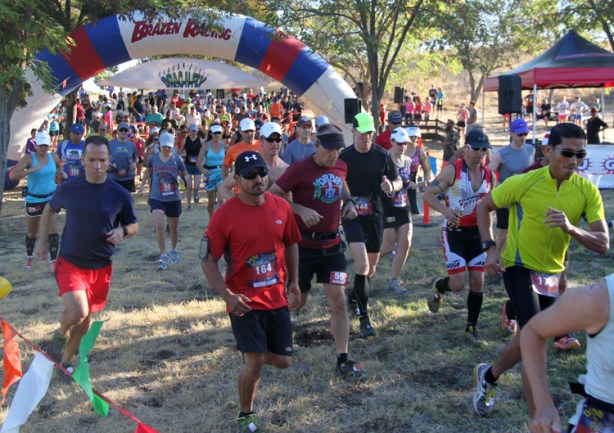

This would be our second Wildcat race, both of us having run the same distances (me the half, Katie the 5K) in 2011.  I don’t remember what compelled me to run the race last year, probably some combination of proximity to home, the promise of serious hills, and the weakly nostalgic connection of my high-school mascot having been a wildcat.  Plus, I’m admittedly an easy sell when it comes to new trail races.  In any case, Katie and I both enjoyed our 2011 outing, which was also our first race under the Brazen banner.  And since I’d completely recovered from and forgiven Brazen for forcing me to run 50K out on sun-baked Mount Diablo last month (at least that’s how I remember it…), we were both looking forward to this year’s Wildcat.

At the start line I was motivated by three thoughts: 1) the possibility of improving on last year’s time (a 13th-place finish in 2:06:30), 2) the chance to defend my age group title, and 3) the opportunity to really trial-by-fire my Merrell Road Gloves on some of the more precarious downhills in the Bay Area.  My familiarity with the course, having experienced its (literal) high and low points the year before, boosted my pre-race confidence.  Unfortunately, the bluegrass music playing in the staging area was no substitute for the (unintentionally?) amusing wildcat growls that had been piped in over the PA system at the 2011 start.  But the weather was cooperative (sunny, high 50s, gusty), the ambience was energizing, and the post-race IT’S-ITs were chilling at the finish line… it was go time.

The race announcer (I assume it was Sam?  I couldn’t see from where I stood) shared some last-second details and reminded us that “This is not an easy half marathon, nobody’s setting any personal records out here today”… although one glance at the lead runners leaning intently across the start line, tightly coiled and ready to spring, suggested that wouldn’t be for lack of trying.  With a final reminder to be wary of potholes as we left the start line, the announcer’s countdown gave way to one mighty blast from the airhorn, and…

Brazen Racing Wildcat Half Marathon start

Runners, take your marks! This is the closest I’d get to the leaders and eventual winners
(photo courtesy of Brazen Racing)

Show time!  I started near the front of the pack, crossing the start line 3 seconds after the horn.  After a crowded 50-foot jog through the grassy start line area, the course veered down then sharply to the right, and the crowd thinned out quickly as we reached the first ascent up Clark Boas Trail.  Normally I’m not a huge fan of races that hit me with immediate uphills before I’m able to catch my second (or even my first) wind.  But my familiarity with this course and my memory of last year’s race gave me the confidence to hit the first hill more aggressively this time, and I was able to pass several runners without being passed myself, reaching the top and heading back downhill just before the first mile marker.  A strong start.

The next 3 miles led us out along the gently rolling out-and-back dirt trails of Belgum Trail, Wildcat Canyon “Parkway” and Wildcat Creek Trail.  I passed the lead runners heading in the other direction – mostly men along with 2 women – and realized that I was starting to recognize some of these faces from, well, from being beaten by them at other Brazen races.  As I approached the turnaround point just after mile 4 (marked by a volunteer standing behind a waist-high cardboard Gu box doubling as a trash can), I noticed a long branch hanging over the right side of the trail as the volunteer warned me to “watch out for the poison oak there”.  I gave the branch a wide berth, circled around the Gu box and headed back in the other direction as the volunteer cheerfully yelled after me, “You’re having fun in those shoes!”  I was cruising along, feeling good and looking forward to tackling the second extended uphill in less than a mile.

Running Wildcat Half Marathon & 5k

Our version of couples therapy!
(photo courtesy of Brazen Racing)

As I turned off the main trail and began to ascend the immediately steep grade up Conlon Trail just before mile 5, I felt another runner close behind me.  Conlon Trail was steeper and lengthier than Clark Boas Trail had been, so to keep myself focused I resolved to stay ahead of my pursuer until at least the top of the hill, knowing that all bets were off once we started downhill.  Fortunately I was able to maintain a reasonable pace as well as my lead as I summited the hill (the highest point of the course at ~1,176 ft).  The next ~1.5 miles led us along a slightly downhill, nicely paved stretch of Nimitz Way.  Unfortunately the 5K and 10K runners didn’t get to experience Nimitz Way… I glanced in all directions at the sprawling panoramic views of Oakland and the San Francisco Bay to my left, along with the San Pablo Reservoir and the East Bay to my right.  During the middle stretch of Nimitz Way (mile 8), I even managed to step up my pace by about a minute per mile, clocking a 7:31 mile before a sharp left turn led me back on to the dirt and down Havey Canyon Trail.

Mike Sohaskey running Wildcat Half Marathon

Rolling down Conlon Trail, with Fernando in hot pursuit
(photo courtesy of Brazen Racing)

The course zigged off Havey Canyon Trail and zagged briefly through a shaded tree-lined stretch of woods.  I one-stepped the lone (meager) creek crossing on the course via a large rock, and exited the woods back on to Wildcat Creek Trail.  At that point my pursuer, a gray-haired fellow wearing a cap on his head and a bandana around his neck, pulled ahead of me and continued to distance himself as we approached the final sustained ascent at mile 10.  I still felt strong as I prepared myself psychologically for the final uphill push, but sensed I’d regret if I tried to keep pace with my surging companion.

The course turned off Wildcat Creek Trail one last time and immediately started another steep ascent, this time up Mezue Trail.  And I reminded myself yet again that hill running is essentially a good ol’ fashioned knock-down, drag-out, beer-bottle-over-the-head barroom brawl between the psyche and the body.  Unless you’re a mountain goat (and I’m not), success on the hills requires that your brain not buy what your body is selling.  And being able to look forward to rather than dread the next ascent is a huge psychological advantage.  I’m not fast, and I know that in a typical road race I have no chance of competing with the best runners.  But I also know I log more miles up and down hills than the vast majority of runners, and more than anywhere else on a race course, hills are where I trust my training.  Only in cases of debilitating heat or altitude, e.g. Diablo last month or Pikes Peak in 2010, has my training abjectly failed me, and in both cases the ascent itself was a secondary issue.  Descents are a different animal – I’m still a work in progress on downhills, and I’m constantly amazed at how fast some runners can fly down a hill – but I hate being passed on uphills.  My attitude is always that if I can keep the runners just ahead of me in view, then they stand a good chance of being caught and passed on the next uphill.

Although I did run Wildcat last year and used the lessons learned to my advantage in this year’s race, some key details of the course still escaped me.  Like the three short-but-steep uphill jags remaining after the final extended climb up Mezue Trail.  As the cap-and-bandana combo ascended ahead of me with what appeared to be surprisingly little effort (maybe I’d found my mountain goat), I put my head down and hammered after him with a balls-to-the-wall “This is it!” attitude that could’ve cost me on a hotter day.  Fortunately I reached the top at around mile 11 with just enough left in the tank to sustain a crisp pace down and back up the three remaining short uphills.  Passing the mile 12 marker, I felt that familiar one-mile-to-go neuron fire excitedly in my brain, and I glanced around to take in one last appreciative view of the East Bay sprawled out below, Whoville-style.  I then turned my attention and momentum to the mile+ home stretch to the finish.  And that’s when my mind began its own anxiety-fueled race, faced with its most vivid memory of Wildcat 2011: the final descent.

In case you snoozed briefly there (not that I blame you), downhills are not my forte.  Whereas many runners see the “down” as a golden opportunity to make up for time lost on the “up”, I’m usually hesitant if not downright uncomfortable on trail descents.  The possibility of holes and cracks in the trail, precariously loose dirt and gravel, or anything else (say a hidden root) that might snag my foot and send me head over heels… together these potential gremlins lend both a physical and mental tension to every trail descent.  Not to mention (except that I am) a rich history of left ankle sprains that I’m never in a hurry to repeat.  Fortunately, thanks to my Merrells I’ve recently gained confidence and made significant improvements to my footwork and downhill technique.  But the final mile of Wildcat contains two (really three) brief descents, on grass and loose dirt and in short succession, that are among the steepest and most precarious I’ve encountered in the Bay Area.  The first downhill, which actually is the steeper of the two based on the elevation profile, primes your quads and feet for the real challenge of the second downhill, an unnervingly steep grade that demands full concentration while requiring that your quads and feet fire rapidly in staccato bursts.  As my legs machine-gunned away, my mind raced frantically with the adrenalizing, edge-of-panic realization that one misstep would upset my already-unstable balance and send me careening head-over-heels down the hill.  I’ve never had to chase my own body in such a frenzied manner before, making this unique stretch my strongest Wildcat memory.  And what I saw in my peripheral vision as I focused on the trail directly underfoot only added to my anxiety… below me, a few 10K participants were slowly and painstakingly hiking their way down this final descent as I neared my own version of terminal velocity.  A momentary image of my unchecked momentum bowling over chubby, exhausted 10Kers like tenpins flashed through my mind, complete with bowling-ball strike sound.  No no no no no… fortunately several potential tenpins looked up in time to see me more or less falling down the hill toward them, and I was able to change direction just enough to slide by without incident.  Altogether, these two harried descents lasted a grand total of… less than a minute each.

As this virtual freefall leveled off, my frazzled quads began to provide immediate feedback.  Whiners.  But I was now close enough to feel the finish line ahead.  And as the eventual third-place women’s finisher went gliding past me looking relaxed and effortless (@&*# downhills!), I tackled the final (relatively) gradual descent with renewed motivation.  A sharp left turn at the bottom of the hill led me back up on to the grass, past the trailhead and across the finish line in… 1:59:19!

Mike Sohaskey finishing Brazen Racing Wildcat Half Marathon

A round of self-applause at the finish line… I must have just glanced at my Garmin
(photo courtesy of Brazen Racing)

My mile splits… wish I could remember where the 3 major uphills were

Katie finished her 5K in 41:58 and bested her 2011 outing by 32 seconds.  On the frustrating side, she placed out of the age group awards by finishing seven and six seconds behind the second- and third-place finishers in her age group.

As we wandered the finish line area cooling down and watching other runners finish, I felt a tap on my shoulder and turned to see my gray-haired companion with the cap and bandana.  His race bib read “Fernando,” and that’s how he introduced himself.  Very nice fellow, I’m glad he found me… Fernando moved to the East Bay from Spain, and apparently he trains frequently on the Wildcat course.  He complimented me on my posture and running form, and I congratulated him on his strong showing and thanked him for motivating me to push myself harder than I might have otherwise.  It’s not unreasonable to think I owe my sub-2:00:00 finish to his shadowing me in the middle stages of the race.  Apparently Fernando’s hamstring tightened up pretty severely near the end of the race, so hopefully that’s now fully recovered and I’ll have a chance to race alongside (and in front of) him again soon.

So I guess I achieved my primary goal for Wildcat, finishing in under two hours and besting my 2011 time by over seven minutes.  However, I did a lousy job of defending my age group title.  Fortunately for Brazen but unfortunately for the rest of us, their races have now grown to the point that they attract some pretty bad-ass ultra runners, including sponsored types who nonchalantly reference their “next” 100-miler and advertise Udo’s Oil on their own blog (never heard of it? exactly…).  On this day both the first- and second-place runners set the Wildcat course record.  The second-place finisher was a fellow from San Francisco named Tim Long, who also set the Diablo 50K course record last month and who documents his own running exploits in an excellent blog, Footfeathers.  Based on his recent domination of the Brazen M(40-44) age group, I may send Tim a birthday/thank-you card myself when he turns 45.

Right now though, I can’t complain… the three fellows who finished ahead of me in my age group are clearly stronger runners.  And the only race variable I can consistently control is my own performance.  Since I don’t race professionally, the only person I need to outperform by the time I reach the finish line is myself.  For now I’ll use a fourth-place finish in my age group as motivation to keep getting stronger.  After all, Trailquake is only three weeks away…

Smiles all around, even before the celebratory IT’S-ITs (NOTE: all runners are drawn to scale)

MISCELLANEOUS THOUGHTS:

  • As challenging and demanding as Wildcat’s hills are, they’re definitely less punishing than the k(hill)ers in either last month’s Diablo 50K or Brazen’s half marathon championship at Rocky Ridge.
  • More evidence that trail running is quickly gaining in popularity: almost twice as many half marathoners (169 vs. 87) crossed the finish line this year compared to 2011, and 503 total runners competed in this year’s Wildcat lineup (half, 10K and 5K) vs. 296 last year, an impressive 70% increase.
  • I made a smart choice not to carry my bottle of Cytomax, as I did last year… no use carrying something I really don’t need, I prefer to leave both hands free in case I need to catch my balance or break a fall.
  • Overheard by Katie on the 5K course, from a man walking with his young (~8-year-old) daughter: “Do you think you’re going to run at all this morning?”

SHOES:  My lightweight Merrell Road Gloves (as well as Fernando) contributed to my faster finish time this year.  Better ground feel than with my Asics GT-2150 trail shoes gave me much more confidence on descents, and as a result my downhill game is improving.  Hopefully a sign of positive things to come. 

PRODUCTION:  Again, the Brazen crew and their volunteers were epic, including their race photographers who always provide some great action shots, free of charge and without the word “PROOF” stamped across your face.  As usual, the course was flawlessly marked.  Mile markers were dead-on with my Garmin (±0.02 miles), and volunteers were stationed at key junctions to avoid any potential confusion and ensure that nobody took a wrong turn.  In fact, the course was so well marked that apparently its flour arrows on the trail wreaked havoc on the next day’s Tilden Tough Ten… so much so that TTT organizers issued a post-race apology to their racers:

We were unaware that there was a race held at Tilden on Saturday (this has never happened in previous years and therefore wasn’t on our radar of possible planning issues) and as a result the course markings were confusing even for our volunteers on the course.  Markings [were] left over from the other race which led some runners the wrong way.  This also resulted in our bike patrol taking some wrong turns and missing the turn around for the race and hence no one being there.

Overall I’d highly recommend Wildcat, it’s the best of the Brazen half marathons I’ve run so far.  It has a lot of what makes trail running great:  several challenging hills, together with more relaxed sections in the middle and stunning views from Nimitz Way and the San Pablo Ridge Trail.  And as I referenced earlier, the all-powerful post-race IT’S-IT – to the best of my knowledge a Brazen exclusive.

Brazen Racing Wildcat Half Marathon medal

This year’s profile medal – a cool alternative to last year’s head-on version

FINAL STATS:
May 19, 2012
13.3 miles in Wildcat Canyon Regional Park
Finish time & pace: 1:59:19 (7:11 faster than 2011), 8:58/mile
Finish place: 17/169 overall, 4/20 in M(40-44) age group
Race weather: sunny, high-50s to mid-60s with gusty winds
Elevation change (Garmin Training Center software): 3248ft ascent, 3234ft descent

Well they’re out there a-having fun, in that warm California sun.
– Henry Glover/Morris Levy

I’m a runner.  I live in the East Bay.  I’ve run races all over the Bay Area – street and trail, flat and hilly, hot and cold, individual and relay – with one glaring hole in my racing resume: I’d never run a race on Mount Diablo.  Since I live in the East Bay, I’ve logged a few training miles in Diablo’s (lack of) shadow, including one forgettable effort that began as an uphill jog in 99°F weather and ended in an overheated string of profanities less than 3 miles up the hill later.  But like an all-star closer in baseball, or a starting cornerback in football, or maybe more appropriately a frontal lobotomy patient, compulsive runners have a short memory for failure.  So when Brazen Racing announced their Diablo Trails Challenge on April 21, I quickly discounted my previous crash-and-burn efforts.  I’d finally have my shot at Diablo, and what better group to hitch a ride with than Brazen (more on them later)?  As I lounged in the comfort of my climate-controlled living room, well fed and fully hydrated (always the best time to make hardcore racing decisions), I decided that after 30 half marathons and 4 full marathons, I’d skip the triple-dog dare and go right for the throat… Diablo would be my first 50K.

Brazen Racing Diablo Trails Challenge 50k map and elevation profile

As further motivation, proceeds from the Diablo Trails Challenge would benefit Save Mount Diablo, an organization working “to preserve, defend and restore the land on and around Mount Diablo”.  I was going to step up, fill out my East Bay racing resume and save Mount Diablo in one fell swoop!  April 21 couldn’t get here soon enough…

But finally, it did.  I was joined at the start line in Round Valley Regional Preserve by two Long Beach veterans of the SoCal ultramarathon scene – my brother Chuck and his partner-in-grime Laura – along with 124 other 50K’ers looking far more ultra-ready than I felt.  Race day was a month later than the previous year’s Challenge, presumably to avoid the suboptimal windy, wet and generally sloppy conditions that had marred that event.  Unfortunately, the Bay Area was experiencing one of its characteristically unseasonal heat spikes that weekend, meaning this year’s race would be a stark contrast to 2011, with sunny skies and temperatures starting in the low 70s before ramping up to the low 90s by mid-afternoon.  Game time was set for 8:00am, a later-than-usual start that, for the first time I could remember, had me wishing for an earlier start time.  It was gonna be, to use hometown East Bay jargon, a hella hot day for a foot race.

So at that point I focused my expectations into a single, hopefully manageable goal: FINISH.  Screw my virtuous ambition to save Mount Diablo, clearly it could take care of itself… the more pressing question was, who was going to save ME?

We donned our race bibs, wrapped up our pre-race prep, and as always I psyched myself up with the memory of all the miles I’d logged and with one all-important reminder: trust your training.  Meanwhile, Laura struck up a conversation with one well-caffeinated racer who took the opportunity to gush (no pun intended) about his new hydration pack and its unparalleled functional genius.  As the race director shared some last-second instructions and thoughts on the day ahead, I finally turned my attention to my own hydration pack.  Biting and sucking frenetically on the line like an amateur vampire, I desperately tried to get the water flowing… a pre-race oversight caused by my not having used the pack in at least a year.  As I began to envision worst-case scenarios involving my parched corpse and a giddy pack of turkey vultures, my water line finally started to flow, and seconds later…

We were off!  The three of us started comfortably near the back of the pack, and I spent the first few minutes slowly passing other runners… with only 31 miles to go, it was time to make my move!  Glancing down at my feet to monitor my footfalls, I noticed the sweat already dripping on my shoetops, the first clear indication that this day would be an education in hydration regulation.  Fortunately, the first 3.5 miles were relatively flat and provided a relaxed opportunity to stretch my legs before the first extended hill kicked in.

Typically I try my darnedest to maintain a minimal jogging pace on hills, regardless of the grade.  I’d much rather keep moving at a slow-but-punishing jog than stop to walk, because for me the only thing tougher than going… is stopping. And then starting again.  In this case I set up the hill at a slow jog, a pace I maintained for roughly 2/3 of the way up the hill, unlike my compadres nearly all of whom had (smartly) chosen to walk uphill.  I only stopped pumping my arms to propel myself forward once I realized that my legs had physically stopped turning over… I’d slowed to a hiking pace without even realizing it.

Finally I crested the first hill triumphantly and jogged along comfortably for the next couple of miles.  We passed a variety of cattle gates along the course, each posing its own distinct challenge… one gate would push open, the next would pull, one required lifting a latch, while another involved reaching over the gate to find the latch semi-hidden on the other side.  I could see how a cow might get confused.  Each gate became its own challenge to try to open quickly, to avoid embarrassing myself by letting another runner catch up to me while I fumbled clumsily to figure out the latch.  Around mile 6, a fellow runner told me he’d already seen somebody give up on one gate and simply vault the low fence.

Running Brazen Racing Mt Diablo Trails Challenge 50k

Into the belly of the beast: a lot of Diablo looks down on a little Chuck
(photograph © 2012 Scott J. Hein, Hein Natural History Photography)

After the first extended uphill, the subsequent downhill carried me into the first aid station at Morgan Territory Road, mile 8.2.  After a barely-there stop to throw back a Dixie cup of water (agh! warm Sprite, last time I’ll make that mistake), I left the aid station and immediately headed straight up the second hill.  This one involved a significant proportion of brisk hiking, until finally I reached the zenith of the course at 2340ft.  From there it was downhill (for the most part) to the second aid station at Old Finley Road, mile 15.6.  There I saw Katie (always a sight for seared eyes!), who quickly traded me for a second bottle of liquified Cytomax-and-Roctane, helped me refill my hydration pack, handed me a Ziploc sandwich bag full of ice, and saw me on my way.  I balanced the Ziploc bag on top of my head and held it in place by pulling my cap down tightly.  Goofy looking?  Probably so, but it stayed in place nicely without leaking, and I would have gladly run with a singing dancing penguin on my head if it would have cooled me down.  A couple of minutes later, I passed Chuck heading in the other direction toward the aid station, and I readied myself psychologically for another steep, extended uphill climb.

The extended climb from around mile 16 to mile 19 was excruciating… I chose one 12-letter word here, rather than three more appropriate 4-letter ones.  Hard to know exactly where I bonked on that hill, but around mile 18 I felt myself starting to overheat.  And I knew from experience (summers spent running in Texas) that as soon as I overheated that first time, I would more quickly overheat a second time, and at that point my day would be over.  DNF… the three dirtiest letters in a runner’s vocab.  So I ratcheted up my water and Cytomax intake (which was already much higher than usual) and slowed to a slightly unstable hiking pace, until Chuck jogged up alongside me shortly after mile 20.  Though he looked to be holding together fine, he joined me at my torrid ~18:00/mile walking pace.  In the meantime, he tried to cheer me up/assess my chances of survival with a steady stream of one-liners.  Sadly, I was so focused on holding it together until we got to the aid station that I could barely crack a smile.  Cows standing on the side of the course cheering on two vegetarian runners strikes me as pretty funny now, sitting comfortably in front of my laptop, but laughter really isn’t the best medicine when your body’s threatening a code red on you.  I look at the Brazen photos of us taken on that segment of the course, a smile on my face and my arms seemingly pumping away, and I appreciate more than ever that a picture really is worth a thousand words… in this case mostly lies and profanities.

Mike and Chuck Sohaskey running Mt Diablo Trails Challenge 50k

Quality brother bonding time (i.e. Chuck trying out his stand-up routine) near Curry Point
(photo courtesy of Brazen Racing)

Finally! we reached the third aid station at Horseshoe, just before mile 23.  I felt reasonably healthy as we pulled in, but as we stood around resting, drinking more water and refilling our hydration packs, I started to feel a bit unsteady.  Katie then caught up to us (an angel here on Diablo? am I hallucinating?), Chuck continued on his way, and I sat for a few minutes trying to cool down.  One of the County Search and Rescue crew members eyed me suspiciously as I stood up and asked if I was doing ok.  I assured her I was fine, while at the same time trying to convince myself that I really was ok to continue… I had short-lived thoughts of ending my day right there and heading back to the car with Katie.  That’s when I met… the icy sponge.  And that sumabitch saved my race… I saturated my head and clothes with icy water and instantly felt more alert, energetic and ready to continue… basically, everything those commercials for 5-Hour Energy promise you.  So roughly 20 minutes after pulling into the Horseshoe aid station, I again rallied behind my all-consuming goal of finishing the race, told Katie I’d see her at the finish, and headed down the next hill…. knowing that worst-case scenario, the next aid station (and hopefully the next icy sponge) awaited only 5+ miles away.

I felt relatively strong and even regained my rhythm to some extent in the next 2-3 miles, which were largely downhill.   At that point the trail was solid rock to the left, solid rock to the right and what seemed like solid rock underfoot, all of it acting like a natural magnifying glass that focused the sun’s rays down on me.  And maybe my sun-soaked brain was daydreaming, or maybe I fell into too comfortable a rhythm, but I dragged my feet just enough to slam my toe into an unyielding rock or root or petrified skull of some former Diablo 50Ker, causing me to lose all balance and pitch forward on to the trail.  My entire life flashed before my eyes!  Ok so maybe that’s a bit of an exaggeration, but losing control of my body was a momentarily scary feeling.  Fortunately I was able to use my forward momentum to land on my side, roll once and bounce back up again.  Looking back on it, I probably made more progress during that stop, drop, and roll than I would have by staying on my feet.  But I got lucky, escaping with a bruised elbow and minor scratches on my leg… it could have been much worse.  And my body must have been unfazed after everything I’d already put it through, because it didn’t even bother to respond with the expected adrenaline surge.  So much for feedback between mind and body; apparently each was now on its own.

With a full marathon behind me, I reached the final extended uphill surge just before mile 27.  And if the first few were bad (and they were), this uphill climb was the most punishing yet.  Forget running or even jogging, I was doubting my ability to hike to the top at that point.  I also realized that, due to the one-two punch of heat and exertion, I’d been taking quick shallow breaths rather than long, deep breaths throughout the race… as soon as I started taking deeper breaths, I realized my kidneys were sore.  So I stopped in a patch of much-needed shade for about 5 minutes to rehydrate heavily and then pushed forward, staring at my shoetops for several more minutes before finally reaching the top.  I’m not sure I’ve ever been so relieved to reach the top of a hill (Pikes Peak notwithstanding; I’m not counting a 14er as a hill).  And it says a lot about the speed of the race at that point that as slowly as I was moving, and even with a 5-minute dead stop thrown in, I’d somehow managed to pass more runners than had passed me since the Horseshoe aid station.  The world around me was moving in slow motion, but at the same time my sluggishness provided an opportunity to appreciate the ultra-green beauty of Diablo and the surrounding countryside.  So the timing of the race was actually fortuitous in one regard, because as one Brazen crew member told me after the race… “We got lucky on the date, in 2 months this will all be brown.”  Perhaps a bit of Schadenfreude in his choice of the term “lucky”, but he had a point.

As I picked up my pace a bit and jogged along the top of the hill, a female runner (race organizer? volunteer? other? I couldn’t tell) passed me going the other way and assured me that I had “only one-and-three-quarters miles to the next aid station”.  I glanced at my Garmin, which read 27.5 miles.  HUH?  The next aid station (Burma) was shown on our race map at 28 miles even, so I was hope-hope-hoping her sense of distance was skewed… an extra mile+ would have been even more taxing psychologically than physically at that point.  Fortunately I pulled into Burma at mile 28.4 (so was she that off, or was she just screwing with us?), where I recovered my strength for the next 10 minutes while chugging cold water and struggling to stomach one bite of melty warm banana (my first food of any kind since breakfast).  After thoroughly dousing and revitalizing myself with the icy sponge one last time (and assuring the race volunteers that I was going to be dreaming about that sponge for days), I rallied my final energy reserves and headed down the final hill toward the home stretch.

Life became relatively easy those final 3 miles, and I was able to maintain a regular jogging pace for the most part.  Though as I descended back down the mountain along the fully exposed single-track trail, the hot air got even more stifling and uncomfortable to breathe, until finally I reached the shaded part of the trail that led directly into Castle Rock.  Having run this part of the trail before, I knew what to expect, and the race finished with 9 or 10 ankle-deep (and refreshingly cold! ‘cuz I had no intention of tiptoeing across rocks) creek crossings in the final 2 miles.  In the final half-mile I picked up the pace ever-so-slightly and passed a fellow racer whose facial expressions told the tale of his exhaustion… by then I was determined to enter the finish line chute alone, hear my name announced over the PA system, and have that brief moment all to myself.  I saw Chuck first, standing on the right side of the trail roughly 50 yards from the finish line, then I saw Katie standing in front of the finish line with camera poised as I broke from the shade and into the sunlight one last time, crossing the finish line and ending the longest day of my running life with an intense mix of relief and exhilaration in 7 hours, 39 minutes and 51 seconds.

Race over! ending as the longer ones frequently do: with an in-the-moment string of exhaustion-fueled promises never, ever, never to do something THAT stupid to myself ever again.

Brazen Racing Mt Diablo Trails Challenge 50k finish

By the time I crossed the finish line in 7:39:51, the heat had clearly taken its toll.
(“Bodies” image courtesy of National Geographic)

Chuck beat me to the finish in 7:11:36 with his (questionable) sense of humor still intact, a kick-ass performance under those conditions.  But considering he’d barely been out on Diablo for 7 hours, how tired could he really be?  While waiting for Laura to finish, Chuck walked back up the trail where he ended up guiding incoming finishers around an agitated rattlesnake coiled up on the side of the trail.  Not to be denied, Laura finally crossed the finish line in 10:16:40, still looking and (so she claimed) feeling good.

I spent the 2 hours after I finished and before Laura arrived basking in my Diablo afterglow, trying to get comfortable with my sore kidneys, and listening in on fellow racers as they swapped stories and reflected on their day.  But so much for the conventional running wisdom of refueling within 30 minutes of a race… I desperately wanted to take advantage of the impressive post-race banquet, but my GI tract limited me to several pieces of pineapple and watermelon.  Couldn’t even stomach a handful of M&Ms, my innards were a defiant lot.

I thanked the members of the County Search & Rescue team as they sat by their tent watchfully eyeing each runner who crossed the finish line.  One of them gestured toward a nearby bench and invited me to sit and recover in front of the icy sponge’s post-race sibling, a giant humidifier-like setup comprising a large barrel of water-with-hose hooked up to a fan that sprayed cold mist.  I was surprised to find only one other runner (a highly appreciative DNFer icing his knees) seated in front of the fan… the Search and Rescue power-mister was hands-down the underappreciated star of the Diablo after party.  Pure genius.

Behold! the life-affirming genius of the Search and Rescue power-mister

That night, after struggling to finish half a slice of Zachary’s pizza for dinner, I hit the bed plenty tired though not exhausted, with sore kidneys and a still noticeably elevated body temperature.  And as I lay there mentally and physically putting the day’s accomplishment to rest, I was already looking forward to the next step in my training…

I think I’ll take tomorrow off.

MISCELLANEOUS THOUGHTS:

• My past 3 races have yielded 3 PRs at different distances:  the Honda L.A. Marathon (3:37:53), the Oakland Half Marathon (1:34:02), and now the Diablo Trails Challenge 50K in 7:39:51.  Hey Chuck, how many AREC points does that get me?

• How ironic (in the Webster’s-approved, non-Alanis sense of the word), after nearly 8 hours of sun exposure in 80+°F heat, that thanks to the modern miracle of SPF 55 sun-block, I crossed the finish line still pale and vitamin D-deficient.

• The course was a nifty diversity of different terrain: well-maintained dirt trail; rutted ground that looked as though a herd of mustangs had trampled the mud before letting it dry and harden again under the Diablo sun… this made for the toughest footing of the day; fire road; loose rocks and gravel; asphalt, as we briefly dodged traffic and crossed South Gate Road; hard packed dirt with large rock outcroppings (one of which still has part of my big toe stuck to it); soft forest detritus; grassy single-track trail just wide enough to put one foot in front of the other; and finally a paved and nicely maintained walking trail with several creek crossings.  Plus a bonus waterfall on the side of the trail somewhere after mile 23 (Chuck saw it too, so I wasn’t hallucinating).  And them’s just the terrain I remember…

• For me, the worst part of a course like Diablo isn’t necessarily the sustained uphills, it’s the many short-lived smaller hills that deceptively show up as tiny, easy-to-overlook blips on the elevation profile of the course.  So many times during the race I’d crest one hill, find myself on a relatively level part of the trail and rally just enough energy to start jogging again… only to look up and see another uphill jag looming immediately ahead that quashed any thoughts I had of regaining momentum.

SHOES:  After some hesitation, I decided to wear my Merrell Road Gloves for the 50K, despite never having run farther than 17 miles in them.  And choose wisely I did, because throughout the race my feet were probably the happiest part of my body.  The shoes felt great, responded well on all the varied terrain, and I appreciated the much-improved ground feel relative to my old Asics GT-2150s, which had been my go-to trail running shoes for previous Brazen races as well as the Pikes Peak Ascent in 2010.  My footing was relaxed and confident (my graceful kiss-the-dirt moment notwithstanding), and the combination of the Road Gloves and my Injinji toesocks kept my feet amazingly blister-free… though I’m glad the water crossings all came at the end of the race.

PRODUCTION:  Sam, Jasmin and all the folks at Brazen Racing deserve huge applause for their organization and execution of not just the Diablo Trails Challenge, but all Brazen events.  I’ve run trail races organized by other local companies, and the Brazen crew is hands-down the best at what they do here in the Bay Area… that is, organizing memorable races on challenging courses in awesome (and often underappreciated) locales.  I’ve now run 6 of their races including the Diablo Trails Challenge, and their attention to detail is unsurpassed.  They do an exemplary job of ensuring that the most important race details (course markings, postrace munchies, the coolest medals and t-shirts) are handled flawlessly, while preserving the low-key, just-me-and-nature feel that is the ethos of trail running.  On this day in particular, the Brazen crew as well as all their incredibly friendly, bend-over-backwards-helpful volunteers at every aid station stood around in the uncomfortable heat for over 10 hours just to take care of a bunch of masochists, and not once did I hear anything but positivity and encouragement (at least not from the voices outside my head).  Can’t wait for Brazen’s Wildcat Canyon half on May 19… last year’s Wildcat was one of my favorite races of 2011.

Brazen Racing Mt Diablo Trails Challenge 50k medal

Another reason Brazen rocks… awesome medals! (although no race-day griffin sightings were reported)

FINAL STATS:
April 21, 2012
31.4 miles from Round Valley Regional Preserve to Castle Rock Park in Walnut Creek, CA (State 1 of 50)
Finish time & pace: 7:39:51, 14:39/mile
Finish place: 47/109 overall, 11/22 in the M(40-44) age group
Race weather: sunny, 71°F starting, ~90°F high
Elevation change (according to my Garmin Forerunner 305): 8,578ft ascent, 8,440ft descent
127 runners crossed the start line, 108 crossed the finish