Archive for the ‘Marathons’ Category

With the marathon, even if you’re hurting, it’s like, ‘Well, I’ve come all this way.  Unless there’s a bone poking out, I might as well finish.’
– Al Roker, cohost of The Today Show

ET logo 2013

Clearly they see it too, because the voices now are impossible to ignore.  Once a barely perceptible pinpoint in the distance, the dazzling and ever-expanding glow that beckons on the horizon now threatens – no, promises – to vanquish the seemingly infinite darkness of the Nevada desert.  And the voices heed its call, compelling me onward like a single-minded moth toward a seductive flame.  Move forward, into the Light, the all-knowing all-seeing all-caring Light… release your tension, confront your pain, let Its radiance guide you, yes that’s it! feel Its warmth sustain you, Its compassion embrace you, Its omnipotence protect you….  I cross the threshold from dark into light, wholly surrendering both mind and body to the indescribable relief that floods every synapse.  Squinting into the soft resplendence, my gaze is met by an unblinking pair of impassive black eyes set in a featureless green, unside-down teardrop of a face.  Certainly the face isn’t human, nor had I expected it to be.  Yet fear, like darkness, has no place here.  The wide, expressionless eyes gaze silently up at me while the soothing voices in my head continue to reassure me – Welcome home, your long journey’s over, it’s time to heal.  My outstretched hand gently caresses the other-worldly face in an awkward mix of exhaustion and wonderment.  I step forward unsteadily, into the light and beyond.

Little green men in the Silver State
I’m no fan of Las Vegas, but I understand its allure… who isn’t instinctively attracted to bright and shiny?  And if bright and shiny appeals to you, then no place rivals the neon-powered spectacle of The Strip at night.  If tackled with the right group of friends, Vegas can be a genuinely fun place… but then, even the DMV can be a fun place with the right group of friends.  With each successive visit, Sin City feels more and more like a high-mileage, weather-beaten Volvo that’s spent the past 20 years parked along the curb, collecting layer upon gradual layer of dirt, pollen and neglect.  Throw in some spinning rims and purple neon undercarriage lighting, and that’s how I view Vegas.  Or in snacking terms, Las Vegas to me is that second donut, with the electric thrill of anticipation quickly mutating into the sickening aftershock of reality.
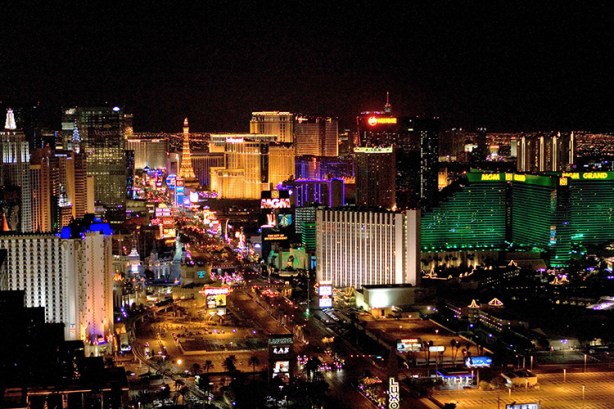
Behold! the spectacle of Seizure City (photo credit TakeTours)

Hey brainiac, here’s a novel concept: stay away.  And gladly I would, but where gambling outsiders like me hit the jackpot is in the city’s proximity – to Hoover Dam, to Red Rocks Canyon, to several National Parks, and to the barely-there town of Rachel, NV, site of last weekend’s E.T. Full Moon Midnight Marathon, organized by the folks at Calico Racing.

Why the E.T. Marathon?  And why now?  For two reasons: first, Chuck and Laura had run the race back in 2008 and highly recommended it.  And second, given that my 2013 racing schedule had already morphed somehow into my own personal X Games – sub-freezing temperatures and icy conditions in my first two races, record-high temperatures in my next – I figured what better place to continue the “extreme” theme than in the midnight darkness of the Nevada desert. With one slight caveat: since the race each year is scheduled to coincide with the full moon (hence the name), we wouldn’t be running in total blackness.

I’ve never been what I’d call an alien aficionado.  I find the subject of little green men more amusing than anything, although the presumption that we’re alone in the universe strikes me as naïve hubris.  During graduate school, I discovered and watched every episode from the first seven seasons of The X-Files, with its spooky (at the time) taglines of “Trust No One” and “The Truth Is Out There.”  Over time, though, my dedication to the show grew in spite of rather than because of its alien conspiracy storyline, which eventually took on an absurd life of its own.  In any case, to this running aficionado the prospect of running under a canopy of stars and by the light of the full moon while dodging alien tractor beams promised a compelling and one-of-its-kind race experience.  Not to mention a pretty cool medal.

So it was that Katie and I found ourselves – after narrowly escaping the crush of Friday afternoon L.A. traffic – cruising northeast along I-15N, through the no-man’s-land of unincorporated California and on the boundary of the Mojave National Preserve.  Like most interstates, I-15N doubles as a steel-belted graveyard, and out here the mangled roadkill of blown tires littered the highway like neglected rubber corpses.  As the temperature outside the car hovered near 110°F, I was surprised by the lack of heat haze rising up from the pavement, a constant from so many childhood summers spent driving under the blistering sun of hot and humid Texas.

The world’s tallest non-functioning digital thermometer in Baker, CA

We’d broken up the drive with a pitstop for gas in Baker, CA, home of the world’s tallest thermometer, an uninspiring and nonfunctional 134-foot-tall landmark built to commemorate the nation’s record-high temperature of 134°F, set in Death Valley in 1913.  As if to apologize for such a lame tourist attraction, Baker paid for half our tank of gas when Katie found an orphaned $20 bill on the floor of the gas station convenience store.  Returning to the car, and anticipating our upcoming arrival in the Silver State, I brought up a playlist from Sin City’s own house band, The Killers.  We then hopped back on the highway and 45 minutes later crossed the border into Primm, NV, where the first of many oversized neon casino signs offered a garish reminder of what awaited us on a much larger scale in Vegas.

Thirty minutes later, we exited the highway and rolled onto the Vegas Strip, center stage in America’s own Theatre of the Absurd.  Thanks to the generosity of Katie’s parents, our base of operations would be centrally located Caesar’s Palace.  After arriving too late to meet several members of our Antarctica contingent for dinner, we carbo-loaded on our own and then wandered among the urban gristle of the Strip before heading up to our room for the night.  “Absurd” is trying to exercise self-discipline and conserve energy in Las Vegas.  In August.  Welcome to the No Fun Zone.

On Saturday, anticipating the day to come, we made ourselves stay in bed until nearly 1:00pm, then ate a quick lunch and headed over to the race expo at the Hard Rock Hotel.  I use the word “expo” because that’s how it was billed, though the entirety consisted of several folding tables on which were stacked registration materials, goodie bags and exterrestrial merchandise/souvenirs.  At a smaller table next to the door sat a fellow selling high density foam rollers.  Even factoring in the time required for mandatory alien photos, we were in and out of the expo in ten minutes, and were again disappointed not to encounter any of our Antarctica colleagues.  From there we returned to our hotel room, where we packed and repacked, checked and double-checked everything we’d need for the long night ahead.  After a quick pasta dinner (carbo-loading session #2), we joined our compression-clad kindred spirits outside the Hard Rock Hotel, as boarding of the buses began for a 2.5-hour ride into the heart of darkness.

Leaving Las Vegas
An hour later, Katie and I sat side by side and lost in thought at the back of a dark and quiet bus bound for the outskirts of Rachel NV, population 54.  Despite its small size, Rachel has large street cred among extraterrestrial hunters as the township closest to Area 51, the mecca for UFO aficionados.  And the timing for this race would be perfect – with the U.S. Government officially acknowledging the existence of Area 51 earlier in the week, I figured UFO sightings in the skies above Rachel would be plentiful, as extraterrestrials staged their own long-awaited “coming out” party.  Adding to my anticipation was the recent experience of NBA player Baron Davis, who insisted just last month that he’d been “actually abducted by aliens” while driving alone from Las Vegas to Los Angeles.  All’s well that ends well, though, since apparently Baron was able to calm his nerves at In-N-Out Burger after his gracious hosts dropped him back to Earth in Montebello, CA.

Admittedly, my real fear about running through Area 51 was that I’d end up like Cartman:

Once on the highway we’d quickly left behind the billboard advertisements for vasectomies, hangover cures and pole-dancing classes, and had transitioned into darkness interrupted only by the occasional pair of oncoming headlights, the Christmas tree-like incandescence of the sporadic refinery, or the distant bolt of lightning greeting arid desert terrain.  I’d momentarily regretted boarding one of the “chatty” (vs. “quiet”) buses when the two fellows in the seat behind us began to discuss loudly and in graphic detail the plot progression of Breaking Bad.  Admittedly it’s my fault I’m five seasons behind and have yet to watch a single episode, but I do intend to watch the entire series at some point, and so I quickly jammed in my iPod earbuds to stem the tide of plot spoilers.

As our bus hummed smoothly along through the desert darkness, round overhead lights spaced at regular intervals bathed the upholstered seats in a soft green glow and cast each passenger in a Hulk-ish sheen.  Enhancing this effect was the neon green compression wear sported by many of our fellow passengers.  Though I myself wouldn’t be decked out in full alien regalia, I’d be tipping my LED-equipped cap to our otherworldly homies by running the (Area) 51K rather than the shorter marathon distance.  This only seemed right… if the race had been held around San Francisco’s Candlestick Park, I would’ve chosen to run the 49K.

Approaching our destination on Nevada Highway 375 – rebranded as the “Exterrestrial Highway” in 1996 – our human driver kept the crowded vehicle well below the unofficial speed limit of Warp 7.  At last the bus slowed to a halt, signaling an end to this leg of the journey and the start of the next.  Both literal and figurative electricity filled the suddenly lively bus, as anxious and excited runners decked out in blinking, flashing multihued running apparel stretched their legs, gathered their belongings, and prepared for what promised to be, one way or another, an out-of-this-world race.

Mike Sohaskey at start of E.T. Full Moon Midnight Marathon 2013

Countdown to midnight: All dressed up and nowhere to glow

We deboarded just before 11:30pm.  Diffusing away from the glare of bus headlights and into the shadows, I made my way toward the very manageable lines forming in front of the eight porta-potties.  After that mandatory stop I triple-checked my gear and nutrition, reminding myself where I’d stashed everything in the UltrAspire Alpha hydration pack I’d purchased two days earlier.  I’d decided to leave the bladder reservoir in the hotel room and use the pack strictly to carry bottles and gels, since the Alpha allows easy access to its front pockets without having to physically remove the pack.

I’d be carrying two bottles, one filled with Skratch Labs hydration mix and the other with Skratch Labs powder sans water, which I planned to fill once I emptied the first.  Normally one bottle would be plenty, particularly for a road race, but on this night my nemesis and leading sponsor Hammer Labs would be stocking all aid stations with their unpalatable HEED drink.  I assume they chose a midnight race so that runners wouldn’t see what they were drinking; in any case, I decided to play it safe and carry my own concoction.

Two water bottles?  check.  Headlamp?  check.  Blinking red light to give those behind me something to chase? check.  Garmin on and satellites found?  check.  Green glow bracelet? check.  And iPod just in case those last few miles got really lonely and I needed a musical pick-me-up?  check.  I was ready-ish.  With that, Katie and I wished each other luck, and she boarded the 11:45pm bus that would transport her to the finish line, where her 10K race – an out-and-back course that would double as the last 6.2 miles of the marathon – was scheduled to begin at 1:00am.

Black Mailbox at start of E.T. Full Moon Midnight Marathon 2013

Do not adjust your monitor: this is the Black Mailbox that stands at the marathon/51K start line

I spent the remaining few minutes before midnight wandering through the sporadically lit start area, searching in vain for the five members of our Antarctica expedition who I knew to be running the marathon.  How could finding five people in a crowd of less than 200 – even in these dimly lit conditions – be so difficult?  That failure behind me, I mulled over my race goals one last time.  By simply finishing I’d shatter my previous 50K PR, a sun-baked 6:33:45 set at the Harding Hustle 50K in June.  That, barring an alien abduction, was more or less a given.  But my unspoken (mainly because no one had asked) goal-that-must-not-be-named was an ambitious yet realistic five hours, a 9:27/mile pace.  It was a goal I wanted, and even in the lingering heat and nearly mile-high elevation, one I should be able to attain.

My glow bracelet popped off my wrist as race director Joyce gathered us around for her prerace announcements, the highlight of which was her congratulating one runner on this being her 200th marathon (cue well-deserved applause).  Then without further ado Joyce wished us luck, counted down the seconds… and as the calendar flipped over to Sunday, the 7th annual E.T. Marathon was underway!

The dark night rises
All race distances would overlap and run similar courses along the Extraterrestrial Highway.  With no turns other than the 51K turnaround at mile 26, the course would be among the straightest (and most straightforward) I’d ever run.  Or so I thought until, less than 100 yards from the start line, my iPod bounced out of the front pocket of my shorts and clattered to the pavement.  Quickly reversing course, I swept it up and jammed it in my calf compression sleeve before the oncoming stampede of runners could bear down on me.  So much for that genius idea… mental note: never again with the iPod.

Almost immediately I could feel the dryness of our surroundings in my parched throat, and by the first mile marker I could already feel myself sweating more than usual courtesy of the 88°F desert heat.  Luckily a cool intermittent headwind kept the night pleasant and my mind focused.  As I ran hugging the shoulder on the left side of the highway, my shadow ran alongside me in the left lane thanks to the full moon, which sat low on the western horizon.  As appealing as the idea of running by moonlight might sound, the idea of treading on an unseen rattlesnake sounded significantly less appealing, and ‘twas the latter concern that kept me running diligently in the arc of light created by my headlamp.  Under the faint glow of the moon, and with nothing but time to let your mind run wild, every tar snake on the highway might as well be the real thing.

Other than the occasional wafting odor of cow manure, I’d encounter no sign of non-human animalia, alive or dead, along the course.  And for natural scenery, the rolling hills silhouetted against the moonlight on either side of the highway would have to do.  Apart from the blinking, glowing and flashing of other runners, this would (not surprisingly) be one of the less visually satisfying races on record.

I reminded myself to blink frequently and not fixate on the arc of my headlamp.  During the Davis (CA) Moo-nlight Half Marathon three years earlier, I’d become so entranced by the beam of light directed at my feet that my left contact lens had dried up and popped out of my eye, forcing me to run the last ½ mile or so with my desiccated contact stuck to the eyelashes of my lower eyelid.  Battling a left eye that in its uncorrected state is only slightly more functional than a marble, I’d accelerated along the final darkened straightaway in a half-blind haze, as if someone had covered my world in a thin layer of Vaseline.  Amazingly, after crossing the finish line I’d recovered the contact which had remained stuck to my eyelid, and popped it back in without further incident.  “I was wondering why you made such a wide and wobbly arc coming around that last turn,” Katie later admitted.
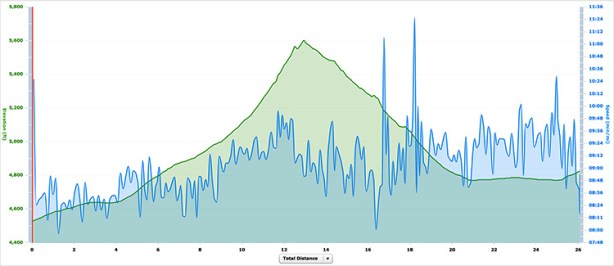
Elevation profile for E.T. Full Moon Midnight Marathon 2013

Back to the Nevada desert, and after five miles of what felt like comfortably strong pacing on a slight uphill, the highway began a more pronounced ascent that seemed to steepen once I passed the mile 11 marker.  I knew from the course profile that this ascent – a climb from 4,523ft at the start to just over 5,600ft climb at mile 12.8 – would be the “gut check” miles, after which the course would change trajectory and carry us back downhill to mile 20 (and for half marathoners, the finish line).

Somewhere near mile 9, I began to pass the brightly lit and colorfully costumed back-of-the-pack half marathoners, a welcome distraction from the dark and quiet sameness of the first eight miles.  I allowed myself a celebratory moment as I passed the double-digit mark at mile 10, and continued to maintain a solid pace as I chugged up the hill, the density of half marathoners increasing as I neared the summit.

As I reached the peak at Coyote Summit, the course changed trajectory, and my downhill muscle groups gradually awakened to the joys of eccentric loading.  Two other runners flew by me on the right and were quickly engulfed by darkness.  At the same time I struggled to pull back on the reins and control my downward momentum after 13 miles of uphill running.  Somewhere along the way I made my second aid station pitstop of the night for water, thanked the faceless volunteers, and before I knew it the mile 16 marker was bathed in the harsh glow of my headlamp.  Halfway home!  Despite the 13-mile ascent in my rearview mirror, I knew the second half of this 51K would be the toughest, as carbohydrate stores ran low and muscle fatigue set in.

I had no way of knowing that a mile later, I’d be longing for the simple discomforts of lactic acid buildup and carbohydrate depletion.

Katie after finishing E.T. Full Moon 10k

Triumphant 10K’er and alien bounty hunter Katie flashes her latest prey

Where ankles fear to tread (Down but not out)
Soon I crossed the first of two cattle guards, the left edge of which was covered with a slender wooden plank to allow runners across.  I consider cattle guards a necessary evil… several can be found along the Nimitz Way trail in Berkeley’s Tilden Regional Park, and they’re the single biggest downside to trail running in Tilden.  I’d hoped never to run across another cattle guard after leaving Berkeley – and now I remember why.

The second cattle guard appeared in the vicinity of mile 17.  A reflective sign just before the guard warned of its existence, and I prepared to cross the wooden board in the same place as the first guard.  Except the board wasn’t there, and my brain momentarily hiccuped as it registered that the board – roughly the same rust color as the guard – was displaced a couple of feet to the right relative to the first guard.  I planted my left foot and cut sharply to my right in order to access the board and negotiate the guard.

And that was when my ankle – as well as my race – took a literal turn for the worst.

I’m no stranger to sprained ankles.  Indeed, the sprained left ankle has been the bane of my running existence since high school basketball, and I’m well versed in the pain and shock that follow a tweaked ankle.  I am, literally and figuratively, a loyal alum of RICE (Rest, Ice, Compression, Elevation) University (go Owls!).  But it had been at least two years since I’d last sprained an ankle, and I’d hoped that all my ankle strengthening exercises had signaled an end to the familiar treatment regimen that had become almost second nature.

The Little A'Le'Inn, a Rachel NV landmark, served as finish line for E.T. Full Moon Midnight Marathon

The Little A’Le’Inn, a Rachel landmark, awaits runners on the other side of the finish line

Given my history of ankle injuries, I knew I was in trouble even before I hit the ground on the opposite side of the cattle guard.  But for the sake of both race and psyche my pride kicked in, and I immediately transitioned into denial mode, telling myself to “rub some dirt on it!” (coach speak) while at the same time trying to convince myself that 15 more miles was eminently do-able.  As much as I wanted to hop over to the side of the road and collapse in a bitter heap, I knew from experience what the consequences of that decision would be – if I were to stop running even momentarily, the ankle would rapidly swell, I’d be unable to put any weight on it, and…

Through the rapidly descending fog of swirling emotions – pain wrapped in anger, swathed in disgust and shrouded in uncertainty – the decision was an easy one.  I hadn’t driven over five hours by car, ridden another 2.5 hours by bus and completed 17 miles including 13 uphill, just so I could go home with my first-ever DNF (Did Not Finish).  Truth be told, I still cringe at the thought of my tendinitis-induced DNS (Did Not Start) at Leadville last summer.  No, I’d come to run.  And barring the ankle coming detached from my leg and rolling off into the sagebrush, I planned to run across that finish line under my own power.

At the same time, I did intend to run – I had no interest in watching slower runners pass me by as I ambled along in “race-saver” mode and eventually finished well off my prerace goal of five hours.  So as I fought my way forward, I focused all my remaining energy on maintaining my ~9:00/mile pace.

I rationalized my decision to continue by telling myself that I couldn’t very well stop running and just lie on the side of the road, staring at the stars and elevating my ankle until someone found me and drove me to the finish line.  But as I concentrated on my footfall one uncomfortable step at a time, the conflicted voices in my head each argued its case, until finally my self-preservationist side struck a deal with my competitive side: I’d run the race, and I’d finish the race, but the race I’d run and finish would be the marathon, not the 51K.  The marathon, to my mind, seemed a perfectly reasonable endpoint and the ideal compromise.  And admittedly, I shed not a single tear at the realization that I wouldn’t have to run an extra 5.5 mind-numbing asphalt miles in the dark.

Hangin' with the locals at the Little A'Le'Inn in Rachel, NV

Hangin’ with the locals at the Little A’Le’Inn

In any case, this would be a different sort of challenge than any I’d faced before.  And from the moment I staggered to my feet on the far side of that cattle guard, the tiresome distraction of running along a desert highway under a full moon gave way to a single-minded determination to keep going, to maintain pace, and to avoid another glitch.  I had no idea how stable my ankle was or how long it would allow me to continue this charade.  Worst case scenario would be the ankle calling it quits far from the finish, thereby ensuring a DNF and leaving me an easy target for an alien tractor beam.  At the same time, I tried to find and focus on this cloud’s silver lining: Sure every step is painful… but at least it’s a consistent, reliable pain.  Ok, so maybe more of a lead lining?

The unanticipated shock to my system also sent my in-race nutritional strategy out the window.  My stomach was now in such upheaval that it was all I could do to stomach the occasional swallow from my bottle… and I knew I wouldn’t be needing any of the gels I’d brought along.

Reaching the brightly lit mile 20 marker, where the half marathoners turned in to the finish line, my headlamp momentarily blinded Katie, who was waiting on the side of the road to cheer me along.  Being careful to let neither face nor gait betray my discomfort, I quickly informed her I’d decided to drop down to the marathon distance.  She nodded in perplexed agreement, wished me good luck and off I went, one painful 10K out-and-back standing between me and rapture – as well as the blowback from one very pissed-off appendage.

Those final 6.2 miles were a hardcore lesson in perseverance, and I would have sworn that a sandbag now hung from my left knee.  But as the field thinned out and the blackness of my surroundings became more complete, I was able to admire and appreciate the stunning celestial landscape that filled the canvas of the eastern sky.  At last, here was the argument to be made for running in Rachel.  The last 6 miles of a marathon is a difficult time to focus on anything, let alone our place in the universe, but only in Southern Utah and Yosemite National Park could I ever recall my naked eye wielding such power over the night sky.  Keep going, the questionably supportive voices implored.  You’re almost there.

Slowly, in what felt like the running equivalent of water torture, each successive mile ticked by (did those mile markers keep moving back?), as the heaviness in my ankle diffused up my leg and into my entire body.  This was a very different “wall” than I’d hit in any previous race, but even so it was a wall… my brain knew it, my body knew it, and only a finish line at this point would shut them both up.  And then it’s there, in the distance, undeniable and unwavering, a life-affirming beacon that draws closer with every edema-inducing step – my wish being granted.
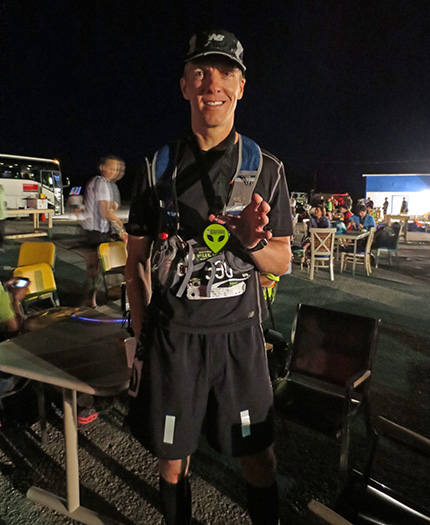
Mike Sohaskey with his hard-earned medal after finishing E.T. Full Moon Midnight Marathon 2013

Ow my ankle ow my ankle – oh, is it picture time? No problem!

Clearly they see it too, because the voices now are impossible to ignore.  Once a barely perceptible pinpoint in the distance, the dazzling and ever-expanding glow that beckons on the horizon now threatens – no, promises – to vanquish the seemingly infinite darkness of the Nevada desert.  And the voices heed its call, compelling me onward like a single-minded moth toward a seductive flame.  Move forward, into the Light, the all-knowing all-seeing all-caring Light….

As the eventual 51K winner glides by me looking very much the gazelle that he is, I momentarily entertain the thought of chasing down the marathoner roughly 20 yards ahead of me.  Stupid thought, I decide… what if he or she wants to race me to the finish?  A shredded ankle and public humiliation, in one fell swoop!  I must have sprained my brain on that cattle guard, too.

Release your tension, confront your pain, let Its radiance guide you, yes that’s it! feel Its warmth sustain you, Its compassion embrace you, Its omnipotence protect you….  Gingerly I make the right turn off the Extraterrestrial Highway, and 20 yards later I’m crossing the blue finish line mat, that symbolic threshold from dark into light.  At the same time, I’m wholly surrendering both mind and body to the indescribable relief that floods every synapse.  “3:56:40,” silently announces the impassive red-numbered clock timer above the finish line, in agreement with my Garmin.  So at least I’ve avoided any “missing time” from a UFO encounter or alien abduction.

Squinting into the soft resplendence of finish-line lighting, my gaze is met by an unblinking pair of impassive black eyes set in a featureless green, unside-down teardrop of a face.  Certainly the face isn’t human, nor had I expected it to be.  Yet fear, like darkness, has no place here.  Gratefully I accept the alien-head medal presented to me, and surrender the timing chip on my shoe to a second volunteer.  The wide, expressionless eyes on the medal gaze silently up at me while the soothing voices in my head continue to reassure me – Welcome home, your long journey’s over, it’s time to heal.  My outstretched hand gently caresses the otherworldly face in an awkward mix of exhaustion and wonderment.  Was it worth it? I ask myself in that same moment, though I have no doubt it was.  I step forward unsteadily, into the light and beyond.

Nothing could be finer than to see the finish line-a in the morning
(with a tip of the cap to Gus Kahn and Walter Donaldson)

What happens in Rachel…
As usual, Katie’s smiling face and boisterous cheers greeted me as I crossed the finish line.  She’d had a strong race of her own, running the entire 10K and surpassing her goal of 80 minutes with a finish time of 1:16:51.  Given the darkness, the warm conditions and the fact that she hadn’t run as much as four miles since 2011, it was an impressive performance.  And she admitted to being glad she’d run, rather than riding the bus as a spectator or even staying behind in Vegas.

She couldn’t have been as glad as I was.  Because I knew that for my crippled ankle, what happened in Rachel would not stay in Rachel.  After letting the official timer know I’d dropped from the 51K to the marathon, I confessed my predicament to Katie and hobbled over to the folding tables set up in the finish area just outside the Little A’Le’Inn (say it aloud), a three-room motel, souvenir shop and restaurant that serves as the hub of Rachel’s tourist traffic.  And there I collapsed in a chair, where highly competent EMTs mobilized by Katie wrapped my foot and ankle in a large ice pack held awkwardly in place by several iterations of tape.  The human body, it occurred to me as they worked, isn’t conveniently built for icing.  Thanks again, fellas!  Much appreciated.

After 20 minutes I removed the ice pack and, in an effort to increase my comfort level, lay flat on my back on the graveled concrete with my ankle propped up on a chair.  The ankle was now throbbing aggressively – even the most short-lived comfort was illusory, and I being to shiver violently in a brutal mix of residual chill from the ice pack, and shock at the damage I’d knowingly inflicted on myself.  Now the voices in my head, once encouraging, began to abandon their sinking ship.  WHAT THE HELL WERE YOU THINKING? they demanded.  They had a right to know, though unfortunately I had no good answer.

As I lay on the ground listening to the sounds of finish line celebrations and reunions all around me, Katie brought me Gatorade and took pictures, and I discovered two pieces of uplifting news on an otherwise dark and emotionally stormy night.  First, the pain and swelling in my ankle were largely confined to the lateral (outer) rather than the usual medial (inner) side, meaning my diligently strengthened ankle hadn’t simply betrayed me to the same injury I’d suffered so many times before.  No, the “good” news was that I’d injured the ankle in a whole new way!  And second, I’d managed to maintain a respectable 9:23/mile pace after spraining the ankle (8:54/mile before), enabling me to finish 12th overall and second in the men’s 40-49 age group.

You had to know this picture was coming

You had to know this picture was coming

Despite Katie’s positive review, my bitterly uncooperative stomach wanted nothing to do with the Little A’Le’Inn’s postrace breakfast buffet.  Even more telling, on the bus ride back to Vegas it would take me 15 minutes to finish a single banana, in contrast to my usual 15 seconds.  Clearly postrace nutrition was going to be an issue.  Fortunately I’d done a solid job of prerace carbo loading, which very likely carried me through those final miles as I tried to find my happy place.

From my vantage point on my back, I heard Joyce announce fellow Antarctica traveller Rich Ehrlich as the winner of the men’s 60-69 age group in 5:07:35.  Congrats, Rich!  And then it was time to board the bus for Vegas.  Awkwardly pulling myself up off the ground, and now unable to put any weight on the ankle, I relied first on Katie and then on a benevolent volunteer to help me over to and up the steps of the bus.

Thus began the long and sleepy-eyed ride back to Vegas, the calico hills now peacefully rendered in the first golden rays of the rising sun.  While many passengers quickly assumed the “eyes closed, mouth open” position, I spent the better part of the ride trying to elevate my ankle and alleviate discomfort, which required monopolizing my personal space and (with her permission) most of Katie’s.

We entered the Las Vegas city limits just before 8:00am, though even at that early hour suffocating heat already blanketed the city.  The combination of stifling heat, mounting fatigue and still-throbbing ankle sent waves of exhaustion washing over me… or maybe that was just my body’s reaction to being back in Vegas.

Luckily we were able, on our second try, to find an open CVS that stocked crutches, enabling me to regain mobility for the rest of the day.  Sort of.  Because I was quickly reminded of another Vegas exclusive: with everything spaced so far apart, it takes forever for an individual with two healthy ankles to get from their hotel room, through the smoke-filled casino and to their destination.  This maze-like arrangement makes Vegas a decidedly subpar place to be handicapped.

We were treated to quite an electrical storm on our drive home

And so, after a clumsy but long-overdue shower, a visit to the Caesar’s Palace brunch buffet (itself nearly a mile long) and a five-hour nap, we decided to take advantage of our bewildered circadian rhythms, plus the lack of heat and traffic, and make the drive back to Los Angeles under cover of darkness.  Four hours and several impressive lightning storms later, we pulled into our garage in Marina del Rey.  Crutching my way slowly up the steps of our multi-level townhouse, I collapsed in our bed with my ankle supported by three pillows.  As consciousness faded, the Nevada desert and Area 51 suddenly seemed light-years away.

As I write this ten days later, the swelling in my ankle has subsided and the remaining soreness is gradually fading.  The foot and ankle feel stable, and I have no trouble balancing on them for two minutes at a time.  I plan to try running again next week.  In the final analysis, I guess all’s well that ends swell.

I’m proud that I was able to grit my teeth and gut out my toughest marathon yet, while still finishing in under four hours and placing well within the top 10% of finishers, including second in my age group.  And I’m satisfied with knowing I gave everything I had to give, and left it all out in the Nevada desert.  Would I have broken five hours if I’d had the chance to finish the 51K healthy?  And would I have run a faster marathon if I’d been pacing accordingly for the entire race?  “Likely” and “probably” would be my answers, although the frustration of not knowing will forever gnaw at the back of my mind.

After all, the truth is still out there.
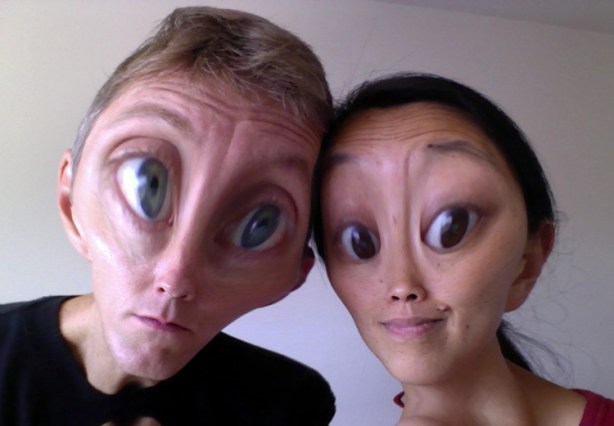
Trust us, all those stories about extraterrestrials in Area 51 are just silly mythology.

PRODUCTION:  Joyce and her Calico crew did a terrific job of bringing together and pulling off what has to be a very difficult-to-organize race.  Coordinating the bus schedule alone would have addled my brain, and yet to my knowledge, all four races went off without a hitch.  Calico’s blend of detail-oriented professionalism and low-key vibe lent the race a much-appreciated “trail running” feel.  The t-shirts (from Greenlayer Sports) fit nicely, and the eye-catching, glow-in-the-dark medal is definitely a collector’s item.  As far as food, Katie gave the postrace buffet at the Little A’Le’Inn a thumbs-up.

Not surprisingly, my main recommendation for future races would be to COMPLETELY cover each cattle guard to ensure safe footing.  This shouldn’t be difficult, and if it spares even one runner’s ankle will be well worth the effort.  My only other disappointment – and even that may be too strong a word – would be in the choice of Hammer as the lead sponsor.  But much better Hammer than no sponsor at all, and my aversion to their products (particularly HEED) is simply personal preference.  Unfortunately my limited postrace mobility prevented me from properly thanking Joyce and all her superb volunteers, but I’ll do so here (thanks, Joyce! thanks, volunteers!) and look forward to running with the Calico crew again soon.  Even if it does mean another stopover in beautiful Las Vegas.

BOTTOM LINE:  Chuck summed it up best in his postrace text: I had a swell time at the E.T. Full Moon Midnight Marathon.  I have to admit that even with a healthy ankle, running on asphalt for several hours in uninterrupted darkness before and after a 2.5-hour bus ride isn’t my ideal racing scenario.  But I’m glad I ran in Rachel, for the novelty as well as the opportunity to run with Calico Racing.  If you’re intrigued by the prospect of running by moonlight, I can’t imagine a better place to do so than Area 51, or a better crew to do it with than Calico.

For an inspiring perspective on running through injury, or if you tend toward schadenfreude, check out Dan’s recent experience at the North Country Run 50-Miler.

E.T. Full Moon Midnight Marathon medal (glow-in-the-dark)

The E.T. medal moonlights as a night-light

FINAL STATS:
August 18, 2013
26.09 miles (the final 9+ miles on a sprained left ankle) in Rachel, NV (State 4 of 50)
Finish time & pace: 3:56:40 (first time running the E.T. Full Moon Midnight Marathon), 9:04/mile
Finish place: 12/141 overall, 2/20 in M(40-49) age group
Race weather: clear, dry and warm (starting temp 88°F), with an intermittent cool breeze
Elevation change (Garmin Connect software): 1,129ft ascent, 843ft descent (starting elevation 4,523ft)


I credit my speedy mile 21 to the adrenaline spike from a Katie sighting

A ship in harbour is safe, but that is not what ships are built for.
– William Shedd

Continued from Act 1:

The 14th Antarctica Marathon (Saturday, March 30)
Race morning arrived in the usual manner, with Andrew’s comforting voice reminding us over the Vavilov‘s PA that it was time to run a marathon on the coldest, highest, driest, darkest and windiest continent on Earth.  Hooray!  Fortunately the day promised to be optimal (in the Antarctica sense of the word), with temperatures hovering around a balmy -5°C (23°F).  More importantly though, wind speed was a near-negligible 12 knots (14 mph), assuaging my concerns that I’d be stumbling 13.1 miles through an unforgiving headwind (and the other 13.1 with a brisk tailwind).

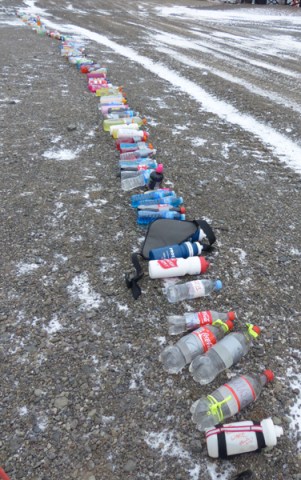
I inventoried my gear one last time.  All race-day nutrients – energy bars, gels, etc. – had to be removed from their original packaging and all paper wrappers left on the ship, in accordance with the 1991 Protocol on Environmental Protection to the Antarctic Treaty.  This wasn’t a problem, since for convenience sake I always liquify my race-day nutrition in my water bottle.  Per Thom’s instructions I’d prepared two such bottles, which I planned to leave at the start/finish area.

In a dining hall alive with the clatter of breakfast dishes and the buzz of pre-race jitters, I waited as long as possible to eat my usual stomach-sanctioned meal of granola and peanut butter, which I’d brought with me from California.  Several steps stood between us and the starting gun – the donning of the tomato-red Wet Skins that would keep us warm and dry, the loading of the zodiacs, the short ride to King George Island, the process of funneling everyone from zodiac to start line – and with 4+ hours of running ahead of me, I wanted to maximize the nutritional payback of my carefully choreographed breakfast.

blue iceberg

The first zodiacs launched at 7:15am, with 12 passengers per zodiac.  After a short 5-minute ride under gray skies and across smooth water, we beached near Bellingshausen Station and stepped ashore for the first time in 3½ days.  Two Gentoo penguins splished and splashed in the water nearby.  Stepping out of my Wet Suit, I could still feel the ground swaying underfoot as I tried to coax out my land legs.  Moreover, the residual effects of the Transderm patch that I’d removed 36 hours earlier continued to wreak havoc on my short-range vision.  Discomforting as my still-dilated pupils were, I was confident they wouldn’t upset my ability to run in a straight line for several hours.

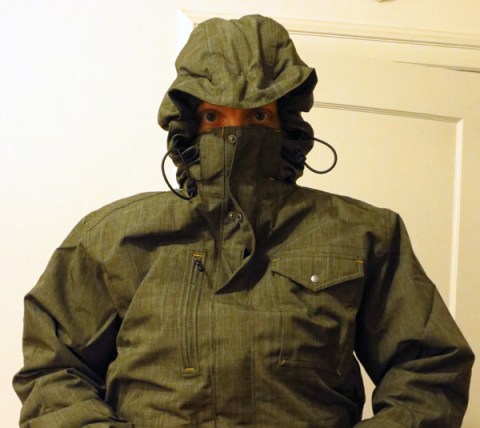
How does a warm-weather Californian train for a marathon in Antarctica?  Much as I hate to divulge trade secrets, here it is: I bought stuff.  More specifically, windproof stuff.  Compared to my typical all-season California running attire, I felt like the Stay-Puft Marshmallow Man in my three upper-body layers (REI wool base layer, synthetic Under Armour mid-layer, Columbia wind- and waterproof outer jacket) and two lower-body layers (REI fleece-lined tights, Pearl Izumi lightweight running pants), plus balaclava that I was hoping to shed early in the race.

Talk about happy feet… Rich’s own have carried him through over 300 marathons

Katie – who as a spectator would be doubling as a volunteer – was even more polar-ready, given that she’d be standing around for an indeterminate amount of time.  She wisely wore her Wet Suit and rubber boots at all times, together with her Arctic Parka from The North Face that was so down-filled and poofy, I entertained the thought of hanging bricks from her sleeves so she wouldn’t blow away.

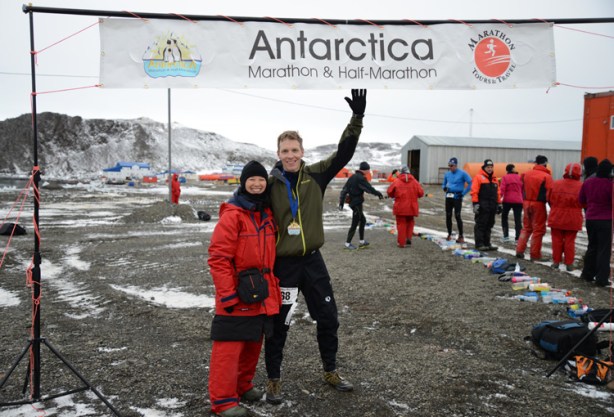
As Thom announced two minutes to start, the One Ocean crew hurriedly set up plastic buckets lined with green trash bags to serve as makeshift latrines.  Fortunately I’d been able to attend to my most pressing needs on the ship, and after a lightning-quick stop at the latrine I jogged to the start line.  For many of the bundled-up runners gathered beneath it, the unassuming white canvas banner represented the culmination of a lifetime of marathon-inspired blood, sweat and tears (with more to come).  For others of us, this would be continent #2.  And for two runners, this would be their first marathon on any continent.

This is how I envision an Antarctica Walmart on Black Friday (footage courtesy of Anita Allen of Marathon Tours):

http://www.youtube.com/watch?v=bjgsbkDg2kM&feature=youtu.be

Regardless of what road you’d taken to get there, Thom’s starting-gun cry of “GO!” triggered a collective release of whole-body tension, as the slow-moving stampede of runners – including members of the Russian and Uruguayan bases – followed the leaders along the dirt and up the initial ascent.  And almost immediately, I dismissed all thoughts of a sub-4:00 finish.  The first mile (which, given the course layout, we would be running six times) was an absolute mess.  This was trail running at its damnedest.  The deep, hardened ruts carved by the Bellingshausen ATVs, combined with the sporadic patches of ice, brought to mind the frozen-over ribcage of a recently excavated T. Rex.

Footing in places was unpredictable at best.  Trail running typically demands that your eyes constantly scan the ground two steps ahead for your next foothold.  But on King George Island, it also became necessary to anticipate several steps beyond that, as the course at several points became an exercise in “Choose Your Own Adventure”: foot-deep powdered snow to your left, slushy ice straight ahead or a seemingly frozen-over stretch to your right.  The demand for constant vigilance gradually took a mental and physical toll and led to lapses in attention, resulting in either (best-case scenario) choosing the more difficult and treacherous route, or (worst-case scenario) a hard and jarring fall on slick rocky terrain.

Mike Sohaskey running Antarctica Marathon 2013

Just a boy and his balaclava, out for a springtime jog

And fall people did: this edition of the Antarctica Marathon might appropriately have been subtitled “There Will Be Blood”.  Many runners fell multiple times, sustaining scrapes and bruises of varying severity.  Two women broke their falls with their faces, yet soldiered on with impressive battle wounds that testified to their toughness.  And post-race rumors circulated that one runner had even suffered broken ribs (yes, plural).  I was among the fortunate few to speak of “fall” rather than “falls” – I got too aggressive and lost my footing during my second loop of that first out-and-back, landing on my backside and bouncing right back up again.  No blood, no foul.  But in homage to March Madness going on back in the states, I adopted a mantra of “survive and advance” that served me well at all remaining icy stretches.

Although the prevailing concern had been shoe-sucking stretches of gooey mud, as it turned out postponing the trip until late March (i.e. closer to winter) meant that most of the would-be muddy bits were now iced over.  Every once in a while I’d hit a slushy patch and submerge my foot, though fortunately wet feet never became a concern.  I think by mile 4, most runners – myself included – gladly would have swapped the ice we had for the mud we didn’t.

Whether it was due to the half-week spent on the ship, or my racing in lower-body layers for the first time ever, I could quickly tell that on this day my legs wouldn’t be their trail-running best.  Fortunately I wouldn’t need them to be – this wasn’t the Chicago Marathon, and the only PR to come out of this day would be Thom’s post-race press release.  I’d run (and specifically trained) on tired legs many times before… the question wasn’t whether I’d finish, it was whether I’d do so before the other 40-something-year-old males on the course.

Alan&Inez

(Top) Overall winner Alan Nawoj leads the way up another icy hill (photo credit Anita Allen);
(Bottom) Third-place finisher & women’s champ Inez Haagen appropriately sports bib #1

Whereas the first 4+ mile stretch out to the Uruguayan base and back was fairly brutal (though with a striking glacier view to distract the mind), the second out-and-back was much more manageable.  After a mile or so of smooth footing on dirt, a series of undulating hills led past the Chilean base and out to the second turnaround near the Chinese base, where yoga guru Liz sat waiting to cheer us on.  Her enthusiasm was a welcome pick-me-up.

With one iteration of the course under my belt, I shed my balaclava and passed through the start/finish area to a chorus of cheers from the most amazing volunteer contingent on the continent.  And as soon as I began my second ascent of that first nasty hill, the assorted aches and pains that had nagged me throughout the first nine miles faded – the lifelessness in my legs, the tightness in my left adductor, the overstretching of my arch that comes and goes in my Merrell Mix Masters.  Even the Patch-induced fog around my head lifted… maybe I’d succeeded in sweating out the residual scopolamine.  In any case, it all vanished.  And finally I was back to doing what I do – I was running.  On rugged trails, and up and down hills.  In one of the most mythical and breathtaking places on the planet.  Life was good.

Gentoo-men, start your engines!  Footage with narration by Martin Evans on the marathon course (thanks, Martin!):

http://www.youtube.com/watch?v=OduzW_Xi1Co&feature=youtu.be

Not that I was running every step with my arms raised and fists pumped.  To be sure, I was enjoying and appreciating the scenery of the course, stopping briefly to breathe in the views and snap a few photos along the first two out-and-backs.  But other runners did a much better job of flipping their switch to carpe diem mode.  Luckily the course layout was motivating for the frequent opportunities it afforded me to see my fellow runners.  Because everyone seemed to be having (cue Dirty Dancing soundtrack) the time of their lives – even the lead runners greeted passing runners with a smile and a wave.  Although in passing, I did overhear one of several marathoners with a cold-weather Canadian pedigree admit, “I wish I could fast-forward the next three hours.”

Some fatigued runners inevitably narrowed their focus later in the race to conserve energy; after the 17-mile mark, for example, I acknowledged and encouraged everyone I passed with the same silent thumbs-up.  But a surprising number of runners I passed during my final out-and-backs still looked like kids riding a roller coaster for the first time – eyes wide, arms raised, huge grins seemingly painted Joker-style across their faces (Why so serious?, their body language seemed to ask).  I admired and respected their live-in-the-moment mindset, in part because I couldn’t relate to it.  The faster I run a race the more I enjoy it, with few exceptions (I can’t think of one right now).  My overall enjoyment of a race is, in large part, a function of how long it takes me to get to the finish line.  I realize expectations change, often in ways we can’t predict, and I know it won’t always be this way… but for now it is.  I can live with that.

We interrupt this running program for some polar humor

Regardless of continent, no trail race would feel official without my taking a wrong turn.  Despite Thom’s clear warnings to stay watchful for arrow signs and not blindly follow the person ahead of us, I unwittingly slipped into auto-pilot mode during mile 14 and blindly followed the person ahead of me.  Ginger, who had recently passed me and was running a strong race, blew by the Chilean airstrip and had almost reached the base itself before realizing that neither the Chilean airstrip nor that large red building on her left was part of the course.  I’d just reached the airstrip when she turned to look over her shoulder, and I gestured in sweeping windmill-type motions for her to turn around.  Fortunately she did, and as I reversed course I saw yet another runner on auto-pilot heading our way.  Retracing my steps to the suspect turn, I continued on my way and within minutes was passed by Ginger again, this time for good.

And that’s how I turned this into my own personal 26.5-mile Antarctica Ultramarathon.  And yes, there was a runner named Ginger on Gilligan’s ship, as well as at least one (assistant) professor.

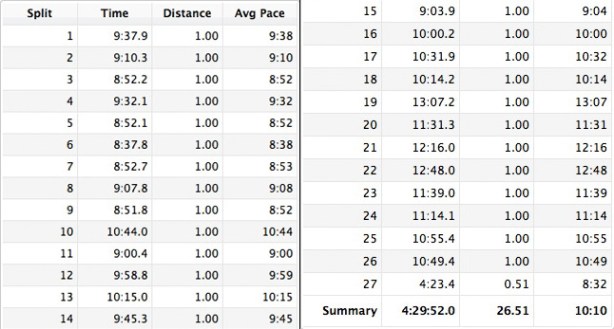
By my third time around the course the temperature had begun to drop, and the icy uphill stretches along miles 18 and 19 had refrozen and become even trickier to negotiate.  This third out-and-back to the Uruguayan base was the low point of my race, as reflected by the uninspired 13:07 it took me to complete mile 19.  Did you run in Crocs?, I could hear the peanut gallery back home asking.

Official "aid station" for Antarctica Marathon 2013

The official Last Marathon aid station

Once I passed through the start/finish area for the final time and approached mile 22, I could see – check that, feel – the light at the end of this tunnel.  As the course approached its final uphill at mile 24.5, I was able to push the pace enough to pass two runners (was he in my age group?) who looked – as I had felt 5 miles earlier – to be running out of gas.  Surging down the final stretch past the Russian base, I felt that unmistakable sensation of “This is why I run” wash over me as Katie and her fantastic fellow supporters cheered me across the finish line in a time of 4:29:50.

The raw, electric thrill of accomplishment overwhelmed me as I embraced Katie and then my fellow Mike from California, with whom I’d trained in Buenos Aires and who had run an inspired race, finishing fifth overall in a time of 4:20:26.  One of the younger volunteers handed me a medal still folded up in its plastic bag, which was perfectly fine with me – by that point he could have handed me a lump of frozen penguin guano and I would have thanked him giddily.

Mike Sohaskey finishing Antarctica Marathon 2013

Lookin’ for someone to hug after just missing a Boston qualifier by a mere 1:14:50

After hanging around the finish area to bask in the moment, take a few photos and cheer across the next two finishers, Thom encouraged me to change out of my wet running gear and into dry clothes.  And as soon as I pulled on a dry base layer, I could feel my body temperature start to drop.  My shiver reflex kicked in, and the feeling drained from my fingers and toes as I hurried to don my cold-weather gear.  Ewan of the One Ocean crew sprang into action, jamming hand warmers into my gloves, zipping me into my parka and Wet Suit (since my fingers had lost all dexterity), and directing Katie and me to a waiting zodiac.  As I’d later learn, Thom and the One Ocean staff were carefully monitoring all finishers after marathon winner Alan and runner-up Billy each ended up in the Russian medical tent with hypothermia.

Whether it was the warm glow of accomplishment, or more likely the dry clothes and hand warmers, by the time the zodiac reached the ship my body temperature had self-regulated.  Maybe, as I’ve referenced before, I really am chasing the endorphin dragon.  But if I could just bottle the pride and elation that gripped me as I crossed that finish line….

Instead, I settled for five blissful minutes in the Vavilov sauna, followed by a hot shower that, if it didn’t quite bring me back to life, at least made me feel a lot less undead.

Mike Sohaskey and Katie Ho at finish line of Antarctica Marathon 2013

Admittedly I was too euphoric to check, but I’m pretty sure that’s Katie inside that Antarctic sumo suit
(photo credit Anita Allen)

The Vavilov continued its spiritual rebirth as more and more runners returned with stories to tell, memories to share, and wounds to heal.  Some of these wounds would be psychological, as with the dozen or so runners who found themselves unable to complete the marathon and were credited with the half marathon instead.  And 78-year-old Wes, appropriately fearful of falling, walked off the course for the first time in his 201 marathons.  Runners – particularly runners willing to travel to the end of the earth – are understandably a proud bunch, but hopefully all bruised egos, like their physical counterparts, will heal with time.

When the dust settled, 60 of the 72 runners who started the marathon, finished.  This may sound harsh or arrogant, though that’s not my intent – but the truth is, there’s a lot to be said for a race that not everyone finishes.  Inextricably wrapped up in its unsurpassed beauty is the harsh reality that Antarctica is a brutal, unforgiving backdrop for any activity, much less a marathon.  You can admire and respect it from afar, you can agree to its singular demands, you can formulate the best-laid plan to overcome it.  But at the end of the day you don’t choose this race, it chooses you.

Joao’s prediction had been correct, of course; with the race in our stern-view mirror, the mood aboard the Vavilov lightened considerably.  But the revival wouldn’t be immediate, and the bar/lounge would masquerade as a quiet zone for one more evening while the rest of the ship surrendered itself to the inexorable force of post-marathon exhaustion.

Antarctica Marathon 2013 course elevation profile

Even without the icy patches, the undulating course would have left a lasting impression

To the victors go the handshakes: BBQ and awards ceremony (Sunday, March 31)
Official results weren’t immediately posted, so as Sunday afternoon rolled around I wasn’t sure where I’d finished overall or whether I’d placed in my age group.  I knew the top five finishers, but beyond that I was in the dark as to who finished where, much less how old anyone was.  I knew that Winter, who’d finished shortly after me, was 14 years old, but that was pretty much the extent of what I knew.

So I was looking forward to the world’s frostiest BBQ and awards ceremony that afternoon on the ship’s third deck.  The food choices – who can say no to macaroni and cheese? – were excellent, the drinks were on ice (seriously, they were on ice), and after lunch had been served Thom stepped to the microphone to present the awards.  Rather than having a prepared list of winners, he seemed to collate the overall results in his head on the fly, and there were long pauses – and the occasional incorrect winner announced – as he arranged each set of age group winners in his head before making the call.  Standing on that deck, I was glad I’d invested in a kick-ass parka.  Thanks, Patagonia.

Mike Sohaskey, winner of M(40-49) division for Antarctica Marathon 2013

Thom (center) congratulates me and Maarten Vroom (great running surname!) on winning the men’s 40-49 division

Alan Nawoj (33) from Boston was the overall marathon winner in an astonishing time of 3:29:56.  Billy Nel (27) from Australia finished second with his own crazy-fast time of 3:37:48.  And Inez Haagen (49) from the Netherlands, the first women’s finisher who has now won five marathons on five continents, rounded out the sub-4:00 finishers (and won the “non-hypothermic finishers” subdivision) with an impressive 3:41:52.  Amazingly, Inez accomplished this mind-boggling feat at age 49, a number I had to read three or four times on the overall results page and which I still don’t actually believe.  Among the runners, I particularly enjoyed watching her and Alan as we passed along the course – each has a smooth, flowing stride that even gravel-strewn patches of black ice couldn’t suppress.

Winter ran a strong race of her own, crossing the finish line in 4:49:45 and seizing the title of youngest runner to complete a marathon on the White Continent.  As such, she remains on track to conquer her larger goal of becoming the youngest runner to finish a marathon on all seven continents before she turns 15 next year.  And more importantly, she’ll raise a whole lot of money for prostate cancer research while doing it.

Despite finishing a solid hour (actually 00:59:54) behind Alan, I managed to win the men’s 40-49 age group in 4:29:50.  In fact, all three Mikes on the roster – me, Mike Hess (34) and Mike Ahrens (62) – won our age group.  ‘Tis a powerful and athletic name, that one.  As their name was called, each winner stepped to the front to receive their award: a handshake from and photo op with Thom.  This was, needless to say, the source of some playfully snide commentary from several age group winners, who’d clearly been hoping for something more, well, medal-y.

Thom with the top 3 women finishers: (left to right) Ginger, Winter and Inez

The awards ceremony culminated with the presentation of Seven Continents Club medals to those 18 marathoners and half-marathoners for whom Antarctica had been their 7th racing continent.  That was, fittingly, one proud and beaming group.  Like the Antarctica Marathon itself, the Seven Continents Club was Thom’s brainchild.  As a runner I’d known of the Club for some time, but only recently did I become truly cognizant of its existence.  My own motivation for wanting to race in Antarctica was my twin desire to (a) visit Antarctica, and (b) race in every compelling locale we visit.  The Seven Continents Club provides the appealing opportunity to race in places we’re already inclined to visit, as well as in some intriguing, out-of-the-way settings we might not otherwise consider.  I can definitely envision myself as a member of the Club someday.

The Last Great Continent (Sun – Tues, March 31 – April 2)
Once the marathon ended and the Vavilov left King George Island behind, our collective stress melted away – and for once, Antarctic thawing was a good thing.  Wes’s sweatshirt spoke for nearly everyone with its proclamation of “GOOD-BYE TENSION, HELLO PENSION”.  People animatedly recapped their race day from start to finish and swapped stories from the course.  Runner-up Billy claimed the marathon “makes Comrades look like a baby,” a comment quickly dismissed by Comrades veterans Rory and Billy’s father Pieter.  Jeff from Manhattan Beach summarized his thoughts succinctly, saying he felt “like I was beaten with a stick.”  Susan from Nova Scotia proudly labeled it her “best personal worst ever.”  And still others compared (and re-bandaged) open wounds.

For the remainder of our trip, we’d have the opportunity to stash our running shoes and immerse ourselves in Antarctica.  And for those who have yet to visit, the best description I can manage is “nature porn.” Every stark, pristine landscape looks as though it were professionally airbrushed for maximal effect – visual features, textures and lighting coalesce in seemingly unreal ways. Supreme Court Justice Potter Stewart might just as easily have been a naturalist talking about the Antarctic wilderness when he wrote, “I can’t define pornography, but I know it when I see it.”

Fournier Bay

Over the next three days we would:

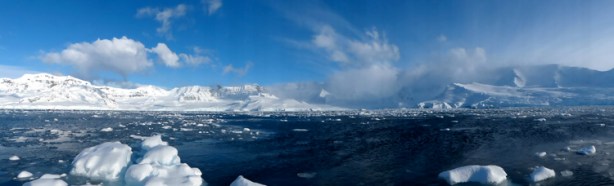
  • witness unique, dramatically lit landscapes – deep blue icebergs framed against a backdrop of solid gray skies and unblemished white peaks – that looked more like Superman’s home planet of Krypton than unspoiled nature.  Staring up from the quiet of our floating zodiac at the exquisitely oriented layers of ice and snow, it was mind-boggling to think these layers had been accumulating, building to their present-day dimensions, unperturbed for… ever?  Plus or minus a few thousand years.
  • visit Gentoo penguin rookeries (and sighted Adelie and Chinstrap penguins) in Mikkelsen Harbor and on Cuverville Island.  Like most of the group I was fascinated by these goofy-looking, -sounding and -acting birds, many of whom passed their days conserving energy while waiting – in a race against time – for their swimming feathers to replace their down covering.
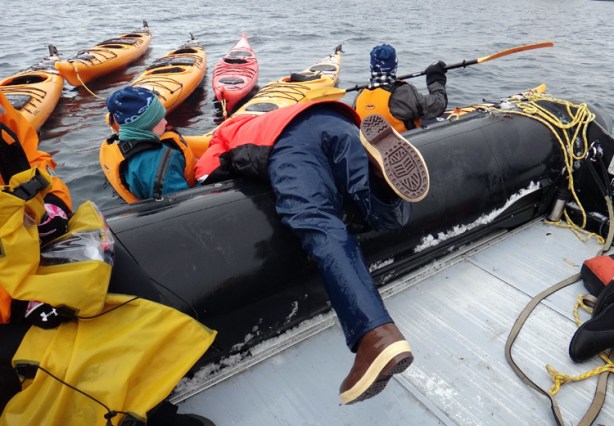
  • experience some of the most awe-inspiring moments of our lives in Neko Harbour and Fournier Bay, courtesy of breaching minke whales and several intimate encounters with humpback whales.  The humpbacks curiously chose to stay and socialize with our kayaks and zodiacs, either of which the whales easily could have flipped had they been of the mind to do so.  To appreciate the combination of power, grace and empathy that the humpback embodies, check out the video below that I filmed from our zodiac.
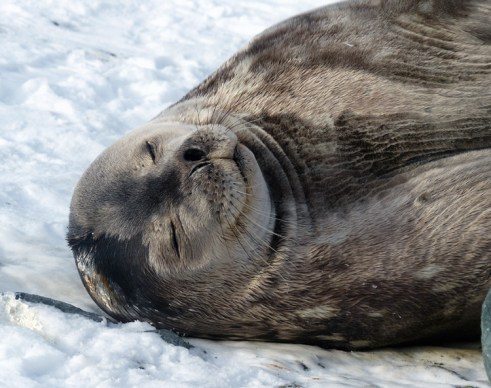
  • get up-close and personal with Weddell seals, Antarctic fur seals, crabeater seals, and even a leopard (penguin-munching) seal.  They may not get the attention afforded their whale and penguin brethren, but the Antarctic seals never ceased to amaze and amuse.
  • hear Assistant Expedition Leader Mark – check that, Maahk – entertain and fire up his audience with his account of how an encounter with a humpback whale – and looking the gentle creature right in the eye – changed his life.  Mark was like a man possessed as he told his story: he was animated, he was jazzed, he was pumped, and you couldn’t help but be inspired by his energy and sense of purpose.

http://www.youtube.com/watch?v=4LeGlQzdqTM&feature=youtu.be

Antarctica is a land so completely devoid of artificial noise – no distant voices, no traffic, no machinery, no hum of electric power lines – that you soon realize: every sound out here matters.  And it’s worth your time to listen.  No static, no background noise, only nature as it has been for thousands of years.  What you see is what you get, and if you don’t like what you see… well, Antarctica doesn’t care.  And it’s not changing for anyone.

When I say “Antarctica,” chances are you think “cold.”  And yes, admittedly it’s cold down here.  But if you’re willing to close your mouth, open your mind and embrace your insignificance, then air temperature won’t be your lasting memory of this place.  Because that’s what this continent asks of its guests: feel free to keep your muddy boots on, but leave your first-world problems at the door.  In subtle, sublime ways that extend beyond the forced reality of the Drake Passage, Antarctica is a land of shifting perspectives.

The many faces of penguins_MS

The many faces of penguins (clockwise from upper left): fat and contemplative, fat and curious, fat and proud, fat and frenzied

On the evening of our final full day in Antarctica, John Bingham hosted a live auction to benefit Oceanites, a non-profit science and educational foundation that collects data for the Antarctic Site Inventory.  Oceanites recently lost their National Science Foundation funding and one-third of their total funding when the Sequester kicked in.  All proceeds from our auction would go to benefit Oceanites, and runners answered the call with generous and in some cases above-and-beyond contributions.  John started fast at a decidedly un-penguin-like pace, kicked it into gear – “I told ’em I could have us out of here in 30 minutes!” – and in no time flat had found homes for mile markers 1, 13 and 26; the start/finish line banner; a “one-of-a-kind” (turns out there were two) nautical chart of our voyage; an author-autographed biography of Frank Wild, Ernest Shackleton’s right-hand man; and the opportunity to present the wake-up announcements over the ship’s PA on the final morning of our journey.

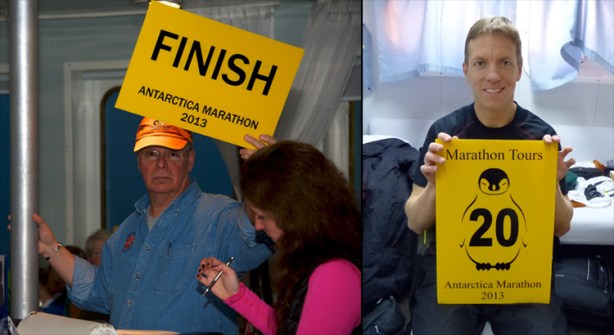
I took advantage of the silent part of the auction to score mile marker 20, a nice round number that to me signifies a key milestone in every marathon effort.

John Bingham & Mike Sohaskey at Antarctica Marathon auction for Oceanites

(Left) Auctioneer John Bingham raises money for Oceanites as Jenny Hadfield tracks the results (photo credit Maarten Vroom); (Right) The closest I’d come to taking home a penguin

Queasy come, queasy go (Wed – Fri, April 3 – 5)
During the auction and dinner that evening, the Drake Passage flexed its muscles once again as we bid the White Continent goodbye and set our sights once again on Ushuaia.  Quickly picking up where it had left off, the Drake rocked the ship with renewed ferocity – silverware clattered to the floor in the kitchen, diners had to side-step broken glass, occupied chairs slid several feet across the dining hall floor (much to the horror of the adults and the delight of the kids), and before dessert was served, half of those seated at our table had excused themselves to go lie down.

By 10:00pm the Vavilov resembled an abandoned ghost ship as people hunkered down in their cabins to ride out the “Drake Shake.”

Looking to preserve our vision during the return voyage, Katie and I both chose to forego the Transderm patch in favor of Dramamine, which worked well for me at a dose of one pill every 12 hours.  No drowsiness, no blurred vision and no seasickness.  Howl as it might outside the portholes in our cabin, the Drake would have to look elsewhere for easy prey.

Mike Sohaskey, Rory Steyn & Katie Ho on Vavilov in Antarctica

Coming together with like-minded folks like Rory, Nelson Mandela’s former chief of security and a 12-time Comrades Marathon finisher, was a highlight of the trip

But life on the Vavilov those two days was anything but comfortable.  As near-hurricane force winds buffeted the ship, the theater that played out from our front-row seats on the bridge could well have been Mother Nature’s production of “The Sound and the Fury.”  And again I felt very, very small.  Credit to the One Ocean staff, they tried to keep our minds occupied… but even if you’re not prone to motion sickness, it’s hard to keep your head in the game when the world is constantly shifting beneath your feet.  With the ship rising and falling unpredictably I felt like a human accordion: tall and stretched-out one second, short and compact the next.

But even the Drake couldn’t stifle all productivity.  Fortunately I had the opportunity during this time to sit and talk shop for a few minutes with Jenny Hadfield.  And I’m glad I did – her professional voice of experience was graciously shared and greatly appreciated.  I had questions about writing and blogging, and she shared her own story of how she’d gotten started in the exercise physiology field and had gradually transitioned to a now-successful writing career (her popular advice column “Ask Coach Jenny” offers training tips and can be found on the Runner’s World website).  She’s not only a terrific professional resource but also, like nearly everyone I met on the Vavilov, a genuine and thoughtful person.

We were all urged to submit our ten best Antarctica photos, and that evening Nate the great photographer of the One Ocean staff presented a slideshow he’d compiled (in record time) from our selected images.  Complete with its own soundtrack, the slideshow was a tour de force that alternately had the audience laughing, cheering, ooh-ing and aah-ing.  Best of all, the One Ocean staff provided each passenger with a USB jump drive containing – among other info – the slideshow, daily newsletters, staff bios, nautical briefing logs and spreadsheet of wildlife sightings from the previous ten days.  I probably should have saved myself (and you) a lot of time by just posting all the data from that jump drive in place of this recap.

They may seem bumbly fumbly stumbly on land, but… proceed to perceive a pleasing pack of porpoising penguins:

http://www.youtube.com/watch?v=2dE7v2a9gfY&feature=youtu.be

It’s been ice to meet you (Fri – Sat, April 5 – 6)
Our voyage culminated that evening with the Captain’s Dinner – salmon, hooray! – in which the Captain of the Vavilov was appropriately recognized by all and presented with a marathon finisher’s medal by Thom.  Throughout the meal glasses were raised, gratitude was expressed, egos were stroked and the microphone rarely sat silent.  Thom invited Winter to say a few words and she acquitted herself well, reminding us about Team Winter and urging everyone to commit their running to a cause important to them.

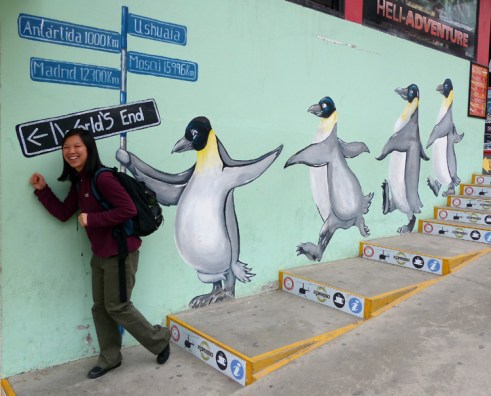
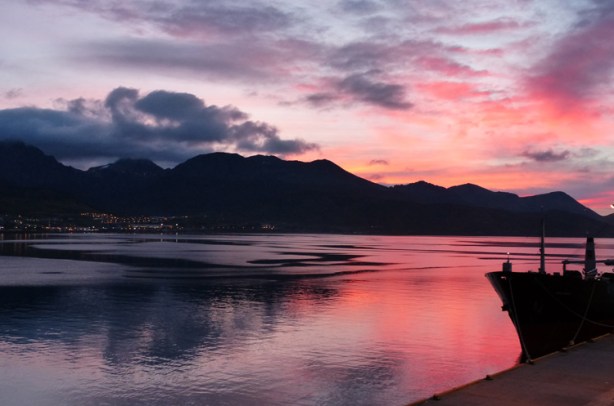
After dinner we set about trying to repack our once-efficiently crammed bags, a task that felt like trying to shove toothpaste back in the tube.  And the next morning we awoke before the sun in Ushuaia, where we began the dual process of reacclimating to civilization and saying our sentimental goodbyes.  Sadly, I realize some folks I’ll never see again, though my cyber-stalking skills will stay sharp.  But the world isn’t big enough to contain these runners’ passion for their sport, and I look forward to (pun intended) running into some of them again in other states, in other countries and on other continents.

Katie Ho leading penguin line in Ushuaia

Katie knows how to pick her running battles (Ushuaia)

Clearly Antarctica was a life-changing whirlwind of firsts and lasts.  And add one more to that list: it was the first time we’d traveled with a group of highly motivated, like-minded athletes… though hopefully it won’t be the last.  Opportunities like this one don’t knock – or in this case email – very often.  My thanks to Thom Gilligan and an anonymous iceberg with paint streaks on it floating somewhere in the Southern Ocean.

Eventually, 38 hours after last waking up on the Vavilov – and following a 3-hour delay in Ushuaia, 3½-hour flight to Buenos Aires, 4½-hour layover in Buenos Aires, 11-hour flight to Dallas/Fort Worth, 3½-hour layover in DFW (1½ hours once we cleared customs and security), 4-hour flight to San Francisco, one-hour train ride to downtown Berkeley and one-mile walk with our bags slung over our shoulders or trailing behind us – we found ourselves standing, exhausted but triumphant, on the doorstep where we’d started Mike and Katie’s excellent adventure 17 days earlier.  Climbing the short flight of stairs inside our front door, I dropped my bags on the top step and exhaled for what felt like the first time since Argentina.  Then I did what I always do when I don’t know what to do next.

I went for a run.

The sun rises over Ushuaia and sets on our Antarctica adventure

BOTTOM LINE:  Assuming I’m talking to running enthusiasts here, my summary statement is simple: run the Antarctica Marathon at least once in your life.  Unless of course you’re a compulsive type-A personality (and running attracts them like no other sport) who hates surprises, then you might want to skip this race.

It’s not an inexpensive outing, but that’s hardly surprising… you get what you pay for.

Was it the most challenging race I’ve run?  No, that distinction still belongs to last year’s sunbaked Mount Diablo Trails Challenge 50K.  But it was certainly challenging enough.  Preparation-wise, it’s important to bear in mind that the Antarctica Marathon is a bona fide trail race, which places it outside many runners’ comfort zone.  Unfortunately, if you want to race on this continent it’s not as though you have a slew of choices – you can’t just opt for the road version of the marathon.  Sensible expectations will go a long way toward optimizing your Antarctica Marathon experience.

PRODUCTION:  Thom and his Marathon Tours crew of Scott, Anita, John and Jenny did a commendable job of orchestrating all aspects of the Antarctica Marathon – from regrouping on the fly after the Great Iceberg Attack of ’13 to their near-flawless race day execution.  I certainly didn’t envy them their pre-race field trip over to King George Island to set up the course, with subfreezing gale-force winds blasting them in the face while they struggled to pound each marker stake through several inches of surface ice.  But set it up they did, and come race day the course was well marked (my own personal detour notwithstanding) and pretty much dead-on accurate at 26.2 ± 0.1 miles.

Other companies have hurried to cash in on the demand from runners seeking to run a marathon at the bottom of the world.  But no other company can boast Thom’s breadth of experience and connections in Antarctica.  At least two companies offer a one-day Antarctica experience in which they fly into King George Island, immediately organize a marathon and then fly out the same day.  To me that would feel like scoring tickets to the Super Bowl, showing up at the stadium and then watching the game on the TVs in the concourse.  Sure you could say you were there… but were you really there?

Apparently my expert editor on all things Antarctica grew tired of penguin pictures

My main critique of the Antarctica race experience would be the post-race awards.  For example, the finisher’s medal should vary from year to year, and should always include the year of the race (or barring that, complementary engraving on the back of the medal that includes name, finish time and year).  There’s no excuse for the fact that the Antarctica Marathon medal has remained the same for at least six straight years now (dating back to the image I found online of the same medal from the 2008 race).  This is particularly true when you’re hosting a group of dedicated, goal-oriented runners, many of them 50 States/Seven Continents Club members for whom race bling is all-important, and deservedly so.

In addition, it would be nice if age-group winners merited distinct medals – for example, a penguin holding up one flipper or two to signify first or second place – to accompany the handshake and photo-op that currently await them. I’d be happy to receive one retroactively.  I feel like these are easily implemented suggestions that would enhance the race experience, even in Antarctica.

UPDATE (15 May 2013): As a runner hell-bent on maintaining forward progress no matter what, I rarely back-pedal… but in this case I’m happy to make an exception.  Yesterday I received in the mail – no doubt delayed in transit because we recently moved – a stylish plaque emblazoned with the Antarctica Marathon logo and engraved to commemorate my first-place finish in the men’s 40-49 age group.  Clearly I had no idea of this impending accolade when I wrote the above sentiment, and I certainly understand why the Marathon Tours crew wouldn’t want to lug 100 race medals plus roughly two dozen plaques down to Antarctica.  And so I stand appreciatively corrected.

Overall, given their professionalism and intimate knowledge of the running community, together with their catalog of compelling international marathons, I look forward to traveling with Thom and his Marathon Tours crew again.

Liz of OOE secures a kayaker, then requests a rowing implement with the order to “Paddle me!”

But in the end, the One Ocean Expeditions staff (and the largely unseen Russian crew members of the Vavilov) were the stars of this show.  Andrew and his 12-person staff did everything in their power to ensure our Antarctica experience met – and in most cases exceeded – expectations.  Without exception, every member of the OOE staff was highly competent, professional, knowledgeable, experienced, entertaining, happy to answer questions and just plain fun to be around.  Granted I haven’t traveled to Antarctica with any other cruise company, but I can recommend OOE without reservation.  Based on conversations with and body language of other passengers, I’m confident the vast majority would echo my thoughts.

As with any successful race, the volunteers were a key element of the Antarctica Marathon.  No doubt I wasn’t the most happy-go-lucky and responsive runner out on the course – and they had to see me six times in my 4½ hours – but Kathy and her crew (Katie, Sharon, Sally, Wayne and company) stood by the start/finish line for the ENTIRE race, and were there to cheer emphatically and shout their support after every out-and-back.  I never dreamed that Katie would willingly – and dare I say happily – stand idly outside in Antarctica for five hours.  Yet there she was, smiling broadly and cheering loudly every time I passed.  Kudos to her solid layering strategery, Arctic Parka and Wet Skin for keeping her toasty and for inspiring that kind of gumption.

Rating the Antarctica Marathon experience based on the race t-shirt feels a bit like rating a 5-star restaurant based on the embroidery of the napkins.  But since I’m clearly not one to cut corners in recapping a race, here goes:  the t-shirt is nice.  Very nice.  And colorful, as long as you’re a fan of baby blue.  It’s a high-quality tech t-shirt with mesh shoulder and side panels.  And if you happen to like the Antarctica Marathon logo emblazoned on the back, then you’re in luck, because the Marathon Tours crew has an assortment of race-related apparel available for purchase in Buenos Aires and on their website.

Antarctica Marathon medal (2013)

For other (more concise) perspectives, check out Jenny Hadfield’s “10 Reasons to Run the Antarctica Marathon” on the Runner’s World website, as well as Winter’s report on “A World Record in Antarctica, and Much More” at Athleta.net.

FINAL STATS:
March 30, 2013
26.5 miles (including an unplanned 0.3-mile detour) on King George Island, Antarctica (continent 2 of 7)
Finish time & pace: 4:29:50 (first time running in Antarctica), 10:10/mile
Finish place: 8/60 overall (73 starters), 1/10 in M(40-49) age group
Race weather: penguin-pleasing cold, low winds (starting temps in the low 20s)
Elevation change (Garmin Connect software): 2,023ft ascent, 2,031ft descent

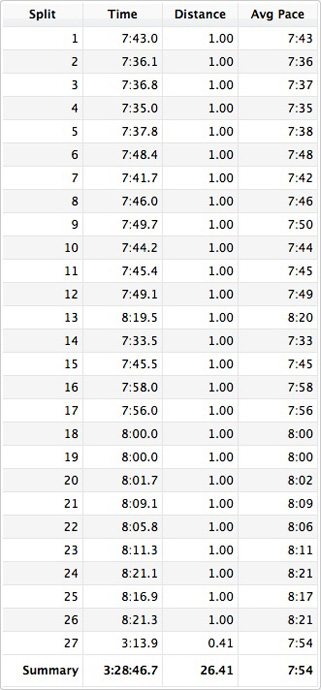
For a race in which my major concern was NOT doing the splits, these aren’t so awful

Roads?  Where we’re going, we don’t need roads.
– Emmett “Doc” Brown, “Back To The Future”

Spyhopping humpback in Fournier Bay, Antarctica (photo credit: Mike Sohaskey)

(PREFACE: This is not a blog post in the usual sense.  Rather, it’s my attempt to chronicle an amazing adventure in two acts, and to – “demystify” is the wrong word – inspire an appreciation for a remarkable ecosystem that’s much more than an alien land of ice and snow.  For anyone seeking an even more detailed account of the Antarctica Marathon and its history, I’d recommend John Hanc’s book, The Coolest Race on Earth.  And for time-challenged readers who simply want the gist of our journey, I’d recommend skipping all the cumbersome words and sticking to the pictures.  Whatever your preference, thanks for reading!)

More so than any month in recent memory, March was a month of firsts.  Or maybe more accurately, it was a month of lasts.

Cut to the morning of February 26, and the last place I expected to find myself a month later was exactly where I found myself a month later: joining upwards of 100 highly motivated runners – including one celebrated back-of-the-packer with the all-too-appropriate nickname of “The Penguin” – aboard a Russian research vessel headed toward the South Pole to race The Last Marathon on the Last Great Continent.  All under the watchful eye of a leader named Gilligan.

As absurd as a “spontaneous” trip to Antarctica sounds, that’s exactly what this would be.  Sometimes, truth really is stranger than fiction… and even less likely.

Damn the icebergs, full speed ahead!
Rewind to the morning of February 26, a morning that began like any other: my spring racing plans were gradually taking shape as I contemplated a return to either the L.A. Marathon – one of my 2012 racing highlights – or the Oakland Marathon, site of my half marathon PR (1:34:02) last year.  Also in my sights were one or more upcoming trail races with my favorite local racing outfit, Brazen Racing.

Yep, spring 2013 was falling into place… until the following e-mail message hit my Inbox, and my best-laid plans went out the porthole:

dear Mike,

The ship that we had chartered for the 2013 Antarctica Marathon to depart in a couple of days has been damaged by an iceberg.

We have rescheduled the trip using the sister ship, the Akademik Vavilov which we have chartered many times in the past.

You are currently waitlisted or confirmed in the future for the Antarctica Marathon. Are you interested in confirming space for these new dates in 2013?

[details omitted]

It always is an adventure. Please advise as soon as possible since most of the confirmed passengers have rescheduled for the later dates. We will have a few spots available.

Please contact us immediately if you are interested.

Thom Gilligan
Marathon Tours & Travel

My immediate reaction was probably similar to yours… 101 years after the Titanic kissed the bottom of the ocean, actual operating ships are still colliding with icebergs?  My secondary response, though, was one of adrenalized bewilderment – Antarctica?  On such short notice?  Was this a legitimate option for us?

In short – yes, it was.  Due to the large number of runners vying for a limited number of slots (roughly 100 per year), the Antarctica Marathon typically requires years of advance planning and a lengthy sojourn on the Marathon Tours waitlist.  As referenced in their e-mail, we’d entered the waitlist in mid-2012 and in doing so had confirmed our spot – for 2016.  So we figured to have three more years to plan for this trip.

Take me to your freezer!

Thing is, I hate procrastination, and putting off until tomorrow what I can do today.  Paradoxically, I have a lot of patience – research science and delayed gratification go hand-in-hand.  But Antarctica promised to be the opportunity of a lifetime.  Cliché as it may sound, life really is too short, as we were starkly reminded by this past week’s tragic events in Boston.  Who knows where we’ll be and what we’ll be doing three years from now?

And although I wouldn’t classify myself as a “bucket list” runner, I do have a short list of three marathons that I consider must-do events: Boston, New York City and Antarctica.  What did it matter that neither Katie nor I owned a legitimate cold-weather jacket, or that I’d only run in tights once in my entire life?  At least we wouldn’t need any vaccinations or immunizations for this trip… I’m pretty sure penguin fever is both unpreventable and incurable.

As the nail in the coffin of March normalcy, we found ourselves in a relatively obligation-free time of personal and professional transition (another post for another time).  Thus the awesome realization dawned on us that yeah, March was actually the perfect time for a frigid flight of fancy.  And within two days, we’d committed to join 98 other adventure-seekers on an unanticipated journey to the Last Great Continent.  Thankfully, our voyage was scheduled to last a bit longer than a 3-hour tour.

And so it was that on March 21, after a highly successful raid on the winter clearance racks at our local REI, The North Face and assorted outlets, Katie and I found ourselves on a flight bound for Buenos Aires, Argentina, where our 17-day adventure would begin.  With little time for pre-trip research and little idea of what to expect (other than the obligatory requests to “Bring back a penguin!”), our ignorance was bliss.

So, just sit right back and you’ll read a tale, a tale of a fateful trip….

ARGENTINA (Fri – Tues, March 22 – 26)
Since this is ostensibly a running blog, I’ll limit my thoughts on the Autonomous City of Buenos Aires to the high (and low) points of our 5-day visit – though use of the word “concise” here would be disingenuous:

Overall, we had a lively visit to Argentina’s capital city – which wasn’t a foregone conclusion, given that I have virtually no interest in soccer, tango dancing or huge slabs of beef.  But with its European-inspired architecture, socioeconomically diverse neighborhoods, thriving theatre industry and plentiful green spaces, Buenos Aires is a culturally vibrant city and a terrific place to explore on foot.  Fortunately, my sub-fluent yet functional Spanish proved good enough to point us in the right direction and keep us out of trouble.

El Obelisco in Plaza de la República, Buenos Aires (photo credit: Mike Sohaskey)

Good morning, good afternoon and good night in the Plaza de la República:
El Obelisco stands on the site where the Argentine flag was first hoisted in Buenos Aires in 1812

Architecturally, the city is a dynamic and captivating mix of old and new.  Highlights of our bus and walking tour included the ornate mausoleums of La Recoleta Cemetary (where many notable Argentinians including Eva Perón are interred), the politically charged Plaza de Mayo (site of La Casa Rosada, mansion and office of the President of Argentina), and the recently renovated Teatro Colón (famed opera house which Pavarotti once praised for its “perfect” acoustics).  And not surprisingly, images of favorite son Cardinal Archbishop of Buenos Aires Jorge Bergoglio, a.k.a. Pope Francis, now adorn the city.

For a city of Buenos Aires’ reputation and importance, however, I was disappointed by the state of abject disrepair in which many of its sidewalks find themselves.  In many places it looked as though The Avengers had been filmed in the city and nobody had bothered to clean up the rubble.  With a marathon on the horizon and after several near tweaks, I felt fortunate to get out of Argentina with both ankles intact.

Photo collage of Buenos Aires highlights (photo credit: Mike Sohaskey)

Buenos Aires illustrated (clockwise from upper left): La Casa Rosada, executive mansion and office of the President of Argentina; plaque marking Eva Perón’s tomb in La Recoleta Cemetery; tango demonstration in the Recoleta district; one of the city’s many neglected sidewalks; colorful Caminito street in the neighborhood of La Boca; steel sculpture of Evita on the north facade of the Social Development and Health Ministry; the steel-and-aluminum Floralis Genérica sculpture in Plaza de las Naciones Unidas

As a runner, I was impressed by the number of Porteños (locals) out on the weekend walking, running or cycling through the city’s many bustling parks.  The typical Porteño I saw certainly was not built like someone whose daily diet consists of at least two large servings of beef – I’d guess the average Houstonian weighs roughly the same as 1.5 Porteños.

Speaking of food, the only part of each day I didn’t look forward to were the meals, for instance the vegetarian pizza we ordered for dinner one evening that arrived smothered in ham (I assumed the pig had been an herbivore).  In addition, the extra – and not insignificant – fee that several restaurants charged for “table service,” coupled with their insistence on serving and charging for bottled water despite the potability of the local tap water, amounted to epic scams.

I don’t usually fault cities for their names, but “Buenos Aires” is a conspicuous misnomer.  Granted the city was originally recognized for its “good airs” (or more likely, its “fair winds”) way back in the 16th century, but these days it would be like changing Omaha’s name to Ocean View, Nebraska.  Collectively, the carbon monoxide-induced asphyxiation from urban traffic (particularly the large number of freight trucks headed to and from the port), the secondhand asphyxiation from the local smoking population, and the impenetrable char-grilled asphyxiation from the parrillas (barbecue grills) bordering the Reserva Ecológica where I ran on two occasions, combined to ensure that my lungs never got too comfortable in their pleura.

This was the top Google search result for parrilla, the catch-all name for the city’s popular BBQ grills.

By keeping close tabs on our cameras and backpacks, we were able to depart Buenos Aires with our wallets and all other personal belongings intact.  Unfortunately, not all our fellow runners were so lucky… we heard of at least two cameras being stolen from dinner tables, and one trusting fellow (a fellow Bay Area native, in fact) lost his wallet to an elaborate pickpocket ruse involving fake bird droppings on his head, two helpful bystanders with a towel and an immediately accessible getaway car.

We meet at last (Sunday, March 24)
Our third evening in Buenos Aires featured the Antarctica Welcome Banquet Dinner.  Here we met Thom Gilligan, the founder and leader of Boston-based Marathon Tours, as well as the four members of his race crew who would be joining us in Antarctica: Scott and Anita, respectively the General Manager and Environmental Officer of Marathon Tours, as well as the husband-and-wife team of John “The Penguin” Bingham and Jenny Hadfield, both well-known to the running community for their books and popular columns in Runner’s World and elsewhere.

John opened with some remarks about The Last Marathon, the first organized sporting event in the history of Antarctica.  Thom then said a few words about “Antarcticer” (his Boston-based pronunciation) and introduced our upcoming adventure with the brutally honest classified ad ostensibly posted in the London Times by explorer Ernest Shackleton, in preparation for his 1907 Antarctic expedition:

Ernest Shackleton

Musical accompaniment for the subsequent slideshow included Dido’s “White Flag,” with its (so we all hoped) tongue-in-cheek chorus of “I will go down with this ship.”  After the slideshow, Thom asked for a show of hands as to who had run a sub-3 hour marathon in the past two years.  Three hands went up.  He then asked for a show of hands from runners in the 3:00 to 3:30 range – three or four more hands went up, including mine.  Although I knew this wouldn’t be a typical marathon, in that the 50-59 and 60-69 age groups would be the most competitive, I knew there would still be plenty of representation by the younger demographics, and I was shocked to find myself immediately seeded so highly.

But for me the most striking realization of the evening, which I hadn’t fully appreciated to that point, was the dedication and commitment of every person in that room.  True we were all headed for Antarctica, and that in itself set this room apart.  But whereas running for most people is a hobby, a way to alleviate stress and stay fit, for this group it was a lifestyle, an obsession in the healthiest sense of the word.  And while not everyone in that banquet hall may have possessed the stereotypical “runner’s body” (that’s why it’s a stereotype), I’d be reminded in the coming week that mind really does matter.

Thom

Thom Gilligan introduces an excited group of marathoners to what lies ahead

That evening I met seemingly normal, well-adjusted individuals who had run over 100, over 200, over 300 marathons.  I met several individuals who had raced in all 50 states, on all 7 continents, and yet had never run a trail race.  I met Winter, a 14-year-old Junior Olympian from Oregon who’d formed Team Winter and resolutely set a goal to run a marathon on all seven continents in support of prostate cancer awareness, after her father was diagnosed with the disease in 2008 and passed away less than a year later.  I met Wes, a 78-year-old lifelong Purdue Boilermaker who’d run 200 marathons (including 100 in the past decade) and in 23 European countries, and for whom Antarctica would be his 7th continent and final marathon.  I met Rory, a charismatic and “Jo-burg proud” South African who had completed the notoriously grueling Comrades Ultramarathon 12 times.  I met Brendan, a running coach and 50 states/6 continents finisher from Chicago who’d failed in his first bid to complete the Antarctica Marathon three years earlier, and was back to exact his racing revenge.  I met the Canadian duo of 70-year-old Georgine and her son James, and was amused to discovered that she was the runner in the family who had persuaded her hockey-playing son to join her in running the Antarctica half marathon.  And I met many others whose stories I’d hear and whose lives I’d share over the next two weeks.

As nonchalantly as most people would discuss their kids’ soccer game, conversations centered around questions like “How many continents is this for you?” and “Have you run Kilimanjaro yet?”  The Great Wall of China, Machu Picchu, the Arctic Circle, even Antarctica already in a few cases – my travel companions had left their footprints, literally, on nearly every conceivable destination on the planet.

I had to admit… these were my kind of people.

Destination: Antarctica (Tues – Thurs, March 26 – 28)
Fast-forward 36 hours, and after one more day spent appreciating the many faces of Buenos Aires, we found ourselves on a flight to Ushuaia (pronounced Oos-why-uh by the locals), the southernmost city in the world and the capital of Tierra del Fuego at the tip of South America.  As the plane touched down in Ushuaia, the cheers from the locals onboard and the sight of the woman seated next to me crossing herself suggested our adventure had begun earlier than planned.

Katie and Mike Sohaskey in Ushuaia, Argentina

It’s the end of the world as we know it… and Katie and I feel fine

After a brief layover and stroll around this sleepy port town we boarded the Akademik Sergey Vavilov, the Russian ship (and one-time research vessel) that would – barring an unforeseen iceberg encounter – carry 105 passengers, 41 crew members and 13 expedition staff to our destination across 600 nautical miles and a particularly gnarly stretch of open ocean that we’d soon come to know all too well.

With rainbows and mist-shrouded peaks dominating the landscape, we “threw ropes” (set sail) at around 6:00pm local time on Tuesday and slowly made our way out of the Beagle Channel.  From that point forward, responsibility for our well-being fell squarely into the hands of the 13-member staff of One Ocean Expeditions.

Akademik Sergey Vavilov in Ushuaia port (photo credit: Mike Sohaskey)

In the Ushuaia port, the Akademik Sergey Vavilov awaits its human cargo

As it turns out, we couldn’t have entrusted our safety and well-being to a more competent, experienced and entertaining group.  As the Managing Director of Canadian-based One Ocean Expeditions, Andrew Prossin would be our solidly-in-charge Expedition Leader whose soothing voice and Canadian sensibilities would greet us first thing every morning with his wake-up announcements over the ship’s PA.  In addition, at each meal he would set our expectations as to weather (always unpredictable), changes to the itinerary and opportunities for wildlife sightings.  His understated cry of “hooray” which punctuated the end of his announcements became a rallying cry for the entire ship.

His One Ocean staff would be an appropriately eclectic collection of three fellow Canadians (Derek, Zoe and Nate); one Australian (Ewan, the kayaking king); a Dane (Louise, our hotel manager); a Welshman-cum-South African-cum-Australian (Mark, passionate whale conservationist and Andrew’s Assistant Expedition Leader); one far-North American (yoga guru Liz, whose “Alaska girls kick ass!” sticker immediately attracted my attention); one Portuguese (all-important mixologist Joao); and chefs Jeremy, John and Mike who, together with pastry chef Elizabeth, embraced and conquered the unenviable task of creatively providing three meals a day, every day, while hundreds of miles from the nearest grocery store or farmer’s market.  Before this trip I’d never eaten, much less looked forward to, daily lunch dessert.

One Ocean Expeditions staff

The One Ocean Expeditions staff included Expedition Leader Andrew (with microphone), Liz, Mark, Ewan, Nate, Zoe and Derek

Katie and I spent the first hour onboard familiarizing ourselves with the ship’s layout and idiosyncracies, including the less-than-romantic bunk beds in our third-deck cabin that prevented me from sitting up straight in either bed.

The next two days belonged to the Drake Passage, the necessary evil of open water between the Beagle Channel and Antarctica that would test every passenger’s sea legs, not to mention their seasickness meds.  We both chose to use the Transderm Scopolamine patch, a nickel-sized prescription patch applied behind the ear that prevents motion sickness for up to three days.  Which it did admirably well, the main drawback being the side effect of dilated pupils that messed up our vision something fierce.  As a result, neither of us felt quite like ourselves during those two days crossing the Drake, as our literal inability to focus prevented productive behaviors such as reading or writing.

This is your brain on scopolamine (left); normal undilated pupil shown on right for comparison 

Unfortunately, all postcards had to be submitted before race day if we wanted them to be postmarked from Antarctica.  And so I found myself seated in the lounge of a wickedly swaying boat with one eye closed, squinting through my open eye Popeye-style as I tried to stabilize both hand and vision long enough to write legible quips about what an awesome time we were having at a destination we hadn’t yet reached.  Lucky family members will no doubt wonder (assuming the cards ever arrive) how many shots of tequila preceded my postcard-ing sessions.

Luckily the One Ocean and Marathon Tours staff had planned other, less cerebrally taxing distractions to pass the time.  Among these, Thom talked about the history of his brainchild, the Antarctica Marathon; John held court and lightened the mood with his entertaining perspective on life as a back-of-the-pack runner; Derek laid down mad knowledge on “Birds of the Southern Ocean”; Liz provided historical context in detailing the ill-fated Scott/Amundsen “Race to the Pole”; and Nate capped the evening with “Marine Superstitions,” after which nobody was caught whistling aboard ship.

Check out this footage of life in the Drake Passage (a.k.a. the “carbo-unloading zone”), filmed through the porthole in our cabin:

http://www.youtube.com/watch?v=VfJMG0uL85E&feature=youtu.be

By Thursday evening we’d more or less cleared the Drake Passage, crossing the Antarctic Convergence and the 60th parallel south to enter the Southern Ocean. Soon after that we approached the South Shetland Islands and specifically King George Island, site of Saturday’s upcoming race.  At that point even our first whale (fin whale, to be exact) sighting of the trip couldn’t disguise the fact that the natives were getting restless.
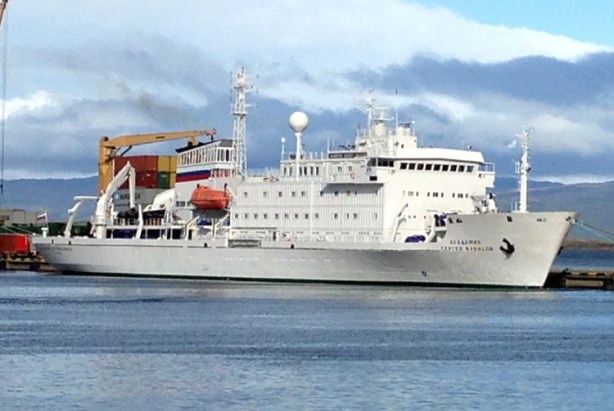
As race day approached and hours spent aboard ship accumulated, the restlessness and nervous energy among the passengers continued to build.  The most tangible reflection of this mindset may have been the bar/lounge on the upper deck of the ship, which experienced two sparsely populated evenings as normally relaxed, sociable runners morphed into their water-swilling, teetotalling pre-race alter egos.  Our bartender Joao was perplexed by but resigned to this transformation, which he’d clearly experienced before.  And his voice of experience predicted a significantly more laid-back ambiance once the race was over.  I raised my water bottle in agreement, and in a toast to more carefree days ahead.

Keeping expectations at (Maxwell) bay (Friday, March 29)
With the planet’s southernmost continent within sight at last, the harsh reality of where we were and what we were about to do finally hit home.  Stepping out on the sixth floor deck to gaze upon King George Island – so close and yet so far – I was greeted by the stinging sensation of a million frozen, finely honed razors slicing right through me.  My skin and two lightweight layers were defenseless against the Antarctic wind.  And to think that tomorrow at this time, I’d be running 26.2 miles in this.  Let the mind games begin…

Despite the initial cold shock, the consensus adjective of the day to describe our first encounter with Antarctica was simply “indescribable.”  A picture may be worth a thousand words, but in this case one would have to suffice.

The plan for the day called for Thom and his crew to make their way across Maxwell Bay to King George Island early that morning to set up the race course.  Meanwhile, the rest of us would finally make an excursion off the boat and potentially even stretch our legs on land at some point.  Ah, perchance to dream….  Instead, the Antarctic winds did what the Antarctic winds do, churning up the water and making conditions unsafe to launch the zodiacs (the rigid inflatable boats used to transport people from ship to shore).  It wasn’t until 1:00pm that the wind died down enough to launch the boats and send Thom’s crew (plus ATVs) on their way to King George Island.  Many of us watched as the zodiacs made their not-so-long yet slow voyage across the bay and toward the Russian base at Bellingshausen Station.

Thom and his crew

The zodiacs approach the Russian base on King George Island, on their way to set up the marathon course

This in itself was uplifting news, because again this was Antarctica, where even the seemingly straightforward process of getting off the boat couldn’t be taken for granted.  Still fresh on everyone’s mind was Thom’s unsettling tale of his 2001 Antarctica Marathon expedition, when uncooperative weather had seized the day(s), only to have the passengers seize it right back.  After several days of thwarted attempts to launch the zodiacs in rough waters, a consensus decision had finally been reached that the show must go on, and that the marathon would be run ON. THE. DECK. OF. THE. SHIP.  Apparently one of the passengers that year had been a qualified race distance certifier, and he mapped out a 26.2-mile course that comprised 422 laps around the upper deck.  The race was run over a 24-hour time period, and don’t ask me how each runner kept track of his/her number of laps completed.  Most strategically, the ship had been moored such that the anchor just touched the continent of Antarctica, thereby validating the venue.  Thus went the story of how the 2001 Antarctica Marathon was staged under the most challenging conditions to date, a testament to human fortitude and resolve that exactly nobody on our ship had any interest in repeating.

Speaking of human fortitude… with our plans for an afternoon expedition foiled, everyone gathered in the bar/lounge to watch “Crossing The Ice,” an intimidating/inspiring documentary about two Aussies and one Norwegian who found themselves competing against each other to become the first persons to complete the trek to the South Pole and back unassisted.  I then retreated to the basement gym to, if nothing else, get the blood pumping and stretch my legs before I’d have to use and abuse them the next day.

Antarctica Marathon 2013 pre-race briefing (photo credit: Mike Sohaskey)

A weary Thom addresses a roomful of restless runners during his pre-race briefing

After dinner – the last supper before the race, which happened to coincide with this being Good Friday – Thom stepped to the microphone for his pre-race briefing looking ruddy and dog-tired from his afternoon excursion.  He informed us that the hilly course would consist of two different out-and-backs that marathoners would run three times, with the start/finish line separating the two.  The first out-and-back would take us past the Russian base, then out to the first turn-around point at the Uruguaryan Artigas Base and back, while the second out-and-back would lead past the Chilean Eduardo Frei Base and out to the turn-around at the Chinese Great Wall Station before retracing its steps.  There would be icy (if not muddy) patches to negotiate that Thom estimated at around 5% of the total course distance.  And based on today’s course conditions, he and his crew would be strictly enforcing the 6-1/2-hour time limit – anything longer and we risked hypothermia.

Google Earth rendering of the Antarctica Marathon 2013 course (credit: Mike Sohaskey)

Google Earth rendering of The Last Marathon course – thanks to Dan, from whom I stole the idea;
my personal detour can be seen leading toward the airstrip near the yellow church
(Click on the map for a larger image)

As we’d suspected, the day had been a rough one for Thom and his crew – John predicted that if we’d had to run the race that day in those conditions, nobody would have finished.  But he concluded the briefing by injecting a shot of humor, warning the room that “Bandits (runners who race without paying an entry fee) will be pulled off the course.”

Back in my cabin I systematically organized my apparel, bottles of Cytomax/GU, Garmin (don’t be silly, of course GPS works in Antarctica!) and thoughts for the day ahead.  And I realized that realistically, I had no idea what to expect.  Cold to be sure, but beyond that I had zero expectations: could I run a sub-4:00 marathon in these conditions?  Probably not, though “probably not” wouldn’t stop me from trying.  Runners are notorious for downplaying expectations – case in point, those ultra-competitive types who qualify for the Boston Marathon and then vow to treat it as a “victory lap”.

But this time, I realized as sleep engulfed my upper bunk – this time I really was out in the cold.

Continued and concluded in Act 2… with an actual race report!

Whether you think you can or you think you can’t, you’re right.
– Henry Ford

“I predict sub 3 30.”

My brother sent his text the week before I’d be running the Chicago Marathon, and at the time I thought little of it. Why should I?  My previous two marathons, the California International Marathon in December 2011 and the L.A. Marathon earlier this year, had yielded successive personal records (PRs) of 3:39:15 and 3:37:53 respectively, a not-so-whopping improvement of one minute, 22 seconds.  And both courses had been relatively flat.  Not only that, but Chicago Marathoners had experienced/endured unseasonably hot temperatures in four of the past five years (by contrast, the 2009 race saw temperatures dip below freezing).  So I’d automatically – and wisely, I thought – adjusted my mindset to expect hot temperatures on race day, and to deal with them as best I could.  When possible I’d even trained under the East Bay sun, with the pace for my most recent long run – 15 miles in 86°F heat – projecting to a sub-3:35 marathon pace.  But regardless of conditions, 15 miles is not 26.2.  And with all that in mind, the thought of somehow shaving another eight minutes off my PR seemed, well, not happenable.

So I was pleasantly surprised when, five days before the race, I received an email from Marathon organizers telling us that “the weather on race day is projected to be partly cloudy, with low temperatures in the upper 30s to low 40s, and high temperatures in the low to mid 50s (degrees F).”  This corresponded to an Event Alert Level of “Green” (Low), which promised favorable conditions for marathon running.  At that point I remembered Chuck’s text, and my mental gears began to turn.  Slowly, to be sure, but the seed had been planted.

Mike Sohaskey after running 2012 Chicago Marathon

To complement the race itself, I’d decided 2½ weeks before race day to run Chicago as a member of Team LIVESTRONG.  Originally established as the Lance Armstrong Foundation, LIVESTRONG is a non-profit organization whose mission is to provide one-on-one support for cancer survivors and their families, to empower them and help them face the challenges of cancer head-on.  Unfortunately Armstrong’s ban by the U.S. Anti-Doping Agency, and U.S.A. Track and Field’s weak-willed agreement to recognize the ban, extended to his running in this year’s Chicago Marathon.  Because Armstrong’s inability to run threatened to weaken LIVESTRONG’s fundraising efforts, I’d decided to help raise funds and awareness to support their cause.  After which many incredibly generous and supportive friends and family, in turn, stepped up to help me achieve this goal in a relatively short amount of time.

So then Chicago would be about more than setting a new PR or hitting a specific time goal… I’d also be motivated and inspired by Team LIVESTRONG and all those who supported my cause.  Particularly gratifying were the individual shout-outs of support that accompanied each donation, shout-outs ranging from sincere (“RunSTRONG, Mike!” and “We support your every step”) to painfully sincere (“Will look for your final time if my browser manages to scroll that far down”).

More on my LIVESTRONG experience, and those who made it possible, later in this post.

Thanks, Chicago… “We’re glad we’re here” too!

On THURSDAY Katie and I flew from Oakland to Chicago Midway, giving us two full days to acclimate our sleep schedules to the two-hour time change.  We’d be staying with close friends Pete and Faby (and their unflappable feline boss Chloe) in the threesome’s comfy and conveniently located 18th-floor high-rise apartment at the corner of Michigan Avenue and East Roosevelt Road, within a mile of both the start and finish lines of the marathon.  As an added bonus, their living space faces directly north overlooking Grant Park, the central hub of Marathon goings-on where the start line, finish line and post-race party would all convene.  With effectively zero planning on our part, this was a strong start to the weekend.

Race-day view facing north from Pete and Faby’s place: Michigan Ave. borders Grant Park on the west, while
E. Roosevelt Rd. (“the hill”) borders Grant Park to the south and is flanked along its length by red banners.  Marathoners can be seen on E. Roosevelt approaching the finish line.  Lake Michigan can be seen at right.

FRIDAY for us was Expo Day, the ritual pre-race boot camp where runners assemble to claim their registration materials, racing bib (i.e. number) and timing chip.  In a kinder, gentler age of running back when my brother was the sole (no pun intended) runner in our family, race officials would actually mail each runner’s materials to him/her before the race.  At some point in the past decade, however, race organizers (and their influential sponsors) must have realized they were missing out on a gem of a retail opportunity: a captive audience of adrenalized runners with racing on the brain and a magnetic attraction to any running-related paraphernalia promising them that elusive “edge”.  And with that, the mandatory pre-race expo was born.

No matter what your expectations for the pre-race expo, this year’s “Health & Fitness Expo” at McCormick Place in downtown Chicago did not disappoint.  It was among the largest expos I’ve attended, with Long Beach, L.A. and San Francisco being the other contenders.  After our shuttle bus dropped us off between Gates 26 and 27 (maybe, say, 26.2?), we followed the signs through the cavernous hallways and up the escalators to where fit-looking folks by the thousands – the vast majority of them reflective white like me – filled one enormous bustling hall.  Nearly all of these marathoners-to-be carried unwieldy Bank Of America-sanctioned swag bags while eliciting glances of (was that envy or scorn?) from the buttoned-up suits filing into and out of the “GRAPH Expo” next door.

When the Nike-bots issue an order, you Just Do It.

Some folks tackled the expo with more deliberate mindsets, whereas most behaved instead like human examples of Brownian motion, diffusing semi-randomly between sponsor booths.  Katie and I fell somewhere between these two extremes: not quite overwhelmed enough to diffuse aimlessly, yet in no real hurry to leave.  And as we strolled the aisles, I noticed a distinct difference between this expo and those I’d attended in California, reflecting perhaps the “Midwestern sensibilities” I’ve heard so much about.  Chicago resembled a more straightforward trade show featuring the most reputable names in running – names like Nike, Asics, Brooks, Saucony, Merrell, Clif Bar, PowerBar and Gatorade.  Representatives manning the booths were for the most part helpful without being pushy.  And although an expo’s an expo, and Chicago’s expo still left me restless for the more carefully choreographed chaos of the Marathon itself, it was decidely more positive than my usual expo-rience.

Because in contrast, California running expos are more likely to feature overcaffeinated meatheads and bronzed booth babes loudly hawking the latest in barely digestible energy bars, alkalinized drinking water, unproven nutritional supplements, and even over-the-top gimmickry such as rubber “Power Balance” bracelets that even the parent company admits are a complete sham.  Not to mention (but I will) that the organizers of possibly the state’s most popular marathon, the Big Sur Marathon, insist on having a booth at nearly all California running expos, despite knowing full well that they’ll be peddling an already sold-out event.  Ah, the hardships we endure who live and run on the West Coast.

Friday night we attended a pre-race dinner for Team LIVESTRONG members at Wrigley Field, featuring a few words by Team LIVESTRONG representatives as well as Chicago Cubs first baseman and Hodgkin’s lymphoma survivor Anthony Rizzo.  This was the first time the LIVESTRONG folks had organized a pre-race event, and hopefully it won’t be the last… the evening provided an excellent opportunity to meet fellow fundraisers/runners in a relaxed setting, and to hear more about LIVESTRONG’s mission without the discomforting feeling of being slammed through a propaganda and marketing machine.  We even had a chance to stroll the dugouts and home plate area of Wrigley Field.  This was Katie’s first visit to Wrigley, and I doubt many other first-time (or any-time) visitors can boast a similar on-field experience.  All in all, a well-planned and well-executed event on LIVESTRONG’s part.  If only the bar hadn’t run out of 312 Urban Wheat Ale so early in the evening….

Team LIVESTRONG members at Wrigley Field… together we raised more than $237,000 at the
Chicago Marathon.  Katie and I are in the center, near the back.  (photo © 2012 Stephen Green Photography)

SATURDAY was spent stepping off curbs very carefully, restricting my diet (though not my calories), running a slow 3 miles with Pete along Lake Shore Drive, brunching with former labmate Vivian, visiting the Field Museum, and avoiding the torrent of Coors Light-toting college football fans streaming toward Soldier Field to watch Notre Dame play the University of Miami.  Hey Notre Dame fan: nothing says “Catholic family values” like a t-shirt that reads “Sucks to be U” or “If you don’t bleed blue & gold, take your bitch ass home.”

By the time 5:40am arrived on SUNDAY morning and my alarm began to jangle incessantly, I was good and ready to be good and running.  After all the training, all the tapering, all the expo-sure, and all the anticipation and visualization, it was go time at last.  As Katie and I prepared for our morning, we watched the sky over Grant Park and Lake Michigan likewise wake up and progressively brighten as the nervous, shivering throngs gathered in the park below.  Soon we joined them and headed immediately toward Start Corral “B”, where I’d begin my circuitous running tour of Chicago with the thousands of other Wave 1 runners anxiously awaiting the 7:30am start.  Slower runners would follow in Wave 2 at 8:00am.

The elite runners stretch before the race… they look even leggier in person (Agora sculpture in Grant Park)

7:18am, and the Wave 1 Start Corrals closed promptly at 7:20am.  Katie was radiating her own nervous energy as we said our good-byes at the gate to the corrals.  “Are you sure you don’t want those?” she asked hurriedly as I stripped off my arm warmers.  “Yes, that’s why I’m taking them off,” I assured her.  Despite the chill in the air (temperatures ranged from 40°F at the start to 47°F at 11:00am), the electricity of the day was invigorating, and I had no trouble staying warm as we were herded, like cattle in compression gear, into our designated Start Corral to await the official start.

I excuse-me’d my way between tightly-packed bodies and positioned myself between the 3:30 and 3:35 pace groups. I’d resolved to keep the 3:35 pacers behind me and then decide on the fly whether to pursue the 3:30 group.  I’d rather run the first half too fast and lose steam later, than start too slow to give myself a legitimate shot at a PR and maybe even 3:30.  I didn’t necessarily expect to break 3:30… the thought of running an entire marathon at an 8 minute/mile average pace may sound good in the Start Corral, with the buzz of pre-race adrenaline and 5-Hour Energy coursing through my bloodstream.  But once we hit the streets, the reality of the race could be dramatically different. As always though, I urged myself to trust my training and push it as far as it would take me.

What do you mean you don’t see me??? I’m RIGHT THERE in the gold shirt!
(photo © 2012 Andrew A. Nelles~Sun-Times Media)

With a collective cheer from the teeming masses and Bruce Springsteen’s “Born To Run” blasting from what sounded like a McDonald’s drive-thru speaker (no fries with that, gotta run!), the 35th Bank of America Chicago Marathon was under way.  Pete and Faby, at home watching the local NBC affiliate’s marathon broadcast, caught a glimpse of me staring down at my Garmin as I crossed the start line.  Not exactly prime-time stuff, but still more auspicious than my 1996 television debut on “Good Morning Texas”, something those who know… know.

As the first wave of spectators loudly showcased their lung capacity from the BP Pedestrian Bridge, we exited Grant Park, passed through the Columbus tunnel and made our first of six crossings over the Chicago River.  These bridge crossings over the river would be the only “hills” (more like fat speed bumps) on the course until the final 400m along Roosevelt Road.

Aerial view of the BP Pedestrian Bridge overlooking the Marathon start line on Columbus Drive (photo © 2012 Matt Marton~Sun-Times Media)

I was careful not to let the fired-up mob mentality dictate my early pace… many runners surrender to their adrenaline and fly out of the chute like their hair’s on fire, only to pay for that decision later.  For the first time in a race, I’d set my Garmin to display both my current mile pace and my overall pace, so I’d know my status at all times.  Early in a race when you’re feeling good, it can be tough to gauge your precise pace… at one point between miles 1 and 2, a fellow next to me asked, “How fast are you running?”  I glanced down at my watch – my current pace read 7:01, yow – and quickly backed off the accelerator, as the voice of experience in my head reminded me that every second I ran too fast at the beginning would come back to haunt me several-fold at the end.

I first saw (and heard) Katie with her yellow LIVESTRONG pompom in the raucous crowd at mile 2.  Soon after a physical median created a fork in the road on N. LaSalle… I forked left, ahead of the 3:30 pacers who forked right. Ne’er again would we meet.

Chicago is a stylish city to be sure, and the powerful verticality of its skyline is always breathtaking.  The city’s most imposing glass-and-steel monoliths, the Willis Tower (formerly Sears Tower) and John Hancock Center, were both visible at different points along the course.  And we ran through several interesting neighborhoods, most notably Little Italy and Chinatown with its fuzzy, oversized red dragon masks and “Welcome to Chinatown” arch engraved in gold cursive letters.  But for the most part, the neighborhoods we traversed didn’t stand out in my (admittedly tired) mind. And I have to admit… as big-city marathons go, I prefer Los Angeles. Starting at Dodger Stadium and ending next to the ocean on the Santa Monica Pier – with Chinatown, Little Tokyo, Hollywood, Beverly Hills and the legendary nightclubs of the Sunset Strip in between – is a tough act to follow.  And for better or worse, unlike L.A. I saw no barefoot runners at Chicago.

But no matter where we were on the course, the volunteers and assembled spectators were invariably rowdy and incredibly supportive.  Chicagoans, for the most part, genuinely seem to embrace the marathon and its runners, and I’m told that Marathon Sunday in October is practically a city-wide holiday.  Upon seeing my medal, several people on the street afterward were quick to smile and tell me “great job, congratulations!”  That was very cool, and it’s not something I’ve ever felt in California where people tend to be more… well, self-involved.  In the most densely packed areas along the course, spectator enthusiasm – as communicated by the sheer volume of their cheering – provided a brief but welcome distraction from the monotony of step-step-breathe, step-step-breathe….

Race volunteers were fantastic, though a ceramic bowl can be tricky to sip Gatorade out of while running (Inside Ancient Egypt at The Field Museum, Chicago)

On the other hand, whereas the quantity was high, I couldn’t help being disappointed by the quality of spectator signage along the course… the generic (i.e. non-personalized ) messages along the course were for the most part uninspired.  Usually I see at least one sign I haven’t seen before that makes me laugh, and I’m sure that sign (and at least a few other clever messages) were out there on Sunday.  I just missed ’em.  Instead I found myself counting the number of “WORST PARADE EVER” (I stopped at six) and “_____ MILES UNTIL BEER” (I lost count) signs.  The “GO RANDOM RUNNER!” sign was more annoying than anything.  And in my own non-violent way, I always want to punch the idiot holding an “ALMOST THERE!” sign anywhere in the first 20 miles… you’re not clever, you’re not funny, and you’re not the first.

But turning gators into Gatorade, I was able to co-opt the motivation from several “GO MIKE, GO!” signs along the course, as well as briefly running alongside a fellow with “MIKE” written on his shirt who was being cheered by name sometime after mile 20.

And speaking of spectators, none of ’em were more spec(tator)tacular on this day than Katie, who legged out roughly 9 miles of her own so she could see me and take pictures at miles 2, 13, 17, 20 and 26… and who still managed to squeeze in a Starbucks stop between miles 2 and 13.  She’s my performance-enhancing, not-so-secret weapon.  GO KATIE, GO!

Katie and I were both happy to reach the post-race party… we covered more than 35 miles between us!

Consistent with my usual racing strategy I avoided the aid stations, though they seemed to be well laid-out with Gatorade in front and water in back.  Starting at mile 9 and then every other mile or so after that, I forced myself to sip my trusty liquified Cytomax/Gu potion.  I discontinued this ritual at mile 22 for two reasons: 1) I was concerned that my faster-than-usual pace might distress my stomach, and 2) I realized that nutritional considerations wouldn’t be a factor over the final 4.2 miles.

As I waved to Katie at mile 13 and passed the halfway point 0.1 miles later (first half split 1:42:22, 7:49/mile), I understood that the real race was just beginning.  Most marathoners would agree that 26.2 miles feels more than twice as far as 13.1, and although those first 13.1 miles are clearly necessary, that finisher’s medal is unquestionably earned in the second half of the race.  There’s a compelling reason few recreational runners venture beyond 13.1.

Mike Sohaskey at halfway point of 2012 Chicago Marathon

If you notice nothing else in this picture, please do notice that both my feet are off the ground.

Mile 14 was the “Charity Block Party”.  Immediately I spotted the familiar black and gold of the Team LIVESTRONG tent and its members on the right side of the street.  They cheered frenetically as I passed, I clapped for them, and the scene rolled on as I glanced around at all the other worthwhile charities who would benefit today from the masochism of so many runners.

After the Charity Block Party mile 16 arrived fairly quickly, along with the always-sobering realization that the elite runners had already finished their race.  Unfortunately, I’ve yet to watch the elites race in person because I’m always running an hour and a half behind them.  And my hometown San Francisco Marathon, with its significant hillage, is understandably not a race that attracts the top elites.

The elites approach mile 13… realistically, I could run/sprint at their marathon pace for about 200m.

Although there was frequent music along the course, I honestly wasn’t paying attention and don’t remember anything specific other than the obligatory “Eye Of The Tiger” (which was appropriate in this case… Survivor’s a Chicago band). The only other thing I remember about the music was two or three moments when I ran very close to a cranked-up, beyond-distorted LOUDspeaker that, rather than energizing me, hit me with a momentary wave of nausea like I was standing on the deck of the Pequod in high seas.  But on the bright side, at least I didn’t have to hear “Call Me Maybe” for 3½ hours.

When I reached mile 22, The Wall I hit was more subtle and insidious than in previous marathons.  After all, my muscles, joints, tendons and ligaments were still cooperating and (as far as I could tell) working properly, and my effort felt much the same as it had throughout the race.  But I noticed that my mile pace times had begun to creep up into the low 8-minute range, and my lower body just felt more leaden, as though I now had the Pequod’s anchor wrapped around my waist (no idea why the “Moby Dick” references, I haven’t read it since high school).  At that point I felt a fleeting sense of “ugh” pass over me, as I reached back in search of that final wind that would carry me to the finish. Fortunately I knew I could run through this feeling of heaviness – both experience and training runs longer than 26.2 miles told me so.

Mike Sohaskey just past mile 20 of 2012 Chicago Marathon

What is there not to be happy about at mile 20?  It’s another Katie sighting!

But as I focused on maintaining my cadence (leg turnover) and stride, I needed something to motivate and distract. And that’s when I called on all the inspiration I’d reserved for just this moment: inspiration from my LIVESTRONG donors, expecting (and in some cases demanding) my best effort; from cancer survivors I knew personally; from all the cancer survivors I would never know who would benefit from this effort; from all the miles of dedicated training I’d put into this moment; from the thought of my brother running his own 26.2-mile training run in sunny Long Beach at that moment (though not at sub-3:30, the cheeky bastard); and from the now-animated (in my mind) finish line taunting me, questioning my runnerhood while daring me to finish strong.

These were just a few of the more-or-less successful mind games I played with myself over the last 10 miles.  Other mental gymnastics included the standard marathoning strategy of telling myself at the 18-mile mark “It’s just an 8-mile race from here,” or at the 20-mile or 23-mile mark “You’ve got this, just a short 10K/5K to go!”  I was now running with the 3:30-or-bust crowd, and these people clearly knew how to finish a marathon.  I noticed very few people pulling up to walk, though it’s also possible that my brain just refused to acknowledge them.

This poor fellow clearly knows what it feels like to hit The Wall
(Tired Man statue by József Somogyi)

The last 6 miles were made significantly easier – or maybe “possibler” would be a better word – by my decision to shadow a thin blonde woman in a periwinkle tank top sporting an unofficial “3:30” bib on her back.  I fell in step behind her for a short time before cautiously deciding, based on her regular cadence and steady pace slightly faster than my own, that she would be a reliable pacer to lead me through the last 6 miles.  I wasn’t disappointed.  She maintained a solid pace in the low-8 minute/mile range, which was just fast enough that I struggled at times to keep up without being left behind.

And keep up I did until the mile 25 marker, when I stopped tracking her and began to enjoy the process of that final mile up Michigan Avenue.  The sun had finally broken through around mile 24, radiating just the slightest bit of comfortable warmth.  And to ensure that marathoners received the full Windy City experience, a chilly headwind kicked in as we tackled that final stretch up Michigan.  During mile 26 I kept repeating the mantra “Keep doing what you’re doing, just keep doing what you’re doing….” This chant intensified as I passed a fellow runner who was clearly fighting cramps, and whose rigid gait made C-3PO look limber by comparison.  My immediate motivation became the end of Michigan straight ahead, where Katie, Pete and Faby waited outside their towering apartment building to cheer me across the finish.  As I high-fived the three of them and turned on to Roosevelt, I knew this marathon was all but over.
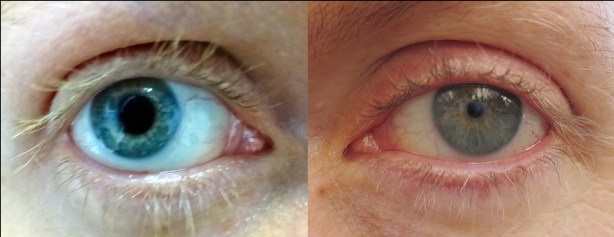
Mile 26  the happiest mile of them all

But first I had to get over the ~200m stretch of Roosevelt that those who have run Chicago jokingly (or not) refer to as “the hill”.  The power of this ever-so-slightly uphill stretch derives from its location at mile 26, tantalizingly close to the finish.  Coming from the Bay Area where “flat” is often a state of mind, I was mortified to feel my legs protesting as I slogged up Roosevelt.  But once I crested that hump and turned left on to Columbus where this all began, the immediate sight of the “200m” sign to my left and the red-and-white finish line straight ahead was indescribably adrenalizing.  WOW.

In that final 60 seconds, as I drifted right to avoid the main crush of finishers to my left, my mindset was a mental purée of wanting to bask in the moment, to embrace it, to squeeze every last iota of accomplishment out of it, blended with the stark reality of seeing that finish line oh… so… close.
The end in sight: the final straightaway on Columbus Drive (hopefully nobody followed the arrows) 

It’s impossible to articulate the stimulative sensation of the ‘runner’s high’, to do justice to the effect that intense physiological stress has on brain chemistry… you have to experience it for yourself.  It’s why some people take recreational drugs, while others run marathons.  Without hesitation, I’d recommend the experience to anyone who’s mulling over the idea of their first marathon, or who’s never run a huge road marathon like Chicago, New York or even L.A.  It’s not that you have to run the course… as I’ve pointed out, the Chicago course per se is not particularly special or memorable.  It’s that you have to feel the course, on a Sunday in October when 37,000 other runners and 1.7 million spectators are all pushing collectively for the same goal.
As I pumped my fist and crossed the finish line, the official race time on the giant digital clock read 3:31:13.  But I already knew I’d done it, and a glance down at my Garmin confirmed it: 3:28:45.  My first sub-3:30 marathon.  And my giddyup pace of 7:54/mile over the final 0.4 miles equaled my average pace for the marathon.

It’s not easy to time your finish so your head fits through the giant orange “O”
(photo © 2012 – believe it or not – MarathonFoto)

The 27th Mile (i.e. the long walk from the finish line to the post-race party) doubled as my victory lap, and I took my own sweet time moving through it.  Not because I was in pain – I wasn’t – but because I felt aglow with success.  And not that my timing would matter; I’d still arrive at our post-race rendezvous site 15 minutes before Katie, Pete and Faby, who had to painstakingly make their way down Michigan, around the barricades, and back up Michigan to Butler Field in Grant Park.  Unfortunately the distracted thrill of finishing, along with the donning en masse of heat-retaining “space blankets” caused me to lose track of my periwinkle-clad pacer, and I never had a chance to properly congratulate or thank her. But at least I know she also hit her 3:30 target.

In the finishing chute I giddily received my medal, posed for pictures, and eavesdropped on other runners’ accounts of the past 26.2 miles.  One finisher faux-boasted to his running mate, “Think what we could’ve run if we’d trained for this… I’d say 3:20.”  Another beamed with pride and quietly celebrated his first sub-3:30 effort in four tries at Chicago. Still another (admittedly I prompted this one) evangelized in an Irish brogue about how “fuckin’ awesome” his Newton running shoes were and how, after some initial getting used to, they’d taken his running to another level.

Mike Sohaskey with Chicago hosts at 2012 Chicago Marathon

Thanks to Faby and Pete (and Chloe, not pictured), the best hosts in the Midwest… we’ll be back soon!

Turns out the day had been a fast one for the elites as well.  Not only were the top three male finishers from Ethiopia, but all three including the winner Tsegaye Kebede broke the course record set last year with finish times of 2:04:38, 2:04:52 and 2:05:28.  The top American (and the top non-Ethiopian/non-Kenyan) finisher, Dathan Ritzhenhein, placed ninth in an impressive 2:07:47.  The women’s race ended in a dramatic near-photo finish, as the winner from Ethiopia broke the tape in 2:22:03 to hold off the Kenyan runner-up by less than one second (2:23:04).  Russian Liliya Shobukhova, trying to become the first runner (man or woman) to win Chicago four years in a row, finished fourth in 2:22:59.  And the top American woman, Renee Metivier Baillie, crossed the line in 2:27:17 to finish eighth.

And not that marathon training or long distance running in general is taxing on the lower body, but both Ritzhenhein and Metivier Baillie had previously suffered Achilles injuries that required surgery to repair.

Once my post-race levels of adrenaline, endorphins, dopamine, serotonin etc. gradually returned to normal later that day and the next, my own aches and pains would be minimal and in all the “right” places… quads, hamstrings, IT bands.  And Sunday evening would feature the usual unsettled stomach and litany of immunosuppressive symptoms caused by intense physical exertion: mild cough, a few chills, nothing a good night’s sleep wouldn’t cure.  And certainly nothing that would keep me away from the LIVESTRONG post-race party at the Rockit Bar later that evening.

I lamented the fact that the post-race party didn’t include an ice bath – it’s the single most effective (and uncomfortable) recovery tool I know. After taking the plunge and reaping the benefits following my first marathon in Long Beach in 2010, I was sold. And since then, I’ve been promising myself I’m gonna get me one of them some day.

I had plenty of motivation in Chicago. Certainly there was the selfish internal motivation of all marathon runners, that of wanting to set a PR or qualify for Boston or even, in my case, break an arbitrary time barrier like 3:30.  But unique to this race was the external motivation provided by all the friends and family who supported me and Team LIVESTRONG. When so many people are willing to rise to a challenge, to step up and sacrifice from their own pockets, to say by their actions “I believe in you and your cause”… that’s motivating.  And there’s no doubt that motivation powered me through the streets of Chicago.  Together we raised over $2000 to help those affected by cancer, and I hope I have the opportunity to do it again soon.

Chuck wasted little time in his post-race texts congratulating both of us – me for my accomplishment, and himself for his sub-3:30 prediction.  In effect his prediction had been self-fulfilling: he’s run better and for longer than I have, and if he thought I could run a sub-3:30, well then I couldn’t very well go out there and fall flat.  Now I’m hoping he doesn’t fire up the “Boston qualifier” prediction, which would require that I shave another 13min45sec off my Chicago time.  Then again, maybe that’s just what I need… who knows what I could do with the right training, mindset and motivation?

As I moseyed my way through the finishing chute, a woman manning the 312 Urban Wheat Ale table smiled broadly, held out an invitingly full plastic cup and declared “You need a beer!”

She was absolutely right.

LIVESTRONG provides free, confidential one-on-one support to anyone affected by cancer – whether you have cancer or are a loved one, friend, health care professional or caregiver of someone diagnosed.  To get help, call them toll-free at 1-855-220-7777, or visit them online at http://www.livestrong.org/Get-Help/Get-One-On-One-Support.

FINAL STATS:
October 7, 2012
26.41 miles through the streets of Chicago, IL (state 3 of 50, World Marathon Major 1 of 6)
38,535 starters, 37,476 finishers
Finish time & pace: 3:28:45, 7:54/mile
Finish place: 3,887/37,476 overall; 3,282/20,682 men; 558/3,451 M(40-44) age group
Race weather: mostly cloudy, 40°F (7:30am start) and 47°F (11:00am finish)
Elevation change (Garmin Training Center software): 121ft ascent, 119ft descent
Footwear: Saucony Mirage 2 shoes, Injinji Midweight toesocks