Archive for the ‘Marathons’ Category

Walt Disney quote - BlistersCrampsHeaves.com

What if I were to tell you that somewhere:

You’d probably assume I was either making these up, or researching a book on “Life in these crazy United States”.  Except that, well, all of them happened in just one state.

Florida.

Ah, Florida – our nation’s fortress of freakery, bastion of the bizarre and theater of the absurd.  As sheer lunacy goes, Florida makes California look like Sunday morning at the bingo parlor.

Luckily though, even Florida follows the Law of Conservation of Crazy – meaning that while most of the state wallows in wacky, the rest of us will always have Walt Disney World.  And we runners looking to cross a finish line in all 50 states (even Florida) will always have the Walt Disney World Marathon.
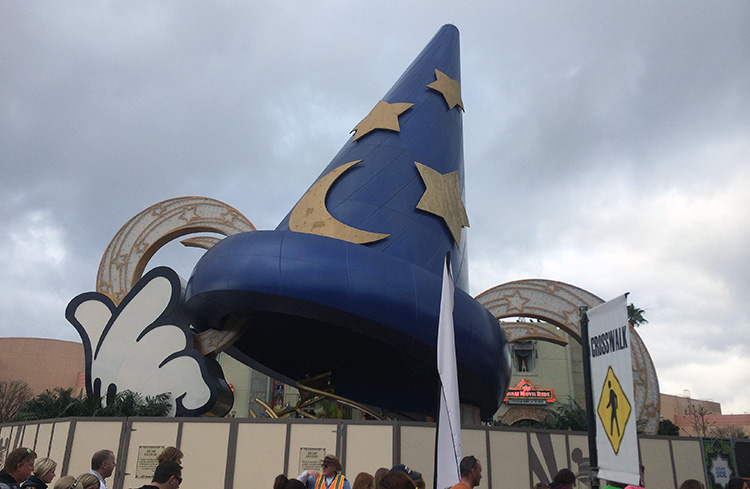
Sorcerer's Hat in Disney's Hollywood Studios

The iconic Sorcerer’s Hat in Disney’s Hollywood Studios (though not for long, they’re taking it down!)

No other marathon elicits such fanatical loyalty and across-the-board glowing recommendations as Disney’s 26.2-miler (as I write this, it’s among the most reviewed events on RaceRaves).  Disney holds a series of wildly popular themed races at both its Florida and California parks throughout the year, but only their January edition includes the full marathon distance.

And that’s not all it includes. As a company that’s never shy to give their paying fans what they never knew they wanted, Disney has taken this mindset to the extreme with what they brand as the “Walt Disney World Marathon Weekend”.  For those runners who embrace the three M’s – miles, medals and Mickey – runDisney offers a 5K race on Thursday, a 10K race on Friday, a half marathon on Saturday and the marathon on Sunday.  And while you could run just one of those distances, the folks at runDisney know you better than that.  For you the Disney devotee, they’ve created two additional profit-making opportunities:

  • the Goofy Challenge, for runners who complete the half marathon on Saturday and the full marathon on Sunday (39.3 total miles), and which includes its own special finisher’s medal;
  • the Dopey Challenge, for runners who complete all four distances on four consecutive days (48.6 total miles), and which includes its own special medal as well as the Goofy Challenge medal

Perhaps the most striking example of the loyalty Disney inspires is that while the marathon and half marathon sold out quickly this year, the Dopey Challenge (now in its second year) sold out immediately and was the first “distance” to do so.  Never mind that when you crunch the numbers – something visitors to any Disney property should know better than to do – the Dopey Challenge with its six medals costs nearly $11 per mile, a return on investment even the folks at the New York City Marathon (at $9.73 per mile for 2014) can’t claim.
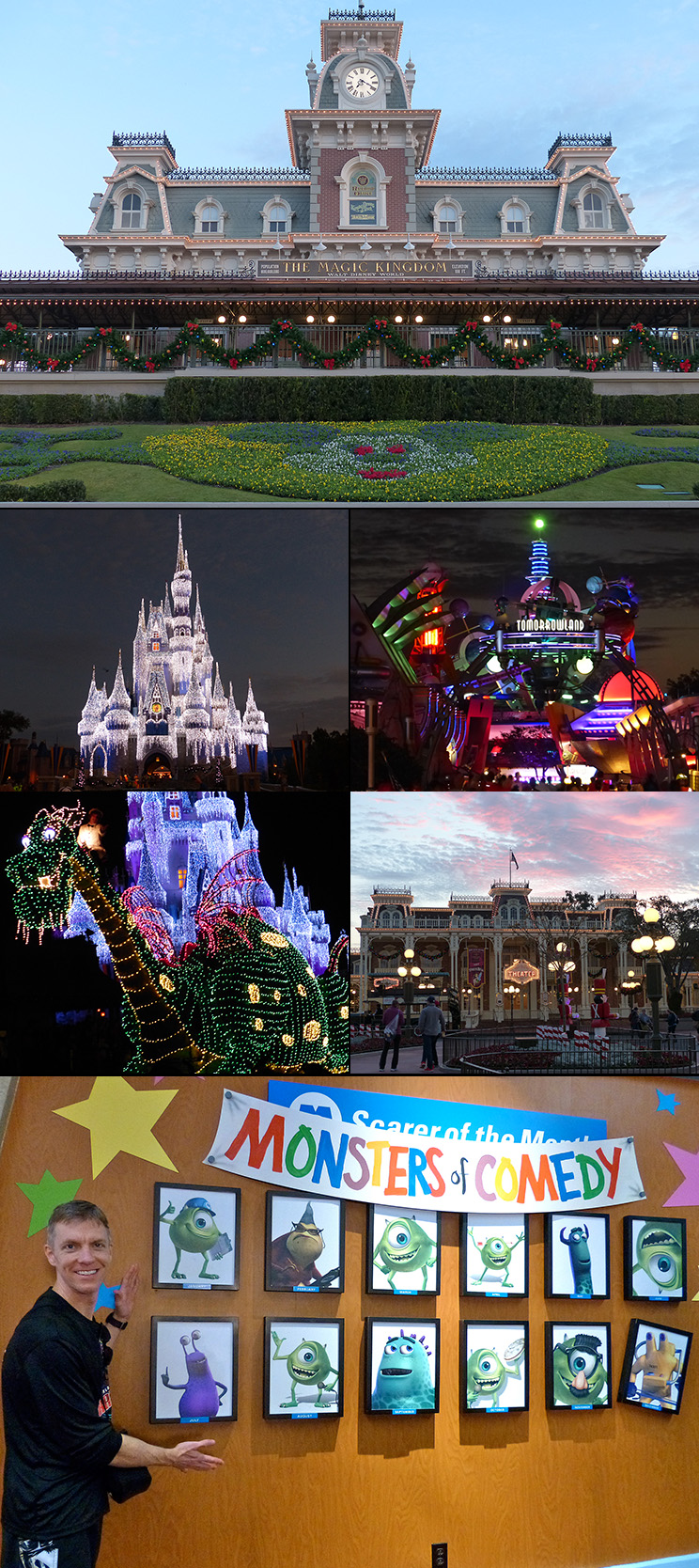
The Magic Kingdom Park collage

Scenes from the Magic Kingdom (clockwise from top): entrance; Tomorrowland; Town Square Theater; one Mike idolizing another; Pete’s Dragon in the Main Street Electrical Parade; Cinderella’s Castle

Thing is, I’ve never once heard a WDW Marathoner go all “Brokeback Mountain” on the Mouse: “I wish I knew how to quit you, Mickey.”  And I’ve yet to meet a Dopey Challenge finisher who said, “What a disappointment, I should’ve put that money toward four other races instead”.  Maybe the pixie dust sprinkled around its parks allows runners to rationalize beyond their wildest dreams. Or maybe, just maybe… that magic is real.  And maybe, like their sedentary counterparts, when it comes to Disney hundreds of thousands of brainwashed zealous runners can’t be wrong.

I was about to find out – though in my case I’d be running on Sunday only.  Disney World isn’t a place I normally equate with hardcore runners, but I used plenty of air quotes over the weekend in Orlando while talking to Goofy and Dopey Challengers, feeling the need to explain that I was running “just” the marathon.

On Friday evening, within an hour of our plane touching down in Orlando, Katie and I were strolling the halls of the pre-race expo at the ESPN Wide World of Sports Complex.  Nearly 70 races into my running fetish, I’ve definitely reached the stage where an expo is an expo is an expo.  That, coupled with the fact that I’d seen many of these same booths two months earlier at the Avengers Half Marathon, meant that one quick go ‘round and we were out of there.

One thing that struck me about the two Disney expos I visited is that an unusually high percentage of the booths are geared toward looking good.  Yes, many runners tend to err on the side of color coordination, but nowhere else have I seen such a diverse collection of blinky, frilly, sparkly, colorful outfits and accessories designed to always keep you looking your start-line best.  Even the New Balance booth featured limited edition Disney running shoes. And as in Anaheim, there was the lonely-looking duo manning the Florida Hospital Celebration Health booth – because who among us doesn’t want to talk resort-style, not-for-profit healthcare at a race expo?

WDW Marathon Weekend Expo floor 2015

This is where the (pre-race) magic happens

Saturday afternoon we spent like all smart runners do the day before a marathon – on our feet, exploring the Animal Kingdom.  I’m admittedly anti-zoo, but I figured if anyone would do hostage-taking right it would be Disney.  So I wanted to give the Animal Kingdom a chance, simply because I think that if done correctly it has a lot to offer in the way of education and appreciation.  Granted I was still saddened and disappointed by the relatively small enclosures afforded the animals to “roam,” but to a man the employees (“crew members”) showed unambiguous awe and respect for their charges while urging environmental conservation.  And where else in their lifetime will most Americans have the chance to experience in close proximity the beauty and grandeur of a rare Sumatran tiger or endangered white rhino?

My primary complaint against the Animal Kingdom actually came outside the park itself.  As we sat inhaling the sickening exhaust of the tram carrying us back to the parking lot (thankfully this wasn’t a humid 100-degree summer day), it occurred to me that a multibillion-dollar company that preaches environmental protection should probably put its money where its mouth is and invest in some electric trams.

Scenes from the Animal Kingdom

Scenes from the Animal Kingdom (clockwise from upper left): white rhino; western lowland gorilla; okapi (more closely related to the giraffe than the zebra); Everest Expedition ride; meerkats; Sumatran tiger

Sunday morning arrived much too quickly, as will happen when you’re staring down the barrel of a 5:30am starter’s pistol.  I’d slept soundly for almost three hours, followed by a final restless hour spent trying to convince my mind it was still asleep.  Unfortunately, even on minimal sleep the mind knows when a challenge awaits, and so I had no choice but to lie quietly until my iPhone chimed in mercifully with its 3:30am wakeup jingle.

After dressing (“Where – is – my – super – suit?“) and mixing my usual race-day fuel of granola/yogurt/peanut butter, we hit the road for the short drive in the dark to the Disney campus, where after a bumper-to-bumper 45-minute wait on Buena Vista Drive, we pulled into the Epcot parking lot. Assuming I’d have minimal elbow room in the corral, I cycled through an abbreviated warmup routine and then embraced my inner moth, the harsh electric lights in the distance luring me onward.

Epcot's Spaceship Earth aglow with WDW race-day anticipation

Epcot’s Spaceship Earth aglow with race-day anticipation

Passing a jumbo screen on which the start line MC was interviewing Boston Marathon Race Director Dave McGillivray, Katie and I parted ways.  Then I picked up my pace and jogged the remaining ¾ mile to where the corrals awaited.  Along the way I passed a DJ blasting “Gangnam Style” for the migrating masses (presumably to expedite their migration) – topical no, but at least it wasn’t the “Cha Cha Slide” or “Macarena” that Dan reported hearing at the 2013 race.

Then I was sliding into corral “C”, and here my only real competitive fire of the day flared briefly – corral C?  With bib #696 and a projected finish time of 3:30?  I turned to glance back at the 13 corrals awaiting their turn behind us, the image of which evoked my favorite t-shirt from Friday’s expo:

"In a Corral Far Far Away" Disney t-shirt

Why wouldn’t Peter Pan make a good pilot?
Because he’d never never land.

Epcot to the Magic Kingdom (start to mile 7, i.e. the “Happy” miles)
My timing was impeccable. I barely had time to catch the not-so-gentle waft of Ben Gay before the final countdown (courtesy of Mickey Mouse) began, and the first set of fireworks lit up the sky to start the wheelchair race.  Moments later we slow-footed corral C types were stretching our legs along darkened Epcot Center Drive, as periodic fireworks continued to light the pre-dawn sky behind us.

One of the coolest details of the race start was the fact that the back-of-the-packers in corral P were given the same enthusiastic fireworks sendoff as the frontrunners in corral A.  It was Disney’s unmistakable way of letting every runner know, You matter.  And it was one of the small yet significant details that makes Disney… well, Disney.

Walt Disney World Marathon start line fireworks

Across the grassy median on the other side of Epcot Center Drive stood a long line of shadowy spectators, and from their ranks arose Katie’s disembodied yet unmistakable cheer.  For a moment I felt more like a professional athlete or a museum exhibit than Joe Schmo runner, with the onlookers positioned so far away from the course.

If you’re looking for a course description, the WDW Marathon can be summarized as plenty of flat, non-scenic stretches of road punctuated by theme parks and character appearances.  And while “non-scenic stretches of road” may not sound like a glowing endorsement, what made this race orders of magnitude better than Disneyland’s Avengers Half was that Disney World – with its four parks plus Speedway plus ESPN Wide World of Sports – has its own sprawling campus.  Meaning the marathon is run entirely within the boundaries of Disney World, eliminating the OC strip malls, church parking lots and neighborhoods that are a necessary evil of every Disneyland race.

So all the roads on the WDW marathon course are well-paved, peaceful and traffic-free (especially at 6:00am).  Not to mention wide open – I can’t vouch for corrals I-P, but throughout the race I had plenty of room to run, only sensing the crowds when I negotiated my way to the side of the road for character photos. Definitely preferable to the constant crush of a Berlin or NYC.

Toy Story three-eyed aliens

The starting corrals were the only crowded part of the course (yes Disney, I may have doctored this image a bit)

I ran in my comfortable bubble, determined to enjoy the moment while keeping my pace around 8:30/mile.  Even allowing for a few photo stops (iPhone in hand), 8:30/mile pacing would leave me in position to finish in under 3:45.  And there you have it – my carefully conceived race strategy for this day.  Bring on the Seven Dwarfs!

The first 5 miles between Epcot and the Magic Kingdom passed quickly, thanks to distractions from Wreck-It Ralph & Vanellope von Schweetz to my left, and Sally from The Nightmare Before Christmas at the cemetery gates to my right.  In between stops my mind filtered out everything but the hypnotic sound of runner footfalls in the crisp predawn air.
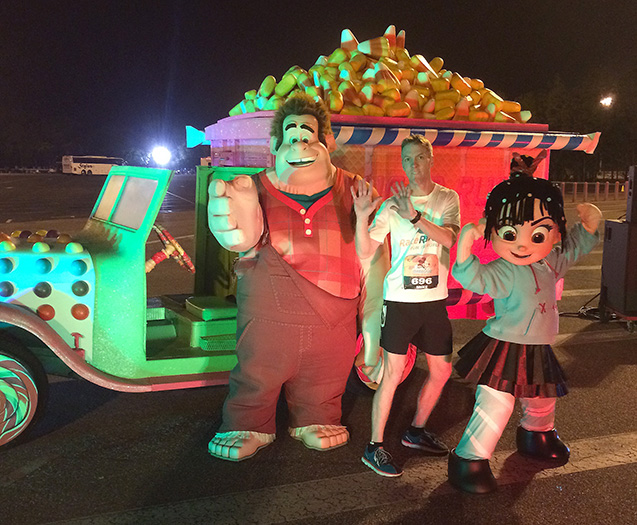
Mike Sohaskey with Wreck-It Ralph & Vanellope von Schweetz

Don’t wreck me, bro!

Mike Sohaskey & Sally from The Nightmare Before Christmas

Unfortunately Jack Skellington bailed just as I reached him and his ghoul-friend Sally

During this stretch I may even have sent a text or two to Katie and my brother as I ran.

Then we were entering the Magic Kingdom, Cinderella’s castle lighting the way directly ahead of us as screaming spectators (including Katie – hi Ho, hi Ho!), cheered us along Main Street USA.  I stopped to let her take a picture, momentarily throwing her off-guard since I’d never done that before.  This was one of the few sections of the course with appreciable spectator turnout, since it was also one of the few convenient dropoff points for the monorail that operates between Epcot and the Magic Kingdom.

As we entered Tomorrowland I remarked to the fellow running alongside me, “I expect to come out of here well rested with my medal around my neck”.  Across the bridge and through Cinderella’s castle we ran, pausing to pose with the White Rabbit from Alice in Wonderland (make it quick, he can’t be late!) before exiting the Magic Kingdom on our way to the Disney World Speedway.  Along the way I interrupted Donald Duck and Goofy, who looked to be enjoying an early round of golf at the Magnolia Golf Course.
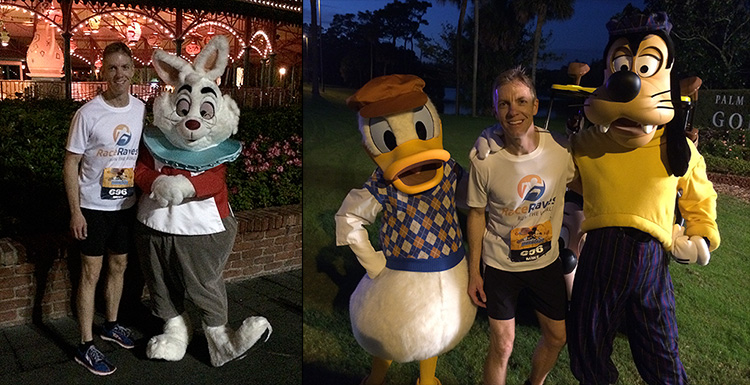
Mike Sohaskey with White Rabbit, Donald Duck & Goofy

Why does Goofy wear two pairs of pants to play golf?
He’s afraid he’ll get a hole in one.

WDW Speedway to Disney’s Animal Kingdom (miles 8 to 13, i.e. the “Sleepy” miles)
Shortly before the Speedway at around the 12K (7.4-mile) mark, I noticed the darkness lifting as the first tinge of blue caressed the morning sky.  This sudden realization knocked my circadian rhythms for a loop, with mind and body rebelling against the notion of running 26.2 miles on three-ish hours of sleep.  Luckily the moment passed quickly (with help from Mary Poppins and her Penguin Waiters), though a general lassitude would maintain its grip on me for the next several miles.

Stopping to show off my finest conjuring pose for Aladdin’s genie, it struck me that I was one of a surprisingly few runners stopping for photos along the course.  I mentioned this to the woman immediately ahead of me who was doing the same, and we agreed that we were here with one goal in mind – to fully enjoy the runDisney experience.

Mike Sohaskey with Mary Poppins & Aladdin

For someone whose interest in cars rivals his interest in dustballs (“Cars” was the first Pixar movie I skipped, “Cars 2” was the second), the lap around the Speedway with its classic cars had me wondering “Are we there yet?”.  We circled the track as the awakening sun made a brief appearance, before changing its mind and retreating back behind the clouds.  Exiting the Speedway I offered words of encouragement to an older fellow sporting a “Dallas Fire Dept” shirt, and settled in for the subdued 3-mile stretch along Bear Island Road leading to the Animal Kingdom.  But not before we’d pass (pregnant pause…) the mile 11 Wastewater Treatment Plant!

In true Disney fashion, even this unremarkable landmark was transformed into a course highlight by one of the coolest photo ops of the day, the Disney Villain & Villainess Squad. Fast forward a bit, and who else would you expect to see along Bear Island Road than the Country Bear Jamboree?  And where there were no characters, signs positioned at regular intervals along the side of the road shared everything you’d want to know about Disney World’s water reuse programs.  I even downed what I think was my first real in-race food ever (a banana), to test whether this would make a difference in my energy levels in the second half.

Villain squad

This section of the course was a microcosm of the WDW Marathon experience – an otherwise ho-hum stretch of road made memorable by Disney’s attention to detail.

Then it was time for my second visit of the weekend to the Animal Kingdom.  As we passed the Everest Expedition roller coaster, I was reminded of a blogger who’d gone on the ride not once but twice during the race.  Given that its sudden & speedy reverse ascent had nearly caused my stomach to reverse gears the day before, I was happy to keep my feet under me this time around.

The Animal Kingdom also signaled the midway point of the race – two parks down, two to go!

Where does Ariel go when one of her friends is missing?
To the lost-and-flounder.

Animal Kingdom to ESPN Wide World of Sports (miles 14 to 20, i.e. the “Grumpy” miles)
The next three nondescript road miles (sans character stops) were highlighted by “Happy” blasting from loudspeakers on the Osceola Pkwy overpass, just short of mile 16.  But as obvious as this setup seemed, I was surprised to find no Dwarf of the same name here – on hearing the music I’d automatically assumed he’d be hanging out to meet ‘n’ greet runners.  In fact the entire course was devoid of Dwarfs, one of the day’s few disappointments (Dopey Challenge runners would get to pose with The Man himself in the finish area).

Mile 17 leading to the ESPN Wide World of Sports Complex featured the only out-and-back section of the course, and here the speedier runners could be seen approaching from the other direction at their mile 21.

The ESPN Zone is well named, because I took the opportunity to zone out as we circled the Complex.  Rounding the running track with its cushioned polyurethane surface, my brain did a double-take thinking “Wait, is it time to speed up?”  Skirting the Softball Diamondplex and rounding Champion Stadium (spring training home of the Atlanta Braves), I stopped to argue a call with umpires Chip ‘n Dale before exiting the complex just before the mile 20 marker.
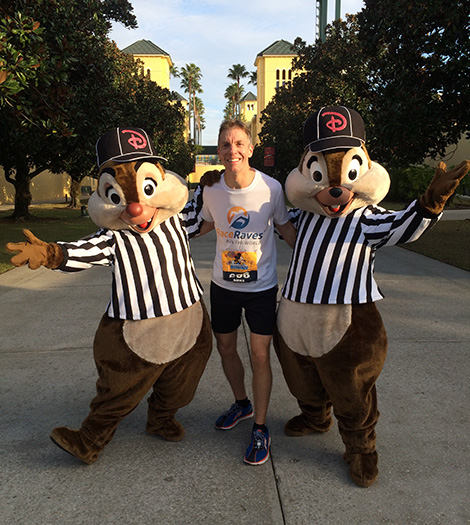
I never argue balls & strikes with umpires who don't wear pants

I never argue balls & strikes with umpires who don’t wear pants

Mile 20!  Might seem crazy what I’m ‘bout to say, but I’d been looking forward to mile 20 for the giant character marionettes lining the side of the road, expecting a repeat performance from the race’s 20th anniversary two years earlier.  Unfortunately that was then, this was now, and hopes are made to be dashed.  Nor had the organizers simply shifted the marionettes down the road two years to mile 22.  Instead, a giant video screen was set up to let tired runners waste valuable energy trying to get a momentary glimpse of themselves on camera as they rounded the corner back onto Osceola Pkwy.

Chalk up disappointment #2 of the day – though admittedly that’s more a function of me being a thankless, impossible-to-please a**hole than any fault of Disney’s.

Mike Sohaskey with Jiminy Cricket

I’d never actually been knee-high to a grasshopper cricket before

Why didn’t the pirate take his young child to the movies?
Because the film was rated “Arrr!”

Disney’s Hollywood Studios to Epcot (miles 21 to finish, i.e. the “Dopey” miles)
The final open stretch of tree-lined road followed.  Spectators at the WDW Marathon are sporadic and appear in clusters, due to the difficulty of accessing the course by either car or monorail.  So there were few spectator signs of note along the course, aside from:

  • the supportive “Blisters are braille for ‘Awesome’ “
  • the brutally honest “What were you thinking?” offered by one Disney crew member
  • the “Go faster! (that’s what she said!)” sign notable only for its curious incongruity (and the fact that a woman was holding it) – pretty sure that one wasn’t sanctioned by Team Disney’s corporate offices.

But just as every race has to have a winning runner, so does every race have to have a winning spectator sign.  And this day’s prize for most clever signage went to the woman holding up a picture of Dory (from “Finding Nemo”) with the caption, “I’ll never sign up for another… ooh, a race!”  Few signs make me laugh on the outside, but that one did.

Incredibles

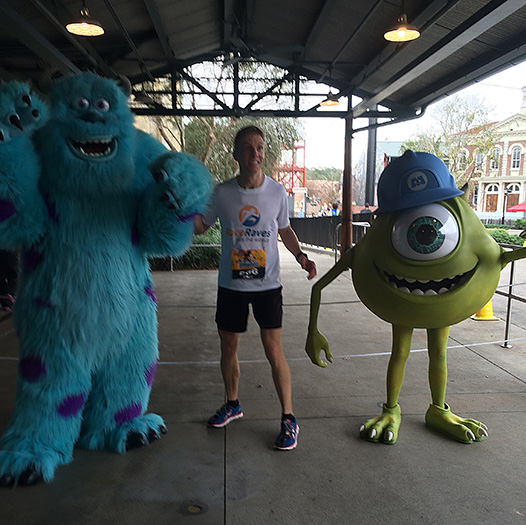
Mike Sohaskey with Sully & Mike Wazowski

By the time we reached Disney’s Hollywood Studios, the frequent starts and stops were starting to take their toll, and I could’ve used Fix-It Felix’s hammer on my upper quads.  Turns out, though, Disney had saved the best for last… and so it was with heavy legs and a light head that I struck a pose with Mr. Incredible & Elastigirl (presumably battling their mile 24 nemesis, Chronic Fatigue Syndrome) before taking one final detour to visit Sully & Mike Wazowski, the latter being the closest thing I have to a namesake.

By mile 24 I was the only runner around me still stopping for photos.  And as we weaved our way past Mickey’s Sorcerer’s Hat and along Hollywood Blvd, plenty of my comrades looked to be auditioning for the role of stiff-legged zombies.  Seeing others stop to walk late in a race is never motivating, so I focused on channeling my inner Dory: Just keep running, just keep running…
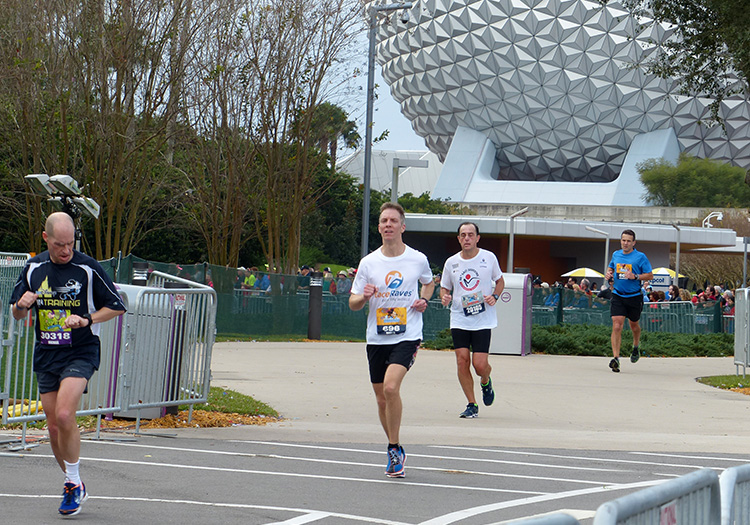
Mike Sohaskey approaching Walt Disney World Marathon finish line

I even managed to squeeze in a bit of running along the way

And keep running I did, along the boardwalk and past the charming seaside cabanas of Disney’s Yacht & Beach Club.  My brain appreciated the fact that this final 5K was run within parks and resorts, to provide a welcome distraction that wide-open roads could not.  Despite stiffening quads my stride remained comfortable, and I was passing other runners while still enjoying the experience (though I barely glanced at one final character I didn’t recognize).  The first half of mile 26 circled the World Showcase Lagoon before a hard right turn led us off the boardwalk and into the home stretch.  There, beckoning in the distance, Spaceship Earth (i.e. the Epcot golf ball) welcomed us home.  And then…

Heigh HO!

Directly ahead, the blue and gold finish arch spanned the road.  I straighted up and extended my stride to try to mask my fatigue from Katie and the other cheering spectators lining the final stretch.  And I tried to savor those last 200 yards, because the truth is I’m very lucky to be able to run, and to be able to run races like this one.  And then, in an all-too-brief 3:41:42, my 26.2-mile tour of the Walt Disney World campus was over.  Not bad when you factor in 19 photo stops.  I even managed negative splits for the first time ever in a marathon (1:52:52 first half, 1:48:50 second half), though that had less to do with the banana I’d eaten than with the fewer number of character stops in the second half.

Finish line confetti for Walt Disney World Marathon women's winner

Disney fires off confetti for every single finisher… just kidding, this is the winner of the women’s race

Why can’t you give Queen Elsa a balloon?
She’ll let it go, let it go!

Post-race afterglow (fully in-Doc-trinated after one last Bashful moment)
With shiny golden Mickey medal around my neck courtesy of a friendly volunteer, I shuffled through the finisher’s chute where I was handed water, a wet towel and a packet of acetaminophen (i.e. Tylenol).  I’ve never received acetaminophen, aspirin or ibuprofen at a race before, and this struck me as another smart Disney idea – though a surprising one, given the company’s litigious mindset.

One item conspicuously lacking from my post-race attire was the mylar heatsheet, now a standard at most marathons.  I may be mistaken, but I do believe heatsheets were reserved exclusively for the Goofy and Dopey Challenge runners.  Apparently Disney has decided runners don’t start to lose appreciable body heat until they pass 26.2 miles or $170.

3:25 pace sign in trash

My 7th grade English teacher might call this symbolism

A second friendly volunteer urged me to grab a box of snacks.  Then it was out into the Family Reunion Area to meet Katie, but not before we passed through the bag-check tent where a dozen or so volunteers cheered and applauded at the runners hobbling past.  This was admittedly embarrassing since I’d done nothing (to my mind) applause-worthy.  But like the corral-specific fireworks at the start, this was Disney’s way of creating magical moments and letting every runner know, You matter.  And in that sense it was a much-appreciated touch.

As I waited for Katie I tried to do my usual post-race leg swings, only to find that my tight quad muscle refused to cooperate – I had to manually lift my left upper leg, like a parent on the playground pulling back the swing to get their child started.  Once the leg began to swing it was fine, but the sensation of not being able to lift it without help was a new one.  Luckily, after an ice bath and good night’s sleep the leg was no worse for wear than after any other marathon.  And in the end, not getting a leg up was a small price to pay for a camera full of memories.
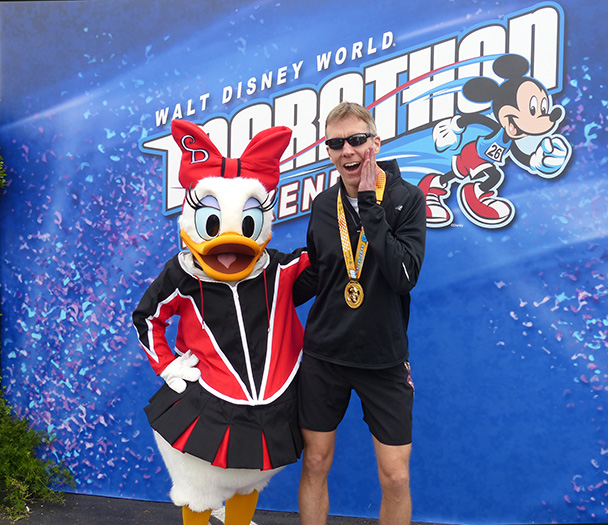
Mike Sohaskey with Daisy Duck

Watch where you’re putting that other hand, Daisy… I’m a married man!

Not that I’d maxed out on the course’s character meet ‘n’ greets – in fact I’d blown by several photo ops including the Pirates of the Caribbean, the Haunted Mansion Gravediggers, two princesses with their princes, Robin Hood and his band of merry men, and the always phreaky Phineas and Ferb.  And those are just the ones I remember.

One sound I now instantly recognize and appreciate around Disney finish lines is the chime-like clinking of medal sliding against medal bouncing off medal.  RunDisney devotees do NOT mess around when it comes to their bling, and many of them have no qualms about jetting back and forth between California and Florida several times a year to ensure they claim every race medal Disney has to offer.  FOMO is powerful, to be sure – just ask Mark Zuckerberg – but the runDisney version is like FOMO on a cocktail of steroids, Red Bull and meth. I’m sure the folks at runDisney will appreciate that loose analogy.

Us_finish line

During WDW Marathon Weekend it was possible – for those light on their feet and heavy in their wallet – to collect as many as six different medals.  So there were plenty of blinged-out, beaming runners walking tall and looking like Mr T, and I pity the fool who comes between them and their swag.

One of the best things about running is its strong sense of community, its all-inclusive mindset that embraces anyone willing to accept its challenge and to show the discipline needed to meet that challenge head-on.  And runDisney embodies that ethic as well as anyone.  As silly as this may sound, the Walt Disney World Marathon is a race for the runners, and that’s honestly something I can’t say with conviction about some of the other races I’ve run.

Katie and I hung around the finish area for a few minutes until the first drops of rain began to fall, after which we escaped to our car in time to beat the resulting short-lived deluge.  Then we said our goodbyes to Epcot and pondered our next step, though as any American sports fan can tell you, our next step was a no-brainer…


BOTTOM LINE: Speaking of no-brainers, if you’re a marathoner then the Walt Disney World Marathon is one of them.  And if you don’t believe me, feel free to read a few of the gazillion blogs dedicated to the runDisney experience.  Nobody stages a more entertaining race than Disney, because nobody can stage a more entertaining race than Disney (Th-th-th-that’s a challenge, Warner Bros).  Whereas other races rely on “loud and abrasive” for their on-course entertainment, Disney relies on its time-honored characters and theme parks.  With a couple of well-timed exceptions (“Happy” at mile 16 being one of them), the WDW Marathon speaks softly and carries a big stick.  And if you’ve only ever run a Disney race in California, don’t think this is more of the same – Florida is a completely different experience.  It’s one of the very few (only?) instances where I’m willing to concede that Florida trumps California.  That and alligator density.

I’ve heard the complaint that Disney races are too expensive – and if price is your sole criteria for judging a race, then maybe you’d be right.  But the truth is, the next runner I hear second-guess their decision to run the WDW Marathon will be the first.  Disregarding Active.com’s processing fee, my marathon registration was $170 (compared to $255 for the NYC Marathon and $195 for the Avengers Half), which by the time I crossed the finish line on Sunday felt like a bargain.  And the fact that their most expensive option – the Dopey Challenge – is also their most popular says all you need to know about the supply & demand at work here.  So if your primary concern is the $170 registration fee, I might suggest you focus less on price and more on value.

Mike Wazowski wearing Walt Disney World Marathon medal

PRODUCTION: No one produces a race better than runDisney, and they have a whopping 68-page Official Event Guide to prove it.  WDW is a race for the runners, as evidenced in every facet of the race organization with the possible exception of the 5:30am start time.  While Disney may claim the early start time helps to beat the Florida (and California) heat, it also conveniently helps to clear as many runners out of the parks as possible before the paying customers rise and shine.

There’s a fine line between “flawless organization” and “military precision”… and I might argue that at times Disney’s organization is so good as to make the process feel devoid of spontaneity.  Who knows, maybe this is the key to producing a race of this magnitude… I’m just not sure they need quite so many crew members and volunteers directing people every step of the way, from expo to race day.  Save the stanchions for Space Mountain, Disney.

That said, my race weekend went off without a hitch.  And every volunteer I met was sincerely wonderful, wonderfully sincere and clearly drinking happy juice by the tankard. I don’t plan to run WDW again anytime soon – after two of their races in two months I’m pretty Disney-ed out, and 41 other states await before a return trip to the Magic Kingdom.  Then again, when it comes to Disney I’ll never say never, even if does bring me back to Florida…

SWAG: For us “marathon only” slackers, the t-shirt was a nice black Champion tech tee.  And the ribbon on the finisher’s medal is fastened to itself by velcro, making it easy to separate ribbon from medal if that’s your preference – one final example of Disney’s unrivaled attention to detail.
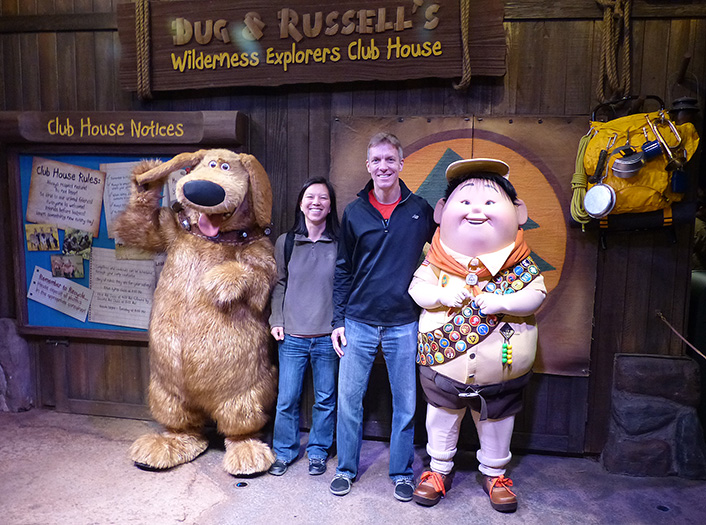
Mike Sohaskey & Katie with Russell & Dug

And they lived UP-ily ever after

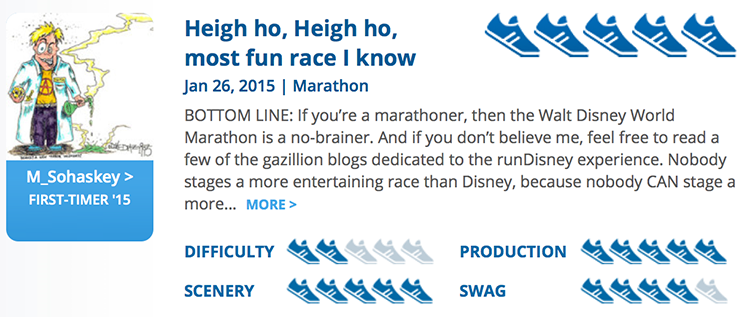
RaceRaves rating:Mike Sohaskey's RaceRaves review for Walt Disney World MarathonFINAL STATS:
January 11, 2015
26.51 miles in Walt Disney World, FL (state 9 of 50)
Finish time & pace: 3:41:42 with 19 photos stops (first time running the WDW Marathon), 8:22/mile
Finish place: 793 overall, 123/1,760 in M(40-44) age group
Number of finishers: 20,048 (9,712 men, 10,336 women)
Race weather: cool and cloudy (starting temp 54°F, light breeze)
Elevation change (Garmin Connect): 58ft ascent, 54ft descent
2016 WDW Marathon Weekend registration opens on April 28, 2015

WDW splits

For those scoring at home that’s 1:52:52 for the first half, 1:48:50 for the second half
Why couldn’t Pheidippides have died at 20 miles?
– Frank Shorter

CIM start line

“Go!” time in Folsom

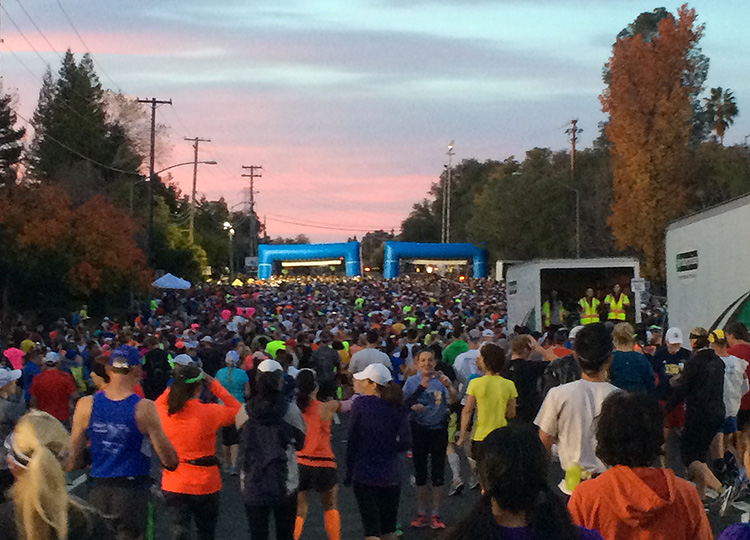
The sun awoke in the eastern sky over Folsom to find a captive audience waiting. Six thousand or so brightly clad disciples all faced toward mecca, in this case the state capitol in Sacramento and the finish line of the 32nd California International Marathon. Rosy tendrils peeked through wispy cloud cover above the start line porta-potties, bathing the compression-clad and KT-taped congregation in muted light. And here, as I parted the sea of 6,000 fellow runners to line up alongside the 3:25 pacer, I felt strangely relaxed. Curiously comfortable. And right where I belonged – like a Twinkie in a fat kid.

I was looking forward to CIM as what I hoped would be the star atop my 2014 racing tree. Not that I’d done much to advance that agenda – my five weeks since New York City had basically amounted to one long taper, with no legit speed work and no long run over 16 miles.

But it was the past two weeks that had me most concerned, a 14-day whirlwind of skipped meals and skewed sleep patterns leading up to the public launch of RaceRaves just 120 hours before race day. The timing was unfortunate but unavoidable, and it enabled me to arrive at the CIM start line having launched a website that Katie and I (objectively) feel is already among the best online resources for runners to find, discover, rate, review and organize their races. Now, as the expressive female vocalist nailed the “la-AND of the FREEEEEE” as all good National Anthem singers should, I was hoping the training I’d banked for Berlin and NYC would cover for my recent self-neglect.

Of course, Berlin and New York might be part of the problem rather than part of the solution. Having run two fast-ish marathons in the past 70 days I was more or less daring my legs to revolt, to suddenly up and decide “We’re good, see you in 2015!” On the bright side, I hadn’t flown 5,800 miles across 9 time zones to be here as I had for Berlin, nor even so much as the 2,500 miles across 3 time zones we’d traveled for New York’s 50,000-person, five-boroughs party. So maybe home-field advantage would play in my favor today.

I could’ve debated endlessly the pros and cons of running CIM, but Steve Jobs said it best: the only way to find out what’s possible is to try. (In Northern California it’s de rigeur  to ask, WWSD – What Would Steve Do?)

So here I was in Folsom, about to find out what was possible. Three factors had prompted me to give CIM another shot after a memorable PR effort (at the time) with several friends back in 2011: 1) I had no races scheduled in December; 2) we’d be in the Bay Area that weekend anyway for our nephew’s 7th birthday; and 3) CIM has an exclusive October registration window for runners chasing a Boston qualifying time.

Normally CIM sells out several months before its early December race date; however, the race organizers now offer post-sellout registration in October to prospective Boston Marathon qualifiers who have recently completed a marathon within 10 minutes of their Boston qualifying time. Granted I’m biased, but this BQ late-registration window is a cool idea that more race directors should and probably will emulate to attract runners.

For me, my current Boston qualifying time is 3:15:00 (although next year it downshifts to 3:25:00) – so having run a 3:24:14 in Berlin, I qualifed for this late registration window. Despite the increased registration fee, I opted to sign up with a “what the heck, we’ll be in the neighborhood anyway” mindset.

The Tower Bridge, a Sacramento landmark

The Tower Bridge, a Sacramento landmark

Start to mile 20: Easy peasy…
Despite the hopeful inclusion of the word “International” in the race name, the word “California” does precede it for good reason – based on pre- and post-race conversations, the field now streaming under the dual blue starting arches would be largely Californian, with little of the global flair of my previous two marathons.

As my final 26.2-mile journey of 2014 began on an immediate downhill trajectory, I savored the sparse crowds and the cool, crisp Northern California air. Weather-wise this would be a perfect day for a group run with 6,000 friends, as the groggy sun had already renewed its morning slumber, leaving a pallid overcast sky to watch over us.

The elbow room all around me stood in (elbow joke!) sharp contrast to New York City, which reminded me of a stat I’d heard at the race expo on Saturday: whereas New York last month had hailed its one millionth finisher in its 44th year, on this day CIM in its 32nd iteration would celebrate its 100,000th finisher. Turns out this was Ann Mueller, appropriately a Sacramento native who finished in 4:45:56 and received a VIP Entry Package for CIM 2015 for her efforts.

The smaller field size is a key reason CIM comes highly recommended, particularly for those hunting that elusive BQ prey. No doubt the organizers at the Sacramento Running Association (SRA) could greedily squeeeeeeze a few thousand more runners into the start line area, or institute a corral system with different waves and start times. Rather than chasing the $$$, though, the SRA has chosen to keep the field size small and manageable, which to my mind significantly improves the race experience.

Just like heaven at miles 6 and 11

Feeling just like heaven at miles 6 and 11

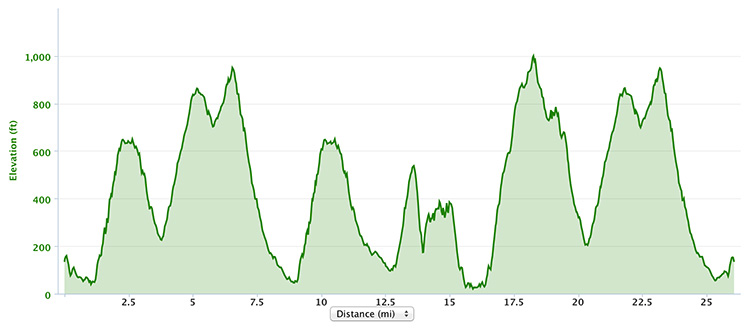
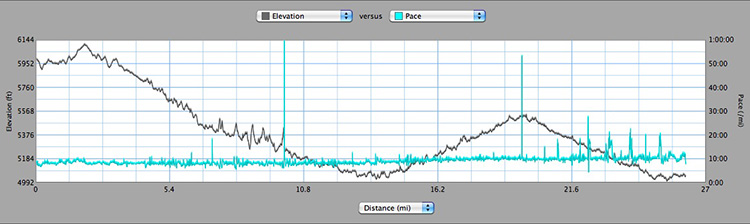
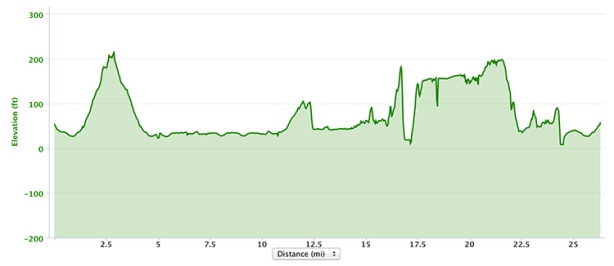
The other main selling point of CIM is the course layout – and this is a good time to mention that this race report is brought to you by the word “net”. As in, the organizers trumpet CIM as a net downhill course beginning at 366 ft and finishing at 26 ft above sea level. Which is absolutely true – only the shortest distance between those two points isn’t a straight line.

CIM has no shortage of rolling hills, particularly in the first half and more specifically in miles 8, 11, 12 and 13. These hills are noticeable, though none were severe enough to affect my pace, and in fact I appreciated the rolling terrain for the respite it afforded my hip flexors. Berlin’s crazy-flat course may allow for fast times, but running on invariably flat asphalt can lead to discomforting tightness caused by recruiting the same muscle groups in the same way for 26.2 miles. So I actually found myself appreciating the brief up and down stretches in the first half of CIM, which reminded me of the three wine country races I’d run in the Bay Area and Santa Barbara.

I’d calculated my ideal 5K splits and wore them taped around my wrist. On Dan’s advice I’d planned to track them in lieu of mile pace times, though I soon realized the course lacked regular 5K markers (these would be a nice addition next year, especially as the race continues to woo BQ wannabes). At any rate, this just didn’t feel like a “live by the watch, die by the watch” type of race. Instead, I monitored my early mile times to avoid doing anything stupid, and after finding my rhythm resolved to run as comfortably hard as I could for as long as I could – while keeping the 3:25 pacer in my rearview mirror.

The one conspicuous downside to CIM is the (lack of) scenery. The 20 miles that separate Folsom from Sacramento are best described as “nondescript” – nondescript suburban roads passing an endless procession of nondescript strip malls. Orangevale, Citrus Heights, Fair Oaks and Carmichael – civic planners could rearrange these towns in any random order, and even their residents would be hard pressed to tell the difference. Like trying to tell Santa’s first eight reindeer apart. CIM is suburban America… but with that monotony comes a sense of inner calm I can’t get running through an urban juggernaut like Chicago, L.A. or New York.

Fighting crime can be tough for a super-hero living in the suburbs, with no tall buildings to swing from

Fighting crime can be tough for a super-hero living in the suburbs, with no tall buildings to swing from

Given the sameness of scenery, I focused instead on the spectators – the older fellow sporting a white tutu, the ram mascot in a “Volunteer” t-shirt, the tiny future runners gleefully lining the street with hands extended, hoping to earn a sweaty high-five for their troubles. For those with their own cars, CIM is an easy course to spectate – as in 2011, Katie stayed north of the course and had no trouble catching me at miles 6, 11 and 18. This ease of spectating was nowhere more apparent than for the ubiquitous woman I saw at three different locations waving a sign that read, “It’s a 10K with a 20-mile warmup!” I nodded in agreement, not realizing how prescient her sign would be.

Cowbells jangled, spectators cheered and the instantly recognizable electric-guitar chorus of “Do You Wanna Dance?” (more Ramones than Beach Boys) greeted us as the miles ticked off. Another tree-lined neighborhood, another gas station, another Subway sandwich shop. Eat fresh, Citrus Heights. Eat fresh, Fair Oaks. Eat fresh, Carmichael. Two spectator signs stuck in my head, the first for its much-appreciated candor (“Keep going! You’re NOT almost there!”) and the second because its esoteric message hit too close to home (“Run like your thesis depends on it!”).

On race day my stomach is typically my canary in the coal mine, and the earliest predictor of rough seas ahead. So when it staged its first mild protest sometime after mile 10, I was chagrined but hopeful it would quiet down enough to let me reach the finish line. But the collywobbles only got worse, forcing me into a pitstop immediately after mile 14. Up to that point I’d been cruising along comfortably at a roughly 7:30/mile pace, and this was my first indication that the machine I was operating might be less finely tuned and not as well-oiled as I’d hoped.

That, as it turns out, was an understatement.

Trying to hail a cab at mile 18, while the fellow behind and to my left primes for takeoff

Trying to hail a cab at mile 18, while the fellow behind to my left primes for takeoff

Mile 21 to finish: … can I stop now, pleasey?
Mile 20 of the marathon represents The Wall – not the Pink Floyd version, but that juncture in the race when unreplenished carbohydrate stores start to dwindle. In the case of CIM, mile 20 also doubles as the gateway to Sacramento – here suburban sprawl gradually gives way to progressively taller buildings and more narrow streets.

The marathon relay at CIM draws a huge number of runners, and soon after the mile 20 marker we passed the third and final relay exchange point of the afternoon. Like the first two, this one was raucous and alive with the anticipation of restless runners awaiting their incoming teammates. Several relay runners blasted past me out of their chute (meep! meep!), presumably fueled by the raw adrenaline of knowing less than 6 miles separated them from the finish line.

Mile 21, and though everything typically slows down 21 miles into a marathon, I’d reached the 20s feeling strong and in solid position for another PR.

And then…

BONK

I wish I could explain what happened next. I wish I could put my finger on why the well ran dry, why the engine ran out of steam, why I started writing in metaphors. Maybe those two whirlwind weeks leading up to race day were to blame. Maybe it was the hubris of trying to fit just one more fast marathon in at the end of the racing season. Or maybe it just wasn’t my day (though what that means scientifically speaking, I’m not sure).

Nothing about my pre-race or race-day routine had changed. I’d topped off my carbohydrate stores the night before, eaten the same granola-yogurt-peanut butter concoction I eat before every race, and even started popping Shot Bloks earlier in the race than usual, just in case. Who knows, maybe it was this routine that ensured I even made it to mile 21 at all.

In any case, what happened next wasn’t pretty, it wasn’t funny, and it was unlike anything I’ve experienced (on the roads, anyway) since my rookie marathon at Long Beach over four years ago. I just kept… slowing… down.

This view couldn’t come soon enough (the Tower Bridge can be seen in the background)

This welcoming scene couldn’t come soon enough (the Tower Bridge can be seen in the background)

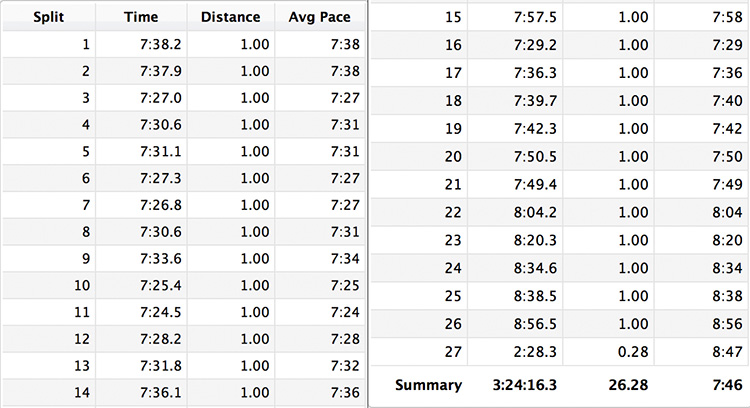
As we crossed the J St. Bridge over the American River and into urban Sacramento, mile 22 became my first 8:00+ mile (8:04). And if the net downhill of the next four miles were a movie, it would be “Slow and Slower”. At no time during this stretch did I glance at my Garmin… what was the use? It wasn’t as though I was holding something back, carefully pacing myself until the clouds parted and the “Chariots of Fire” theme resonated from the heavens, inspiring a finisher’s kick that was lying in wait, like a coiled snake, just waiting to strike.

Mile 23 passed in 8:20.

My entire focus shifted to simply not stopping. Not on trying to maintain pace or even speed up in the face of escalating fatigue, but on a goal as basic as moving forward. So much easier writ than done. In Berlin my brain had tried unsuccessfully to persuade me that 22 (or 23, or 24) miles was plenty, and that I deserved a walking break – hey slow down, take in the city, when will we be back in Berlin? But at CIM, even more than my brain it was now my body urging me to pull over and take a well-deserved breather.

Mentally I shifted focus, assessing my body head to toe, scanning for any sign of an ally in this battle. Hey, my ears still felt pretty good. So did my teeth. And with my shoes tied much less tightly than in Berlin, the tops of my feet could easily knock out another ten miles, at least.

Mile 24 crept by in 8:34.

We interrupt this downward spiral for a sweet slice of Americana, seen during our lunch stop

We interrupt this downward spiral for a sweet slice of Americana, seen during our lunch stop

There comes a point in every marathon where spectator support takes the form of blatant lies. An earnest fellow to our left hollered, “You’re having so much FUN!!!” Honestly, I’m having +/- ZERO fun.

From the other side of the road came another shout: “You’re all making this look so EASY!!!” Are you watching the same race I’m running?

Mile 25 trickled by in 8:38.

Strong-legged, relaxed-looking runners floated past me on either side, looking like gazelles bounding past the sick member of the herd who would ultimately become dinner for some lucky lion. Something wasn’t right here, something was definitely out of place, why – then it hit me. Relay runners. I felt a spike of relief knowing I hadn’t missed out on some magic speed-restoring elixir at the last aid station.

Less than a mile to go. I am actually going to finish this. Has the 3:25 pacer passed me yet? Glad I don’t have to watch myself right now, my form feels awful. Glad I don’t have to watch myself ever, how boring would that be? Poor Katie. No check that, lucky Katie, she’s waiting at the finish. Next time will be different. #lessonlearned. Did I just hashtag my thoughts? My teeth are starting to hurt.

Mile 26 oozed by in 8:56, and looking back at my splits, I claim as a moral victory the fact that I kept this final mile under 9:00.

Floating toward the (men’s) finish line on the final turn

Floating toward the (men’s) finish line on the final turn

I kicked in the jets for the final stretch, covering the last 0.28 miles at a breakneck 8:47/mile pace. I could feel myself crossing the center line as my stride degenerated and a feeling of light-headedness washed over me. By the time I crossed the finish line (men to the right, women to the left, a CIM exclusive), I had no idea what news – good or bad – my Garmin held in store for me. As the spots in my field of vision dissipated, I exhaled and glanced down at my wrist.

3:24:16. Official time 3:24:15 – one second slower than my Berlin PR.

I’d just run 26.2+ miles – the last five feeling like a water buffalo, and the last 20 without glancing at my watch once – and missed my PR by a single second. Insult to injury, my Garmin congratulated me on my best marathon time ever, having clocked an unofficial 3:24:17 in Berlin.

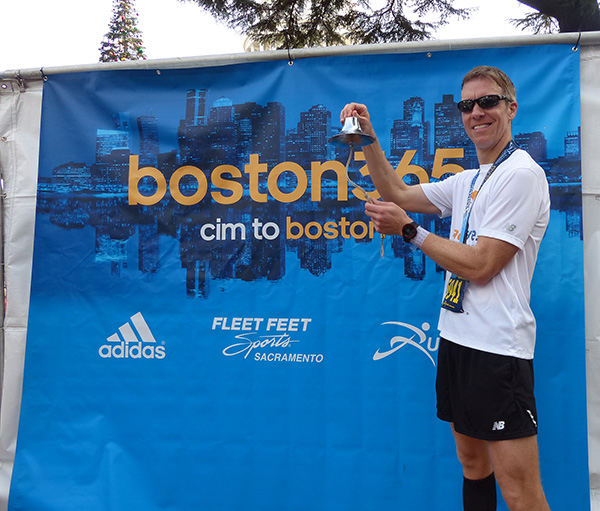
Damn right I’ll ring that Boston bell, every chance I get

Damn right I’ll ring that Boston bell, every chance I get

As I thanked the teenage volunteer for my medal, a frenzy of conflicting emotions flooded my head. Should I be pleased with my second-fastest marathon ever? Or frustrated by not having taken advantage of a cool day on a fast course? Pleased that I’d qualified twice for Boston in less than 70 days? Or frustrated that I hadn’t nailed down a more convincing BQ the second time? (if you’re confused by what it means to “qualify” for Boston, see my Berlin Marathon report). Both emotions heated my blood and frayed my nerves . And as I write this I still feel very much… plustrated.

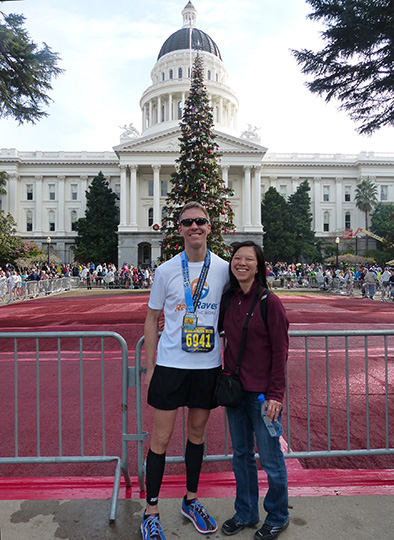
Drifting through the finish chute wrapped in my heat sheet, I emerged in front of the capitol building where I reunited with Katie – always the best part of any race. We wandered the finish area around a fenced-off Christmas tree, appreciating the small-town feel and snapping our traditional finish-line photo, a photo we’d been unable to take in either Berlin or New York. No doubt, it felt good to be home.

Celebrating a capital day in the capitol city

Celebrating a capital day in the capitol city

Later, at our niece’s basketball game, our newly 7-year-old nephew asked to see the CIM medal that, in our haste to get back from Sacramento in time, still hung around my unshowered neck. He turned it over in his hand. “Did you win?” he asked.

I thought about his question, and about my day. The promising first 20 miles, followed by a final 10K that left me crossing the finish line with a head like a helium balloon. Another golden opportunity to nail down a Boston qualifier, sabotaged by a convergence of events that left me unable to properly respect the marathon distance. Yet at the same time, a near-PR effort and an inarguable performance given the circumstances… although I hate the phrase given the circumstances.

No doubt time will recalibrate my warped perspective. It’s easy to take a disappointing race personally, to imbue it with far more meaning than it deserves. Truth was, I’d wrung a lot out of my body in 70 days – I’d slammed into two (figurative) walls 5600 miles apart and in both cases kept pushing, refusing to concede as every myofiber and brain cell screamed at me to call it quits and walk it in. Truth was, 2014 was the year I made the 3:25 marathon my new norm, and set the bar even higher for 2015. Truth was, CIM was all part of a process that couldn’t (and wouldn’t) be rushed. And the truth was, I couldn’t rationally argue with the day I’d just had, no more than I could with the earnest little boy now sitting in my lap.

“Yeah,” I responded, his small but strong heels bouncing off my shins. “I guess I did.”

He’s a tough little critter to shake

He’s a tough little critter to shake

BOTTOM LINE: Six letters to sum up six pages: run CIM. The organizers bill their marathon as the “fastest, friendliest, most spectacular course in the West!”, and they may well be 2/3 right. Suburban monotony notwithstanding, the net downhill course is PR-friendly and offers just enough variety (i.e. hillage) in the first half to keep the legs guessing. From its readily navigated expo to its easy start line access to its cowbell-toting spectators, CIM is a first-class marathon that doesn’t sacrifice its relaxed, small-town vibe. The field size (5,805 finishers this year) is very reasonable, not to mention fast – my 3:24:15 placed me in 997th place. Spectators and musical entertainment along the course maintain the low-key feel of the race, being supportive but not oppressively so. And weather conditions have been ideal both years I’ve run, although December typically is the rainy season in Northern California (a reality Jen experienced first-hand in 2012).

For runners looking for a year-end marathon in the first week of December, I wouldn’t hesitate to recommend either CIM (if you’re partial to roads) or The North Face Endurance Challenge Championship in SF (if you’re partial to trails). Both are terrific, well-produced races.

CIM medal

PRODUCTION: Don’t be fooled by its lack of bells (except cowbells) & whistles – race production for CIM is among the best you’ll find anywhere. And though there’s never a perfect race, clearly the SRA puts a lot of hard work into chasing that goal.

Take my 40-minute journey from hotel (in nearby Rancho Cordova) to starter’s pistol: Katie drove me ~15 minutes to the start-line shuttle pickup point, where I hopped aboard one of the last departing shuttles at 6:40am, arrived at the start line at 6:50am, made a quick pitstop at one of the abundant porta-potties (more proof of CIM’s keen attention to detail – porta-potties nearly as far as the eye can see), surrendered my drop bag and lined up alongside the 3:25 pacer by the time the National Anthem faded on the breeze. Now THAT’S customer service.

The race’s late-registration window for BQ wannabes is, to my knowledge, another CIM exclusive. This is a pretty genius idea on the SRA’s part, one I’d anticipate other race directors adopting in the not-too-distant future.

SWAG: This year’s shirt is a nicely designed, dark blue long-sleeve cotton tee and admittedly one of the few race t-shirts I’ll wear with any regularity after race weekend. And the finisher’s medal is a stylish periwinkle-and-gold souvenir with the capitol building and Tower Bridge emblazoned across a gold “CIM”. All in all, a nice collection of parting gifts.

RaceRaves rating:CIM review on RaceRaves
FINAL STATS:
December 7, 2014
26.28 miles from Folsom to Sacramento, CA
Finish time & pace: 3:24:15 (second time running the California International Marathon), 7:46/mile
Finish place: 997 overall, 146/552 in M(40-44) age group
Number of finishers: 5,805 (3,231 men, 2,574 women),
Race weather: cool and cloudy (starting temp 48°F)
Elevation change (Garmin Connect): 317 ft ascent, 654 ft descent

CIM splits

cim-elevation-profile_bch

On CIM’s net downhill course, the keyword is “net”

It is only exceptional men who can safely undertake the running of twenty-six miles, and even for them the safety is comparative rather than absolute…. For the great majority of adults, particularly in an urban population, to take part in a Marathon race is to risk serious and permanent injury to health, with immediate death a danger not very remote.
The New York Times, “Marathon Racing Dangerous”, February 24, 1909

Get Your Signage On
You’re going to need a bigger bridge.

Sure I’d seen the pictures, and so I knew all these runners really would fit (in waves) on the Verrazano-Narrows Bridge. And yet gazing out over the huddled masses yearning to breathe free – the shivering runners who covered seemingly every square inch of Fort Wadsworth on Staten Island – I understood how Police Chief Brody must have felt upon seeing his great white shark breach the water’s surface for the first time.

Puny. Overwhelmed. And wholly exhilarated.

Admittedly New York City and I don’t see eye to eye. As the country’s biggest cities go, L.A. is our home for its year-round sunshine and creative culture, Chicago beguiles with its Midwestern affability and striking architecture, and Houston imprinted me with some of my fondest memories for having spent my college years there.

New York City, though, has always filled me with meh. Subway stations infused with the waft of indifference and the unmistakable stench of… seriously? A half-full (or is that half-empty?) coffee cup thrown from a passing car that lands at our feet on a stroll through industrial Brooklyn. Piercing screams of “Shut the fuck up!!” exploding from the open windows of a battered black sedan as it accelerates through the intersection in front of us to beat a red light. Car horns that seem a natural extension of their driver’s arm, and which raise stress levels far more often than they raise awareness. And in the summer months, urban “drips” that {bloop} on your head unannounced and which you can only hope came from that overhead A/C window unit.

Speaking of the summer months, being a Red Sox fan doesn’t help to nurture a love for New York.

Like its residents, a city that never sleeps starts to get bloodshot in the eyes and ragged around the edges. Its reaction times slow and its patience thins. It requires ever more caffeine and adrenaline to maintain its façade of invulnerability. And Times Square, with its perpetual luminescent glow, gaudy advertising and food carts selling soggy hot dogs at 2:00am, starts to look and feel an awful lot like the Vegas strip.

As if that weren’t enough, the Shark Foundation tells me I’m 10x more likely to be bitten by another human in New York City than by a shark anywhere.

So the upshot is that blasphemous though it may be, I don’t ❤ NY. And yet, if you chum the autumn waters with the world’s largest annual 26.2-mile running party, you can bet I’ll bite hard. At least once.

Scenes from NYC - (C) Mike Sohaskey

Scenes from the NYC (clockwise from upper left): the Rink at Rockefeller Center; Lady Liberty, seen from the Staten Island ferry; Central Park; the Empire State Building dominates the night skyline

I’d arrived at the start line of the 2014 TCS New York City Marathon via a more circuitous route than most of my fellow runners. This had nothing do with the 6-hour flight from LAX to JFK, the 60-minute rush-hour cab ride from JFK to Brooklyn, the 15-minute subway ride from Brooklyn to Manhattan, the 30-minute ferry ride from Manhattan to Staten Island and the 30-minute bus trip to the start line at Fort Wadsworth. Rather, after failing to gain entry via the New York Road Runners (NYRR) lottery system for the past three years (at $11 a pop), I was able to invoke their excellent “3 strikes and you’re in” policy. Meaning that having lost out in the lottery for three straight years, I was automatically accepted for the 2014 race.

Apparently this rule rubbed someone at NYRR the wrong way, because 2014 would be the last year they’d honor it. So despite the fact that I’d just run another huge World Marathon Major in Berlin five weeks earlier, my timing for NYC would be perfect.

We’d arrived at our hotel in Park Slope, Brooklyn on Thursday evening. On Friday, after lunching at a super-speedy Chinese dumpling restaurant in downtown Brooklyn, we’d spent a cool and cloudy afternoon on the other side of the East River in Manhattan. There, as all good marathoners do, we’d attended the pre-race expo in the impressive glass belly of the Javits Convention Center.

Mike Sohaskey - World Marathon Major #3!

They say you never forget your third…

Clearly a lot of forethought was given to the expo’s design and execution, because it was surprisingly intimate and easy to negotiate. All sponsor booths were contained within one reasonably sized conference hall, where upon entering we immediately found ourselves in the registration area. There, after a zero wait time to pick up my race number, drop bag and t-shirt from friendly volunteers, we were channeled through the Asics store where colorful racks of official marathon merchandise stretched in all directions. Diffusing into the expo proper, a thirsty Katie appreciated that water (courtesy of Poland Spring) and Gatorade greeted attendees exiting the Asics store. Other booths laid out the usual free samples of protein bars, Stinger waffles, electrolyte drinks and smoothies. BERLIN ARE YOU PAYING ATTENTION?

A separate hall upstairs hosted various NYRR presentations and appearances (e.g. Kathrine Switzer). And speaking of halls, Ryan Hall was scheduled to appear at the Asics booth on Friday, since apparently he doesn’t run the actual race anymore. Then again, American marathon record holder and 41-year-old bad-ass Deena Kastor also appeared at the Asics booth that same day, before finishing as the third American woman in Sunday’s marathon.

New York City Marathon stats from Expo

From these stats I learned 1) as in life, men fade sooner than women in the marathon (upper left); and 2) NYC is understandably popular with first-time marathoners (lower right)

The expo consisted primarily of large corporate sponsors – TCS (TATA Consulting), Gatorade, Poland Spring Water, Oakley, PowerBar, GU, Saucony, runDisney, The North Face, Tag Heuer and even Tiffany – along with a smattering of smaller players, such as Altra and Vitamix. The highlight of our expo time was a visit to the Marathon Tours & Travel booth to catch up with Thom, Scott and Jeff… always great to see those guys preaching the globerunner’s gospel to a receptive audience.

From the expo we walked straight to the Theater District, where we enjoyed dinner in the excellent company of fellow traveling runners and Antarctica/Berlin buddies Jeff and Susan. Jeff and Susan are the type of folks you hope to meet as a traveling runner – very fun, call-it-like-they-see-it couple with a much-appreciated edge to them, and always with entertaining stories from their travels. After a meal that flew by way too quickly (and which ended with Jeff recounting his awkward meeting with a couple looking for a good time in a Vegas hotel pool), we ventured out to catch the Halloween night freakery around Times Square.

Mike Sohaskey and Katie Ho at dinner with Jeff & Susan at Lattanzi

Susan, me, Jeff and Katie at Lattanzi

It didn’t disappoint. Looking at the pint-sized superheroes on one hand and the blood-soaked zombies on the other, it struck me that nowhere is the stark difference between a child’s and an adult’s mindset more apparent than in their Halloween costumes. My favorite was the fuzzy, three-foot-tall great white shark with menacing teeth and an impressive dorsal fin, sobbing in its mother’s arms after swimming right into the sidewalk. Clearly this predator was of the “Fish are friends, not food” lineage. But the most memorable exchange was overheard on the stairs of the subway station heading back to Brooklyn:

Dude #1: “Hey, you get my mask?”
Dude #2: “What’s that?”
Dude #1: “My mask! My mask! My mask! Did you get my mask?”
Dude #2: “IDIOT! It’s on your fucking HEAD!”
Dude #1 (feeling for the mask atop his head): “Aw, maaaaaaan…

Saturday would have been the calm before the storm, except that an actual storm rolled in early and dropped rain for much of the day. In any case we spent the day close to home, joining friends Eric and Betsy and adorably rambunctious 3-year-old Phoebe for brunch at their stylishly decorated loft condo, which overlooks the Gowanus Canal and offers breathtaking views of the Manhattan skyline.

The rest of the afternoon was spent pounding out work at a café and strolling the cold, wet and windy streets of Brooklyn. That evening we settled in at Broccolino, a comfortably authentic Italian restaurant across the street from the Barclays Center (home of the New Jersey Nets) for my customary carbo-loading session. Another diner passed our table and instantly identified me as a runner, saying “You look like you’ve done this before.” He seemed like a pleasant and earnest fellow, so without further elaboration I chose to accept this as a compliment.

Back in our hotel room I organized my race-day gear, along with the extra layers needed to weather the two-hour wait outdoors on Staten Island. On the bright side, thanks to either lucky coincidence or shrewd planning by the NYRR, we’d be gaining an extra hour overnight with the end of daylight savings. Settling into bed for an extravagant 6½ hours of sleep, I lay in the dark listening to the Ghost of Marathons Yet To Come whistling and howling outside our window.

Getting there is half the battle (and half the fun)
And a restless ghost it was, as Sunday began just as Saturday had ended – dark and windy. If my iPhone alarm were not insisting it was 4:50am, I would have guessed I’d just fallen asleep. T minus 4 hours, 50 minutes until marathon start. Pulling aside the curtains, I was pleased to discover that at least the rain had subsided, which would make the wait on Staten Island significantly more tolerable, if not quite comfortable.

Methodically I dressed, donning my RaceRaves t-shirt along with black arm sleeves (for warmth) and calf sleeves (for compression). Jamming my gear into my drop bag along with my standard granola/yogurt/peanut butter breakfast for later, I bid Katie farewell until mile 6, when the course would pass in front of our hotel. Then I embarked on the subway-to-ferry-to-bus-to-start line journey that is a logistical hallmark of the NYRR’s flagship race.

Groggily poking at my phone on the near-deserted subway, my first real sense of forboding arrived as an email from the NYRR:

Due to high winds, we are reducing the amount of tenting, directional signage, and other structures at the marathon staging areas at the start, along the course, and at the finish.

Good thing I’d left my running cape back in California.

Staten Island Ferry - (C) Mike Sohaskey

Even in my groggy state at 6:15am, this was hard to miss

Twenty minutes later, listening to the animated chatter around me while awaiting the Manhattan ferry to Staten Island, I recalled Dan’s half-joking reference to NYC as the “Europe Descends Upon America” Marathon. Nowhere else in the U.S. have I ever been so grossly unable to eavesdrop. Myriad languages and conversations jostled for space in the crowded terminal, and only the PA announcer and the clearly readable ads decorating the walls confirmed I was no longer in Berlin.

My second real sense of forboding came on the ferry ride, when I stepped outside momentarily to snap a photo of the Statue of Liberty. Instantly my cheeks felt bombarded by tiny ice daggers, my eyes began to water and my nose began to run its own race.

You may think it’s funny that my nose was runny… but it’s snot.

Roughly an hour later, after a protracted but uneventful bus ride from the ferry terminal to Fort Wadsworth, I stood scanning the area where the “blue” runners gathered. (Runners are typically organized into three groups by color: blue and orange runners start on the upper deck of the Verrazano-Narrows Bridge, green runners start on the lower deck.) Although an orange runner myself, I was now in search of Otter, who’d been assigned to blue and had caught an earlier ferry. According to his Saturday text he’d be wearing a royal blue long sleeve shirt and dayglo orange running cap, a bright combination I figured would stand out in even a crowd this size.

Turns out the running gods have a wicked sense of humor.

Many among the assembled masses wore their official race shirt, an attractive royal blue long sleeve tee. Many others wore pom beanies bearing the orange-and-pink color scheme of race sponsor Dunkin’ Donuts. Hunting for Otter in the royal-blue-and-orange throng brought to mind the final museum scene from “The Thomas Crown Affair”. Admitting defeat and still needing to check my drop bag, I headed grudgingly toward the orange gathering area.

Did I mention I had 50 minutes to kill in a crowded corral

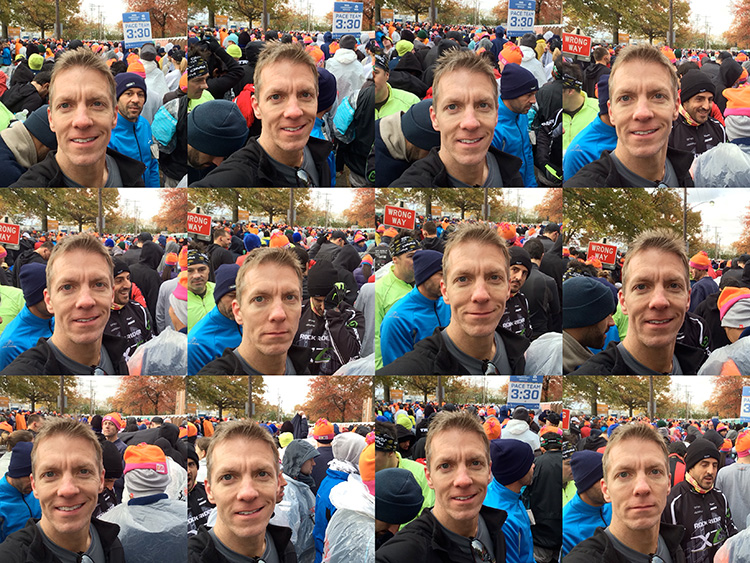
I had a “burst” setting and 50 minutes to kill in the start corral

Thirty minutes later I stood in my start corral, where all orange runners in Wave 1 would remain for another 50 minutes until race start. Luckily the corral was largely shielded from the wind. As in the ferry terminal, excited chatter in a thousand (or so) languages added to the electricity. I’d shed all my non-running clothes except for light gloves and January’s Mississippi Blues Marathon fleece with the broken zipper. Waiting in line for the porta-potty, I had to admit ignorance (if not indifference) to a fellow who saw the logo on my fleece and asked who’d won the Mississippi State vs. Arkansas football game.

Not knowing what to expect with the high winds, and planning to carry my iPhone so I could take pictures along the course, I lined up near the 3:30 pacer as a starting point.

Verrazano-Narrows Bridge at New York City Marathon start

Yes people of the world, RUN! Run from me and my mighty iPhone camera!

Staten Island start
Finally, at around 9:30am, the corral surged forward toward the direction of the Verrazano-Narrows Bridge and the waiting start line. Outer garments of all colors and sizes were discarded in the Goodwill bins, my own fleece among them. My prize for “most expendable garment” goes to the woman wearing a “Kerry/Edwards Iowa Election Team 2004” fleece with the price tag still attached.

In the distance the final notes of the “The Star-Spangled Banner” drifted faintly toward us before being whisked away on the prevailing gusts. Adrenalized runners jogged toward the start line, only to endure another “hurry up and wait” moment as race organizers made last-minute announcements over the PA, introducing Mayor Bill de Blasio and (twice) the elite runners.

Unlike the clear skies we’d left behind in Manhattan, a patchwork quilt of gray clouds had gathered over Staten Island and the Verrazano-Narrows. The weather – well, I’ll let The New York Times describe it:

The runners were greeted with a sunny day for the marathon, in contrast to Saturday’s rain and gloom, but it was cold and windy for the entire race. The temperatures poked into the mid-40s, and the winds were about 31 miles per hour at the start but gusted to nearly 50.

Nearly five hours after I’d awoken in the dark in Brooklyn, the starter’s pistol fired at last. Months of mounting hype and anticipation coursed through my body. My legs awoke from their four-day slumber and fired to life, carrying me confidently out onto the bridge…

… and into the teeth of Mother Nature’s ferocious lung power. After 60+ races, the wind on the Verrazano-Narrows was unlike any I’ve ever raced in. In fact, concerns over wind strength had compelled race organizers to shorten the wheelchair and handcycle races by three miles and move their start line to the Brooklyn side of the bridge. I can see how having your challenged athletes blown into the East River might make for a suboptimal race and some bad publicity.

Dunkin’ Donuts hats soon littered the road bed, and “tempest-tost” runners pushed forward with one hand on their chest as if to prevent their safety-pinned numbers from taking flight. With my head focused on battling the wind and struggling not to be blown off balance, I never felt the steady incline that makes mile 1 among the steepest on the course. At the same time I soaked up the scene around me – on Jeff’s recommendation I had begun on the left side of the bridge with the Manhattan skyline visible in the distance. Now I drifted cautiously toward the center divide to capture the runners streaming toward and away from me.

I glanced down as my Garmin chirped and vibrated to signal the end of mile 1 in 8:49. This certainly wasn’t beginning like a 3:30:00 marathon (average pace 8:00/mile)…

New York CIty Marathon - Brooklyn on 4th Ave

Heading north on 4th Avenue, with One Hanson Place on the horizon

Brooklyn
After mile 1, the bridge’s steady incline transitioned into a gradual decline, finally dropping us down into South Brooklyn. Here sunnier skies and gentler breezes greeted us on the six-mile trek north along 4th Avenue. Miles 2-8 passed through largely commercial/industrial neighborhoods, with One Hanson Place (formerly the Williamsburgh Savings Bank Tower) standing tall in the distance.

I distracted myself by scanning the spectators to my left, in the hopes of glimpsing Eric with Phoebe atop his shoulders cheering from the sidelines. I wasn’t sure where to expect them, and of course they could be on the right side of the road, in which case I’d miss them completely. At the same time I tried to appreciate the abundant spectator signage, while mentally filing away three of my favorites:

Restrooms are conveniently located at the finish!

If a marathon were easy, it would be called your Mom! (i.e. “Welcome to New York!”)

You are my density, Kosuke.

And I’ve gotta admit to enjoying the “big head” signs that spectators create for their favorite runner. If I saw a ginormous and disembodied image of my face bouncing up and down on the sidelines, I’d speed up if for no other reason than to escape the horror.

Approaching mile 6, my attention turned to where Katie waited outside our hotel on the (agreed-upon) left side of the road. The bluster atop the Verrazano-Narrows had yielded to now-perfect running weather, and I tossed her my gloves which by that point served only to hinder operation of my iPhone.

New York City Marathon elite packs (men and women) at mile 6

The men’s (not surprisingly with Meb in the lead) and women’s lead packs chew up mile 6 in Brooklyn

Nearly half the race (~12 miles) would be run in Brooklyn. During our stay, I appreciated Brooklyn for the simple fact that I saw more Dodgers apparel than Mets and Yankees gear combined, despite the fact that the Dodgers left Brooklyn for Los Angeles in 1957.

Other than bagpipes (always cool!) early in our Brooklyn segment, I can’t recall where I heard who for the musical entertainment. Sprinkled along the course were a gospel choir, assorted rock bands, Jack Johnson-type singer-songwriters and a horns section playing what sounded like “Eye of the Tiger” performed on whoopie cushion as we passed.

Finally around mile 9, our surroundings transformed into real Brooklyn – residential neighborhoods lined with traditional brownstones. Here immodest trees lined Bedford Avenue, scantily clad in green, orange and gold leaves and deep in the throes of their autumn striptease. Our more attractive surroundings helped to fend off the ennui that normally strikes around miles 9-13, which for me are the “gotta get through ‘em” miles.

Then it was past more shops and stores, past cheering Jews and gentiles and up onto the Pulaski Bridge, where we marked the halfway point of the marathon on our way out of Brooklyn. Stretched out ahead of and below us lay Queens.

New York City Marathon - Pulaski Bridge halfway point

13 down, 13 to go on the Pulaski Bridge leading from Brooklyn to Queens

Queens
Queens was probably – check that, definitely – the least memorable segment of our 26.2-mile journey. But in defense of Queens, this was largely due to the brevity of the segment rather than any shortcoming of the borough itself. Only two miles elapsed before our next transition, over Roosevelt Island and into Manhattan via the Queensboro Bridge.

As the only bridge crossing where we didn’t run on the top deck, and which felt claustrophobic with its dark and rusted steel infrastructure overhead, Queensboro was my least favorite of the bridges.

The “highlight” of Queens was not a highlight at all; rather, I missed seeing Katie at mile 14 when she exited the subway on the right (i.e. wrong) side of the street and couldn’t cross over to the left side in time to catch me. Here, despite her innocuous position just off the curb, a walkie talkie-toting officer brusquely grabbed her by the arm and pulled her back, suggesting belligerently that “If you like running so much go join them, otherwise back away.” And Katie wasn’t alone – apparently Otter’s friend got to wear the metal bracelets after calling another officer a “prick” and telling him to “get off [his] high horse” in the face of similar treatment. Hey race security, hands off the spectators!

New York City Marathon - on 1st Avenue in Manhattan

Heading north on 1st Avenue in Manhattan – even the spectators had Dunkin’ Donuts hats

Manhattan
Most of the runners I talked to after the race – and especially the first-timers – said they hit a low point if not a wall right around the Queensboro Bridge (miles 16-17). This jibed with a telling statistic shared by one NYRR member at the expo on Friday. He cautioned runners to be wary of the transition off the Queensboro Bridge into Manhattan, saying an energizing burst of spectator support causes runners to accelerate by nearly 5% on average during this mile. For an 8:00 mile, 5% equates to 24 seconds… probably not what you want to be doing in mile 17 of a marathon. Especially as a first-timer.

Growing up in Texas I’m a fair judge – everything in Manhattan was bigger. The buildings, the crowds, the sense of being in the nation’s largest city. Running up 1st Ave, I tipped my imaginary cap as we passed Memorial Sloan Kettering Cancer Center, one of the world’s foremost cancer research and treatment hospitals where several friends have and (in Eric’s case) still do work.

New York City Marathon - fun t-shirt

In my defense I only followed this guy for, like, 24 miles

Sometime in mile 17 or 18 I glanced up to see Kenya’s finest Wilson Kipsang smiling broadly on a huge video screen set up above the crowd to my left. Kipsang wore the laurel wreath crown declaring him the 2014 World Marathon Majors champion and (by extension) the NYC Marathon winner. Though I didn’t catch his finish time (a wind-swept 2:10:59 at a relatively lethargic 5:00/mile), I smiled knowing his victory had just earned him the $500,000 World Marathon Majors prize. Dennis Kimetto’s world record in Berlin notwithstanding, it’s tough to argue – after setting a course record in London and winning NYC outright – that Kipsang isn’t currently the greatest marathoner in the world. In any case, I’m amazingly lucky to have run my past two races with the two most recent world record holders.

And as I cruised along at my reasonably taxing 8:00/mile pace, the fact that Kipsang and I had started within two minutes of each other wasn’t lost on me. As the t-shirts say, in my mind I’m a Kenyan.

As if suddenly realizing it had only four miles left to wreak havoc, the northern wind awoke as we made our way up 1st Ave. Strong gusts reared their head for the first time since the Verrazano-Narrows, and discarded paper cups blew toward and swirled around us as we approached aid stations. It wasn’t ideal, but then again it wasn’t as debilitating as I’d imagined. Of course I’d imagined my pants and shoes blowing off, so clearly perception is all about expectations.

You’ve heard of shrinkage? That’s exactly what happened to the buildings as we transitioned into East Harlem and high-rises turned to low-rises. Soon we found ourselves heading up the Willis Ave Bridge, over the Harlem River and into the Bronx.

New York City Marathon - Willis Ave Bridge entering Bronx

That fellow straddling the rail to the right? Definitely not running the tangents

The Bronx
Our mile+ in the Bronx passed quickly, and given that it was mile 20 I’m guessing most runners were preoccupied with their own mind games and trying to coax their hip flexors back to life. In any case my own memories of the Bronx were limited to 1) red brick facades, and 2) an older lady holding up a sign that read “Thanks for visiting the Bronx. See you next year!”

Crossing five major bridges within 21 miles (literally) elevates NYC above other urban marathons. Starting and running on the Verrazano-Narrows is hands down the highlight of the course; however, the Madison Ave (138th St) Bridge by which we re-entered Manhattan from the Bronx, with its Erector Set-like construction and arch bridge design, holds a certain charm of its own.

Five bridge crossings sounds like an intricate bit of course choreography on the NYRR’s part, until you realize that the city has over 2,000 of them. Basically, New York City is one big bridge.

New York City Marathon - 5th Avenue in Manhattan

By the time we reached Manhattan for the second time, many runners were shadows of their former selves

Manhattan, the sequel
Approximately 9 miles of the marathon were run through the streets of Manhattan. Together with the 12 miles or so through Brooklyn, this meant roughly 80% of the race would take place in Brooklyn and Manhattan. This also meant that in hop-skip-&-jumping through the other boroughs, the course bypassed both Citi Field (home of the Mets) in Queens and Yankee Stadium in the Bronx. Ah well, can’t win ‘em all – especially if you’re the Mets! {rimshot}

Heading south down 5th Ave toward Central Park, buildings and spectators were silhouetted against the midday sun directly ahead of us. I spied Katie – smiling and cheering as always – for the second and final time at mile 22. And the wind – damn, we were still running into a headwind! I should have known better than to trust that a headwind would seamlessly morph into a tailwind once we turned the other cheek(s) – winds like these don’t blow in one direction, they swirl.

New York City Marathon - Mike Sohaskey in mile 22 (Harlem)

Cruising through Harlem in mile 22

As usual I bypassed the aid stations, opting instead to pop the occasional Clif Shot Blok and use that time to snap photos. With every stop I noticed the 3:30 pacer gradually fading in the distance, until his sign was engulfed in the surging wall of bodies ahead of me. Stifling my competit-osity, I chose not to put my head down and give chase, since what did I stand to gain other than more quickly finishing a race I was in no hurry to finish?

As we skirted Central Park along 5th Ave I was too busy sightseeing and picture-taking to feel the steady tug of gravity. Even so, with its deceptively steady uphill mile 24 (Museum Mile) ended as my second-slowest of the day. Understandably this late-stage ascent broke some wills, and a couple of runners stopped right in front of me in the middle of the street, so that I barely avoided rear-ending them (note to reader: don’t never ever NEVER do this). Others showed Rocky Balboa-like stamina in refusing to concede; these exhausted souls simply drifted into or out of my path, as though inebriated or blown gently by the crosswind.

As my Garmin chimed to signal the end of mile 25, I glanced down for the first time since mile 1 to see the display reading 3:22:something. And I decided that a sub-3:33:00 would be an excellent goal.

New York Marathon - Central Park home stretch

Mile 26: fall foliage meets finishing fever in Central Park

In and out of Central Park
At last we skirted Columbus Circle and turned north into Central Park. Reaching the final straightaway, with the world’s flags flanking the road along with bleachers of rowdy spectators, I momentarily considered pulling up short to snap one final photo. Then I quickly came to my senses, discarded that idea as borderline reckless and crossed the multi-hued mat to finish World Marathon Major #3 – and the largest marathon ever held – in 3:32:04.

Realizing I’d quickly be herded away from the finish line in the opposite direction, I took a few steps forward to get out of the way before turning and taking one final photo of the oncoming finisher’s traffic. Soon afterward I received an awesome text from Jen back in the Bay Area, who’d been watching the marathon coverage on ESPN2 and had seen me with camera raised at the finish line.

And just like that, RaceRaves had our first national TV exposure!

New York City Marathon - Finish line

Victorious runners stream across the finish line, all warmed up for the long walk out of Central Park

I gratefully (as always) accepted my medal and mylar heatsheet from a friendly (as always) volunteer, and began the long mile 27 walk toward 85th St at the northern end of the park. A huge swath of Central Park was designated as a “frozen” zone inaccessible to spectators, and so runners had to exit the park before reuniting with friends and family. Meaning the next 30-45 minutes just sucked. Exhausted yet elated runners shuffled north toward their designated exits, those who’d checked bags having to walk farther than those who had not. Meanwhile, Central Park’s inviting green expanses lay inaccessible behind makeshift fences to our right.

Race organization and execution was unrivaled, it really was… and I can’t imagine what goes on behind the scenes to choreograph so many moving parts. But my one (significant) complaint to the NYRR would be this: I understand that New York as a city is hypervigilant about security, but YOU HAVE TO OPEN UP CENTRAL PARK TO RUNNERS AND SPECTATORS. Roll in food trucks and sponsor booths and let the runners celebrate their accomplishment (keep in mind that upwards of 75% just finished their first marathon!). And if security is your primary concern, throw up your makeshift fences around the post-race party and install metal detectors at the entrances – it worked on Staten Island before the race, so why not in Central Park after?

New York Marathon - Heatsheet crowd at finish

It was as if the Dunkin’ Donuts hats turned into mylar heatsheets after the race

This long cold stroll out of Central Park prevented finishers from cheering on other runners at the finish and from easily finding each other after the race. I had no chance of hanging around to catch either Jeff or Otter – once your race was over, your race was OVER. You don’t have to go home, but you can’t stay here.

Without the benefit of 8:00/mile progress to keep me warm, and with cold gusts blowing my heatsheet up around my armpits like Marilyn Monroe’s iconic wind-blown dress, self-congratulation soon turned to self-preservation.

Runners who chose not to check a bag would have a shorter post-race walk and receive a Marathon finish poncho upon exiting the park. Given we live in a region where it never rains and rarely drops below 50°F, I opted for the bag drop, deciding I needed a poncho like Lebron James needs a pair of cleats. In retrospect, had I known a) how nice the ponchos would be (were those vinyl?) and b) by the time I retrieved my bag I’d be shivering too hard to even tap out a text, I might have reconsidered.

“You just ran 26 miles, don’t stop smiling now!” offered one female volunteer to shivering, slack-jawed finishers along this stretch. Thanks, shiny happy volunteer in jacket, gloves and long pants!

But all’s swell than ends swell, and my New York state of mind quickly returned once I found Katie and donned warmer clothes.

New York City Marathon winners (1970 & 2014)

Then and now: Gary Muhrcke wins the 1970 inaugural NYC Marathon in 2:31:38 (photo @NYCParks via Instagram); Wilson Kipsang crosses the 2014 finish line in 2:10:59 (photo AP)

Not only was the 2014 New York City Marathon the largest marathon ever held (with 50,564 finishers), but the race also celebrated the one-millionth finisher in its 44-year history. Congrats to Brooklyn native and one-millionth finisher Katherine Slingluff, whose 4:43:36 performance guaranteed her entry into the NYC Marathon for life. If you haven’t gotten your “funny photo fix of the week” yet, check out this awkward gem.

As World Marathon Majors go, NYC was a better overall experience than Berlin (PR notwithstanding), due in large part to its stellar production. So then how did this windy city compare to The Windy City? Setting aside my preference for Chicago the other 364 days a year, the NYC Marathon is a remarkably ambitious production, epic in scope and challenging by design. And yet I still think the flatter course in Chicago does a better job of showcasing the city’s distinct neighborhoods, ethnic diversity and architectural grandeur. Nowhere else but Chicago have strangers on the street congratulated me upon seeing my medal. And Chicago even lets its runners step on the grass in Grant Park after the race.

So as much as I’d recommend NYC, and though I’m not quite ready to buy Dan’s impassioned argument for Chicago as the “best race in the world,” I would give the World Marathon Majors edge to Chicago. As huge and impersonal races go, Chicago just felt more personal. But you can bet all three medals will hang proudly on my wall alongside each other for a long time.

That night, as we nestled all snug in our hotel room bed, the Ghost of Marathons Past took the baton from its predecessor, whistling and howling and raising a ruckus outside our window. Only this time I smiled to myself, knowing we had nowhere to go.

So let it blow, let it blow, let it blow.

Mike Sohaskey & Katie Ho at the New York City Marathon finish line

Getting our “hurry up and smile before they dismantle the finish line” on

BOTTOM LINE: New York City is a marathon in every sense of the word, and if you don’t like your races epic, you probably won’t enjoy New York. But I’m willing to bet you will – and that like the rest of us, once you’re running through its five boroughs with thousands of raucous strangers cheering you on, you’ll be willing to forgive New York its logistical hoops. The lengthy lag time between rise-and-shine and time-to-run is now an engrained part of the New York experience; it’s well worth the chance to start on the Verrazano-Narrows Bridge, and it hella beats running several loops within Central Park (as runners did until 1976). And by the time you reach that start line, you’ll be ready to run through a wall. Besides, what marathoner doesn’t want to be part of the world’s largest running party? Boston may be the marathoning mecca for the fast kids, but for everyone else, that distinction goes to New York City.

New York City Marathon 2014 medal
PRODUCTION: Not once did I hear – nor have I ever heard – a single runner complain about the marathon’s $255 entry fee ($288 for me, taking into account my three previous lottery entries at $11 apiece). Because it’s clear where all the money goes. This is a first-class production, choreographed down to the smallest detail and on par with the Best of Broadway. The NYRR did a {insert superlative here} job of ensuring the race and the entire weekend went off without a hitch. The expo was easily navigable, the swag (nice shirt, cool medal, sleek finisher poncho) was great, and the entire weekend was laid out in a colorful 53-page PDF, of which half the pages were ads.

So race production was silky smooth from the time we set foot in the expo to the moment I crossed the finish line. Which makes the NYRR’s misstep in mile 27 even more perplexing. Once the cheering died, and despite finding ourselves in the city’s emerald oasis, exhausted finishers were unceremoniously funneled out of the park and regurgitated onto Central Park West. Even – or maybe especially – with post-marathon brain it struck me: Why can’t we hang out here?

Note to NYRR CEO Mary Wittenberg: official post-race party or not, that’s your call… but you need to convince the city to open up Central Park to your runners and spectators. You already have the biggest race on the planet – this will bring you one step closer to having the best.

You must know better than anyone that endorphins sell merch. Were I in your position, I would a) be overwhelmed, but b) take full advantage of each and every runner’s post-race euphoria and hard-earned sense of accomplishment by setting up food carts, sponsor booths, a massage tent, the Asics finisher gear store and a medal engraving station right there in Central Park. My guess is the NYRR lost a lot of potential profit by inexplicably herding runners out of Central Park immediately after the race, and by asking them to return on Monday to buy finisher gear and have their medal engraved. Many folks were on their way home or already back at work by Monday, so this finish-line faux pas was a head-scratcher.

FINAL STATS:
November 2, 2014
26.37 miles in New York, NY (state 8 of 50, World Marathon Major 3 of 6)
Finish time & pace: 3:32:04 (first time running the NYC Marathon), 8:03/mile
Finish place: 4,772 overall, 864/5,881 in M(40-44) age group
Number of finishers: 50,511 (30,097 men, 20,414 women), largest marathon ever
Race weather: clear and windy (starting temp 43°F, winds 31 mph gusting up to 50 mph)
Elevation change (Garmin Connect): 499ft ascent, 529ft descent

Mile split times

One chance is all you need.
– Jesse Owens

Berlin Marathon - runners finishing through Brandenburg Gate

Soon-to-be Berlin Marathon finishers stream through the Brandenburg Gate

(A BC&H early happy birthday to fellow scientist/runner/blogger Jen over at Running Tangents… I tried to take your blog title to heart in Berlin, I really did…)

Realization often strikes in retrospect.  Sometimes, though, you know when you’re facing a moment of truth.  With the Brandenburg Gate rising imposingly behind and the Victory Column looming straight ahead, the start line of the 41st Berlin Marathon felt like that moment.

In recent years, Berlin has achieved a singular level of cachet among hardcore runners.  This is due in part to its status as one of the six World Marathon Majors, alongside Boston, Chicago, London, New York and Tokyo.  That, and Berlin has practically become the home court of the world marathon record – prior to this year, the world record had been set in Berlin five times in the past eleven years, most recently in 2013 by Kenya’s Wilson Kipsang (2:03:23).  Amateur runners from across the globe come each year to race Berlin’s famously flat and speedy course, and to check another World Marathon Major off their bucket list.  For many of these runners, Berlin offers a golden opportunity to qualify for another celebrated six-letter marathon that starts with a ‘B’ and ends with an ‘N’.

Admittedly, this was my own rationale in designating Berlin as my target race for 2014.  With all due respect to the granddaddy of all marathons in New York City (which I’ll be running next month), Berlin would offer me the best shot at setting a new PR and qualifying for Boston in 2016, when my age group qualifying time slows by ten minutes, from 3:15:00 to 3:25:00.  Killing three birds with one stone, it would also represent my second World Marathon Major and third continent, alongside North America and Antarctica.

Berlin’s standing as one of the most historically and culturally relevant cities in the world (and sister city to our own L.A.) didn’t hurt my decision.  And Katie, who’s always happy to use my running to advance her travel agenda, immediately and enthusiastically green-lit Berlin for 2014.

That was when the race organizers launched Operation: Buzzkill, a.k.a. the Berlin Marathon lottery.

Mike Sohaskey at Berlin Marathon Expo

Peace, Berlin!  And thanks for being my second World Marathon Major

Granted it came as no surprise… Berlin was the last of the World Marathon Majors to move to a lottery (or in the case of Boston, qualifying) system, wherein interested runners submit their name in the hopes of being chosen at random to participate in the race.  But its “overdue and imminent” status didn’t make the institution of a lottery any less frustrating, particularly since several of us had already made plans to run Berlin this year.  So when none of our names were among those chosen from the pool of 74,707 applicants, two of my friends opted to head for the wine country and run the Donostia-San Sebastian Marathon in Spain instead.

With my head and heart still set on Berlin, Katie and I decided to hitch a ride with our friends at Marathon Tours & Travel, with whom we’d traveled to Antarctica and who offer packages (including race entry) for the Berlin Marathon.  And I persuaded myself that bypassing the frustration of future lottery selections would be well worth the added expense.  Besides, I’ll still have the fun of the London, Tokyo and potentially Boston lotteries to look forward to, with others sure to follow.

Let him that would move the world first move himself. – Socrates
I’d positioned myself at the front of the start corral, and as the official starter’s countdown hit zero I surged forward toward the Siegessäule (Victory Column) 600 yards ahead.  Immediately I found myself running in open space.  Adrenalized runners shot by me like cartoon Road Runners {meep meep!}, and despite my brain’s protests I dialed back my own effort to avoid the hair-on-fire mistake of going out too fast.  I had no way of knowing that in contrast to every other race I’ve ever run, those first 600 yards would be the least congested part of the course.

Also unlike other races I’ve run, I’m pretty sure this was the first time I’d seen not one but two runners smoking in the staging area before a race.  I tried to get a photo of the first one with cigarette in hand and bib number in place, but he jumped up to embrace a group of friends before I could reach my camera.  And I noticed the second fellow after I’d already conceded my drop bag, when he dropped his cigarette butt on the sidewalk, stamped it out and ran to join his corral at the start line.  Probably beat me to the finish, too.

But the most important difference between Berlin and all the other races I’ve run, was that I’d arrived in the Tiergarten on Sunday to do just one thing: run.  We’d allowed time before and after the race for exploring the city, so I had every intention of running as hard as I could until either I reached the finish line or my race ended otherwise in less storybook fashion.  So I didn’t pay nearly the attention I normally would to what was going on around me, though if you think that will make this race report any shorter, well…

Berlin Marathon - Tiergarten start & finish

The start/finish area in the Tiergarten… the Victory Column and Brandenburg Gate are labeled in orange

Berlin is like being abroad in Germany. It’s German, but not provincial. – Claudia Schiffer
After arriving on Thursday evening, Friday began with a bus tour of the city organized by Marathon Tours.  I’m not a big “bus tour” guy, generally preferring to wander and explore new cities on my own.  But this turned out to be an excellent intro to Berlin courtesy of Matt, our British expat guide.  He admitted that Berlin’s sordid role in recent world history is “nearly impossible to avoid,” and stressed that the city “approaches its history in a very open, honest, responsible way”.  And he taught us much more about his adopted home than I could have learned on my own in the same amount of time.

Among the highlights of our 4+ hour tour, we learned:

  • Berlin was built on swampland, and above-ground pipe networks were established to pump groundwater away from construction sites.  These pipes – pink in some places, blue in others – are evident throughout the city, in some cases spanning intersections with no nod to aesthetic subtlety.
  • Memorials to the victims of Nazi genocide have been erected in and around the Tiergarten, including discrete monuments to the Jewish, homosexual, parliamentary and Sinti and Roma (gypsy) victims of National Socialism.  In particular, the Berlin Holocaust Memorial (Memorial to the Murdered Jews of Europe) contains 2,711 concrete slabs of varying size and height, arranged in a grid-like pattern on variably uneven ground to convey a sense of unease.  Lending a grim irony to the adage “business is business,” the same company that produces the graffiti-resistant coating used to prevent neo-Nazi vandalism to the Memorial once manufactured Zyklon B, the cyanide-based pesticide used in the gas chambers of the Nazi concentration camps during World War II.
  • The Berlin Wall (actually two walls fortified by a series of trenches and electrified fences, all patrolled by armed guards with attack dogs) was actually constructed around the perimeter of West Berlin.  So in their zeal to prevent East Berliners from escaping, the Soviets effectively encircled the free half of the city with their Wall.
  • No official signage marks the site of Adolf Hitler’s death, as nearly 70 years later German officials still fear it becoming a shrine for neo-Nazi groups.
  • A staged Soviet propaganda photo of soldiers raising the Soviet flag over the Reichstag (German Parliament Building) in May 1945 had to be altered before its release because one of the soldiers could clearly be seen wearing a wristwatch on each arm, suggesting that he’d been looting.
  • The city is 60 billion Euros (roughly $75 billion) in debt.
Berlin Marathon 2014 - Berlin city sites

Berlin illustrated (clockwise from upper left): Charlottenburg Palace, 17th-century palace commissioned by the wife of Friedrich III; “Inferno”, sculpture created for the Dachau concentration camp and now on display in the German History Museum; the unsettling Memorial to the Murdered Jews of Europe; the German flag flies high over the Reichstag; Olympiastadion, site of Jesse Owens’ triumphant 1936 Olympic Games; modern-day remnants of Checkpoint Charlie, primary gateway between East and West Berlin during the Cold War; Memorial to the Murdered Members of the Reichstag; still-standing stretch of the Berlin Wall near the site of the former Gestapo headquarters; Brandenburg Gate

The tour bus then dropped us off at the marathon expo, held in the former Berlin Tempelhof Airport.  For any of us paying attention, the fact that the race expo was held in a former airport should have been an ominous sign – turns out it was a bloated monstrosity, filling several hangars of the airport and making the 2012 Chicago Marathon expo, held in the largest convention center in North America, feel like an intimate affair by comparison.  Like shepherding sheep through a maze, signs and arrows and SCC Events staff directed the flow of traffic, with only runners who brandished proof of registration being allowed to enter the bib pickup area. And once you exited the pickup area, security personnel ensured you didn’t try to re-enter.

Way too many booths hawked way too much gear and way too many gimmicks, with the Container Store-like promise of solving problems you never knew you had (tired of relying on burdensome free safety pins to hold your number in place?  Try our 15€ alternative!).  Free samples, a predictable feature of any reasonably sized expo, were rare commodities in Berlin, with even the PowerBar folks posting a sentry next to their electrolyte drink fountain (one booth did offer free cups of water).  At the Brooks booth, vegan ultrarunner and now-ubiquitous self-evangelist Scott Jurek signed copies of his autobiography Eat and Run.

Adding to the list of unlike other races I’ve run, Berlin provided no t-shirt with race registration, a void that the folks at the overstaffed Adidas storefront would be happy to fill for 30€ (~$39).  Judging that I needed another race t-shirt like a third shoe, I opted instead to invest my $39 in race photos, including finish-line shots with the Brandenburg Gate in the background.

Mike Sohaskey & Katie Ho straddling boundary of former Berlin Wall

We thought we were pretty cool, Katie standing in the former East Berlin and me in West Berlin… until we saw the show-off in the pink tights

On Saturday morning Katie, despite a nagging cold, elected to run the appropriately named Breakfast Fun Run along with roughly 10,000 other runners, many of whom were irrepressibly cheery and proudly clad in the colors of their home country.  The main reason for doing the run was the route itself, which began at the Charlottenburg Palace and ended 6K (3.6 miles) later at Olympiastadion, where in the 1936 Olympics Jesse Owens won four goal medals and essentially gave Hitler’s notion of Aryan supremacy the double middle finger.  Ironically, Owens was able to share accommodations with his teammates in Nazi Germany, a freedom denied him back home in the segregated United States.  In response to reports that Hitler refused to shake his hand, Owens said, “Although I wasn’t invited to shake hands with Hitler, I wasn’t invited to the White House to shake hands with the President either.”

In the unfamiliar role of spectator, I hopped the U-Bahn (subway) and arrived just in time to see Katie enter the stadium and finish with ¾ of a lap on the overcrowded synthetic blue track.  Amusingly, the post-6K spread with its coffee, donuts and chocolate milk would prove far superior to what awaited me at mile 27 the next day.

KT_6K finish

On the track at Olympiastadion… “Heads up, coming through, mad dash to the finish!!!”

Saturday evening we gathered at the hotel Sofitel Berlin Kurfürstendamm for the Marathon Tours pre-race pasta dinner.  There we topped off our carb stores and listened to guest speaker Tom Grilk, Executive Director of the Boston Athletic Association.  He talked about the B.A.A’s response to the 2013 Boston Marathon bombings, as well as life in the immediate and long-term aftermath of the bombings.  And he spoke humbly and appreciatively of all the runners who year after year make Boston the success that it is.

I was surprised to learn that only 85% of runners in the Boston Marathon meet qualifying standards (the other 15% presumably being charity runners), a number that seems awfully low given Boston’s prestige and its exclusive qualifying process.  I’m all for running in the name of charitable causes, and did so myself in Chicago in 2012. But in the case of Boston, I’m also a strong proponent that qualifying standards should apply to ALL runners, particularly in light of the fact that the B.A.A. has had to turn away qualified runners in the past two years.

After dinner, with race number pinned to shirt and timing chip secured to shoe (really, Berlin? still using timing chips?), and with the next morning mapped out to avoid surprises, there was nothing left to do but call it an early night.

Tom Grilk_Executive Director Boston Athletic Association

B.A.A. Executive Director Tom Grilk addresses the room at the Marathon Tours pre-race pasta dinner

With the new day comes new strength and new thoughts. – Eleanor Roosevelt
Early Sunday morning I awoke in the dark, convinced I’d heard my alarm and that it was time to rise and shine.  My iPhone told a different story: 1:27 a.m.

Some time later I awoke feeling well-rested, wide awake and ready to roll, before my iPhone again burst my bubble: 4:40 a.m.  So I lay in bed visualizing the day ahead and listening to the resonant hum of the city.  Eighty painstaking minutes later, my alarm finally conceded what my brain and body already knew – it was go time.  Berlin Marathon Day.

I donned my shiny new RaceRaves t-shirt (yes! you should click on that link and sign up), mixed the granola and yogurt I’d brought in an insulated pouch from California, and prepared my drop bag.  Bidding super-spectator Katie farewell, I joined my fellow anxious runners on the bus destined for the giant Hauptbahnhof U-Bahn station, where I sat and ate breakfast as the compression-clad masses streamed toward the staging area.  Soon I joined them – and that’s when an already edgy morning turned stressful.

With an 8:45 a.m. start time, I arrived in the Tiergarten staging area just before 8:00 a.m. and immediately hopped in line for the port-o-lets.  And there I stood 40 MINUTES LATER, as the ten available units were forced to serve literally hundreds of runners.  This was an indefensible screw-up on the organizers’ part, and my stress levels soared as I watched other runners finish their warmups and head toward the start line.  Adding insult to injury, by the time I reached the front of the line, my unit was out of toilet paper.  Luckily years on the trails have taught me always to carry my own supply, though I doubt the people after me were so lucky.  And there were plenty of runners still in line when I exited the overworked unit at 8:43 a.m.

Hurriedly I handed my drop bag to the teenage volunteer and jogged toward the start line, hearing the distant sounds of the starting horn sending the runners in my corral on their way.  Finally reaching the start line a couple of minutes later, I slipped in at the front of the next shoulder-to-shoulder wave.  With the Brandenburg Gate rising imposingly behind and the Victory Column looming straight ahead, I positioned myself three feet behind the most important start line of my running career to await the starter’s countdown.

Mike Sohaskey at 7KM marker - Berlin Marathon 2014

Almost missing Katie at the 7-km mark

Don’t watch the clock; do what it does. Keep going. – Sam Levenson
The first half of the race passed smoothly, other than my usual energy lull between miles 8 and 11.  Every once in a while I’d look up to see another km marker ahead (the 42 separate km markers were significantly more than the 26 mile markers I’m used to), and every so often we’d run through a cloud of cigarette smoke or splash through the puddles of another aid station.  And as my Garmin chimed to signal mile 13, my average pace held steady at 7:43/mile.  Nice.

Turns out this was a good race to stay focused and block out distractions, since it’s not like I could read the spectator signage or understand most of the conversations going on around me.  Other than the drawing of Yoda with German caption that I saw twice on the course, the only other sign I distinctly remember is the simply rendered black-and-white board reminding runners that “Finishing is your ONLY fucking option!”  Well said, and way to showcase the subtleties of the English language!

My only nagging concern throughout the race was that, in wanting to ensure my unusually wide Altra shoes stayed snug on my feet, I’d not only tied them too tight but also double-knotted them.  By the time I sensed them squeezing the tops of my feet like a vise, I refused to relinquish the minute or so I’d need to stop, untie, loosen and re-tie them.  That minute could be huge in the big picture… so to compound my stupidity I chose instead to suck it up and check back regularly to ensure I could still feel my toes.

Kimetto & Mutai in lead pack of Berlin Marathon at 7KM

Dennis Kimetto and Emmanuel Mutai (rear), on their way to each breaking Wilson Kipsang’s world record

Approaching the 12 km (7.4 mile) mark I saw the Strausberger Platz Fountain ahead and noticed at the same time that the street before the fountain was soaked with water.  My distracted brain immediately put two and two together and concluded the fountain was overflowing, before realizing that in fact I’d reached another aid station.

Unfortunately the race organizers chose to use plastic rather than paper cups at the aid stations, which may sound trivial but which meant the course was littered with cups and shards of plastic rolling underfoot.  More than once I saw a runner stop momentarily to dislodge a cup that was stuck on his foot – just what you want to be doing at mile 19 of a marathon.

Twice (7 km and the halfway point at 21 km) I saw Katie along the course, and twice – thanks to crowd density and a limited field of vision – I’d nearly passed by before noticing her.  Even at Chicago, a similarly sized race, I’d been able to locate her in the crowd and react well in advance of reaching her.

As the second half (i.e. the real race) began, I found myself dodging and weaving around slower runners to maintain pace – check out this glitchy footage of me and my fellow caravanners at 25 km/15.5 miles.  On Berlin’s narrow streets and with spectators often spilling out into the street, the course seemed always to be congested, and I’d given up trying to run the tangents (i.e. the shortest and most efficient route).  Twice I had to slow down to wait as a spectator cut in front of me, pulling a child across the street with him.  And several times I heard an “Oop!” just as a runner cut me off trying to reach either an aid station or family members in the crowd.

One thing I realized in Berlin is that during a race loud music, raucous crowds and random noises have the opposite of their intended effect on me – they seem to siphon energy away, so that every time we’d pass a boisterous stretch I’d feel a wave of exhaustion wash over me.  Several times on Sunday morning I found myself longing for a nice, quiet trail race.

Mike Sohaskey on Berlin Marathon course

When I say RaceRaves was running ads in Berlin, I mean it literally

It’s always too early to quit. – Norman Vincent Peale
Inevitably all my dodging and weaving took its toll, and sometime around mile 18 I slammed into my own sobering version of the Berlin Wall.  Like its real-life predecessor, the odds of getting over this Wall looked grim, as an extended bottleneck and mounting fatigue led to my first 8:00+ minute mile of the day (8:18).  At that point my short-circuiting brain apparently thought it a great idea to share its negative scenarios, and disheartening images of my BQ goal slipping away began to flash before my eyes.

Slowing down now would be the death knell for my BQ chances, and if I gave in to fatigue then one slow mile would certainly morph into several slower ones.  It didn’t help that the sun was now high in a cloudless sky… and though the course’s exposed stretches were brief, the sun’s 60°F heat was definitely at work.

But with 7+ miles still to go, I wasn’t ready to call it a day.  In the months leading up to this race, I’d purposefully spent a lot of time visualizing positive outcomes.  So quickly I popped a Clif Shot Blok (i.e. sugar bomb) in my mouth and refocused on picking up the pace.  Luckily I still had a surge left in me, and mile 20 ended as my fastest mile of the day (6:51).  Now my concern shifted to how much more I had left.

The marathon is a difficult undertaking and a daunting challenge under the best of circumstances.  But just as the elites are running a whole different race than the rest of us, those who aspire to really race are running a different event than their fellow runners who are simply looking to finish and have fun doing it.  I ran back-to-back marathons in Mississippi and Alabama earlier this year, with the goal of finishing each in a comfortable 3 hours, 45 minutes.  Certainly I was tired after each race, potty-cularly given the circumstances in Alabama – but in both states I stopped at several aid stations along the way, and by the time I crossed the finish (at least in Mississippi) I could have run another few miles if necessary.

Berlin would be a very different story.  The marathon doesn’t truly begin until your brain – i.e. your own worst enemy – gets involved, and its pessimistic chatter starts to remind you of how tired you are, telling you it’s ok to slow down a bit, you’ve gotta be hurting, you can’t possibly keep this up…

Berlin Marathon - Top 3 female finishers

Shalane poses on the big screen with winner Tirfi Tsegaye (ETH) and runner-up Feyse Tadese (ETH)

Mile 22, and with the pealing of the Kaiser Wilhelm Gedächtnis-Kirche (Memorial Church) bells ringing through my haze, the remaining dregs of my mental reserves were laser-focused on maintaining leg turnover and cadence, to keep my mile paces as close to 7:45 as possible.  Ask not for whom the bell tolls…

On the bright side, escalating exhaustion overpowered the acute pain on the tops of my feet.

With roughly 5 km (3 miles) to go I doggedly fell in step behind a red-shirted fellow with sweat flying off him whose pace matched my own, and I resolved to do whatever I could to keep him within striking distance.  At mile 25 I glanced down at my Garmin, and was rewarded with the miraculous news that somehow, my average pace was holding steady at 7:43/mile.  Desperate not to let it all slip away in the final 1.2 miles, I focused on anything and everything to distract from my leaden legs and mounting exhaustion – correct my wavering stride, pick off other zombified runners, visualize the Brandenburg Gate as always being just… around… the corner…

Until finally it was.  Angels (maybe it was the winged figure atop the Gate?) sang on high as this time the raucous cheers of thousands of spectators propelled me along the final stretch, one of the most “WOW”-ly historic stretches of race course in the world.  Overcome with the emotional realization that this is it, weakly I threw up my arms as I passed through the Gate and saw…

… the finish line, still 400 yards dead ahead.  400 very. long. yards.  Feeling like a rusted old jalopy running on fumes and leaking oil with every step, I dug down as deep as I could for one last surge – and came up empty.  I had nothing left.  No final surge, no proud sprint to the finish – only muscle memory and a few carefully hoarded molecules of ATP carried me those final 400 yards and across the finish to where the happy people waited.

Shakily I wobbled to a stop, threw back my head and gulped down a few deep breaths as I stared at the sky in dazed disbelief.  Meanwhile, the MarathonFoto folks positioned above the finish line looked beyond me as though to indicate “OK buddy you’re done, move it along, more interesting runners to photograph here.”  Happily I obliged.

Mike Sohaskey - finishing Berlin Marathon through the Brandenburg Gate

On the shiny happy side of the Brandenburg Gate

High expectations are the key to everything. – Sam Walton
Glancing down at my Garmin, I was elated to see the number I’d hoped for – average marathon pace, 7:44/mile!  Beeping over to the next screen, though, my elation wilted as my Garmin stoically displayed an overall time of 3:24:14, rather than the 3:22:30 (plus or minus) I’d expected to clock at that pace.  Confusedly I checked again, and saw the number that made my still-pounding heart sink – 26.44 miles.  Despite my best intentions of running the most efficient race possible, all the dodging and weaving around other runners had cost me to the tune of an extra ¼-mile.

To explain my chagrin: since the 2013 bombings, the number of qualified runners vying to run the Boston Marathon has outstripped the number of slots available (though again, if there weren’t so many charity slots set aside this wouldn’t be an issue).  This means that some runners who achieve a qualifying time STILL will not get into Boston, and so the B.A.A. has instituted the practice of admitting only the fastest runners in each age group.  In 2014, qualified runners actually had to run 98 seconds faster than their qualifying time to get into Boston, and for 2015 the number dropped to 62 seconds.  Based on these re-jiggered times, besting my qualifying time of 3:25:00 by a mere 42 seconds won’t cut it for 2016.

So to bottom-line this convoluted tale – YES I did qualify for Boston, but NO I probably won’t get in (though I might) based on my Berlin time and two years of Boston precedents.  Talk about bittersweet.  And to make matters more bitter than sweet, if I I’d hammered out just one more 7:45 mile rather than the 8:10 I clocked at mile 26, I would have beaten my qualifying time by 67 seconds and put myself in much better (though still tenuous) position for Boston 2016.

Then again, as my high school basketball coach used to say to what if scenarios, “If your aunt had a package she’d be your uncle” (he was kind of a philosopher-coach).  What ifs aside, I’m determined to turn gators into Gatorade here – now that I’ve broken 3:25:00, I know I can run an even faster marathon.  And as much as I would have loved to score a PR and qualify for Boston at the same time (and admittedly threaten Dan’s solid PR of 3:23:12 in the process), I do understand the importance of baby steps.  But that doesn’t mean I like it.

So in the final analysis, Berlin will go down in my marathon catalog as lucky #13 – I worked my way from PF (plantar fasciitis) to PR (personal record) in less than four months and qualified for Boston in the process.  And my body felt great doing it.  Along the way we reunited with old friends, made new ones and parted with an eye toward future reunions (see y’all in NYC!).  All adding up to a kick-ass time in a kick-ass city.  Now I’m confident that the extra motivation gained from my Berlin experience will keep my training focused and ultimately get me where I need to go.  That being the start line in Framingham in April 2016.

Mike Sohaskey - at Berlin Marathon finish

Thanks to the fellow behind me for blowing me across the finish line

Ich bin ein Berliner. – John F. Kennedy
Some runners care little for race bling, while others outright scoff at the idea.  But I have to admit that after 13 marathons, accepting that finisher’s medal from a friendly volunteer never gets old… and the moment always fills me with endorphin-fueled appreciation, for my own performance as well as for all those who helped me get to the finish.  Each medal hanging on my wall at home recognizes the collective efforts of a largely nameless and faceless support crew – plus of course Katie, always the most important member of that crew.

Coincidentally, the flip side of the 2014 Berlin medal pictures Wilson Kipsang, whose 2013 Berlin world record (2:03:23) lasted one short year before falling to fellow Kenyans Dennis Kimetto (2:02:57) and Emmanuel Mutai (2:03:13).  Their record-setting duel fired up the running community and re-ignited the Holy Grail debate over the imminence of a sub-2 hour marathon.  Great job guys, and enjoy your nine months of “LAST CHANCE TO ORDER!” emails from MarathonFoto.

Mike Sohaskey and Katie Ho in front of Reichstag post-Berlin Marathon

Out of the way you two, you’re blocking a sweet shot of the Reichstag building!

Mike Sohaskey and Daniel Otto at Reichstag post-Berlin Marathon

Catching up with a victorious Otter… luckily that finger wasn’t loaded

Meanwhile, only one American (Fernando Cabada, 11th overall) finished in the top 50.  Five zero.

And though no world records were set on the women’s side, Shalane Flanagan again muscled up for the U.S., earning third place by running the second-fastest marathon ever by an American women (2:21:14, behind only Deena Kastor’s 2:19:36 performance at London in 2006).  Huge congrats to Shalane… her 2014 will be a tough year to beat.

Entering the finish chute I could finally collapse on the curb and loosen my shoes, as by now my badly bruised feet and shins were screaming at me.  Apparently 43 years hasn’t been enough for me to learn how to tie shoelaces.  Aside from cutting off my circulation though, the Altra The One2 shoes I wore worked out great.  Every race really is a learning experience.

With the post-race heat sheet draped around me like Superman’s cape, I hobbled a significant distance through the finish chute before reaching the first water station. There I was shunted to another station after being told the water was for medical emergencies only.  Finally quenching my thirst, I glanced around in search of post-race munchies.  Disappointed to find nothing more substantial than apple slices and bananas (and no thank you to alcohol-free beer), I hustled out of the chute and happened to spy Katie as we both converged on the grassy front yard of the Reichstag.  From her final post alongside the Brandenburg Gate, she’d had to circumnavigate the entire perimeter of the finish area before reaching the family reunion area, where we now settled down to soak up the sun.

As we compared notes and shot photos, I kept one eye on the steady stream of runners exiting the finish chute.  As unlikely as it seemed in a crowd of 40,000+ people, I was on the lookout for a familiar (I have one of my own) red 2012 Chicago Marathon shirt. Sure enough, my persistence paid off when I glanced up to see Otter and several friends in animated conversation heading our way.  In a scene that’s quickly becoming a cool “destination race” tradition, Otter and I congratulated each other (he’d run his first sub-4 marathon in nearly a year), immortalized the moment and made plans to meet the next day.  Which we did.  Given that we’ll both be running NYC in three weeks, I’ll be scanning the crowds in Central Park in the hopes of keeping this tradition alive.

Mike Sohaskey and Herzel celebrating Berlin Marathon finish

“Prost!” to a race well run, with fellow traveling runner (and Bay Area native) Herzel

At that moment, sunning myself lazily on the lawn of the Reichstag amidst a rainbow of nationalities and with unfamiliar languages swirling around me, I heard JFK’s decidedly non-Germanic accent in my head: Ich bin ein Berliner.  At that moment, beaming runners from North America, South America, Africa, Asia, Europe and Oceania all proudly sported the same finisher’s medal hanging from the same black, red and gold ribbon around their necks.  And at that moment, we were all Berliners.

Because while soccer may claim to be the world game, running is the world sport.  Unlike other competitions, where our team plays your team and our fans sit across the stadium from your fans, running brings everyone together at the same time and on the same playing field.  Nothing says “Maybe we CAN all get along” like 56,000 athletes from 130 countries all moving in the same direction toward a common goal, like sneaker-clad iron filings toward a magnet.  More than anything else, this is what the World Marathon Major is all about.  Berlin 2014 showcased the spirit and camaraderie of the international running community, and I was both psyched and privileged to be a middle-of-the-pack part of that.

And speaking of international events, it’s time I started tapering for New York…

Berlin Marathon 2014 medal

BOTTOM LINE: “Flat and fast” is the phrase most often used to describe the Berlin Marathon, and I’d agree with the first part of that – the course is flat for everyone. And in all fairness, its obscene flatness does make it faster than just about any other marathon course out there – even the Chicago Marathon has “Mount Roosevelt” lying in wait at mile 26.  But Berlin’s fastness is deceptive because as flat as the course is, unless you’re an elite it’s also among the most crowded courses you’ll ever run (stay tuned for NYC in three weeks).  And it’s crowded for pretty much the entire 26.2 miles, with Berlin’s narrow streets allowing for only occasional stretches of comfortably uncongested running.

So race day felt a bit like an extended cattle drive, and race production – especially for a world marathon major – was surprisingly subpar (see below).  But if you’re a hardcore runner, it’s doubtful anything I write will discourage you from running Berlin.  In some ways it feels as though the organizers are saying, “Hey, if you want to go run a DIFFERENT world marathon major, be our guest.”  They know they have a captive audience of rabid runners with bucket lists written in blood, and that runners looking to run all six majors will dutifully line up each year to throw their name into the Berlin lottery hat.

And honestly, I wouldn’t want to discourage anyone from running Berlin, if for no other reason than to experience and immerse yourself in one of the world’s most historically and culturally amazing cities.  Despite my wanting to curl up and sleep under it by that point, running through the Brandenburg Gate at mile 26 was an indescribable thrill, and moments like that are a major reason I love running the world.  I just wish the organizers would listen to runner feedback, or that the other world marathon majors would implore Berlin to step up its game.  Because as epic a race weekend as this was, a few tweaks could have made it so much better.

PRODUCTION: I can only imagine how challenging it must be, and how much choreography and security must be involved, to organize and stage a marathon the size and gravitas of Berlin.  With that in mind I tip my cap to the organizers, since to a person every runner I spoke with had an overall positive experience.

That said, race production is where Berlin fell short on many levels.  In comparison to the only other marathon major I’ve run so far, Chicago 2012, Berlin was a disappointing second.  And these aren’t the isolated grievances of one bitter runner who did-but-didn’t qualify for Boston – many if not all of these issues were echoed by other runners:

  • The expo was TOO FREAKING HUGE, and was more like a trade show than a race expo.  It’s a pretty clear indication your expo is out of control when it expands to fill several hangars of a former airport.  Unlike U.S. race expos there were scarcely any free samples to be had… every item seemingly carried a price tag, and even the normally generous PowerBar peeps were carefully guarding their electrolyte drink station.  What’s more, the expo was a harbinger of things to come on race day as I felt inexorably herded in different directions, first to access each separate hangar, then to enter the bib pickup area, then to exit the bib pickup area, then to traverse (how convenient!) the Adidas storefront hawking official race merchandise, and finally toward the ausgang (exit).
  • And on the topic of the Adidas storefront, as absurd as it sounds in 2014, Berlin race registration includes NO race t-shirt – though official race shirts were available at the expo for the {ahem} bargain price of 30€ (= $39).  Do a quick calculation, and you can estimate how much money the organizers must be a) saving by not providing t-shirts, and b) raking in by charging for shirts.
  • Re: the pre-race setup, I arrived one hour beforehand and waited in line for ~40 minutes to use one of the ten port-o-lets that were serving literally hundreds of anxious runners.  This was horrific planning by the organizers, and was by far the most stressful part of race weekend – even the much smaller (and more well-organized) California International Marathon, which I ran in 2011, had roughly 10x the number of units as Berlin.  Not only that, but when I finally reached the front of the line my port-o-let was out of toilet paper.  And to top off my pre-race cortisol levels, I completed my harried pit stop two minutes before my wave was scheduled to depart, and had to hurriedly jog another ¼-mile (at least) to reach the start line where I barely arrived in time to join the corral departing in the wave after mine.  Damn, I’m getting stressed out all over again just writing this.
  • Luckily I took advantage of only one aid station on the entire course, so I don’t have much to report about their frequency or offerings.  But I couldn’t avoid noticing that the organizers chose plastic rather than paper cups – an unfortunate choice since plastic cups ended up bouncing underfoot at every aid station, as runners were forced to expend energy sidestepping carefully to avoid getting their foot caught in one.  Note to organizers: next year, when your supplier asks “paper or plastic?”, do the right thing and answer “PAPER”.
  • The post-race spread was abysmal, and in fact I walked what felt like several hundred yards through the finish chute before even reaching the first water station (at which point I was shunted to another table, since that water was only for medical emergencies).  And with apologies to Erdinger, their sponsorship was a big ol’ letdown.  I don’t think it’s unreasonable to expect that, after running a world marathon major in Germany’s largest city, the word “free” should fall before rather than after the word “alcohol”.  Chicago after all had free-flowing real beer (thanks, Goose Island!).  Alcohol-free beer after the Berlin Marathon felt like having your picture taken with a cardboard Mickey Mouse cut-out at the Walt Disney World Marathon.
  • Food-wise, the only offerings I could see were apples and bananas, with no obvious source of protein – ironic, considering that even the 6K fun run Katie had run the day before had provided its scarcely winded finishers with both regular and chocolate milk.  Later I realized that the not-so-goodie bag handed out by volunteers in the finish chute (why do I need another goodie bag?) contained a PowerBar wafer product, which like so many of their products over the years held true to the PowerBar ethic of falling just this side of “Soylent” on the palatability scale.  Accordingly, I gave up after two nibbles.

FINAL STATS:
September 28, 2014
26.44 miles in Berlin, Germany (continent 3 of 7, World Marathon Major 2 of 6)
Finish time & pace: 3:24:14 (first time running the Berlin Marathon), 7:44/mile
Finish place: 4,044 overall, 921/4,218 in M(40-44) age group
Number of finishers: 29,021 (22,226 men, 6,795 women)
Race weather: clear and calm (starting temp 52°F)
Elevation change (Garmin Connect): 485ft ascent, 488ft descent

Berlin splits

My tightest marathon splits to date: 1:42:00 for the first half, 1:42:14 for the second half

The reason we race isn’t so much to beat each other… but to be with each other.
– Christopher McDougall, Born To Run

Bixby Bridge, midway point of Big Sur International Marathon

The iconic Bixby Bridge, midway point of the Big Sur International Marathon

There’s a lot to be said for running on the ragged edge of the Western world.

I could happily fill this post with my usual edge-of-your-seat, 4,000-word race report.  After all, there’s a reason the Big Sur International Marathon (BSIM) appears on so many “must-run” lists, including the Men’s Health bucket list of “11 Races to Run Before You Die”.  There’s a reason (aside from his likeness appearing on the mile 24 course marker) Bart Yasso of Runner’s World says, “If we were told we could only run one marathon in our lifetime, Big Sur would have to be it.”  And there’s a reason this year’s race sold out in a record 59 minutes (after the 2013 edition had taken, appropriately enough, 26.2 hours to fill).

I could easily fill this post with shameless shout-outs to all the friends who reminded me that the benefits of running extend far beyond the cardiovascular:

  • Bay Area buddies Jen and Tim, who enjoyed what may have been Jen’s strongest marathon to date. Whether you’re planning to run Big Sur yourself or prefer to race vicariously, I’d recommend her meticulously detailed race report.
  • Otter, who I’d first met in Portland last year and who showed serious fortitude with a sub-4:15 finish at Big Sur, despite a nagging knee injury that had prevented him from running anything longer than ten miles since November. An awful lot of life stuff can happen when you commit to a race nine months in advance.
  • And a remarkable contingent of fellow Antarctica 2013 travelers in Donn and Rod, Wally and Larissa, Melissa and Wayne, Drew, Gerard, Karen, Liz, Louann and Mike.  Amazingly, of the 100 passengers who boarded the Akademik Sergey Vavilov last March, 13 of us (plus one crew member in Liz) were reunited in Monterey.  And my loudest shout-out would go to Mike, who in support of his sister Mindy’s battle against breast cancer left nothing in the tank, running a 3:22:49 on what may be the toughest road marathon course in the country.
Mike Sohaskey and Jen with Big Sur International Marathon finisher's medallions

Me and Jen got it, so we gonna flaunt it!

Mike Sohaskey & Otter at Big Sur International Marathon start

Sporting a tan camel’s hair blazer over teal race shirt, Otter was an easy find at the start line
(photo credit the nice lady holding Otter’s cell phone)

Drew, Mike Sohaskey and Donn after Big Sur International Marathon

Great to catch up with Antarctica travel mates including Drew (left, celebrating his 24th state and
28th marathon) and Donn (right), without the ground swaying beneath us

If I were to reference old friends, I’d be remiss in not acknowledging new ones – particularly Big Sur Marathon veteran Bala from Sunnyvale, who has the questionable distinction of being the first person to officially recognize and approach me based on having read the blog.  Thanks for introducing yourself Bala, it was a pleasure to meet you despite the ribbing I took afterward as “famous blogging guy”.  Hopefully your own weekend in Big Sur was a resounding success… and hopefully you’re still reading!

Turning away from the sunbeams and rainbows, I could try (unsuccessfully) to share my angst from the week leading up to the race, an angst I owed to a stubborn case of plantar fasciitis (PF) that had taken hold of my left heel in mid-March, causing both foot and training regimen to suffer.  A 26 x 200m track workout ten days before Big Sur – which ironically felt good and seemed like a good idea at the time – reduced me to a zombie-like limp for two days afterward.

But it wasn’t so much the idea of running the Big Sur Marathon with PF that stressed me out – it was the idea of not running the Big Sur Marathon with PF.  Big Sur was unequivocally not a race I wanted to DNS.  And if I started the race, then I would finish the race, even if it meant awkwardly limp, step, limp, step-ping my way through 26.2 miles.  For this reason, I set my “A” goal for race day at a don’t-do-anything-stupid four hours, with my “B” goal being simply to cross the finish line under my own power.  I figured if I could complete a hilly midnight marathon at altitude on a sprained ankle in less than four hours, then four hours should be a reasonable goal for Big Sur.  All in all, a very scientific appraisal.

Hurricane Point, mile 12 of Big Sur International Marathon

View from Hurricane Point, three days after the race (the Bixby Bridge is just visible in the distance)

As for the race itself, I could fill paragraphs reflecting on the easily navigated pre-race expo, the flawlessly executed pre-dawn (4:00am) shuttle ride to Pfeiffer Big Sur State Park, the start-line sendoff from American marathon record-holder Deena Kastor, the finish-line massage tent, and every vivid detail in between.  I could recount the most memorable snippets of conversation overheard during my 3:56:19 journey (“A raisin or pistachio out the window in a big city is not littering – fact.”).

And normally I would.

But at the Big Sur International Marathon, the point-to-point course – beginning in Big Sur and running north to Carmel – is the star of the show.  With its seemingly infinite blue-on-blue oceanscapes of swirling whitecaps pounding rocky outcroppings, the ragged coastline is quintessential California.  And it’s a key reason so many Californians will tell you that the relatively high cost of living here is negligible compared to the higher cost of not living here.

Big Sur International Marathon course on Google Earth

(Google Earth; click on the image for a larger version)

The BSIM course speaks for itself.  And so for once – with the help of the GoPro camera I wore (with variable success) during the race – I’ll let it.  Apologies for the oft-shaky video… but then again I am running, and despite our proximity this ain’t Hollywood.  So turn up the volume, and keep an eye out for:

  • the soaring, awe-inspiring redwoods of Big Sur (~0:17)
  • Ultramarathon Man Dean Karnazes, seen at several points wearing a white-and-orange singlet.  Dean was running his own Karnazesque version of the BSIM, having already run 32 miles from Monterey to the start line in Pfeiffer Big Sur State Park earlier that morning.  I even seized the opportunity to strike up a brief conversation (not shown in the video) – after all, what better time than during a marathon to talk shop with a man who once ran 50 marathons in 50 states in 50 days?
  • the Watsonville Taiko Drummers, just before the climb up to Hurricane Point (~1:30)
  • the iconic Bixby Bridge at mile 13 (~2:25)
  • pianist Michael Martinez on a Yamaha Grand Piano, just past the Bixby Bridge (~3:20)
  • a fleeting glimpse of a cheering Katie leaning over the Barnyard sign at the finish (~5:15)
  • as well as crazy ocean views and quirky-cool mile markers (unfortunately I didn’t catch the best of the day’s markers at mile 14, which showed Kenyan marathoner Stephen Muange “motivating” oncoming runners with taunts of “In my country, we call that walking”).

Thanks for watching!

https://www.youtube.com/watch?v=agZ1VKDqzkI

BOTTOM LINE: Not to disagree with the fellow singing plaintively in the above video, but I’d go back to Big Sur in a heartbeat.  Nearly as impressive as the course itself is that the BSIM boasts an impressive field of national and international runners (from 50 states and 30 countries) while maintaining a decidedly low-key vibe.  Yes, the BSIM will be among the toughest road marathons you’ll ever run, and if you’re looking for a Boston Qualifier then keep looking.  But if you’re the type of runner who prefers to run with your head up regardless of pacing, you’ll be richly rewarded with stunning views on even the cloudiest day.  And if I were to recommend just one road marathon in California, I have to agree with Bart Yasso that this would be it.

Unfortunately, change for the not-better may be imminent, as rumors swirling around race weekend hinted that registration for next year’s race could move to a {shudder} lottery system.  We’ll know for sure come May 15, when new registration procedures are announced.  Don’t do it, BSIM organizers!

If you’ll be running the BSIM as a destination race (smart choice!), your most convenient option will likely be to fly into the San José International Airport, then either drive or catch the Monterey Airbus down to the Monterey Peninsula.  Alternatively, the Monterey Airport – with direct flights to Denver, Las Vegas, Los Angeles, Phoenix, San Francisco and San Diego – is located only minutes away from downtown, site of both host hotels as well as the race expo.  Leave yourself time for a leisurely self-guided tour of this quaint seaside town including its premier destination, the Monterey Bay Aquarium.

Mike Sohaskey heading toward Big Sur International Marathon finish line

Homeward bound!

PRODUCTION: Not to be outdone by the course itself, race production was almost picture-perfect. The Goldilocks-style expo (not too big, not too small, but just right), conveniently located adjacent to both host hotels, was easy to navigate. The pre-race pasta dinner, though a bit pricey at $25, hit the spot without poisoning any runners. The 4:00am shuttles assigned to carry marathoners the 30+ miles to the start were dispatched efficiently and ran on time – and if I’m not mistaken, I thought I heard Race Director Doug Thurston say they mobilized 185 buses (!) on race day. Where they found 185 buses in Monterey and Carmel, I have no idea.

The most consistent element of every race I run seems to be the fantastic volunteers, and the BSIM was no exception. The selfless folks in maroon shirts worked tirelessly to ensure that every runner’s race experience was as positive and as worry-free as possible. Special thanks to Cheryl for my first-ever post-race massage, which refreshed my tired legs despite its inability to appease my overworked plantar fascia.

On a more somber note, my condolences go out to the family and loved ones of the volunteer bike marshal who died after collapsing near the 21-mile mark during the race.

Aside from the prominent Michelob Ultra tent in the post-race Marathon Village (all the appealing local microbrews to pick from, and we end up with Michelob?), my only legitimate gripe from the weekend would be the disappointing performance of the runner tracking app, which after the 13.1-mile mark became increasingly unreliable. I’m not exactly sure why runner tracking is such a difficult technology to implement correctly, but its erratic behavior in this case wreaked havoc on my ability to catch friends at the finish.

Mike Sohaskey & Katie at the finish of Big Sur International Marathon

At the finish line, “PF” stood for “Pretty F@#&ing happy to be done”


Big Sur International Marathon medallion

Big Sur is a road marathon with some serious mussels muscle

FINAL STATS:
April 27, 2014
26.4 miles from Big Sur to Carmel, CA
Finish time & pace: 3:56:19 (first time running the Big Sur International Marathon), 9:01/mile (moving time 3:55:15, including one pit stop in mile 6)
Finish place: 630/3,338 overall, 74/264 in M(40-44) age group
Number of finishers: 3,338 (marathon), 631 (21 miler), 1,225 (10.6 miler), 755 (9 miler), 571 (5K)
Race weather: cloudy and cool (starting temp 54°F), with minimal wind
Elevation change (Garmin Connect): 2,235ft ascent, 2,521ft descent

BSIM splits


Official first-half split = 1:57:01; second-half split = 1:59:18


If you can’t fly then run, if you can’t run then walk, if you can’t walk then crawl, but whatever you do you have to keep moving forward.
― Martin Luther King Jr.

Downtown Mobile skyline at sunset - 2014 First Light Marathon

Upwardly Mobile: The RSA Trustmark Building and Battle House Tower stand tall at sunset…

Downtown Mobile skyline at dusk - 2014 First Light Marathon

… and at dusk, in electric red-and-blue evening wear

The irony struck me immediately.  After hearing “Sweet Home Alabama” no fewer than three times during our first six hours in Mississippi, what greeted me now as I strolled through the lobby of the Holiday Inn in Mobile, Alabama was the equally classic guitar riff from “Hotel California”.

Certainly Mobile felt more like California than had Jackson, if for no other reason than its proximity to Mobile Bay and the Gulf of Mexico.  And the distinctively patriotic red and blue illumination of the three buildings that dominate its downtown landscape (including the 35-story RSA Battle House Tower, the tallest building in Alabama) does lend Mobile, by night at least, a more metropolitan vibe than anything we’d encountered in Jackson.

We’d arrived in Mobile under cover of darkness after a 200-mile drive from Jackson, where that Saturday morning I’d run the Mississippi Blues Marathon.  After a quick check-in to unload our bags, we vamoosed across the street to catch the pre-race expo and pasta carbo-load for the weekend’s second marathon – the Servis1st Bank First Light Marathon.

Several months earlier, I’d seen an article on either Active.com or Competitor.com (probably both) with tips on how to beat the “post-marathon blues,” that emotionally lethargic period following intense exercise when jacked-up levels of adrenaline, dopamine, serotonin and other neurotransmitters return to baseline.  On this weekend, my own solution to the post-marathon blues would be to avoid the post-race period altogether – by running another marathon the next day.  Race, rest, repeat.  I have a doctorate in biology, so clearly this was brilliant scientific problem-solving on my part.

In the high-ceilinged atrium of the Mobile Government Plaza building, the First Light Marathon expo was smaller and even more low-key than the Mississippi Blues expo had been.  Included with my race registration was a “BACK 2 BACK” long-sleeve tech t-shirt (in addition to the normal race t-shirt) and a colorful handmade plaque designed exclusively for runners who would be running both races.  Each plaque was painted by a member of the Mobile chapter of L’Arche, an “international federation of communities in which people with intellectual disabilities and those who help them can live, work, and share their lives together.”  The race itself would benefit L’Arche Mobile, and as a long-time supporter of Special Olympics, I’m partial to any organization whose mission is to empower special-needs individuals.

Southern belles at 2014 First Light Marathon expo

A colorful reminder that y’all are in the Heart of Dixie, now!

Although I’d known there’d be other back-to-backers here (Marathon Maniacs are, after all, omnipresent runneroids), I was floored by the numbers posted at the expo: out of 1,310 total marathoners and half marathoners, a whopping 28% (372) would be running their second race of the weekend.  Unfortunately I don’t know how many of those 372 were full marathoners… but never let it be said that running is an addiction.

Sidling up to the well-stocked pasta buffet before it closed, I fell in line across from another back-to-backer who immediately shared the fact that he’d twisted his ankle that morning on Mississippi’s uneven streets (which weren’t nearly as uneven as I’d expected), and that as a vegan he hadn’t eaten pasta in months – though what not eating pasta had to do with being vegan was unclear (maybe he’d grown up on Chef Boyardee Lard-a-roni?).  If within ten seconds of meeting you I know your dietary habits, and your name’s not Scott Jurek, you could probably be making a better first impression.

But even better was his second impression.  Moving on to the drink table with no hint of a limp, he pointed to a cup filled with what looked to be iced tea and asked the older gentleman manning the table, “What is this?”  “Sweet tea,” the man replied in a measured Southern lilt.  “What’s it sweetened with?” volleyed his guest.  “Um… sugar,” was the matter-of-fact response.  “So, like, REAL sugar, not that high-fructose stuff?” pressed the younger man.  At that point our host apparently decided it was time to finalize this exchange: “Son, you’re in Alabama… it’s sugar.”  Stifling a laugh, I grabbed a cup of water with my free hand to keep from high-fiving the older man.  If the real world came with a floating “Like” button, I would’ve punched it at that moment.

The next 30 minutes I spent restocking my diminished carbohydrate stores (that’s runner–speak for “stuffing my face”).  Satiated, we retired to our room to resume my painful play date with the sadistic Orb, and to catch up on lost sleep from the night before.  Gazing up at the ceiling, just visible in the soft electric glow outside our window, I anticipated the next morning’s zombie-like stiffness, and pondered the potentially cruel irony of running my second marathon of the weekend in a town called Mobile.

Mardi Gras mask at Mobile Carnival Museum

Mobile’s true claim to fame may be as the birthplace of Mardi Gras
(Mobile Carnival Museum)

The calm before the storm (start – mile 8)
It’s Sunday 6:00am, and my brain knows full well for whom the alarm bell tolls.  After 7+ hours of solid sleep (which in pre-race equivalents might as well be 20), it awakens ready to hit the ground running and ensure my body does the same.  Sympathetic signals fire along neural projections and hurdle busy synapses, poking and prodding my still-sleeping legs to assess their status for the 26.2-mile day ahead.  Sensing a minor muscular mutiny in progress, my brain sends another signal instructing both hands to attack the right iliotibial band with passion and prejudice.  Lazily I pass the directive along to Katie, whose own hands painfully (and a bit sadistically, I note) quell the mutiny before its message of dissension can spread to other impressionable muscle groups.

And with that, I’m ready to race.  Sliding out of bed, I felt surprisingly as though Saturday had never happened.  Legs? Strong.  Feet?  Rested.  Even the residual abdominal soreness from an ill-advised workout earlier in the week had faded.  Outside sunny skies beckoned, and on the street below randomly diffusing individuals were beginning to coalesce into something more deliberate.  So after a breakfast indistinguishable from (though slightly less frozen than) the day before, we descended 15 stories to join the start line festivities on the street corner outside our hotel.  Nothing beats lodging within easy walking distance of the start line, I highly recommend it.  And smaller races enable it.

Donning light gloves, I fist-bumped Katie and positioned myself among the brightly colored throngs as the singing of “The Star-Spangled Banner” was ending.  A minister stepped forward to bless the race (a distinctly Southern touch), thereby ensuring that nothing could possibly go wrong for the next eight hours.  As runners of all shapes and sizes stood restlessly waiting… waiting… waiting… I wondered whether my imperceptible shivering was due to the early morning chill (owing to a start temperature of 37ºF) or to the butterflies in my stomach at the prospect of chasing down a second consecutive sub-3:45 finish.  Then the {CRACK} of the starter pistol sliced through my thoughts, the crowd pressed forward, and marathon #11 in state #7 was underway.

2014 First Light Marathon start line

The no-frills, stay-in-that-crosswalk-until-the-gun-goes-off start line

As the third largest town in Alabama, Mobile is slightly more populated than Jackson, where I’d been running 24 hours earlier.  But I could tell immediately that today’s race, like the previous night’s expo, would have a more small-town feel.  For one thing, there were no conspicuous pace groups.  And crossing a start line devoid of the usual blue and red timing mat, it hit me that I’d seen no evidence of a timing chip on either my bib or in my goodie bag.

Timing chips are worn to track a runner’s progress and assign an exact finish time based on when he/she crosses the start and finish lines.  Without a timing chip, every runner’s finish time is based solely on “gun time,” that is, how long it takes them to cross the finish line from the moment the starter pistol fires, no matter how long it takes them to cross the start line.  In that situation, all else being equal, those who line up nearer the start line have an inherent advantage over those who start farther back.  Timing chips eliminate the anxiety caused by the inevitable hurry-up-and-wait of the start line bottleneck.  But today in Mobile – sans timing chip – that anxiety was in full bloom, and by starting back in the pack I’d already relinquished a minute or so before I’d even crossed the start line.

Not that I was legitimately concerned… after all, I‘d just run a comfortable 3:43:36 in Jackson the day before.  And today’s cool weather was even more race-friendly.  But again, I was in uncharted territory here with my second marathon of the weekend, and it was still unclear how my body would respond to the challenge.  I’ve seen how quickly the wheels can fall off on race day for even the most prepared runners.

And I planned to be among the most prepared runners in Mobile.  In the past two months I’d logged two 70-mile weeks and two more 60-mile weeks.  November had been a 278-mile training month.  Over the holidays I’d run cold 19-milers on consecutive days through the mind-numbing monotony of suburban Dallas – a decidedly unappealing place to be a pedestrian, much less a runner.

Bottom line: my goal here in Mobile was to reach the finish line in less than 3 hours, 45 minutes.  And if, three hours from now, I found myself balled up in the fetal position beside the mile 20 aid station, gently cajoling my precious legs in my best Gollum voice, then so be it.

2014 First Light Marathon course map

That dirt-brown swath to the far right is the Mobile-Tensaw River emptying into Mobile Bay
(Google Earth; click on the image for a larger version)

It took only a hundred yards or so to convince myself that all muscle groups were not only present and accounted for, but were in fact feeling good, with no hint of fatigue.  And so I maintained a comfortably fast pace (8:00-8:10/mile) for the first few miles over uneven residential streets.  Although the organizers of the Mississippi Blues Marathon had warned us in advance about the iffy condition of their streets (“they’ve got some blues of their own”), I actually found the streets in Mobile to be more shady – in part because they were more shady.  Sparsely clad tree limbs filtered the morning sunlight, bathing the street in irregular patterns of light and shadow that made it tough to track my footing.  And so my attention early in the race focused on doing just that.

Nearby church bells resonated loudly, heralding the start of Sunday mass.  My own thoughts turned momentarily to my dad as we passed the Mobile National Cemetery late in mile 2.  He and I had actually stayed overnight in Mobile (my only previous visit to Alabama) in the early 80s, on an epic father-son road trip to Disney World.

In the context of Alabama vs. Mississippi, Mobile struck me as more glossy than Jackson, with fewer rough edges.  Then again, Katie and I hadn’t had a chance to show ourselves around before the race as we had in Jackson, so I was only privy to what the race organizers wanted us to see – namely middle- to upper-class neighborhoods, commercial stretches of small businesses and strip malls, highway overpasses, two universities (University of South Alabama and Springhill College), and the Azalea City Golf Course.

As the home of baseball greats Hank Aaron, Satchel Paige and Willey McCovey, Mobile also struck me as much whiter than I’d expected.  Although 2010 census numbers estimated the African-American population at just over 50% (compared to 79% in Jackson), the Mobile I saw presented a more homogenous ethnic profile.  Again, though, I tend to think that reflects the neighborhoods in which we ran and stayed.  In any case, the field of runners was definitely more monochromatic than it had been the day before in Mississippi.

Mike Sohaskey at mile 5 of 2014 First Light Marathon

In early pursuit of my blue-shirted friend at mile 5

Carbo-unloading (mile 8 – mile 21)
Approaching mile 8 at an 8:05/mile clip, my stomach began to feel like a bounce house hosting a birthday party.  Curious, I thought.  Only once before – during my first marathon, in Long Beach back in 2010 – had I ever made an in-race pitstop.  But today my gut left me no choice, and so I pulled up to two aid station porta-potties alongside another runner in a long-sleeve blue shirt.  As he and I waited, I stared impatiently at the red dots on the doors signaling both stand-alone plastic closets were in use.  Good thing I’m in no hurry today, I mused as 15, then 30, then 45 seconds ticked away.

After nearly a minute of wait time, I finally gained access and quickly rejoined the race with a more settled stomach, ramping up my pace to make up for lost time.  Soon I passed my companion in the blue long-sleeve shirt, and normalcy looked to have been restored.

But denial, to quote SNL’s Stuart Smalley, isn’t just a river in Egypt.  And apparently the other body parts had appointed the stomach their spokes-organ for the day, because whereas my muscles, tendons and ligaments all felt strong and responsive, my stomach would end up filing several more urgent grievances:

At mile 10.

And mile 12.

And mile 16.

And mile 21.

Thankfully this was only a marathon and not a long race.

“Enjoy the runs! 🙂 ” a friend on Facebook had exhorted me upon learning I’d be racing in Mississippi and Alabama on consecutive days.  I’m pretty sure this wasn’t what he’d had in mind.

Amazingly, despite three stops in the first twelve miles, I reached the halfway point at an 8:20/mile pace, well ahead of my 3:45 finish goal (8:35/mile) and nearly identical to my first-half split in Jackson.  If not for my gut’s capriciousness, I would actually have been enjoying my second marathon in 24 hours, and might even have entertained the thought of chasing a 3:35 finish.

Mike Sohaskey after 2014 First Light Marathon

No doubt the medical tent’s proximity to the food tent was purely coincidental

After each unscheduled stop, I hurried to catch up to the imaginary Back-to-the-Future me who wasn’t having GI issues.  My stomach may be captaining this ship, but damned if I was going to let it steer me on to the rocks.  And each time I’d pull up alongside my blue-shirted buddy (who quickly became my de facto pacer after each pitstop), he’d have a few light-hearted words for me:

At mile 10: “You have to stop again, brother?”  I explained that I’d raced in Mississippi the day before, and that my stomach was apparently confused at having to repeat the process today.

At mile 12: “Wow, how fast did you run that race yesterday?”, probably thinking I must’ve run like my hair was on fire to warrant such persistent complications.

At mile 16: “I’d hate to see how fast you’d run this thing without stopping!”  You and me both, friend-o.  At that point he told me he was shooting for a 3:40-3:45 finish, so I felt good about my chances as long as I stayed ahead of him.  And whenever I’d pull ahead of him, I was able to chart his progress and proximity by the timbre of the “War Eagle!” with which he enthusiastically greeted any spectator sporting Auburn University apparel.

By mile 21, though, I was sadly on my own, having pulled far enough ahead that not even one last carbo-unloading session on my part would allow my affable 3:45 pacer to overtake me.  Now if I could just maintain my pace for five more miles.

Five long miles.  Five very long miles.  Five of the most joyless miles I’d ever run.

Mike Sohaskey finishing 2014 First Light Marathon

Based on that street sign in the upper left, euphoria begins at the moment of Conception

Finishing strong not weak (mile 21 – finish)
The realization dawned on me that with each successive pitstop, it wasn’t time I was losing so much as it was more and more of my race-day hydration and nutrition.  The cumulative effect being that by mile 17, traversing the Azalea City Golf Course with the sun now shining down from a cloudless sky, I felt exhaustion setting in.  Unfortunately, I couldn’t simply refuel with the Clif Shot Bloks I carried in my pocket, because any attempt to either eat or drink – even water – sent my stomach careening into another downward spiral.  With a sense of admirvation (admiration + aggravation), I marveled at how the marathon can morph into a beast of so many different heads.

The first 11 and last five miles of the course were flat enough to make a spirit level proud.  The intervening ten miles through the Country Club of Mobile, the University of South Alabama, the Azalea City Golf Course and Municipal (Langan) Park offered a series of wicked uphill jags, several of which were short-lived but deceptively steep.

Mike Sohaskey sporting medals from 2014 Mississippi Blues & First Light marathons

More apropos than the side-by-side medals may be the side-by-side porta-potties in the background

Luckily the final four miles or so were a straight shot down Dauphin Street, so I was able to keep my head down and focus all remaining energy on maintaining my ~8:30/mile pace.  Just run.  I reassured both mind and body I wasn’t tired, although a momentary energy lull swept over me at mile 24, with the realization that I’d just logged my 50th mile of the weekend.  And any vocal spectator I passed (even Katie) in the last eight miles or so received little more than a thumbs-up and a weak smile for their support.

Through it all my mercurial stomach lay dormant, like a restless volcano primed to erupt.  One more eruption and my goal of a sub-3:45 finish would be up in smoke.  Though with little to no control over my gut’s comings and goings, I tried not to dwell on this fact.  Now, I considered, would be a pretty good time to have back that first minute wasted behind the start line.

Was the feeling that flooded my synapses more joy or relief at seeing the finish line straight ahead of me on Dauphin Street?  I honestly can’t recall.  But in the end, aside from the near-constant discomfort, my five pitstops mattered not a whit as I crossed the finish line in a gun time of 3:44:12.  Gratefully accepting my handmade finisher’s medallion from a smiling member of L’Arche Mobile, I embraced Katie and hobbled out of the finish chute as two blisters – apparently indignant at all the attention afforded my stomach – staged vehement protests of their own.

Mike Sohaskey & Katie Ho selfie at 2014 First Light Marathon finish line

Reunited and it feels so good

The First Light of understanding
Based on Garmin data, my total elapsed time was 7 minutes, 13 seconds longer than my total moving time, meaning that – since I hadn’t stopped to eat or drink – I’d squandered over seven minutes just babysitting my stomach.  Not to mention the time spent trying to talk it down between pitstops.  Perhaps more telling, my average pace (including stops) of 8:29/mile contrasted sharply with my average moving pace of 8:13/mile.  So at least I was running when my innards weren’t.

And Katie, upbeat ever-supportive Katie… every time she saw me (at miles 5, 10, 15 and 20), I felt like I was in an awkward hurry to get past her and to the next aid station.  As usual she seemed to teleport around the course, covering more ground than some of the city’s cracked streets.  She was a one-woman spectating army in both Jackson and Mobile (and the reason all my blog images don’t have “PROOF” splashed across them), and I’m lucky she enjoys the process as much as she does – even when it takes us to the Heart of Dixie.

Tentatively, I joined the festive post-race party already in progress in sun-dappled Bienville Square.  In the center of the grassy plaza, under a white tent surrounded by live oak trees and a multi-tiered cast iron fountain, friendly volunteers served BBQ sandwiches with red beans and rice.  Solid food at that moment sounded as appealing as a Chris Christie foot massage, so I was content to sip at the chocolate milk generously provided in a large drink dispenser.  Meanwhile my stomach, starved only for more attention, refused to relinquish its moment in the sun just yet.  Fortunately, we were able to stick around the post-race festivities long enough to enjoy Mobile’s own Excelsior Band:

http://www.youtube.com/watch?v=Am5cAvR1i4g&feature=youtu.be

I assumed, throughout the race and in its immediate aftermath, that my “runner’s trots” had been my body’s exaggerated response to running two hard marathons in two days.  And maybe that was true – after all, stranger things have happened.  In any case, I was ready to file the incident under “Lessons learned” and “Just one of those things”… until I received this email from the race organizers three days later:

We have learned that a number of runners who participated in the Marathon had complaints of stomach problems.  We have been in touch with the Mobile County Board of Health about this and we want to assist them in investigating this issue.

Please respond to the survey [from the Alabama Department of Public Health] that can be reached through the link below.

Then followed a series of questions about my symptoms, and what I had and had not eaten at the pre-race pasta buffer.  So in retrospect, maybe the race organizers should have commissioned an exorcist rather than a minister for the start line blessing.

On Monday I awoke with a stable stomach and greater-than-expected elasticity in my quads and IT bands.  With a steady rain falling outside, we elected to spend our remaining time in the Deep South at the Mobile Carnival Museum, a small but impressively stocked attraction that chronicles Mobile’s history as “the true birthplace of Mardi Gras” dating back to 1703.  The museum’s extensive collection of robes, costumes, masks, relics, photographs and a gently rocking parade float capture much of the pomp and pageantry (and Moon Pies) of Mardi Gras, all for the bargain admission price of $5 per person.  Plus, the sweet and attentive older lady working the front desk sounded like a female Jimmy Carter with her soft Southern drawl.  Rain or shine, the MCM is a highly recommended way to spend a couple of hours getting to know Mobile.

In the final analysis, I’d rate our whirlwind weekend in Mississippabama (Alabamassippi?) an unqualified success, having accomplished my goal of running two sub-3:45 marathons, while gaining a glimmer of appreciation for two states whose self-inflicted legacies do them no favors.  Boarding our return flight from L.A. (Lower Alabama) to L.A. (Los Angeles), I had to smile as the instrumental piano version of Imagine Dragons’ “Radioactive” softly filled the cabin, just as it had four days earlier to begin our journey.

And with that, our weekend in the Deep South had come full circle… and not a moment too soon.  Two marathons in two states in two days – particularly given the singular circumstances of round two – had taken a lot out of me.

Truth be told, I was pooped.

2014 First Light Marathon medallion

The finisher’s medallion from the front (left) and back (right)

BOTTOM LINE: Maybe this is the endorphins talking – but allowing for the fact that the organizers may have inadvertently poisoned their customers, I appreciated my 26.2-mile tour of Mobile.  I always welcome the chance to support smaller races, particularly when they benefit as worthwhile a cause as L’Arche Mobile, whose members played a significant role in both the preparation and execution of the race.  And as the second half of a geographically convenient back-to-back, the First Light Marathon will always hold a special place in the hearts and pocketbooks of Marathon Maniacs, Half Fanatics and 50 States runners.

PRODUCTION: First Light is a low-frills yet well-organized race.  The course profile is unusual for a road marathon, in having a surprisingly hilly middle section (miles 12-21) flanked by perfectly flat stretches at the start and finish.  Most important on this day was the abundance of aid stations along the course.  Normally 19 aid stations would be about 18 more than I’d need, but on Sunday I found myself wishing – in the uneasy gap between stations – that there were actually more.  On the bright side, I feel qualified to vouch for the cleanliness (if not the godliness) of the First Light porta-potties.

Potential dysentery notwithstanding, the pre-race pasta buffet hit the spot and was included with race registration (additional tickets were $10).  And if I were running First Light next year, I’d feel confident the organizers would be extra-diligent in ensuring the Alabama Dept. of Public Health doesn’t get involved.

The First Light race shirt is a highly wearable long-sleeve black tech shirt with “MARATHON” printed along the sleeve.  And as referenced above, back-to-back (Mississippi Blues Marathon/First Light Marathon) runners received their own long-sleeve white tech shirt with both race logos on the front and a “BACK 2 BACK” design on the back, as well as a commemorative plaque hand-painted by a community member of L’Arche Mobile.  Nothing notable to report from the race goodie bag except the bag itself, which was both reusable and neon orange.

On-course entertainment was limited to the running commentary and frequent cries of “War Eagle!” from my blue-hued colleague.  Spectators were sparse but supportive, though not as supportive as in Jackson, where everyone happily thanked us for coming.  The enthusiastic orange-clad sentries stationed along the course in Jackson were replaced in Mobile by purposeful police officers whose job it was to keep both foot and motor traffic flowing smoothly.

FINAL STATS:
January 12, 2014
26.41 miles in Mobile, AL (state 7 of 50)
Finish time & pace (Official): 3:44:12 (first time running the Servis1st Bank First Light Marathon), 8:34/mile average pace
Finish time & pace (Unofficial, moving): 3:36:59, 8:13/mile moving pace
Finish place: 69/533 overall, 16/52 in M(40-44) age group
Race weather: sunny and cool (starting temp 39°F)
Elevation change (Garmin Connect): 650ft ascent, 649ft descent

First Light splits

Don’t bother just to be better than your contemporaries or predecessors.  
Try to be better than yourself.
– William Faulkner

US and Mississippi state flags in Jackson
“The world needs more Kardashians.”

“Kale or fries?  Kale, please.”
“Fanny packs are so sexy.”
“Oh boy, another Geico ad!”
“I’ve gotta get to Mississippi.”

There are certain five-word combinations most Americans will never hear or say.  And yet last Thursday, seated aboard our flight awaiting takeoff while an unapologetically Muzak version of “Radioactive” by Imagine Dragons wafted through the cabin, I reflected on that evening’s destination, one I’d chosen of sound mind and which Katie had failed to veto: Jackson, Mississippi.

But why – I’d coaxed her – why stop in the Deep South when we could venture into the even Deeper South?  Either she’d misunderstood the question or the sheer idiocy of it had caught her off-guard, because our ultimate (meaning last, not best) weekend destination, after a two-day stopover in Jackson, would be the God-fearing town of Mobile in Alabama, Mississippi’s next-door neighbor to the east.

If you’re thinking “Alabamassippi? Mississippabama?”, you’re not alone.  I’d guess most Americans, particularly those who don’t follow college football, treat the two interchangeably and with a level of apathy normally reserved for Kansas and Nebraska.  And yes, I was treated to my share of raised eyebrows and “Wait, you’re serious?” double-takes from friends and family upon divulging my travel plans.  One non-runner buddy put it best when he texted, “You are checking off two states I plan on never setting foot in.”

City of Jackson, MS seal

But I’m not a stamp collector, I’m a runner, and therein lies the method to my madness.  Because overpowering any sense of Mississip-pathy was a new challenge I couldn’t resist to start my 2014 running season: the Mississippi Blues Marathon, held in Jackson on Saturday, and the Servis1st Bank First Light Marathon, held in Mobile the next day, would be my first opportunity to race marathons on consecutive days.  Two marathons, two states, two days.  Luckily, at this point in my running fetish, even Mom’s protests of “That can’t be good for you” come much fewer and farther between.

And yes, this trip would strategically allow me to “check off” two more states on my list of marathoning destinations.  Because as much as I look forward to eventually running in every state, I couldn’t easily rationalize – financially or psychologically – separate trips to Mississippi and Alabama.  And the race organizers must sense this sentiment among runners, because both registration forms touted the commemorative “back-to-back” t-shirt and award that awaited runners of both races.  So this struck me as the ideal time to kill two birds with one stone… just as long as I didn’t kill one boy with two races.

And so several hours later, as our plane made its moth-like descent into the industrial electric flame of Jackson, Mississippi, I reflected on what little I knew about the two states we’d be visiting.  I knew from glancing at a U.S. map that the two states were virtual mirror images of each other, as if born from the same Confederate womb some 200 years ago.  I knew we wouldn’t be lacking for vowels during our stay, since Alabama has more a’s and Mississippi more i’s than any other state in the Union.  And as a child growing up in Texas, much of what I’d learned about the Deep South had come from watching Yosemite Sam zealously defend the “Masee-Dixee” Line against Bugs Bunny’s Yankee intrusion.

Unfortunately, most of the content in my mental Wiki wasn’t particularly flattering, as both states have a long and sordid history of racial inequality that remains evident to this day.  For instance, Mississippi’s flag remains the only state flag to display the Confederate battle flag’s saltire.  And Alabama may be best known for its antagonist role in the Civil Rights Movement of the 1960s.  So I was eager to experience two states that tend to share not the nebbish reputation of a Kansas or Nebraska, but the less forgiveable reputation earned by actively crusading on the wrong side of history.

Standard Life building at night in Jackson, MS

The Standard Life Building dominates the night landscape in Jackson

Shallow impressions of the Deep South
On Friday, under gray skies and with storm clouds on the horizon, we got out and about in Jackson.  My first impression of Mississippi, based on its capital and largest city, was of a state in disrepair.  Like concrete chameleons in the gloomy weather, the drab coloration of the downtown architectural landscape – dominated by the 18-story Standard Life Building – suggested an indelible layer (or layers) of age-old soot.

Around downtown Jackson near our hotel, much of what I observed on my morning run and afternoon drive could only be described as urban blight: vacant lots filled with piles of dirt and construction debris, rusted-out dumpsters and freight train cars, collapsed chain link fences, low-slung cinder block walls, and ribbons of yellow “Caution” tape snaking along badly neglected streets lined with accumulated trash.  On the front lawn of one rickety wooden house, a disinterested dog lay with brow furrowed alongside a pile of discarded aluminum cans.  And on many overgrown lots stood burned-out structures at drunken angles, presumably homes at one time but now gutted wooden skeletons looking poised to collapse at the slightest provocation.

As it turned out, this was the Jackson we wouldn’t be seeing during Saturday’s race.

Dilapidated home around downtown Jackson, MS

This may be an extreme example, but dilapidated homes are common around downtown Jackson

Luckily beauty is only skin deep, and what Jackson lacks in aesthetics it makes up for in amiability.  Readers of Condé Nast Traveler recently voted Jackson the 7th most friendly city in the country, and coming from self-satisfied California it’s easy to see why.  When even airport workers greet you with a smile and “Have a nice day!”, you know you’ve hit the friendliness jackpot.

Case in point Rob, our healthily bearded and tattooed waiter at the High Noon Café, an excellent vegetarian lunch spot in the local (and only) organic grocery store.  Rob welcomed us, shared a bit of the city’s history – did you know Jackson is the only capital city in the world built on a volcano? – and told us very matter-of-factly that Jackson is “one of those places you get stuck”.  He also admitted he likes to “Robsess” (“Cuz my name’s Rob”) about life path numbers and sacred numerology.  Very warm and genuine guy, and in that sense Rob fits in well in Jackson.

After lunch we visited the home of former NAACP Field Officer and Civil Rights activist Medgar Evers, who in June 1963 was assassinated in his driveway by a member of the White Citizens’ Council (in true Mississippi tradition, his assassin lived as a free man before being convicted of the murder 31 years later, in 1994).  We then stopped by the Medgar Evers Statue to pay our respects, before heading over to the marathon expo.

Held in the Jackson Convention Center, the expo was small and easily navigated, though I think running icon Bill Rodgers may be stalking me because there he was again, sitting at a table signing autographs just like in Portland.  The highlight of my expo-rience was that for once, when a helpful volunteer urged me to “Have a great race tomorrow!”, I managed to catch myself before blurting out a reflexive “You too!”  Then it was time for the pre-race pasta gorge at a local Italian restaurant, before our West Coast circadian rhythms settled in for an extended nap ahead of a 5:30am (3:30am PDT) wakeup call.

Medgar Wiley Evers library statue in Jackson, MS

Action, Jackson! (start – mile 13.1)
Saturday morning greeted us unexpectedly with crunchy yogurt and frozen smoothies, courtesy of an overzealous hotel room fridge.  Fortunately that would be the only frosty surprise of this rain-washed morning, as stepping outside we were treated to sparsely cloudy skies and temperatures in the low 60s.  Strolling the four blocks from our hotel to the start line, we arrived with five whole minutes to spare.

Although a first for me, by hardcore running standards my “double” would be nothing newsworthy.  Ultramarathons routinely require their victims participants to cover 50 or 100 miles or more, often over brutally hilly terrain and with minimal support.  Nor would my own back-to-back effort elevate me much above couch-potato status compared to running automaton Dean Karnazes, whose 2008 national tour saw him run 50 marathons in 50 states in 50 days, with his final marathon in New York City being his fastest.  And more recently, I’d met up with Chicago running hetero-lifemates Dan and Otter in Portland, where they successfully completed their own back-to-back marathons after running in Washington state the day before.  So although a cut above standard weekend warrior fare, doubling up on marathons wouldn’t exactly get me on the cover of Sports Illustrated.

But my objective here in the Deep South wouldn’t just be to finish two marathons, but to do so in less than 3 hours, 45 minutes each.  This ambition – which seemed reasonable given my PR of 3:28:45 – I deliberately kept to myself, while assuring Katie that I’d only push myself hard enough to break four hours.  And so, excusing and pardoning my way in among the start line crowd, I settled in next to the 3:45:00 pacer in time to hear a bluesy rendition of the Star-Spangled Banner performed with much vibrato on a surf-green Fender Stratocaster.  Then, as the last well-held note dispersed on the warm morning breeze, the 7th annual Mississippi Blues Marathon was underway.

Mississippi Blues Marathon start 2013

For many of the nearly 2,500 runners (1/3 marathoners, 2/3 half marathoners) thundering down Pascagoula St., a rusted old freight train on a nearby overpass provided a stark first impression of Jackson.  Glancing to my left I saw Bill Rodgers cruising along the sidewalk by himself, and with measured acceleration I sped up to pass him as though the 1978 Boston Marathon were on the line.

I’m a sucker for a good college campus, and this course featured several, including Jackson State University (JSU), Mississippi College and Belhaven University.  The JSU band and pep squad greeted us loudly as we passed through their campus and circled back toward downtown in the direction we’d come.  And just as my legs were warming up, I was pleasantly surprised by my first Katie sighting of the day at mile 3.  Three more would follow at miles 10, 15 and 20.

Mike Sohaskey past mile 3 of Mississippi Blues Marathon 2013

Hangin’ steady with Pacer Bob and the 3:45 group at mile 3

Around mile 7, past the University of Mississippi Medical Center, we entered our first residential neighborhood featuring nicely kept ranch-style homes, a clear step up the socioeconomic ladder from what we’d seen on our self-guided tour the day before.  Tree-lined streets offered plenty of shade, a welcome motif that would repeat itself throughout the day as direct sunlight rarely became an issue.  The remainder of the course would alternate among residential neighborhoods, small strip malls and highway frontage roads.

Though I seldom ran with the chatty pack of five to ten 3:45 runners, I stayed within striking distance throughout.  Wary of another Portland-style pacing fiasco, I kept a close eye on my Garmin and was pleased when our group hit the halfway point at 8:20/mile, which I quickly estimated as a projected finish time of under 3:40.  Sure this was faster than I’d planned to run, but I also knew that “banking” time in the first half would leave us more wiggle room (which we’d undoubtedly use) in the second half.  So it was all good.

Google Earth rendering of Mississippi Blues Marathon course 2013

Come on Google Earth, I’m counting on you to make this course look compelling! (Click to enlarge)

This IS my race pace (mile 13.1 – finish)
On occasion I’d run close enough to the 3:45 pack to hear Pacer Bob entertaining and encouraging his charges with his running commentary, e.g. “This isn’t a hill, it’s a side incline,” or on one extended uphill, “These reverse downhills are tiring.”  At other times I’d zone out and lose myself in my own thoughts, as I enjoyed the simple pleasure of running a relatively leisurely marathon at a comfortable pace.  Thanks to the rolling course profile (it’s a slightly hillier course than Portland), my legs were always engaged and never bored.

Usually I do my darnedest to avoid aid stations, but though I never grabbed more than a couple of sips of water at any one station, I must have slowed at no fewer than eight aid stations in Jackson.  It was a novel experience, and I kept expecting someone to call me out or a sour-faced volunteer to pull back a cup of water and ask, “Haven’t you had enough?”

Not that there was a single sour-faced volunteer on the entire course, because the Mississippi Blues Marathon featured some of the nicest volunteers and spectators you’ll ever encounter.  Although sparse (which I never mind, I’m always flattered when people show up to cheer on runners), spectators along the course were unfailingly supportive.  Both the spectators and the familiar orange-clad volunteers cheered us along the course with cries of “Thanks for coming!”  Wait a minute, I thought, shouldn’t that be my line?  The only stolid faces I saw along the entire course belonged to two police officers directing traffic early in the race.  And here I’d like to apologize profusely to the poor volunteer fellow picking up discarded cups, to whom I tossed my half-full water cup.  I’m such an idiot, I thought as the cup hit his open palm and splashed everywhere.

Mike Sohaskey playing the blues at Mississippi Blues Marathon Expo 2013

Playing the blues is all about the right facial expressions

Passing the mile 17 marker we entered Jackson’s land of milk and honey.  Here home and lot size increased dramatically, with opulent multi-level homes showcasing ornately sculpted columns, fenced-in porches and painstakingly manicured lawns that resembled golf course fairways.  Whereas “home security” around downtown Jackson had meant a sleepy-looking dog tethered to a tree and a fear of tetanus, several homes in this neighborhood were set back from the street behind wrought-iron security gates.  “All the kids here go to Hogwarts,” joked Pacer Bob.

Like many American urban centers, Jackson poses a striking dichotomy in terms of socioeconomic and racial stratification.  As a white guy coming from California, I can’t claim to fathom – after 36 hours in Jackson – the depth of racial tension that outsiders identify with Mississippi.  Hopefully, though, as Rob from the High Noon Café had told us the day before, the city continues to push forward in an earnest attempt to rise above its segregationist history.

Although we’d been told there’d be various musical acts along the course, music didn’t figure prominently in my race experience.  I noticed only one performer before mile 10, and then every five miles or so after that, though none were particularly loud.  The most memorable performer was the fellow at mile 20 (Scott Albert Johnson, according to the race guide) – I passed his riser just in time to catch a lyric about how we’d all be “partying until the Second Comin’ ”.  Katie’s own recollection of the Scott Albert Johnson experience was the partial lyric “and all it got him was nailed to the cross.”  SAJ was well placed at mile 20, where runners typically begin to hit The Wall, and where any pick-me-up that distracts from the mounting fatigue is much appreciated.

Mike Sohaskey looking good at mile 20 of Mississippi Blues Marathon 2013

Still smiling with Scott Albert Johnson behind me, Katie ahead of me, and a mile 20 zombie in hot pursuit

To supplement my frequent water intake and because I had them unwrapped in my pocket, I started popping Clif Shot Bloks at mile 19.  With roughly the caloric equivalent of one gel, three Bloks are less messy and much easier to deal with during a race.  Plus again, they’re a great way to distract the mind during those final few miles.

Sometime after mile 20 and my fourth (!) Katie sighting of the day, Pacer Bob made his second brief porta-potty stop and took his handheld pace sign with him.  Amazingly, without their leader his close-knit group of five to ten runners – who had been clustered around him for most of the race – quickly dispersed, like ducklings who had lost their mama. Once he returned to reestablish his position, and with the other 3:45ers fighting to push through The Wall, he and I alone made up the 3:45 pace group.  “Does this happen much at the end when you’re pacing?” I asked.  “It’s happened a few times,” was his reply.

Mile 25 saw us pass the small-scale Belhaven University spirit zone, as well as the house where Pulitzer Prize-winning author Eudora Welty lived and wrote for 76 years, until her death in 2001.  It’s too bad the marathon course didn’t also pass by Medgar Evers’ home, though admittedly that would require significant re-routing of the course.

One final right turn brought the finish line into view.  With a thumbs-up to Katie, I ended my morning run along a stretch of Lamar St. lined with the flags of all 50 states, an appropriate and well conceived touch on this day when all 50 states were represented at a Mississippi sporting event for the first time ever.  Very cool to count myself as part of an historic sports moment.

Mike Sohaskey finishing strong at Mississippi Blues Marathon 2013

All thumbs are up on the flag-lined homestretch of Lamar Street

Race, recover, repeat
I heard my name and hometown announced over the PA as I crossed the finish line, thereby dotting all the i’s in Mississippi in a time of 3:43:36.  After accepting my medal I shook hands with Pacer Bob and congratulated a tired-but-beaming runner who’d bested her PR after sticking right with the 3:45 pace group until the last couple of miles.  Pacer Bob did a terrific job throughout the race, and hopefully he and all the pacers realize how much their efforts are appreciated.  Thanks, Bob!

A few words about the medal (see photo below): with roughly 60 race medals in my collection now, the Mississippi Blues Marathon medal is easily a top-fiver.  Not only does it exemplify race bling in its size, heft and glittery blueness, but it’s forged in the shape of a guitar – a classic B.B. King Lucille-style model with a metal body and headstock and a ribbon fretboard.  And the coup de grâce is the dangling guitar pick inscribed with race logo and year that was included only with the marathon medal (sorry, halfers!).  Testifying to the medal’s imposing size, the TSA agent at the airport had to remove the medal from my backpack for separate security screening after it attracted attention as a large, indistinct blob on the X-ray scanner.  It took me a minute to realize what it was he was searching for.

Mike Sohaskey & Katie Ho selfie at finish line of Mississippi Blues Marathon 2013

Sure there are Chinese people in Mississippi, but I much prefer to bring my own

The post-race spread consisted primarily of bananas, pizza, cookies, chocolate milk and soft drinks.  Immediately upon exiting the finishers chute I began my post-race recovery and pre-race Alabama prep, following in part the recent suggestions of Marathon Running magazine.  These included:

1)  drinking water, chocolate milk (for the protein) and Dr. Pepper (for the sugar), before munching on some trail mix we’d brought and grabbing lunch a short time later;
2)  getting off my feet, which I did by settling into a chair in the Mississippi Museum of Art’s Art Garden.  There I monitored the post-race festivities and watched enviously as the male and female marathon winners each accepted their prize of a Cort guitar;
3)  soaking my legs and feet for 12 minutes in our do-it-yourself hotel ice bath – start with the coldest water possible, then after acclimating to the temperature add a bucket of ice;
4)  taking two Advil… normally a bad idea since inflammation is key to repairing post-race muscle damage; unfortunately, it’s also key to increasing post-race soreness.  I’d have plenty of time after noon on Sunday for my frazzled muscles to repair themselves;
5)  treated an angry blister and, with the help of Katie and my sadistic Orb, massaged hamstrings, IT bands and quads before hitting the road for Alabama.

Then, to quote another Southern gentleman, we were on the road again, headed 200 scenery-free highway miles southeast to Mobile, with a brief stop to stretch in Hattiesburg.  After my first marathon of the weekend, the scorecard stood at one blister, zero cramps and zero heaves.  I’d accomplished my low-stress goal of a sub-3:45 finish, and in the process had discovered a laid-back marathon with all the fixins, in a place most people would never bother to look.

But as much as I’d enjoyed day one of my Southern Fried running experiment, day two – and the real challenge of the weekend – lay ahead.  And if I knew then what awaited me in Alabama, you can bet I would’ve been singin’ the blues.

Mississippi Blues Marathon medal 2013

BOTTOM LINE: If you’re a 50 States runner or are simply looking for a low-key, well organized road marathon that appreciates its runners, then you’ve gotta get to the Magnolia State for the Mississippi Blues Marathon.  With its frequent turns and rolling profile the course isn’t necessarily PR-friendly, but it does offer an unrivaled opportunity to see Mississippi’s capital city up close and personal.  Climate-wise, the state is tough to beat as a winter running destination.  And if you’re a musician, the medal alone is almost worth the trip.

PRODUCTION: Aside from eating crunchy yogurt for breakfast on Saturday (through no fault of the organizers), my race weekend in Jackson went off without a hitch.  Communication leading up to race weekend was minimal but sufficient, and the pre-race expo was small with just a handful of vendors.  The post-race party in the Art Garden was similarly low-key; food choices could have been more diverse, but I was perfectly happy snacking on bananas and chocolate milk to supplement the trail mix we’d brought with us.

Race volunteers are typically among the most patient and friendly people you’ll meet anywhere.  But the volunteers in Mississippi were a cut above in terms of friendliness, seemingly always smiling and taking every chance to thank the runners for coming to Jackson.

Other than the people, thoughtful race swag set this race apart.  In addition to the eye-catching, core-strengthening finishers medal, each race goodie bag contained a Hohner harmonica and a “Made in Mississippi” CD featuring music of the Mississippi Blues Marathon (including the appropriately titled track, “Done Got Tired of Tryin’ ”).  And rather than a race t-shirt, all runners received a long-sleeve black microfleece with the race logo emblazoned on the left lapel, and with a zipper that quickly broke.  [UPDATE (Jan. 31): A huge thumbs-up for Race Director John Noblin – all Mississippi Blues runners today received an email saying he’d heard our feedback and would be replacing “all of the shirts that have bad zippers”.  As a runner, you can’t ask for a more committed and responsive RD than that… thanks, John!]

One suggestion for next year’s race would be to have MUCH larger labels for each handheld pace group sign.  Pacer Bob did a great job, but whenever he got more than about fifteen feet ahead of me, I needed binoculars to read the time on his pace group sign.

FINAL STATS:
January 11, 2014
26.34 miles in Jackson, MS (state 6 of 50)
Finish time & pace: 3:43:36 (first time running the Mississippi Blues Marathon), 8:30/mile
Finish place: 107/830 overall, 17/82 in M(40-44) age group
Number of finishers: 830 marathon, 1606 half marathon
Race weather: sunny and warm (starting temp 61°F), with an intermittent breeze
Elevation change (Garmin Connect): 832ft ascent, 840ft descent

MS Blues splits

I like this place and could willingly waste my time in it.
― William Shakespeare

The North Face Endurance Challenge Championship marathon banner

A BC&H shout-out to Ironman husband-and-wife team Jimmy and Catherine Nam of Novato, who both muscled up and nailed down new PRs and their first Boston qualifiers at the California International Marathon this month.  Nice job, Nams!  Who would’ve thought all those 5:00am track workouts would actually pay off?

View of Golden Gate Bridge from Marin Headlands

San Francisco viewed from the Marin Headlands… Sutro Tower is visible in the distance to the right

Minnesota may have its 10,000 lakes, but California is the land of 10,000 races.  Or at least it seems that way.  According to the website Running in the USA, the state boasts (coincidentally) 2,013 races of all distances for this calendar year alone.  And the best of them all may well be The North Face’s appropriately named Endurance Challenge.

The North Face Endurance Challenge Championship (TNFECC) is staged each chilly December in the Marin Headlands of the Golden Gate National Recreation Area (GGNRA), quite literally a stone’s throw from the Pacific Ocean.  The folks at The North Face stage five Endurance Challenge events annually – New York in May, Washington D.C. in June, Wisconsin and Georgia in September, and Missouri in November – culminating in this, their year-end championship event.  And they don’t throw around the term “Championship” loosely, the way a mom-and-pop burger joint might wishfully tout its “world famous” chili cheese fries.  The crown jewel of the TNFECC docket, the 50-mile race, really is the Kentucky Derby of trail running with its $30,000 prize purse, including $10,000 each to the male and female winners.

During my years of living and running in the Bay Area, I gained an intimate familiarity with the GGNRA.  That familiarity had evolved into an almost Stockholm Syndrome-like relationship:  the more miles I logged (or legged) up and down and down and up its relentlessly grueling trails, the more I tried to win their respect and show I belonged, and the more I grew to admire their equally relentless splendor.  Trails come in all shapes and sizes, and trail running means different things to different people… but to me the Marin Headlands empower a runner like nowhere else I’ve run.  With a tip of the cap to Boulder (CO), Flagstaff (AZ) and Bend (OR), the Bay Area – thanks in large part to the GGNRA’s 117 square miles – deserves its reputation as one of the country’s trail-running meccas.

So it was that I returned to my old plodding grounds for this year’s TNFECC.  I’d run the half marathon distance twice before, in 2008 and 2009, and in fact the 2008 edition had first opened my eyes to trail racing.  This time around I’d be stepping up to the marathon distance – I’d originally intended to run the 50K, but had found it sold out by the time I’d registered in August.  In any case, I was pretty sure 26.2 miles in the Marin Headlands would be enough to score a solid runner’s high.

If I even made it to the start line, that is.

The North Face Endurance Challenge Championship Marathon course (San Francisco)

Google Earth rendering of The North Face Endurance Challenge Championship Marathon course
(the Golden Gate Bridge can be seen at lower right)

Stressing out
The weather forecast in the days leading up to the race was bleak, as the Bay Area was hit by an atypical cold front that dropped temperatures all the way down into the – brace yourself, non-California reader – low 30s.  Certainly nothing to rival the wintry conditions that had forced cancellation of that weekend’s Dallas Marathon and St. Jude Memphis Marathon, but nonetheless harsh by West Coast standards.  And like the postal service, neither snow nor rain nor heat nor gloom of night would keep us from the not-so-swift completion of our appointed rounds in the Marin Headlands.

And that was the problem.  Because the real issue wasn’t the inevitable cold – it was the rain which on Friday, less than 24 hours before the race, began to fall as temperatures rose above freezing just enough to presage a truly miserable race experience.  Though I hadn’t run it, still fresh in my mind was the memory of last year’s TNFECC, when a “sky is falling”-type deluge had forced race organizers to reroute the course, and had created a race-day experience replete with DNFs that would leave its psychological mark on even those of us who hadn’t been there.  Such conditions would be miserable enough on a flat course, but on this one… I tried to allay my angst by reminding myself that we’d packed pretty much every item of clothing I’d worn to run in Antarctica.  And in the comfort of our heated motel room, with the rain-soaked wind working its intimidation tactics outside, I nestled deeper into my state of denial before falling asleep.

As it turned out, on this Saturday at least, the running gods would be benevolent deities.  Maybe, like the rest of us, they wanted to see trail-running phenoms like Rob Krar, Emelie Forsberg and Max King tackle the technically demanding course in ideal conditions.  Whatever the reason, the new day dawned on a world unrecognizable from the one we’d left hours earlier.  Bright blue skies, near-windless conditions and temperatures in the low 40s coalesced into a dazzling morning deserving of several deep breaths.  As we navigated the Presidio en route to the Golden Gate Bridge, the sight of a high-spirited running club out for their morning workout confirmed that today would be a very good day for a run.

We arrived at the overflow parking lot on Bunker Road in 15 minutes and, flagging down some volunteers, hitched a ride to the start line near Fort Berry half a mile away.  The circular staging area had widened since my last visit here four years earlier, an indication of the race’s increased popularity.  But on the perimeter of the grassy, sun-dappled field ringed with sponsor tents, the sight of that familiar red start (and finish) arch started my adrenaline flowing.  Which helped to combat the numbness seeping into my toes through the thin uppers of my Merrell Road Gloves.

Marin Headlands - Golden Gate National Recreation Area sign

I gathered around the start line with the other marathoners, where The North Face’s pride and joy Dean Karnazes was waiting to send us on our way.  He informed us that the current temperature was actually ten degrees colder than it had been for the 50-mile race start at 5:00am (the 50K had followed at 7:00am).  And asking if this would be anyone’s first marathon, he responded to the smattering of hands with the promise that “I can almost guarantee your second marathon will be easier.”  That’s what I like to hear.

I’d become an acknowledged Deanophile in 2008, after reading his inspiring Ultramarathon Man: Confessions of an All-Night Runner.  And I’d met him at this same race in 2009.  According to the disembodied announcer voice now addressing us over the PA, The North Face Endurance Challenge was originally Dean’s brainchild, so there again I found reason to skew my sentiment in his favor.

I’ve heard nearly all the arguments against Dean as the (very visible) public face of the running community, and to my mind the vast majority smack of jealous petulance or taking sides, as though there were a fixed amount of media coverage to go around.  Certainly he isn’t perfect – but let’s face it, neither is Scott Jurek or any of the other athletes who have taken potshots at Dean as a self-promotion machine.  And any coverage that brings positive press to the sport of running (including Scott’s own now-ubiquitous self-promotion campaign) can’t be a bad thing.

It struck me that the red-and-black TNF jacket Dean was wearing looked very similar to the one he’d worn four years earlier.  And as the exuberant emcee on the PA system counted down the seconds to start, I amusingly envisioned race organizers, after each TNFECC event, packing Dean in bubble wrap like a fragile vase to preserve and protect their prized athlete, then carefully loading him on a climate-controlled truck before shipping him off to the next TNFECC event.  My mind cut to a TNF employee in Missouri receiving the bubble-wrapped package marked “FRAGILE” and proclaiming – à la Darren McGavin in the 1983 classic “A Christmas Story” – “Frag-ee-lay… he must be Italian!”

My reverie was interrupted as the animated emcee’s countdown reached zero and the small crowd (the second of two waves of marathoners, nearly 200 runners in all) surged across the start line.  The North Face Endurance Challenge Championship Marathon – on this day the distance equivalent of a kid’s fun run – was underway.

Dean Karnazes at start of the North Face Endurance Challenge Championship Marathon

Dean lives near the GGNRA, though his pre-race pep talk didn’t include a “Get off my lawn!”

Settling in (miles 1-13)
After an initial ¾-mile descent on asphalt to awaken legs and lungs, we crossed Bunker Road and left-turned onto the forgiving dirt trails that lay stretched out ahead, like a rock-strewn orange carpet, for most of the next 25.5 miles.  A quick right turn led on to the popular Miwok Trail, where our eager caravan faced its first physical and psychological test, an ascent of 600 vertical feet over 1¼ miles.  The smooth, well-groomed dirt slid by underfoot as I passed a number of runners on my way to the top.  Per my usual trail-running M.O., however, many of those same runners flew by me on the corresponding downhill stretch of Old Springs Trail to Tennessee Valley, as I cautiously picked my way over the rocky singletrack and acclimated my legs to the uneven terrain.  As tempting as it can be to rock that start line adrenaline and chase the herd, I’ve learned the hard way not to let anyone else dictate my early pace.  There would be plenty of time for downhill heroics later, and I had no doubt I’d be seeing most of these folks again soon.

Sure enough, as I breezed past the first water stop at Tennessee Valley and turned up the Marincello Trail, I passed many familiar faces along the 680-foot, 1½-mile climb.  The Marincello Trail and Coastal Trail, which together comprise four of the six major hills on the marathon course, are two of my favorite Bay Area hill workouts.  Throw in two climbs up the Miwok Trail, and you have six major hills accounting for most of the course’s 4,757ft of elevation gain.  From this perspective, the course breaks down as follows:

1)   Miwok, mile 1
2)   Marincello, mile 3.7 (followed by Alta, mile 5.8)
3)   Miwok, mile 9
4)   Coastal (part I), mile 12.6
5)   Coastal (part II), mile 16.4
6)   Marincello, mile 20.3 (followed by Alta, mile 22.4)

The North Face Endurance Challenge Championship marathon elevation profile (2013)

Nearing its summit, the Marincello Trail opens out onto panoramic views of Marin City, which like a newly painted small-scale model lies neatly laid-out below at the foot of Richardson Bay.  From there the trail transitioned on to the still-wider and more rock-littered Bobcat Trail, which after a brief downhill respite jagged sharply up the Alta Trail for ¾-mile before beginning a protracted descent down the Rodeo Valley Trail.  This descent circled back to the base of the Miwok Trail, where with a few words of silent encouragement, I began my second (less inspired) ascent.

A few more marathoners were walking the trail’s uphill grade this time around, and I managed to pass several of them while maintaining my own slow-but-steady jog to the top.  And amazingly, I felt great doing it.  I couldn’t recall the last time I’d run serious hills with such modest effort, especially considering the frequent shifting of gears required to transition from uphill to downhill mode and back again on this course.  True, no mountain goats would be seen flirting with me, but relatively speaking I was in a zone.

Another descent of the Old Springs Trail followed, this one more fluid and well-paced than the first.  Passing the Miwok Livery Stables and reaching Tennessee Valley for the second time, I paused to thank the friendly volunteers and throw back a shot of CLIF Juice before continuing through the parking lot to begin the marathon’s equally demanding but even more scenic second half.

View from Coastal Trail during The North Face Endurance Challenge Championship marathon 2013

Welcome to life at the western edge of the world (Coastal Trail, mile 15)

Zoning out (miles 14–26.2)
After morphing into a paved walking path for just over half a mile, the course again transitioned onto joint-friendly dirt to begin major ascent #4 (440 vertical feet in just under a mile), this time up the Coastal Trail.  And if the idea of running along the western edge of the continent overlooking the Pacific Ocean doesn’t entice you, then you’d probably be better served reading a blog about dust balls or corrugated cardboard.

With the sight of sheer coastline and the sound of crashing waves to keep me company, the next 2+ miles over rocky single track passed quickly, until the trail turned east away from the ocean and began its downhill trajectory toward Muir Beach.  Here I got an unenviable glimpse into the future, as faster marathoners and slower 50Kers trudged back up the steep trail in my direction, none of them looking like they’d just won the lottery.  I tried to encourage many of them with a “great job!” though that’s admittedly little solace coming from a guy who’s letting gravity do most of the work for him.

The Coastal Trail bottomed out at the Muir Beach aid station and turnaround point, where I chugged another shot of CLIF Juice and turned back the way I’d come.  As at all aid stations, a small but vocal group of spectators cheered my arrival and hasty departure.

And then it was time to climb again.  So back up the Coastal Trail I labored, determined to maintain a jogging pace on the most ughhhhh ascent of the day, 980 vertical feet in just under two miles.  This, the fifth major ascent of the morning, seemed to grind down many runners, and I passed several more on my way to the top, again determined not to heed my own brain’s suggestion to go ahead, walk a spell, just a few steps, you’ll feel soooo much better. Suddenly, despite my still-swinging arms, I realized my lower body had called it quits.  Traitor!  So I power-hiked a few yards until my sluggish legs were able to renew a jog and crest what was now the Coyote Ridge Trail, the zenith of the course at (so says my Garmin) 999 feet above sea level.

And that may be the ultimate testament to this course’s bad-assedness: its singular ability to flex its muscle while topping out at 1,000 feet elevation.  It’s not the most punishing non-ultra race in the Bay Area – I still reserve that distinction for Brazen Racing’s Rocky Ridge Half Marathon, with its 3,600 feet of climbing over 13.1 miles – but neither will you go home feeling cheated.

Mike Sohaskey on Rodeo Valley Trail (mile 23) during 2013 The North Face Endurance Championship Challenge marathon

Position your photographer near an aid station, and you’re bound to capture “eat & run” moments like this

What went up (me) then came down the Miwok Trail toward a third and final date with Tennessee Valley.  The wide black cracks snaking through the firmly packed dirt told no tales of the previous day’s rain.  Brittle coastal chapparal swept by on each side, and with the surrounding hills blending into near-cloudless blue skies all around me, I was pleasantly surprised when my Garmin chirped to indicate 20 miles down and one 10K to go.

Third time was indeed a charm at Tennessee Valley, as I was heartened by my first Katie sighting of the day – she’d apparently underestimated my pace and missed me on my first two passes.  She quickly updated me on the score of the Conference USA championship game (“Rice is up, 34-10!”), and with that extra motivation I turned up the Marincello Trail one last time.  “Only one hill left!” offered a well-meaning volunteer, conveniently glossing over the fact that the one hill was a mile and a half long.  But for once, the two words that looped through my mind were well trained.  Sure, the earth’s gravitational pull had increased noticeably since my first climb up the Marincello 2½ hours earlier… but with my “pass the slower kids” mindset still intact, I looked forward to finishing strong.

Cruising along the Alta Trail, I was greeted by another race-day first – hunger.  Regardless of distance, my stomach normally shuts down at the starter’s pistol and doesn’t re-open for business until after the race.  So the sensation of mild hunger pangs was curious, since my stomach seemed not to care that we were at mile 22 of a marathon.  Sadly my feet were decidedly less zen, owing to the combination of sharp rocks and my Road Gloves’ lack of underfoot cushioning.

One final tree-lined stretch signaled the end of mile 23 and the Alta Trail.  At the aid station I gratefully chugged two more shots of CLIF Juice, popped two CLIF Shot Bloks in my mouth and rolled down the Rodeo Valley Trail toward home.  Peeking over the hilltops to my left, both Sutro Tower and the Golden Gate Bridge slyly monitored my progress from afar.  The next three downhill miles flew by blissfully as the sugary gels dissolved on my tongue.

Re-emerging onto Bunker Road, one short pavement climb was all that remained between me and done.  Runners in dark orange bib numbers (marathon relayers?) inexplicably passed me running the other way.  A stiff but short-lived headwind hit me squarely in the face (not done yet my pretty, it seemed to say) as I rounded the final curve, rolled down the grassy slope and returned to Fort Barry under the tomato-red finish arch.

Mike Sohaskey crossing finish line of 2013 The North Face Endurance Challenge Championship marathon

And here’s my immediate post-race reaction:

Cashing in (post-race afterglow)
A wave of euphoria washed over me as I crossed the blue-and-red finish line mat, and glancing down at my Garmin I realized why: 4:17:38.

As unpleasantly surprised as I’d been by my Portland Marathon finish time, I was that pleasantly surprised by this one.  Mentally I’d set my best-case scenario finish time at 4:30:00 (10:18/mile).  Not only had I bested that, but I’d done so at a 9:53/mile pace.  Sub-10:00 miles on this course!  Talk about a runner’s high.

Adding to that high was the discovery I’d earned third place in my age group.  Which in turn earned me a nice pair of TNF arm warmers, assorted CLIF products, a Road ID coupon and – check your excitement – a SmartWool product brochure and stickers.  Luckily we’d be celebrating my nephew’s sixth birthday later that day, so thanks to SmartWool I now had a present for him.

Ecstatic as I was, I doubt my euphoria compared to that of overall 50-mile winner Rob Krar, who finished a close second at the Western States 100-Mile Endurance Run earlier this year, and women’s winner Michele Yates.  Each earned $10,000 for their efforts.  And though I’d like to feel special, I’m betting they probably got some SmartWool stickers, too.

View from Rodeo Valley Trail during 2013 The North Face Endurance Challenge Championship marathon

Cruising down the Rodeo Valley Trail, mile 7 (and 24)… the Golden Gate Bridge is just visible to the left

After several minutes spent floating around the finish line festival, I eagerly set upon the post-race buffet, which offered a selection of very decent options for meat-eaters and vegetarians alike.  Half of the grassy field now enjoyed the warmth of full sunlight, whereas the other half found itself trapped in bitterly cold shade.  I hope the sponsors in those shady booths negotiated a reduced fee, as runners/potential customers looking to chill after their race flocked ironically toward the sunny side.

Recovery-wise, what surprised me the most over the next few days wasn’t my soreness, but rather my soreless.  As in, I had none.  My body felt like I’d spent the weekend on the couch – no aches, no pains, and even the soles of my feet had short-term memory.  Neither did stairs present their usual stiff-legged challenge.  Maybe I’ve reached the point where my body now considers 26.2 miles a solid starting point.  Maybe my legs were so excited to be back on trails that they forgave me the distance.  Or maybe it was the infectious mojo of a man (Dean) who once ran 50 marathons in 50 states in 50 days, with the final marathon being his fastest.  In any case, I don’t expect this to be the new norm. I just hope it’s not the calm before the storm.

So am I a road runner?  Or a trail runner?  The answer is yes – and no.  I’m a runner.  I think of myself as an all-terrain vehicle, and I hope I always will.  But for whatever reason – whether it’s lack of speed, or love of hills, or evolutionary affinity – I feel an acute sense of belonging on the trails.  After a four-year hiatus, my return to The North Face Endurance Challenge felt like a homecoming of sorts and an uplifting reminder of why I keep coming back to the Marin Headlands – because there’s so much there out there.  And running within sight of the Golden Gate Bridge never sucks.

But man, I’m glad to be back in SoCal… it’s freaking cold up there.

Mike Sohaskey and Katie Ho after 2013 The North Face Endurance Challenge Championship marathon

Based on the lighting, my post-race afterglow spilled over to the pictures

BOTTOM LINE: Unless you’re allergic to dirt or ocean breezes, I’d strongly recommend the North Face Endurance Challenge at any distance.  If you’re looking for a challenging trail race or just a memorable way to round out the year’s race schedule, this is it.  The course is stunningly scenic, the weather’s been beautiful all three years I’ve run it, and Ultramarathon Man mojo hangs in the air.  What’s not to like?

PRODUCTION: The North Face organizers do a great job staging a race they’re obviously proud of.  During race bib pickup at the SF store, I had animated conversations about the race with two employees, one of whom would be running it as his first 50-miler.  On race day the course was well marked, and strategically positioned aid stations were well stocked and manned by terrific volunteers who, despite having to stand out in the cold, were unfailingly supportive.

Other than the venue, one of the main reasons to recommend this race is the always impressive swag.  This year’s goodies included a pair of SmartWool socks and a nice royal blue TNF tech t-shirt, with the TNFECC insignia on the sleeve plus the option of having your race distance and “California Championship” screen printed on the front.  And the virtual goody bag included a gem I’ve never seen before – a free magazine subscription from Rodale that allowed you to opt for a $20 refund rather than the free subscription.  All this for a $95 registration fee (not including a $5.75 processing fee from Raceit)… so even without the sweet offer from Rodale, the marathon is reasonably priced for a high-profile trail race.

My only (minor) grievance would be the 50-question post-race survey sent out by the folks at TNF.  Unfortunately I didn’t realize its scope until I was already committed (I’m sure that’s their intent), and though I did complete it, I was definitely losing patience by the midway point.  I mean, imagine if you started reading something and it just went on and on and on and never seemed to know when to end, I mean how obnoxious would THAT be?

And some friendly feedback for whoever brainstormed the survey question, “Would it effect [sic] your decision to participate in this event if it was held in another trail network of the San Francisco Bay Area (i.e. East Bay, South Bay, etc.)?”  My answer is a definitive “YES!”  The GGNRA is the perfect venue… so if it ain’t broke, don’t break it.

The North Face Endurance Challenge Championship marathon medal (2013)

FINAL STATS:
December 7, 2013
26.07 miles in the Marin Headlands of the Golden Gate National Recreation Area (CA)
Finish time & pace: 4:17:38 (first time running The North Face Endurance Challenge Championship Marathon), 9:53/mile
Finish place: 29/198 overall, 3/13 in M(40-44) age group
Race weather: sunny and cool (starting temp 45°F), with light winds
Elevation change (Garmin Connect software): 4,757ft ascent, 4,743ft descent

TNFEC splits

A very great vision is needed, and the man who has it must follow it as the eagle seeks the deepest blue of the sky.
Crazy Horse

Crazy Horse Monument Oct 2011

The devil, we’re told, is in the details.  In which case some readers may deem me a practicing Satanist.  In an effort to document the races I run for myself and like-minded runners, I prefer to err on the side of ample detail.  Creating and writing this blog hasn’t necessarily changed how I observe and absorb the world around me, but it has given my brain a more compelling reason to do so.  I now appreciate the importance not just of seeing but of noticing – noteworthy facts, amusing details, poignant behaviors.  The stuff that makes every race – and even the most ho-hum training run – unique from every other.

BC&H was born after my near-literal meltdown on Mt. Diablo in April 2012.  More recently, though, in considering the 44 races of varying distances (including four marathons) that I logged prior to Diablo, it struck me that I really should have begun the blog six months earlier.  I should have begun with a race that still ranks among my favorite running experiences, and whose blow-by-blow details remain remarkably vivid in my mind two years later.  I should have begun with the 2011 Run Crazy Horse Marathon.

And so, with the help of Garmin, Google Maps and Katie’s own memory and record-keeping, I’ve decided to put my pre-blog perspicacity to the test, and right this wrong before it gets any wronger.  Besides, I’d hate to look back years from now, once I’ve hopefully medaled in all 50 states and on all 7 continents, and end up kicking myself because I’m left with only vague, surreal memories of an extraordinary weekend in the Black Hills of South Dakota.

Here then is the truth, the whole truth and nothing but the truth (as I remember it) about marathon #2 in state #2 – inspired by a single-minded sculptor who was every bit as crazy as the legend he sought to immortalize.

The Motive
I live in a scenic warm-weather state full of amazing races.  Why, then, for my second marathon would I travel to the middle of the country to run in a state that most Americans think of (if they think of it at all) as Flyover Land?  A state that too often gets grouped with its northern counterpart under the collective heading of “The Dakotas”?

I’d visited South Dakota nearly a decade earlier, with buddies Pete and Matt on a road trip through several of the less populated states.  Realizing Katie would get a similar charge out of its natural beauty and majestic monuments, I resolved to bring her back with me on a future visit.  Nine years later, while training for the 2011 California International Marathon, I remembered hearing of an October marathon in South Dakota that allowed runners to start from either of the state’s two deftly chiseled mountains, the Mount Rushmore National Memorial or the Crazy Horse Memorial.  That was all I needed to know, to know I’d found my next race.

My interwebs research quickly revealed that the “Monument Challenge” Marathon had been discontinued two years earlier, in 2009.  Fortunately, it had been reborn the following year as the inaugural Run Crazy Horse Marathon.  More importantly, what hadn’t changed was that the two memorials still sat nestled in the Black Hills, only 16 miles apart.

Mt Rushmore - day and night view

The difference between these two is like night and day

So it was that Katie and I found ourselves on Friday flying into South Dakota over the dark, tree-covered terrain that earned the region its Lakota designation – Paha Sapa, or “hills that are black”.  Our flight touched down in Rapid City, which lies in the southwest corner of the state and is its second most populous city after Sioux Falls.  Luckily for us, the timing of race weekend happened to coincide with the final evening lighting ceremony of the year at Mount Rushmore, which was scheduled to start 90 minutes after our plane landed.  So we hit the ground renting (a car, that is) and made the 45-minute drive in time for Katie to witness Mount Rushmore as few visitors do their first time – with the faces of Washington, Jefferson, Roosevelt and Lincoln slowly emerging out of the Black Hills darkness and into (artificial) light.

Mount Rushmore is one of the few national icons that every American recognizes.  In fact, its façade is so ubiquitous in American culture that you could be forgiven for assuming, as I did, that the real thing couldn’t possibly live up to the hype.  But you’d be wrong.  Seeing those four intricately carved faces gazing like silent sentries from atop the mountain is breathtaking even in broad daylight, against the typical backdrop of visitor traffic and vocal toddlers.  But at night, under dramatic lighting and with life’s usual exhortations muted, the majesty of Mount Rushmore speaks softly and carries a very big stick.

City of Presidents

Rapid City’s “City of Presidents” includes (clockwise from upper left) Franklin Pierce,
James Buchanan, Abraham Lincoln and Theodore Roosevelt
(It’s unclear whether the real Buchanan had a rhino-like horn on his head)

After bidding Mount Rushmore goodbye, we headed back to Rapid City, where we enjoyed a late dinner at Wine Cellar, a local restaurant with the look and feel (if not quite the food) of a Napa Valley bistro.  Our waiter welcomed us with the news that we’d arrived in the midst of an unseasonal heat wave (my 8th grade English teacher would call this foreshadowing).  He also shared his story of how, the previous summer, Guns N’ Roses had dropped by the restaurant for dinner prior to playing the nearby Sturgis Monkey Rock USA Festival, their first U.S. show in four years – and how, in typical Axl Rose fashion, their time to hit the stage had come and gone while the band’s members sat in the restaurant.  I had to smile at the comforting thought that – nearly 20 years after I’d twice experienced that same G N’ R volatility as a college kid in Houston – the more Axl changed, the more he stayed the same.

Saturday began with a short morning run along the Mickelson Trail near our hotel in Hill City (my 8th grade English teacher might point to the town’s name as a second example of foreshadowing).  We then grabbed lunch on Main Street, site of the next day’s finish line.  I would say Hill City looks like a land that time forgot, except I’m not sure the town cares to be remembered.  With business names like the Bumpin Buffalo Bar & Grill, the Mangy Moose Saloon and Broken Arrow Trading Company, Hill City gives the impression of a dusty one- or two-horse town that embraces its Wild West ethos.  Amidst the quaint local shops that line Main Street, the town’s Harley-Davidson dealership offers a nod to the pervasive and freewheeling biker (i.e. motorcycle) culture that puts this region on the national map for one week a year in August.

After lunch we made the quarter-mile walk across town to the Boys & Girls Clubs of the Black Hills, where the low-key race expo was housed in one modestly sized room.  We quickly negotiated the 5-10 sponsor booths, with the exception of one booth where a chatty older woman selling alkalinized water bent our ear for several minutes, seemingly delighted to have someone to talk to.

Run Crazy Horse Marathon 2011 elevation profile

The elevation profile agrees: the high point of the course was the monument at mile 2

Katie studied the posted list of registered runners and commented on how few out-of-towners would be running the marathon.  Meanwhile, glancing at the course map, I was taken aback to discover a key variable I’d completely overlooked in my twitterpated zeal to revisit the Black Hills: elevation.  Turns out the marathon would begin at 5,919 ft of elevation before reaching its zenith at 6,083 ft (foreshadowing hat trick complete).  But at just over a mile high, I tried to reassure myself, how much of an impact could altitude really have?  After all, I’d gained 7,815 vertical feet to finish the Pikes Peak Ascent at 14,115ft the previous summer – a ludicrous comparison that did absolutely nothing for my confidence.

With race bib and newfound trepidation in hand, we made the 30-minute drive back to Rapid City, where we strolled its impressive downtown “City of Presidents” display of life-size bronze statues honoring all 43 former U.S. Presidents (with Barack Obama in the works).  Collectively, the statues elevate Rapid City from “sleepy town near Mount Rushmore” to “sleepy town with cool historical diversion near Mount Rushmore”.

Feeling like participants in a South Dakota scavenger hunt, we hopped back in the car and returned to Mount Rushmore, where we were able to appreciate the monument in full daylight and from all possible ground angles, via a walking path that leads around the base of the mountain.  At last, the time came to bid Rushmore adieu for the second and final time – Crazy Horse beckoned, and who were we to keep a legend waiting?

Mount Rushmore as framed through a one-lane tunnel on U.S. Route 16A

The Monument
The sprawling horizon was reeling in a rose-hued sun as we pulled into the parking lot of the Crazy Horse Memorial.  Despite being the final listing under the heading of “National Parks and Monuments” on South Dakota’s Wiki page, Crazy Horse is an astonishing testament to one man’s vision, tireless resolve and get-‘er-done-itude.  Except that sadly, it isn’t done… and in fact it’s nowhere close.

The Memorial began life as the passion project of Korczak Ziolkowski, a Boston-born sculptor of Polish descent.  After assisting fellow sculptor Gutzon Borglum in the creation of Mount Rushmore, Korczak returned to the Black Hills in 1947 at age 38 at the invitation of Lakota Chief Henry Standing Bear, who shared his idea for a similar mountain tribute to honor Native Americans.  “My fellow chiefs and I would like the white man to know the red man has great heroes, too,” wrote Standing Bear.  Work began and the Crazy Horse Memorial was dedicated on June 3, 1948.

The sheer size and scope of Korczak’s project is mind-boggling.  The sculptor designed his carving of Lakota war leader Crazy Horse, pointing with outstretched arm astride his steed, to be the largest sculpture in the world: upon completion, it would measure 563ft high by 641ft long.  All four heads of Mount Rushmore would easily fit inside Crazy Horse’s own 87½-foot-high head.

Crazy Horse 1/34-size scale model

Sculptor Korczak’s 1/34-size scale model of the finished monument (with the real thing in the background)

Unfortunately, due to Korczak’s insistence that the project subsist entirely on charitable donations and private funding, work on the monument has proceeded at a lugubrious pace, and only the Lakota Chief’s face has so far been completed.  According to the Crazy Horse Memorial Foundation, Korczak twice refused federal grants of ten million dollars because he wanted his Memorial to be a “humanitarian project built by the interested public and not the taxpayer.”

Korczak’s master plan extends beyond the monument itself, envisioning an entire campus that includes an Indian Museum of North America and the American Indian University and Medical Training Center.  After his death in 1982, Korczak’s wife Ruth along with seven of their ten children took up the mantle and continue to oversee work on the project to this day.  If and when the Memorial might be completed, however, remains anyone’s guess.

So I was happy to support Korczak’s grand vision, and my support began with a pre-race pasta dinner at the Memorial’s Laughing Water Restaurant, followed by a laser light show projected on the monument itself.  Whereas the meal was excellent in its simplicity, the light show was well-meaning but surreal, thanks in part to its ’70s musical choreography.  In particular, “Music Box Dancer” is a discomforting instrumental that would – as bad music is wont to do – spend the rest of the weekend pirouetting its way through my impressionable brain.  Ouch.

Laser light show

The laser light show was projected on the monument itself

The Marathon
On Sunday morning we made the return drive from Hill City to Crazy Horse for the 8:00a.m. marathon start.  With the awakening sun stretching out over the Black Hills and the start area still swathed in shade, the already warm weather brought to mind our waiter’s words from two nights earlier: unseasonal heat wave.  I was wearing the most lightweight tech shirt I owned, carrying a bottle of my usual Cytomax/GU concoction, and hoping most of the course would be adequately shaded.  I might just as well have hoped for Pegasus to swoop down and carry me across the finish line.

I have vague recollections of Native American drum beats playing to start the race and send 700 eager runners on our way toward Hill City.  Beginning from the Memorial Visitors Center, the first 3.5 miles of the course would be run on Memorial grounds.  After initially leading runners away from the monument, the course looped back past the “BLASTING AREA CLOSED TO PUBLIC” sign and to a turnaround point just below the mountain.  Glancing upward yielded an awesome view of Crazy Horse’s meticulously chiseled face.  Then the monument was behind us once again, and the paved course headed downhill and out of the complex to meet up with the region’s famed George S. Mickelson Trail.

Mike Sohaskey running Run Crazy Horse Marathon 2011

If the mountain won’t run to Muhammad…

The next ten miles, cruising along the crushed limestone and gravel surface of the Mickelson Trail adjacent to U.S. Route 16, infused me with a Bob Marley-like confidence that Every little thing, gonna be all right!  Verdant pines and golden autumn foliage threw wispy shadows across the sun-dappled trail, which periodically traversed a converted railroad bridge.  Adding to my confidence was the trail’s persistent downward trajectory, which enabled me to pass several runners and string together ten relatively easy 8-minute miles.  I resolved to bank time by running comfortably fast on this first-half descent, though not so fast that I risked flaming out before the more demanding second half.

As we approached the midway point of the race, the course transitioned from the comfy packed gravel of the Mickelson Trail onto the asphalt Main Street of downtown Hill City.  Here, across from the Bumpin Buffalo, the inflatable black-and-blue (coincidence?) finisher’s arch greeted joyful half marathoners while spurning the rest of us.  This struck me as the ultimate mind game, forcing the 26.2ers to pass within inches of the finish line while watching our fellow 13.1ers collect their medal and revel in their accomplishment.  The race organizers clearly have a sadistic streak, and even at the time I had to nod my approval.

Mike Sohaskey on Mickelson Trail during Run Crazy Horse Marathon 2011

Nearing mile 19 on the Mickelson Trail (left), where shetland ponies look on in bemusement (right)

If the first half of the race was the charming Dr. Jekyll, the second half morphed gruesomely into Mr. Hyde.  A hilly 13-mile out-and-back awaited, and the sun’s onslaught intensified as if seizing its opportunity to do some damage along this shade-free stretch.  Katie was waiting as always with a smile and encouragement as the course left Main Street, circled Major Lake and began its punishing ascent toward a reunion with the Mickelson Trail.

Returning to the smooth dirt surface of the Mickelson Trail, my pace gradually slowed.  I was already fighting the twin trials of escalating 80-degree heat and mile-high elevation, and strike three would come in the form of a steady uphill out to the turnaround point at mile 19.6.  The blunt-force reality of the situation hit me along that out-and-back stretch, when I looked up to see the leader and eventual winner – who was headed back in the opposite direction – stopped in his tracks and standing bent over with hands on knees.  That’s not something you want to see at any point in a race, much less before you’ve even reached the turnaround.

Katie had driven to the aid station where Deerfield Rd intersected with the Mickelson Trail, and was waiting to cheer me on just after mile 18.  We traded a few words as I walked through the aid station in an attempt to cool down and rehydrate.  Unfortunately the aid station doubled as a transfer point for the marathon relay – and as annoyances go, there’s little to rival the bouncy, fresh-faced relay runner who starts their race at mile 20 and clearly expects your dragging ass to yield the right-of-way to them as they fly by.

Mike Sohaskey and Katie at finish line of Run Crazy Horse Marathon 2011

Katie would be front and center on the Mount Rushmore of support crews

By the time I returned to that same aid station 3½ miles later, I was feeling light-headed from the combination of elevation and sun exposure, and also embarrassed that Katie was still there to see me slowly shuffle by like an overheated mule.  Four painfully long miles lay ahead, and as Katie cheered me on with promises to meet at the finish, I reflected bitterly on the FAQ section of the race website:

Will I be affected by the altitude, especially if I am flying from a place at or near sea level?
The short answer is “no,” you won’t be affected.  The slightly longer answer is that any minimal affect from the altitude is offset by the perfect running conditions, cool and dry.

All I want, I told myself more than once, is to finish this race… Crazy Horse ain’t got nothin’ on this insanity.  Suddenly, the Bumpin Buffalo and Mangy Moose felt very far away.  And I couldn’t imagine how the few runners I’d passed must be feeling.  I walked my oxygen-deprived muscles through yet another aid station, dousing myself with water in a futile attempt to revive myself.  By this time my pace had crept up into consistent 10-minute/mile territory (mile 24 even crawled above 11 minutes), and I entered the runner-populated town of Bonk City – a city devoid of homes, offices or even roads, but with only one impassably high Wall encircling the entire city.  And struggle as I might, there was no way I’d be scaling The Wall in my overheated state.

Run Crazy Horse Marathon 2011 finish line approach

The shortest distance between two points is NOT this convoluted path to the finish (Google Earth)

I had heat-induced visions of the race organizers surreptitiously extending what now seemed a never-ending stretch of trail.  Damn thing has to end eventually.  And at long long last it did, transitioning back on to now-blessed asphalt.  Wearily I took a few deep breaths as I shuffled my way down that final incline, not daring to look at my Garmin for fear I’d already blown past the four-hour mark.  I reached Main Street and approached the finisher’s arch from the opposite direction.  And whether I was thinking of myself or the finish line, the only two words my sun-addled brain could register were dead ahead.  This time the finish line couldn’t turn me away…

Except it did.  Roughly 50 yards from the finish, we were unexpectedly detoured by a right turn, followed by a quick left that led us down one last 0.1-mile stretch of alleyway parallel to Main Street.  And I’d thought the race organizers were sadistic at mile 13.1.  With that final blow to my psyche, I honestly felt I might collapse in that alleyway, propped up against a fence and unable to stand after running 26.1 miles.  I felt none of the home-stretch euphoria that’s typified every other marathon I’ve run – only a grinding, full-body exhaustion.  But stay upright I did, long enough to make two more quick left turns that led me back to Main Street and across the finish line in a surprisingly triumphant time of 3:55:22.  Turns out my strong first half had more than covered for my shaky second half.

Mike Sohaskey approaching finish of Run Crazy Horse Marathon 2011

Desperado may be Lakota for “desperate to finish this race before it kills me”

The Aftermath
Crossing that finish line might have elicited more emotion if my equilibrium hadn’t been in such turmoil.  Gratefully I accepted my ceramic finisher’s medal from a smiling volunteer and, after eschewing (because there’d be no chewing) solid food in favor of a few sips of Powerade, I sprawled out awkwardly on my back on a knee-high brick wall.  The rough brick was only slightly more forgiving than lying on stairs, but at that moment I needed to lie down somewhere I wouldn’t be underfoot.

Fortunately I was able to avoid making any gastric sacrifices to the running gods, but suffice it to say I’ll always have naus-talgic memories of Crazy Horse.

As I lay there trying to regain some sense of normalcy, Katie checked the results and discovered that my sub-four finish had earned me third place in my age group.  For my effort I received a very cool dreamcatcher, which remains the most distinctive award (age group or otherwise) I’ve received to date.

Although my pose – flat on my back with sunglasses shielding my eyes – couldn’t have looked too inviting, another fellow stopped alongside me to ask “Hey how do you like those compression socks do you wear them for all your marathons I tried to wear mine for a 50K a while back but they really messed up my Achilles so now I can’t wear them anymore but I was just wondering how you like ‘em I mean do they give you any problems ‘cuz like I said mine rub my Achilles and…”  Still queasy and getting queasier by the word, I croaked out a weak “They’ve been great.”  This seemed to either satisfy his curiosity or clue him into my plight, because he continued on his way without another word.

Devils Tower photo taken by Mike Sohaskey

Devils Tower was our first national monument (1906), and still is one of many good reasons to visit Wyoming

Eventually I stumbled to my feet and we returned to our nearby hotel, where I collapsed on the bed for another few minutes before dragging myself into the shower.  After checking out we settled on Subway as a safe and familiar lunch option to appease my disgruntled GI tract.  Then it was time to put South Dakota in our rearview mirror, and we were able to admire the not-quite-autumnal textures of the Black Hills one last time as we crossed the border on Interstate 90 into rugged Wyoming.  That evening and the next morning we hiked around Devils Tower, the nation’s first national monument and another awe-inspiring testament to the power and beauty of Flyover Land.

The American philospher George Santayana warned us that “Those who cannot remember the past are condemned to repeat it.”  Hopefully one day, in the case of one memorable weekend in the Black Hills, those who can remember it will have that same chance.

Run Crazy Horse Marathon 2011 finishers & age group medals

BOTTOM LINE: The race’s official name says it all – Run Crazy Horse.  The Marathon offers a wicked combination of picturesque beauty, historical context and a challenging course you’ll both love and hate in a span of five miles.  As such, Crazy Horse is a no-brainer for any runner looking to get out, explore a less ballyhooed region of the country and spice up their race catalog.  I appreciate the argument against desecrating nature, but at the same time if you’re going to vandalize a mountain, you’d better have a Mount Rushmore or Crazy Horse to show for it.

PRODUCTION: Sadistic though they may be, the organizers of the Run Crazy Horse weekend did a terrific job from start (expo and pre-race dinner) to finish (medals).  The Marathon had the comforting feel of a low-key trail race, yet without any wrong turns or logistical glitches.  Though I carried my own bottle and the details of the aid stations escape me, I recall them being there when I needed water to dump on my head.  As swag goes, the race shirt was a serviceable red short-sleeve tech tee.  But the stars of the show, other than the Memorial itself, were the ceramic finisher’s medal and age-group dreamcatcher, both of which will always evoke the spirit of Crazy Horse and the dedication of those who have toiled to keep his memory alive.

For another perspective, I’d recommend Dan’s eerily similar experience at the 2012 Run Crazy Horse Marathon.

FINAL STATS:
October 2, 2011
26.19 miles from the Crazy Horse Memorial to Hill City, SD (State 2 of 50)
Finish time & pace: 3:55:22 (first time running the Run Crazy Horse Marathon), 8:59/mile
Finish place: 21/119 overall, 3/9 in M(40-44) age group
Race weather: Sunny and unseasonally hot (temperatures reached the low 80s)
Elevation: 5,919ft at the start, 6083ft max

Crazy Horse splits

The marathon can humble you.
Bill Rodgers

Portland Marathon 2013 street banners

First and most important things first… HAPPY 40th BIRTHDAY, KRISTINA!  Please consider this blog post my present to you, in the form of another fun place to take the family.  Though with today being particularly busy, you should feel free to wait to read it until, say, 12:01am tomorrow…

Admittedly I‘m no connoisseur of marathon training programs, but I’d imagine very few recommend the following regimen for weeks 10-12 of a 16-week training cycle:

(From Bart Yasso’s race-tested intermediate marathon-training program, Runner’s World July ’09)

Unfortunately, thanks to a nasty ankle sprain at the E.T. Midnight Marathon in August, this is exactly what my training Franken-program would look like leading up to the Portland Marathon last Sunday.  Yes, I was acutely aware that cramming in 50-mile weeks was a risky remedy for two weeks on the couch.  But I was equally determined not to go first-time marathoner, fizzling out at mile 20 and death-marching my way across the finish line.

After my first four races this year alternated among rain, snow, ice, extreme heat and darkness – along with a healthy dose of hillage – I was looking forward to my first legitimate opportunity of 2013 to get out and run.  And Portland would be just what this doctor ordered: a largely – though as I’d soon learn, not entirely – flat course under cool, sunny skies.  In fact, Portland would be the coolest running weather I’d experienced since moving to L.A. from the Bay Area in April.  So I was hoping that a summer’s worth of heat training would give me a literal leg up toward a new PR in the Pacific Northwest.  Turns out I really should pay attention to course maps before the race.

I chose Portland as my autumn road marathon for two reasons:  1) Katie and I hadn’t visited the Rose City in over a decade and were eager to return; and 2) Fellow running blogger (runnogger?) Dan, whose goal is to run a half marathon or farther in all 50 states, had chosen this year’s Portland Marathon as his Oregon race.  Dan and I first met after he found my Chicago Marathon post last October, and his blog quickly became a must-read thanks to its fluid style and narrative knack for making the reader feel like a strategic third eye in the middle of his forehead.  Though our physical paths had never crossed (not counting the 2011 Austin Half Marathon, where we apparently finished 72 seconds apart), over the past year I’d watched him morph from 3:30:00 wannabe into hardcore ultrarunner whose no-joke marathon PR of 3:23:12 I now find myself chasing from a distance.
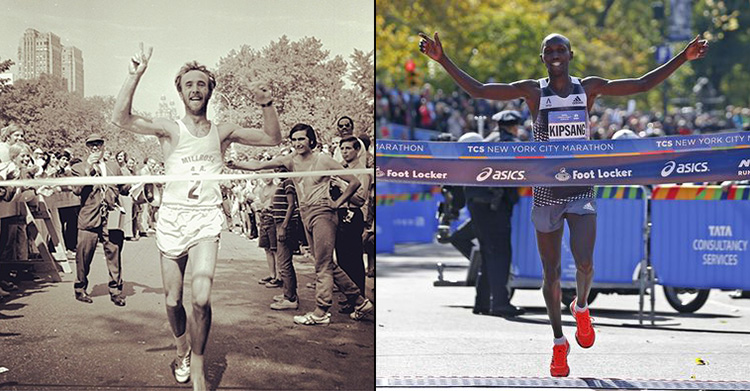
Dan and his buddy Otter (whose self-deprecating blog chronicles his own entertaining path to ultrarunning enlightenment) would be tackling Portland as the back end of their own personal gut check: back-to-back marathons.  On consecutive days.  In neighboring states.  After running the Leavenworth Oktoberfest Marathon in Washington on Saturday, they would be driving five hours to knock out another 26.2 in Portland on Sunday.  Like me, Dan’s most recent race had been truncated by injury, so I was psyched when he texted me shortly after noon on Saturday to say “3:57 for the first one.  Tomorrow should be… interesting.”  How prophetic he was.

Hotel-room view of the Hawthorne Bridge over the Willamette River, with snow-capped Mt. Hood beyond

We arrived in Portland on Friday afternoon.  As we settled back for the 38-minute light rail ride from the airport to our downtown hotel, what struck me was the number of trees and the sheer amount of greenery (and autumn orangery, pinkery, and goldery) that lined our route.  Not your typical urban train ride.  A short time later, wheeling our luggage along city blocks that looked like they’d been washed down with a fire hose, my lungs filled with the crisp, newly scrubbed air that follows a good cry from Mother Nature.

Although Portlanders and Seattleites will argue over whose city gets more rain, Portland’s reputation as one of the soggier cities in the country is well-earned.  Case in point, the week before our arrival saw the city buffeted by the tail end of a Pacific Typhoon that led more than one local to tell us how lucky we were “not to be here last week”.  Portland is a very green city, and a beautiful place when the sun shines (as it would for us all weekend)… but with great greenery comes great precipitation.  Such is life in the Pacific Northwest.

Even if I’d had no race the next day, Saturday alone would almost have justified our trip.  The day began with a relaxed 3-mile run north along the western banks of the Willamette River (a friend now living in Portland reminded us that when in doubt of the river’s pronunciation, it’s the Willamette, damn it!).  As I passed the Portland Saturday Market, the spirited sounds of weekend gaiety and the smoky smells of char-grilling billowed from an eclectic collection of white tents.  The law of conservation of energy was on clear display in the sun-dappled park, with restless children chasing and giving chase while drowsy adults lay sprawled out on the grass in full repose.

After lunch we hit the bustling race expo, held in the basement of the Portland Hilton.  With its red velvet stanchions and awkwardly slanted floors, the venue felt like a low-budget amusement park ride.  Sponsor booths, which were confusedly distributed among two rooms and a hallway, featured the usual combination of high-profile brands and less established companies.  But the hands-down highlight was the opportunity to meet running legend Bill Rodgers.  The line at Rodgers’ table was surprisingly short, and we chatted for a couple of minutes before he signed my copy of his new memoir, Marathon Man: My 26.2-Mile Journey from Unknown Grad Student to the Top of the Running World (based on the title, I’m halfway there!).  He also recommended former teammate Alberto Salazar’s own autobiography.

Mike Sohaskey with running legend Bill Rodgers

 With running legend Bill Rodgers… between us we’ve won 4 Boston Marathons, 4 New York City Marathons and 1 Limantour Half Marathon in Point Reyes, CA

The second highlight of the day would come that evening, as fellow Antarctica travelers Donn and Rod hosted us and several other guests at their beautiful floating home on the Willamette River.  Rod’s veggie lasagne was carbo-perfect, the camaraderie was excellent, and we spent much of the evening admiring the view of the river from their gently swaying deck.  Donn recounted their first morning in the house, when he’d glanced out the window to see a seal feasting on a salmon, followed by two bald eagles swooping in to scavenge the leftovers.  By the time he dropped us off at our hotel, I felt rested and ready to leave my non-carbon footprints all over this city.

Sunday morning’s alarm rudely interrupted our sixth hour of sleep.  Pulling back the curtains on a still-darkened and slumbering city, I dressed and prepared my standard pre-race meal, an easily digestible mush of granola, peanut butter and almond milk yogurt.  Contrary to conventional wisdom, my rapid metabolism compels me to eat no earlier than an hour before the starting gun, so I don’t burn through my glycogen stores by mile 10.  Legs feel good, feet feel good… race day adrenaline gradually kicked in as we made our way through the nascent twilight toward Lownsdale Square, where the start line awaited.

On this day Portland would be honoring those affected by the Boston Marathon bombings.  I was relieved, then, to see no overt indicators of beefed-up security as we made our way through the throngs toward corral A.  Kudos to the organizers for recognizing that you can’t police random acts of hatred without sacrificing a whole lot else.

It struck me how long it had been since I’d seen race-day weather like this: clear skies and a starting temperature in the low 40s.  I was pretty sure I wouldn’t need to reference the warning signs of heat exhaustion and heat stroke listed on the back of my oversized race bib.

Mike Sohaskey at start line of Portland Marathon 2013

Who let the slow guy so close to the start line?

Finally 7:00a.m. arrived.  After a moment of silence in remembrance of Boston, the assembled runners joined together in an a capella singing of the national anthem, followed over the PA system by a few bars of “Sweet Caroline,” again in tribute to Boston (I’d be sporting my own “I Run For Boston” shirt).  Then my good buddy Bill Rodgers counted us down to zero, the crowd surged forward, and the streets of Portland beckoned.

Taking care not to fire out of the gate too quickly, I fell in with the 3:25:00 pace group and reached the mile 1 marker in a disappointing 8:16, already 33 seconds behind last year’s Chicago PR pace (an eventual 3:28:45 finish).  I resolved to stick with the 3:25 group for as long as possible – if I could stay between the 3:25 and 3:30 pacers (and preferably closer to 3:25) from start to finish, I’d be a happy running man.  This would be the first time I’d chosen to fall in with a pace group so early in a race.

Within the first mile, a female punk band supported on a platform over the street provided our first musical entertainment.  The next few miles along the waterfront then featured, in rapid succession, an amusingly diverse collection of incongruent acts:  a female singer/guitarist, solo harpist, honky-tonk bluegrass band, pan flutist and some sort of wind chimes which I thought might segue into “Silver Bells”.  Apparently unimpressed by this latter selection, the fellow next to me shouted “Play ‘Eye of the Tiger’!”  Ah, what highly trained creatures of habit we are.

Inspirational or not, the music in the first three miles distracted from the course’s steady uphill trajectory between miles 1 and 3.  I retreated into my own head for the early stages of the race, mentally ticking off each muscle group in turn to ensure we were all on the same page.  After that I focused on a game of “Name That Shoe,” as I tested my knowledge by guessing the brand – and in some cases the model – of shoe being worn by those around me: So those are the Brooks PureProject line, but PureFlow or PureCadence?  I think that color scheme is only offered for the PureFlow… and the Brooks logo on top of the upper tells me PureFlow 2, second generation.  The early “get-through-em” miles of a marathon can be kinda boring.

Portland Marathon 2013 elevation chart

That inexplicably sharp dip at mile 17 is, somehow, the St. John’s Bridge

After a 4-mile out-and-back hairpin loop through a typically urban mix of residential and commercial neighborhoods, we hugged the downtown waterfront for another mile before entering the least inspiring section of the course, another out-and-back through the train yards and industrial wasteland along Front Avenue.  But for me, Front Avenue turned out to be the most eventful section of the course.

First, it was along this stretch that Dan and I met, offering quick words of recognition and encouragement as we headed in opposite directions.  This was more challenging than it sounds, since the southeast-facing “back” segment I was running faced directly into a blinding sun.  As seen through sunglasses, runners approaching from the other direction were nebulous silhouettes, leading me to run with sunglasses in hand as I squinted into the steady stream of oncoming runners.  Fortunately Dan and I spotted each other around mile 10, as he looked to be well on his way to his second sub-4:00 marathon in 24 hours.  Nothing seemed more appropriate at that moment than two marathoners meeting for the first time mid-race and in mid-stride.

I kept an eye out for Otter as well, but not knowing his pace or what he was wearing, I’d have to wait to meet him at the finish.  Shortly after seeing Dan, we passed a loudspeaker blasting REM’s “Losing My Religion,” which despite being a catchy song did little for my motivation with its plaintive refrain of “Trying to keep, up, with you… and I don’t know if I can do it….”

But my gold star for “Worst Premeditated Idea” goes to the idiots in the pirate costumes, who apparently decided – with Boston still fresh on everyone’s mind – that firing off a cannon was a totally awesome way to show their support for the runners.  As the blast exploded, runners around me momentarily broke stride before seeing the setup ahead and angrily realizing what had happened.  Too bad we had no plank handy for those pirates to walk.

“HEY EVERYBODY, WHAT’S THE HURRY?”

Thanks to the train tracks that regularly cross the course along Front Avenue, I found myself flashing back to my recent ankle sprain at the E.T. Midnight Marathon and monitoring my footing closely.  On the bright side, any distraction (other than warring pirates) along this stretch of industrial nothingness was much appreciated.

Just before the mile 11 turnoff on to NW 17th Avenue, we passed one of Portland’s many (or so I hear) gentlemen’s clubs.  Some useful trivia for those looking to plan a bachelor party for a hippie buddy: With its “live and let live” attitude and sketchy past, Portland boasts more strip clubs per capita than Las Vegas.  And if I hadn’t been glancing around trying to distract myself at that moment, I probably would’ve missed the amusing sign advertising “hardwood” on the building next door to the strip club.  If we weren’t all adults here, I’d compliment Portland on its sly sense of humor.

Still feeling strong and with the Front Avenue out-and-back now thankfully out of the way, I scored a momentary burst of adrenaline upon seeing Katie for (already) the third time at mile 11.5.  We passed the midway point at mile 13.1 without fanfare and transitioned on to the spectator-free shoulder of busy NW St. Helens Road, where Smart cars, hybrids and a smattering of fossil fuel guzzlers zoomed by on our right.  Three miles later I paused at the mile 15.5 aid station to spill a cup of Ultima Replenisher on myself (about half made it into my mouth) before setting off again in pursuit of the 3:25 pace group, which was slowly creeping ahead.

Mike Sohaskey at mile 11.5 of Portland Marathon 2013

All smiles at mile 12 – clearly we are having an awful lot of fun

The course then veered left past a “Checkpoint Charlie” overseen by marines in uniform.  Here began the toughest and most noticeable ascent of the day, a slow ½-mile burn up to the St. John’s Bridge.  Pushing uphill as hard as I dared without risking a flame-out, I reached the roadbed of the St. John’s Bridge with the 3:25 pacers still in my sights about 25 yards ahead.  The bridge provided a much-needed respite as my hill-addled legs tried to recover from the brief but taxing climb.  And there I was able to appreciate the highlight of the course, a stunning panoramic view of Mt. Hood in the distance.

Unfortunately, the damage had been done.  Although I wouldn’t realize it until after the race, the hills had taken enough out of my legs that mile 16 (at 7:52/mile) would be my final sub-8:00 mile of the day.  Not coincidentally, as we reached the eastern (opposite) side of the St. John’s Bridge, I glanced up to see the 3:25 pace group gradually… pulling… away.  In that moment, I felt strong enough to convince myself that as long as I maintained my current pace, I might still be able to gain back some ground in mile 23 or 24.  And even if I didn’t catch them (a more likely scenario), I’d still set myself up for a 3:27-ish finish, which would send me home from Portland with a nice PR.

As we descended from the bridge on to Willamette Blvd, we re-entered the spectator zone where onlookers were once again vocalizing their much-appreciated support.  And though I paid little attention to the signage along the course, the crowds at Portland left a lasting impression for one reason: their unfailing ability to pronounce my last name correctly.  With my last name printed on my bib, I heard it included in shouts of support at least a half-dozen times.  It really is easy to pronounce – So-has-key – but newcomers almost always insist on throwing a “z” or “j” into the mix.  Yet with just a fleeting glance at my bib, the Portland literati nailed it time and time again.  At one point I trailed a runner with “Mike” printed on his bib, so I’d hear frequent cries of “Yeah, Mike!”, “Go Mike!” and “Looking good, Mike!” along with the sporadic cheer of “Go Sohaskey!”  These people love me! I hallucinated.  It was like I’d brought my own cheering section… which I had, except she was now waiting at the finish line.

St. John's Bridge

On the St. John’s Bridge (image and clouds courtesy of Google Maps)

The 6.5 miles after the bridge began with more tree-lined neighborhoods and led us down the eastern side of the Willamette, with occasional glimpses of the Portland skyline (unobscured by clouds!) visible across the river.

Throughout the race I kept reminding myself to smile, stay positive and do whatever I could to reduce my all-important perceived effort.  And I kept returning to one simple mantra: Just run.  Time to tackle another uphill?  Just run.  Hit an energy lull at mile 15?  Just run.  3:25 pacer fading in the distance?  Just run.  Boneheads in pirate gear firing off a cannon in my ear?  Freak out momentarily… then just run.  This mantra proved particularly helpful in the last six miles, as the world around me began to look more and more like a casting call for The Walking Dead.  Runners in front of me suddenly stopped running and started walking.  Several more pulled over to the side of the road to nurse cramps.  And still others trudged along wearily at a non-quite-running/not-quite-walking pace, eyes cast downward as though burdened with a lead brick around their neck.

Just run rhymes with Just fun.

Sometime around mile 20, when I could have used a raucous blast of three-chord distorted guitar, what I got instead was a lounge-style smooth jazz ensemble that made me want to curl up and take a nap.  I half-expected a cocktail waitress in Sauconys to pull up alongside me and offer me a martini.  As much as I appreciate a good saxophone solo in the right place and at the right time, this was neither.  Nearly three hours after I’d scoffed at the same request, this was “Eye of the Tiger” time.

"It's Almost Over" sign near finish of Portland Marathon 2013

Although my nutritional reserves weren’t noticeably dwindling, I paused at the mile 21 aid station to force down some Ultima and an Accel Gel, my first solid fuel of the race.  As my legs and hips slowly ossified, I wanted to ensure I’d have enough energy to maintain – if not increase – my pace over the last five miles.

And the last five miles felt surprisingly good.  Like a trip down memory lane, miles 23 and 24 led us through one last industrial stretch alongside one last series of train tracks.  We then looped around and crossed back over the Willamette River on the Broadway Bridge, which looked to have been constructed from a Paul Bunyan-sized Erector Set.  Returning the way we’d come along the waterfront, I barely registered the final aid station as I turned away from the river, waved to Katie one last time and fired down those final 385 yards to the finish line.  My stride still felt stable, and despite not having seen the 3:25 pacer in nearly 8 miles, I felt confident a PR was within reach…

… until I made one final left turn on to 3rd Avenue.  “3:30:17” read the finish line clock matter-of-factly as I entered the home stretch.  Crossing the blue and red finish line mat, I heard my name announced over the PA system (another perfect pronunciation!) and glanced down at my Garmin for the first time.  3:30:28.  Dumbly accepting my medal from one of the day’s many fantastic volunteers, my mind was already grinding away in search of answers.  How had I finished more than five minutes behind the 3:25 pace group?  And more stupefying than that, how had I finished behind a 3:30 pace group which I was almost certain had never passed me??

Mike Sohaskey in final stretch of Portland Marathon 2013

Officer, that speedy man just ran a red light!

Absent-mindedly I accepted a white rose and mylar heat sheet from two cheerful volunteers, before turning back toward the finish in search of the 3:30 pace group.  Sure enough, moments later I saw the “3:30” red lizard sign (all pace groups carried red lizard placards showing their target finish times) enter the finish chute.

Son of a @%*$#!

True, I had no way of knowing how far ahead the 3:25 pacer had finished.  But I’m accustomed to pacers finishing a minute or two ahead of their projected time, to ensure that all runners in their group meet their individual time goals.  And based on where I positioned myself in corral A, I don’t see how I could have crossed the start line that far ahead of Team 3:30.

So as I chugged a pint of chocolate milk and gnawed away at an orange slice, I was a bit dazed and a lot disap-pointed.  Not only hadn’t I scored a PR, I hadn’t broken 3:30.  Apparently I should revise my mantra to Just run faster.

But life – and more to the point, traffic in the finish chute – goes on, and riding the wave of triumphantly exhausted runners, I turned my attention to finding Katie.  Before I could reach her though, volunteers handed me 1) two small velvet pouches containing a finisher’s coin and mini-me pendant version of the finisher’s medal; 2) an eye-catching long sleeve baby blue and gold finisher’s shirt; and 3) a tree seedling I politely declined, having left my third hand back in the hotel room.  I wondered how much of Portland’s verdure had been planted by zealous marathon finishers.

Mike Sohaskey and Katie Ho after Portland Marathon 2013

I know, kinda rude of me to jump in front of Katie’s selfie

As I hobbled through the finish chute, one of the friendly volunteer florists obliged my request for a red rose, which I shared with my all-in-one support crew/cheering section/race photographer.  As always, Katie the Ubiquitous had seen me off at the start, beaten me to the finish and cheered me on at several points in between…. all while capturing some pretty sweet shots of the action.  In fact, she took several impressive photos of Dan at mile 11.5… before she’d ever met him.  And as I wearily admired the deep red petals perched atop a long supple stem, it occurred to me that not every rose has its thorn.

After reuniting with Katie, we circled back to watch Dan complete his second sub-4:00 marathon of the weekend and check off Oregon as state 34 on his 50-states running tour (compared to the fifth state on my own less strategic tour).  With Otter still en route, the three of us convened at Portland Brewery’s “26.3 Mile Gathering Place,” a grassy street corner nearby.  There we relaxed on the grass, the late-morning sun warming us as we happily sipped local brews and compared notes.

With so many people now wearing their blue and gold finisher’s shirt, the area looked like a convention of Boston Marathon wannabes, myself included.  Otter was all smiles when he joined us, and though his second marathon of the weekend had hit a few more rough patches than Dan’s, he’d earned his medal like everyone else.  And his ills were nothing an IPA or two couldn’t smooth over.

Otter, Dan Solera and Mike Sohaskey... celebrating completion of Portland Marathon 2013

Otter, Dan and me… nobody told me to bring my own box to stand on

After following Dan’s Marathon for the past year and Otter’s I Drank For Miles in recent months, and after seeing so many photos from so many places, I got a kick out of finally matching voices to faces and personalities to blog posts.  And at 6’0”, it was one of the few times I’ve ever felt legitimately short.  Congrats to both of them on an amazing athletic feat… on amazing athletic feet.  I do relish the mind games of running, and theirs is an accomplishment that’s just crazy enough to have set my own mental gears in motion.

That evening we continued the celebration over a satisfying dinner at Deschutes Brewery & Public House in the Pearl District of Portland.  Both conversation and drinks flowed easily, as though among old friends who simply hadn’t seen each other in a while.  The discussion centered around all things running, but it didn’t stop there, and I was reminded that runners are some of the most genuine and sociable people you’d ever want to meet.  My head hit the pillow that night wishing I’d had more time to get to know these guys.  Hopefully I’ll have that chance – and in the meantime, I’ll keep reading to see what crazy shit they talk each other into next.

Once I’d had a chance to ice my legs and clear my mind, I had to admit – the weekend had come up roses.  Portland lived up to its reputation as a clean, green progressive machine.  The city had admirably hosted a marathon that, while not exactly scenic, provided a solid urban challenge.  And despite a two-week training hiatus, I’d run my second-fastest marathon on a relatively hilly course, and learned a valuable lesson about relying on pacers (i.e. don’t do it).

When I wasn’t running, we’d reunited with old friends and rendezvoused with new ones.  I’d met a bigger-than-life yet decidedly down-to-earth icon whose name is synonymous with American distance running.  And in a town maybe best known for its persistent precipitation, we hadn’t once opened our umbrella.

All told, I’d call it a pretty successful weekend along the Willamette, damn it.

Powell’s Books is the de facto center of Portland’s cultural universe

BOTTOM LINE:  Portland is a beautiful city when the sun is shining.  And while October isn’t the driest month in the Pacific Northwest, Les Smith claimed in his October Newsletter and Pre-Event Instructions that only once in his 33 years as Race Director had it rained on race day.  So chances are good you’ll get as lucky as we did.  I’d like to run every race Oregon has to offer, since much of the state is a trail runner’s paradise… but if road running is more your forte, I’d recommend Portland as a worthwhile urban footrace.  And I’d recommend you not underestimate those harmless-looking hills on the course map.

PRODUCTION:  Overall, the Portland Marathon was well organized and well executed.  For the most part, I enjoyed marathon weekend and my 3 hour 30 minute tour of the city.  The race medal is stylish (see below) in a “military service medal” sort of way, and the inclusion of two race shirts – one for registrants and another for finishers, both attractive, high-quality offerings from Leslie Jordan – was a very nice touch.  That said, I’d suggest a few changes to make the weekend even better:

First, the out-and-back through the train yards along NW Front Avenue is an uninspiring eyesore, a reaction I heard from several runners after the race.  In a city as green and picturesque as Portland, it’s unclear (aside from convenience) why the organizers settled on this 4½-mile stretch of industrial badlands.

Second, the aid stations in Portland featured gummy bears as their primary source of carbs.  Yes, gummy bears – a great choice if my 5-year-old nephew is running your race.  Unfortunately, it’s not like you can pop a gummy bear in your mouth and let it dissolve over the next ½ mile.  It’s hard enough for many runners to stomach energy gels, let alone a tiny pencil eraser.  And the last thing anyone needs at mile 20 of a marathon is a snack food that fights back.  So please Portland, talk to the folks at Gu, or Clif, or PowerBar, or Accel Gel, or Stinger, or any of a hundred honey companies before next year’s race.

One last on-course item: this isn’t a big deal for me since I always judge mileage by the twitter (not Twitter) of my Garmin, but the mileage markers were consistently short for most of the course.  One surprised runner asked, as we passed the mile 1 marker, “How far is this marathon?”  Only in the last five miles or so did the markers more or less sync with my Garmin.

Swag-wise, the two t-shirts and finisher’s medal are nice keepsakes, but I’m less sold on the finisher’s coin and mini-me medal.  While I appreciate the sentiment, I certainly don’t need more stuff, and I’m quite sure I’ll never again open those velvet pouches.

And finally the expo, held in the basement of the Portland Hilton, was organized (or disorganized, as it were) in a convoluted maze of rooms that made the whole thing difficult to negotiate.  I was never quite sure which aisles I’d already strolled and which booths I’d already passed.  In the end though (or was it the beginning?), the circuitous route was worth navigating for the chance to meet Bill Rodgers.

2013 Portland Marathon Medal

FINAL STATS:
October 6, 2013
26.3 miles in Portland, OR (State 5 of 50)
Finish time & pace: 3:30:27 (first time running the Portland Marathon), 8:02/mile
Finish place: 610/6958 overall, 77/524 in M(40-44) age group
Race weather: sunny and cool (starting temp 39°F), with an intermittent breeze
Elevation change (Garmin Connect): 728ft ascent, 742ft descent (compared to 121ft, 119ft at Chicago)

Portland splits