Archive for the ‘CATCH-ALL’ Category

We’ll keep training harder, for the people who perished today.
– Wesley Korir, 2012 Boston Marathon winner
BAA logo

It shouldn’t have to be this way.

I was ready to publish a much different post today.  It was (and still will be) a post about my most recent marathon experience, a literal example of how I’ll go to the end of the earth and back for a sport I love.  Like a digital carpenter I’d plied the tools of the blogging trade in referencing the grueling workouts, the frequent ups and downs, the thrill of accomplishment, the rapturous sense of being a better person for having given everything I had to give for 26.2 miles.  But more than anything, I’d chronicled the camaraderie that emerges when a diverse collection of like-minded individuals strives toward and achieves a common goal.

But then, in a cruel twist of fate, it was that sense of camaraderie that got kicked in the gut by yesterday’s gruesome and tragic events at the 117th Boston Marathon, where two explosions near the finish line killed three people and injured at least 176 others.  And in seconds, all perspective changed.

Clearly running means a lot to me – I spend a lot of time sharing my thoughts on the sport and my involvement in it.  But the city of Boston is also ingrained in my constitution – my father was born and raised in Newton, MA, roughly 5 miles from the marathon finish on Boylston Street.  I’m a lifelong Celtics and Red Sox fan.  And despite The Onion’s recent decidedly Onion-like portrayal of Beantowners as “playing their adorable little game of ‘Big City’ “, Boston is a dynamic and storied place, and one of the few East Coast cities that doesn’t make me immediately want to leave.

So understandably, as I sat 3,000 miles away in the safety of my living room, a maelstrom of raw emotions gripped me in the aftermath of the bombings:

Sadness and empathy – for the three individuals who lost their lives for no other reason than that they were in the wrong place at the wrong time, and for all those directly affected by the wanton bloodshed of the day’s events.

Sadness, too, that nobody is talking about how Kenya and Ethiopia once again dominated both the men’s and women’s marathon, or how Americans Jason Hartmann and Shalane Flanagan captured strong fourth-place finishes.  Before 3:00pm EDT, I had to root around on the ESPN.com homepage just to find race results – ESPN was so disinterested that coverage of the WNBA draft trumped the marathon.  Thirty minutes later Boston was dominating the website’s headlines for all the wrong reasons, and suddenly my desire for more in-depth marathon coverage was perversely granted.  And now I long for the day when “explosion” isn’t the top choice among Google’s Autocomplete suggestions when I type in “Boston Marathon.”

Shock – at stark images of blood-strewn sidewalks and first-hand accounts from runners like Roupen Bastajian, a Rhode Island state trooper and former Marine who crossed the finish line just before the first explosion and then hurried to help other runners.  “These runners just finished and they don’t have legs now,” Bastajian said. “So many of them. There are so many people without legs. It’s all blood. There’s blood everywhere. You got bones, fragments. It’s disgusting. It’s like a war zone.”

Sympathy – for the entire city of Boston, whose distinctive pride and spirit – as embodied by their own distinctive holiday – should have been on full celebratory display yesterday in front of an international audience.

Violation – for the ravaged innocence of my sport and its flagship event, neither of which can ever get it back.  I don’t look forward to the new and perverted definition of normalcy that awaits us at future marathons.

Anger – at the (to this point) faceless cowards whose own misguided anger motivated such a senseless and unconscionable act of – just typing the word makes me angry – terrorism.

Finish line

© 2013 The New York Times Company

Shortly after the news broke I received concerned text messages from several friends wanting to make sure Katie and I were okay.  I appreciated their thinking I was fast enough to qualify for Boston, even though the closest I’ve come so far was the 5 miles I bandited during my brother’s 3:14:05 effort in 1998.

Nonetheless like most runners, I knew several people who would be among the select few racing in Boston this year.  My sister-in-law qualified this year and even registered for the race before deciding to sit it out.  Based on her standard marathon finish time of around 4 hours, she likely would have been finishing around the time chaos engulfed Boylston Street.

Several friends in this year’s race had already finished and left the Copley Square area before the bombings.  And another friend, whom I was fortunate to meet just last month, was leading a blind runner and had just passed mile 25.5 when the first explosion forced them off the course.  Fortunately for both him and his running mate, there will be other Bostons.  Not so for the 8-year-old boy and two others who were killed by the blasts.

It’s unclear at this point who is responsible for the carnage that dominated Copley Square in the latter stages of yesterday’s marathon.  It’s unclear whether they were targeting a particular person or group of persons, the Boston Athletic Association, the marathon event itself, Patriots’ Day as a symbolic holiday, or perhaps even the entire city of Boston.

But what is clear is that the sport of running is forever changed.  Not in the sense of big obvious changes such as beefed-up security at major events, though that will inevitably happen.  Rather, I worry about more subtle and insidious changes to psychology as doubt and hesitation creep in, replacing the easy confidence of some runners who find themselves racing in large crowded venues.  Am I really comfortable doing this?, they will ask.  Others who qualify to race in Boston next year may very well decline the opportunity.

It shouldn’t have to be this way.

I experienced September 11, 2001 with a sense of surreal detachment, as though like a movie all the events I saw unfolding on television would cease to be and life would return to normal as soon as I turned off my set.  I wasn’t directly affected on a personal level by the 9/11 attacks, and so honestly I always felt removed from the situation, like a zoo patron watching tigers feed from behind the glass.

But even though I still live in Northern California as I did then, Boston feels more personal.  Not only because of my history with the city, but because the running community really is an extended family.  If you don’t believe me, lose yourself for an hour in the intricately woven web of the running blogosphere.  Or check out the sheer number of “Team In Training” runners at your next local marathon.  Or spend some time with a group of Marathon Maniacs… you’ll wonder how you ever had fun without running 26.2 miles.

The runners who line up in Hopkinton and finish in downtown Boston 26.2 miles later are the best of the best.  The vast majority of them I don’t know and will never meet.  But as one who shares their passion, I understand and appreciate the sacrifices – not to mention the fartleks, hill repeats, tempo work, icing, stretching, compression and “vitamin I” (ibuprofen) doses – required of those who chase the elusive unicorn.

They’re tall, short, young, old, husbands, wives, sons, daughters, leaders, followers, Nike aficionados and Saucony loyalists.  They’re strange friends to some and friendly strangers to others.  They’re the elites I emulate, the bloggers I follow, the weekend warriors I cheer.  They’re all very different, yet very much the same.  And regardless of race, creed, age, gender, color, nationality, religion, disability, socioeconomic status, sexual orientation or even marathon finish time, they’re my people.  One nation, indivisible, with fast starts and strong finishes for all.

And so I can add to the list one more emotion that gripped me in the aftermath of Monday’s tragedy: Certainty.  Certainty that both the fiercely proud city of Boston and the equally strong-willed running community will rally together behind yesterday’s tragic events.  Certainty that an unambiguous message will be sent to those responsible, the message that after all the literal blood, sweat and tears we put into training for, qualifying for and preparing for this race; the tireless hard work and dedication we put year after year into maintaining the Boston Marathon as the oldest annual marathon and most prestigious organized foot race in the world; and the unwavering focus we put into doing things our own way – after all that, you think two bombs can demolish our dreams and deter us from our mission?

I look forward to proving you wrong.

My original post for today will appear in a few days.  In the meantime, the city of Boston and those of us who define ourselves as runners will slowly but surely return to life as usual.  For many – myself included – that life will continue to boast the same ambitious and overriding goal: to qualify for Boston.  And hopefully one day, all of us not-yet-fast-enough marathoners will again be able to say resolutely and without a hint of twisted irony, “I’d give my left arm to run Boston.”

It shouldn’t have to be this way.

Well done is better than well said.
– Benjamin Franklin

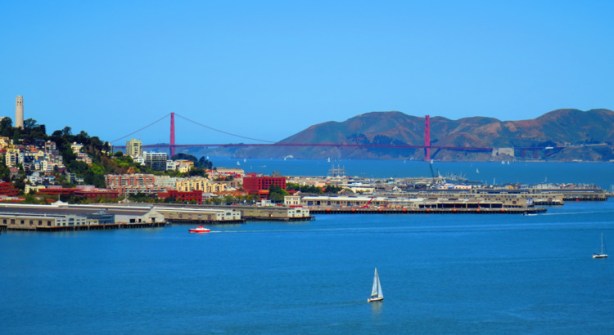
Sunset on the Bay Bridge, with San Francisco aglow in the background (original photo here)

18 February 2013

Dear Bay Area Toll Authority,

It’s not often I write an open – or for that matter a closed – letter to a government entity.  It feels too much like yelling at the TV.  But just this once I thought I’d make an exception… because as a current East Bay and former South Bay resident, I have a long-overdue plan to help ensure the San Francisco-Oakland Bay Bridge – with its new eastern span to be completed later this year – is the architectural marvel and civic masterpiece it deserves to be.  Besides, isn’t speaking up and making my voice heard the mark of a good Bay Area resident?

Don’t worry, I’m not writing to take you to task – as many Bay Area residents already have – for the project’s staggering and ever-escalating price tag (currently estimated at over $12 billion, making it the most expensive public works project in California history), nor for the fact that design and construction of the bridge’s Self-Anchored Suspension Tower has been outsourced to at least seven countries, chief among them China.  Though admittedly, these would provide solid starting points for a discussion of California’s enduringly inept bureaucracy.

Nope, I’m writing to you today as a runner, one who’s spent countless hours exploring the Bay Area’s myriad roads and trails on foot.  Fact is, the Bay Area’s calling card is its geographic, cultural, ethnic and socioeconomic diversity, and running provides ready access to that diversity as no other mode of transport can.  So my ongoing issue with the Bay Bridge is one not of unchecked excess but of glaring omission.  It’s a first-world problem, but here in the pedestrian-friendly Bay Area it’s also a conspicuous oversight.  It’s the lack of a Bay Bridge pedestrian/bike path extending from Oakland to San Francisco.

GG Bridge from Bay Bridge

It makes me blue to think that this view – shot from the Bay Bridge at 50 mph – is inaccessible by foot

Do you know what the East Bay, North Bay, South Bay, and City by the Bay all have in common?  It’s not a trick question.  The San Francisco Bay separates east from west, Oakland from San Francisco, A’s fan from Giants fan, Raiders fan from 49ers fan, future Warriors fan from former Warriors fan, and foggy from, well, foggier.  Several months ago, while the 49ers were flexing their muscles and the Raiders were regularly getting sand kicked in their face, the cheeky response to the question of “What separates the NFL’s best and worst teams?”  would have been “the San Francisco Bay.”  But as divisive as five miles of water can be (particularly during football season), it’s the Bay Bridge that physically connects and otherwise unifies the two sides of the bay.  Unless, of course, you’re on foot.

Granted, both Bay Area Rapid Transit (BART) and an inconvenient ferry system operate between Oakland and SF.  But as Bay Area residents we pride ourselves on our progressive joie de vivre, particularly as regards our spectrum of eco-friendly transportation options.  I see more hybrid vehicles at a typical stoplight here than I see during an entire week in most other states.  Bike lanes are a staple of our commuting diet, and out-of-town guests are constantly amazed by the pedestrian-savvy temperament of the drivers here.  From my home base in the East Bay, I feel like I can get pretty much anywhere I want to get in the San Francisco Bay Area on foot.

Except San Francisco.

The fact that I can’t run directly from Oakland to San Francisco is absurd.  Currently all my runs along the Berkeley Marina end by necessity on the border of Emeryville, at the eastern end of the Bay Bridge.  From there it’s either head back up the Marina the way I came, head east into Emeryville (which without Pixar would pretty much qualify as Oakland’s appendix), or gaze longingly across the bay at a vast running landscape that in those moments of frustration might as well be the Emerald City.  Except that – OOPS! – we forgot to build a yellow brick road.

Artist’s rendering of a Bay Bridge pedestrian/bike path… look how much fun those faux people are having!
(photo © 2011 Rmleczko, courtesy MTA)

Why has a Bay Bridge pedestrian and bike path not yet happened?  It’s unclear why its original architect – unlike the architects of its more popular and flamboyant neighbor, the Golden Gate Bridge (GGB) – failed to prioritize pedestrian access in his part-suspension, part-cantilever design.  This oversight is even more puzzling given that initial construction on both bridges began six months apart in the same year, 1933.  It’s hard to imagine that two groups of architects, each working on its own similarly massive engineering project, could operate in such close physical proximity without swapping stories or sharing ideas.  In any case, since opening in May 1937 the GGB has boasted pedestrian walkways on its eastern and western sides.  On pleasant days these walkways are crowded with sightseeing tourists and smitten locals, around whom I’ll dance and weave as I hoof my way from the Marin Headlands to all parts of San Francisco.

True, the new Bay Bridge eastern span leading from Oakland to Yerba Buena and Treasure Islands will contain a pedestrian/bike lane, a fact that former SF mayor Willie Brown is quick to take credit for.  Inexplicably, however, there are no plans to extend pedestrian access all the way to SF.  This feels like popping a handful of M&Ms in your mouth, only to discover after your first chew that they’re actually Skittles – great expectations give way to visceral annoyance gives way to resigned disappointment.  It’s a bewildering lapse in both planning and judgment that’s earned the new walkway the derisive nickname of “bike path to nowhere.”  Try not to take it too hard, Treasure Island.

From a busine$$ perspective, I’m envisioning the commercial applications for a Bay Bridge pedestrian/bike path.  This past week, Matier and Ross reported in the SF Chronicle that a 12.5-mile run from Oakland City Hall to SF City Hall is in the works as part of the opening weekend festivities for the new bridge.  It’s a terrific idea, but why stop there?  Add another half mile to the course, and what Bay Area runner wouldn’t sign up and line up to run the annual “Hall to Hall” Half Marathon to benefit Oakland and SF charities, with the incentive of an additional donation (plus bragging rights) going to the city with the fastest runners?  The walkways on the Golden Gate Bridge figure prominently in three current SF races – the U.S. Half, the newly rebranded Rock ‘n’ Roll San Francisco Half, and the 200-mile Golden Gate Relay.  Plus the city’s signature event, the Wipro San Francisco Marathon, runs on the GGB roadbed.  There’s no reason the Bay Bridge couldn’t (and shouldn’t) follow suit.

I’m happy to design a Bay Area-savvy medal for the “Hall-to-Hall” Half Marathon

I expect your higher-ups at the Bay Area Toll Authority will be quick to cite financial constraints and design considerations, and to suggest that I get in line behind everyone else’s pet projects.  But that’s why I’ve addressed this letter to your agency – because you have the authority (the word’s in your name, after all) to “fund the long-term capital improvement and rehabilitation of the bridges.”  And given that the Bay Bridge east span replacement is already grossly over budget – a budget that has been alarmingly immune to public scrutiny – what’s another half a billion dollars among friends?  You’ll likely spend a solid chunk of that on Labor Day opening ceremonies anyway.

I’m encouraged to read that finally we’ve reached the stage where a Bay Bridge pedestrian/bike path is now an official project eligible for funding.  But you and I both know that’s government-speak for “we’ll get to it when we get to it,” and unless the project shows up on someone’s priority list soon, it will remain without funding ad infinitum.  In the meantime, while the relevant “project initiation document” sits gathering the sloughed-off dead skin of feckless government officials dust in a file cabinet in Sacramento, think about the vital opportunity the Bay Area is losing to improve traffic flow and further reduce carbon emissions by increasing the number of commuters biking (or even running!) to work.  And running or biking is more affordable than riding BART or taking the ferry.

Since we the taxpayers are obligated to foot the bill for Bay Bridge reconstruction, then we should also be able to foot the Bay Bridge.  A two-way pedestrian and bike path should have happened years – nay, decades – ago.  Yet somehow, here in the nation’s crown jewel of progressive foresight and ingenuity, I can still swim from Oakland to San Francisco faster than I can run.  So come on BATA, let’s get this done!  Do the right thing and don’t drop the ball on this one.  We both know the Raiders don’t need the competition.

Best regards,
Mike Sohaskey
Founder and Chief Running Officer, CRO-BAR (Concerned Runners Of the Bay Area)

2012 by the number

Posted: January 1, 2013 in CATCH-ALL, Year in Review
Tags:

Statistics are human beings with the tears wiped off. 
– Paul Brodeur

cartoon07

(© 1980 Arnie Levin, published in The New Yorker)

I love numbers.  As a scientist I genuflect at their altar, and I understand the power of their use and (maybe more so) abuse.  But I don’t so much love them in my running.  Sure, like most runners I’m constantly chasing my next PR.  But many of my training runs are unscripted, and I often leave my Garmin at home.  Admittedly I do track most of my miles, but the idea of counting my every step flies in the face of why I run in the first place.  I train, I train hard, and I try to get everything I can from everything I’ve got.  I’m not convinced more numbers will help me do that.

On the other hand, I do acknowledge and appreciate their importance for many runners, and I’ve now read several blogs that break down 2012 by the numbers: total miles run, races subdivided by distance, average finish times, average pace, even the number of GU packets consumed (ok, I might have made that last one up… but I’m betting it’s out there somewhere).  The head-spinning reams of statistics in the running blogosphere – together with lingering injuries – provide their owners with a clear, concise representation of their personal year in running.  Naturally all these blogs got me thinking about which of my own running numbers matter the most.

And I realized that, aside from personal records, the only number I really care about is this one: 91.  That’s my overall race percentile, meaning that I finished in the upper 9% of all runners at the ten races I ran in 2012.  If I were to combine my seven half marathons, two marathons and one 50K from this past year into a Pangaea-like super race, I would have crossed the finish line 5,433rd out of 61,281 finishers.  Or to turn that lemonade back into lemons, I finished in the top 9% of all losers.  That’s the number I’m most focused on surpassing in 2013… the five pairs of new running shoes I bought in 2012 notwithstanding.

I hope you hit and surpass your own numbers in 2013, running or otherwise.  I realize this blog, like running itself, is an inherently selfish act, and I appreciate your indulging my selfishness.  Except for you Mom, I know you’re only here to make sure I wear clean underwear on every run.

Happy New Year!

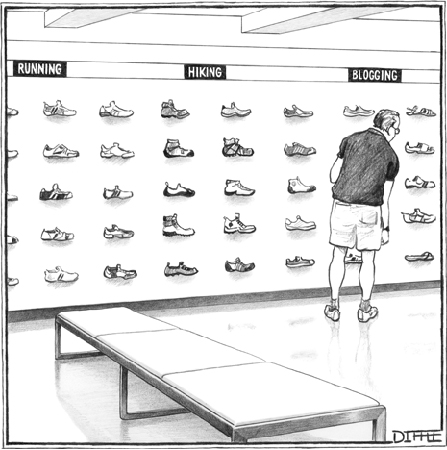
090914_cartoon_c_a14283_p465

With a little luck, I should easily double my shoe collection in 2013
(© Matthew Diffee, published in The New Yorker)

Sports don’t build character, they reveal it.
– John Wooden

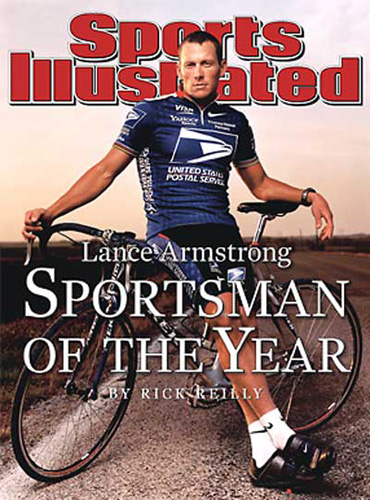
(Image courtesy of www.reuters.com)

Lance Armstrong is arguably the greatest endurance athlete who’s ever lived.

Last week the United States Anti-Doping Agency (USADA) unilaterally declared Armstrong, the 7-time Tour de France winner, guilty of using performance-enhancing drugs during his professional cycling career.  As a result, USADA issued Armstrong a lifetime ban from any sport that follows the World Anti-Doping Code, and officially stripped him of his seven Tour de France titles.

We each have our personal machines to rage against, and I guess this one is mine (you might say it makes me want to… heave).  But why?  In the interest of full disclosure: Lance is a fellow Texan, having been born and grown up in my hometown just north of Dallas… we attended rival high schools on opposite sides of the city at the same time, though to my knowledge we’ve never met.  Like everyone else, and perhaps with some deeper sense of understanding thanks to my PhD in Cancer Biology, I admire and respect everything he’s accomplished – from beating stage III testicular cancer, to winning an Olympic bronze medal (2000) and seven Tour titles (1999-2005), to tirelessly growing his Foundation into one of the nation’s leading non-profits in the fight against cancer.

And given such a chock-a-block trophy case, what runner can’t appreciate/sympathize with his admission that his sub-3 hour New York City Marathon in 2006 “was without a doubt the hardest physical thing I have ever done”?

Armstrong running in (left) and getting finished by (right) the 2006 NYC Marathon (images courtesy of www.celebrity-sunglasses-finder.com and www.cyclismas.com)

So do these factors play into my disdain for USADA and its official censure of Armstrong’s career?  Maybe… but my disdain goes beyond considerations of Armstrong’s lineage or individual accomplishments.  Because more important than the cyclist, what’s been blatantly violated is a fundamental ideology that’s done civilization proud for centuries:

The scientific method.  A major reason we’re not all still living in caves and eating dirt.

I’m a scientist, not a lawyer.  So rather than argue against USADA’s competence using esoteric legal terms in a dead language, I’ll argue for the basic steps of the scientific method that we all learned in elementary school.  I can only assume USADA CEO Travis Tygart was confined to the corner eating paste on the day these were taught:

1) Ask a question
2) Formulate a hypothesis
3) Test your hypothesis
4) Analyze, interpret and report your results
5) Refine your hypothesis accordingly

USADA asked its question, namely “How did Lance Armstrong overcome stage-three cancer to become arguably the most successful and decorated cyclist in history?”  It then formulated the hypothesis that Armstrong’s accomplishments resulted from his use of performance-enhancing drugs, including steroids and the red blood cell-inducing protein erythropoietin (EPO).  USADA and its partner anti-doping agencies even tested their hypothesis in a seemingly rigorous scientific manner by administering (literally) hundreds of random blood and urine tests over the course of Armstrong’s professional career.

So far, so good…

But here, where USADA is obliged to analyze, interpret and report its results, is where the anti-doping agency’s credibility begins to crumble like a bike seat made of Saltines.  Because of those hundreds of tests he took for illegal substances over the course of his cycling career, Armstrong failed… none of them.  Not one.  Ever.  Zeros across the board.

True, there have been occasional reports of a positive test, though such reports were never substantiated.  After a positive corticosteroid test at the 1999 Tour de France, Armstrong’s doctor told officials that the drug had been prescribed for topical treatment of saddle sores.  And the New York Times recently reported that USADA’s evidence includes “blood profiles from 2009 and 2010 that were consistent with doping,” a finding which apparently led the head of one anti-doping lab to declare “This is not an adverse finding, but this is certainly a sufficient equivalent to testing positive.”

Granted I’ve never been a professional athlete, but I would tend to think that from the athlete’s point of view, testing positive might be considered an “adverse finding”.

USADA, however, refuses to act responsibly and conclude, based on hundreds of agency-sanctioned negative drug tests, that they lack the scientific evidence to support their contention that Armstrong used performance-enhancing drugs.  No, with their hypothesis discredited, the frustrated higher-ups at USADA have chosen… to ignore all the silly bothersome data that refute their claims.  Instead, they apparently subscribe to the theory, cynically voiced by one local sportscaster here in the Bay Area last week, that “The only thing a negative test shows is that you can mask.” (We’ve had some issues with pro athletes and steroids around here in the past couple of weeks…)

So with little apparent regard for its own credibility, USADA tried to shift the burden of proof on to Armstrong himself, by relying on a far less powerful, less ethical, and less lawful ally: hearsay.  USADA’s case against Armstrong now rests heavily, if not entirely, on oft-contradicated testimony from Armstrong’s former, less talented teammates.  These teammates include Floyd Landis, who had his own 2006 Tour de France title stripped after he failed a drug test during the race, and who was recently convicted of defrauding his supporters; Tyler Hamilton, who failed multiple drug tests during his own career and who just happens to have a well-timed autobiography scheduled for release next month; and George Hincapie, who reportedly admitted to doping in his 2011 testimony to a federal grand jury.

Based on what USADA has shared with the public, questionable testimonies such as these constitute the crux of its case against Armstrong.  But you don’t need to own the Matlock box set to understand that guilt by association proves nothing, particularly when those associates are acknowledged dopers with – in some cases – a clear conflict of interest (e.g. peddling a book).  In his statement last week, Armstrong also asserted that “USADA has allegedly made deals with other riders that circumvent their own rules as long as they said I cheated.”

True or not, the possibility raises more than a reasonable doubt as to the integrity and motives of USADA’s key eyewitnesses.

So rather than refine its hypothesis in the absence of corroborating data, USADA has chosen the time-honored standard of the playground bully: deploy headlock and squeeze until victim cries “uncle” or faints from lack of oxygen.

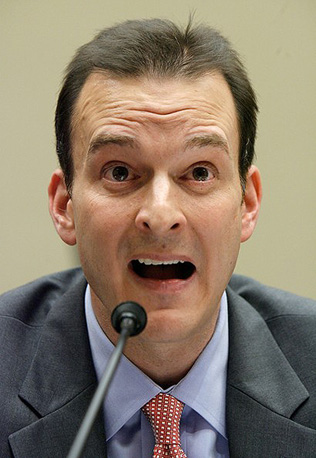
Travis Tygart, USADA CEO and data-despising ty-rant
(image courtesy of www.zimbio.com)

Now even Armstrong, arguably the greatest endurance athlete who’s ever lived, has finally reached his breaking point.  Saying “enough is enough,” he has declared that he’s “finished with this nonsense” and will no longer dedicate his time and resources to fight USADA’s charges.  Some detractors have seen this as an admission of guilt… after all, isn’t that how Lance became Lance, by overcoming insurmountable odds and outlasting the competition when the stakes were highest?

But for better or worse, the Tour de France and even cancer have something very important in common that USADA’s doping allegations lack… an endgame.  Because although Armstrong no doubt has the financial means to continue the battle, USADA has made it clear that its only objective at this point is to find him guilty, and that it intends to make his battle unwinnable by any means necessary.  So sure, Armstrong (like USADA) could continue to throw money, resources and life-hours at these allegations in a futile effort to clear his name, but honestly… how, in the face of Tygart’s “Damn the data, full speed ahead!” mentality, will he ever prove his innocence to USADA’s satisfaction?  Have you ever tried to prove a negative, say for example that you didn’t eat the last donut hole?  Good luck with that.

It’s easy to have a high threshold for someone else’s pain, and that’s the case here with those who see Armstrong’s turn-the-page mindset as slam-dunk evidence of his guilt.  I’ve heard members of the sporting media declare with fire and brimstone how THEY would defend their honor to the bitter end if THEY were ever falsely accused of such vile wrongdoing.  And they’d probably be right the first, second, third or maybe even the tenth time they were confronted with the same unsupported allegations.  But eventually, as the process evolved into (as Armstrong’s lawyer described it) “an endless game of whack-a-mole,” one that farcically shifted the burden of proof on to the shoulders of the accused, well… be honest now… what would you do?  Take your bike and go home, maybe?

And the fallout from USADA’s denunciation of Armstrong’s career?  Unsolicited donations to his Foundation were up nearly 25-fold (from $3,200 to $78,000) the day after USADA’s announcement, while the number of individual donors was up 9-fold.  And according to ESPN.com Sports Business reporter Darren Rovell, Armstrong’s corporate sponsors – including Nike, Oakley and FRS – have responded by reaffirming their support for both Armstrong and his foundation.  So clearly, both the general public and some pretty powerful sports brands with a lot at stake have serious misgivings about USADA’s tactics and conclusions.

Any legitimate scientist who chose to navigate the treacherous waters of loose standards mapped out by USADA would be set adrift in his chosen field.  And given that USADA is largely funded by a federal grant, it too should be held accountable for its deliberate misappropriation of tax dollars and resources.  Even the U.S Attorney’s Office, led by Jeff Novitzky, recently dropped all charges against Armstrong for lack of evidence.  Novitzky is the steroid-centric FDA agent who has shown a stubborn if inept willingness to misappropriate federal funds in the name of his own brand of nebulous anti-doping justice.

I nominate, as the next CEO of USADA…
(image courtesy of www.crazyabouttv.com)

“Science can’t decide everything,” according to David Howman, director general of the World Anti-Doping Agency (WADA).  But Howman is wrong.  His uninformed statement might be more accurately expressed as “Our science can’t decide everything.”  If the scientific tools available to athletes for masking a positive drug test happen to be more advanced than the tests used by the world’s foremost anti-doping agencies… well then, what does that say about the value of those agencies as watchdogs of integrity, anyway?

Small wonder, then, that its failure to discredit Armstrong has clearly left USADA as a frustrated and defeated agency.  But its frustration shouldn’t have been allowed to escalate into full-scale harassment.  In any case, it’s not even clear that USADA has the jurisdiction to bring charges against Armstrong, much less strip him of his Tour de France titles.

I’m not naĂŻve, nor am I in denial; I acknowledge that Armstrong may very well have taken performance-enhancing drugs during his career.  I’m also not a Lance apologist; unlike the many people whose lives have been positively impacted by the tremendous works of his Foundation, I have no reason to invest my hope and faith in Armstrong as a personal savior.  Heck, I don’t even blame him for the fact that the 2011 LIVESTRONG Austin Half Marathon featured the most shoddily crafted race t-shirt I’ve ever received (thanks, Nike).

No, the only dog I have in this fight is the overwrought poodle named science that USADA has nonchalantly tossed into its ring of frustrated and ravenous pit bulls.

(Image courtesy of www.washingtonpost.com)

Armstrong has characterized USADA’s cranky-poodle-on-the-pantleg mentality as an “unconstitutional witch hunt.”  He’s not far off.  And in a time of unsettling intellectual laziness, when many Americans equate “truth” with their own personal belief system (creationism? intelligent design? “legitimate” rape?), this sets a dangerous precedent.  Hey, if our federally funded agencies are shamelessly willing to play outside the lines and run roughshod over the rules of engagement, well then why should we be expected to do any different?

In his arrogant refusal to abide by the principles set forth by cycling’s governing bodies (including his own), Travis Tygart has made himself and his agency the center of attention in this sordid saga.  USADA’s self-appointed stance as judge, jury and executioner even led U.S. District Judge Sam Sparks to write that “USADA’s conduct raises serious questions about whether its real interest in charging Armstrong is to combat doping, or if it is acting according to less noble motives.”  Sparks also warned that “The deficiency of USADA’s charging document is of serious constitutional concern”.

So then based on the taxpayer dollars, federal resources, man-hours, and professional credibility he’s wasted for himself, his agency and the sport of cycling… based on all that he’s willfully squandered in his ego-driven pursuit of Lance Armstrong, if I could ask Travis Tygart one question it would be this:

Who’s the real cheater here?

Good artists copy, great artists steal.
Steve Jobs (attributed to and stolen from Pablo Picasso)

Without reservation I’ve always thought of myself as a great artist, and now I offer proof… I stole today’s blog post. Shamelessly, in fact.  Hopefully every current/one-time/future runner out there is familiar with The Onion (“America’s Finest News Source”) and has already read what follows, but if not I’m happy to provide a public service.  As happens with the best humor – a disproportionate amount of which is found in The Onion – there’s plenty of absurd truth in the next 800+ words.  I’m just glad they’re not talking about me… after all, my race reports MATTER.

And hopefully the folks at The Onion aren’t done yet, since I’m looking forward to the sequels, “I’m Truly Sorry For This, But You’re About To Hear All About The Last Round Of Golf I Played” and “I’m Truly Sorry For This, But You’re About To Hear All About My Children’s Tiresome Exploits.”

The original article can be found here.

I’m Truly Sorry For This, But You’re About To Hear All About The Last Marathon I Ran

BY MICHAEL COWIE
JULY 31, 2012 | ISSUE 48•31

Listen, it’s great catching up with you, and believe me, I’m really enjoying this conversation we’re having, but I’m afraid I now have to do something that will make this exchange very awkward and unpleasant for you. I feel absolutely terrible about it, and so I want to give you fair warning: You’re about to hear all about the marathon I just ran.

I’m truly sorry, but I’m going to have to go pretty in depth about my months of preparation, talk all about the encouragement and support I received from friends and family, and give you a mile-by-mile assessment of my state of mind and physical condition during the race. I hate to say it, but it’s going to take quite a bit of your time.

Mile split times, cramping, hydration levels, chafing—you’re about to hear all of that. Plus, I’ll be dwelling on one point around mile 17 when I considered stopping but then decided to keep going because I’d already come so far. There’s a lot to cover, so I want to be upfront and apologize right off the bat.

This is going to be pretty unbearable.

I’ll inevitably start with how I carbo-loaded the night before the race, which by itself will not be a particularly long or objectionable story, but let me assure you it will segue right into an excruciatingly detailed explanation of the diet I maintain to stay in peak physical shape. And that, in turn, will lead into my training regimen, my special lightweight marathon gear, and, unfortunately for you, a lengthy period during which I expound upon the health benefits of distance running.

I know this isn’t the kind of thing you want to listen to—hey, no one does—but I’m going to include several anecdotes about my running partner Erik, a person you don’t know and couldn’t possibly be interested in hearing about. You’ll learn that he’s an attorney and a rock climber and that we’re part of a team that does the Run for Leukemia 10k every year, which will be another whole five-minute aside right there. Sorry.

Believe me, if I could stop myself from talking about this, I would. But I can’t, and so I’m going to tell you all about my personal best time, and you’re going to think to yourself, “This guy’s the fucking worst.” But here’s the truly awful part: Out of politeness, you will have to pretend to be impressed by that number, even though to you it will seem completely arbitrary and hold no meaning at all.

You’ll also be hearing quite a bit about the sense of accomplishment I felt upon finishing the race. You’re going to hate that, trust me. There will be detestable phrases like “I never thought I could do it, but I did” and “It truly was a life-changing experience” and “It’s a huge commitment, but definitely worth it.” I’ll be repeating the number 26.2 an infuriating number of times.

My God, I can barely express how insufferable I’m going to be.

I’m so sorry, I know you’ve done nothing to deserve this, but right when you think I’m finished talking—just when you get your hopes up—I’ll mention how this wasn’t my first marathon, and then you’re going to hear details of my three other full marathons, as well as a half marathon and a couple marathon relays I did. I can’t even imagine how horrible it will be for you to hear how I believe I’ve progressed as a runner, but by that point in, there just won’t be any getting around it.

And while it is at best tangentially related, I may at any moment during the conversation launch into an agonizing digression on the merits of five-day juice cleanses. I beg your forgiveness.

Worst of all, though, I’m definitely going to run other marathons in the future, so I’ll have to tell you all about the various races I’m thinking about entering and the pros and cons of each course. Please, accept my deepest apologies in advance, because as excruciating as today’s discussion is, it won’t end here. Every single day during my weeks of preparation leading up to the next race, I’m going to make you stop whatever you’re doing to tell you the number of miles I ran the previous evening. Isn’t that awful? No one should have to listen to that.

I’ll also have to tell you that you should run one of these things, too. I honestly can’t convey how intensely sorry I feel that these words will soon be coming out of my mouth, but I will actually say to you that if I can run a marathon, so can you.

Wow, I’m really, really sorry. I don’t know how you’ll be able to tolerate this.

But anyway, here goes.