
In three words, I can sum up everything I’ve learned about life: it goes on.
– Robert Frost
I never imagined I’d preface a blog post this way, but the following contains graphic images (not my own) from an automobile accident along with potentially disturbing descriptions of human suffering. This is the most difficult post I’ve ever written; I double- (and triple-) clutched several times, uncertain where to start, uncertain where to end, and still uncertain of what exactly transpired to change lives so suddenly and so dramatically on the evening of September 23. As unwelcome as the memory is, though, if writing this can save one person’s life out on the open roads of America, then it’s worth it. Thanks for hanging in there with me.
They never had a chance.
Like a swarm of angry bees, the realization buzzed angrily through my head as I tried to verbalize what I knew to the calm, earnest voice on the other end of the line. Grim desperation settled across my shoulders like a lead blanket, my dazed mind trying to find words for what I’d just witnessed.
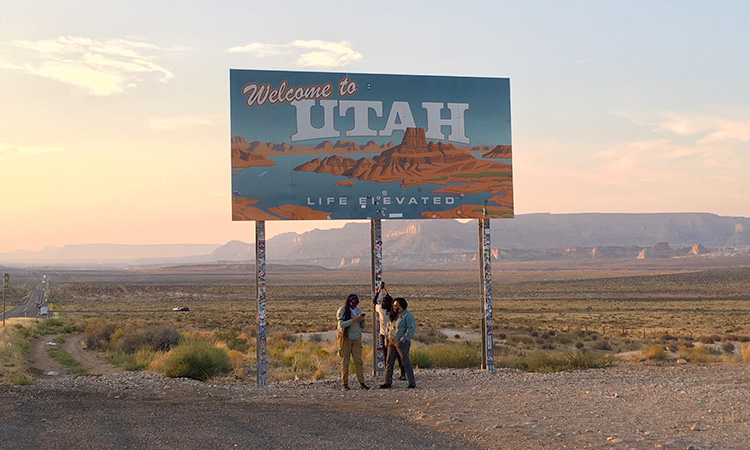
How could the world suddenly have gone so… quiet? Ironically, it was the search for much-needed solitude that had drawn us out here to Southern Utah, that and its indescribable beauty. And to be sure, we’d found both in recent days in such breathtaking destinations as Zion National Park, Cedar Breaks National Monument and Bryce Canyon National Park, not to mention one of the most spectacular views in the United States, the Horseshoe Bend in the Colorado River just outside Page, Arizona.
My atheism notwithstanding, if any place on the planet would qualify as God’s Country, it’s Southern Utah. And the past week had been an incredible road trip I’d not soon forget. Now, though, standing helplessly beneath a vast desert sky, I’d have given it all back just to rewind the world by two minutes.
Like the eye of a hurricane, the sudden quiet in which I now found myself was the calm at the center of an emotional storm, a storm that had broken without warning moments earlier as the most horrific scene of my life played out before my disbelieving eyes. And like the most unforgiving storms, this one was about to get worse.
Every day the dreamers die
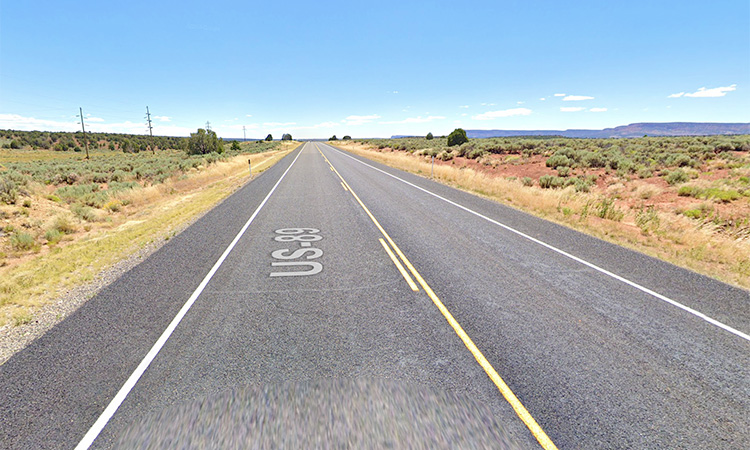
Trying to remain calm, I described to the 911 operator what I’d just witnessed on this lonely stretch of two-lane highway outside Kanab, Utah—how we’d been driving west after leaving Arizona when the SUV first passed us, crossing the dotted yellow line at significant speed to do so before accelerating further as we dropped back a safe distance; how that same SUV had then done the unthinkable, blindly crossing the solid yellow line that separated us from the other lane in a reckless attempt to pass a slower-moving semi truck—and then, as we watched in horror, how the SUV had realized its disastrous error and attempted at the last second to retreat back into its own lane, the semi alongside unwittingly acting as a fast-moving wall blocking its path.
In the split second that followed before all hell broke loose, I’d felt like I was living in the Matrix.
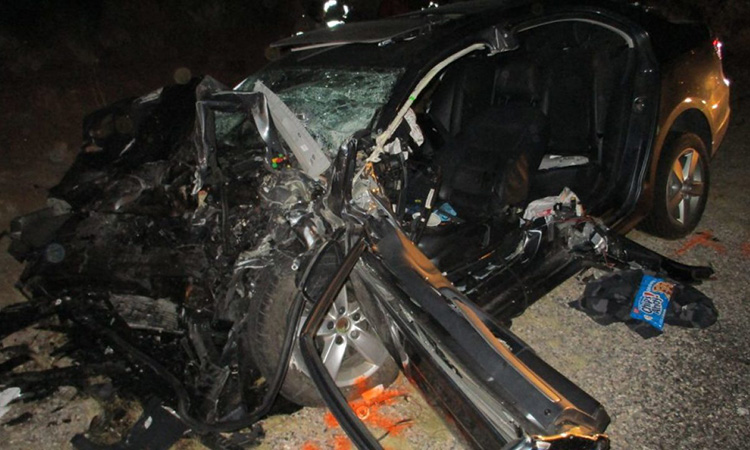
No no no no no, this cannot be happening—the panicked thought barely took shape before the {BOOM} of immovable object meeting irresistible force at 80 mph, accompanied by the instantaneous shattering of glass and crumpling of steel, caused my stomach to convulse in horror. The sickening sound, as I remembered it afterward, was strangely muted, unlike the carefully choreographed symphony of destruction we’ve been conditioned to expect by Hollywood.
“Oh, SHIT!” I yelled as Katie pulled over and I immediately dialed 911, throwing open the door of our car and stepping out into a ghastly and deafening quiet. No noise could I hear from within either vehicle—not the movement of a door trying to open, nor the wounded groan of an injured driver, nor the desperate voice of someone crying for help. Nothing. The only sounds I recall were the voice of the 911 operator in my ear and the hiss of steam rising from beneath the hood of the mangled VW sedan, which had absorbed the full impact of the oncoming SUV without any time to react.
They never had a chance.
Fighting back shock, I slowly approached the VW, watching for signs of flames arising from either vehicle—I had no idea what to expect, no idea how I’d be able to help anyone involved in such a brutal head-on collision at such an impossibly fatal speed. I relayed the relevant details (along with several non-relevant ones) to the 911 operator as I focused my attention on the disfigured VW. Both vehicles looked so… beyond help, and I couldn’t imagine my long-dormant CPR skills being of much good to anyone inside. My brain’s instinctive warning signals aside, though, I had no choice.
Steeling myself, I glanced inside the driver’s side window. The tinting coupled with the oblique lighting from the setting sun at our back made it tough to see anything inside the sedan, and neither the driver’s side nor passenger’s side door would budge. Dammit. Helplessness washed over me as I relayed my findings to the 911 operator, admitting I wasn’t sure how many passengers were inside the vehicle and asking her whether I should try to move anyone in the vehicle if it came to that. She told me she’d leave that to my judgment and, before hanging up, assured me that highway patrol and a medical team had been dispatched to the scene. According to my phone log, the call lasted roughly four minutes.
It’s shocking how long four minutes can seem.
Fortunately, passing drivers had begun to stop, and several were now leaving their cars to help assess the situation and clear scattered debris from the road. Circling to the passenger side of the car, I could see a man of approximately college age in the back seat, leaning against the door with a dazed look on his face. And my heart fell with the realization that this meant there was likely another passenger in the front.
Other passers-by were now checking on the driver and passenger(s) in the SUV, none of whom had moved. From my own vantage point I could see only the deployed airbag on the front passenger side of the vehicle, suggesting the driver had at least had time to hit the brakes. But that was as much as I cared to know; no one else here had witnessed the brutal scene unfold as we had, and so still battling a maelstrom of emotions—not the least among them disgust toward the SUV driver—I returned my focus to the VW sedan. And suddenly it occurred to me—the semi was nowhere to be seen; apparently it had continued on its way without stopping.
Once someone else was able to break the driver’s side window, I reached in and tried to access the lever to either recline the seat or move it back, a futile effort given the condition of the vehicle. As I did so, I heard the driver before I saw her.
She was sprawled out awkwardly across the front seat facing away from me, her long blonde hair and slight build the only indications of her gender. In the gathering shadows I couldn’t see her legs—where were her legs?—but her lifeless, incoherent figure resembled a toppled retail-store mannequin.
In a different context, I’d never have imagined the guttural, staccato sound that now filled the vehicle to be human. As awful as it was, though, her labored breathing was at the same time heartening—she was alive, struggling courageously for every breath but still very much alive, despite the devastating blunt-force trauma she must have suffered from the steering column that now occupied much of the driver’s personal space. Alive, but for how long? I had no way of knowing and no hope of freeing her from the wreckage that imprisoned her and her passenger. And what if I could? I dared not risk trying to move her—with my lack of medical training, who knew what additional damage I might do trying to play hero.
She’d never had a chance.
My mind was racing as I turned away from the car in frustration. Where was the highway patrol? Where were the medics? Why were they taking so long? Soon several others were able to get the rear door on the driver’s side open to help the back-seat passenger escape the car, and I glanced up to see a young white man with tousled reddish hair, blood streaming down his face from a nasty gash above his left eye. Luckily I’m not squeamish, and though I can’t speak for Katie, the look in her eyes said she too was dialed in and ready to help.
Another man gently guided the stunned passenger away from the wreckage and over to the side of the road, where an off-duty nurse (who’d likewise stopped to help) spread out a blanket for him to lay on. Katie and I agreed to stay with and monitor him while the chaos continued to unfold around us.
Meanwhile, someone succeeded in smashing the front passenger-side window, and our nurse friend reached in to check for a pulse on the motionless form still trapped within the gnarled mess of the front seat. A moment later I saw her shake her head and knew that at least one member of the car was beyond help.
The surreal futility of the moment was wrenching—I knew absolutely nothing about this passenger, no clue as to their age, gender or ethnicity. Moments earlier they’d been very much alive, engaged in a spirited conversation with their companions, on scrolling on their phone, or catnapping en route to who knows where, the road ahead of them paved with sky-high hopes and crazy plans and whimsical dreams. Now those hopes, those plans, those dreams—that life—had all been destroyed in the blink of an eye, strewn across the asphalt like so much broken glass. And they’d likely never seen it coming.
Strength in numbers
Thankfully our young charge, though clearly disoriented, was alive and conscious with no apparent difficulty breathing, a huge relief since neither of us are medical professionals and we didn’t know when they’d arrive. Understandably, he was also in severe shock. As he lay on the blanket, he repeated several times that his tummy hurt and that he had to throw up. We helped turn him on his side, realizing after several false alarms that this was a sentiment he would continue to repeat until the medics arrived.
In the meantime we were advised to keep him talking, and so we asked him about himself. He told us in a quiet, distant voice that his name was Lee; we also learned Lee was possibly a college student in Sandy, Utah. Few other details were forthcoming and we didn’t press; we simply wanted to ensure that his adrenaline kept him conscious and safe until the medics arrived. He kept repeating at regular intervals that his tummy hurt; calmly we tried to reassure him that this was normal, that he was strong and that his tummy would be fine because the doctors were coming to take care of him.
Lee asked us a couple of times what had happened and at one point asked about Annie and another name I didn’t catch, suggesting he’d been traveling with friends and not his parents. Casually we dodged each question and again inquired about his breathing, which he seemed to confirm was not an issue; this allowed us to breathe easier too. Our new nurse friend came to check on Lee and told him he’d been in an accident, which seemed to surprise him—I’d never witnessed shock to this extent, and clearly this was the body’s psychological defense mechanisms on full display. In a way I envied his ignorance at that moment, though I knew his return to reality would be anything but enviable.
Their heroic and selfless efforts notwithstanding, in that moment I couldn’t imagine being a highway patrol officer or Emergency Medical Technician (EMT) whose job it is—if not routinely, then far too often—to respond in the aftermath of accidents such as this. My own reaction came from a place of naïve shock at having never witnessed death play out before my eyes in such a jarring and senseless fashion. And as far as my own mental health goes, I hope never to reach a place where inexplicable violence no longer comes as a visceral shock to my system.
“I’m scared,” Lee said softly, his voice wavering slightly as he lay with eyes closed beneath a clear night sky that now shimmered with stars. We held his hand and assured him he was ok, that he was safe, that we wouldn’t let anything happen to him, and that we would care for him as long as we needed to until the doctors got there. Several times he asked us to promise him as much. Our confident reassurances seemed to calm him a bit; fortunately his demeanor hadn’t changed, and his breathing seemed stable. We complimented him on his strength, on his bravery, on how well he was doing and how much better he’d feel just as soon as the doctors arrived. Where were the medics?
With my focus on Lee, I noticed in my peripheral vision the crews that were now laboring with crowbars to remove the front section of the VW sedan, presumably to gain access to the driver and passenger.
Throughout this ordeal, Katie and I were the only ones on the scene to wear face coverings, and unless I was called on to perform CPR—which now seemed against all odds—I saw no reason to remove mine. This was the first time I’d willingly defied social distancing guidelines in more than six months, and despite the circumstances our close proximity to other people felt remarkably normal. And welcome.
As we continued to reassure Lee of his health and safety I noticed his anklet, his painted fingernails, and the metal cross dangling from one ear. I wondered about their significance as a helicopter appeared overhead, landing on the road beyond the demolished SUV. Someone in uniform finally joined us, quickly examining Lee and asking him, “I don’t care what you think of him, do you know who the president is?” Lee answered correctly which was encouraging, and one of the officers now on the scene asked me to don gloves and hold Lee’s neck steady on his side until the medics could apply a brace. Which I did until he began to complain of difficulty breathing, at which point I let him roll onto his back again.
Soon reinforcements arrived and the professionals took over, skillfully wrapping and immobilizing Lee in a sleeping bag-like cocoon before attaching him to a stretcher and whisking him away to Kane County Hospital and our own eventual destination, the nearby town of Kanab.
Then our attention shifted to finding the officer in charge and letting him know we were the only witnesses to the accident. After expressing his appreciation for our help, he told us that medics had intubated the driver to help her breathe and that her legs would never be the same. But she was alive and in good hands, and that was more than I’d dared to hope for after seeing her car absorb the full impact of a high-speed, head-on collision. At this point we have no way of knowing what her quality of life will be going forward, as she struggles to recover from a complete stranger’s wildly reckless and inexplicable decision. But at least she’ll have a second chance, and that’s infinitely more than her passenger got.
Days later a Google search would reveal that the driver, 19-year-old Piper Anderson, had been flown to Dixie Regional Medical Center in St. George where she’d been admitted to the ICU in stable but critical condition. Katie and I wish Lee and Piper all the best for a robust recovery and lifelong health—and if any of their friends or family reads this, please let them know their strength and courage that evening exceeded anything I’ve seen in my half-century on this planet. Tragically, our hearts go out to the family of 20-year-old Annika “Annie” Jaramillo, the passenger who died at the scene and whose mother lovingly described her as a popular figure on TikTok and “a light to hundreds.”
All we’ve learned to this point about the SUV is that the driver was taken to Kane County Hospital in poor condition while the passenger was flown to Dixie Regional Medical center in critical condition. And so we may never get an answer to the evening’s most burning question: Why? How did it happen? What was the driving thinking? Was he or she distracted? Under the influence? Or simply arrogant enough to think the rules of the road, carefully designed to prevent accidents and ensure everyone’s safety, didn’t apply to them?
The officer in charge kindly informed us that our off-duty nurse friend had spoken very highly of our efforts at the scene, which lifted my spirits a bit since we could take solace in knowing we may have saved at least one life. In fact, before she’d left us (to let her husband know her whereabouts before he panicked), she’d gently assured us that to suffer only one fatality out of five in a high-impact collision like this was “really good.” And another kindhearted nurse, this one a member of the onsite medical team, advised us to take care of ourselves, saying “You’ll need it for a while.” How right she was.
Stepping away briefly, the officer returned with two clipboards and asked us each to fill out a report as to what we’d seen, which we gladly did. During our conversation I’d been wearing my RaceRaves mask, and as I handed back the clipboard he smiled and said to me, “You look like an ultrarunner; you look like you wouldn’t stop at 26 miles.” I smiled for the first time in hours as I confirmed his detective work, and he told me he’d be running his first marathon at the upcoming Beaver Canyon Marathon, with a sub-four-hour finish as his goal. We chatted briefly about his training, and I wished him well while assuring him he’d do great. Afterward it occurred to me that our exchange was probably his shrewdly professional way of introducing a kernel of normalcy into the evening’s chaos, and I appreciated him for it.

The Long Road Home
Still in a mental fog but with nothing more to add, we returned to our car and continued on our way, past the long and unmoving line of cars trying to fathom why their evening commute had come to an abrupt stop out here in God’s Country. Fortunately, our 30-mile drive to Kanab was uneventful, though I found myself leaning—as if pulled by an invisible hand—to the right and away from oncoming traffic as I tried to relax in the front passenger’s seat, the same position Annie had occupied two hours earlier. Katie’s a skilled and vigilant driver, but she could have been Evil Knievel and it wouldn’t have mattered—my anxiety on that drive was exceeded only by the next day’s drive to the North Rim of the Grand Canyon and the following day’s 500-mile drive home to Los Angeles.
And if I’m being honest, I can’t tell you when—if ever—I’ll feel comfortable driving on a two-lane highway again, something I’ve spent countless hours of my life doing without hesitation on road trips across America.
My own reluctance, though, will be nothing compared to what awaits the driver of the SUV. Even if he or she is fortunate enough to make a full physical recovery (and let’s hope they are), how do you recover psychologically—not to mention financially—from the most devastating decision of your life? How do you wake up every morning under the black cloud of vehicular manslaughter? And how much guilt can one person shoulder? I wish them all the strength and support they’ll need to live a life that isn’t defined by its worst day.
Later that night I cried—brief but cathartic, and not necessarily for anyone in particular but again for the abject futility of what we’d witnessed, of one life taken and four others shattered so suddenly and so senselessly. Some things you can never unsee. The emotional black hole of my thoughts was overwhelming, and it’s no surprise human beings cope with grief and loss by assuring ourselves everything happens for a reason, while denying the same could happen to us.
Because while we like to think our own ending will be happy, that we’ll have the luxury of living disease-free to a ripe old age before fading away in our sleep surrounded by loved ones, the reality is that few of us will. This year alone, we’ve been confronted with countless sobering reminders of that fact—from Kobe Bryant to Chadwick Boseman to Ruth Bader Ginsburg to Eddie Van Halen to the 250,000 Americans who have already died from COVID-19. And as a ubiquitous pandemic assails us with daily reminders of our own mortality, it’s no surprise the number of Americans reporting mental health challenges has risen dramatically in recent months.
“I know I was born and I know that I’ll die; the in between is mine.” These lyrics from another musically gifted Eddie, Pearl Jam lead singer Eddie Vedder, were the first words published on this blog more than eight years ago. They were words to live by then, as they still are today. And so I try—try to seize every day as an opportunity never to be taken for granted, and to make every second of the in-between count. Try not to sweat (too much of) the small stuff, because it’s safe to say that if in 2015 you’d asked me where I saw myself in five years, my answer probably wouldn’t have been, “Sequestered in my house avoiding other people all day.”
Try always to do what I love and love what I do, even if that means forsaking my comfort zone for something completely different. Try to learn from my mistakes. Try to make people laugh. Try to err on the side of empathy. Try to take care of the people closest to me. Try not to hold grudges. And try to appreciate how lucky I am to be with someone who makes me a better human every day, a goal I certainly couldn’t achieve on my own. To bring this full circle back to Pearl Jam, I’m glad Katie can’t find a better man.
That’s it; that’s all I can do. And while I may not always succeed in my efforts, it won’t be for lack of trying. And if one day I’m out running trails and happen to get gored off the side of a mountain by a cantankerous billy goat—well, c’est la vie. Life is funny, often in very unfunny ways. And at the end of the day Robert Frost was right, though with one important caveat.
Life does go on—except when it doesn’t.





 Blisters, Cramps & Heaves