
Roads? Where we’re going, we don’t need roads.
– Emmett “Doc” Brown, “Back To The Future”

(PREFACE: This is not a blog post in the usual sense. Rather, it’s my attempt to chronicle an amazing adventure in two acts, and to – “demystify” is the wrong word – inspire an appreciation for a remarkable ecosystem that’s much more than an alien land of ice and snow. For anyone seeking an even more detailed account of the Antarctica Marathon and its history, I’d recommend John Hanc’s book, The Coolest Race on Earth. And for time-challenged readers who simply want the gist of our journey, I’d recommend skipping all the cumbersome words and sticking to the pictures. Whatever your preference, thanks for reading!)
More so than any month in recent memory, March was a month of firsts. Or maybe more accurately, it was a month of lasts.
Cut to the morning of February 26, and the last place I expected to find myself a month later was exactly where I found myself a month later: joining upwards of 100 highly motivated runners – including one celebrated back-of-the-packer with the all-too-appropriate nickname of “The Penguin” – aboard a Russian research vessel headed toward the South Pole to race The Last Marathon on the Last Great Continent. All under the watchful eye of a leader named Gilligan.
As absurd as a “spontaneous” trip to Antarctica sounds, that’s exactly what this would be. Sometimes, truth really is stranger than fiction… and even less likely.
Damn the icebergs, full speed ahead!
Rewind to the morning of February 26, a morning that began like any other: my spring racing plans were gradually taking shape as I contemplated a return to either the L.A. Marathon – one of my 2012 racing highlights – or the Oakland Marathon, site of my half marathon PR (1:34:02) last year. Also in my sights were one or more upcoming trail races with my favorite local racing outfit, Brazen Racing.
Yep, spring 2013 was falling into place… until the following e-mail message hit my Inbox, and my best-laid plans went out the porthole:
dear Mike,
The ship that we had chartered for the 2013 Antarctica Marathon to depart in a couple of days has been damaged by an iceberg.
We have rescheduled the trip using the sister ship, the Akademik Vavilov which we have chartered many times in the past.
You are currently waitlisted or confirmed in the future for the Antarctica Marathon. Are you interested in confirming space for these new dates in 2013?
[details omitted]
It always is an adventure. Please advise as soon as possible since most of the confirmed passengers have rescheduled for the later dates. We will have a few spots available.
Please contact us immediately if you are interested.
Thom Gilligan
Marathon Tours & Travel
My immediate reaction was probably similar to yours… 101 years after the Titanic kissed the bottom of the ocean, actual operating ships are still colliding with icebergs? My secondary response, though, was one of adrenalized bewilderment – Antarctica? On such short notice? Was this a legitimate option for us?
In short – yes, it was. Due to the large number of runners vying for a limited number of slots (roughly 100 per year), the Antarctica Marathon typically requires years of advance planning and a lengthy sojourn on the Marathon Tours waitlist. As referenced in their e-mail, we’d entered the waitlist in mid-2012 and in doing so had confirmed our spot – for 2016. So we figured to have three more years to plan for this trip.
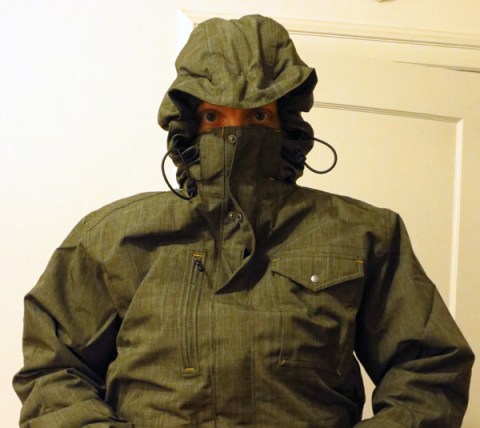
Take me to your freezer!
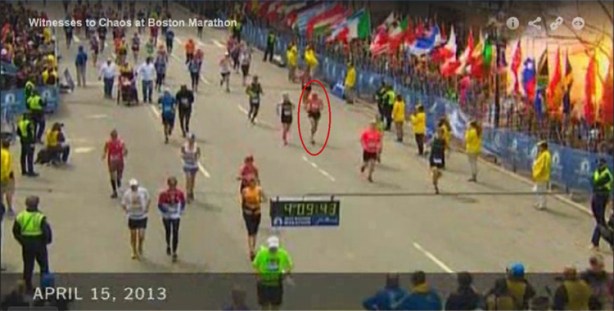
Thing is, I hate procrastination, and putting off until tomorrow what I can do today. Paradoxically, I have a lot of patience – research science and delayed gratification go hand-in-hand. But Antarctica promised to be the opportunity of a lifetime. Cliché as it may sound, life really is too short, as we were starkly reminded by this past week’s tragic events in Boston. Who knows where we’ll be and what we’ll be doing three years from now?
And although I wouldn’t classify myself as a “bucket list” runner, I do have a short list of three marathons that I consider must-do events: Boston, New York City and Antarctica. What did it matter that neither Katie nor I owned a legitimate cold-weather jacket, or that I’d only run in tights once in my entire life? At least we wouldn’t need any vaccinations or immunizations for this trip… I’m pretty sure penguin fever is both unpreventable and incurable.
As the nail in the coffin of March normalcy, we found ourselves in a relatively obligation-free time of personal and professional transition (another post for another time). Thus the awesome realization dawned on us that yeah, March was actually the perfect time for a frigid flight of fancy. And within two days, we’d committed to join 98 other adventure-seekers on an unanticipated journey to the Last Great Continent. Thankfully, our voyage was scheduled to last a bit longer than a 3-hour tour.
And so it was that on March 21, after a highly successful raid on the winter clearance racks at our local REI, The North Face and assorted outlets, Katie and I found ourselves on a flight bound for Buenos Aires, Argentina, where our 17-day adventure would begin. With little time for pre-trip research and little idea of what to expect (other than the obligatory requests to “Bring back a penguin!”), our ignorance was bliss.
So, just sit right back and you’ll read a tale, a tale of a fateful trip….
ARGENTINA (Fri – Tues, March 22 – 26)
Since this is ostensibly a running blog, I’ll limit my thoughts on the Autonomous City of Buenos Aires to the high (and low) points of our 5-day visit – though use of the word “concise” here would be disingenuous:
Overall, we had a lively visit to Argentina’s capital city – which wasn’t a foregone conclusion, given that I have virtually no interest in soccer, tango dancing or huge slabs of beef. But with its European-inspired architecture, socioeconomically diverse neighborhoods, thriving theatre industry and plentiful green spaces, Buenos Aires is a culturally vibrant city and a terrific place to explore on foot. Fortunately, my sub-fluent yet functional Spanish proved good enough to point us in the right direction and keep us out of trouble.
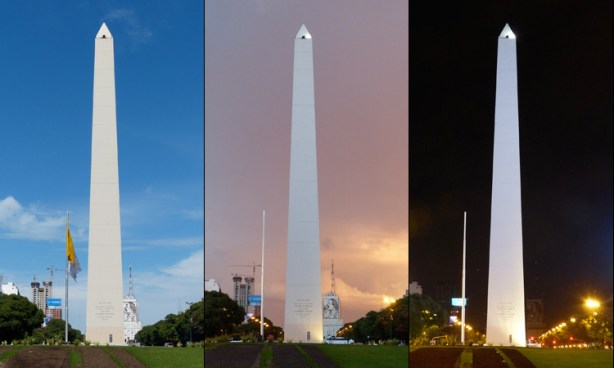
Good morning, good afternoon and good night in the Plaza de la República:
El Obelisco stands on the site where the Argentine flag was first hoisted in Buenos Aires in 1812
Architecturally, the city is a dynamic and captivating mix of old and new. Highlights of our bus and walking tour included the ornate mausoleums of La Recoleta Cemetary (where many notable Argentinians including Eva Perón are interred), the politically charged Plaza de Mayo (site of La Casa Rosada, mansion and office of the President of Argentina), and the recently renovated Teatro Colón (famed opera house which Pavarotti once praised for its “perfect” acoustics). And not surprisingly, images of favorite son Cardinal Archbishop of Buenos Aires Jorge Bergoglio, a.k.a. Pope Francis, now adorn the city.
For a city of Buenos Aires’ reputation and importance, however, I was disappointed by the state of abject disrepair in which many of its sidewalks find themselves. In many places it looked as though The Avengers had been filmed in the city and nobody had bothered to clean up the rubble. With a marathon on the horizon and after several near tweaks, I felt fortunate to get out of Argentina with both ankles intact.
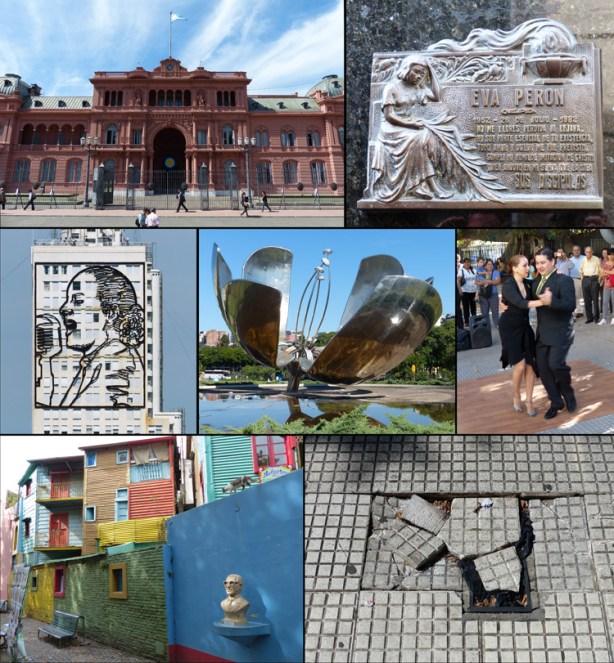
Buenos Aires illustrated (clockwise from upper left): La Casa Rosada, executive mansion and office of the President of Argentina; plaque marking Eva Perón’s tomb in La Recoleta Cemetery; tango demonstration in the Recoleta district; one of the city’s many neglected sidewalks; colorful Caminito street in the neighborhood of La Boca; steel sculpture of Evita on the north facade of the Social Development and Health Ministry; the steel-and-aluminum Floralis Genérica sculpture in Plaza de las Naciones Unidas
As a runner, I was impressed by the number of Porteños (locals) out on the weekend walking, running or cycling through the city’s many bustling parks. The typical Porteño I saw certainly was not built like someone whose daily diet consists of at least two large servings of beef – I’d guess the average Houstonian weighs roughly the same as 1.5 Porteños.
Speaking of food, the only part of each day I didn’t look forward to were the meals, for instance the vegetarian pizza we ordered for dinner one evening that arrived smothered in ham (I assumed the pig had been an herbivore). In addition, the extra – and not insignificant – fee that several restaurants charged for “table service,” coupled with their insistence on serving and charging for bottled water despite the potability of the local tap water, amounted to epic scams.
I don’t usually fault cities for their names, but “Buenos Aires” is a conspicuous misnomer. Granted the city was originally recognized for its “good airs” (or more likely, its “fair winds”) way back in the 16th century, but these days it would be like changing Omaha’s name to Ocean View, Nebraska. Collectively, the carbon monoxide-induced asphyxiation from urban traffic (particularly the large number of freight trucks headed to and from the port), the secondhand asphyxiation from the local smoking population, and the impenetrable char-grilled asphyxiation from the parrillas (barbecue grills) bordering the Reserva Ecológica where I ran on two occasions, combined to ensure that my lungs never got too comfortable in their pleura.

This was the top Google search result for parrilla, the catch-all name for the city’s popular BBQ grills.
By keeping close tabs on our cameras and backpacks, we were able to depart Buenos Aires with our wallets and all other personal belongings intact. Unfortunately, not all our fellow runners were so lucky… we heard of at least two cameras being stolen from dinner tables, and one trusting fellow (a fellow Bay Area native, in fact) lost his wallet to an elaborate pickpocket ruse involving fake bird droppings on his head, two helpful bystanders with a towel and an immediately accessible getaway car.
We meet at last (Sunday, March 24)
Our third evening in Buenos Aires featured the Antarctica Welcome Banquet Dinner. Here we met Thom Gilligan, the founder and leader of Boston-based Marathon Tours, as well as the four members of his race crew who would be joining us in Antarctica: Scott and Anita, respectively the General Manager and Environmental Officer of Marathon Tours, as well as the husband-and-wife team of John “The Penguin” Bingham and Jenny Hadfield, both well-known to the running community for their books and popular columns in Runner’s World and elsewhere.
John opened with some remarks about The Last Marathon, the first organized sporting event in the history of Antarctica. Thom then said a few words about “Antarcticer” (his Boston-based pronunciation) and introduced our upcoming adventure with the brutally honest classified ad ostensibly posted in the London Times by explorer Ernest Shackleton, in preparation for his 1907 Antarctic expedition:

Musical accompaniment for the subsequent slideshow included Dido’s “White Flag,” with its (so we all hoped) tongue-in-cheek chorus of “I will go down with this ship.” After the slideshow, Thom asked for a show of hands as to who had run a sub-3 hour marathon in the past two years. Three hands went up. He then asked for a show of hands from runners in the 3:00 to 3:30 range – three or four more hands went up, including mine. Although I knew this wouldn’t be a typical marathon, in that the 50-59 and 60-69 age groups would be the most competitive, I knew there would still be plenty of representation by the younger demographics, and I was shocked to find myself immediately seeded so highly.
But for me the most striking realization of the evening, which I hadn’t fully appreciated to that point, was the dedication and commitment of every person in that room. True we were all headed for Antarctica, and that in itself set this room apart. But whereas running for most people is a hobby, a way to alleviate stress and stay fit, for this group it was a lifestyle, an obsession in the healthiest sense of the word. And while not everyone in that banquet hall may have possessed the stereotypical “runner’s body” (that’s why it’s a stereotype), I’d be reminded in the coming week that mind really does matter.
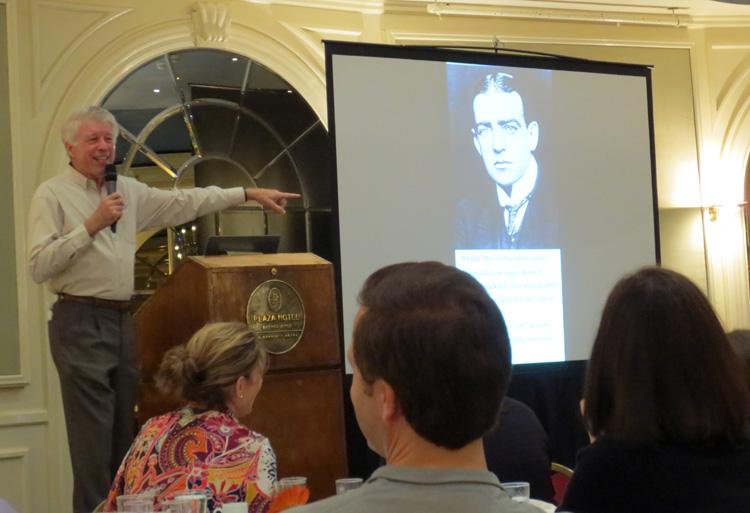
Thom Gilligan introduces an excited group of marathoners to what lies ahead
That evening I met seemingly normal, well-adjusted individuals who had run over 100, over 200, over 300 marathons. I met several individuals who had raced in all 50 states, on all 7 continents, and yet had never run a trail race. I met Winter, a 14-year-old Junior Olympian from Oregon who’d formed Team Winter and resolutely set a goal to run a marathon on all seven continents in support of prostate cancer awareness, after her father was diagnosed with the disease in 2008 and passed away less than a year later. I met Wes, a 78-year-old lifelong Purdue Boilermaker who’d run 200 marathons (including 100 in the past decade) and in 23 European countries, and for whom Antarctica would be his 7th continent and final marathon. I met Rory, a charismatic and “Jo-burg proud” South African who had completed the notoriously grueling Comrades Ultramarathon 12 times. I met Brendan, a running coach and 50 states/6 continents finisher from Chicago who’d failed in his first bid to complete the Antarctica Marathon three years earlier, and was back to exact his racing revenge. I met the Canadian duo of 70-year-old Georgine and her son James, and was amused to discovered that she was the runner in the family who had persuaded her hockey-playing son to join her in running the Antarctica half marathon. And I met many others whose stories I’d hear and whose lives I’d share over the next two weeks.
As nonchalantly as most people would discuss their kids’ soccer game, conversations centered around questions like “How many continents is this for you?” and “Have you run Kilimanjaro yet?” The Great Wall of China, Machu Picchu, the Arctic Circle, even Antarctica already in a few cases – my travel companions had left their footprints, literally, on nearly every conceivable destination on the planet.
I had to admit… these were my kind of people.
Destination: Antarctica (Tues – Thurs, March 26 – 28)
Fast-forward 36 hours, and after one more day spent appreciating the many faces of Buenos Aires, we found ourselves on a flight to Ushuaia (pronounced Oos-why-uh by the locals), the southernmost city in the world and the capital of Tierra del Fuego at the tip of South America. As the plane touched down in Ushuaia, the cheers from the locals onboard and the sight of the woman seated next to me crossing herself suggested our adventure had begun earlier than planned.
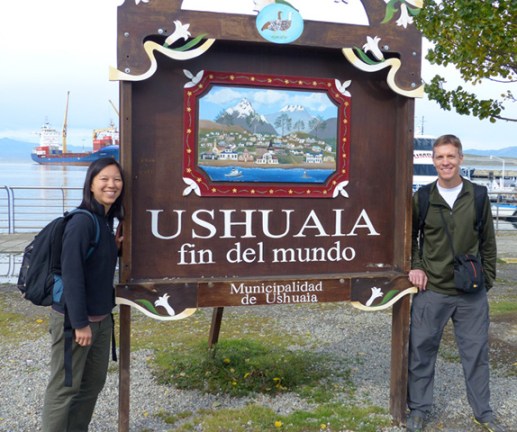
It’s the end of the world as we know it… and Katie and I feel fine
After a brief layover and stroll around this sleepy port town we boarded the Akademik Sergey Vavilov, the Russian ship (and one-time research vessel) that would – barring an unforeseen iceberg encounter – carry 105 passengers, 41 crew members and 13 expedition staff to our destination across 600 nautical miles and a particularly gnarly stretch of open ocean that we’d soon come to know all too well.
With rainbows and mist-shrouded peaks dominating the landscape, we “threw ropes” (set sail) at around 6:00pm local time on Tuesday and slowly made our way out of the Beagle Channel. From that point forward, responsibility for our well-being fell squarely into the hands of the 13-member staff of One Ocean Expeditions.
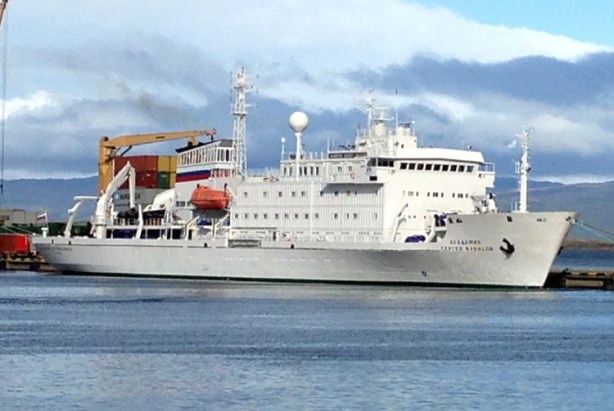
In the Ushuaia port, the Akademik Sergey Vavilov awaits its human cargo
As it turns out, we couldn’t have entrusted our safety and well-being to a more competent, experienced and entertaining group. As the Managing Director of Canadian-based One Ocean Expeditions, Andrew Prossin would be our solidly-in-charge Expedition Leader whose soothing voice and Canadian sensibilities would greet us first thing every morning with his wake-up announcements over the ship’s PA. In addition, at each meal he would set our expectations as to weather (always unpredictable), changes to the itinerary and opportunities for wildlife sightings. His understated cry of “hooray” which punctuated the end of his announcements became a rallying cry for the entire ship.
His One Ocean staff would be an appropriately eclectic collection of three fellow Canadians (Derek, Zoe and Nate); one Australian (Ewan, the kayaking king); a Dane (Louise, our hotel manager); a Welshman-cum-South African-cum-Australian (Mark, passionate whale conservationist and Andrew’s Assistant Expedition Leader); one far-North American (yoga guru Liz, whose “Alaska girls kick ass!” sticker immediately attracted my attention); one Portuguese (all-important mixologist Joao); and chefs Jeremy, John and Mike who, together with pastry chef Elizabeth, embraced and conquered the unenviable task of creatively providing three meals a day, every day, while hundreds of miles from the nearest grocery store or farmer’s market. Before this trip I’d never eaten, much less looked forward to, daily lunch dessert.

The One Ocean Expeditions staff included Expedition Leader Andrew (with microphone), Liz, Mark, Ewan, Nate, Zoe and Derek
Katie and I spent the first hour onboard familiarizing ourselves with the ship’s layout and idiosyncracies, including the less-than-romantic bunk beds in our third-deck cabin that prevented me from sitting up straight in either bed.
The next two days belonged to the Drake Passage, the necessary evil of open water between the Beagle Channel and Antarctica that would test every passenger’s sea legs, not to mention their seasickness meds. We both chose to use the Transderm Scopolamine patch, a nickel-sized prescription patch applied behind the ear that prevents motion sickness for up to three days. Which it did admirably well, the main drawback being the side effect of dilated pupils that messed up our vision something fierce. As a result, neither of us felt quite like ourselves during those two days crossing the Drake, as our literal inability to focus prevented productive behaviors such as reading or writing.
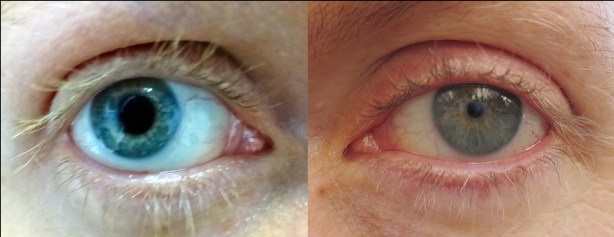
This is your brain on scopolamine (left); normal undilated pupil shown on right for comparison
Unfortunately, all postcards had to be submitted before race day if we wanted them to be postmarked from Antarctica. And so I found myself seated in the lounge of a wickedly swaying boat with one eye closed, squinting through my open eye Popeye-style as I tried to stabilize both hand and vision long enough to write legible quips about what an awesome time we were having at a destination we hadn’t yet reached. Lucky family members will no doubt wonder (assuming the cards ever arrive) how many shots of tequila preceded my postcard-ing sessions.
Luckily the One Ocean and Marathon Tours staff had planned other, less cerebrally taxing distractions to pass the time. Among these, Thom talked about the history of his brainchild, the Antarctica Marathon; John held court and lightened the mood with his entertaining perspective on life as a back-of-the-pack runner; Derek laid down mad knowledge on “Birds of the Southern Ocean”; Liz provided historical context in detailing the ill-fated Scott/Amundsen “Race to the Pole”; and Nate capped the evening with “Marine Superstitions,” after which nobody was caught whistling aboard ship.
Check out this footage of life in the Drake Passage (a.k.a. the “carbo-unloading zone”), filmed through the porthole in our cabin:
By Thursday evening we’d more or less cleared the Drake Passage, crossing the Antarctic Convergence and the 60th parallel south to enter the Southern Ocean. Soon after that we approached the South Shetland Islands and specifically King George Island, site of Saturday’s upcoming race. At that point even our first whale (fin whale, to be exact) sighting of the trip couldn’t disguise the fact that the natives were getting restless.
As race day approached and hours spent aboard ship accumulated, the restlessness and nervous energy among the passengers continued to build. The most tangible reflection of this mindset may have been the bar/lounge on the upper deck of the ship, which experienced two sparsely populated evenings as normally relaxed, sociable runners morphed into their water-swilling, teetotalling pre-race alter egos. Our bartender Joao was perplexed by but resigned to this transformation, which he’d clearly experienced before. And his voice of experience predicted a significantly more laid-back ambiance once the race was over. I raised my water bottle in agreement, and in a toast to more carefree days ahead.
Keeping expectations at (Maxwell) bay (Friday, March 29)
With the planet’s southernmost continent within sight at last, the harsh reality of where we were and what we were about to do finally hit home. Stepping out on the sixth floor deck to gaze upon King George Island – so close and yet so far – I was greeted by the stinging sensation of a million frozen, finely honed razors slicing right through me. My skin and two lightweight layers were defenseless against the Antarctic wind. And to think that tomorrow at this time, I’d be running 26.2 miles in this. Let the mind games begin…
Despite the initial cold shock, the consensus adjective of the day to describe our first encounter with Antarctica was simply “indescribable.” A picture may be worth a thousand words, but in this case one would have to suffice.
The plan for the day called for Thom and his crew to make their way across Maxwell Bay to King George Island early that morning to set up the race course. Meanwhile, the rest of us would finally make an excursion off the boat and potentially even stretch our legs on land at some point. Ah, perchance to dream…. Instead, the Antarctic winds did what the Antarctic winds do, churning up the water and making conditions unsafe to launch the zodiacs (the rigid inflatable boats used to transport people from ship to shore). It wasn’t until 1:00pm that the wind died down enough to launch the boats and send Thom’s crew (plus ATVs) on their way to King George Island. Many of us watched as the zodiacs made their not-so-long yet slow voyage across the bay and toward the Russian base at Bellingshausen Station.

The zodiacs approach the Russian base on King George Island, on their way to set up the marathon course
This in itself was uplifting news, because again this was Antarctica, where even the seemingly straightforward process of getting off the boat couldn’t be taken for granted. Still fresh on everyone’s mind was Thom’s unsettling tale of his 2001 Antarctica Marathon expedition, when uncooperative weather had seized the day(s), only to have the passengers seize it right back. After several days of thwarted attempts to launch the zodiacs in rough waters, a consensus decision had finally been reached that the show must go on, and that the marathon would be run ON. THE. DECK. OF. THE. SHIP. Apparently one of the passengers that year had been a qualified race distance certifier, and he mapped out a 26.2-mile course that comprised 422 laps around the upper deck. The race was run over a 24-hour time period, and don’t ask me how each runner kept track of his/her number of laps completed. Most strategically, the ship had been moored such that the anchor just touched the continent of Antarctica, thereby validating the venue. Thus went the story of how the 2001 Antarctica Marathon was staged under the most challenging conditions to date, a testament to human fortitude and resolve that exactly nobody on our ship had any interest in repeating.
Speaking of human fortitude… with our plans for an afternoon expedition foiled, everyone gathered in the bar/lounge to watch “Crossing The Ice,” an intimidating/inspiring documentary about two Aussies and one Norwegian who found themselves competing against each other to become the first persons to complete the trek to the South Pole and back unassisted. I then retreated to the basement gym to, if nothing else, get the blood pumping and stretch my legs before I’d have to use and abuse them the next day.
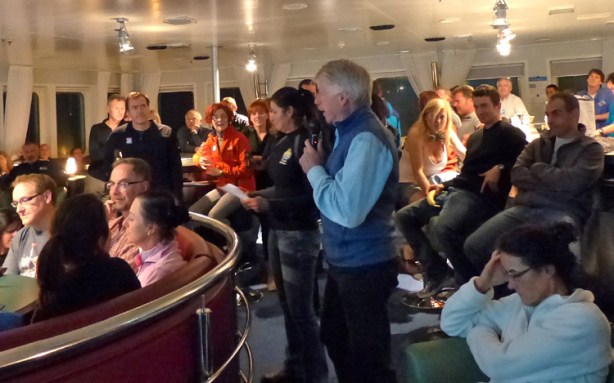
A weary Thom addresses a roomful of restless runners during his pre-race briefing
After dinner – the last supper before the race, which happened to coincide with this being Good Friday – Thom stepped to the microphone for his pre-race briefing looking ruddy and dog-tired from his afternoon excursion. He informed us that the hilly course would consist of two different out-and-backs that marathoners would run three times, with the start/finish line separating the two. The first out-and-back would take us past the Russian base, then out to the first turn-around point at the Uruguaryan Artigas Base and back, while the second out-and-back would lead past the Chilean Eduardo Frei Base and out to the turn-around at the Chinese Great Wall Station before retracing its steps. There would be icy (if not muddy) patches to negotiate that Thom estimated at around 5% of the total course distance. And based on today’s course conditions, he and his crew would be strictly enforcing the 6-1/2-hour time limit – anything longer and we risked hypothermia.

Google Earth rendering of The Last Marathon course – thanks to Dan, from whom I stole the idea;
my personal detour can be seen leading toward the airstrip near the yellow church
(Click on the map for a larger image)
As we’d suspected, the day had been a rough one for Thom and his crew – John predicted that if we’d had to run the race that day in those conditions, nobody would have finished. But he concluded the briefing by injecting a shot of humor, warning the room that “Bandits (runners who race without paying an entry fee) will be pulled off the course.”
Back in my cabin I systematically organized my apparel, bottles of Cytomax/GU, Garmin (don’t be silly, of course GPS works in Antarctica!) and thoughts for the day ahead. And I realized that realistically, I had no idea what to expect. Cold to be sure, but beyond that I had zero expectations: could I run a sub-4:00 marathon in these conditions? Probably not, though “probably not” wouldn’t stop me from trying. Runners are notorious for downplaying expectations – case in point, those ultra-competitive types who qualify for the Boston Marathon and then vow to treat it as a “victory lap”.
But this time, I realized as sleep engulfed my upper bunk – this time I really was out in the cold.
Continued and concluded in Act 2… with an actual race report!








 Blisters, Cramps & Heaves