Archive for October, 2012

Experience: that most brutal of teachers.  But you learn, my God do you learn.
– C.S. Lewis
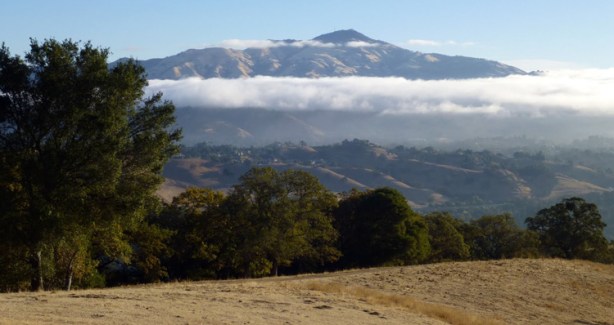
(photo courtesy of Brazen Racing)

The experience of Rocky Ridge taught me a lot last October.

I learned it’s wise to approach the course with a healthy measure of respect.  I Iearned that after 13.7 miles in the Las Trampas Regional Wilderness, I’ll have earned that coveted flaming-tiger finisher’s medal and post-race IT’S-IT.  I learned the humbling frustration that comes from having to walk hills I had no intention of walking, and feel exhaustion I had no intention of feeling.  And I learned (or rather confirmed) that although I’m a sucker for the trails, I’m no mountain goat.

But most of all, I learned that Rocky Ridge is the “Super Bowl of Brazen Racing” for a reason: because with roughly 4,000ft of elevation gain/loss, it’s the most challenging half marathon in the Bay Area, and the toughest half I’ve run aside from Pikes Peak.  All within 2,000ft of sea level, courtesy of a whole lot of up-ing and down-ing.
So with that in mind and 5-Hour Energy in body, Katie and I parked and hustled to the start line at the Las Trampas Corral Camp on Saturday morning.  We’d dragged a bit that morning and ended up cutting it close, arriving just as Sam was announcing one minute until the start of the half marathon (the 10K and 5K would follow 15 and 30 minutes later, respectively).  Truth is, I have yet to find the race where the running part is as difficult as the getting-out-of-bed-that-morning part.  But having carefully read Sam’s pre-race email and having run the course last year, I assumed I could safely dispense with any more pre-race announcements.

So after cycling through the CliffsNotes version of my warm-up routine, I ducked under the ribboned rope and into the start corral, as usual lining up among the front 20-25% of runners.  Forty seconds later the familiar Brazen airhorn sounded one mighty blast, and Las Trampas opened its arms and bared its fangs to welcome some of the strongest trail runners in the Bay Area.  And the rest of us, too.
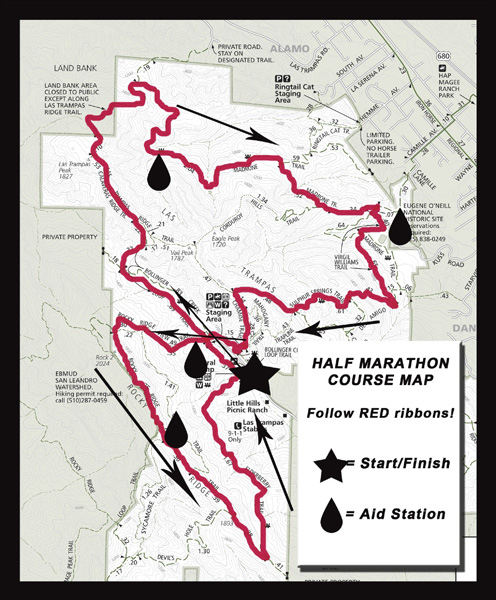
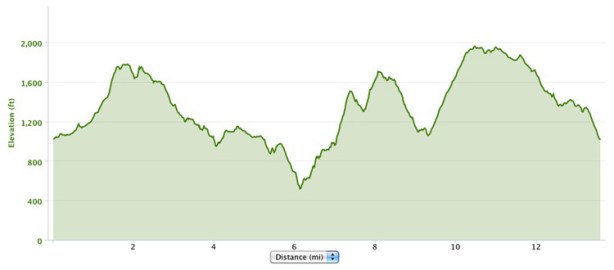
Rocky Ridge Half Marathon Course Map

I followed the leaders into the wild with one goal in mind: to beat last year’s finish time of 2:33:46.  I was confident for several reasons.  First, I’d learned some valuable lessons from my 2011 experience, lessons that as a now-seasoned Rocky Ridge veteran would help me… if not tame this beast, then at least understand how it hunts.  Second, my half marathon PR of 1:34:02 was set at this year’s Oakland Running Festival the week after I’d run the L.A. Marathon, so I was hoping for a similar post-Chicago bounce.  True, this would be a dramatically different race than Oakland; as Sam had pointed out in his pre-race email, Rocky Ridge is “known for forcing the fastest of runners down to a slow slog!”  Nonetheless, I was psyched for this race and counting on another strong post-marathon performance.  And lastly, weather conditions would be more favorable this year, with persistent morning fog holding the sun at bay, and temperatures hovering in the mid-50s.

So when it came to beating myself, I liked my chances.  But placing in my age group would be another matter.  As Brazen’s championship race with championship money at stake, Rocky Ridge attracts more than its share of talented runners, among them a number of Brazen first-timers including male newbies in the 40-44 range.  Meaning that if I expected to place in my age group, I’d have my work cut out for me.  Last year, for example, I’d placed a ho-hum 6th out of 20 runners in my age group.  And I was pretty sure Brazen hadn’t extended their age-group medals to include a polydactylous six-fingered hand.

I’m still waiting to receive my age-group medal
from last year’s race

Not only is Rocky Ridge the Super Bowl race for all Brazen runners, but it doubles as the final race in Brazen’s more selective Ultra-Half Series.  To qualify as an Ultra-Half Series finisher, runners must race in at least four of the nine series races, plus the series finale at Rocky Ridge.  Scoring is based on each runner’s cumulative “time back” from the winner (the winner’s “time back” being 0) in their four best races, plus Rocky Ridge.  The top three runners with the lowest cumulative “time back” after Rocky Ridge are the Ultra-Half Series winners, and earn the same prize money as the overall winners.  Best of all for the rest of us, all Ultra-Half Series finishers earn a special finisher’s coaster to complement their Rocky Ridge race medal.

I missed out on becoming an Ultra-Half Series finisher last year through my own ineptitude… I’d misunderstood their Nitro Trail Half Marathon to be one of the qualifying races, not realizing until the week of Rocky Ridge that this wasn’t the case.  So I was determined not to screw myself out of another shot at die-cast glory this year.  That is, until tendonitis derailed my plans to run the Trail Quake Half Marathon in June, meaning I would have run only three (rather than the necessary four) qualifying races before Rocky Ridge: Wildcat, Bear Creek and Drag-N-Fly.

In a curious twist, though, I’d also run the Mount Diablo Trails Challenge in April… except that there, I’d chosen to run the longer 50K rather than the qualifying half marathon distance.  Fortunately (and sensibly), the Brazen folks posted on their Facebook page in late August that the Diablo 50K would be accepted as a Series qualifier, though with a caveat: runners using the 50K as a qualifier would not be factored into the final standings and thus would not be eligible for the prize money, due to the differences in “time back” scoring between the 50K and half marathon distances.  I was fine with this decision, since the governing body’s (i.e. Sam’s) reasoning made sense.  My real disappointment lay in my own inability to run Trail Quake… had I run it in a time consistent with my other three finish times, I would have found myself at least 5th, and potentially as high as 4th, in the Ultra-Half Series standings in the week leading up to Rocky Ridge.
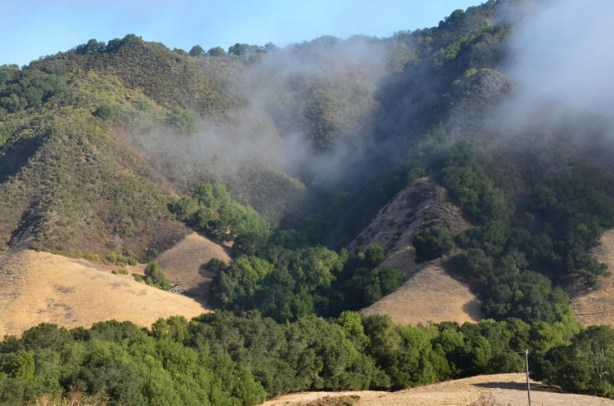
Like beach sand in your swimsuit, the Las Trampas fog found its way into every nook and cranny
(photo courtesy of Brazen Racing)

Back to race-day reality, and all these musings amounted to little more than neural debris as the trail rolled gradually upward toward its first steep ascent, beginning just after the midway point of mile one.  Rocky Ridge wastes little time in muscling up, and the last echoes of the airhorn had scarcely faded when we reached the first leg-searing uphill of the course.  Sticking with my usual Brazen modus operandi I hugged the left side of the trail and began to pass other runners, many of whom chose (willingly or unwillingly) to walk this uphill section.  I passed about a dozen walkers before I spotted Julie Neumann, the women’s Ultra-Half Series winner in 2011 and eventual second-place finisher this year.  For a brief stretch she and I were the only two runners maintaining a jogging pace, as I trailed roughly ten yards behind her all the way to the top of that first hill.  Just before the mile 2 marker we crested, the trail began its first extended downhill and she kicked off the parking brake and left me in her dust.  Literally.  Oh downhills, why must you insist on following uphills?

If I told you that miles 2-6 of Rocky Ridge were predominantly downhill, you may be misled into thinking the course can’t be that tough.  And if I then copped to the fact that the final 2.5 miles are mostly downhill as well… well, you may conclude that for a grown man who seems to enjoy punishing his body, I sure do whine a lot.  But Newton wasn’t kidding: what comes down must first go up.  And Rocky Ridge earns its stripes as the most challenging of all Brazen races for five reasons: miles 7-11.

As Hall of Fame golfer Bobby Locke once remarked, “Drive for show, putt for dough.”  By analogy, if the other 8+ miles are for show, then miles 7-11 are for dough (literally, for those runners vying for a share of the prize purse).  Those five life-affirming miles are the reason I didn’t give in to early adrenaline and attack that first downhill more aggressively.  The experience of 2011 had taught me that my real race would begin at mile 7, and that the strategic (i.e. gravitationally challenged) runner tries not to do anything too heroic, too soon.

RUNSTRONG? I sense a sponsorship opportunity! (photo courtesy of Brazen Racing)

Further complicating this initial descent was the muscle on the medial/inner aspect of my left arch (abductor hallucis, I presume?), which suddenly and sharply began to feel over-stretched.  After a quick on-the-move assessment, I concluded that the pain was limited to my arch and excluded from my previously injured tendon, and I self-diagnosed that I wouldn’t risk further injury by continuing to run.  Based on my experience with other Merrell footwear, I attributed the pain to the new Merrell Mix Master 2 shoes I was wearing for only the second time.  The twinge in my foot came and went over the next several miles, though fortunately it never evolved from fleeting discomfort into full-blown “your body’s trying to tell you something” pain.  So on I ran… it wasn’t as though I’d been expecting a comfortable morning in the best of circumstances.

As the trail widened a bit in its descent through mile 3, a shorter gray-haired fellow asked me in a Russian accent, “Excuse me, how many more hills are there?”  I contemplated this for a second, not sure how to break the news to him.  “Two long ones, really,” I breathed roughly. “But miles 7 through 11 feel like one long extended hill.”  He nodded forcefully twice.  “So then one more hill? Thank you!” he replied, and accelerated down the hill.  I was pretty sure I’d be seeing him again before the finish line.

Over the next four miles I maintained a steady pace of ~8:15/mile on the downhill sections, as my foot continued to protest intermittently.  The downhill momentum of the course was briefly interrupted by a short-but-strenuous uphill jag near the mile 4 marker, before continuing its rolling descent through miles 5 and 6.  The final 0.1 miles of this descent were particularly steep, and I kept my own momentum in check to ensure I didn’t stumble over a root and slide the rest of the way down on my face.

Mike Sohaskey on Rocky Ridge Half Marathon singletrack

Leader of the pack on the singletrack (photo courtesy of Brazen Racing)

The trail then bottomed out at what appeared to be a dry stream bed.  By that time, the downward momentum I’d gained made it that much harder to switch gears as the course abruptly began its grueling climb up to mile 10.5 and a peak elevation of 1,950ft.  But switch gears I did, forcing myself to maintain whatever semblance of a jogging pace I could as slowly, with tortoise-like efficiency, I caught and passed many of the speedy downhill folks who had passed me in the previous four miles.  Among these folks was the older Russian fellow, whom I quickly passed, this time for good.  I never got to ask him what he thought of that one more hill.

Having experienced Rocky Ridge before, the anticipation of miles 7 to 11 initially triggered in me the same sort of anxiety a child might feel on hearing his agitated mother promise “Just wait until your father gets home!”  Sure the reality would probably be unpleasant, but the psychological distress inflicted by the anticipation itself would always be worse.  What I needed was a more productive strategy.  So I channeled my own anxiety into a respectful appreciation for what lay ahead of me, and resolved to maintain as fast a pace as possible for as long as possible.

Like most of the course, miles 7-9 featured plenty of soft dirt and prominent roots along singletrack trail.  This kept me on my toes knowing, as I’d slide past someone walking uphill, that he or she would likely be right on my heels trying to pass me once the trail leveled out or headed back downhill.

One of my greatest triumphs at Rocky Ridge was that only twice did I have to slow to a true hiking pace: once during an infuriatingly steep stretch just before the mile 7 marker, when I felt like a bowling ball on legs; and again during mile 8, when my legs refused to turn over and the sand-like quality of the dirt rewarded maximum effort with minimal progress.  Understanding the dangers of inertia, though, I kept my hiking to a minimum (less than 0.1 miles in each instance) and picked up the pace again as soon as possible.

During the uphill portion of mile 8 I also encountered a Brazen first for me: a fellow runner’s stomach reversing gears (i.e. vomiting) on the side of the trail.  Assuming he would be fine I soldiered on, which turned out to be a good call since he passed me on the next downhill.  We then switched places again as I caught and passed him for good on the next uphill.  After the race I found him sitting near the finish line and congratulated him on a strong showing… though now that I think about it, I probably shouldn’t have shaken his hand.  Purell, anyone?

Unlike the two miles on either side of it, mile 9 is largely downhill and a welcome reprieve from the uphill grind.  Which may explain why I’d forgotten one of the more sadistic aspects of the course layout.  As I reached the mile 9 marker, I could clearly hear Sam’s disembodied voice booming from the PA system at the nearby finish line, a finish line I wouldn’t be seeing for another 50 minutes.  Adding insult to injury, I was just in time to hear him announce the men’s half marathon winner across the finish line.  The trail then turned away from the finish line, Sam’s voice was engulfed by fog, and I transitioned on to the paved section of the course at aid station #3 – the gateway to mile 10 and the most relentless uphill yet.
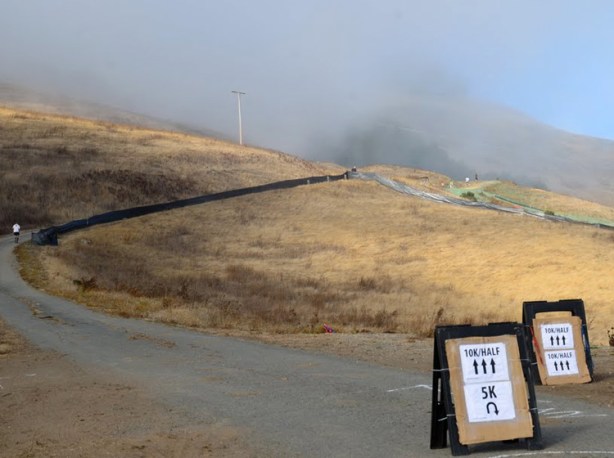
Heading up, up and away into the fog on mile 10 (photo courtesy of Brazen Racing)

Around this time I had an epiphany of sorts, as I realized that the beastly beauty of Rocky Ridge lay not just in the severity of its hills, but in their strategic positioning as well.  The most lung-busting, gut-churning and soul-squelching uphills on the course – those beginning at miles 7 and 10 – immediately follow steep extended downhills.  And if you haven’t experienced it for yourself, this abrupt shift in both momentum and muscle groups can be exhausting.  In effect it’s this transition from downhill to uphill, and the stark contrast between the two, that deadens the legs and makes the uphills seem even nastier than they are.  It’s also a major reason why strength training for trail runners typically emphasizes the gluteal (butt) and core (abdominals, back, hips) muscle groups.  I’d reached the same conclusion about hill placement and this “roller coaster effect” as I’d struggled up and down the Marin Headlands during the 2008 and 2009 North Face Endurance Challenge half marathon.

Now, with mile 10 and Rocky Ridge itself looming ahead of me, I recalled vividly the critical first-timer’s mistake I’d made here last year – allowing myself to look ahead at the paved trail stretching out in front of me, winding its way up, and up, and up some more, until it seemed to disappear into the clouds like Jack’s beanstalk.  And in that same moment I’d seen all the other runners painstakingly hiking their way up toward the ridge like a caravan of snails.  Understandably, my glimpse into the future had been demoralizing.  The gut-wrenching promise of another punishing ascent, coupled with the heat and the crippling power of suggestion conveyed by so many others walking, had taken their toll on my psyche and led to a less-than-stellar performance the rest of the way.

So with the tough-love lessons of 2011 in mind, I hit the asphalt with my head down this time, only glancing up to thank the aid station volunteer as he pointed straight ahead and said, “That way!  That’s all I’m going to say.”  Staring at the ground two feet ahead of me, I plowed straight ahead at a labored but consistent jog.  With this strategy I passed three more people on my way to the top, and before I knew it asphalt was once again yielding to more forgiving dirt.  Which of course makes for more difficult footing… but still I kept my head down and stuck with the game plan.
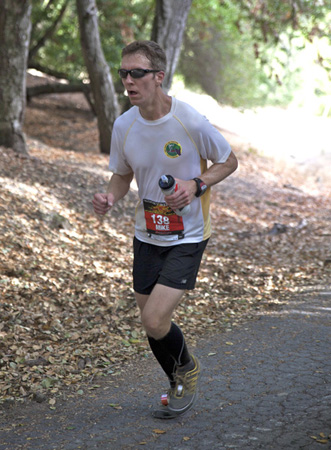
View from the curiously stationed mile 10 “flatter cam”
(photo courtesy of Brazen Racing)

During this stretch I also comforted myself by deploying one of my favorite mental pick-me-ups during a race, asking: If I’m feeling this ugh, how must the runners behind me be feeling?  That thought usually helps me to wrestle aside fatigue and renew my focus on chasing down runners ahead of me.

And then, around mile 10.5, something glorious happened: the running gods smiled down, tiny angels danced on the heads of the safety pins holding my racing bib in place, and the course started… to level… out.  Finally, I’d reached Rocky Ridge.  And finally I started to enjoy myself.  Unfortunately the view from on high was minimal thanks to the dense fog, but I’d gladly trade last year’s heat for this year’s cool.  With the trail shrouded in fog and visibility at times limited to no more than 20ft, I half-expected the Black Pearl to emerge from the fog bank ahead of me.  Eerie.  The scene reminded me of running in the Marin Headlands, a favorite hangout for Bay Area fog.

Mike Sohaskey running Rocky Ridge Half Marathon in fog

Looks like the scenery wasn’t the only thing in a fog
(photo courtesy of Brazen Racing)

Up on the ridge I could again hear Sam’s PA-amplified voice, though I still couldn’t see him or the surrounding scenery.  Moisture from the saturated air began to soak my hair and drip into my face.  As I approached the end of the ridge and one final uphill jag, a chilly headwind blasted me in the face.  I hate running into a headwind – I’ll take heat, cold, rain, snow or a plague of locusts over a stiff headwind – and as I labored forward, I briefly toyed with the idea of hiking that short uncomfortable stretch.  But I kept my head down and plowed on, knowing that significant downhillage (and soon after, the finish line) awaited me on the other side.

As I passed the mile 12 marker, the course turned off Rocky Ridge and on to Elderberry Trail for the home stretch.  At that point my foot stopped whining and I was able to stretch my legs, lengthen my stride and actually run for a change.  Although Las Trampas wasn’t about to go down quietly, as confirmed by a couple more short-but-sweet uphill jags en route to the finish line.
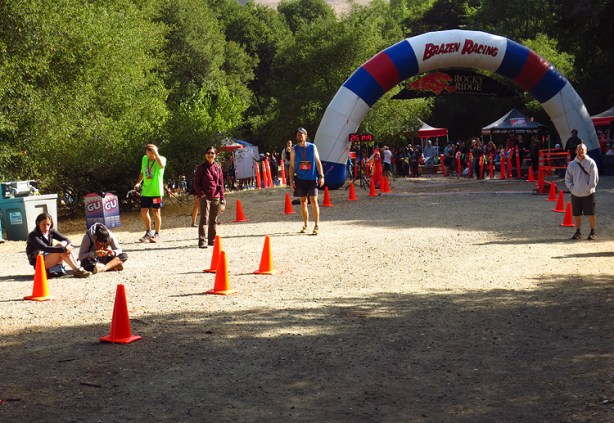
The Pearly Gates, seen through the eyes of a trail-running atheist (complete with Saint Katie in purple fleece)

I ran more or less by myself for the last 4+ miles.  And as I made one last downhill turn and saw the finish line laid out beautifully ahead of me, I had that all to myself as well.  Basking in the last 10 yards between me and the finish, I could hear Katie and a few other spectators cheering, and the official clock welcomed me back with a reading of 2:29:14 (chip time 2:29:11).

When I say I ran by myself, I’m not kidding… I finished over three minutes behind the runner ahead of me, and one minute ahead of my closest competition.

Mike Sohaskey crossing finish line at Rocky Ridge Half Marathon

In stark contrast to Chicago, I had the finish line all to myself at Rocky Ridge
(photo courtesy of Brazen Racing)

As I thanked the volunteer who cheerfully handed me my finisher’s medal, I flashed back to last year’s finish line.  There I’d been greeted with a look of horror from a fellow finisher, who’d handed me a cup of water and proclaimed “Dude, you need a salt tablet!”  Apparently sunscreen mixed with sweat on a hot day had left my face streaked with a white residue that Mr. Well-Meaning had mistaken for my body’s weight in salt.  This time I gulped down my remaining bottle of coconut water, which I’d carried the entire race but had only felt the need to sip from in the final two miles.  Without the heat, my thirst had been minimal… that, and it’s tough to swallow when you’re using your mouth as an extra breathing orifice on uphills.

And though I’d carried my own bottle and bypassed the well-stocked aid stations, I’d made sure to gasp out my thanks to the volunteers at all four stations.  They’d offered plenty of smiles and encouragement to supplement their selection of GU, Ultima and M&Ms.

I reunited with Katie and we made our way toward the one table set up for just this occasion, where qualifying runners could claim their hard-earned coaster as a (say it loud! say it proud!) Ultra-Half Series finisher.  And though admittedly I’d been dubious about the idea of a coaster rather than another hangable medal, Brazen’s artwork does not disappoint… it’s an impressive piece of die-cast craftsmanship with significant heft.  In the event that a Wizard of Oz-style tornado hits Berkeley anytime soon, I’ll be perfectly confident dropping this anchor in my pocket and waiting out the twister in my living room.
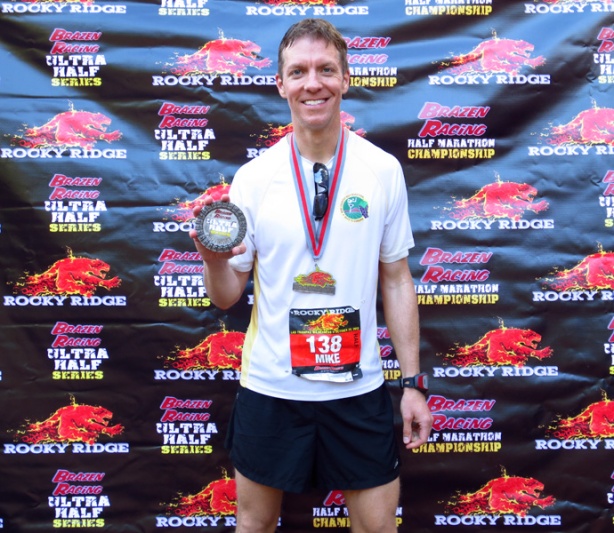
Mike Sohaskey with finisher's & Ultra-Half Series medals at Rocky Ridge Half Marathon

Forget the Shake Weight®… hoisting the Ultra-Half Series finisher’s coaster is the ultimate forearm workout

As for the final Ultra-Half Series standings (for which you’ll recall I didn’t qualify): not that I’m keeping track, but in this the Series finale I finished nearly seven minutes ahead of the eventual Series 4th-place finisher.  Fourth place, as in one spot out of the prize money.  I can live with that.

As I helped myself to the always excellent post-race spread and exhausted finishers continued to trickle in, Sam played the role of trail racing’s Ed McMahon and presented oversized sweepstakes-style checks to the first- ($1,000), second- ($500) and third- ($250) place men’s and women’s finishers for both this race and the Ultra-Half Series.  CONGRATULATIONS to all the winners, it’s a kick to race alongside (ok, behind) some amazing trail runners.

Sam (in blue) presents the winner’s checks to the men’s and women’s Rocky Ridge champions…

and to the men’s and women’s Ultra-Half Series champions

Also saw hardcore Brazen-ophile Isak, wearing his familiar black skullcap, cross the finish line in just over 3½ hours. True to what he’d told us at Drag-N-Fly, he apparently hadn’t looked at the course elevation map before Rocky Ridge.  Honestly, I’m not sure whether to label that decision “ballsy” or “reckless.”  But I have to admire his attitude and respect his reasoning: to his mind, he’d already registered for all of Brazen’s races this year anyway, and he intends to run every step of every race as well as he can, regardless of what the course he can’t see looks like.  At any rate, he survived Rocky Ridge and received his own well-deserved coaster.  Having had the opportunity to chat with Isak at several Brazen races, I’ve no doubt that if it’s up to him, he’ll be back at Las Trampas next October to do it all over again.  And I’ll be lining up next to him.

Isak Saad and Mike Sohaskey after finishing Rocky Ridge Half Marathon

No Brazen race feels official until the finish line debriefing with Isak

Before I finished my race Katie witnessed a 4-year-old and his father, each wearing a 5K bib, cross the finish line… almost.  Apparently the father crossed first, then retraced his steps to retrieve his tiny son, who had stopped juuuust short of the finisher’s mat and stood rooted to that spot, hugging his stuffed animal.  “We’re pretty sure he won his age group,” Jasmin offered over the PA.
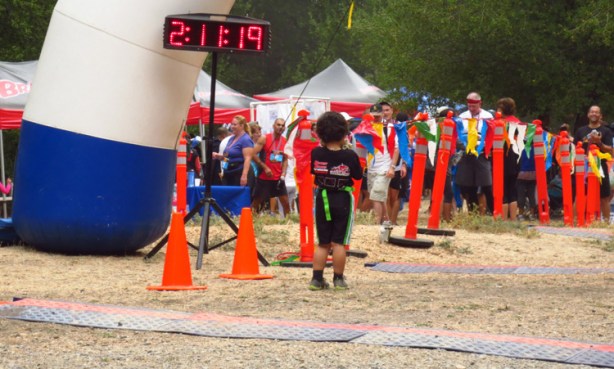
Brazen’s littlest Rocky Ridge finisher, 3 steps from glory

As the finish area filled with tired but triumphant runners, Sam urged everyone to chow down on the IT’S-ITs, challenging each person to eat two.  I limited myself to one, never being sure how and when my stomach will respond to post-race snacking.  But that one was frozen perfection as usual… and hopefully my frugality allowed someone else to enjoy three of their own.

Making our way toward the parking lot, I shook hands with Sam (not to worry Sam, I found the Purell) and thanked him for another great outing.  Jasmin was still moving quickly and purposefully around the finish area so I didn’t want to bother her, but now I can take this opportunity to say… if you’re reading, thanks again Jasmin!  Look forward to seeing you both at another Brazen start line soon.

After the race Chuck texted me to ask how it went, and I texted back: “3 words: brutal. brutal. over.”

Mike Sohaskey and Katie Ho at Rocky Ridge Half Marathon

All smiles on the happy side of the finish line

But again, I learned (and re-learned) a lot from Rocky Ridge.  I learned that although I’ll never be a mountain goat, it won’t be for lack of trying.  I learned that those Bay Area folks who don’t know about Las Trampas are missing out.  I learned that Brazen’s championship race may be brutal and grueling, but it’s precisely that brutality and, um, gruel that keep me dragging my uncooperative body out of bed on race mornings.  If 4-year-old legs can conquer Rocky Ridge, then I have no excuses.  And I learned that no matter how many times I see ’em, giant prize checks will always be cool… and presumably even more so if one has your name on it.

Most of all, I was reminded that although huge, adrenalizing road races like Chicago certainly have their place in my racing schedule, nothing beats the cathartic solitude of lacing up my trail shoes and hitting the dirt.  What some would call the middle of nowhere, I call the middle of nowhere-I’d-rather-be.  No concrete.  No traffic.  No road (or trail) rage. No 7-Elevens to spoil miles 7-11.  And… no way, is that another steep uphill ahead?

In the final analysis Rocky Ridge 2011 was a valuable learning experience, based on which I reworked my strategy and expectations for 2012, and cut 4½ minutes off my finish time.  Nothing mind-blowing, but certainly better than adding 4½ minutes.  Along the way I extracted some beauty from that beast, and ultimately had myself a successful morning in Las Trampas.  And really, I guess I shouldn’t be surprised.

After all, I had the best teacher.

Rocky Ridge Half Marathon medals

PRODUCTION:  With each race of theirs I run, I find another reason to pat the Brazen crew on the back.  During Rocky Ridge I had plenty of time to think, albeit not particularly deep thoughts, and it struck me that for the Brazen trail races I’ve run, each course has many potential turnoffs where trails converge and diverge.  Meaning many potential race courses.  Yet Sam and Jasmin do a terrific job of mapping out some of the most challenging and scenic half marathon courses (or a 50K course, in the case of Mount Diablo) in the Bay Area, while always keeping them within limping distance of 13.1 miles.  Amazingly, my Garmin after the Diablo 50K (= 31.1 miles) read 31.4 miles.  At the same time, none of these courses consists of three flat loops around a marshy duck pond, or four out-and-backs along a single trail so you see way too much of your fellow runners… they’re well-designed loop courses (the Diablo 50K is point-to-point) that typically incorporate the steepest hills in the area.  Kick-ass (literally and figuratively) courses like these don’t design themselves, and I don’t imagine they happen without some serious planning and execution.  I might not be singing their praises so loudly if the Brazen crew held their events in the Marin Headlands, or in other well-worn trail-running hot spots as do other race organizers in the Bay Area.  Instead, Brazen has carved out an impressive niche among local racing companies by doing their research and taking advantage of less-appreciated parks (or wilderness, in the case of Las Trampas) in both the East Bay and South Bay.

If race attendance is any indication, it’s clear that Brazen’s star is on the rise.  And I hope Sam and Jasmin continue to grow and expand their operation to become the premier racing company in the Bay Area, if that’s their long-term goal.  Fortunately, one of the (many) positives of a Brazen trail race is that they tend to be held in smaller regional parks where park guidelines restrict the number of runners.  So Brazen aficionados can rest assured that the singletrack sections of Rocky Ridge won’t ever end up looking like the sidewalks outside the Apple store on the eve of a new iPhone release, with runners holding spots in line for other runners.

If Apple buys out Brazen, they should rebrand Rocky Ridge the “iPlod Half”
(photo courtesy of tuaw.com)

GEAR:  My Merrell Mix Master 2 trail shoes, which I wore for the first time in race conditions, performed admirably with regard to grip and traction.  They’re comfortably light but have enough of a heel to provide some braking capacity on steep descents.  On the downside, I tend to think the pain in my arch during the race was due in part to the Mix Master 2’s minimal support on downhills… I’ve experienced a similar ache only once before while running in my Sonic Gloves, so I attribute it to the shape of the shoe last in these models.  Admittedly I want to like the Mix Master 2’s because I think they’re a well-conceived, not-quite-minimalist trail shoe (and because I invested in them), and I’ll log a few more miles in ’em before making a decision.  But at this point I prefer my more minimalist Road Gloves, based on how they contour to and support my midfoot and arch.

Now I know how Pig-Pen feels

And hopefully this is the last time I’ll address this topic… my Injinji Midweight socks, which I wore at Chicago and on one other asphalt 30-miler before Rocky Ridge, survived the ups and downs of the trails better than the Injinjis I’ve worn in past Brazen races.  The only obvious casualty is a very small hole developing in the middle toe of my right foot.  So the Midweight toesocks do seem to hold together better than their more lightweight counterparts, but it may simply be the case that toesocks of any weight are more vulnerable than normal socks to the stresses of trail running. I’ll probably stick with them for races because even though I dislike their short lifespan, I dislike blisters caused by running on uneven terrain even more.

FINAL STATS:
October 20, 2012
13.6 miles in Las Trampas Regional Wilderness
Finish time & pace: 2:33:11 (4:35 improvement over 2011), 10:58/mile
Finish place: 38/170 overall, 4/20 in M(40-44) age group
Race weather: foggy and cool, mid-50s
Elevation change (Garmin Connect software): 3,577ft ascent, 3,558ft descent
(Garmin Training Center software): 4,426ft ascent, 4,303ft descent

Success at Rocky Ridge means never
having to say you ran a 17-minute mile
Whether you think you can or you think you can’t, you’re right.
– Henry Ford

“I predict sub 3 30.”

My brother sent his text the week before I’d be running the Chicago Marathon, and at the time I thought little of it. Why should I?  My previous two marathons, the California International Marathon in December 2011 and the L.A. Marathon earlier this year, had yielded successive personal records (PRs) of 3:39:15 and 3:37:53 respectively, a not-so-whopping improvement of one minute, 22 seconds.  And both courses had been relatively flat.  Not only that, but Chicago Marathoners had experienced/endured unseasonably hot temperatures in four of the past five years (by contrast, the 2009 race saw temperatures dip below freezing).  So I’d automatically – and wisely, I thought – adjusted my mindset to expect hot temperatures on race day, and to deal with them as best I could.  When possible I’d even trained under the East Bay sun, with the pace for my most recent long run – 15 miles in 86°F heat – projecting to a sub-3:35 marathon pace.  But regardless of conditions, 15 miles is not 26.2.  And with all that in mind, the thought of somehow shaving another eight minutes off my PR seemed, well, not happenable.

So I was pleasantly surprised when, five days before the race, I received an email from Marathon organizers telling us that “the weather on race day is projected to be partly cloudy, with low temperatures in the upper 30s to low 40s, and high temperatures in the low to mid 50s (degrees F).”  This corresponded to an Event Alert Level of “Green” (Low), which promised favorable conditions for marathon running.  At that point I remembered Chuck’s text, and my mental gears began to turn.  Slowly, to be sure, but the seed had been planted.

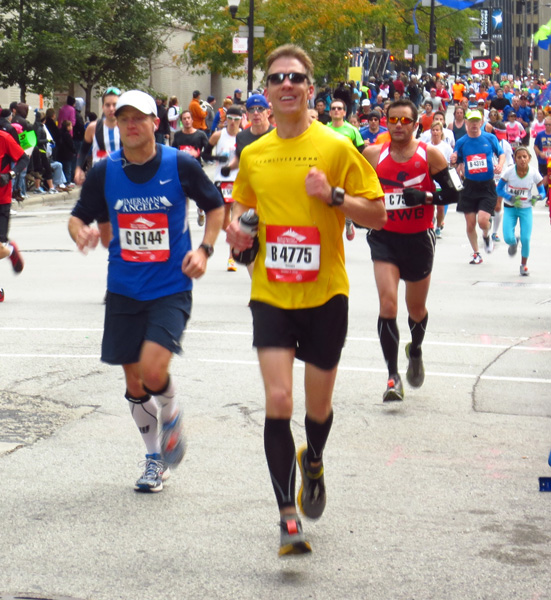
Mike Sohaskey after running 2012 Chicago Marathon

To complement the race itself, I’d decided 2½ weeks before race day to run Chicago as a member of Team LIVESTRONG.  Originally established as the Lance Armstrong Foundation, LIVESTRONG is a non-profit organization whose mission is to provide one-on-one support for cancer survivors and their families, to empower them and help them face the challenges of cancer head-on.  Unfortunately Armstrong’s ban by the U.S. Anti-Doping Agency, and U.S.A. Track and Field’s weak-willed agreement to recognize the ban, extended to his running in this year’s Chicago Marathon.  Because Armstrong’s inability to run threatened to weaken LIVESTRONG’s fundraising efforts, I’d decided to help raise funds and awareness to support their cause.  After which many incredibly generous and supportive friends and family, in turn, stepped up to help me achieve this goal in a relatively short amount of time.

So then Chicago would be about more than setting a new PR or hitting a specific time goal… I’d also be motivated and inspired by Team LIVESTRONG and all those who supported my cause.  Particularly gratifying were the individual shout-outs of support that accompanied each donation, shout-outs ranging from sincere (“RunSTRONG, Mike!” and “We support your every step”) to painfully sincere (“Will look for your final time if my browser manages to scroll that far down”).

More on my LIVESTRONG experience, and those who made it possible, later in this post.

Thanks, Chicago… “We’re glad we’re here” too!

On THURSDAY Katie and I flew from Oakland to Chicago Midway, giving us two full days to acclimate our sleep schedules to the two-hour time change.  We’d be staying with close friends Pete and Faby (and their unflappable feline boss Chloe) in the threesome’s comfy and conveniently located 18th-floor high-rise apartment at the corner of Michigan Avenue and East Roosevelt Road, within a mile of both the start and finish lines of the marathon.  As an added bonus, their living space faces directly north overlooking Grant Park, the central hub of Marathon goings-on where the start line, finish line and post-race party would all convene.  With effectively zero planning on our part, this was a strong start to the weekend.

Race-day view facing north from Pete and Faby’s place: Michigan Ave. borders Grant Park on the west, while
E. Roosevelt Rd. (“the hill”) borders Grant Park to the south and is flanked along its length by red banners.  Marathoners can be seen on E. Roosevelt approaching the finish line.  Lake Michigan can be seen at right.

FRIDAY for us was Expo Day, the ritual pre-race boot camp where runners assemble to claim their registration materials, racing bib (i.e. number) and timing chip.  In a kinder, gentler age of running back when my brother was the sole (no pun intended) runner in our family, race officials would actually mail each runner’s materials to him/her before the race.  At some point in the past decade, however, race organizers (and their influential sponsors) must have realized they were missing out on a gem of a retail opportunity: a captive audience of adrenalized runners with racing on the brain and a magnetic attraction to any running-related paraphernalia promising them that elusive “edge”.  And with that, the mandatory pre-race expo was born.

No matter what your expectations for the pre-race expo, this year’s “Health & Fitness Expo” at McCormick Place in downtown Chicago did not disappoint.  It was among the largest expos I’ve attended, with Long Beach, L.A. and San Francisco being the other contenders.  After our shuttle bus dropped us off between Gates 26 and 27 (maybe, say, 26.2?), we followed the signs through the cavernous hallways and up the escalators to where fit-looking folks by the thousands – the vast majority of them reflective white like me – filled one enormous bustling hall.  Nearly all of these marathoners-to-be carried unwieldy Bank Of America-sanctioned swag bags while eliciting glances of (was that envy or scorn?) from the buttoned-up suits filing into and out of the “GRAPH Expo” next door.

When the Nike-bots issue an order, you Just Do It.

Some folks tackled the expo with more deliberate mindsets, whereas most behaved instead like human examples of Brownian motion, diffusing semi-randomly between sponsor booths.  Katie and I fell somewhere between these two extremes: not quite overwhelmed enough to diffuse aimlessly, yet in no real hurry to leave.  And as we strolled the aisles, I noticed a distinct difference between this expo and those I’d attended in California, reflecting perhaps the “Midwestern sensibilities” I’ve heard so much about.  Chicago resembled a more straightforward trade show featuring the most reputable names in running – names like Nike, Asics, Brooks, Saucony, Merrell, Clif Bar, PowerBar and Gatorade.  Representatives manning the booths were for the most part helpful without being pushy.  And although an expo’s an expo, and Chicago’s expo still left me restless for the more carefully choreographed chaos of the Marathon itself, it was decidely more positive than my usual expo-rience.

Because in contrast, California running expos are more likely to feature overcaffeinated meatheads and bronzed booth babes loudly hawking the latest in barely digestible energy bars, alkalinized drinking water, unproven nutritional supplements, and even over-the-top gimmickry such as rubber “Power Balance” bracelets that even the parent company admits are a complete sham.  Not to mention (but I will) that the organizers of possibly the state’s most popular marathon, the Big Sur Marathon, insist on having a booth at nearly all California running expos, despite knowing full well that they’ll be peddling an already sold-out event.  Ah, the hardships we endure who live and run on the West Coast.

Friday night we attended a pre-race dinner for Team LIVESTRONG members at Wrigley Field, featuring a few words by Team LIVESTRONG representatives as well as Chicago Cubs first baseman and Hodgkin’s lymphoma survivor Anthony Rizzo.  This was the first time the LIVESTRONG folks had organized a pre-race event, and hopefully it won’t be the last… the evening provided an excellent opportunity to meet fellow fundraisers/runners in a relaxed setting, and to hear more about LIVESTRONG’s mission without the discomforting feeling of being slammed through a propaganda and marketing machine.  We even had a chance to stroll the dugouts and home plate area of Wrigley Field.  This was Katie’s first visit to Wrigley, and I doubt many other first-time (or any-time) visitors can boast a similar on-field experience.  All in all, a well-planned and well-executed event on LIVESTRONG’s part.  If only the bar hadn’t run out of 312 Urban Wheat Ale so early in the evening….

Team LIVESTRONG members at Wrigley Field… together we raised more than $237,000 at the
Chicago Marathon.  Katie and I are in the center, near the back.  (photo © 2012 Stephen Green Photography)

SATURDAY was spent stepping off curbs very carefully, restricting my diet (though not my calories), running a slow 3 miles with Pete along Lake Shore Drive, brunching with former labmate Vivian, visiting the Field Museum, and avoiding the torrent of Coors Light-toting college football fans streaming toward Soldier Field to watch Notre Dame play the University of Miami.  Hey Notre Dame fan: nothing says “Catholic family values” like a t-shirt that reads “Sucks to be U” or “If you don’t bleed blue & gold, take your bitch ass home.”

By the time 5:40am arrived on SUNDAY morning and my alarm began to jangle incessantly, I was good and ready to be good and running.  After all the training, all the tapering, all the expo-sure, and all the anticipation and visualization, it was go time at last.  As Katie and I prepared for our morning, we watched the sky over Grant Park and Lake Michigan likewise wake up and progressively brighten as the nervous, shivering throngs gathered in the park below.  Soon we joined them and headed immediately toward Start Corral “B”, where I’d begin my circuitous running tour of Chicago with the thousands of other Wave 1 runners anxiously awaiting the 7:30am start.  Slower runners would follow in Wave 2 at 8:00am.

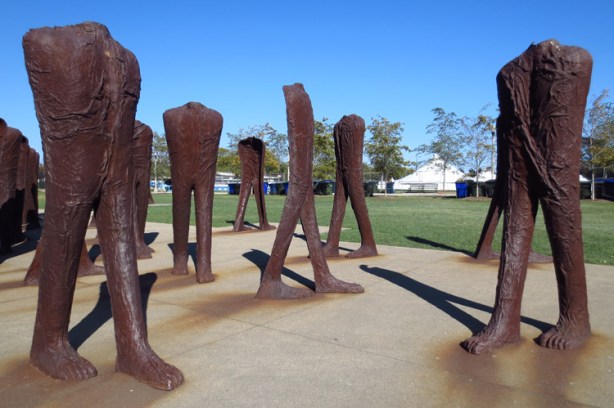
The elite runners stretch before the race… they look even leggier in person (Agora sculpture in Grant Park)

7:18am, and the Wave 1 Start Corrals closed promptly at 7:20am.  Katie was radiating her own nervous energy as we said our good-byes at the gate to the corrals.  “Are you sure you don’t want those?” she asked hurriedly as I stripped off my arm warmers.  “Yes, that’s why I’m taking them off,” I assured her.  Despite the chill in the air (temperatures ranged from 40°F at the start to 47°F at 11:00am), the electricity of the day was invigorating, and I had no trouble staying warm as we were herded, like cattle in compression gear, into our designated Start Corral to await the official start.

I excuse-me’d my way between tightly-packed bodies and positioned myself between the 3:30 and 3:35 pace groups. I’d resolved to keep the 3:35 pacers behind me and then decide on the fly whether to pursue the 3:30 group.  I’d rather run the first half too fast and lose steam later, than start too slow to give myself a legitimate shot at a PR and maybe even 3:30.  I didn’t necessarily expect to break 3:30… the thought of running an entire marathon at an 8 minute/mile average pace may sound good in the Start Corral, with the buzz of pre-race adrenaline and 5-Hour Energy coursing through my bloodstream.  But once we hit the streets, the reality of the race could be dramatically different. As always though, I urged myself to trust my training and push it as far as it would take me.

What do you mean you don’t see me??? I’m RIGHT THERE in the gold shirt!
(photo © 2012 Andrew A. Nelles~Sun-Times Media)

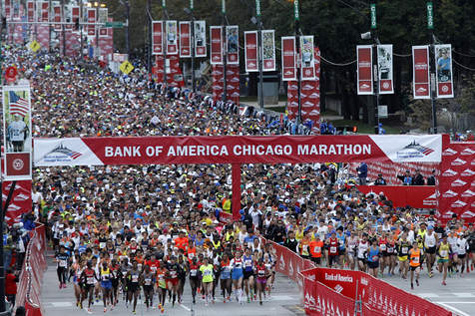
With a collective cheer from the teeming masses and Bruce Springsteen’s “Born To Run” blasting from what sounded like a McDonald’s drive-thru speaker (no fries with that, gotta run!), the 35th Bank of America Chicago Marathon was under way.  Pete and Faby, at home watching the local NBC affiliate’s marathon broadcast, caught a glimpse of me staring down at my Garmin as I crossed the start line.  Not exactly prime-time stuff, but still more auspicious than my 1996 television debut on “Good Morning Texas”, something those who know… know.

As the first wave of spectators loudly showcased their lung capacity from the BP Pedestrian Bridge, we exited Grant Park, passed through the Columbus tunnel and made our first of six crossings over the Chicago River.  These bridge crossings over the river would be the only “hills” (more like fat speed bumps) on the course until the final 400m along Roosevelt Road.

Aerial view of the BP Pedestrian Bridge overlooking the Marathon start line on Columbus Drive (photo © 2012 Matt Marton~Sun-Times Media)

I was careful not to let the fired-up mob mentality dictate my early pace… many runners surrender to their adrenaline and fly out of the chute like their hair’s on fire, only to pay for that decision later.  For the first time in a race, I’d set my Garmin to display both my current mile pace and my overall pace, so I’d know my status at all times.  Early in a race when you’re feeling good, it can be tough to gauge your precise pace… at one point between miles 1 and 2, a fellow next to me asked, “How fast are you running?”  I glanced down at my watch – my current pace read 7:01, yow – and quickly backed off the accelerator, as the voice of experience in my head reminded me that every second I ran too fast at the beginning would come back to haunt me several-fold at the end.

I first saw (and heard) Katie with her yellow LIVESTRONG pompom in the raucous crowd at mile 2.  Soon after a physical median created a fork in the road on N. LaSalle… I forked left, ahead of the 3:30 pacers who forked right. Ne’er again would we meet.

Chicago is a stylish city to be sure, and the powerful verticality of its skyline is always breathtaking.  The city’s most imposing glass-and-steel monoliths, the Willis Tower (formerly Sears Tower) and John Hancock Center, were both visible at different points along the course.  And we ran through several interesting neighborhoods, most notably Little Italy and Chinatown with its fuzzy, oversized red dragon masks and “Welcome to Chinatown” arch engraved in gold cursive letters.  But for the most part, the neighborhoods we traversed didn’t stand out in my (admittedly tired) mind. And I have to admit… as big-city marathons go, I prefer Los Angeles. Starting at Dodger Stadium and ending next to the ocean on the Santa Monica Pier – with Chinatown, Little Tokyo, Hollywood, Beverly Hills and the legendary nightclubs of the Sunset Strip in between – is a tough act to follow.  And for better or worse, unlike L.A. I saw no barefoot runners at Chicago.

But no matter where we were on the course, the volunteers and assembled spectators were invariably rowdy and incredibly supportive.  Chicagoans, for the most part, genuinely seem to embrace the marathon and its runners, and I’m told that Marathon Sunday in October is practically a city-wide holiday.  Upon seeing my medal, several people on the street afterward were quick to smile and tell me “great job, congratulations!”  That was very cool, and it’s not something I’ve ever felt in California where people tend to be more… well, self-involved.  In the most densely packed areas along the course, spectator enthusiasm – as communicated by the sheer volume of their cheering – provided a brief but welcome distraction from the monotony of step-step-breathe, step-step-breathe….

Race volunteers were fantastic, though a ceramic bowl can be tricky to sip Gatorade out of while running (Inside Ancient Egypt at The Field Museum, Chicago)

On the other hand, whereas the quantity was high, I couldn’t help being disappointed by the quality of spectator signage along the course… the generic (i.e. non-personalized ) messages along the course were for the most part uninspired.  Usually I see at least one sign I haven’t seen before that makes me laugh, and I’m sure that sign (and at least a few other clever messages) were out there on Sunday.  I just missed ’em.  Instead I found myself counting the number of “WORST PARADE EVER” (I stopped at six) and “_____ MILES UNTIL BEER” (I lost count) signs.  The “GO RANDOM RUNNER!” sign was more annoying than anything.  And in my own non-violent way, I always want to punch the idiot holding an “ALMOST THERE!” sign anywhere in the first 20 miles… you’re not clever, you’re not funny, and you’re not the first.

But turning gators into Gatorade, I was able to co-opt the motivation from several “GO MIKE, GO!” signs along the course, as well as briefly running alongside a fellow with “MIKE” written on his shirt who was being cheered by name sometime after mile 20.

And speaking of spectators, none of ’em were more spec(tator)tacular on this day than Katie, who legged out roughly 9 miles of her own so she could see me and take pictures at miles 2, 13, 17, 20 and 26… and who still managed to squeeze in a Starbucks stop between miles 2 and 13.  She’s my performance-enhancing, not-so-secret weapon.  GO KATIE, GO!

Katie and I were both happy to reach the post-race party… we covered more than 35 miles between us!

Consistent with my usual racing strategy I avoided the aid stations, though they seemed to be well laid-out with Gatorade in front and water in back.  Starting at mile 9 and then every other mile or so after that, I forced myself to sip my trusty liquified Cytomax/Gu potion.  I discontinued this ritual at mile 22 for two reasons: 1) I was concerned that my faster-than-usual pace might distress my stomach, and 2) I realized that nutritional considerations wouldn’t be a factor over the final 4.2 miles.

As I waved to Katie at mile 13 and passed the halfway point 0.1 miles later (first half split 1:42:22, 7:49/mile), I understood that the real race was just beginning.  Most marathoners would agree that 26.2 miles feels more than twice as far as 13.1, and although those first 13.1 miles are clearly necessary, that finisher’s medal is unquestionably earned in the second half of the race.  There’s a compelling reason few recreational runners venture beyond 13.1.

Mike Sohaskey at halfway point of 2012 Chicago Marathon

If you notice nothing else in this picture, please do notice that both my feet are off the ground.

Mile 14 was the “Charity Block Party”.  Immediately I spotted the familiar black and gold of the Team LIVESTRONG tent and its members on the right side of the street.  They cheered frenetically as I passed, I clapped for them, and the scene rolled on as I glanced around at all the other worthwhile charities who would benefit today from the masochism of so many runners.

After the Charity Block Party mile 16 arrived fairly quickly, along with the always-sobering realization that the elite runners had already finished their race.  Unfortunately, I’ve yet to watch the elites race in person because I’m always running an hour and a half behind them.  And my hometown San Francisco Marathon, with its significant hillage, is understandably not a race that attracts the top elites.

The elites approach mile 13… realistically, I could run/sprint at their marathon pace for about 200m.

Although there was frequent music along the course, I honestly wasn’t paying attention and don’t remember anything specific other than the obligatory “Eye Of The Tiger” (which was appropriate in this case… Survivor’s a Chicago band). The only other thing I remember about the music was two or three moments when I ran very close to a cranked-up, beyond-distorted LOUDspeaker that, rather than energizing me, hit me with a momentary wave of nausea like I was standing on the deck of the Pequod in high seas.  But on the bright side, at least I didn’t have to hear “Call Me Maybe” for 3½ hours.

When I reached mile 22, The Wall I hit was more subtle and insidious than in previous marathons.  After all, my muscles, joints, tendons and ligaments were still cooperating and (as far as I could tell) working properly, and my effort felt much the same as it had throughout the race.  But I noticed that my mile pace times had begun to creep up into the low 8-minute range, and my lower body just felt more leaden, as though I now had the Pequod’s anchor wrapped around my waist (no idea why the “Moby Dick” references, I haven’t read it since high school).  At that point I felt a fleeting sense of “ugh” pass over me, as I reached back in search of that final wind that would carry me to the finish. Fortunately I knew I could run through this feeling of heaviness – both experience and training runs longer than 26.2 miles told me so.

Mike Sohaskey just past mile 20 of 2012 Chicago Marathon

What is there not to be happy about at mile 20?  It’s another Katie sighting!

But as I focused on maintaining my cadence (leg turnover) and stride, I needed something to motivate and distract. And that’s when I called on all the inspiration I’d reserved for just this moment: inspiration from my LIVESTRONG donors, expecting (and in some cases demanding) my best effort; from cancer survivors I knew personally; from all the cancer survivors I would never know who would benefit from this effort; from all the miles of dedicated training I’d put into this moment; from the thought of my brother running his own 26.2-mile training run in sunny Long Beach at that moment (though not at sub-3:30, the cheeky bastard); and from the now-animated (in my mind) finish line taunting me, questioning my runnerhood while daring me to finish strong.

These were just a few of the more-or-less successful mind games I played with myself over the last 10 miles.  Other mental gymnastics included the standard marathoning strategy of telling myself at the 18-mile mark “It’s just an 8-mile race from here,” or at the 20-mile or 23-mile mark “You’ve got this, just a short 10K/5K to go!”  I was now running with the 3:30-or-bust crowd, and these people clearly knew how to finish a marathon.  I noticed very few people pulling up to walk, though it’s also possible that my brain just refused to acknowledge them.

This poor fellow clearly knows what it feels like to hit The Wall
(Tired Man statue by József Somogyi)

The last 6 miles were made significantly easier – or maybe “possibler” would be a better word – by my decision to shadow a thin blonde woman in a periwinkle tank top sporting an unofficial “3:30” bib on her back.  I fell in step behind her for a short time before cautiously deciding, based on her regular cadence and steady pace slightly faster than my own, that she would be a reliable pacer to lead me through the last 6 miles.  I wasn’t disappointed.  She maintained a solid pace in the low-8 minute/mile range, which was just fast enough that I struggled at times to keep up without being left behind.

And keep up I did until the mile 25 marker, when I stopped tracking her and began to enjoy the process of that final mile up Michigan Avenue.  The sun had finally broken through around mile 24, radiating just the slightest bit of comfortable warmth.  And to ensure that marathoners received the full Windy City experience, a chilly headwind kicked in as we tackled that final stretch up Michigan.  During mile 26 I kept repeating the mantra “Keep doing what you’re doing, just keep doing what you’re doing….” This chant intensified as I passed a fellow runner who was clearly fighting cramps, and whose rigid gait made C-3PO look limber by comparison.  My immediate motivation became the end of Michigan straight ahead, where Katie, Pete and Faby waited outside their towering apartment building to cheer me across the finish.  As I high-fived the three of them and turned on to Roosevelt, I knew this marathon was all but over.

Mile 26  the happiest mile of them all

But first I had to get over the ~200m stretch of Roosevelt that those who have run Chicago jokingly (or not) refer to as “the hill”.  The power of this ever-so-slightly uphill stretch derives from its location at mile 26, tantalizingly close to the finish.  Coming from the Bay Area where “flat” is often a state of mind, I was mortified to feel my legs protesting as I slogged up Roosevelt.  But once I crested that hump and turned left on to Columbus where this all began, the immediate sight of the “200m” sign to my left and the red-and-white finish line straight ahead was indescribably adrenalizing.  WOW.

In that final 60 seconds, as I drifted right to avoid the main crush of finishers to my left, my mindset was a mental purée of wanting to bask in the moment, to embrace it, to squeeze every last iota of accomplishment out of it, blended with the stark reality of seeing that finish line oh… so… close.

The end in sight: the final straightaway on Columbus Drive (hopefully nobody followed the arrows) 

It’s impossible to articulate the stimulative sensation of the ‘runner’s high’, to do justice to the effect that intense physiological stress has on brain chemistry… you have to experience it for yourself.  It’s why some people take recreational drugs, while others run marathons.  Without hesitation, I’d recommend the experience to anyone who’s mulling over the idea of their first marathon, or who’s never run a huge road marathon like Chicago, New York or even L.A.  It’s not that you have to run the course… as I’ve pointed out, the Chicago course per se is not particularly special or memorable.  It’s that you have to feel the course, on a Sunday in October when 37,000 other runners and 1.7 million spectators are all pushing collectively for the same goal.

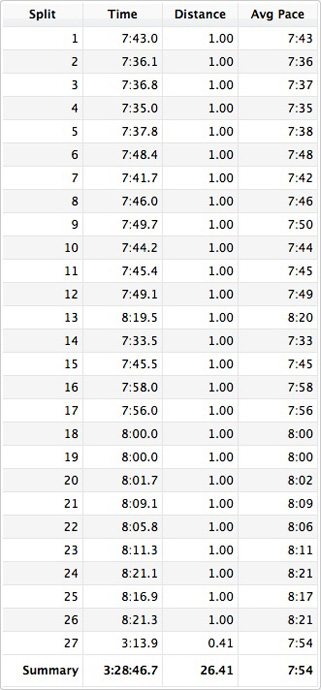
As I pumped my fist and crossed the finish line, the official race time on the giant digital clock read 3:31:13.  But I already knew I’d done it, and a glance down at my Garmin confirmed it: 3:28:45.  My first sub-3:30 marathon.  And my giddyup pace of 7:54/mile over the final 0.4 miles equaled my average pace for the marathon.

It’s not easy to time your finish so your head fits through the giant orange “O”
(photo © 2012 – believe it or not – MarathonFoto)

The 27th Mile (i.e. the long walk from the finish line to the post-race party) doubled as my victory lap, and I took my own sweet time moving through it.  Not because I was in pain – I wasn’t – but because I felt aglow with success.  And not that my timing would matter; I’d still arrive at our post-race rendezvous site 15 minutes before Katie, Pete and Faby, who had to painstakingly make their way down Michigan, around the barricades, and back up Michigan to Butler Field in Grant Park.  Unfortunately the distracted thrill of finishing, along with the donning en masse of heat-retaining “space blankets” caused me to lose track of my periwinkle-clad pacer, and I never had a chance to properly congratulate or thank her. But at least I know she also hit her 3:30 target.

In the finishing chute I giddily received my medal, posed for pictures, and eavesdropped on other runners’ accounts of the past 26.2 miles.  One finisher faux-boasted to his running mate, “Think what we could’ve run if we’d trained for this… I’d say 3:20.”  Another beamed with pride and quietly celebrated his first sub-3:30 effort in four tries at Chicago. Still another (admittedly I prompted this one) evangelized in an Irish brogue about how “fuckin’ awesome” his Newton running shoes were and how, after some initial getting used to, they’d taken his running to another level.

Mike Sohaskey with Chicago hosts at 2012 Chicago Marathon

Thanks to Faby and Pete (and Chloe, not pictured), the best hosts in the Midwest… we’ll be back soon!

Turns out the day had been a fast one for the elites as well.  Not only were the top three male finishers from Ethiopia, but all three including the winner Tsegaye Kebede broke the course record set last year with finish times of 2:04:38, 2:04:52 and 2:05:28.  The top American (and the top non-Ethiopian/non-Kenyan) finisher, Dathan Ritzhenhein, placed ninth in an impressive 2:07:47.  The women’s race ended in a dramatic near-photo finish, as the winner from Ethiopia broke the tape in 2:22:03 to hold off the Kenyan runner-up by less than one second (2:23:04).  Russian Liliya Shobukhova, trying to become the first runner (man or woman) to win Chicago four years in a row, finished fourth in 2:22:59.  And the top American woman, Renee Metivier Baillie, crossed the line in 2:27:17 to finish eighth.

And not that marathon training or long distance running in general is taxing on the lower body, but both Ritzhenhein and Metivier Baillie had previously suffered Achilles injuries that required surgery to repair.

Once my post-race levels of adrenaline, endorphins, dopamine, serotonin etc. gradually returned to normal later that day and the next, my own aches and pains would be minimal and in all the “right” places… quads, hamstrings, IT bands.  And Sunday evening would feature the usual unsettled stomach and litany of immunosuppressive symptoms caused by intense physical exertion: mild cough, a few chills, nothing a good night’s sleep wouldn’t cure.  And certainly nothing that would keep me away from the LIVESTRONG post-race party at the Rockit Bar later that evening.

I lamented the fact that the post-race party didn’t include an ice bath – it’s the single most effective (and uncomfortable) recovery tool I know. After taking the plunge and reaping the benefits following my first marathon in Long Beach in 2010, I was sold. And since then, I’ve been promising myself I’m gonna get me one of them some day.

I had plenty of motivation in Chicago. Certainly there was the selfish internal motivation of all marathon runners, that of wanting to set a PR or qualify for Boston or even, in my case, break an arbitrary time barrier like 3:30.  But unique to this race was the external motivation provided by all the friends and family who supported me and Team LIVESTRONG. When so many people are willing to rise to a challenge, to step up and sacrifice from their own pockets, to say by their actions “I believe in you and your cause”… that’s motivating.  And there’s no doubt that motivation powered me through the streets of Chicago.  Together we raised over $2000 to help those affected by cancer, and I hope I have the opportunity to do it again soon.

Chuck wasted little time in his post-race texts congratulating both of us – me for my accomplishment, and himself for his sub-3:30 prediction.  In effect his prediction had been self-fulfilling: he’s run better and for longer than I have, and if he thought I could run a sub-3:30, well then I couldn’t very well go out there and fall flat.  Now I’m hoping he doesn’t fire up the “Boston qualifier” prediction, which would require that I shave another 13min45sec off my Chicago time.  Then again, maybe that’s just what I need… who knows what I could do with the right training, mindset and motivation?

As I moseyed my way through the finishing chute, a woman manning the 312 Urban Wheat Ale table smiled broadly, held out an invitingly full plastic cup and declared “You need a beer!”

She was absolutely right.

LIVESTRONG provides free, confidential one-on-one support to anyone affected by cancer – whether you have cancer or are a loved one, friend, health care professional or caregiver of someone diagnosed.  To get help, call them toll-free at 1-855-220-7777, or visit them online at http://www.livestrong.org/Get-Help/Get-One-On-One-Support.

FINAL STATS:
October 7, 2012
26.41 miles through the streets of Chicago, IL (state 3 of 50, World Marathon Major 1 of 6)
38,535 starters, 37,476 finishers
Finish time & pace: 3:28:45, 7:54/mile
Finish place: 3,887/37,476 overall; 3,282/20,682 men; 558/3,451 M(40-44) age group
Race weather: mostly cloudy, 40°F (7:30am start) and 47°F (11:00am finish)
Elevation change (Garmin Training Center software): 121ft ascent, 119ft descent
Footwear: Saucony Mirage 2 shoes, Injinji Midweight toesocks